REVIEW 2 major objections 5 minor 21 references
Supermodulation-driven evolution of the nodal structure of bismuth-based cuprate superconductors
T0 review · 2 major / 5 minor · reviewed 2026-08-07 · deepseek-v4-flash
Pith's one-line read BiO supermodulation in bismuth cuprates can drive two transitions in the superconducting nodal structure, creating semi-Dirac nodes at accessible coupling strengths.
desk verdict Norman gives a plausible, new mechanism for semi-Dirac nodes in Bi2212/Bi2201 driven by the supermodulation, with a clean model calculation and honest caveats; the main missing piece is a quantitative check of the gap sign/magnitude relation at the crossing points. read the letter →
The pith
A machine-rendered reading of the paper's core claim, the machinery that carries it, and where it could break.
The reading
What carries the argument
The central object is the $6\times6$ Bogoliubov Hamiltonian that couples the main band $\epsilon_k$ to the two supermodulation-translated bands $\epsilon_{k\pm Q}$ through a constant potential $V$, with $d$-wave gaps $\Delta_k=\Delta_0[\cos(k_xa)-\cos(k_ya)]/2$. At the crossing points the gaps are equal and opposite, so along the crossing line the problem reduces to a $4\times4$ form whose eigenvalues are $E = \pm V \pm \sqrt{\epsilon^2+\Delta^2}$. That identity carries the argument: it predicts zero-energy nodes when $V=\Delta_c$, explains the splitting and motion of the nodes with increasing $V$, and yields the second semi-Dirac node at $V=2\Delta_c$.
What would settle it
Angle-resolved photoemission on optimally doped Bi2212, focused at the crossing point where the main Fermi surface meets its superstructure replica, should reveal a Bogoliubov minimum touching zero near $V\approx12.5$ meV with a $\sqrt{E}$ density of states; if the minimum stays gapped or the detected $V$ is far from $0.3\Delta_0$, the central claim is contradicted.
Extended reading notes
Core claim
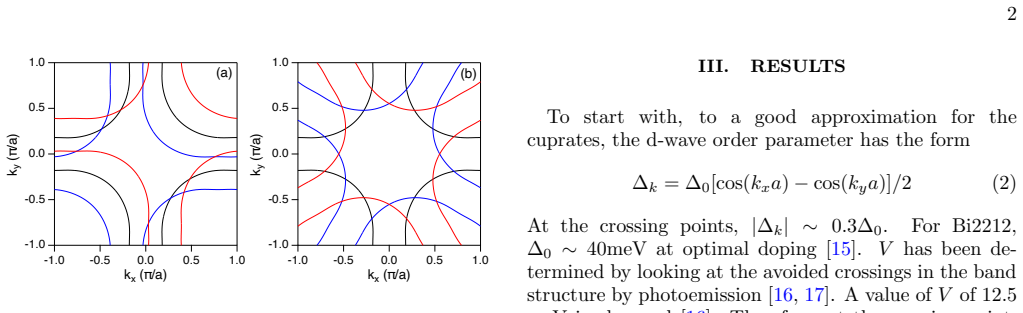
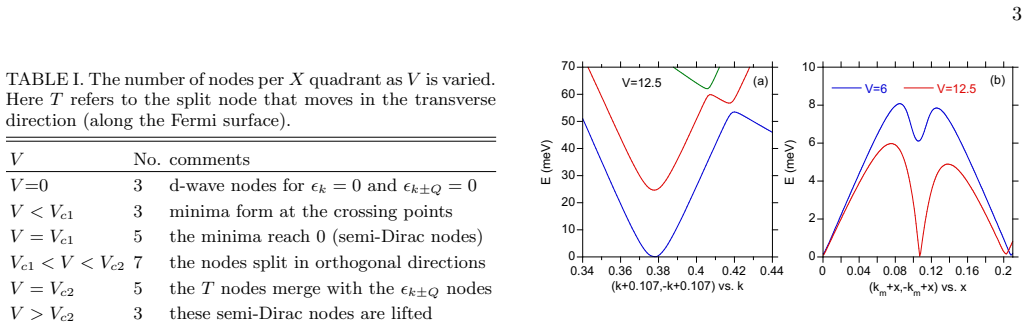
The central claim is that the Fermi-surface crossing points between the main band and the $\pm Q$ supermodulation-translated bands are special because the $d$-wave order parameters there are equal in magnitude but opposite in sign. Treating the supermodulation as a constant potential $V$ and projecting the $6\times6$ Bogoliubov problem onto the two crossing bands, the positive-energy dispersions along the crossing line become $E = \pm V \pm \sqrt{\epsilon^2+\Delta^2}$. When $V=\Delta_c\approx 0.3\Delta_0$, the minimum at the crossing point reaches zero and forms a semi-Dirac node with quadratic dispersion along the crossing line and linear dispersion perpendicular to it. For $V_{c1}<V<V_{c2}\approx 2\Delta_c$, this node splits into two nodes moving in orthogonal directions; at $V_{c2}$ they merge with a translated-band $d$-wave node to form a second semi-Dirac node with the quadratic and linear directions swapped, and beyond $V_{c2}$ the node lifts. With $\Delta_0=40$ meV, the numerically located critical values are $V_{c1}\approx12.5$ meV and $V_{c2}\approx24.5$ meV.
Load-bearing premise
The load-bearing premise is that the supermodulation acts as a constant, momentum-independent potential $V$ coupling the main band to the $\pm Q$ translated bands, with those translated $d$-wave gaps equal in magnitude and opposite in sign to the main gap at the crossing points; the analytic dispersion $E=\pm V\pm\sqrt{\epsilon^2+\Delta^2}$ and the critical values $V_{c1}\approx\Delta_c$ and $V_{c2}\approx2\Delta_c$ follow from that exact relation.
Editorial extensions
If this is right
- Bi2212 at optimal doping, with $\Delta_0\approx40$ meV and $V\approx12.5$ meV, sits essentially at $V_{c1}$; its crossing-point minimum should be a semi-Dirac node.
- Bi2201, whose gap is roughly half that of Bi2212, sits near $V_{c2}$; its nodes should merge into the second type of semi-Dirac node.
- Doping or $c$-axis pressure changes $\Delta_0$ or $V$, sweeping the system through the critical points and changing the node count per quadrant in the sequence 3, 5, 7, 5, 3.
- At a semi-Dirac node the density of states near the chemical potential scales as $\sqrt{E}$, giving a thermodynamic signature of the transition.
- The bilayer splitting, ignored in the main calculation, is small near the nodes (order $(0.3)^2$), so the nodal evolution survives as the dominant effect.
Reading between the lines
- If the supermodulation potential is momentum dependent rather than constant, the exact $E=\pm V\pm\sqrt{\epsilon^2+\Delta^2}$ form is modified; the critical values would shift, and in some regions the nodes could become small pockets or open gaps instead of touching at zero.
- The predicted $\sqrt{E}$ density of states should be visible as a zero-bias anomaly in scanning tunneling spectroscopy centered on the crossing points, providing a spatially local probe of the scenario.
- Because the supermodulation acts like a linear charge density wave, the mechanism is non-chiral; comparing its nodal evolution with the trilayer twisted case could distinguish intrinsic sign-change effects from twist-induced chirality.
Editorial analysis
A structured set of objections, weighed in public.
Referee Report
Summary. This paper studies the effect of the BiO supermodulation—modeled as a momentum-independent potential V in a 6×6 Bogoliubov–de Gennes Hamiltonian—on the nodal structure of bismuth-based cuprate superconductors. Using an ARPES-derived tight-binding dispersion and a d-wave gap Δ_k = Δ0[cos(k_x a)-cos(k_y a)]/2, the author shows that as the ratio V/Δ_c grows, minima at the Fermi-surface crossing points first touch zero at V=Vc1, forming a semi-Dirac node, then split into two nodes that later merge with the folded d-wave nodes at V=Vc2, forming an orthogonal semi-Dirac node. The author argues that Bi2212 (Δ0≈40 meV, V≈12.5 meV) lies near Vc1 and Bi2201 (Δ0 about half) lies near Vc2, and discusses ARPES and thermodynamic signatures, including a √E density of states.
Significance. If correct, the result is notable because it predicts an intrinsic, twist-free realization of semi-Dirac nodal points in existing materials under ambient or near-ambient conditions, with concrete ARPES and thermodynamic signatures. The model is transparent, uses independently measured parameters rather than fitted targets, and is accompanied by explicit 6×6 numerical calculations and an analytic two-band reduction that gives a clear physical picture. The main uncertainties concern the quantitative identification of Bi2212 and Bi2201 with the two critical points and the need to verify the sign/magnitude relation of the folded gap at the actual Fermi-surface crossings.
major comments (2)
- [Section IV, material identification] The central mechanism rests on the assertion that along the crossing line both ε_k = ε_{k−Q} and Δ_k = −Δ_{k−Q} with equal magnitude. This is stated but not demonstrated for the realistic tight-binding dispersion with Q=(0.21,0.21)π/a. The condition that ε(k)=ε(k±Q)=0 at the crossing points does not by itself imply Δ(k±Q)=−Δ(k) for the d-wave form of Eq. (2). In a two-band model the node condition is V² + Δ(k)Δ(k±Q)=0; if the magnitude ratio r = |Δ(k±Q)/Δ(k)| differs from 1, the critical V scales as √(1/r), and if the sign is not opposite, no semi-Dirac node forms at all. I request that the author report the numerical values of Δ(k*), Δ(k*+Q), and Δ(k*−Q) at the crossing points used in Figs. 2–4, together with the corresponding Vc1 and Vc2 from the 6×6 diagonalization. This would verify that the approximate analytic dispersion E = ±V ± √(ε² + Δ²) is actually valid at the operative crossing points rather than being an assumed input.
- [Section IV, material identification] See above.
minor comments (5)
- [Abstract] The word 'liner' in the abstract should be 'linear'.
- [Section III] In the sentence 'When V increases to 12 meV, this minimum at the crossing point movers to near zero energy', 'movers' should be 'moves'.
- [Fig. 2 caption] The caption labels panel 'V=12 meV' while the text identifies Vc1 as about 12.5 meV; please make the label consistent with the value used in the calculation.
- [Section II, Eq. (1)] The hat over H(k) is not defined; the matrix is presumably the Bogoliubov–de Gennes Hamiltonian in Nambu notation, but a brief definition would improve readability.
- [Section IV] The phrase 'linear charge density wave' is used without definition; since the supermodulation is incommensurate and the coupling V is modeled as a constant, it would help to clarify the intended meaning.
Circularity Check
No significant circularity: critical points are derived from an explicit Bogoliubov model with independently measured inputs.
full rationale
The paper constructs a 6×6 Bogoliubov Hamiltonian (Eq. 1) and d-wave gap (Eq. 2) with parameters Δ0 ≈ 40 meV and V ≈ 12.5 meV taken from independent ARPES determinations, then derives the eigenvalue structure analytically (E = ±V ± sqrt(ε² + Δ²)) and numerically. The semi-Dirac critical points Vc1 ≈ Δc and Vc2 ≈ 2Δc are algebraic consequences of the model, not fitted targets. The opposite-sign gap relation at crossing points is an input assumption supported by independent photoemission [12], not a result asserted in this paper. The tight-binding dispersion comes from Ref. [14], a prior paper by the author, but that is an external parameterization from photoemission data; it does not by itself force the node topology. The caveat about bilayer splitting and the sensitivity of the analytic result to the quantitative gap relation are acknowledged as limitations and belong to correctness risk, not circularity. No equation in the paper reduces to its own output by construction, and no load-bearing argument rests on an unverified self-citation.
Assumptions & free parameters
free parameters (4)
- supermodulation potential V =
12.5 meV for Bi2212, varied from 6 to 27 meV in figures
- d-wave gap amplitude Δ0 =
40 meV for Bi2212, about 20 meV for Bi2201
- supermodulation wavevector Q =
(0.21, 0.21) π/a
- tight-binding dispersion parameters =
not listed in the paper; from Norman et al. 1995 (ref 14)
assumptions (5)
- domain assumption d-wave order parameter form Δk = Δ0[cos(kx a) - cos(ky a)]/2
- domain assumption Constant, k-independent supermodulation potential V
- domain assumption Opposite sign of d-wave gaps at crossing points on translated Fermi surfaces
- domain assumption Negligible bilayer splitting in Bi2212
- standard math Bogoliubov-de Gennes formalism for the superconducting state
Cite this review
Pith. "Pith review of Supermodulation-driven evolution of the nodal structure of bismuth-based cuprate superconductors." pith.science (2026). https://pith.science/paper/G3AVT2KZ
@misc{pith2026250607862,
  author       = {Pith},
  title        = {Pith review of: Supermodulation-driven evolution of the nodal structure of bismuth-based cuprate superconductors},
  year         = {2026},
  howpublished = {\url{https://pith.science/paper/G3AVT2KZ}},
  note         = {Machine review of arXiv:2506.07862}
}
read the original abstract
Recent work has shown novel properties of twisted cuprates. In this paper, I point out that related phenomena occur intrinsically in bismuth-based cuprate superconductors due to the presence of the BiO supermodulation. As the ratio of the supermodulation potential to the superconducting energy gap increases, two critical points are found where semi-Dirac nodes form (that is, that have quadratic dispersion in one direction and liner dispersion in the orthogonal direction). The first critical point should be realized in Bi2212, the second in Bi2201. Implications of these findings are discussed.
Figures

Figures from the paper (1 more)

Reference graph
Works this paper leans on
-
[1]
O. Can, T. Tummuru, R. P. Day, I. Elfimov, A. Damas- celli, and M. Franz, High-temperature topological super- conductivity in twisted double-layer copper oxides, Na- ture Physics 17, 519 (2021)
2021
- [2]
-
[3]
A. Mercado, S. Sahoo, and M. Franz, High-temperature Majorana zero modes, Phys. Rev. Lett. 128, 137002 (2022)
work page 2022
-
[4]
X.-Y. Song, Y.-H. Zhang, and A. Vishwanath, Doping a moir´ e Mott insulator: A t − J model study of twisted cuprates, Phys. Rev. B 105, L201102 (2022)
work page 2022
-
[5]
P. A. Volkov, J. H. Wilson, K. P. Lucht, and J. H. Pixley, Magic angles and correlations in twisted nodal supercon- ductors, Phys. Rev. B 107, 174506 (2023)
work page 2023
-
[6]
P. A. Volkov, J. H. Wilson, K. P. Lucht, and J. H. Pix- ley, Current- and field-induced topology in twisted nodal superconductors, Phys. Rev. Lett. 130, 186001 (2023)
work page 2023
-
[7]
P. A. Volkov, S. Y. F. Zhao, N. Poccia, X. Cui, P. Kim, and J. H. Pixley, Josephson effects in twisted nodal su- perconductors, Phys. Rev. B 111, 014514 (2025)
work page 2025
-
[8]
T. Tummuru, E. Lantagne-Hurtubise, and M. Franz, Twisted multilayer nodal superconductors, Phys. Rev. B 106, 014520 (2022)
work page 2022
Show all 21 references
-
[9]
K. P. Lucht, J. H. Pixley, and P. A. Volkov, 2.5- dimensional topological superconductivity in twisted su- perconducting flakes, npj Quantum Materials 10, 10 (2025)
2025
-
[10]
S. Y. F. Zhao, X. Cui, P. A. Volkov, H. Yoo, S. Lee, J. A. Gardener, A. J. Akey, R. Engelke, Y. Ronen, R. Zhong, G. Gu, S. Plugge, T. Tummuru, M. Kim, M. Franz, J. H. Pixley, N. Poccia, and P. Kim, Time-reversal symmetry breaking superconductivity between twisted cuprate su- p...
2023
-
[11]
Martini, Y
M. Martini, Y. Lee, T. Confalone, S. Shokri, C. N. Saggau, D. Wolf, G. Gu, K. Watanabe, T. Taniguchi, D. Montemurro, V. M. Vinokur, K. Nielsch, and N. Poc- cia, Twisted cuprate van der Waals heterostructures with controlled Josephson coupling, Materials Today 67, 106 (2023)
2023
-
[12]
Q. Gao, J. M. Bok, P. Ai, J. Liu, H. Yan, X. Luo, Y. Cai, C. Li, Y. Wang, C. Yin, H. Chen, G. Gu, F. Zhang, F. Yang, S. Zhang, Q. Peng, Z. Zhu, G. Liu, Z. Xu, T. Xi- ang, L. Zhao, H.-Y. Choi, and X. J. Zhou, ARPES de- tection of superconducting gap sign in unconventional su- p...
2024
-
[13]
B. Zhan, Q. Gao, R. Chi, Y. Chen, L. Zhao, D. Lv, X. Zhou, and T. Xiang, Superconducting phase in- terference effect in momentum space, Science Bulletin https://doi.org/10.1016/j.scib.2025.05.026 (2025)
2025 doi
-
[14]
M. R. Norman, M. Randeria, H. Ding, and J. C. Cam- puzano, Phenomenological models for the gap anisotropy of Bi 2Sr2CaCu2O8 as measured by angle-resolved pho- toemission spectroscopy, Phys. Rev. B 52, 615 (1995)
1995
-
[15]
I. M. Vishik, M. Hashimoto, R.-H. He, W.-S. Lee, F. Schmitt, D. Lu, R. G. Moore, C. Zhang, W. Meevasana, T. Sasagawa, S. Uchida, K. Fujita, S. Ishida, M. Ishikado, Y. Yoshida, H. Eisaki, Z. Hus- sain, T. P. Devereaux, and Z.-X. Shen, Phase competi- tion in trisected supercondu...
2012
-
[16]
Valla, I
T. Valla, I. Pletikosi´ c, I. K. Drozdov, and G. D. Gu, Reconstruction of the Bi 2Sr2CaCu2O8+δ Fermi surface, Phys. Rev. B 100, 241112 (2019)
2019
-
[17]
Q. Gao, H. Yan, J. Liu, P. Ai, Y. Cai, C. Li, X. Luo, C. Hu, C. Song, J. Huang, H. Rong, Y. Huang, Q. Wang, G. Liu, G. Gu, F. Zhang, F. Yang, S. Zhang, Q. Peng, Z. Xu, L. Zhao, T. Xiang, and X. J. Zhou, Selective hybridization between the main band and the super- structure ban...
2020
-
[18]
S. Lim, C. M. Varma, H. Eisaki, and A. Kapitulnik, Ob- servation of broken inversion and chiral symmetries in the pseudogap phase in single- and double-layer bismuth- based cuprates, Phys. Rev. B 105, 155103 (2022)
2022
-
[19]
S. Jung, B. Seok, C. j. Roh, Y. Kim, D. Kim, Y. Lee, S. Kang, S. Ishida, S. Shin, H. Eisaki, T. W. Noh, D. Song, and C. Kim, Spontaneous breaking of mirror symmetry in a cuprate beyond critical doping, Nature Physics 20, 1616 (2024)
2024
-
[20]
De Almeida-Didry, Y
S. De Almeida-Didry, Y. Sidis, V. Bal´ edent, F. Giovan- nelli, I. Monot-Laffez, and P. Bourges, Evidence for intra- 5 unit-cell magnetic order in Bi 2Sr2CaCu2O8+δ, Phys. Rev. B 86, 020504 (2012)
2012
-
[21]
Mangin-Thro, Y
L. Mangin-Thro, Y. Sidis, P. Bourges, S. De Almeida- Didry, F. Giovannelli, and I. Laffez-Monot, Char- acterization of the intra-unit-cell magnetic order in Bi2Sr2CaCu2O8+δ, Phys. Rev. B 89, 094523 (2014)
2014
Reviewed August 7, 2026 · model on record in the stance chip above.
Discussion (0). Sign in to comment.