REVIEW 3 major objections 5 minor 4 references
Towards a Base-Station-on-Chip: RISC-V Hardware Acceleration for wireless communication
T0 review · 3 major / 5 minor · reviewed 2026-08-07 · deepseek-v4-flash
Pith's one-line read This paper attempts to show that a RISC-V vector processor with scalable lane counts can accelerate the compute-heavy physical-layer kernels of a wireless base station enough to make a Base-Station-on-Chip viable.
desk verdict Workshop-level benchmark whose lane-count conclusion isn't supported by the VLEN-only figure; fix that and add baselines before relying on the numbers. read the letter →
The pith
A machine-rendered reading of the paper's core claim, the machinery that carries it, and where it could break.
The reading
What carries the argument
The load-bearing mechanism is data-level parallelism (DLP) exposed by the RISC-V Vector Extension (RVV) on the open-source Ara processor: the processor's vector registers have configurable length (V LEN), and the number of hardware lanes decides how many 64-bit elements are operated on each cycle. The kernels are expressed so that their matrix inversions, Hermitian products, and steering-vector products decompose into parallel element-wise and row/column operations; Cooley-Tukey radix-4 FFT is also used. The variable vector length is what lets a single software implementation scale across hardware configurations, and it is the quantity the experiments vary.
What would settle it
Run the same kernels on a scalar RISC-V core (or a fixed-length SIMD core) at the same technology node and compare both cycle counts and numerical outputs against a reference LSE/MMSE, zero-forcing, and beamforming result; if the vector implementation is not faster or its outputs diverge, the central reduction claim fails.
Extended reading notes
Core claim
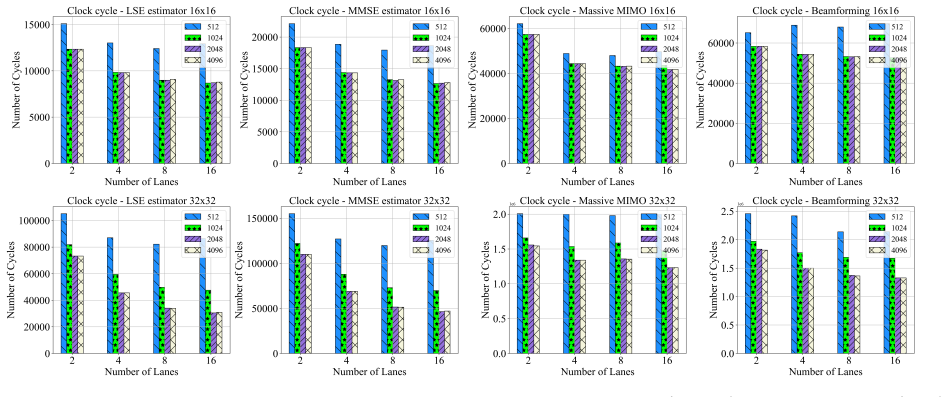
The central claim is that clock-cycle count falls as the number of parallel processing lanes grows, because the algorithms used in the low PHY—least-squares and MMSE channel estimation solving $H = YX^{-1}$, zero-forcing precoding using $W = H^H(HH^H)^{-1}$, and beamforming with steering vectors—are dominated by matrix operations that vectorize cleanly. For fixed matrix sizes (here $16\times 16$ and $32\times 32$), increasing the vector register length (V LEN) from 512 to 4096 bits lets the Ara core process more elements per cycle and cuts the cycle count. The intended consequence is that a RISC-V vector DSP with scalable lane counts can serve as the computational core of a compact, adaptable, intelligent base station, and that custom instructions attached to the same core could push performance further.
Load-bearing premise
The reported clock cycles are taken as the measure of performance; the paper assumes the C implementations are numerically correct and that the Ara cycle-accurate simulation faithfully reflects real processor behaviour, without comparing against a reference or a scalar baseline.
Editorial extensions
If this is right
- Doubling vector register length should roughly halve clock cycles for fixed-size matrices, so the four kernels' execution time tracks available DLP.
- The same C-level kernels could be moved to other RISC-V vector cores with compatible RVV, making low-PHY processing portable across open-source hardware.
- Software-only vectorization can handle channel estimation, precoding, and beamforming; remaining gains require custom instructions or accelerator modules attached to the processor.
- The measured scaling motivates integrating these kernels with AI/ML and network-management functions on a single BSoC die.
Reading between the lines
- A reader could test whether the same DLP argument extends to larger realistic antenna arrays (e.g., $64\times64$ or $128\times16$) and to sparse channel models, where memory bandwidth rather than arithmetic may dominate.
- The clock-cycle metric leaves out power; the BSoC motivation depends on whether the vectorized execution also lowers energy per bit, which the paper has not measured.
- If a scalar RISC-V baseline with the same technology were benchmarked, the speedup would separate the benefit of vectorization from the cost of the matrix algorithm itself.
Editorial analysis
A structured set of objections, weighed in public.
Referee Report
Summary. The paper proposes a Base-Station-on-Chip (BSoC) vision and reports preliminary software implementations of four wireless PHY kernels—LSE and MMSE channel estimation, zero-forcing precoding for mMIMO, and digital beamforming—on the RISC-V-based Ara vector processor. The authors simulate these kernels and report clock-cycle counts for different vector register lengths (VLEN 512, 1024, 2048, 4096 bit) and matrix sizes (16x16 and 32x32). The central conclusion is that exploiting data-level parallelism reduces clock-cycle counts as the number of parallel processing lanes increases. The paper also outlines future work on custom instructions and hardware integration.
Significance. If the reported measurements are reliable, the paper offers a useful early datapoint for the BSoC agenda: that standard PHY kernels can be expressed in C and run on a configurable RISC-V vector processor, with cycle counts that decrease as vector length grows. The authors give explicit implementations of the kernels and use a cycle-accurate simulator, which is a concrete starting point for the community. However, the paper is a very short preliminary report: there is no code release, no reproducibility artifact, no reference-model verification, and no baseline comparison. The significance is therefore conditional on additional evidence. The central claim about lane-count scaling is not actually supported by the figure, which varies VLEN rather than lane count.
major comments (3)
- [Preliminary results / Conclusion and Outlook, Figure 1] The conclusion states that the clock-cycle reduction is achieved as the number of parallel processing lanes increases, but Figure 1's caption and the horizontal axis describe a sweep over VLEN values (512, 1024, 2048, 4096 bit) and do not report any lane counts. In the Ara architecture, VLEN and lane count are distinct parameters; increasing VLEN can reduce cycle counts by lengthening each vector operation or reducing strip-mining overhead even when the lane count is fixed. The text in 'Preliminary results' says the number of lanes was adjusted, but no data point is labeled with a lane count. This mismatch means the experiment as reported does not actually test the paper's central claim. Please either add a lane-count sweep to Figure 1 with lane counts reported per data point, or revise the conclusion to state that the reduction is observed as VLEN (vector register length) increases.
- [Preliminary results] The paper reports a single cycle-count value per configuration with no error bars, no repeated measurements, and no comparison against a scalar or baseline implementation. With one data point per condition, it is impossible to assess measurement noise or whether the observed differences are meaningful. More importantly, there is no verification that the C implementations produce correct outputs; for example, the LSE and MMSE channel estimates and the ZF precoder weights are not compared against a reference model. Without correctness checks, the reported cycle counts could be for kernels that do not compute the intended functions. Please add a description of the simulation setup (number of runs, compiler flags, Ara configuration) and at least one reference-verification step or a scalar baseline.
- [Introduction / Conclusion and Outlook] The stated second objective is to 'Develop custom hardware modules optimized for each signal processing kernel', and the abstract says the work explores how RVV combined with custom instructions can address PHY demands. However, the experimental section only evaluates software kernels on the off-the-shelf Ara core; no custom instruction, custom hardware module, or AXI integration is presented. This is a mismatch between the paper's advertised scope and its actual content. Please clarify that the current study covers only the first objective (software kernel acceleration on a vector processor) and that custom instructions are strictly future work, or include an initial evaluation of at least one custom instruction.
minor comments (5)
- [Figure 1] The horizontal axis is not labeled; please add an axis label showing VLEN values (and lane counts if they were varied) so the figure is self-contained.
- [Preliminary results] The sentence 'The Ara core supports 64-bit values, which dictates he number of elements processed in parallel' contains a typo: 'he' should be 'the'.
- [Introduction] The phrase 'Open Radio Radio Unit (O-RU)' contains a duplicated word; it should be 'Open Radio Unit'.
- [Abstract] The phrase 'consolidating of the signal processing' is ungrammatical; it should be 'consolidating signal processing' or 'the consolidation of signal processing'.
- [Reference [3]] Reference [3] is introduced only in the conclusion as future work; consider citing it in the introduction or approach section where the Ara processor and cluster-based designs are discussed.
Circularity Check
No circularity: the paper's conclusions are empirical cycle-count measurements from Ara simulations; the one self-citation is incidental and not load-bearing.
full rationale
The paper reports cycle counts from cycle-accurate Ara simulations of four PHY kernels under varying VLEN and lane configurations. There is no derivation chain, no fitted parameter, and no equation whose output is defined in terms of its input. The conclusion that clock cycle count falls as parallelism increases is an empirical summary of Figure 1; even if Figure 1's axis labels are ambiguous between VLEN and lane count, that is a measurement-reporting concern, not circularity. The only self-referential element is citation [2] by two of the present authors, used as 'consistent with the findings presented in [1, 2]' in the Preliminary results section. This citation is not load-bearing: the paper's own simulation measurements are the evidence, and [1] is an independent prior result. No circular step, renamed known result, or imported uniqueness theorem is present.
Assumptions & free parameters
assumptions (3)
- standard math Cooley-Tukey radix-4 FFT correctly computes the required transforms for OFDM-related kernels.
- standard math Matrix inversion and conjugate transpose operations in LSE, MMSE, and ZF precoding are computed as commonly defined.
- domain assumption The Ara cycle-accurate simulation produces cycle counts representative of real processor behavior.
Cite this review
Pith. "Pith review of Towards a Base-Station-on-Chip: RISC-V Hardware Acceleration for wireless communication." pith.science (2026). https://pith.science/paper/KSOIX2N5
@misc{pith2026250607873,
  author       = {Pith},
  title        = {Pith review of: Towards a Base-Station-on-Chip: RISC-V Hardware Acceleration for wireless communication},
  year         = {2026},
  howpublished = {\url{https://pith.science/paper/KSOIX2N5}},
  note         = {Machine review of arXiv:2506.07873}
}
read the original abstract
The evolution of 5G and the emergence of 6G wireless communication systems impose higher demands for computing capabilities and lower power consumption in the front-end and processing circuitry. Furthermore, the incorporation of Artificial Intelligence (AI)/Machine Learning (ML) in the Radio Access Network (RAN) introduces heightened computational needs and stringent low-latency requirements for both training and inference. The concept of a Base Station on Chip (BSoC) addresses those demands by consolidating of the signal processing, neural network computations and network management functions into a single chip. This new computing platform relies on a sophisticated hardware/software co-design to optimize performance, power efficiency, and scalability, enabling a compact, yet adaptable and intelligent base station solution for next-generation wireless networks. This research investigates the efficient implementation of conventional Channel Estimation (CE), massive Multiple Input Multiple Output (mMIMO), and beamforming kernels on a state-of-the-art RISC-V vector Digital Signal Processors (DSP) to capitalize on Data Level Parallelism (DLP). Moreover, it explores how RISC-V Vector Extensions (RVV) combined with custom instructions can effectively address the throughput and latency demands of LOW Physical Layer (PHY) kernels.
Figures
Reference graph
Works this paper leans on
-
[1]
Efficient Parallelization of 5G- PUSCH on a Scalable RISC-V Many-Core Processor
Marco Bertuletti et al. “Efficient Parallelization of 5G- PUSCH on a Scalable RISC-V Many-Core Processor”. In: 2023 Design, Automation and Test in Europe Conference and Exhibition (DATE) . 2023, pp. 1–6. doi: 10.23919/ DATE56975.2023.10137247
arXiv 2023
-
[2]
5G Channel Estimation Kernels on RISC-V Vector Digital Signal Processors
Javier Acevedo, Frank H. P. Fitzek, and Patrick Seeling. “5G Channel Estimation Kernels on RISC-V Vector Digital Signal Processors”. In:2024 International Conference on Microelectronics (ICM). 2024, pp. 1–8. doi: 10 . 1109 / ICM63406.2024.10815830
arXiv 2024
-
[3]
Yichao Zhang et al.A 1024 R V-Cores Shared-L1 Cluster with High Bandwidth Memory Link for Low-Latency 6G- SDR. 2024. arXiv: 2408.08882 [cs.DC] . url: https:// arxiv.org/abs/2408.08882
work page Pith review arXiv 2024
-
[4]
Javier Acevedo et al. “Hardware Acceleration for RLNC: A Case Study Based on the Xtensa Processor with the Tensilica Instruction-Set Extension”. In:Electronics 7.9 (2018), p. 180. doi: 10.3390/electronics7090180 . url: https://doi.org/10.3390/electronics7090180. 2 RISC-V Summit Europe, Paris, 12-15th May 2025
Reviewed August 7, 2026 · model on record in the stance chip above.
Discussion (0). Sign in to comment.