REVIEW 5 major objections 6 minor 6 references
Optimization of Bottlenecks in Quantum Graphs Guided by Fiedler Vector-Based Spectral Derivatives
T0 review · 5 major / 6 minor · reviewed 2026-08-07 · deepseek-v4-flash
Pith's one-line read This paper claims that bottlenecks in quantum directed acyclic graphs can be optimized by rewiring along the outer product of the Fiedler vector, producing a soft adjacency matrix that raises the Cheeger constant and lowers effective…
desk verdict Wrong spectral derivative and ill-posed objective sink QFERN, despite a useful summary of spectral graph concepts. read the letter →
The pith
A machine-rendered reading of the paper's core claim, the machinery that carries it, and where it could break.
The reading
What carries the argument
The load-bearing object is the Fiedler vector $f$, the eigenvector of the graph Laplacian $L = D - A$ belonging to the second-smallest eigenvalue $\lambda_2$, which separates a graph into its two most weakly connected halves. QFERN forms the update gradient as $\mathrm{gradient}[i,j] = -f[i]f[j]$ for $i \neq j$, sets $A_{\mathrm{soft}} = A + \alpha \cdot \mathrm{gradient}$, and then iteratively removes and adds edges while tracking the Cheeger constant and effective resistance. The Cheeger inequality ties $\lambda_2$ to the bottleneck width, and the effective-resistance formula $R(u,v) = (e_u - e_v)^T L^{+} (e_u - e_v)$ ties that bottleneck structure to the cost of moving entanglement between nodes.
What would settle it
Run Algorithm 1 on a small connected graph such as a five-node path and record $\lambda_2$, the Cheeger constant, and total effective resistance at every iteration; if any iteration moves $\lambda_2$ downward or $h(G)$ downward, the claimed optimization direction fails. The analytical check is that the first-order change in a Laplacian eigenvalue $\lambda_2$ under a change in the $(i,j)$ edge weight is $(f_i - f_j)^2$, which does not agree with the $-f[i]f[j]$ update used by the algorithm.
Extended reading notes
Core claim
The central claim is that the Fiedler eigenbasis of a Quantum Directed Acyclic Graph's Laplacian can serve as a rewiring guide: modifying the adjacency matrix along the outer product of the Fiedler vector produces a soft adjacency matrix $A_{\mathrm{soft}}$ whose spectral gap is enlarged, whose Cheeger constant is increased, and whose effective resistance is reduced. The paper frames this as minimizing total effective resistance subject to maximizing the Cheeger constant $h(G)$, and uses the Cheeger inequality $h^2/2 \le \lambda_2 \le 2h$ to argue that a larger second eigenvalue $\lambda_2$ means a narrower bottleneck. It further claims that the resulting effective-resistance landscape identifies desynchronization-prone zones in the Kuramoto model, and that the QFERN spectral bounds corroborate the synchronization stability criterion $\|L^{+}\omega\|_{E,\infty} < 1$ for acyclic oscillator networks. The authors present illustrative rewiring experiments on small generated DAGs as support for these claims.
Load-bearing premise
The whole method rests on treating the product of the two Fiedler-vector entries at an edge's endpoints as the direction in which to change that edge to widen the graph's bottleneck gap; if that product is not the right sensitivity, the rewiring can make the bottleneck worse instead of better.
Editorial extensions
If this is right
- A graph rewired by QFERN should have a larger algebraic connectivity $\lambda_2$, meaning the two clusters identified by the Fiedler vector become less separable and the bottleneck between them narrows.
- Total effective resistance across the network should fall, so entanglement from a single resource node reaches clients, repeaters, and memory nodes more easily.
- High-resistance regions identified from the spectral decomposition mark where Kuramoto phase synchronization is fragile, so a stabilizer node placed among the highest-resistance nodes should tighten the phase-cohesive stability margin.
- Because the appendix bounds $\|L^{+}\omega\|$ by a term involving $1/\lambda_2$, any successful widening of the spectral gap directly expands the region in which the synchronization stability condition holds.
- Treating the Cheeger constant as a bottleneck index gives a threshold for qubit entanglement and coherence loss, so the optimization goal of raising $h(G)$ is also a goal of keeping the network above a critical coherence threshold.
Reading between the lines
- The objective is not quantum-specific, so the same Fiedler-based rewiring rule could be applied to classical communication, transportation, or chip-layout networks whose bottlenecks are also governed by effective resistance and spectral gap.
- A natural testable refinement would be to replace the heuristic gradient with the exact eigenvalue sensitivity of the Laplacian, which scales as $(f_i - f_j)^2$ per edge; this would turn QFERN into a monotone spectral-gap maximizer with a clear stopping rule.
- The effective-resistance heat map suggests a preventive design rule: place repeaters or stabilizer nodes according to high $R(u,v)$ before coherence loss is observed, rather than after desynchronization has already occurred.
Editorial analysis
A structured set of objections, weighed in public.
Referee Report
Summary. The manuscript introduces QFERN, a heuristic that rewires a Quantum Directed Acyclic Graph (QDAG) by updating an adjacency matrix Asoft = A + alpha * gradient, where gradient[i,j] = -f[i] * f[j] and f is the Fiedler vector. It claims that this procedure minimizes effective resistance, maximizes the Cheeger constant, and thereby optimizes bottlenecks in quantum entanglement networks; it further links these quantities to synchronization stability through a Kuramoto-model condition. The paper presents several formulas for effective resistance and the Cheeger constant, an algorithm, and illustrative figures. The central mathematical claim, however, rests on an incorrect spectral derivative and on internally inconsistent resistance formulas.
Significance. If the core heuristic were correct, QFERN could offer a low-cost spectral rewiring method for quantum network topologies and a way to locate fragile regions for synchronization. The manuscript does contain some correct background material, notably the Cheeger inequality and a correct expression for effective resistance in Eq. (9) and in the appendix, and it connects to a relevant stability condition from Dörfler and Bullo. However, because the principal update rule is not a spectral derivative and the objective function is ill-posed, the paper provides no validated method; the figures are illustrative only and do not substantiate the claims.
major comments (5)
- [Section III.B and Algorithm 1] The update rule gradient[i,j] = -f[i]*f[j] is not the derivative of the algebraic connectivity with respect to the adjacency matrix. For the graph Laplacian L = D - A and a normalized Fiedler vector f, the derivative of lambda_2 with respect to an edge weight A_ij is (f_i - f_j)^2. The algorithm's direction can either increase or decrease lambda_2 depending on the signs of f_i and f_j, so the claimed optimization of the spectral gap is unsupported.
- [Equations (2) and (7)] The effective resistance formulas in Eq. (2) and Eq. (7) contain f_u f_v / lambda_i instead of the correct (f_u - f_v)^2 / lambda_i, which is given later in Eq. (9) and in the appendix. Since the objective evaluation in Section V.B.4 uses Eq. (7), the computed quantity is not the effective resistance, and the claimed minimization of effective resistance is therefore not established.
- [Equation (3)] The stated objective, min_G Reff(G) subject to max_G h(G), is not a well-posed optimization problem. A single graph cannot simultaneously minimize and maximize as written; a scalarized objective or a constrained formulation with a threshold is needed. As stated, the objective does not define a meaningful optimization criterion.
- [Section V.B.3] The optimization loop removes an edge and adds a new edge from a set E', but it does not use the gradient computed in Algorithm 1, so there is no demonstrated connection between the Fiedler-vector update and the edge-swapping procedure. The text also says the new Cheeger constant is calculated 'as per Equation (2)', which is an effective-resistance equation, not Eq. (4) for the Cheeger constant; the appendix similarly refers to a nonexistent 'condition (58)'. These are not merely typographical because they indicate that the algorithmic steps and the formal statements are not consistently linked.
- [Section VI and Appendix] The synchronization analysis relies on Eq. (8), Delta theta_ij proportional to R_ij * omega_ij, without derivation, and then asserts that QFERN validates the Dörfler-Bullo condition. Because the QFERN update direction is not a valid spectral derivative, the paper does not actually demonstrate that its rewiring increases lambda_2 or decreases effective resistance, so the claimed validation of the synchronization condition is unsupported.
minor comments (6)
- [Abstract and Introduction] There are multiple typos and infelicities, including 'implimented', 'Adjaceny', and 'suceptable', and some sentences are incomplete or run-on; the manuscript would need careful editing.
- [Section III.A] The displayed equations for LFiedler and T * grad are broken and not mathematically meaningful as typeset; they should be either removed or rewritten with explicit definitions.
- [Section IV.A] The notion of 'thresholds for qubit entanglement and coherence loss' is introduced but never formally defined or connected to the graph quantities; this weakens the claimed quantum interpretation.
- [Section IV and V] The paper uses the graph Laplacian L = D - A while also discussing directed acyclic graphs, but the directed Laplacian is not defined and the Fiedler vector is not generally meaningful for a directed graph in the same way; this needs clarification.
- [References] Several references are incomplete or inconsistently formatted, for example [2] lacks a full publication venue and page numbers, and [6] has a DOI that does not match the cited volume and pages; the reference list should be corrected.
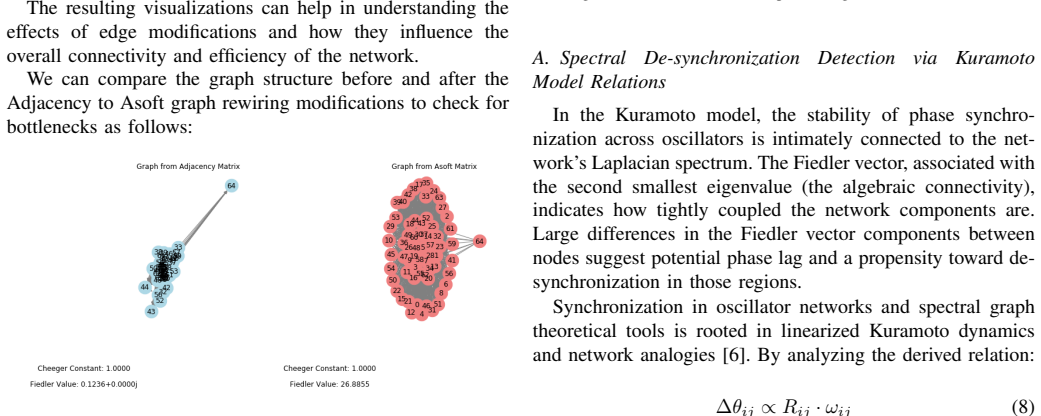
- [Figures] Figures 1-5 have very short captions and are not discussed quantitatively; without numerical values or error bars they cannot be used to assess whether the algorithm actually improves connectivity.
Circularity Check
Only the Appendix's claim that QFERN 'confirms' the Dörfler–Bullo condition is circular; the main algorithm is mathematically unsupported but not circular.
-
renaming known result
[Appendix 'QFERN Framework and Spectral Bounds'; also Section VIII Conclusion]
"The QFERN approach provides a framework that supports the sufficiency of the spectral condition. It demonstrates that increasing the algebraic connectivity λ2 or decreasing the maximum effective resistance Ruv enhances the synchronization stability margin. Specifically, the spectral bounds derived through QFERN confirm that the condition ∥L†ω∥E,∞ < 1 is both necessary and practically tight, especially in topologies where the extremal eigenvalues are well characterized, as discussed by Dörfler and Bullo (2013) [6]."
The 'spectral bounds derived through QFERN' are exactly the bounds imported from the cited Dörfler–Bullo corollary: the appendix states ∥L†ω∥E,∞ ≤ max_i |f(i)Tω|/λ2 and identifies the condition ∥L†ω∥E,∞ < 1 as corollary 7.5 of [6]. QFERN is defined, in Algorithm 1 and Section III.B, as a Fiedler-vector adjustment intended to increase λ2, and the synchronization benefit is then read off from that cited λ2-bound. Thus the claimed confirmation that QFERN 'demonstrates' or 'validates' the stability condition is a restatement of the cited theorem in new language; the conclusion is the input citation by construction, with no independent mechanism derived.
full rationale
The central QFERN algorithm is not circular: it does not fit a parameter and then predict a quantity that is forced by that fit. Its update rule gradient[i,j] = −f[i]·f[j] is presented as a spectral derivative, but for the graph Laplacian the actual derivative of λ2 with respect to an edge weight is (f_i − f_j)^2, not −f_i f_j; this is a mathematical error, not a self-referential reduction. Likewise, Eq. (7) and Eq. (9) give inconsistent effective-resistance formulas, which is an internal correctness problem rather than circularity. The one genuine circular move is the paper's claim that QFERN 'confirms' or 'derives' the Dörfler–Bullo synchronization condition ∥L†ω∥E,∞ < 1; that condition and the accompanying λ2 bound are the very external theorem cited as [6], and QFERN's stated purpose is to increase λ2. Hence the Appendix's validation reduces to the theorem it relies on, presented as a QFERN-derived spectral bound. Because the main optimization claim is not itself a fit or a self-citation chain, the overall circularity score is modest.
Assumptions & free parameters
free parameters (3)
- alpha =
not given
- sigma_i =
undefined
- R_uv threshold =
not given
assumptions (5)
- standard math Cheeger inequality relating λ2 and h(G)
- standard math Effective resistance formula R_uv = (e_u - e_v)^T L+ (e_u - e_v)
- domain assumption Spectral condition for Kuramoto synchronization, ||L†ω|| < 1
- domain assumption Graph Laplacian is defined for undirected graphs while QDAGs are directed
- ad hoc to paper The gradient of λ2 with respect to adjacency is -f_i f_j
Cite this review
Pith. "Pith review of Optimization of Bottlenecks in Quantum Graphs Guided by Fiedler Vector-Based Spectral Derivatives." pith.science (2026). https://pith.science/paper/3FFOE24L
@misc{pith2026250607875,
  author       = {Pith},
  title        = {Pith review of: Optimization of Bottlenecks in Quantum Graphs Guided by Fiedler Vector-Based Spectral Derivatives},
  year         = {2026},
  howpublished = {\url{https://pith.science/paper/3FFOE24L}},
  note         = {Machine review of arXiv:2506.07875}
}
read the original abstract
This paper discusses the relationships between the Fiedler vector, the Cheeger constant, and threshold behaviors in networks of quantum resource nodes represented as Quantum Directed Acyclic Graphs (QDAGs). We explore how these mathematical constructs can be applied to understand the dynamics of quantum information flow in QDAGs, especially in the context of routing problems with bottlenecks in graph signal processing, and how new eigenvalue-based rewiring techniques can optimize entanglement distribution between nodes in a QDAG.
Figures


Figures from the paper (1 more)

Reference graph
Works this paper leans on
-
[6]
D ¨orfler, F. and Bullo, F. (2013). Synchronization in complex networks of phase oscillators: A survey. SIAM Journal on Control and Optimization , 50(3), 1616–1642. DOI: https://doi.org/10.1137/100791476
-
[1]
Lov ´asz, Random walks on graphs: A survey, Combinatorics, Paul Erd˝os I, Keszthely, 1993
L. Lov ´asz, Random walks on graphs: A survey, Combinatorics, Paul Erd˝os I, Keszthely, 1993
work page 1993
-
[2]
W. E. Donath and A. L. Hoffman, Lower bounds for the partitioning of graphs, IBM Research Report, 1980
work page 1980
-
[3]
Daniel. A. Spielman and Nikhil Srivastava, Graph sparsification by effective resistances, Proceedings of the 39th Annual ACM Symposium on Theory of Computing, 2008
work page 2008
-
[4]
Mari ´a C.V . Nascimento and Andr´e C.P.L.F. de CarvalhoSpectral methods for graph clustering – A survey , Instituto de Ci ˆencias Matem ´aticas e de Computac ¸˜ao, Universidade de S ˜ao Paulo, Caixa Postal 668, S ˜ao Carlos- SP, CEP 13560-970, Brazil
-
[5]
Cheeger, J. (1970). A Lower Bound for the Smallest Eigenvalue of the Laplacian. A Symposium in Honor of Salomon Bochner, Princeton Univ. Press, Princeton, 195-199. https://doi.org/10.1515/9781400869312-013
Reviewed August 7, 2026 · model on record in the stance chip above.
Discussion (0). Sign in to comment.