REVIEW 4 major objections 6 minor 39 references
Spatio-Temporal State Space Model For Efficient Event-Based Optical Flow
T0 review · 4 major / 6 minor · reviewed 2026-08-07 · deepseek-v4-flash
Pith's one-line read A state-space model estimates event-camera optical flow with a fraction of the compute of today's best methods while staying close to their accuracy.
desk verdict A genuinely cheap Mamba-based flow architecture, but the headline efficiency and accuracy claims rest on an inconsistent comparison and an unsupported inference-time number. read the letter →
The pith
A machine-rendered reading of the paper's core claim, the machinery that carries it, and where it could break.
The reading
What carries the argument
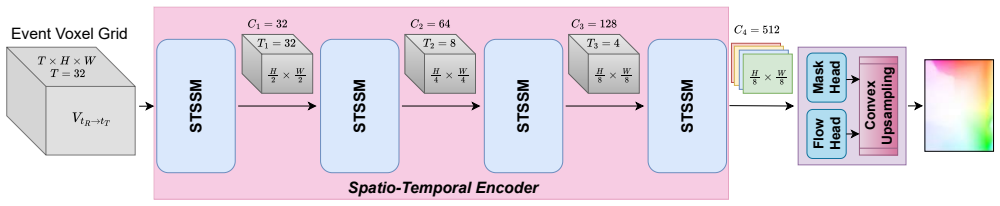
The core module is the Spatio-Temporal State Space Model (STSSM) block. It takes a spatio-temporal event volume (a voxel grid discretizing events into time bins, height, and width), cuts it into 3D patches of size m by k by k per channel, flattens them through a linear projection into a 1D sequence, adds a learnable temporal embedding to separate the temporal from the spatial axes, runs the sequence through a selective state-space model (the paper uses Mamba-style SSM layers) for linear-time sequence transformation, and reprojects the sequence back into a feature volume. Four such blocks form an encoder that progressively reduces spatial resolution while increasing channels and compressing time to a single frame; a flow head plus mask head then performs RAFT-style convex upsampling to full resolution, replacing the heavy decoder used in U-Net architectures.
What would settle it
Run the same STSSM architecture with an added second, temporally shifted event volume feeding a small correlation lookup (as in iterative-refinement methods) while keeping compute similar; if the EPE on DSEC drops by more than the roughly 0.3 pixel margin the paper reports against E-RAFT, that would show the single-volume premise, not the state-space model, is doing the accuracy work.
Extended reading notes
Core claim
The central claim is that optical flow can be estimated from event data by a single spatio-temporal voxel volume processed with state-space models (SSMs), removing the need for 4D correlation volumes and reference/target view pairs that characterize current iterative-refinement methods. The authors argue that within a sufficiently large time window the events alone determine the flow, and they build a network whose encoder stacks four STSSM blocks, each patching the volume, projecting to a 1D sequence, adding a temporal embedding, applying selective state-space layers, and reprojecting to a feature volume, ending in a 2D feature map from which a lightweight head predicts flow plus convex upsampling masks for full-resolution output. On the DSEC benchmark they report an average endpoint error of about 1.11 pixels at 32 GMACs, with the abstract claiming 4.5x faster inference and 8x lower computation than TMA and 2x lower than EV-FlowNet; the experimental section separately quotes 8x and 16x reductions against E-RAFT and TMA. The paper also presents ablations indicating that Mamba-style SSMs outperform transformer and 3D-CNN encoders for this task at lower cost.
Load-bearing premise
The load-bearing premise is that a single event voxel volume over a large enough time window contains all the information needed to estimate the flow; if this is false, the network's accuracy would collapse no matter how good the state-space backbone is, and the paper does not directly test it.
Editorial extensions
If this is right
- If the central claim holds, accurate event-based optical flow becomes feasible on embedded or mobile processors, since 32 GMACs per inference is within reach of real-time hardware.
- The single-volume design removes the 4D correlation volume, the main space and time bottleneck of iterative-refinement methods, so frame-rate gains scale with camera resolution rather than with the flow search range.
- The ablations showing Mamba-style SSMs beating a ViT encoder in the same head suggest attention may be unnecessary for event-based motion; future event-vision backbones could standardize on state-space layers.
- Replacing the U-Net decoder with convex upsampling cuts most of the decoder cost (the paper notes EV-FlowNet's decoder is about 80 percent of its compute), so later efficient flow networks can follow the same lightweight-head pattern.
Reading between the lines
- The single-volume assumption, if correct, extrapolates to other event-based tasks that currently pair reference and target views: depth, egomotion, and deblurring could each be reformulated as single-volume mapping problems and inherit the same compute savings; that is an inference, not a claim of the paper.
- Because SSMs scale linearly in sequence length, the architecture may tolerate much longer temporal windows than the paper tests, potentially improving accuracy on slow motion or at low event rates; this is testable by scaling the input time dimension on DSEC, which the paper does not do.
- The reported speedups versus TMA depend on operating points (iteration counts) and hardware; a same-GPU wall-clock benchmark varying iteration counts would more directly verify the 4.5x figure, and the paper's Table 2 already hints the comparison is best-case for the proposed method.
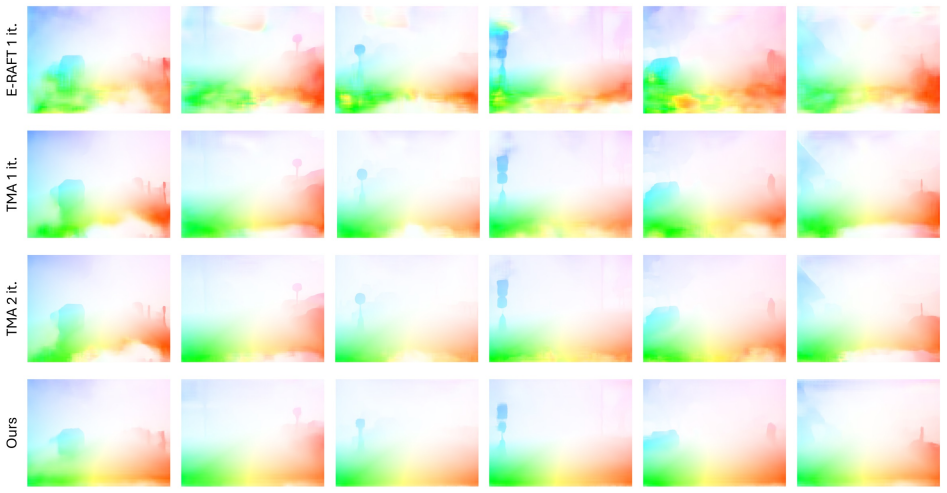
- The qualitative BlinkFlow results reveal weakness on occlusions and thin objects; an independent benchmark with dense independent moving objects and occlusions would clarify whether the single-volume state-space design has a systematic failure mode.
Editorial analysis
A structured set of objections, weighed in public.
Referee Report
Summary. The paper proposes a spatio-temporal state space model (STSSM) for event-based optical flow. The network encodes a single spatio-temporal event volume with a series of STSSM blocks built on Mamba, then predicts low-resolution flow and uses convex upsampling to obtain full-resolution flow, avoiding 4D correlation volumes and iterative refinement. The authors report an EPE of 1.11 on DSEC at 32 GMACs, claim 8x lower computation than TMA and 2x lower than EV-FlowNet with competitive accuracy, and provide ablations over SSM variants, temporal/position encoding, and backbone choices.
Significance. If the quantitative claims hold, the work is a useful step toward efficient event-based optical flow, demonstrating that SSMs can replace expensive correlation volumes and iterative refinement while retaining competitive accuracy. The paper's strengths include a clearly described architecture, extensive ablations across S4, S4D, S5, and Mamba, experiments on both DSEC and BlinkFlow, and a planned public code release. However, the central efficiency-accuracy claim depends on an unambiguous evaluation protocol and a direct timing comparison, both of which are currently missing or ambiguous. The novel application of SSMs to event-based flow is interesting and likely of interest to the workshop audience, but the headline numbers require verification before the claims can be accepted as stated.
major comments (4)
- [§4.1 / Table 1] The evaluation protocol behind Table 1 is not specified. Section 4.1 states that ground truth for the DSEC test set is unavailable and that you created a validation split following [2] for training and ablation studies, but Table 1 is captioned "Evaluation results on DSEC [9] dataset" and does not state whether all rows were evaluated on the same split. If the baseline EPE/AE/3PE values are the published test-set numbers while "Ours" is evaluated on the custom validation split, the comparison is not apples-to-apples and the "competitive performance" claim is unsupported. Please state for every row the exact split and source of the numbers, and either re-evaluate all baselines on the same split or submit to the official test server.
- [Abstract / §4.2] The abstract claims "4.5x faster inference compared to TMA", but no wall-clock latency comparison is reported anywhere. Table 4 reports inference times only for the authors' own SSM variants (6.3-20.9 ms) and Table 2 reports GMACs and memory, not latency. There is no description of a controlled timing experiment on identical hardware for TMA or E-RAFT. Please add a measurement protocol (GPU, batch size, input resolution, number of runs) and actual latencies for all compared methods, or remove the inference-speed claim from the abstract.
- [§4.2 / Abstract] The quantitative efficiency claims are internally inconsistent. Section 4.2 states a 16x computational reduction versus TMA, while the abstract says 8x lower computations compared to TMA; Table 1 lists TMA at 522 GMACs, which is about 16.3x the 32 GMACs reported for the proposed method, whereas 8x corresponds to Table 2's TMA with 2 iterations (233.6 GMACs). Also, the claim of a "264% reduction in EPE" relative to EV-FlowNet is arithmetically wrong: 2.32 to 1.11 is a 52% reduction. Please correct these numbers and state the reference configuration explicitly for each comparison.
- [§3.1.3] The modeling premise that a single sufficiently large event volume ε(tR,tT) suffices for flow estimation, without reference/target views or correlation volumes, is not directly tested. The paper argues this from the event-generation model, but the only empirical support is the DSEC comparison, whose split is ambiguous (see above). An ablation that varies the temporal window size, or compares the single-volume input against a two-volume/correlation-volume variant with the same backbone, would directly test this premise. Without it, the architecture's central design choice rests on an unverified assumption.
minor comments (6)
- [§3.2.1 / Fig. 5] There are several typos: "vocel grid" should be "voxel grid", "demostrate" should be "demonstrate", and "T A system" in §3.1.3 appears to be a formatting artifact.
- [Table 3] The table layout is not self-explanatory: the meaning of the row labels "No", "t", and "t+p" under the shared header "Enc." should be defined in the caption. Also, for Vi-T, "t+p" (EPE 1.15) improves over "t" (EPE 1.34), so the conclusion that position encoding is unnecessary should be scoped to the Mamba branch, not stated as a general finding.
- [Tables 2 and 5] In Table 2, the "iters" column for "Ours" is set to 1 even though the model is not iterative; clarify what this entry represents. In Table 5, the "Conv (Baseline)" row has no value in the N column; indicate whether N is not applicable.
- [Figure 1] The right-hand comparison plot lacks axis labels and units in the caption; please specify what the horizontal and vertical axes represent (e.g., GMACs and EPE) and identify the marker for the proposed method.
- [§4.1] The validation split following [2] is not described concretely. Please list the DSEC sequences used for training and validation, the temporal window size, and the number of evaluation samples so that the results can be reproduced and compared.
- [§3.1.3 / §3.4] Equations (7) and (8) reuse the symbol A for both the continuous-time and discretized state matrices; using a distinct symbol (e.g., Ā) would avoid confusion. Also, the statement "for the first time we study the use of SSMs for spatio-temporal data" overclaims novelty given the cited VideoMamba and VMamba works; it should be rephrased as "for the first time for event-based optical flow" or similar.
Circularity Check
No circularity: the central efficiency-accuracy claim rests on external DSEC benchmark measurements and is not derived from fitted constants or self-referential argumentation.
full rationale
The paper's central claim is that the proposed STSSM architecture achieves competitive optical-flow performance on DSEC (EPE 1.11) at much lower computation (32 GMACs). This is an empirical result obtained by training on the DSEC validation split of Cuadrado et al. and comparing against published baseline numbers from external sources such as E-RAFT, TMA, and EV-FlowNet. The reported EPE and GMAC values are measurements, not quantities forced by construction: the architecture's design choices (STSSM blocks, convex upsampling, single event volume) are motivated by arguments about spatio-temporal correlations, but the final numbers are benchmarked against an external dataset and against independently published baselines. There is no fitted parameter renamed as a prediction: the only learned parameters are network weights trained with a standard L1 loss, and no target result is encoded into the loss or architecture by definition. Section 3.1.3's assertion that a sufficiently large spatio-temporal event window is enough for flow estimation is an unproven modeling premise, but it is not circular; it is a hypothesis that the ablations and benchmarks attempt to support empirically. The paper contains no load-bearing self-citations: the reference list does not include the present authors' prior work, and the cited SSM works (Mamba, S4, S4D, S5) are external, so no uniqueness theorem or ansatz is smuggled in via self-citation. The most serious concern is the evaluation protocol: Section 4.1 states that because test ground truth is unavailable, a validation split following Cuadrado et al. was created, while Table 1 compares against published baseline numbers, and Section 4.4 even acknowledges that ablation results on this split 'may be a discrepancy with the benchmarking results reported in Table 1.' That is a potential comparability weakness in the empirical claim, but it is a correctness/rigor issue rather than circular reasoning. No step in the paper reduces, by the paper's own equations or by self-citation, to its own inputs. Therefore the circularity score is 0.
Assumptions & free parameters
free parameters (5)
- STSSM patch sizes per stage =
k = {32, 8, 4, 1}, m = {1, 4, 2, 4}
- Number of Mamba blocks in series per STSSM module =
2
- Projection dimension D and channel count C =
Not stated
- Temporal embedding dimension =
Not stated
- Training hyperparameters =
lr=2e-4, weight_decay=1e-5, batch=10, 100 epochs, OneCycle
assumptions (5)
- domain assumption Brightness constancy and local spatial consistency (Eq. 1-3) underlie the need for both spatial and temporal correlation extraction.
- domain assumption Event generation threshold model: an event fires when log-intensity change reaches ±C, with ΔL≈∇L·Δu (Eq. 5-6).
- ad hoc to paper A single sufficiently large event volume ε(tR,tT) is enough for flow estimation without reference/target views or correlation volumes.
- domain assumption Mamba/SSM sequence transformations can capture the interleaved spatial and temporal correlations in voxel grids.
- domain assumption The voxel grid representation (Eq. 9) with bilinear interpolation preserves the motion information needed for flow.
Cite this review
Pith. "Pith review of Spatio-Temporal State Space Model For Efficient Event-Based Optical Flow." pith.science (2026). https://pith.science/paper/WQX2LNXL
@misc{pith2026250607878,
  author       = {Pith},
  title        = {Pith review of: Spatio-Temporal State Space Model For Efficient Event-Based Optical Flow},
  year         = {2026},
  howpublished = {\url{https://pith.science/paper/WQX2LNXL}},
  note         = {Machine review of arXiv:2506.07878}
}
read the original abstract
Event cameras unlock new frontiers that were previously unthinkable with standard frame-based cameras. One notable example is low-latency motion estimation (optical flow), which is critical for many real-time applications. In such applications, the computational efficiency of algorithms is paramount. Although recent deep learning paradigms such as CNN, RNN, or ViT have shown remarkable performance, they often lack the desired computational efficiency. Conversely, asynchronous event-based methods including SNNs and GNNs are computationally efficient; however, these approaches fail to capture sufficient spatio-temporal information, a powerful feature required to achieve better performance for optical flow estimation. In this work, we introduce Spatio-Temporal State Space Model (STSSM) module along with a novel network architecture to develop an extremely efficient solution with competitive performance. Our STSSM module leverages state-space models to effectively capture spatio-temporal correlations in event data, offering higher performance with lower complexity compared to ViT, CNN-based architectures in similar settings. Our model achieves 4.5x faster inference and 8x lower computations compared to TMA and 2x lower computations compared to EV-FlowNet with competitive performance on the DSEC benchmark. Our code will be available at https://github.com/AhmedHumais/E-STMFlow
Figures


Figures from the paper (2 more)

Reference graph
Works this paper leans on
-
[2]
Optical flow es- timation from event-based cameras and spiking neural net- works
Javier Cuadrado, Ulysse Ranc ¸on, Benoit R Cottereau, Fran- cisco Barranco, and Timoth ´ee Masquelier. Optical flow es- timation from event-based cameras and spiking neural net- works. Frontiers in Neuroscience, 17:1160034, 2023. 2, 3, 6, 7
work page 2023
-
[26]
Scalable event-by-event processing of neuromorphic sen- sory signals with deep state-space models
Mark Sch ¨one, Neeraj Mohan Sushma, Jingyue Zhuge, Christian Mayr, Anand Subramoney, and David Kappel. Scalable event-by-event processing of neuromorphic sen- sory signals with deep state-space models. arXiv preprint arXiv:2404.18508, 2024. 3
arXiv 2024
-
[39]
State space models for event cameras
Nikola Zubic, Mathias Gehrig, and Davide Scaramuzza. State space models for event cameras. In Proceedings of the IEEE/CVF Conference on Computer Vision and Pattern Recognition (CVPR), pages 5819–5828, 2024. 3
work page 2024
-
[9]
Dsec: A stereo event camera dataset for driv- ing scenarios
Mathias Gehrig, Willem Aarents, Daniel Gehrig, and Davide Scaramuzza. Dsec: A stereo event camera dataset for driv- ing scenarios. IEEE Robotics and Automation Letters, 6(3): 4947–4954, 2021. 1, 2, 6
work page 2021
-
[1]
Speech recognition using biologically-inspired neural net- works
Thomas Bohnstingl, Ayush Garg, Stanisław Wo ´zniak, George Saon, Evangelos Eleftheriou, and Angeliki Pantazi. Speech recognition using biologically-inspired neural net- works. In ICASSP 2022 - 2022 IEEE International Confer- ence on Acoustics, Speech and Signal Processing (ICASSP), pages 6992–6996, 2022. 3
work page 2022
-
[3]
Hugnet: Hemi- spherical update graph neural network applied to low-latency event-based optical flow
Thomas Dalgaty, Thomas Mesquida, Damien Joubert, Amos Sironi, Pascal Vivet, and Christoph Posch. Hugnet: Hemi- spherical update graph neural network applied to low-latency event-based optical flow. In Proceedings of the IEEE/CVF Conference on Computer Vision and Pattern Recognition , pages 3952–3961, 2023. 2, 3
work page 2023
-
[4]
Spatio-temporal recurrent networks for event-based optical flow estimation
Ziluo Ding, Rui Zhao, Jiyuan Zhang, Tianxiao Gao, Ruiqin Xiong, Zhaofei Yu, and Tiejun Huang. Spatio-temporal recurrent networks for event-based optical flow estimation. In Proceedings of the AAAI conference on artificial intelli- gence, pages 525–533, 2022. 2
work page 2022
-
[5]
Flownet: Learn- ing optical flow with convolutional networks
Alexey Dosovitskiy, Philipp Fischer, Eddy Ilg, Philip H¨ausser, Caner Hazirbas, Vladimir Golkov, Patrick van der Smagt, Daniel Cremers, and Thomas Brox. Flownet: Learn- ing optical flow with convolutional networks. In 2015 IEEE International Conference on Computer Vision (ICCV), pages 2758–2766, 2015. 2
work page 2015
Show all 39 references
-
[6]
An image is worth 16x16 words: Transformers for image recognition at scale
Alexey Dosovitskiy, Lucas Beyer, Alexander Kolesnikov, Dirk Weissenborn, Xiaohua Zhai, Thomas Unterthiner, Mostafa Dehghani, Matthias Minderer, Georg Heigold, Syl- vain Gelly, Jakob Uszkoreit, and Neil Houlsby. An image is worth 16x16 words: Transformers for image recognition ...
2021
-
[7]
A unifying contrast maximization framework for event cam- eras, with applications to motion, depth, and optical flow es- timation
Guillermo Gallego, Henri Rebecq, and Davide Scaramuzza. A unifying contrast maximization framework for event cam- eras, with applications to motion, depth, and optical flow es- timation. In 2018 IEEE/CVF Conference on Computer Vi- sion and Pattern Recognition, pages 3867–3876, 2018. 2
2018
-
[8]
Event-based vision: A survey
Guillermo Gallego, Tobi Delbr ¨uck, Garrick Orchard, Chiara Bartolozzi, Brian Taba, Andrea Censi, Stefan Leutenegger, Andrew J Davison, J ¨org Conradt, Kostas Daniilidis, et al. Event-based vision: A survey. IEEE transactions on pattern analysis and machine intelligence, 44(1)...
2020
-
[10]
E-raft: Dense optical flow from event cam- eras
Mathias Gehrig, Mario Millh ¨ausler, Daniel Gehrig, and Da- vide Scaramuzza. E-raft: Dense optical flow from event cam- eras. In 2021 International Conference on 3D Vision (3DV), pages 197–206, 2021. 1, 2, 3, 4, 5, 6, 7, 8
2021
-
[11]
Dense continuous-time optical flow from event cameras
Mathias Gehrig, Manasi Muglikar, and Davide Scaramuzza. Dense continuous-time optical flow from event cameras. IEEE Transactions on Pattern Analysis and Machine Intel- ligence, 2024. 2, 3, 4, 5, 6
2024
-
[12]
Mamba: Linear-time sequence modeling with selective state spaces
Albert Gu and Tri Dao. Mamba: Linear-time sequence modeling with selective state spaces. arXiv preprint arXiv:2312.00752, 2023. 2, 3, 4, 6, 8
2023 arXiv
-
[13]
On the parameterization and initialization of diagonal state space models
Albert Gu, Karan Goel, Ankit Gupta, and Christopher R ´e. On the parameterization and initialization of diagonal state space models. Advances in Neural Information Processing Systems, 35:35971–35983, 2022. 2, 4, 8
2022
-
[14]
Efficiently mod- eling long sequences with structured state spaces
Albert Gu, Karan Goel, and Christopher R´e. Efficiently mod- eling long sequences with structured state spaces. In The In- ternational Conference on Learning Representations (ICLR),
-
[15]
Self-supervised learning of event-based optical flow with spiking neural networks.Advances in Neural Infor- mation Processing Systems (NeurIPS), 34:7167–7179, 2021
Jesse Hagenaars, Federico Paredes-Vall ´es, and Guido De Croon. Self-supervised learning of event-based optical flow with spiking neural networks.Advances in Neural Infor- mation Processing Systems (NeurIPS), 34:7167–7179, 2021. 2, 3
2021
-
[16]
Adaptive-spikenet: event-based optical flow estimation using spiking neural net- works with learnable neuronal dynamics
Adarsh Kumar Kosta and Kaushik Roy. Adaptive-spikenet: event-based optical flow estimation using spiking neural net- works with learnable neuronal dynamics. In 2023 IEEE In- ternational Conference on Robotics and Automation (ICRA), pages 6021–6027. IEEE, 2023
2023
-
[17]
Spike- flownet: event-based optical flow estimation with energy- efficient hybrid neural networks
Chankyu Lee, Adarsh Kumar Kosta, Alex Zihao Zhu, Ken- neth Chaney, Kostas Daniilidis, and Kaushik Roy. Spike- flownet: event-based optical flow estimation with energy- efficient hybrid neural networks. In European Conference on Computer Vision, pages 366–382. Springer, 2020. 2, 3
2020
-
[18]
Videomamba: State space model for efficient video understanding, 2024
Kunchang Li, Xinhao Li, Yi Wang, Yinan He, Yali Wang, Limin Wang, and Yu Qiao. Videomamba: State space model for efficient video understanding, 2024. 3, 8
2024
-
[19]
Blinkflow: A dataset to push the limits of event-based opti- cal flow estimation
Yijin Li, Zhaoyang Huang, Shuo Chen, Xiaoyu Shi, Hong- sheng Li, Hujun Bao, Zhaopeng Cui, and Guofeng Zhang. Blinkflow: A dataset to push the limits of event-based opti- cal flow estimation. ArXiv, abs/2303.07716, 2023. 2, 3, 4, 7
2023 arXiv
-
[20]
Tma: Tempo- ral motion aggregation for event-based optical flow
Haotian Liu, Guang Chen, Sanqing Qu, Yanping Zhang, Zhi- jun Li, Alois Knoll, and Changjun Jiang. Tma: Tempo- ral motion aggregation for event-based optical flow. arXiv preprint arXiv:2303.11629, 2023. 1, 2, 3, 5, 6, 7
2023 arXiv
-
[21]
Vmamba: Visual state space model
Yue Liu, Yunjie Tian, Yuzhong Zhao, Hongtian Yu, Lingxi Xie, Yaowei Wang, Qixiang Ye, and Yunfan Liu. Vmamba: Visual state space model. arXiv preprint arXiv:2401.10166,
-
[22]
Efficient meshflow and opti- cal flow estimation from event cameras
Xinglong Luo, Ao Luo, Zhengning Wang, Chunyu Lin, Bing Zeng, and Shuaicheng Liu. Efficient meshflow and opti- cal flow estimation from event cameras. In Proceedings of the IEEE/CVF Conference on Computer Vision and Pattern Recognition, pages 19198–19207, 2024. 2, 3
2024
-
[23]
Back to event basics: Self-supervised learning of image reconstruc- tion for event cameras via photometric constancy
Federico Paredes-Vall ´es and Guido CHE De Croon. Back to event basics: Self-supervised learning of image reconstruc- tion for event cameras via photometric constancy. In Pro- ceedings of the IEEE/CVF Conference on Computer Vision and Pattern Recognition, pages 3446–3455, 2021. 2
2021
-
[24]
Paredes-Vall´es, Kirk Y
F. Paredes-Vall´es, Kirk Y . W. Scheper, Christophe de Wagter, and G.C.H.E. de Croon. Taming contrast maximization for learning sequential, low-latency, event-based optical flow. ArXiv, abs/2303.05214, 2023. 2, 3, 6
2023 arXiv
-
[25]
Neuromorphic optical flow and real-time implementation with event cameras
Yannick Schnider, Stanisław Wo ´zniak, Mathias Gehrig, Jules Lecomte, Axel von Arnim, Luca Benini, Davide Scara- muzza, and Angeliki Pantazi. Neuromorphic optical flow and real-time implementation with event cameras. In 2023 IEEE/CVF Conference on Computer Vision and Pattern R...
2023
-
[27]
Secrets of event-based optical flow
Shintaro Shiba, Yoshimitsu Aoki, and Guillermo Gallego. Secrets of event-based optical flow. InEuropean Conference on Computer Vision (ECCV), pages 628–645, 2022. 2, 6
2022
-
[28]
Smith, Andrew Warrington, and Scott Linder- man
Jimmy T.H. Smith, Andrew Warrington, and Scott Linder- man. Simplified state space layers for sequence modeling. In The International Conference on Learning Representations (ICLR), 2023. 2, 3, 4, 8
2023
-
[29]
Simultaneous opti- cal flow and segmentation (sofas) using dynamic vision sen- sor
Timo Stoffregen and Lindsay Kleeman. Simultaneous opti- cal flow and segmentation (sofas) using dynamic vision sen- sor. ArXiv, abs/1805.12326, 2018. 2
2018 arXiv
-
[30]
Raft: Recurrent all-pairs field transforms for optical flow
Zachary Teed and Jia Deng. Raft: Recurrent all-pairs field transforms for optical flow. In Computer Vision–ECCV 2020: 16th European Conference, Glasgow, UK, August 23– 28, 2020, Proceedings, Part II 16, pages 402–419. Springer,
2020
-
[31]
Sdformerflow: Spatiotem- poral swin spikeformer for event-based optical flow estima- tion, 2024
Yi Tian and Juan Andrade-Cetto. Sdformerflow: Spatiotem- poral swin spikeformer for event-based optical flow estima- tion, 2024. 2
2024
-
[32]
Attention is all you need
Ashish Vaswani, Noam Shazeer, Niki Parmar, Jakob Uszko- reit, Llion Jones, Aidan N Gomez, Ł ukasz Kaiser, and Illia Polosukhin. Attention is all you need. In Advances in Neu- ral Information Processing Systems. Curran Associates, Inc.,
-
[33]
Learning dense and continuous optical flow from an event camera
Zhexiong Wan, Yuchao Dai, and Yuxin Mao. Learning dense and continuous optical flow from an event camera. IEEE Transactions on Image Processing, 31:7237–7251, 2022. 3
2022
-
[34]
Lightweight event-based optical flow estimation via iterative deblurring
Yilun Wu, Federico Paredes-Vall ´es, and Guido CHE de Croon. Lightweight event-based optical flow estimation via iterative deblurring. arXiv preprint arXiv:2211.13726, 2022. 2, 6, 7
2022 arXiv
-
[35]
Sa-flownet: Event-based self- attention optical flow estimation with spiking-analogue neu- ral networks
Fan Yang, Li Su, Jinxiu Zhao, Xuena Chen, Xiangyu Wang, Na Jiang, and Quan Hu. Sa-flownet: Event-based self- attention optical flow estimation with spiking-analogue neu- ral networks. IET Computer Vision, 2023. 2
2023
-
[36]
Ev-flownet: Self-supervised optical flow estimation for event-based cameras
Alex Zihao Zhu, Liangzhe Yuan, Kenneth Chaney, and Kostas Daniilidis. Ev-flownet: Self-supervised optical flow estimation for event-based cameras. arXiv preprint arXiv:1802.06898, 2018. 2, 5, 6
2018 arXiv
-
[37]
Unsupervised event-based learning of optical flow, depth, and egomotion
Alex Zihao Zhu, Liangzhe Yuan, Kenneth Chaney, and Kostas Daniilidis. Unsupervised event-based learning of optical flow, depth, and egomotion. In Proceedings of the IEEE/CVF Conference on Computer Vision and Pattern Recognition, pages 989–997, 2019. 2, 3, 4
2019
-
[38]
Vision mamba: Efficient visual representation learning with bidirectional state space model
Lianghui Zhu, Bencheng Liao, Qian Zhang, Xinlong Wang, Wenyu Liu, and Xinggang Wang. Vision mamba: Efficient visual representation learning with bidirectional state space model. ArXiv, abs/2401.09417, 2024. 3, 8
2024 arXiv
Reviewed August 7, 2026 · model on record in the stance chip above.
Discussion (0). Sign in to comment.