REVIEW 4 major objections 5 minor 38 references
Stone Soup: ADS-B-based Multi-Target Tracking with Stochastic Integration Filter
T0 review · 4 major / 5 minor · reviewed 2026-08-07 · deepseek-v4-flash
Pith's one-line read The third-order stochastic integration filter produces more consistent multi-target tracks than the extended Kalman filter, particularly when targets fly close together.
desk verdict A useful but under-powered extension of SIF to multi-target tracking; the single-run evidence is too thin to support the stated conclusion. read the letter →
The pith
A machine-rendered reading of the paper's core claim, the machinery that carries it, and where it could break.
The reading
What carries the argument
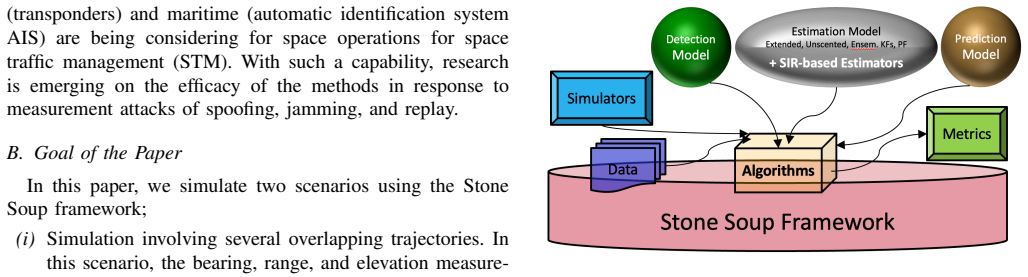
The central object is the third-order stochastic integration filter (SIF), a local nonlinear filter that evaluates the Gaussian-weighted integrals in the Kalman update by stochastic numerical integration rather than by linearising the measurement function as the EKF does. The SIF's random integration points give an asymptotically accurate approximation of the conditional mean and covariance, and the resulting covariance estimates stay better scaled in nonlinear geometries. The machinery that carries the argument is the interplay between that covariance realism and the global nearest neighbour data associator, which uses Mahalanobis distance to decide which detection updates which track: when the filter's covariance is too small or misshapen, the associator can lock onto the wrong target. The paper compares the SIF against the EKF (and notes that the UKF with default settings failed to keep covariance positive semidefinite) using OSPA, SIAP ambiguity, SIAP position accuracy, and sum of Frobenius covariance norms.
What would settle it
Rerun both multi-target scenarios many times with independent random seeds and record the OSPA, SIAP ambiguity, and sum-of-covariance-norms traces; if the EKF's covariance spikes are not consistently larger or more frequent than the SIF's across runs, the reported advantage is a single-realization artifact.
Extended reading notes
Core claim
On the paper's own terms, the central finding is that the third-order SIF demonstrates a notable albeit subtle performance uplift over the EKF in both test scenarios. In the simulated class-B airspace, where ten maneuvering targets follow overlapping trajectories, the SIF's covariance norms remain smooth while the EKF shows large uncertainty spikes at moments of ambiguous association; the EKF also never fully resolves its SIAP ambiguity, while the SIF keeps association clean. In the ADS-B class-A scenario, 84 aircraft are tracked with three simulated radars, and the SIF shows only marginal improvement, which the paper attributes to targets being far apart so that EKF linearization suffices. The paper reads the dense-scenario result as evidence that filter covariance consistency directly improves measurement-to-track association, and it suggests the advantage could grow in cluttered environments, although clutter is not actually simulated in either experiment.
Load-bearing premise
The paper's conclusions rest on one realization of each scenario without repeated trials or error bars, and on the interpretation that EKF covariance spikes are a cause rather than a consequence of association errors.
Editorial extensions
If this is right
- In dense multi-target scenarios with overlapping trajectories, switching the local estimator from EKF to third-order SIF should reduce association-induced covariance spikes and keep ambiguity scores closer to the ideal value of one.
- In sparse airspace, EKF remains adequate; the SIF's benefit is small enough that its higher computational cost may not be justified there.
- Filter covariance consistency is not just an internal property: it directly shapes measurement-to-track association, so improving the filter can improve tracking without changing the association algorithm.
- The SIF's advantage is expected to be more pronounced in cluttered environments, though this was not tested in the paper.
Reading between the lines
- A testable extension the paper leaves implicit: add clutter and false alarms to the class-B scenario; if covariance realism is the mechanism, the SIF's association advantage should widen when spurious detections compete with true ones.
- The GNN associator's Mahalanobis gating depends on predicted covariance scale; this suggests that any filter that better calibrates covariance, not only the SIF, could yield similar association benefits in dense scenarios.
- One could swap the associator (e.g., joint probabilistic data association or multiple hypothesis tracking) to see whether the SIF advantage shrinks once association decisions are made more robustly, which would clarify how much of the benefit is due to the filter alone.
- Because each scenario is shown for a single run, the size of the SIF's advantage should be quantified with repeated runs before relying on it in filter selection.
Editorial analysis
A structured set of objections, weighed in public.
Referee Report
Summary. The paper evaluates the Stochastic Integration Filter (SIF) against the Extended Kalman Filter (EKF) for multi-target tracking within the Stone Soup framework, using two scenarios: a simulated Class-B airspace scenario with ten maneuvering targets and an ADS-B Class-A scenario with 84 aircraft whose detections are simulated from three radars. Performance is compared through OSPA, SIAP ambiguity, SIAP position accuracy, and sums of covariance norms. The central claim, stated in Section VII, is that the third-order SIF yields a 'notable albeit subtle' performance uplift over the EKF, particularly in the dense Class-B scenario, and that this stems from more consistent covariance propagation that reduces association-induced ambiguity spikes. The authors provide source code for the scenario definitions and Stone Soup setup.
Significance. If the empirical claim is reproducible, the paper is a useful practical demonstration that a stochastic integration filter can improve dense multi-target tracking within an open-source tracking framework. The use of standard Stone Soup metrics, the inclusion of a realistic ADS-B-based scenario, and the release of source code are genuine strengths that make the proposed comparison easy to reuse and extend. However, the significance is currently conditional: the evidence consists of a single realization of each scenario, the filter itself is stochastic, and the load-bearing causal mechanism is asserted rather than isolated. The paper is therefore a promising application study whose central claim needs stronger empirical support before it can be accepted.
major comments (4)
- [V.B, VI.C, VII] The paper's central claim rests on a single run of each scenario, but the SIF is a stochastic filter whose integration points are randomized (Section III.B, Eq. (17)). No random seed, number of repetitions, or error bars are reported for the OSPA, SIAP, or covariance-norm traces in Figures 2-8. Since the reported uplift is described as 'subtle,' run-to-run variation is material; the observed SIF advantage may be seed-specific. Please add Monte Carlo repetitions (ideally with a stated number of seeds and mean/quantile traces, or at minimum a fixed reproducible seed plus a sensitivity check) so the reader can assess whether the SIF-EKF gap is signal rather than noise.
- [V.B] The prose attributes the EKF covariance spikes to association errors and claims the SIF avoids them through better covariance propagation, but this causal mechanism is not demonstrated. In a single unseeded run, association errors and covariance inflation are confounded: an association error inflates covariance, and an inflated covariance can cause further association errors, as the text itself notes by describing the 'interdependent nature' of the two effects. To separate these effects, please include a controlled comparison with oracle or ground-truth data association; if the SIF advantage persists under perfect association, the covariance-propagation explanation is supported, and if not, the advantage should be attributed to interaction with the GNN associator rather than to the filter alone.
- [I.B, IV.B, IV.C, VII] There is a direct contradiction about whether clutter is present. Section I.B says scenario (ii) involves 'introducing the clutter,' Section IV.C says the metrics evaluate performance 'in the presence of clutter,' but Section IV.B states 'for the purpose of this paper, we are not considering clutter,' and Section VII says the clutter scenario 'was not tested in this paper.' The manuscript must specify the actual clutter configuration. If no clutter is used, remove the clutter language from Sections I.B and IV.C and temper the concluding speculation that SIF 'may have a significant advantage in tracking targets in the presence of clutter'; if clutter is used, provide its model, density, and any relevant parameters.
- [VI.A, Eq. (26)] The three-dimensional measurement model in Eq. (26) appears to be incorrectly typeset and, as written, does not describe a consistent range-azimuth-elevation model. The elevation expression uses x_{3,k} (east position) where the vertical coordinate should appear, and the second and third components have malformed subscripts/superscripts. The state vector for the 3D case is also not explicitly defined. Please correct Eq. (26), define the state ordering, and verify that the provided code implements the corrected formula.
minor comments (5)
- [III.A, Eq. (15)] In Eq. (15), P^{xx}_{k+1|k} is equated to E[x_{k+1}|z_k], which is a mean, not a covariance; the equation should state the covariance expression explicitly (and should use P_{k|k} consistently with the notation introduced earlier).
- [II] There is a duplicated word in the sentence 'The Stone Soup project project is an open-source tracking and estimation framework.'
- [VI.A] The text refers to 'FightRadar24' in the introduction; this should be 'FlightRadar24.'
- [V.A] The simulation region is described as '30 [km] by 300 [km2]'; the units are inconsistent and should be clarified, e.g., 30 km by 300 km.
- [IV.B] The UKF is excluded because it failed to maintain a positive semidefinite covariance with default Stone Soup parameters, but no details of the failure or of any attempted tuning are given. Since the stated goal in Section I.B is filter selection, please add a sentence explaining whether the exclusion is a Stone Soup implementation issue or an inherent UKF limitation in these scenarios.
Circularity Check
No circularity: the SIF-vs-EKF comparison is an empirical benchmark with independent metrics and data, not a derivation that reduces to its own inputs.
full rationale
This is an empirical evaluation paper, not a derivation. The central claim (Section VII) that the third-order SIF shows a 'notable albeit subtle performance uplift' over the EKF is supported by Stone Soup metrics (OSPA, SIAP ambiguity, SIAP position accuracy, sum of covariance norms) computed on a simulated Class-B scenario and a real ADS-B Class-A scenario. No parameter is fitted to the reported conclusion and then renamed as a prediction: the SIF and EKF are run as distinct filters, and the metrics are external to the filter designs. The stochastic integration rule in Eq. (17) is a previously published estimator, and the self-citations [8], [10], [11] are used as background support for SIF's general robustness, not as the load-bearing evidence for the present comparison; the actual evidence is the new experiments, standard metrics, and openly provided code. The single-run nature of the scenarios is a reproducibility/statistical-significance concern, which belongs to correctness risk, not circularity. Accordingly, no circular step can be exhibited, and the appropriate score is 0.
Assumptions & free parameters
free parameters (4)
- OSPA cardinality cutoff c =
10 (Class-B), 250 (Class-A)
- GNN missed-detection distance threshold =
5
- Track deletion time threshold =
10
- Process noise intensities qx, qy, qz =
0.05 (Class-B), 10, 10, 5 (Class-A)
assumptions (5)
- domain assumption Gaussian-assumed filtering density so local filters are adequate (Eq. 8, Section III.B)
- domain assumption Zero-mean Gaussian, mutually independent process/measurement noise with known covariances (Eqs. 3-5)
- domain assumption ADS-B broadcasts are exact ground truth (Section VI.A)
- domain assumption GNN with 2D assignment and Mahalanobis distance is a sufficient data association solution for the studied scenarios (Section IV.A)
- standard math The third-order SIF quadrature (Eq. 17) provides an accurate approximation of the Gaussian integrals
Cite this review
Pith. "Pith review of Stone Soup: ADS-B-based Multi-Target Tracking with Stochastic Integration Filter." pith.science (2026). https://pith.science/paper/HAQJD4W4
@misc{pith2026250607889,
  author       = {Pith},
  title        = {Pith review of: Stone Soup: ADS-B-based Multi-Target Tracking with Stochastic Integration Filter},
  year         = {2026},
  howpublished = {\url{https://pith.science/paper/HAQJD4W4}},
  note         = {Machine review of arXiv:2506.07889}
}
read the original abstract
This paper focuses on the multi-target tracking using the Stone Soup framework. In particular, we aim at evaluation of two multi-target tracking scenarios based on the simulated class-B dataset and ADS-B class-A dataset provided by OpenSky Network. The scenarios are evaluated w.r.t. selection of a local state estimator using a range of the Stone Soup metrics. Source code with scenario definitions and Stone Soup set-up are provided along with the paper.
Figures


Figures from the paper (4 more)


Reference graph
Works this paper leans on
-
[1]
Prentice Hall, New Jersey (1979)
Anderson, B.D.O., Moore, J.B.: Optimal Filtering. Prentice Hall, New Jersey (1979)
work page 1979
-
[2]
Arasaratnam, I., Haykin, S.: Cubature Kalman filters. IEEE Trans. on Automatic Control 54(6) (2009) 1254–1269
work page 2009
-
[3]
YBS Publishing, Storrs, CT (2011)
Bar-Shalom, Y ., Willett, P.K., Tian, X.: Tracking and Data Fusion: A Handbook of Algorithms. YBS Publishing, Storrs, CT (2011)
work page 2011
-
[4]
V olume 12122., SPIE (2022) 1212205– 1212205–17
Barr, J., Harrald, O., Hiscocks, S., Perree, N., Pritchett, H., Vidal, S., Wright, J., Carniglia, P., Hunter, E., Kirkland, D., Raval, D., Zheng, S., Young, A., Balaji, B., Maskell, S., Hernandez, M., Vladimirov, L.: Stone Soup open source framework for tracking and state estimation: enhancements and applications. V olume 12122., SPIE (2022) 1212205– 1212205–17
work page 2022
-
[5]
Blackman, S.S., Popoli, R.F.: Design and Analysis of Modern Tracking Systems. Artech House (1999)
work page 1999
-
[6]
Blasch, E., Niu, R., O’Rourke, S.: Target tracking analysis for Stone Soup. In: Int’l Conf. on Information Fusion. (2020)
work page 2020
-
[7]
In: 2024 27th International Conference on Information Fusion (FUSION)
Chong, Z.Y ., Pritchett, H., Li, Q., Gan, R., Kındap, Y ., Godsill, S.: Implementation of non-gaussian motion models within Stone Soup. In: 2024 27th International Conference on Information Fusion (FUSION). (2024) 1–8
work page 2024
- [8]
Show all 38 references
-
[9]
IEEE Transactions on Aerospace and Electronic Systems 55(1) (2019) 251–272
Dun ´ık, J., Sot ´ak, M., Vesel ´y, M., Straka, O., Hawkinson, W.J.: Design of Rao-Blackwellised point-mass filter with application in terrain aided navigation. IEEE Transactions on Aerospace and Electronic Systems 55(1) (2019) 251–272
2019
-
[10]
IEEE Transactions on Automatic Control 58(6) (2013) 1561–1566
Dun ´ık, J., Straka, O., ˇSimandl, M.: Stochastic integration filter. IEEE Transactions on Automatic Control 58(6) (2013) 1561–1566
2013
-
[11]
IEEE Transactions on Aerospace and Electronic Systems 51(2) (2015) 1403–1421
Dun ´ık, J., Straka, O., ˇSimandl, M., Blasch, E.: Random-point-based filters: Analysis and comparison in target tracking. IEEE Transactions on Aerospace and Electronic Systems 51(2) (2015) 1403–1421
2015
-
[12]
IEEE Transactions on Automatic Control 57(9) (2012) 2411–2416
Dun ´ık, J., ˇSimandl, M., Straka, O.: Unscented Kalman filter: Aspects and adaptive setting of scaling parameter. IEEE Transactions on Automatic Control 57(9) (2012) 2411–2416
2012
-
[13]
Springer Verlag (2009)
Evensen, G.: Data assimilation: The ensemble Kalman filter. Springer Verlag (2009)
2009
-
[14]
John Wiley & Sons, New York (2001)
Grewal, S.G., Andrews, A.P.: Kalman Filtering: Theory and Practise Using MATLAB (Second Edition). John Wiley & Sons, New York (2001)
2001
-
[15]
In: 2021 IEEE 24th International Conference on Information Fusion (FUSION)
Hiles, J., O’Rourke, S.M., Niu, R., Blasch, E.P.: Implementation of ensemble Kalman filters in stone-soup. In: 2021 IEEE 24th International Conference on Information Fusion (FUSION). (2021) 1–8
2021
-
[16]
IEEE Proceedings 92(3) (2004) 401–421
Julier, S.J., Uhlmann, J.K.: Unscented filtering and nonlinear estimation. IEEE Proceedings 92(3) (2004) 401–421
2004
-
[17]
IEEE Transactions on Automatic Control 45(3) (2000) 477– 482
Julier, S.J., Uhlmann, J.K., Durrant-Whyte, H.F.: A new method for the nonlinear transformation of means and covariances in filters and estimators. IEEE Transactions on Automatic Control 45(3) (2000) 477– 482
2000
-
[18]
Artech House (2007)
Mahler, R.: Statistical Multisource-Multitarget Information Fusion. Artech House (2007)
2007
-
[19]
Artech House (2014)
Mahler, R.: Advances in Statistical Multisource-Multitarget Information Fusion. Artech House (2014)
2014
-
[20]
Proceedings of the IEEE 106(2) (February 2018) 221–259
Meyer, F., Kropfreiter, T., Williams, J.L., Lau, R., Hlawatsch, F., Braca, P., Win, M.Z.: Message passing algorithms for scalable multitarget tracking. Proceedings of the IEEE 106(2) (February 2018) 221–259
2018
-
[21]
Technical report, Technical University of Denmark
Nørgaard, M., Poulsen, N.K., Ravn, O.: Advances in derivative-free state estimation for nonlinear systems. Technical report, Technical University of Denmark. Department of Mathematical Modelling. Department of Automation (2000) IMM-REP-1998-15
2000
-
[22]
Automatica 36(11) (2000) 1627–1638
Nørgaard, M., Poulsen, N.K., Ravn, O.: New developments in state estimation for nonlinear systems. Automatica 36(11) (2000) 1627–1638
2000
-
[23]
readthedocs.io/en/v1.5/ (2025) Accessed: February 2025
OSTEWG: Welcome to Stone Soup’s documentation! https://stonesoup. readthedocs.io/en/v1.5/ (2025) Accessed: February 2025
2025
-
[24]
arXiv preprint arXiv:1601.05585 (2016)
Rahmathullah, A.S., Garc ´ıa-Fern´andez, A.F., Svensson, L.: Gen- eralized optimal sub-pattern assignment metric. arXiv preprint arXiv:1601.05585 (2016)
2016 arXiv
-
[25]
golub and charles f
Randall, T.J.: Matrix computations, by gene h. golub and charles f. van loan. pp 476. 1983. isbn 0-8018-3010-9 (johns hopkins university press). Mathematical gazette 69(448) (1985) 152–152
1985
-
[26]
Artech House (2004)
Ristic, B., Arulampalam, S., Gordon, N.: Beyond the Kalman Filter: Particle Filters for Tracking Applications. Artech House (2004)
2004
-
[27]
Standard, Radio Technical Commission for Aeronautics (RTCA) (De- cember 2006)
RTCA: Minimum operational performance standards for global posi- tioning system / wide area augmentation system airborne equipment. Standard, Radio Technical Commission for Aeronautics (RTCA) (De- cember 2006)
2006
-
[28]
Cambridge University Press (2013)
S ¨arkk¨a, S.: Bayesian Filtering and Smoothing. Cambridge University Press (2013)
2013
-
[29]
In: Proceedings of the 13th International Symposium on Information Processing in Sensor Networks, Piscataway, NJ, USA, IEEE Press (2014) 83–94
Sch ¨afer, M., Strohmeier, M., Lenders, V ., Martinovic, I., Wilhelm, M.: Bringing up OpenSky: A large-scale ADS-B sensor network for research. In: Proceedings of the 13th International Symposium on Information Processing in Sensor Networks, Piscataway, NJ, USA, IEEE Press (20...
2014
-
[30]
Wiley-Interscience (2006)
Simon, D.: Optimal State Estimation: Kalman, H Infinity, and Nonlinear Approaches. Wiley-Interscience (2006)
2006
-
[31]
Canadian Journal of Statistics 28(3) (2000) 641–652
Song, P.X.K.: Monte Carlo Kalman filter and smoothing for multivariate discrete state space models. Canadian Journal of Statistics 28(3) (2000) 641–652
2000
-
[32]
In: SPIE Proceedings
Thomas, P.A., Barr, J., Balaji, B., White, K.: An open source framework for tracking and state estimation (’stone soup’). In: SPIE Proceedings. V olume 10200., SPIE (2017) 1020008–1020008–10
2017
-
[33]
IEEE Trans
V o, B.N., V o, B.T., Phung, D.: Labeled random finite sets and the Bayes multi-target tracking filter. IEEE Trans. Signal Process. 62(24) (Dec. 2014) 6554–6567
2014
-
[34]
Technical report (October 2001) Technical Report
V otruba, P., Nisley, R., Rothrock, R., Zombro, B.: Single integrated air picture (SIAP) metrics implementation. Technical report (October 2001) Technical Report
2001
-
[35]
Automatica 45(7) (2009) 1749–1757
ˇSimandl, M., Dun´ık, J.: Derivative-free estimation methods: New results and performance analysis. Automatica 45(7) (2009) 1749–1757
2009
-
[36]
Technical report (2000) Technical Report, Massachusetts Institute of Technology
Weber, M.E.: Faa surveillance radar data. Technical report (2000) Technical Report, Massachusetts Institute of Technology
2000
-
[37]
In: 2024 27th International Conference on Information Fusion (FUSION)
Wright, J.S., Sun, M., Davies, M.E., Proudler, I.K., Hopgood, J.R.: Implementation of AKKF-based multi-sensor fusion methods in Stone Soup. In: 2024 27th International Conference on Information Fusion (FUSION). (2024) 1–7
2024
-
[38]
Sensors 17(11) (2017)
Zhou, D., Guo, L.: Stochastic integration hinfinity filter for rapid transfer alignment of ins. Sensors 17(11) (2017)
2017
Reviewed August 7, 2026 · model on record in the stance chip above.
Discussion (0). Sign in to comment.