REVIEW 3 major objections 8 minor 2 cited by
Fundamental Parameters for Central Stars of 103 Infrared Bowshock Nebulae
T0 review · 3 major / 8 minor · reviewed 2026-08-07 · deepseek-v4-flash
Pith's one-line read This paper measures fundamental parameters for 103 OB stars that power infrared bowshock nebulae and argues that the high binary fraction among the runaways (at least 15 of 19) favors dynamical ejection over the binary-supernova channel.
desk verdict A genuinely useful census of bowshock central-star parameters, with a DES conclusion that is shakier than the data product. read the letter →
The pith
A machine-rendered reading of the paper's core claim, the machinery that carries it, and where it could break.
The reading
What carries the argument
The load-bearing mechanism is the joint plane of projected rotation $v \sin i$ against two-dimensional peculiar velocity $v_{\rm 2D}$, divided into the binary-supernova region (fast rotators with moderate speed), the dynamical-ejection region (slow rotators with high speed), an ambiguous strip, and an avoidance region, together with binarity flags from single-lined, double-lined, eclipsing, and astrometric indicators. The stellar parameters are produced by fitting blue optical spectra to a grid of hot-atmosphere model spectra with a Markov-chain Monte Carlo sampler, then fitting the photometry with a spectral-energy-distribution plus evolutionary-track code to obtain radius, luminosity, mass, and extinction. The quadrant diagram is what carries the channel-attribution argument: apparent rapid rotation in the supernova region is shown to be inflated by unresolved binary blends, leaving the binary-rich, slow-rotating runaway population as the observed signature of dynamical ejection.
What would settle it
A high-resolution, multi-epoch radial-velocity campaign on the 19 runaways, combined with updated astrometry, would settle the matter: if fewer than about half of the runaways are confirmed as binaries, or if their peculiar velocities fall below the 25 km/s threshold, the claimed at-least-79% binary fraction and the dynamical-ejection preference would collapse.
Extended reading notes
Core claim
On its own terms, the paper's discovery is a statistical statement about runaway OB stars. Among 103 bowshock-powering OB stars (temperatures 16.5–46.8 kK, $\log g = 2.57$–4.60, $v \sin i$ from below 100 to 400 km/s), at least 60% show evidence of binarity, matching other OB samples. Of the stars with usable kinematics, 19 are runaways under the $v_{\rm 2D} \geq 25$ km/s criterion, and at least 15 of those 19 are binaries. Because simulations of the binary-supernova channel leave only a small fraction of runaways bound, while dynamical ejection leaves 20–45% of its runaways in binaries, the paper concludes that the observed $\geq$79% binary fraction favors dynamical ejection. A secondary finding is that bowshock stars are unexceptional: they occupy the same gravity–rotation locus and the same HR diagram as normal Galactic OB stars, with $\zeta$ Oph as the only near-critical rotator, so the sample can stand in for ordinary OB stars in future mass-loss work.
Load-bearing premise
The load-bearing premise is that the earlier Gaia-based two-dimensional space velocities and the earlier low-resolution checks that flag some stars as binaries are both accurate; if either set is biased, the claim that 15 of 19 runaway bowshock stars are binaries is not independently established.
Editorial extensions
If this is right
- Confirmed runaway bowshock stars are mostly binary systems; the binary-supernova channel alone can account for at most a small bound fraction, so the $\geq$79% binary rate makes dynamical ejection the default explanation for these runaways.
- The measured $T_{\rm eff}$, $\log g$, $v \sin i$, $R_*$, $L_*$, and $A_V$ values are the inputs needed to convert bowshock standoff distances into wind mass-loss rates for 103 stars.
- Because bowshock stars occupy the same parameter space as ordinary OB stars, mass-loss rates derived from them should be applicable to OB stars generally, not just to bowshock-selected objects.
- The SED-derived extinctions running 2–3 magnitudes above earlier infrared color-excess values imply that previous H–[4.5]-based extinctions for early-type bowshock stars should be revised.
- Aside from $\zeta$ Oph, bowshock stars do not rotate near critical speeds, so near-critical rotation is not a prerequisite for producing a bowshock nebula.
Reading between the lines
- A testable path the paper does not itself take: measure radial velocities of the 19 runaways at high resolution over several epochs; if the confirmed binary fraction drops below roughly half, the observed 15-of-19 rate was inflated by the inherited low-resolution flags and the dynamical-ejection conclusion weakens.
- Recomputing the two-dimensional velocities and binarity flags with newer astrometry and a homogeneous high-resolution survey of all 103 stars would show whether the runaway–binary link is a real property of the population or a selection effect of how runaways were identified.
- If the result generalizes beyond bowshock stars, runaway binary fractions become a clean observational diagnostic of cluster ejection, and population-synthesis models that route most runaways through the supernova channel would need to be recalibrated.
- A direct check of the mass-loss promise would be to compare bowshock-derived mass-loss rates against H-alpha or ultraviolet wind measurements for the same stars, testing whether the nebula geometry is a truly independent probe.
Editorial analysis
A structured set of objections, weighed in public.
Referee Report
Summary. This paper presents low-resolution blue optical spectra (R ≈ 1500–2200) of 104 candidate central stars of infrared bowshock nebulae taken from the catalogs of Kobulnicky et al. (2016) and Jayasinghe et al. (2019). The authors fit TLUSTY OSTAR2002/BSTAR2006 model grids with a grid-search plus MCMC pipeline to measure effective temperature, surface gravity, and projected rotational broadening, and combine the results with Gaia EDR3 parallaxes and broadband photometry in EXOFASTv2 with MIST models to derive stellar radius, luminosity, and visual-band extinction. The analysis is calibrated on 28 comparison stars with literature parameters; temperature and gravity are recovered with scatter of about 1.5 kK and 0.20 dex, respectively, while v sin i carries an acknowledged resolution floor near 100 km/s and an unexplained systematic offset of about 25 km/s above it. The principal science results are: (i) the 103 OB bowshock stars span Teff = 16.5–46.8 kK and log g = 2.57–4.60 and occupy the same spectroscopic and conventional HR-diagram loci as normal Galactic OB stars; (ii) roughly 60% of the sample shows at least one binarity indicator; and (iii) 19 of the stars with kinematic data meet the v2D ≥ 25 km/s runaway threshold, and 15 of these 19 (≥79%) show binarity indicators, which the authors interpret as favoring dynamical ejection over the binary supernova channel as the production mechanism for runaway OB stars.
Significance. If the headline inference holds, the paper supplies rare observational leverage on the long-standing dynamical-ejection versus binary-supernova debate for runaway OB stars, and the census itself (Teff, log g, v sin i, R*, L*, AV for 103 bowshock central stars, many measured for the first time) is a solid foundation for the bowshock-based wind mass-loss technique of Kobulnicky et al. (2018, 2019). The methodological strengths are real: fitting is done against public TLUSTY grids rather than tunable private models; the comparison-sample validation quantifies accuracy; the SED analysis uses standard public tools; and the authors are unusually transparent about their own limitations (the −25 km/s v sin i offset, the 100 km/s resolution floor, SB2-related v sin i inflation, and the exclusion of the F-star interloper HD 157642). The DES/BSS inference in §5.2 is the weakest link: it depends on binarity flags of heterogeneous provenance, it lacks any uncertainty or sensitivity analysis, and the counts supporting it are internally inconsistent (60 vs 62 vs 65 binaries; 84 vs 87 kinematic stars; 22% vs 23% runaway fraction).
major comments (3)
- [§5.2, Figure 15; Table 4; §4.4] The headline inference—'at least 15 (≥79%) are binaries, favoring dynamical ejection'—is presented as a bare point estimate, without uncertainty or sensitivity analysis, and it rests on flags of heterogeneous provenance. Among the 19 runaways, the 15 binary flags comprise 10 SB2 classifications from single-epoch R≈2200 spectra, 3 SB1 flags imported from Kobulnicky & Chick (2022) through footnote 13 (BS303, BS360, BS361), and 2 EB flags from Malkov et al. (2006). Section 4.4 itself cautions that 'our analysis is most problematic for de-blended SB2s' and that line splitting inflates v sin i, so the binarity flags and the v sin i values used to partition Figure 15 are not independent products of the same spectra. The comparison logic is also muddled: the observed ≥79% lies above the quoted DES multiplicity range of 20–45% (Perets & Šubr 2012), so the conclusion is qualitative rather than a statement that the measurement falls inside the DES prediction; the binomial 95% confidence interval for 15/19 is roughly 54–94%, and detection selection effects (e.g., ease of flagging SB2s; magnitude-limited sample) are not discussed. Even if 2–3 of the 15 flags were spurious, the binary fraction would remain high (about 63–68%), so the DES preference would probably survive, but the authors should demonstrate this with (i) a binomial confidence interval, (ii) a sensitivity test that recomputes the fraction without the least certain flag classes, and (iii) an explicit discussion of binarity-detection biases in this 24 µm-selected sample.
- [§5.2; §6; Abstract] The size of the kinematic subsample is reported inconsistently. Section 5.2 states that '19 of the 87 OB stars with kinematic data (22%)' are runaways; Section 6 states '22% of bowshock stars with kinematic data (19 of 84)'; and the abstract quotes a 23% runaway fraction. The arithmetic does not close: 19/84 = 22.6% (which rounds to 23%) while 19/87 = 21.8% (which rounds to 22%), so the percentages in Section 6 and the abstract cannot both be right, and neither agrees with the other section's denominator. The authors should verify the number of stars with v2D from Kobulnicky & Chick (2022) and use a single, consistent value everywhere. Because the v2D values and the 25 km/s runaway threshold are taken unchanged from that earlier work, the text should also state explicitly that the runaway classification is inherited rather than re-derived here, so the reader can gauge the independence of the runaway sample.
- [Abstract; §4.4; §6; Table 4] The total binary count appears as three different numbers: 'at least 60 of 103 (60%)' in the abstract, '62 bowshock stars (60%)' in Section 4.4, and '65 (60%)' in Section 6. Counting the flag column of Table 4 gives 62 unique stars with at least one indicator (16 SB1, 41 SB2, 3 EB, and 15 R flags, allowing for overlap), so Section 4.4 and the table agree while the abstract and Section 6 do not; additionally, 60/103 = 58.3% and 65/103 = 63.1%, so the percentages attached to those two counts are arithmetically wrong. The three occurrences should be reconciled against the table, and the presentation of the RUWE flag should clarify the bright-star exclusion (footnote 14), since BS388 (RUWE 2.496) and κ Cas (RUWE 2.368) appear in Table 4 without R flags.
minor comments (8)
- [§3.1, Eq. (2)] Equation (2) places σ_i in the denominator of the reduced χ² expression; the standard statistic requires σ_i². As printed, the quantity is not a χ² and downweights noisy pixels less aggressively than intended; please correct the formula or clarify that σ_i denotes the variance rather than the standard deviation.
- [§3.5.1; Figure 8; Figure 15] The honest disclosure of the unexplained −25 km/s systematic in v sin i ('We cannot explain this deviation') is not carried through to §5.2, where Figure 15 partitions the sample at v sin i = 120 km/s. The 19 runaways sit mostly far from the boundary, but BS377 (104 ± 29 km/s, SB2) and BS667 (153 ± 16 km/s, EB) are near it; a sentence confirming that the region assignments, and hence the binary-count statistic (which depends only on v2D), are insensitive to this offset would close the loop.
- [Abstract; §4.1; Appendix B] The abstract reports spectra for 104 stars but then quotes binary statistics for 103; the reduction from 104 to 103 (exclusion of the F star HD 157642, Appendix B) should be stated in the abstract itself, since the denominator change is otherwise unexplained.
- [Table 2; §5.2] BS667 is listed as 'V* V1012 Sco' in Table 2 but referred to as 'V1202 Sco' in §5.2; the variable-star designation should be made consistent.
- [§5.1, Eq. (3)] The critical-rotation comparison adopts a fixed Eddington factor Γ = 0.30; because 'no bowshock stars rotate near critical velocity' is a stated result, a sentence on how the vcrit tracks shift over the plausible Γ ≈ 0.2–0.5 range for OB stars would make the claim more robust.
- [§4.4; §5] The statement that the binary fraction is 'consistent with the multiplicity fraction of other OB samples' mixes detection methods: the RUWE > 1.4 astrometric flag and the EB flag from Malkov et al. (2006) are not directly comparable to the spectroscopically determined multiplicity fractions cited from Sana & Evans (2011) and Chini et al. (2012); a sentence acknowledging this methodological mismatch is needed.
- [§3.5.2] The stellar radius validation is based on only three objects (ζ Oph, HD 191423, AE Aur), and the HD 191423 comparison is weakly constraining because the literature value carries a very large uncertainty (18.3 ± 8.7 R⊙); a sentence noting the limited scope of the radius validation would aid the reader.
- [Throughout] There are numerous typographical errors: 'intenral' (§2.2), 'uncertaintiy' (§3.1 and Table 3 note), 'nebuae' (Table 4 note), 'metalicity' (Figure 14 caption), 'Thompson' for Thomson (§5.1), 'temperatire' (§3.2), 'V er tically' (Fig Set 16 title), and 'survery' (§1); these should be corrected in a final pass.
Circularity Check
No circularity: stellar parameters are fitted against public model grids and validated on comparison stars; the DES inference rests on independent kinematic and binarity data, not on the new fits.
full rationale
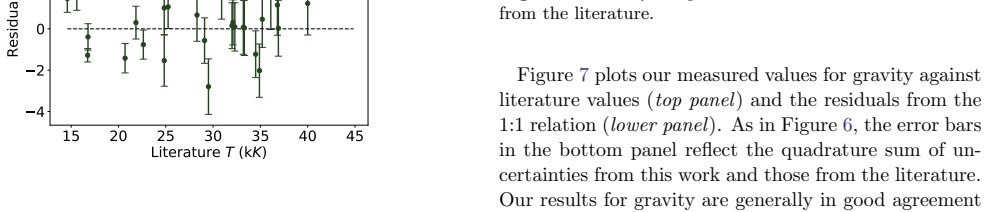
The paper's central measurements (Teff, log g, v sin i) come from fitting TLUSTY/BSTAR2006 model grids to new blue spectra, and R*, L*, and AV come from SED fitting with EXOFASTv2 plus MIST models; both procedures are benchmarked against 28 literature comparison stars, including ζ Oph, with reported agreement (Figures 6–8, Section 3.5). The load-bearing dynamical-ejection claim in Section 5.2 uses (1) two-dimensional peculiar velocities v2D >= 25 km/s from Kobulnicky & Chick (2022), which are Gaia EDR3 proper-motion measurements, and (2) binarity flags from radial-velocity variability (SB1, from earlier observations), line splitting/composite spectra (SB2, from the new low-resolution spectra), eclipsing-binary catalogs, and Gaia RUWE. None of these inputs is derived from, or fitted by, the spectral parameters measured in this paper: the runaway selection and the binary classification are independent of the TLUSTY/MCMC fits and the SED-derived radii and luminosities. The comparison of the resulting 79% binary fraction to the 20–45% DES prediction of Perets & Subr (2012) and the 14% bound BSS fraction of Renzo et al. (2019) is an external theoretical benchmark. Same-group citations to Kobulnicky & Chick (2022) exist and are load-bearing for the runaway subsample, but they carry independent Gaia astrometry and prior RV measurements, so they do not make the argument circular. The internal numerical inconsistencies noted in the paper (19/87 vs 19/84 runaways; 60/103 vs 62/104 vs 65/104 binary counts) are consistency/accuracy concerns, not evidence that any claimed prediction is equivalent to its inputs by construction.
Assumptions & free parameters
free parameters (3)
- Eddington factor Gamma =
0.30
- Runaway threshold v2D =
25 km/s
- BSS/DES region boundaries =
v sin i = 120 km/s; v2D = 40 km/s
assumptions (4)
- domain assumption TLUSTY model grid with solar helium abundance is adequate for fitting OB star spectra.
- domain assumption MIST evolutionary tracks and EXOFASTv2 SED fitting yield reliable radii, luminosities, and extinction.
- standard math Cardelli et al. (1989) extinction curve with Rv = 3.1 applies.
- domain assumption Gaia EDR3 inverse parallaxes are unbiased distance estimators for these stars.
Cite this review
Pith. "Pith review of Fundamental Parameters for Central Stars of 103 Infrared Bowshock Nebulae." pith.science (2026). https://pith.science/paper/KBHKKP6A
@misc{pith2026250607904,
  author       = {Pith},
  title        = {Pith review of: Fundamental Parameters for Central Stars of 103 Infrared Bowshock Nebulae},
  year         = {2026},
  howpublished = {\url{https://pith.science/paper/KBHKKP6A}},
  note         = {Machine review of arXiv:2506.07904}
}
abstract
Stellar bowshock nebulae are arcuate shock fronts formed by the interaction of radiation-driven stellar winds and the relative motion of the ambient interstellar material. Stellar bowshock nebulae provide a promising means to measure wind-driven mass loss, independent of other established methods. In this work, we characterize the stellar sources at the center of bowshock nebulae drawn from all-sky catalogs of 24 $\mu$m-selected nebulae. We obtain new, low-resolution blue optical spectra for \numstars~stars and measure stellar parameters temperature \teff, surface gravity \logg, and projected rotational broadening \vsini. We perform additional photometric analysis to measure stellar radius \rstar, luminosity \lstar, and visual-band extinction $A_V$. All but one of our targets are O and early B stars, with temperatures ranging from $T$=16.5--46.8~k\kelvin, gravities $\log g=$2.57--4.60, and \vsini~from $<$100--400~\kms. With the exception of rapid rotator $\zeta$ Oph, bowshock stars do not rotate at or near critical velocities. At least 60 of 103 (60\%) OB bowshock stars are binaries, consistent with the multiplicity fraction of other OB samples. The sample shows a runaway fraction of 23\%, with \numrunaway~stars having $v_{\text{2D}}\geq25$~\kms. Of the 19 runaways, at least 15 ($\geq$79\%) are binaries, favoring dynamical ejection over the binary supernova channel for producing runaways. We provide a comprehensive census of stellar parameters for bowshock stars, useful as a foundation for determining the mass-loss rates for OB-type stars -- one of the single most critical factors in stellar evolution governing the production of neutron stars and black holes.
Figures


Figures from the paper (13 more)




Forward citations
Cited by 2 Pith papers
-
An Halpha survey of infrared bow-shocks around OB-type stars
Fifteen plus one serendipitous clear H-alpha bow shocks are detected among 78 IR candidates; several are consistent with radiation-supported regimes while others match classical wind-supported shocks.
-
Why do massive stars form bow shocks? Bulk ISM motion as the main driver of bow shock formation and geometry
Bulk interstellar gas motion, not stellar motion, dominates most massive star bow shocks; only about 21% are classical aligned bow shocks.
Reference graph
Works this paper leans on
-
[1]
- [1] #1 = = ^ ^ ^ .\!\!^ d .\!\!^ h .\!\!^ m .\!\!^ s .\!\!^ @mss
thebibliography [1] 20pt to REFERENCES 6pt =0pt \@twocolumntrue 12pt -12pt 10pt plus 3pt =0pt =0pt =1pt plus 1pt =0pt =0pt -12pt =13pt plus 1pt =20pt =13pt plus 1pt \@M =10000 =-1.0em =0pt =0pt 0pt =0pt =1.0em @enumiv\@empty 10000 10000 `\.\@m \@noitemerr \@latex@warning Empty `thebibliography' environment \@ifnextchar \@reference \@latexerr Missing key o...
2017
-
[2]
P., Abbott , R., Adhikari , R., et al
Abbott , B. P., Abbott , R., Adhikari , R., et al. 2009, Reports on Progress in Physics, 72, 076901, 10.1088/0034-4885/72/7/076901
-
[3]
Abbott , D. C., Bieging , J. H., Churchwell , E., & Cassinelli , J. P. 1980, , 238, 196, 10.1086/157973
-
[4]
G., Belgacem , E., Benkel , R., et al
Arun , K. G., Belgacem , E., Benkel , R., et al. 2022, Living Reviews in Relativity, 25, 4, 10.1007/s41114-022-00036-9
-
[5]
2023, , 671, A36, 10.1051/0004-6361/202244906
Aschenbrenner , P., Przybilla , N., & Butler , K. 2023, , 671, A36, 10.1051/0004-6361/202244906
-
[6]
Avvakumova , E. A., Malkov , O. Y., & Kniazev , A. Y. 2013, Astronomische Nachrichten, 334, 860, 10.1002/asna.201311942
-
[7]
2002, , 123, 2627, 10.1086/339837
Bally , J., Heathcote , S., Reipurth , B., et al. 2002, , 123, 2627, 10.1086/339837
-
[8]
Benaglia , P., Vink , J. S., Mart \' , J., et al. 2007, , 467, 1265, 10.1051/0004-6361:20077139
Show all 125 references
-
[9]
O., Puls , J., & Najarro , F
Bj \"o rklund , R., Sundqvist , J. O., Puls , J., & Najarro , F. 2021, , 648, A36, 10.1051/0004-6361/202038384
2021 doi
-
[10]
O., Singh , S
Bj \"o rklund , R., Sundqvist , J. O., Singh , S. M., Puls , J., & Najarro , F. 2023, , 676, A109, 10.1051/0004-6361/202141948
2023 doi
-
[11]
1961, , 15, 265
Blaauw , A. 1961, , 15, 265
1961
-
[12]
1961, , 15, 291
Boersma , J. 1961, , 15, 291
1961
-
[13]
Bolton , C. T. 1972, , 235, 271, 10.1038/235271b0
1972 doi
-
[14]
1990, Nuclear Instruments and Methods in Physics Research A, 289, 518, 10.1016/0168-9002(90)91525-G
Bradaschia , C., Del Fabbro , R., Di Virgilio , A., et al. 1990, Nuclear Instruments and Methods in Physics Research A, 289, 518, 10.1016/0168-9002(90)91525-G
1990 doi
-
[15]
2023, , 672, A22, 10.1051/0004-6361/202245145
Britavskiy , N., Sim \'o n-D \' az , S., Holgado , G., et al. 2023, , 672, A22, 10.1051/0004-6361/202245145
2023 doi
-
[16]
J., & Pickering , E
Cannon , A. J., & Pickering , E. C. 1993, VizieR Online Data Catalog: Henry Draper Catalogue and Extension (Cannon+ 1918-1924; ADC 1989) , VizieR On-line Data Catalog: III/135A. Originally published in: Harv. Ann. 91-100 (1918-1924)
1993
-
[17]
2019, Spitzer Enhanced Imaging Products (SEIP) Source List, IPAC, 10.26131/IRSA3
Capak; Peter . 2019, Spitzer Enhanced Imaging Products (SEIP) Source List, IPAC, 10.26131/IRSA3
2019 doi
-
[18]
A., Clayton , G
Cardelli , J. A., Clayton , G. C., & Mathis , J. S. 1989, , 345, 245, 10.1086/167900
1989 doi
-
[19]
P., Puls , J., Sundqvist , J
Carneiro , L. P., Puls , J., Sundqvist , J. O., & Hoffmann , T. L. 2016, , 590, A88, 10.1051/0004-6361/201527718
2016 doi
-
[20]
Carretero-Castrillo , M., Rib \'o , M., & Paredes , J. M. 2023, , 679, A109, 10.1051/0004-6361/202346613
2023 doi
-
[21]
T., Kobulnicky , H
Chick , W. T., Kobulnicky , H. A., Schurhammer , D. P., et al. 2020, , 251, 29, 10.3847/1538-4365/abc0e5
2020 doi
-
[22]
H., Nasseri , A., Stahl , O., & Zinnecker , H
Chini , R., Hoffmeister , V. H., Nasseri , A., Stahl , O., & Zinnecker , H. 2012, , 424, 1925, 10.1111/j.1365-2966.2012.21317.x
2012
-
[23]
2016, , 823, 102, 10.3847/0004-637X/823/2/102
Choi , J., Dotter , A., Conroy , C., et al. 2016, , 823, 102, 10.3847/0004-637X/823/2/102
2016 doi
-
[24]
M., Mandel , K
Czekala , I., Andrews , S. M., Mandel , K. S., Hogg , D. W., & Green , G. M. 2015, , 812, 128, 10.1088/0004-637X/812/2/128
2015 doi
-
[25]
X., Wolff , S., & Przybilla , N
Daflon , S., Cunha , K., de Ara \'u jo , F. X., Wolff , S., & Przybilla , N. 2007, , 134, 1570, 10.1086/521707
2007 doi
-
[26]
G., Lehnert , M
Dahlem , M., Petr , M. G., Lehnert , M. D., Heckman , T. M., & Ehle , M. 1997, , 320, 731
1997
-
[27]
A., & Puls , J
de Burgos , A., Sim \'o n-D \' az , S., Urbaneja , M. A., & Puls , J. 2024, , 687, A228, 10.1051/0004-6361/202348808
2024 doi
-
[28]
E., Langer , N., Izzard , R
de Mink , S. E., Langer , N., Izzard , R. G., Sana , H., & de Koter , A. 2013, , 764, 166, 10.1088/0004-637X/764/2/166
2013 doi
-
[29]
S., Paggeot , K., Castro , N., & Moe , M
Dorigo Jones , J., Oey , M. S., Paggeot , K., Castro , N., & Moe , M. 2020, , 903, 43, 10.3847/1538-4357/abbc6b
2020 doi
- [30]
-
[31]
W., Massa , D
Fullerton , A. W., Massa , D. L., & Prinja , R. K. 2006, , 637, 1025, 10.1086/498560
2006 doi
-
[32]
2020, VizieR Online Data Catalog: Gaia EDR3 (Gaia Collaboration, 2020) , VizieR On-line Data Catalog: I/350
Gaia Collaboration . 2020, VizieR Online Data Catalog: Gaia EDR3 (Gaia Collaboration, 2020) , VizieR On-line Data Catalog: I/350. Originally published in: 2021A&A...649A...1G, 10.26093/cds/vizier.1350
2020 doi
-
[33]
D., Olson , G
Garmany , C. D., Olson , G. L., van Steenberg , M. E., & Conti , P. S. 1981, , 250, 660, 10.1086/159413
1981 doi
- [34]
-
[35]
1998, , 339, L5
Glatzel , W. 1998, , 339, L5
1998
-
[36]
Gott , J. R. 1971, , 234, 342, 10.1038/234342b0
1971 doi
-
[37]
O., & Corbally , J., C
Gray , R. O., & Corbally , J., C. 2009, Stellar Spectral Classification
2009
-
[38]
J., Ram \' rez-Agudelo , O
Grin , N. J., Ram \' rez-Agudelo , O. H., de Koter , A., et al. 2017, , 600, A82, 10.1051/0004-6361/201629225
2017 doi
- [39]
-
[40]
2024, , 272, 45, 10.3847/1538-4365/ad46f8
Guo , Y., Wang , L., Liu , C., et al. 2024, , 272, 45, 10.3847/1538-4365/ad46f8
2024 doi
-
[41]
V., & Bomans , D
Gvaramadze , V. V., & Bomans , D. J. 2008, , 490, 1071, 10.1051/0004-6361:200810411
2008 doi
-
[43]
V., Kniazev , A
Gvaramadze , V. V., Kniazev , A. Y., Kroupa , P., & Oh , S. 2011 a , , 535, A29, 10.1051/0004-6361/201117746
2011 doi
-
[44]
V., Menten , K
Gvaramadze , V. V., Menten , K. M., Kniazev , A. Y., et al. 2014 a , , 437, 843, 10.1093/mnras/stt1943
2014 doi
-
[45]
V., Miroshnichenko , A
Gvaramadze , V. V., Miroshnichenko , A. S., Castro , N., Langer , N., & Zharikov , S. V. 2014 b , , 437, 2761, 10.1093/mnras/stt2087
2014 doi
-
[46]
V., R \"o ser , S., Scholz , R
Gvaramadze , V. V., R \"o ser , S., Scholz , R. D., & Schilbach , E. 2011 b , , 529, A14, 10.1051/0004-6361/201016256
2011 doi
-
[47]
1987, , 316, 323, 10.1086/165204
Hartigan , P., Raymond , J., & Hartmann , L. 1987, , 316, 323, 10.1086/165204
1987 doi
-
[48]
M., Lehnert , M
Heckman , T. M., Lehnert , M. D., & Armus , L. 1993, in Astrophysics and Space Science Library, Vol. 188, The Environment and Evolution of Galaxies, ed. J. M. Shull & H. A. Thronson , 455, 10.1007/978-94-011-1882-8_25
1993 doi
-
[49]
J., Gotthelf , E
Helfand , D. J., Gotthelf , E. V., & Halpern , J. P. 2001, , 556, 380, 10.1086/321533
2001 doi
-
[50]
A., Templeton , M., Terrell , D., et al
Henden , A. A., Templeton , M., Terrell , D., et al. 2016, VizieR Online Data Catalog: AAVSO Photometric All Sky Survey (APASS) DR9 (Henden+, 2016) , VizieR On-line Data Catalog: II/336. Originally published in: 2015AAS...22533616H
2016
-
[51]
P., Vilchez , J
Herrero , A., Kudritzki , R. P., Vilchez , J. M., et al. 1992, , 261, 209
1992
-
[52]
Holgado , G., Sim \'o n-D \' az , S., Herrero , A., & Barb \'a , R. H. 2022, , 665, A150, 10.1051/0004-6361/202243851
2022 doi
-
[53]
Hoogerwerf , R., de Bruijne , J. H. J., & de Zeeuw , P. T. 2000, , 544, L133, 10.1086/317315
2000 doi
-
[54]
1982, Michigan Catalogue of Two-dimensional Spectral Types for the HD stars
Houk , N. 1982, Michigan Catalogue of Two-dimensional Spectral Types for the HD stars. Volume\_3. Declinations -40\_ 0 to -26\_ 0
1982
- [55]
-
[56]
D., & Smith , K
Howarth , I. D., & Smith , K. C. 2001, , 327, 353, 10.1046/j.1365-8711.2001.04658.x
2001
-
[57]
R., & McSwain , M
Huang , W., Gies , D. R., & McSwain , M. V. 2010, , 722, 605, 10.1088/0004-637X/722/1/605
2010 doi
-
[58]
2011, Synspec: General Spectrum Synthesis Program , Astrophysics Source Code Library, record ascl:1109.022
Hubeny , I., & Lanz , T. 2011, Synspec: General Spectrum Synthesis Program , Astrophysics Source Code Library, record ascl:1109.022
2011
-
[59]
2014, , 565, A63, 10.1051/0004-6361/201323167
Irrgang , A., Przybilla , N., Heber , U., et al. 2014, , 565, A63, 10.1051/0004-6361/201323167
2014 doi
-
[60]
S., et al
Jayasinghe , T., Dixon , D., Povich , M. S., et al. 2019, , 488, 1141, 10.1093/mnras/stz1738
2019 doi
-
[61]
T., Augusteijn , T., et al
Kaper , L., van Loon , J. T., Augusteijn , T., et al. 1997, , 475, L37, 10.1086/310454
1997 doi
- [62]
-
[63]
A., & Chick , W
Kobulnicky , H. A., & Chick , W. T. 2022, VizieR Online Data Catalog: Kinematic and astrometric data for SBN stars (Kobulnicky+, 2022) , VizieR On-line Data Catalog: J/AJ/164/86. Originally published in: 2022AJ....164...86K, 10.26093/cds/vizier.51640086
2022 doi
-
[64]
A., Chick , W
Kobulnicky , H. A., Chick , W. T., & Povich , M. S. 2018, , 856, 74, 10.3847/1538-4357/aab3e0
2018 doi
- [65]
-
[66]
A., Gilbert , I
Kobulnicky , H. A., Gilbert , I. J., & Kiminki , D. C. 2010, , 710, 549, 10.1088/0004-637X/710/1/549
2010 doi
-
[67]
A., Kiminki , D
Kobulnicky , H. A., Kiminki , D. C., Lundquist , M. J., et al. 2014, , 213, 34, 10.1088/0067-0049/213/2/34
2014 doi
-
[68]
A., Chick , W
Kobulnicky , H. A., Chick , W. T., Schurhammer , D. P., et al. 2016, , 227, 18, 10.3847/0067-0049/227/2/18
2016 doi
-
[69]
2016, , 459, 3460, 10.1093/mnras/stw824
K \"o rtgen , B., Seifried , D., Banerjee , R., V \'a zquez-Semadeni , E., & Zamora-Avil \'e s , M. 2016, , 459, 3460, 10.1093/mnras/stw824
2016 doi
-
[70]
2021, , 647, A28, 10.1051/0004-6361/202039900
Krti c ka , J., Kub \'a t , J., & Krti c kov \'a , I. 2021, , 647, A28, 10.1051/0004-6361/202039900
2021 doi
- [71]
-
[72]
B., Oey , M
Lamb , J. B., Oey , M. S., Segura-Cox , D. M., et al. 2016, , 817, 113, 10.3847/0004-637X/817/2/113
2016 doi
-
[73]
Lamers , H. J. G. L. M., & Leitherer , C. 1993, , 412, 771, 10.1086/172960
1993 doi
-
[74]
1997, in Astronomical Society of the Pacific Conference Series, Vol
Langer , N. 1997, in Astronomical Society of the Pacific Conference Series, Vol. 120, Luminous Blue Variables: Massive Stars in Transition, ed. A. Nota & H. Lamers , 83
1997
-
[75]
1998, , 329, 551
Langer , N. 1998, , 329, 551
1998
-
[76]
2012, , 50, 107, 10.1146/annurev-astro-081811-125534
---. 2012, , 50, 107, 10.1146/annurev-astro-081811-125534
2012 doi
-
[77]
Langer , N., & Kudritzki , R. P. 2014, , 564, A52, 10.1051/0004-6361/201423374
2014 doi
- [78]
- [79]
-
[80]
G., Reipurth , B., Ostriker , E
Lee , C.-F., Mundy , L. G., Reipurth , B., Ostriker , E. C., & Stone , J. M. 2000, , 542, 925, 10.1086/317056
2000 doi
- [81]
-
[82]
Leonard , P. J. T. 1991, , 101, 562, 10.1086/115704
1991 doi
-
[83]
2019, , 241, 32, 10.3847/1538-4365/ab0a0d
Liu , Z., Cui , W., Liu , C., et al. 2019, , 241, 32, 10.3847/1538-4365/ab0a0d
2019 doi
-
[84]
Mahy , L., Rauw , G., De Becker , M., Eenens , P., & Flores , C. A. 2015, , 577, A23, 10.1051/0004-6361/201321985
2015 doi
-
[85]
R., Zasowski , G., & Nidever , D
Majewski , S. R., Zasowski , G., & Nidever , D. L. 2011, , 739, 25, 10.1088/0004-637X/739/1/25
2011 doi
-
[86]
Y., Oblak , E., Snegireva , E
Malkov , O. Y., Oblak , E., Snegireva , E. A., & Torra , J. 2006, , 446, 785, 10.1051/0004-6361:20053137
2006 doi
-
[87]
Marcolino , W. L. F., Bouret , J. C., Martins , F., et al. 2009, , 498, 837, 10.1051/0004-6361/200811289
2009 doi
-
[88]
2008, , 478, 823, 10.1051/0004-6361:20077919
Markova , N., & Puls , J. 2008, , 478, 823, 10.1051/0004-6361:20077919
2008 doi
-
[89]
W., & Prinja , R
Massa , D., Fullerton , A. W., & Prinja , R. K. 2017, , 470, 3765, 10.1093/mnras/stx1443
2017 doi
-
[90]
N., Mamajek , E
Mellon , S. N., Mamajek , E. E., Stuik , R., et al. 2019, , 244, 15, 10.3847/1538-4365/ab3662
2019 doi
- [91]
-
[92]
Negueruela , I., Sim \'o n-D \' az , S., de Burgos , A., Casasbuenas , A., & Beck , P. G. 2024, , 690, A176, 10.1051/0004-6361/202449298
2024 doi
-
[93]
F., & Przybilla , N
Nieva , M. F., & Przybilla , N. 2012, , 539, A143, 10.1051/0004-6361/201118158
2012 doi
-
[94]
1997 a , , 114, 837, 10.1086/118517
Noriega-Crespo , A., van Buren , D., Cao , Y., & Dgani , R. 1997 a , , 114, 837, 10.1086/118517
1997 doi
-
[95]
1997 b , , 113, 780, 10.1086/118298
Noriega-Crespo , A., van Buren , D., & Dgani , R. 1997 b , , 113, 780, 10.1086/118298
1997 doi
-
[96]
M., Lopez , L
Olivier , G. M., Lopez , L. A., Rosen , A. L., et al. 2021, , 908, 68, 10.3847/1538-4357/abd24a
2021 doi
-
[97]
J., & Mamajek , E
Pecaut , M. J., & Mamajek , E. E. 2013, , 208, 9, 10.1088/0067-0049/208/1/9
2013 doi
- [98]
-
[99]
S., Benaglia , P., & Isequilla , N
Peri , C. S., Benaglia , P., & Isequilla , N. L. 2015, , 578, A45, 10.1051/0004-6361/201424676
2015 doi
-
[100]
2010, , 404, 1564, 10.1111/j.1365-2966.2010.16376.x
Pflamm-Altenburg , J., & Kroupa , P. 2010, , 404, 1564, 10.1111/j.1365-2966.2010.16376.x
2010
-
[101]
D., Oey , M
Phillips , G. D., Oey , M. S., Cuevas , M., Castro , N., & Kothari , R. 2024, , 966, 243, 10.3847/1538-4357/ad3909
2024 doi
-
[102]
1967, Boletin de los Observatorios Tonantzintla y Tacubaya, 4, 86
Poveda , A., Ruiz , J., & Allen , C. 1967, Boletin de los Observatorios Tonantzintla y Tacubaya, 4, 86
1967
-
[103]
S., Benjamin , R
Povich , M. S., Benjamin , R. A., Whitney , B. A., et al. 2008, , 689, 242, 10.1086/592565
2008 doi
-
[104]
P., Herrero , A., et al
Puls , J., Kudritzki , R. P., Herrero , A., et al. 1996, , 305, 171
1996
-
[105]
E., et al
Renzo , M., Zapartas , E., de Mink , S. E., et al. 2019, , 624, A66, 10.1051/0004-6361/201833297
2019 doi
-
[106]
G., Puls , J., Massey , P., & Najarro , F
Rivero Gonz \'a lez , J. G., Puls , J., Massey , P., & Najarro , F. 2012, , 543, A95, 10.1051/0004-6361/201218955
2012 doi
-
[107]
M., Sundqvist , J
Rubio-D \' ez , M. M., Sundqvist , J. O., Najarro , F., et al. 2022, , 658, A61, 10.1051/0004-6361/202040116
2022 doi
-
[108]
Ryans , R. S. I., Dufton , P. L., Rolleston , W. R. J., et al. 2002, , 336, 577, 10.1046/j.1365-8711.2002.05780.x
2002
-
[109]
Sana , H., & Evans , C. J. 2011, in IAU Symposium, Vol. 272, Active OB Stars: Structure, Evolution, Mass Loss, and Critical Limits, ed. C. Neiner , G. Wade , G. Meynet , & G. Peters , 474--485, 10.1017/S1743921311011124
2011 doi
-
[110]
H., H \'e nault-Brunet , V., et al
Sana , H., Ram \' rez-Agudelo , O. H., H \'e nault-Brunet , V., et al. 2022, , 668, L5, 10.1051/0004-6361/202244677
2022 doi
-
[111]
R., Kaper , L., & De Koter , A
Shepard , K., Gies , D. R., Kaper , L., & De Koter , A. 2022, , 931, 35, 10.3847/1538-4357/ac66e6
2022 doi
- [112]
-
[113]
2017, , 597, A22, 10.1051/0004-6361/201628541
Sim \'o n-D \' az , S., Godart , M., Castro , N., et al. 2017, , 597, A22, 10.1051/0004-6361/201628541
2017 doi
-
[114]
R., et al
Sota , A., Ma \' z Apell \'a niz , J., Walborn , N. R., et al. 2011, , 193, 24, 10.1088/0067-0049/193/2/24
2011 doi
-
[115]
R., Beichman , C
Stapelfeldt , K. R., Beichman , C. A., Hester , J. J., Scoville , N. Z., & Gautier , III, T. N. 1991, , 371, 226, 10.1086/169884
1991 doi
-
[116]
Stone , R. C. 1979, , 232, 520, 10.1086/157311
1979 doi
-
[117]
1988, , 329, L93, 10.1086/185184
van Buren , D., & McCray , R. 1988, , 329, L93, 10.1086/185184
1988 doi
-
[118]
van den Heuvel , E. P. J., & Heise , J. 1972, Nature Physical Science, 239, 67, 10.1038/physci239067a0
1972 doi
-
[119]
1996, , 305, 825
van Rensbergen , W., Vanbeveren , D., & De Loore , C. 1996, , 305, 825
1996
-
[120]
2024, , 692, A91, 10.1051/0004-6361/202451169
Verhamme , O., Sundqvist , J., de Koter , A., et al. 2024, , 692, A91, 10.1051/0004-6361/202451169
2024 doi
- [121]
-
[122]
S., de Koter , A., & Lamers , H
Vink , J. S., de Koter , A., & Lamers , H. J. G. L. M. 2001, , 369, 574, 10.1051/0004-6361:20010127
2001 doi
-
[123]
L., Slane , P., Morrell , N., & Kaspi , V
Wang , Z., Kaplan , D. L., Slane , P., Morrell , N., & Kaspi , V. M. 2013, , 769, 122, 10.1088/0004-637X/769/2/122
2013 doi
- [124]
-
[125]
2022, , 668, A92, 10.1051/0004-6361/202243973
We mayer , D., Przybilla , N., & Butler , K. 2022, , 668, A92, 10.1051/0004-6361/202243973
2022 doi
-
[126]
1957, , 44, 64
Zwicky , F. 1957, , 44, 64
1957
Reviewed August 7, 2026 · model on record in the stance chip above.
Discussion (0). Sign in to comment.