REVIEW 4 major objections 5 minor 1 cited by
SpeeDe3DGS: Speedy Deformable 3D Gaussian Splatting with Temporal Pruning and Motion Grouping
T0 review · 4 major / 5 minor · reviewed 2026-08-07 · deepseek-v4-flash
Pith's one-line read On the 50-scene MonoDyGauBench, pruning plus grouped SE(3) motion makes DeformableGS render 13.71x faster and train 2.53x faster while keeping image quality, using 10x fewer Gaussians.
desk verdict Solid efficiency win for dynamic 3DGS, but the abstract's fidelity claim is overstated and the protocol-dependent quality numbers need qualification before the headline 'preserving neural-field fidelity' can be taken at face value. read the letter →
The pith
A machine-rendered reading of the paper's core claim, the machinery that carries it, and where it could break.
The reading
What carries the argument
The load-bearing object is the temporal sensitivity score $\tilde{U}_{G_i} \approx \sum_{\phi,t \in P_{gt}} (\nabla_{g_i} I_{G_t}(\phi))^2$, the squared image-space gradient of the rendered image with respect to each Gaussian's 2D projection, accumulated over training views and timesteps; it identifies Gaussians that matter for reconstruction across time. Temporal Sensitivity Sampling adds an annealed Gaussian perturbation to the deformation network's timestamp input, so sensitivities are probed at nearby motion states and floaters that look stable on training frames are exposed. GroupFlow clusters Gaussians by trajectory similarity around farthest-point-selected control points and estimates a per-cluster SE(3) transform via Umeyama alignment, reducing per-timestep motion predictions from $N$ parameters to $J$, with $J=2048$ chosen by ablation.
What would settle it
A concrete test: train SpeeDe3DGS on a scene with a strongly non-rigid moving object, such as a waving flag or cloth, and measure PSNR against the unpruned DeformableGS baseline; if the quality gap is much larger than the average loss on MonoDyGauBench, or if increasing $J$ from 2048 to 4096 or restoring per-Gaussian motion closes the gap, the rigid-cluster assumption is the load-bearing part. A second check would compare each Gaussian's sensitivity score against a ground-truth leave-one-out impact measure to verify that the quadratic gradient approximation identifies the removable primitives.
Extended reading notes
Core claim
The central discovery is that integrating Temporal Sensitivity Pruning and Temporal Sensitivity Sampling into DeformableGS cuts rendering cost by 6.78x on average across MonoDyGauBench's 50 scenes while staying within neural-field fidelity, using about 10x fewer Gaussian primitives; adding GroupFlow raises the speedup to 13.71x for rendering and 2.53x for training, with SSIM and MS-SSIM above the unpruned DeformableGS baseline. The authors' reading is that per-Gaussian neural inference is largely redundant: temporally aware pruning removes the least informative primitives, and GroupFlow replaces the remaining per-Gaussian deformation predictions with $J=2048$ shared rigid SE(3) transformations, so the scene is rendered with grouped motion rather than full neural-field evaluation.
Load-bearing premise
The central assumption is that the squared image-space gradient sensitivity score correctly ranks which Gaussians can be removed without losing high-frequency detail, and that most dynamic scenes decompose into locally rigid clusters so that 2,048 shared rigid transforms reproduce the neural motion well enough.
Editorial extensions
If this is right
- DeformableGS-style neural motion fields can render at over 270 FPS after pruning and grouping, roughly 13.7x faster than the unpruned baseline.
- Training time drops by about 2.5x on the same benchmark, making iterative tuning and scene-specific adaptation substantially cheaper.
- The roughly 10x Gaussian reduction shrinks model storage by 7x or more, easing memory-constrained deployment.
- GroupFlow's shared rigid motion acts as a regularizer, improving SSIM and MS-SSIM on scenes with noisy or unstable camera poses.
- Because TSP and TSS apply to any dynamic 3DGS framework, the pruning speedup is not limited to the DeformableGS backbone used here.
Reading between the lines
- If the quality-preservation claim holds broadly, dynamic novel-view synthesis may not need neural fields at inference time at all; a static Gaussian model trained with a neural teacher plus clustered rigid transforms could become the standard deployment form.
- A natural extension the paper leaves implicit is adaptive group counts: instead of a global $J=2048$, regions with high estimated non-rigidity could use more groups, which would directly address the limitation about highly deformable areas losing fidelity.
- The temporal-jitter idea behind TSS could transfer to other time-conditioned representations such as voxel grids or compact 4D Gaussians, suppressing flicker without extra supervision.
- A testable prediction is that scenes with large non-rigid surfaces, such as cloth or hair, should show a clear quality gap at $J=2048$ that shrinks as $J$ approaches $N$.
Editorial analysis
A structured set of objections, weighed in public.
Referee Report
Summary. The paper proposes SpeeDe3DGS, a set of three modules for accelerating deformable 3D Gaussian Splatting: Temporal Sensitivity Pruning (TSP), which removes low-sensitivity Gaussians using temporally aggregated gradient statistics; Temporal Sensitivity Sampling (TSS), which perturbs timestamps during sensitivity estimation to suppress floaters; and GroupFlow, which groups Gaussians by trajectory similarity and replaces per-Gaussian neural deformation with shared SE(3) transforms. The modules are integrated into DeformableGS and evaluated on MonoDyGauBench (50 scenes), NeRF-DS, D-NeRF, and HyperNeRF. The headline claims are 6.78x rendering speedup and 10x fewer primitives with pruning alone, and 13.71x rendering speedup and 2.53x shorter training when GroupFlow is added, with image quality stated as preserved or improved. The appendix provides per-scene tables, ablations of pruning ratios and group counts, and a discussion of limitations.
Significance. If the claims are fully supported, the paper would make a practically useful contribution: it shows that a large fraction of per-Gaussian neural deformation inference is redundant and can be replaced by temporally pruned Gaussians plus grouped rigid motion, yielding real-time rendering speeds while staying close to neural-field quality. The experimental breadth is a strength: 50 scenes across five benchmark datasets, per-scene reporting, and ablations of the main hyperparameters. The rendering speedups are consistently supported across tables and are measured on the same GPU for baselines and the proposed method. However, the fidelity-preservation claim is not robust across evaluation protocols, and the reported training-time speedups involve a GPU mismatch. These issues need to be addressed before the central claims can be accepted as stated.
major comments (4)
- [§5.2, Table 2 vs. Appendix A.2, Table 8] The claim that SpeeDe3DGS 'maintains neural-field fidelity' is protocol-dependent and is not supported by the authors' own codebase comparison. On D-NeRF (Table 8), the full pipeline (TSP+TSS+GroupFlow) gives PSNR 35.07 vs. DeformableGS 38.92, a loss of 3.85 dB, with LPIPS worsening from 0.0143 to 0.0365. The MonoDyGauBench wrapper baseline (Table 3) is itself weaker than the original DeformableGS codebase (37.14 vs. 38.92 dB), so the aggregate 0.55 dB drop in Table 2 is measured against a degraded baseline. Per-scene Table 12 shows drops exceeding 5 dB on mutant (41.90 to 36.32) and standup (43.44 to 37.51). The abstract and Section 5.2 statements about 'maintaining neural-field fidelity' and 'preserving superior image quality' should be qualified, and both evaluation protocols should be reported side by side so readers can see the protocol dependence.
- [Table 2, Table 1, Table 8, and Appendix A.6 (Table 16)] Training-time speedups are computed on mismatched GPUs. In Table 2, baseline Train Time is measured on an RTX 3090 while our Train Time* is measured on an RTX A5000; Tables 1 and 8 likewise list FPS on an RTX 3090 and Train Time on an RTX A5000. Since these are different GPUs, the '2.53x shorter training' headline and all training-time ratios are not valid apples-to-apples comparisons. The authors should re-measure at least one representative configuration on a single GPU or provide a same-hardware calibration table. The rendering FPS comparisons are on the same RTX 3090 and therefore remain credible; the training-time comparisons are the problematic part.
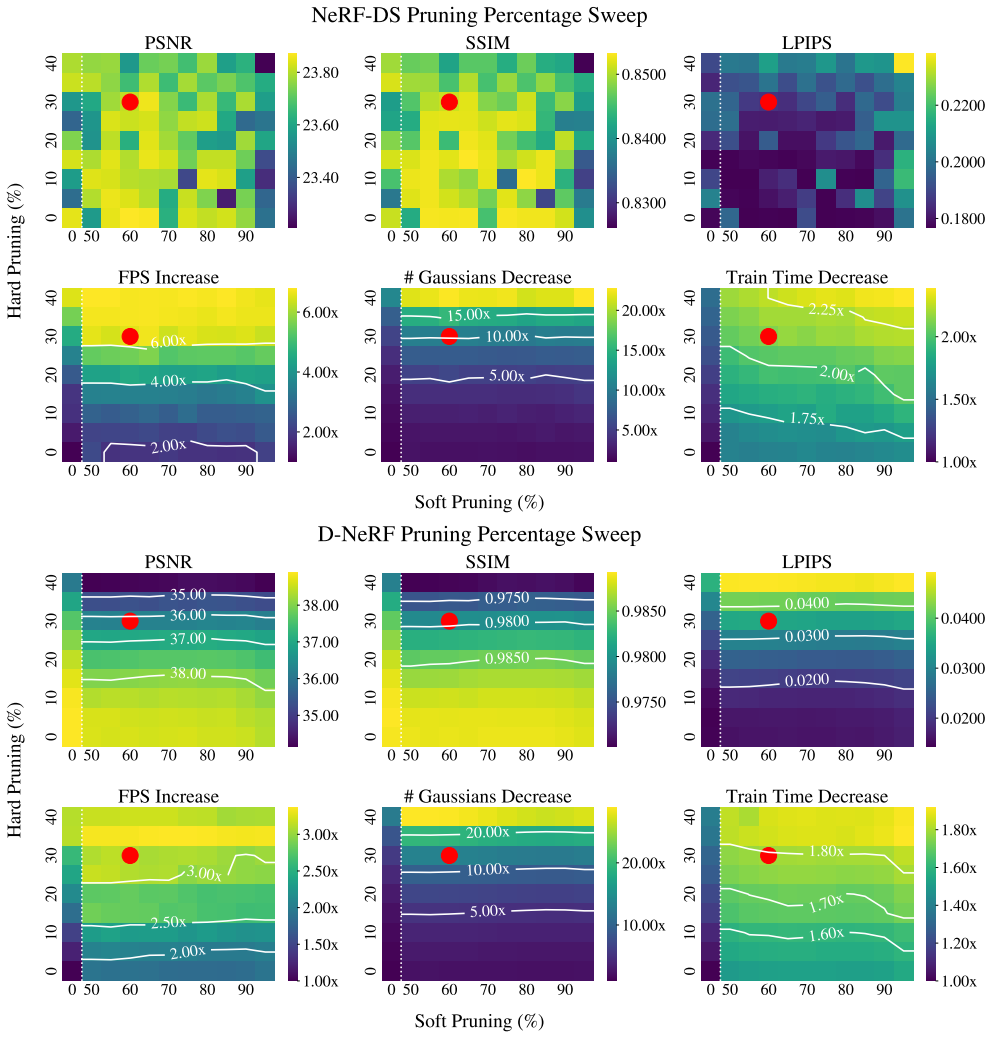
- [§4.1, Eq. (5)-(6); §5.1, Figure 5] The score in Eq. (6) is called 'second-order sensitivity' but is actually the squared image-space gradient after dropping the residual Hessian term; this is a first-order heuristic inherited from static pruning methods such as PUP and Speedy-Splat. That is acceptable as a pruning criterion, but the terminology is misleading. More importantly, the pruning sweep in Figure 5 shows that on D-NeRF the PSNR varies by roughly 3 dB across pruning percentages, so 'minimal fidelity loss' is not a universal property of TSP; it depends on dataset and on the chosen soft/hard pruning schedule. The claims in Section 5.1 should be scoped accordingly.
- [§4.2.2, Eq. (11); §6; Table 12] GroupFlow replaces per-Gaussian deformation with a shared SE(3) transform per cluster, which assumes locally rigid motion. The paper's own Section 6 states that 'highly deformable regions may lose fidelity when the number of motion groups is limited.' This is borne out by Table 12, where the largest PSNR drops on D-NeRF occur on mutant and standup, the most deformable scenes. Since the abstract claims that the method 'preserving[s] superior image quality' without this caveat, the claim should be restricted to scenes that satisfy the local-rigidity assumption, or the paper should include a quantitative failure analysis of non-rigid motion.
minor comments (5)
- [Table 16] The header contains a typo: 'lemom' should be 'lemon'.
- [Table 10] The table rows are densely formatted with values concatenated without spaces, making them difficult to read; please reformat the table for clarity.
- [Appendix A.4] The text says 'We adopt the same beta=0.1 and tau=20,000 as DeformableGS [53]'; DeformableGS does not use TSS, so this attribution is confusing and should be rephrased.
- [§5.1, paragraph 1] The sentence 'Applying TSP alone accelerates rendering by 6.38x... while maintaining the image quality of DeformableGS' is contradicted by the D-NeRF results in Table 8, where TSP alone drops PSNR from 38.92 to 36.19; the sentence should be scoped to NeRF-DS or the MonoDyGauBench protocol.
- [Table 7 and Table 2] In Table 7, the DeformableGS Train Time is marked with an asterisk without a corresponding footnote; please clarify whether this value was measured under a different protocol from the other baselines.
Circularity Check
No significant circularity: speedups and quality are externally benchmarked; self-citations to Speedy-Splat/PUP are building blocks, not forced reductions.
full rationale
The paper's derivation chain is self-contained against external benchmarks and no core prediction reduces by construction to a fitted value. TSP is defined by the gradient-based sensitivity score in Eqs. (5)-(6), an algebraic approximation of a Hessian importance heuristic borrowed from published pruning work; the score is not defined in terms of the later PSNR/SSIM/FPS numbers. TSS (Eq. 7) adds annealed timestamp noise, and GroupFlow (Eqs. 9-12) clusters trajectories and fits shared SE(3) transforms via Umeyama alignment. These are compression/distillation operations, and the reported speedups are measured frame rates rather than restatements of primitive-count reductions. The main self-citations are to Speedy-Splat [14] and PUP 3D-GS [15], both from overlapping authors; the paper says it is 'Building on the gradient-based pruning method of Speedy-Splat [14]' but also cites external gradient-sensitivity analyses [18, 48], so the load-bearing premise is not a self-citation chain. Section 6 and Appendix A.8 explicitly acknowledge fidelity loss under extreme pruning and limited group counts, and Appendix A.2 Table 8 shows a 3.85 dB PSNR drop against DeformableGS on D-NeRF in the authors' own codebase while the MonoDyGauBench baseline is itself about 1.8 dB weaker there; this is an evaluation-protocol/fidelity concern, not circularity. Appendix A.4's statement 'We adopt the same β=0.1 and τ=20,000 as DeformableGS [53]' is an unsupported attribution since DeformableGS does not define TSS hyperparameters, but it affects hyperparameter provenance, not the derivation. Overall, only minor non-load-bearing self-citations are present, so a score of 2 is appropriate.
Assumptions & free parameters
free parameters (9)
- soft pruning percentage (60%) =
60% per pruning step during densification
- hard pruning percentage (30%) =
30% after densification
- TSS perturbation magnitude beta =
0.1
- TSS annealing period tau =
20,000 iterations
- GroupFlow group count J =
2048
- trajectory similarity weighting lambda_r =
0.5
- per-group sampling cap Nmax =
100
- TSP pruning start (iteration 6000) and interval (3000) =
6000, every 3000 iterations
- GroupFlow initialization at iteration 15000 =
15000
assumptions (3)
- domain assumption The squared gradient approximation in Eq. (6) is valid because the residual term (I - I_gt) times the second derivative diminishes as training converges.
- domain assumption Most real dynamic scenes are locally rigid, so J=2048 SE(3) transforms adequately replace the neural motion field.
- domain assumption MonoDyGauBench's baseline numbers and the DeformableGS implementation are correct and comparable.
Cite this review
Pith. "Pith review of SpeeDe3DGS: Speedy Deformable 3D Gaussian Splatting with Temporal Pruning and Motion Grouping." pith.science (2026). https://pith.science/paper/3LTBF6OO
@misc{pith2026250607917,
  author       = {Pith},
  title        = {Pith review of: SpeeDe3DGS: Speedy Deformable 3D Gaussian Splatting with Temporal Pruning and Motion Grouping},
  year         = {2026},
  howpublished = {\url{https://pith.science/paper/3LTBF6OO}},
  note         = {Machine review of arXiv:2506.07917}
}
abstract
Dynamic extensions of 3D Gaussian Splatting (3DGS) achieve high-quality reconstructions through neural motion fields, but per-Gaussian neural inference makes these models computationally expensive. Building on DeformableGS, we introduce Speedy Deformable 3D Gaussian Splatting (SpeeDe3DGS), which bridges this efficiency-fidelity gap through three complementary modules: Temporal Sensitivity Pruning (TSP) removes low-impact Gaussians via temporally aggregated sensitivity analysis, Temporal Sensitivity Sampling (TSS) perturbs timestamps to suppress floaters and improve temporal coherence, and GroupFlow distills the learned deformation field into shared SE(3) transformations for efficient groupwise motion. On the 50 dynamic scenes in MonoDyGauBench, integrating TSP and TSS into DeformableGS accelerates rendering by 6.78$\times$ on average while maintaining neural-field fidelity and using 10$\times$ fewer primitives. Adding GroupFlow culminates in 13.71$\times$ faster rendering and 2.53$\times$ shorter training, surpassing all baselines in speed while preserving superior image quality.
Figures


Figures from the paper (3 more)


Forward citations
Cited by 1 Pith paper
-
Does it matter which Gaussians you pick in 4D Gaussian streaming?
A reinforcement-learned plug-in sampler can match or beat IGS@8192 quality on N3DV and MeetingRoom using as few as 256 anchors while reducing per-frame time.
Reference graph
Works this paper leans on
-
[1]
Muhammad Salman Ali, Maryam Qamar, Sung-Ho Bae, and Enzo Tartaglione. Trimming the fat: Efficient compres- sion of 3d gaussian splats through pruning.arXiv preprint arXiv:2406.18214, 2024. 2
arXiv 2024
-
[2]
Elmgs: Enhancing memory and computation scalability through compression for 3d gaussian splatting
Muhammad Salman Ali, Sung-Ho Bae, and Enzo Tartaglione. Elmgs: Enhancing memory and computation scalability through compression for 3d gaussian splatting. In2025 IEEE/CVF Winter Conference on Applications of Computer Vision (WACV), pages 2591–2600. IEEE, 2025. 2
work page 2025
-
[3]
Hexplane: A fast representation for dynamic scenes
Ang Cao and Justin Johnson. Hexplane: A fast representation for dynamic scenes. InProceedings of the IEEE/CVF Con- ference on Computer Vision and Pattern Recognition, pages 130–141, 2023. 2, 4
work page 2023
-
[4]
Neural radiance flow for 4d view synthesis and video processing
Yilun Du, Yinan Zhang, Hong-Xing Yu, Joshua B Tenenbaum, and Jiajun Wu. Neural radiance flow for 4d view synthesis and video processing. InProceedings of the IEEE/CVF Interna- tional Conference on Computer Vision, pages 14324–14334,
-
[5]
Lightgaussian: Unbounded 3d gaus- sian compression with 15x reduction and 200+ fps.Advances in neural information processing systems, 37:140138–140158,
Zhiwen Fan, Kevin Wang, Kairun Wen, Zehao Zhu, Dejia Xu, Zhangyang Wang, et al. Lightgaussian: Unbounded 3d gaus- sian compression with 15x reduction and 200+ fps.Advances in neural information processing systems, 37:140138–140158,
-
[6]
Mini-splatting: Representing scenes with a constrained number of gaussians
Guangchi Fang and Bing Wang. Mini-splatting: Representing scenes with a constrained number of gaussians. InEuropean Conference on Computer Vision, pages 165–181. Springer,
-
[7]
Fast dynamic radiance fields with time-aware neural voxels
Jiemin Fang, Taoran Yi, Xinggang Wang, Lingxi Xie, Xi- aopeng Zhang, Wenyu Liu, Matthias Nießner, and Qi Tian. Fast dynamic radiance fields with time-aware neural voxels. InSIGGRAPH Asia 2022 Conference Papers, 2022. 2
2022
-
[8]
K-planes: Explicit radiance fields in space, time, and appearance
Sara Fridovich-Keil, Giacomo Meanti, Frederik Rahbæk War- burg, Benjamin Recht, and Angjoo Kanazawa. K-planes: Explicit radiance fields in space, time, and appearance. In Proceedings of the IEEE/CVF Conference on Computer Vi- sion and Pattern Recognition, pages 12479–12488, 2023. 2
work page 2023
Show all 59 references
-
[9]
Dynamic view synthesis from dynamic monocular video
Chen Gao, Ayush Saraf, Johannes Kopf, and Jia-Bin Huang. Dynamic view synthesis from dynamic monocular video. In Proceedings of the IEEE/CVF International Conference on Computer Vision, 2021. 2
2021
-
[10]
Monocular dynamic view synthesis: A reality check
Hang Gao, Ruilong Li, Shubham Tulsiani, Bryan Russell, and Angjoo Kanazawa. Monocular dynamic view synthesis: A reality check. InNeurIPS, 2022. 12, 13, 17
2022
-
[11]
Strivec: Sparse tri-vector radiance fields
Quankai Gao, Qiangeng Xu, Hao Su, Ulrich Neumann, and Zexiang Xu. Strivec: Sparse tri-vector radiance fields. In Proceedings of the IEEE/CVF International Conference on Computer Vision, pages 17569–17579, 2023. 2
2023
-
[12]
Ea- gles: Efficient accelerated 3d gaussians with lightweight en- codings
Sharath Girish, Kamal Gupta, and Abhinav Shrivastava. Ea- gles: Efficient accelerated 3d gaussians with lightweight en- codings. InEuropean Conference on Computer Vision, pages 54–71. Springer, 2024. 2
2024
-
[13]
Neural deformable voxel grid for fast optimization of dynamic view synthesis
Xiang Guo, Guanying Chen, Yuchao Dai, Xiaoqing Ye, Jiadai Sun, Xiao Tan, and Errui Ding. Neural deformable voxel grid for fast optimization of dynamic view synthesis. In Proceedings of the Asian Conference on Computer Vision, pages 3757–3775, 2022. 2
2022
-
[14]
Speedy-splat: Fast 3d gaus- sian splatting with sparse pixels and sparse primitives
Alex Hanson, Allen Tu, Geng Lin, Vasu Singla, Matthias Zwicker, and Tom Goldstein. Speedy-splat: Fast 3d gaus- sian splatting with sparse pixels and sparse primitives. In Proceedings of the Computer Vision and Pattern Recognition Conference (CVPR), pages 21537–21546, 2025. 2, 4
2025
-
[15]
Pup 3d-gs: Principled uncertainty pruning for 3d gaussian splatting
Alex Hanson, Allen Tu, Vasu Singla, Mayuka Jayawardhana, Matthias Zwicker, and Tom Goldstein. Pup 3d-gs: Principled uncertainty pruning for 3d gaussian splatting. InProceedings of the Computer Vision and Pattern Recognition Conference (CVPR), pages 5949–5958, 2025. 2, 4
2025
-
[16]
Sc-gs: Sparse-controlled gaus- sian splatting for editable dynamic scenes
Yi-Hua Huang, Yang-Tian Sun, Ziyi Yang, Xiaoyang Lyu, Yan-Pei Cao, and Xiaojuan Qi. Sc-gs: Sparse-controlled gaus- sian splatting for editable dynamic scenes. InProceedings of the IEEE/CVF conference on computer vision and pattern recognition, pages 4220–4230, 2024. 2
2024
-
[17]
Temporally compressed 3d gaussian splatting for dynamic scenes, 2024
Saqib Javed, Ahmad Jarrar Khan, Corentin Dumery, Chen Zhao, and Mathieu Salzmann. Temporally compressed 3d gaussian splatting for dynamic scenes, 2024. 2
2024
-
[18]
Fisherrf: Active view selection and uncertainty quantification for radiance fields using fisher information.arXiv, 2023
Wen Jiang, Boshu Lei, and Kostas Daniilidis. Fisherrf: Active view selection and uncertainty quantification for radiance fields using fisher information.arXiv, 2023. 4
2023
-
[19]
A compact dynamic 3d gaussian representation for real-time dy- namic view synthesis
Kai Katsumata, Duc Minh V o, and Hideki Nakayama. A compact dynamic 3d gaussian representation for real-time dy- namic view synthesis. InEuropean Conference on Computer Vision, pages 394–412. Springer, 2024. 2, 4, 8, 12, 13
2024
-
[20]
3d gaussian splatting for real-time radiance field rendering.ACM Transactions on Graphics, 42(4), 2023
Bernhard Kerbl, Georgios Kopanas, Thomas Leimkühler, and George Drettakis. 3d gaussian splatting for real-time radiance field rendering.ACM Transactions on Graphics, 42(4), 2023. 1, 2, 3
2023
-
[21]
Dynmf: Neural motion factorization for real-time dynamic view syn- thesis with 3d gaussian splatting
Agelos Kratimenos, Jiahui Lei, and Kostas Daniilidis. Dynmf: Neural motion factorization for real-time dynamic view syn- thesis with 3d gaussian splatting. InEuropean Conference on Computer Vision, pages 252–269. Springer, 2024. 2
2024
-
[22]
Compact 3d gaussian representation for radiance field
Joo Chan Lee, Daniel Rho, Xiangyu Sun, Jong Hwan Ko, and Eunbyung Park. Compact 3d gaussian representation for radiance field. InProceedings of the IEEE/CVF Conference on Computer Vision and Pattern Recognition, pages 21719– 21728, 2024. 2
2024
-
[23]
Mosca: Dynamic gaussian fusion 9 from casual videos via 4d motion scaffolds.arXiv preprint arXiv:2405.17421, 2024
Jiahui Lei, Yijia Weng, Adam Harley, Leonidas Guibas, and Kostas Daniilidis. Mosca: Dynamic gaussian fusion 9 from casual videos via 4d motion scaffolds.arXiv preprint arXiv:2405.17421, 2024. 2
2024 arXiv
-
[24]
Spacetime gaus- sian feature splatting for real-time dynamic view synthesis
Zhan Li, Zhang Chen, Zhong Li, and Yi Xu. Spacetime gaus- sian feature splatting for real-time dynamic view synthesis. InProceedings of the IEEE/CVF Conference on Computer Vision and Pattern Recognition, pages 8508–8520, 2024. 2, 4, 8, 12, 13
2024
-
[25]
Monocular dynamic gaussian splatting: Fast, brittle, and scene complexity rules.Transactions on Machine Learn- ing Research, 2025
Yiqing Liang, Mikhail Okunev, Mikaela Angelina Uy, Run- feng Li, Leonidas Guibas, James Tompkin, and Adam W Harley. Monocular dynamic gaussian splatting: Fast, brittle, and scene complexity rules.Transactions on Machine Learn- ing Research, 2025. Survey Certification. 1, 2, 4,...
2025
-
[26]
Rtgs: Enabling real- time gaussian splatting on mobile devices using efficiency- guided pruning and foveated rendering.arXiv preprint arXiv:2407.00435, 2024
Weikai Lin, Yu Feng, and Yuhao Zhu. Rtgs: Enabling real- time gaussian splatting on mobile devices using efficiency- guided pruning and foveated rendering.arXiv preprint arXiv:2407.00435, 2024. 2, 8
2024 arXiv
-
[27]
Gaussian- flow: 4d reconstruction with dynamic 3d gaussian particle
Youtian Lin, Zuozhuo Dai, Siyu Zhu, and Yao Yao. Gaussian- flow: 4d reconstruction with dynamic 3d gaussian particle. InProceedings of the IEEE/CVF Conference on Computer Vision and Pattern Recognition, pages 21136–21145, 2024. 2
2024
-
[28]
Lgs: A light-weight 4d gaussian splatting for efficient surgical scene reconstruction
Hengyu Liu, Yifan Liu, Chenxin Li, Wuyang Li, and Yixuan Yuan. Lgs: A light-weight 4d gaussian splatting for efficient surgical scene reconstruction. InInternational Conference on Medical Image Computing and Computer-Assisted Interven- tion, pages 660–670. Springer, 2024. 2
2024
-
[29]
Devrf: Fast deformable voxel radiance fields for dynamic scenes.Advances in Neural Information Processing Systems, 35:36762–36775, 2022
Jia-Wei Liu, Yan-Pei Cao, Weijia Mao, Wenqiao Zhang, David Junhao Zhang, Jussi Keppo, Ying Shan, Xiaohu Qie, and Mike Zheng Shou. Devrf: Fast deformable voxel radiance fields for dynamic scenes.Advances in Neural Information Processing Systems, 35:36762–36775, 2022. 2
2022
-
[30]
Compgs: Efficient 3d scene representation via compressed gaussian splatting
Xiangrui Liu, Xinju Wu, Pingping Zhang, Shiqi Wang, Zhu Li, and Sam Kwong. Compgs: Efficient 3d scene representation via compressed gaussian splatting. InProceedings of the 32nd ACM International Conference on Multimedia, pages 2936–2944, 2024. 2
2024
-
[31]
Dynamic 3d gaussians: Tracking by persistent dynamic view synthesis
Jonathon Luiten, Georgios Kopanas, Bastian Leibe, and Deva Ramanan. Dynamic 3d gaussians: Tracking by persistent dynamic view synthesis. In3DV, 2024. 2
2024
-
[32]
Resfields: Residual neural fields for spatiotempo- ral signals.International Conference on Learning Represen- tations, 2024
Marko Mihajlovic, Sergey Prokudin, Marc Pollefeys, and Siyu Tang. Resfields: Residual neural fields for spatiotempo- ral signals.International Conference on Learning Represen- tations, 2024. 2
2024
-
[33]
Nerf: Representing scenes as neural radiance fields for view syn- thesis.Communications of the ACM, 65(1):99–106, 2021
Ben Mildenhall, Pratul P Srinivasan, Matthew Tancik, Jonathan T Barron, Ravi Ramamoorthi, and Ren Ng. Nerf: Representing scenes as neural radiance fields for view syn- thesis.Communications of the ACM, 65(1):99–106, 2021. 1, 2
2021
-
[34]
Radsplat: Radiance field-informed gaussian splat- ting for robust real-time rendering with 900+ fps
Michael Niemeyer, Fabian Manhardt, Marie-Julie Rakoto- saona, Michael Oechsle, Daniel Duckworth, Rama Gosula, Keisuke Tateno, John Bates, Dominik Kaeser, and Federico Tombari. Radsplat: Radiance field-informed gaussian splat- ting for robust real-time rendering with 900+ fps. ...
2025
-
[35]
Reducing the mem- ory footprint of 3d gaussian splatting.Proceedings of the ACM on Computer Graphics and Interactive Techniques, 7 (1):1–17, 2024
Panagiotis Papantonakis, Georgios Kopanas, Bernhard Kerbl, Alexandre Lanvin, and George Drettakis. Reducing the mem- ory footprint of 3d gaussian splatting.Proceedings of the ACM on Computer Graphics and Interactive Techniques, 7 (1):1–17, 2024. 2
2024
-
[36]
Nerfies: Deformable neural radiance fields
Keunhong Park, Utkarsh Sinha, Jonathan T Barron, Sofien Bouaziz, Dan B Goldman, Steven M Seitz, and Ricardo Martin-Brualla. Nerfies: Deformable neural radiance fields. InProceedings of the IEEE/CVF international conference on computer vision, pages 5865–5874, 2021. 2, 12, 13, 17
2021
-
[37]
Barron, Sofien Bouaziz, Dan B Goldman, Ricardo Martin- Brualla, and Steven M
Keunhong Park, Utkarsh Sinha, Peter Hedman, Jonathan T. Barron, Sofien Bouaziz, Dan B Goldman, Ricardo Martin- Brualla, and Steven M. Seitz. Hypernerf: A higher- dimensional representation for topologically varying neural radiance fields.ACM Trans. Graph., 40(6), 2021. 1, 2, 7...
2021
-
[38]
Representing volumetric videos as dynamic mlp maps
Sida Peng, Yunzhi Yan, Qing Shuai, Hujun Bao, and Xiaowei Zhou. Representing volumetric videos as dynamic mlp maps. InProceedings of the IEEE/CVF Conference on Computer Vision and Pattern Recognition, pages 4252–4262, 2023. 2
2023
-
[39]
D-NeRF: Neural Radiance Fields for Dynamic Scenes
Albert Pumarola, Enric Corona, Gerard Pons-Moll, and Francesc Moreno-Noguer. D-NeRF: Neural Radiance Fields for Dynamic Scenes. InProceedings of the IEEE/CVF Con- ference on Computer Vision and Pattern Recognition, 2020. 2, 3, 7, 12, 13, 14, 15, 16
2020
-
[40]
Spotlesssplats: Ignoring distractors in 3d gaussian splatting.ACM Transactions on Graphics, 44 (2):1–11, 2025
Sara Sabour, Lily Goli, George Kopanas, Mark Matthews, Dmitry Lagun, Leonidas Guibas, Alec Jacobson, David Fleet, and Andrea Tagliasacchi. Spotlesssplats: Ignoring distractors in 3d gaussian splatting.ACM Transactions on Graphics, 44 (2):1–11, 2025. 2
2025
-
[41]
As-rigid-as-possible surface modeling
Olga Sorkine and Marc Alexa. As-rigid-as-possible surface modeling. InSymposium on Geometry processing, pages 109–116. Citeseer, 2007. 6
2007
-
[42]
Least-squares estimation of transformation parameters between two point patterns.IEEE Transactions on Pattern Analysis & Machine Intelligence, 13(04):376–380,
Shinji Umeyama. Least-squares estimation of transformation parameters between two point patterns.IEEE Transactions on Pattern Analysis & Machine Intelligence, 13(04):376–380,
-
[43]
Superpoint gaussian splatting for real-time high-fidelity dynamic scene reconstruc- tion
Diwen Wan, Ruijie Lu, and Gang Zeng. Superpoint gaussian splatting for real-time high-fidelity dynamic scene reconstruc- tion. InProceedings of the 41st International Conference on Machine Learning, pages 49957–49972, 2024. 2
2024
-
[44]
Neural trajectory fields for dynamic novel view synthesis
Chaoyang Wang, Ben Eckart, Simon Lucey, and Orazio Gallo. Neural trajectory fields for dynamic novel view synthesis. InProceedings of the IEEE/CVF Conference on Computer Vision and Pattern Recognition, 2021. 2
2021
-
[45]
Masked space-time hash encoding for efficient dynamic scene reconstruction.Advances in neural informa- tion processing systems, 2023
Feng Wang, Zilong Chen, Guokang Wang, Yafei Song, and Huaping Liu. Masked space-time hash encoding for efficient dynamic scene reconstruction.Advances in neural informa- tion processing systems, 2023. 2
2023
-
[46]
Shape of mo- tion: 4d reconstruction from a single video
Qianqian Wang, Vickie Ye, Hang Gao, Weijia Zeng, Jake Austin, Zhengqi Li, and Angjoo Kanazawa. Shape of mo- tion: 4d reconstruction from a single video. InInternational Conference on Computer Vision (ICCV), 2025. 2
2025
-
[47]
Degauss: Dynamic-static decomposition with gaussian splatting for distractor-free 3d reconstruction
Rui Wang, Quentin Lohmeyer, Mirko Meboldt, and Siyu Tang. Degauss: Dynamic-static decomposition with gaussian splatting for distractor-free 3d reconstruction. InProceed- ings of the IEEE/CVF International Conference on Computer Vision, pages 6294–6303, 2025. 2
2025
-
[48]
Pop-gs: Next best view in 3d-gaussian splatting with p-optimality
Joey Wilson, Marcelino Almeida, Sachit Mahajan, Martin Labrie, Maani Ghaffari, Omid Ghasemalizadeh, Min Sun, 10 Cheng-Hao Kuo, and Arnab Sen. Pop-gs: Next best view in 3d-gaussian splatting with p-optimality. In2025 IEEE/CVF Conference on Computer Vision and Pattern Recognitio...
2025
-
[49]
4d gaussian splatting for real-time dynamic scene rendering
Guanjun Wu, Taoran Yi, Jiemin Fang, Lingxi Xie, Xiaopeng Zhang, Wei Wei, Wenyu Liu, Qi Tian, and Xinggang Wang. 4d gaussian splatting for real-time dynamic scene rendering. InProceedings of the IEEE/CVF Conference on Computer Vision and Pattern Recognition (CVPR), pages 20310–20320,
-
[50]
Swift4d: Adaptive divide-and-conquer gaussian splatting for compact and efficient reconstruction of dynamic scene.arXiv preprint arXiv:2503.12307, 2025
Jiahao Wu, Rui Peng, Zhiyan Wang, Lu Xiao, Luyang Tang, Jinbo Yan, Kaiqiang Xiong, and Ronggang Wang. Swift4d: Adaptive divide-and-conquer gaussian splatting for compact and efficient reconstruction of dynamic scene.arXiv preprint arXiv:2503.12307, 2025. 2
2025 arXiv
-
[51]
Das3r: Dynamics-aware gaussian splatting for static scene reconstruction.arXiv preprint arxiv:2412.19584, 2024
Kai Xu, Tze Ho Elden Tse, Jizong Peng, and Angela Yao. Das3r: Dynamics-aware gaussian splatting for static scene reconstruction.arXiv preprint arxiv:2412.19584, 2024. 2
2024 arXiv
-
[52]
Nerf-ds: Neural radiance fields for dynamic specular objects
Zhiwen Yan, Chen Li, and Gim Hee Lee. Nerf-ds: Neural radiance fields for dynamic specular objects. InProceedings of the IEEE/CVF Conference on Computer Vision and Pattern Recognition, pages 8285–8295, 2023. 3, 5, 7, 12, 13, 14, 15, 16
2023
-
[53]
Deformable 3d gaussians for high- fidelity monocular dynamic scene reconstruction
Ziyi Yang, Xinyu Gao, Wen Zhou, Shaohui Jiao, Yuqing Zhang, and Xiaogang Jin. Deformable 3d gaussians for high- fidelity monocular dynamic scene reconstruction. InProceed- ings of the IEEE/CVF conference on computer vision and pattern recognition, pages 20331–20341, 2024. 1, 2...
2024
-
[54]
Real-time photorealistic dynamic scene representation and rendering with 4d gaussian splatting
Zeyu Yang, Hongye Yang, Zijie Pan, and Li Zhang. Real-time photorealistic dynamic scene representation and rendering with 4d gaussian splatting. InInternational Conference on Learning Representations (ICLR), 2024. 2, 4, 8, 12, 13
2024
-
[55]
Mega: Memory-efficient 4d gaus- sian splatting for dynamic scenes
Xinjie Zhang, Zhening Liu, Yifan Zhang, Xingtong Ge, Dailan He, Tongda Xu, Yan Wang, Zehong Lin, Shuicheng Yan, and Jun Zhang. Mega: Memory-efficient 4d gaus- sian splatting for dynamic scenes. InProceedings of the IEEE/CVF International Conference on Computer Vision, pages 27...
2025
-
[56]
Lp-3dgs: Learning to prune 3d gaussian splatting
Zhaoliang Zhang, Tianchen Song, Yongjae Lee, Li Yang, Cheng Peng, Rama Chellappa, and Deliang Fan. Lp-3dgs: Learning to prune 3d gaussian splatting. InAdvances in Neu- ral Information Processing Systems, pages 122434–122457. Curran Associates, Inc., 2024. 2
2024
-
[57]
Hugs: Holistic urban 3d scene understanding via gaussian splatting
Hongyu Zhou, Jiahao Shao, Lu Xu, Dongfeng Bai, Weichao Qiu, Bingbing Liu, Yue Wang, Andreas Geiger, and Yiyi Liao. Hugs: Holistic urban 3d scene understanding via gaussian splatting. InProceedings of the IEEE/CVF Conference on Computer Vision and Pattern Recognition (CVPR), pa...
2024
-
[58]
Ewa splatting.IEEE Transactions on Visual- ization and Computer Graphics, 8(3):223–238, 2002
Matthias Zwicker, Hanspeter Pfister, Jeroen Van Baar, and Markus Gross. Ewa splatting.IEEE Transactions on Visual- ization and Computer Graphics, 8(3):223–238, 2002. 3 11 A. Appendix A.1. Per-Dataset Metrics for MonoDyGauBench We analyze results on Monocular Dynamic Gaussian S...
2002
-
[2024]
1, 2, 4, 7, 8, 12, 13
Reviewed August 7, 2026 · model on record in the stance chip above.
Discussion (0). Sign in to comment.