REVIEW 2 major objections 6 minor 35 references
From Local Updates to Global Balance: A Framework for Distributed Matrix Scaling
T0 review · 2 major / 6 minor · reviewed 2026-08-07 · deepseek-v4-flash
Pith's one-line read Under any row/column update order, local normalization drives a nonnegative matrix with support to a unique doubly stochastic limit determined only by its positively supported entries.
desk verdict Plausible and useful generalization of Sinkhorn's algorithm, but the proof of the key limit theorem relies on a false general result and needs repair before it can be trusted. read the letter →
The pith
A machine-rendered reading of the paper's core claim, the machinery that carries it, and where it could break.
The reading
What carries the argument
The key objects are $K$-diagonals and the $K$-positive supported part of a matrix: a $K$-diagonal selects entries so that every row or column whose index lies in the set $K$ appears at most once, and $W_0^{K_0}$ keeps exactly the entries of $W_0$ that lie on some $K_0$-positive diagonal. The main mechanism is an extended Birkhoff theorem stating that a matrix whose selected rows and columns are balanced is a convex combination of $K$-permutation matrices. Around this, the paper shows that the distance $d_B = d_R + d_C$ from the matrix to the row- and column-stochastic sets is nonincreasing under every single normalization and that the product of normalization factors stays bounded whenever a positive $K_0$-diagonal exists. These ingredients force the normalized entries corresponding to $K_0$ to converge to zero and pin every limit to be diagonally equivalent to $W_0^{K_0}$.
What would settle it
Find or construct a nonnegative matrix $W_0$ with support and a normalization sequence whose infinitely visited rows and columns form a set $K_0$ for which the positive supported part $W_0^{K_0}$ has a positive entry lying on no $K_0$-positive diagonal; if two different subsequences of the normalized matrices then converge to limits that are not diagonal rescalings of each other, the characterization in Theorem 3.7 fails. A small numerical search over $3 \times 3$ zero-one patterns with one row and one column visited finitely often would settle the question directly.
Extended reading notes
Core claim
The central technical claim is a characterization theorem for the limit of any row/column normalization sequence. Call $K_0$ the set of row/column indices that are normalized infinitely often; the paper proves that the relevant convergence holds exactly when $W_0$ has a positive $K_0$-diagonal. Under that condition every subsequential limit is diagonally equivalent to the $K_0$-positive supported part of $W_0$, and when $K_0$ contains all rows and columns this forces a unique doubly stochastic limit that depends only on $W_0^+$. The proof rests on an extension of Birkhoff's theorem to submatrices restricted by $K_0$, together with a diagonal-equivalence argument adapted from Sinkhorn and Knopp. This is the paper's answer to the question left open by the classical alternating algorithm: even with arbitrary order and locality of updates, the balanced state is determined by the support pattern of the initial weights alone.
Load-bearing premise
The proof assumes that the submatrix of entries that can lie on positive diagonals is fully supported, meaning every positive entry sits on some positive diagonal, but the paper never verifies this for the submatrix built from the infinitely updated rows and columns.
Editorial extensions
If this is right
- A decentralized random walk on a strongly connected directed graph, in which one agent at each step normalizes the row and column of its current vertex, converges almost surely to a doubly stochastic transition matrix, so the long-run fraction of visits to every vertex is $1/N$.
- The construction extends to finitely many agents, so global balance is achieved without any agent holding global information or memory about the path.
- The classical alternating Sinkhorn algorithm is a special case of this framework, and the new theorem gives a complete description of the possible limits even when an exact doubly stochastic scaling does not exist.
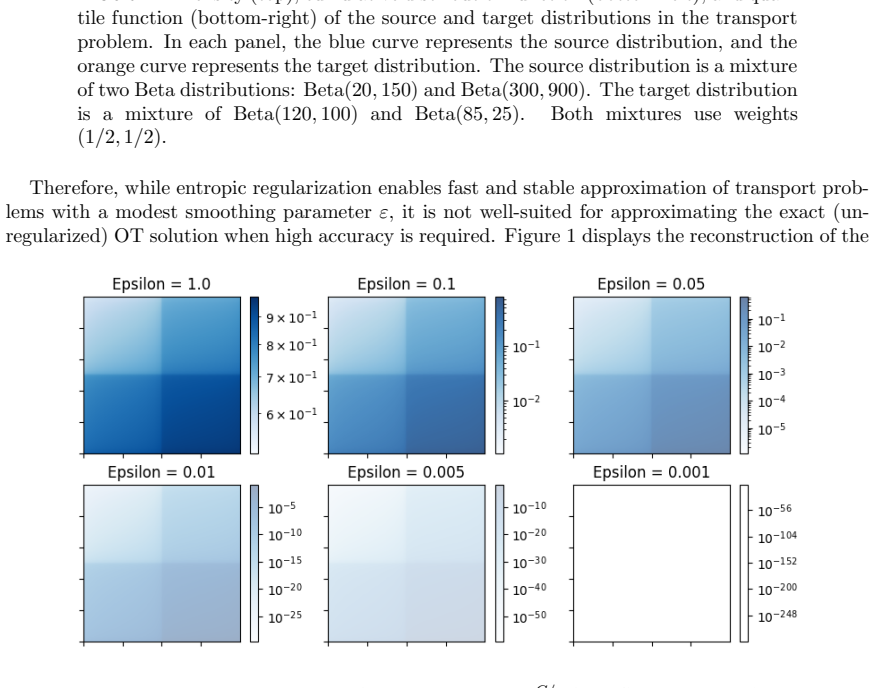
- In entropically regularized optimal transport, as $\varepsilon \to 0$ the scaled cost matrix $\xi = e^{-C/\varepsilon}$ loses support below a threshold, so the iterative scaling cannot converge and the exact unregularized optimal transport solution is not reachable this way.
Reading between the lines
- The paper leaves implicit that the same convergence should hold for asynchronous or randomized update orders, provided each coordinate is revisited infinitely often with probability one; the deterministic $K_0$ formulation is ready-made for Borel-Cantelli arguments.
- The proof's excursion argument suggests a quantitative stopping rule: because the distance $d_B$ drops by a fixed amount on each bad excursion between two visits to a coordinate, the number of revisits controls the convergence rate, which could become a local criterion for deciding when to stop updating.
- A natural testable extension is to time-varying graphs whose edge weights change while the walker runs; nothing in the proof uses stationarity of $W_0$ except through its initial support, so the limit may then track the persistence of the positive supported part rather than a fixed matrix.
- The optimal transport underflow phenomenon could be mitigated by restarting the scaling on the positive supported part of $\xi$ after entries fall below machine precision, precisely because the limit depends only on that supported part; this algorithmic suggestion is not pursued in the paper.
Editorial analysis
A structured set of objections, weighed in public.
Referee Report
Summary. The paper studies a class of matrix scaling algorithms in which, at each step, a single row or column of a nonnegative matrix is normalized, with no constraint on the order of the updates. The authors introduce a distance dB measuring deviation from double stochasticity, prove that every local normalization decreases it, and state a Birkhoff-type theorem for submatrices as well as a characterization of convergence in terms of the set K0 of coordinates updated infinitely often. The advertised main result is Corollary 3: under the hypothesis that every row and column is normalized infinitely often and W0 has support, the sequence (Wt) converges to a doubly stochastic limit that depends only on the positive supported part W+0 of W0. Applications are given to decentralized random walks on directed graphs and to entropic optimal transport.
Significance. If the main result can be proved rigorously, it is a substantial and elegant generalization of classical Sinkhorn-Knopp convergence: the asymptotic limit is independent of the order of local updates and is determined only by the support pattern of the initial matrix. The decentralized random walk application is natural and would be a genuine contribution to distributed balancing algorithms. The paper is self-contained and does not fit free parameters; the arguments are built on standard tools such as Birkhoff's theorem and the Knopp-Sinkhorn theorem. However, the proof of the central theorem contains a serious gap, and one of the stated general theorems is false as written. The value of the contribution can therefore be assessed only after the proof is repaired.
major comments (2)
- [Section 3.1, Theorem 3.7] Theorem 3.7 is false as stated. The proof applies Lemma 3.8 to the matrix W^{K0}_0, but Lemma 3.8 requires that the matrix has total support, and the paper never establishes that W^{K0}_0 has total support. Definition 3.3 does not imply it. For example, take N=2, K0={(r,1)}, and W0=[[1,1],[1,0]]. W0 has a positive K0-diagonal, and the sequence that only normalizes row 1 (so that K0 is exactly that set) converges to [[1/2,1/2],[1,0]]. This limit is not diagonally equivalent to W^{K0}_0 under either natural reading of Definition 3.3: if K0-diagonals may omit the index (r,1), then W^{K0}_0=W0, and if they must include it, W^{K0}_0 consists only of the first row of W0. In both cases W^{K0}_0 lacks total support and the claimed diagonal equivalence fails. Corollary 3 concerns the full-K0 case, where W^{K0}_0=W+0 and Remark 4 does give total support, so the central claim may be salvageable, but the proof must isolate that case and cannot rely on the false general theorem. The step "if (i0,j0) does not lie on any positive K0-diagonal then Ai0j0=0 by Theorem 3.3 and Theorem 3.4" is also not justified, since Theorem 3.3 does not by itself control entries whose row and column are both outside K0.
- [Lemma 3.6 and proof of Theorem 3.4] The proof of Lemma 3.6 is not valid as written for the case used in Theorem 3.4. The displayed inequality before the product estimate requires the integration interval [1,1+d] to lie within [1,H], i.e. H >= 1+d, but the hypothesis only gives d <= H. When H<1, the case "1 <= s <= H" is vacuous, and the inequality can be false for s>H. In Theorem 3.4 the lemma is applied with H=dB(W0), and dB(W0) can be smaller than 1. The lemma itself is plausible and can likely be proved by a different inequality of the form ln(1+d)-d <= -c d^2 for d in (-1+epsilon, H] with c>0, but the proof as written does not cover the relevant case.
minor comments (6)
- [Proposition 3.5] The quantities w0 and w0 are defined with nearly identical symbols, which makes the inequalities hard to read; one of them should be typeset with an underline or another distinguishing mark.
- [Proposition 3.5] In the definition of I0 the text writes "m=1,...,m" where the upper limit should be M; this typo makes the multiplicity counting in equation (9) difficult to follow.
- [Section 3.1, proof of Theorem 3.7] The sentence "We are not ready to give the proof of our theorem" should read "We are now ready to give the proof of our theorem."
- [Section 3.1, proof of Theorem 3.7] There is a reference to "Remark 3.3" that does not exist; the intended reference is likely Remark 6.
- [Throughout] The terms "bistochastic" and "double stochastic" should be uniformly replaced by "doubly stochastic," and "counternominal" should be "contrapositive."
- [Section 4.2] The discussion refers to Figure 2, but the text does not actually include or interpret the figure in enough detail to support the claim about the threshold epsilon_0; either add the figure or reduce the strength of the statement.
Circularity Check
No significant circularity: the derivation is self-contained and the cited supports are external classical results.
full rationale
The derivation chain is self-contained and does not reduce to its own inputs. The paper proves its main convergence statements from explicit operator definitions (row/column normalization maps), distance monotonicity, and external classical theorems — Birkhoff's theorem, Knopp-Sinkhorn's Lemma 3.8, and Knopp-Sinkhorn's uniqueness Theorem 3.9. None of these are authored by Aletti or Naldi, and none of them assume the paper's target result. There is no fitted parameter renamed as a prediction: the only inputs are the initial matrix W0 and the normalization schedule, and the claimed limit is derived, not imposed. The DRW application follows from Corollary 3 rather than being used to establish it, so no self-supporting application loop is present. The one substantive concern in the paper — Theorem 3.7 applies Lemma 3.8 to W^{K0}_0 without explicitly verifying total support — is a possible correctness gap in the proof, but it is not circularity: a missing hypothesis does not make the conclusion equivalent to an input by construction. No self-citation is load-bearing, no uniqueness theorem is imported from the authors' prior work, and no known result is merely renamed. Therefore the circularity score is 0.
Assumptions & free parameters
assumptions (5)
- standard math Birkhoff's theorem: every doubly stochastic matrix is a convex combination of permutation matrices.
- standard math Lemma 3.8 from Knopp and Sinkhorn [21], requiring total support.
- standard math Theorem 3.9 from Knopp and Sinkhorn on uniqueness of diagonally equivalent doubly stochastic matrices.
- domain assumption Initial matrix W0 has no null rows or columns.
- domain assumption The positive supported part W+0 is irreducible almost surely in the DRW application.
invented entities (2)
-
K-diagonal and K-permutation matrix
-
Decentralized Random Walk (DRW)
independent evidence
Cite this review
Pith. "Pith review of From Local Updates to Global Balance: A Framework for Distributed Matrix Scaling." pith.science (2026). https://pith.science/paper/4SQ4BBNO
@misc{pith2026250608035,
  author       = {Pith},
  title        = {Pith review of: From Local Updates to Global Balance: A Framework for Distributed Matrix Scaling},
  year         = {2026},
  howpublished = {\url{https://pith.science/paper/4SQ4BBNO}},
  note         = {Machine review of arXiv:2506.08035}
}
read the original abstract
This paper investigates matrix scaling processes in the context of local normalization algorithms and their convergence behavior. Starting from the classical Sinkhorn algorithm, the authors introduce a generalization where only a single row or column is normalized at each step, without restrictions on the update order. They extend Birkhoff's theorem to characterize the convergence properties of these algorithms, especially when the normalization sequence is arbitrary. A novel application is explored in the form of a Decentralized Random Walk (DRW) on directed graphs, where agents modify edge weights locally without global knowledge or memory. The paper shows that such local updates lead to convergence towards a doubly stochastic matrix, ensuring a uniform stationary distribution across graph vertices. These results not only deepen the theoretical understanding of matrix scaling but also open avenues for distributed and agent-based models in networks.
Figures

Reference graph
Works this paper leans on
-
[1]
H. Balakrishnan, I. Hwang, and C. Tomlin. Polynomial approximation algorithms for belief matrix maintenance in identity management. In Decision and Control, 2004. CDC. 43rd IEEE Conference on , volume 5, page 4874 –4879, 2004-12
work page 2004
-
[2]
R. B. Bapat. D1ad2 theorems for multidimensional matrices. Linear Algebra and its Applications, 48(0):437 –442, 1982
work page 1982
-
[3]
J.-D. Benamou, G. Carlier, M. Cuturi, L. Nenna, and G. Peyr´ e. Iterative bregman projections for regularized transportation problems. SIAM Journal on Scientific Computing , 37(2):A1111–A1138, 2015
work page 2015
- [4]
-
[5]
R. A. Brualdi, S. V. Parter, and H. Schneider. The diagonal equivalence of a nonnegative matrix to a stochastic matrix. Journal of Mathematical Analysis and Applications , 16(1):31 –50, 1966
work page 1966
- [6]
-
[7]
W. Deming and F. F. Stephan. On a least squares adjustment of a sampled frequency table when the expected marginal totals are known. Ann. Math. Statist , 11(4):427–444, 1940-12
work page 1940
-
[8]
S. E. Fienberg. An iterative procedure for estimation in contingency tables.The Annals of Mathematical Statistics, 41(3):907–917, 1970
work page 1970
Show all 35 references
-
[9]
R. Fortet. R´ esolution d’un syst` eme d’equations de m. schr¨ odinger.J. Math. Pure Appl , IX:83 –105, 1940
1940
-
[10]
Franklin and J
J. Franklin and J. Lorenz. On the scaling of multidimensional matrices. Linear Algebra and its Applications , page 114 – 115 0, 1989. Special Issue Dedicated to Alan J. Hoffman,
1989
-
[11]
Friedland
S. Friedland. On schr¨ odinger’s bridge problem, 2016. arXiv:1608.05862v1 [math-ph]
2016 arXiv
-
[12]
W. Gorman. Estimating trends in Leontief matrices: a note on Mr. Bacharach’s paper . Nuffield College, In, 1963
1963
-
[13]
L. Gurvits. Classical complexity and quantum entanglement. Journal of Computer and System Sciences , 69(3):448 –484, 2004. Special Issue on STOC
2004
-
[14]
M. Idel. A review of matrix scaling and sinkhorn’s normal form for matrices and positive maps, 2016
2016
-
[15]
Ireland and S
C. Ireland and S. Kullback. Contingency tables with given marginals. Biometrika, 55:179–189, 1968
1968
-
[16]
Ivanyos, Y
G. Ivanyos, Y. Qiao, and K. Subrahmanyam. Non-commutative edmonds’ problem and matrix semi-invariants,
-
[17]
E. T. Jaynes. Information theory and statistical mechanics. Physical review, 106(4):620, 1957
1957
-
[18]
Kalantari
B. Kalantari. A theorem of the alternative for multihomogeneous functions and its relationship to diagonal scaling of matrices. Linear Algebra and its Applications , 236(0):1 –24, 1996
1996
-
[19]
Kalantari
B. Kalantari. On the complexity of general matrix scaling and entropy minimization via the ras algorithm. Mathematical Programming, 112(2):371–401, 2008
2008
-
[20]
Kalantari and L
B. Kalantari and L. Khachiyan. On the complexity of nonnegative-matrix scaling. Linear Algebra and its Appli- cations, 240(0):87 –103, 1996
1996
-
[21]
Knopp and R
P. Knopp and R. Sinkhorn. Concerning nonnegative matrices and doubly stochastic matrices. Pacific Journal of Mathematics, 21(2):343 – 348, 1967
1967
-
[22]
Kruithof
R. Kruithof. Telefoonverkeersrekening. De Ingenieur , 52:15– 25, 1937
1937
-
[23]
G. Letac. A unified treatment of some theorems on positive matrices. Proc. Amer. Math. Soc, 43(1):11–17, 1974
1974
-
[24]
S. M. Macgill. Theoretical properties of biproportional matrix adjustments. Environment and Planning A , 9(6):687–701, 1977
1977
-
[25]
A. W. Marshall and I. Olkin. Scaling of matrices to achieve specified row and column sums. Numerische Mathe- matik, 12(1):83–90, 1968
1968
-
[26]
Pukelsheim and B
F. Pukelsheim and B. Simeone. On the iterative proportional fitting procedure: Structure of accumulation points and l1-error analysis, 2009. url:
2009
-
[27]
Raghavan
T. Raghavan. On pairs of multidimensional matrices. Linear Algebra and its Applications , 62(0):263 –268, 1984
1984
-
[28]
U. G. Rothblum and H. Schneider. Scalings of matrices which have prespecified row sums and column sums via optimization. Linear Algebra and its Applications , page 114 – 115 0, 1989. Special Issue Dedicated to Alan J. Hoffman,
1989
-
[29]
M. H. Schneider and S. A. Zenios. A comparative study of algorithms for matrix balancing. Operations Research, 38(3):439–455, 1990
1990
-
[30]
Schr¨ odinger.Sonderausgabe a
E. Schr¨ odinger.Sonderausgabe a. Verlag W. de Gruyter, Berlin, 1931
1931
-
[31]
Sinkhorn
R. Sinkhorn. A relationship between arbitrary positive matrices and doubly stochastic matrices. Annals of Math- ematical Statistics, 35(2):876–879, 1964
1964
-
[32]
Sinkhorn and P
R. Sinkhorn and P. Knopp. Concerning nonnegative matrices and doubly stochastic matrices. Pacific Journal of Mathematics, 21(2):343–348, 1967
1967
-
[33]
F. F. Stephan. An iterative method of adjusting sample frequency tables when expected marginal totals are known. The Annals of Mathematical Statistics , 13(2):166–178, 1942
1942
-
[34]
R. Stone. Multiple classifications in social accounting. Bulletin de l’institut International de Statistique , 39(3):215–33, 1962
1962
-
[2015]
arXiv:1508.00690v2 [cs.DS]
Reviewed August 7, 2026 · model on record in the stance chip above.
Discussion (0). Sign in to comment.