REVIEW 1 major objections 4 minor 34 references
Mass inflation from rough initial data for the spherically symmetric Einstein-Maxwell-scalar field system with $\Lambda$
T0 review · 1 major / 4 minor · reviewed 2026-08-07 · deepseek-v4-flash
Pith's one-line read This paper proves that prescribing finite-energy, non-smooth ingoing data for the spherically symmetric Einstein-Maxwell-scalar field system with positive cosmological constant makes the Hawking mass diverge at the Cauchy horizon for…
desk verdict Genuinely new and technically serious, but the p=2 'every s' mass-inflation claim rests on an unstated rate condition in Lemma 5.2; deserves review with major revision. read the letter →
The pith
A machine-rendered reading of the paper's core claim, the machinery that carries it, and where it could break.
The reading
What carries the argument
The carrying object is the renormalized Hawking mass $\varpi = e^2/(2r)+r/2-\Lambda r^3/6 + 2r\nu\lambda/\Omega^2$, which generalizes the black hole mass in spherical symmetry. The argument exploits the mild blow-up of the rough ingoing data $f_1(u)=u^{-1/p}|\log u|^{-2\gamma/p}$ to fix the signs of $\partial_u\phi$ and $\partial_v\phi$ in the whole interior, then uses the monotonicity identities (A.6) and (A.11) for $\varpi$ to turn those signs into a divergence. A redshift-region decay rate $c_p(s)=\min\{s, 2K_+/p' - C(\eta)\}$ controls the propagation of $L^p$ bounds from the event horizon through the no-shift and blueshift regions, and the exponential Price law lower bound selects the sign of $\partial_v\phi$ along the event horizon. The proof closes with an adaptation of the zigzag mass-inflation argument of [Daf05, CGNS17] to the integral formulation of the field equations.
What would settle it
A direct test is to construct or simulate a characteristic evolution with the rough profile $f_1(u)=u^{-1/2}|\log u|^{-\gamma}$ and an event-horizon derivative $\partial_v\phi(0,v)=e^{-s v}(1+\epsilon \sin v)$ normalized so its exponential rate of decay is $s$ but with no lower bound at rate $l(s)<3s$; if $\varpi(u,v)$ stays bounded along a sequence $v_n\to\infty$, the theorem's lower-bound assumption is necessary, not just sufficient.
Extended reading notes
Core claim
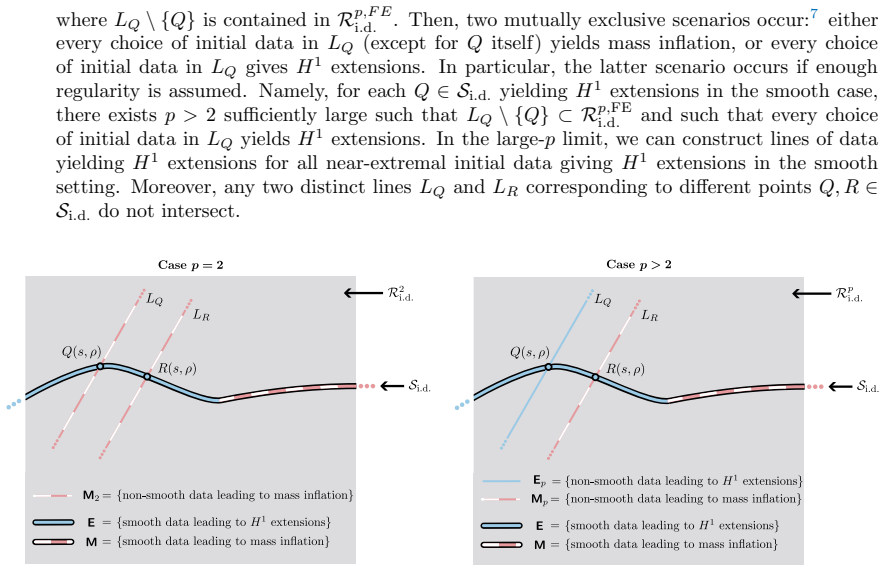
On the system's own terms, the central claim is Theorem 5.4 together with Theorem 1.1(3): under the rough-data profile $f_1(u)=u^{-1/p}|\log u|^{-2\gamma/p}$ with $p=2$, and under the exponential Price law bounds $e^{-C v} \leq |\partial_v \phi|(0,v) \leq e^{-s v}$ with the lower bound at a rate $l(s)$ strictly between $s$ and $3s$, the Hawking mass $\varpi(u,v) \to +\infty$ as $v\to\infty$ for every $u\in(0,U]$, for every choice of charge, mass, and cosmological constant of a sub-extremal Reissner-Nordström-de Sitter reference black hole. The quantity $\varpi$ is an $H^1$ geometric quantity, so its divergence is mass inflation at the Cauchy horizon. For $p>2$ the same construction yields a dichotomy: mass inflation when either $\rho=K_-/K_+ > 2(1-1/p)$ or $l(s)<K_-$, and $H^1$ extensions when $s>K_-$ and $\rho<2(1-1/p)$. Consequently the smooth data that previously produced $H^1$ extensions are non-generic in the finite-energy moduli space, in the sense that through each such smooth datum there pass infinitely many non-intersecting lines of rough data, all but the smooth point of which give mass inflation.
Load-bearing premise
The load-bearing premise is the exponential Price law lower bound along the event horizon, $\partial_v\phi|_{H^+} \gtrsim e^{-l(s)v}$ with $s<l(s)<3s$; if the scalar field decays faster than every such rate, or oscillates, the sign of the field and the mass-inflation proof do not close.
Editorial extensions
If this is right
- If the $p=2$ result is correct, finite-energy ingoing radiation makes the Cauchy horizon of every sub-extremal Reissner-Nordström-de Sitter black hole a mass-inflation singularity, regardless of the decay rate $s$ of the outgoing radiation along the event horizon.
- The smooth initial data that yield $H^1$ extensions beyond the Cauchy horizon occupy a positive-codimension subset of the finite-energy data space; generically in that space, weak cosmic censorship in its $H^1$ formulation is restored.
- For $p>2$, increasing regularity of the ingoing data reopens the door to $H^1$ extensions for near-extremal parameters, and the set of such parameters approaches the smooth-data set as $p\to\infty$.
- Continuous extendibility up to the Cauchy horizon holds for all $p\geq 2$ rough data, so the instability is specifically a divergence of the Hawking mass, not a loss of continuity of the metric.
- Mass inflation implies the Kretschmann scalar blows up, so no $C^2$ extension exists beyond the Cauchy horizon in the rough-data solutions.
Reading between the lines
- One natural reading is a regularity selection principle: the weak formulation of strong cosmic censorship may hold generically precisely because finite-energy data are the physical threshold for solving the Einstein equations, while the smooth-data violations are measure-zero in the data space.
- If the exponential Price law lower bound were replaced by an oscillatory tail that dips below $e^{-l(s)v}$, the sign-fixing step would fail and the mass-inflation conclusion could fail; this suggests the lower bound is not a technical convenience but a physical switch between mass inflation and extended solutions.
- A direct numerical test is to evolve near-extremal Reissner-Nordström-de Sitter with an ingoing pulse in $L^2$ but not $L^q$ and monitor $\varpi(u,v)$ along late $v$; the theorem predicts divergence for every near-extremal parameter, while smooth pulses of the same amplitude should remain bounded in the $H^1$-extension region.
- The same rough-data mechanism may apply outside spherical symmetry: if Kerr-Newman-de Sitter inherits finite-energy blueshift instabilities, the near-extremal $H^1$ extension results may similarly be non-generic.
Editorial analysis
A structured set of objections, weighed in public.
Referee Report
Summary. The paper studies the spherically symmetric Einstein-Maxwell-real scalar field system with positive cosmological constant, with characteristic initial data of low Sobolev regularity. It establishes local well-posedness in an integrated sense, constructs a black hole interior up to a Cauchy horizon with continuous extensions, proves existence of H^1 extensions for p>2 under suitable parameter conditions, and proves mass inflation at the Cauchy horizon for rough data, in particular claiming mass inflation for p=2 for every Price-law decay rate s. The main novelty is the treatment of rough initial data, with a bootstrap construction adapted to the integral formulation and a mass inflation argument following Dafermos and Costa-Girão-Natário-Silva, conditional on exponential Price-law upper and lower bounds.
Significance. If correct, this is a substantial contribution: it provides the first rigorous nonlinear mass inflation results for rough initial data in the cosmological charged black hole setting, and it formalizes a sense in which smooth data yielding H^1 extensions are non-generic among finite-energy data. The paper is detailed and self-consciously conditional: the Price-law lower bound is stated as an assumption, and the dependence on the specific rough profile (1.20) is explicit. The integrated formulation and the low-regularity extension criterion are valuable technical tools in their own right. However, the central 'every s' mass inflation claim for p=2 rests on a sign-propagation lemma whose proof requires a stronger inequality than the stated assumptions provide; this gap affects Theorem 1.1(3) and Theorem 5.4 as written.
major comments (1)
- [Section 5, Lemma 5.2 and Eq. (5.5)] The proof of Lemma 5.2 requires the unstated condition l(s) < 2s + c_p(s), where c_p(s) is defined in (3.13). For p=2 and s>K_+, one has c_p(s)=K_+-C(eta), hence 2s+c_p(s)=2s+K_+-C(eta) < 3s for s>K_+ and eta small. The hypotheses (1.21)/(3.5) only impose s<l(s)<3s, so they permit values with 2s+c_p(s)<l(s)<3s. In that case the assumed lower bound e^{-l(s)v} is exponentially smaller than the error term delta e^{-(2s+c_p(s))v} in (5.5), so the chain e^{-l(s)v} \lesssim \partial_v\varphi(0,v) - \delta e^{-(2s+c_p(s))v} cannot hold for all large v, and the positivity conclusion \partial_v\varphi>0 in J^-(A) is not established. Since Lemma 5.3 and the estimate (C.6) in Appendix C depend on this positivity, the claim of mass inflation for p=2 'for every s' does not follow from the assumptions as stated. The gap disappears if one assumes the physically expected l(s)=s+\varepsilon used in Figure 3, or if the theorem is amended to require l(s)<2s+c_p(s).
minor comments (4)
- [Abstract and Theorem 1.1] The abstract states that initial data in W^{1,2}\setminus W^{1,q} alone yield mass inflation for every parameter choice, but the mass inflation theorem also requires the specific profile f_1(u)=u^{-1/p}|\log u|^{-2\gamma/p} from (1.20) and the exponential Price-law lower bound (1.21)-(1.22). The theorem itself states these hypotheses, but the abstract should be amended to avoid overstating the advertised data class.
- [Theorem 5.4] In the statement of Theorem 5.4, the condition on the lower bound is written as 'where e^{-l(s)} \lesssim \partial_v\varphi|_{H^+}(0,v) < e^{-sv}'; this should presumably be e^{-l(s)v}.
- [Remark 3.5 and proof of Proposition 3.7] Remark 3.5 refers to 'proposition 3.7' when the surrounding discussion concerns the early-blueshift region, and the proof of Proposition 3.7 says estimates along gamma hold 'due to the results of proposition 3.7'; the intended cross-references appear to be to Propositions 3.4 and 3.6.
- [Lemma 5.2] The sentence 'By continuity of \partial_u\varphi and \partial_v\varphi away from the event horizon' is not accurate in the stated regularity class, since \partial_u\varphi is only in L^p_u. The sign propagation should be justified through the integrated equations and a density argument, as is done elsewhere in the paper.
Circularity Check
No constructional circularity: the theorem is an honest implication from explicit rough-data and Price-law assumptions; the only heavy debt is to the author's own prior paper [Ros25] for technical estimates, which is minor self-citation rather than a reduction of the claim to its inputs.
-
other
[Sections 3.4–3.8 and Theorem 4.1 (esp. Prop. 3.6 and proof of Thm 4.1)]
"The proof follows from that of [Ros25, Lemma 4.16], where now the integral formulation of (1.6)–(1.10) is adopted. // The proof is analogous to that of [Ros25, theorem 5.1] (where we can set the scalar field mass to be zero and the black hole charge to be constant), where now (A.15), (A.12), (A.2) are used in the place of the equations of the smooth formulation of the PDE system."
Several load-bearing interior estimates (redshift/blueshift region propagation and the H^1-extension boundedness of the Hawking mass) are taken from the author's own paper [Ros25] rather than re-derived from first principles. This is a self-citation with overlapping authorship. However, it is not a constructional circularity: [Ros25] is an external published result, the present paper adapts it to a different W^{1,p} integrated formulation, and the central mass-inflation theorem does not reduce to [Ros25] alone, since it also invokes [Daf05, CGNS17] and new rough-data sign and blow-up estimates. The debt lowers self-containedness but does not make the conclusion equivalent to its assumptions.
full rationale
The main claims are conditional implications: given the explicit rough profile (1.20)/(3.2), the exponential Price upper and lower bounds (1.17)/(3.5), and asymptotic approach to a sub-extremal RNdS reference, the paper constructs a unique W^{1,p} solution and proves that the Hawking mass diverges at the Cauchy horizon. No parameter is fitted to the conclusion, no quantity used as an input is redefined as the output, and the mass-inflation mechanism is imported from external works [Daf05, CGNS17] rather than from the paper's own assumptions. The non-genericity statement is explicitly conditional on the expected exponential lower Price bound; that conditionality is a limitation and a potential correctness risk, not a circularity. Similarly, the proof of Lemma 5.2 appears to require l(s)<2s+c_p(s), which is not implied by the stated s<l(s)<3s when p=2 and s>K_+; this is an internal gap in the proof as written, not a circular identification. Overall the derivation is self-contained in its logical structure apart from reliance on the author's prior [Ros25] for technical estimates, which I score as a minor, non-circular self-citation.
Assumptions & free parameters
free parameters (3)
- s =
arbitrary s > 0
- l(s) =
s < l(s) < 3s
- gamma =
> 1/2
assumptions (4)
- domain assumption Sub-extremal Reissner-Nordstrom-de Sitter reference solution with ρ = K_-/K_+ > 1
- domain assumption Exponential Price law upper and lower bounds along the event horizon
- domain assumption Rough initial data profile along the ingoing segment
- standard math Standard real analysis and PDE background
Cite this review
Pith. "Pith review of Mass inflation from rough initial data for the spherically symmetric Einstein-Maxwell-scalar field system with $\Lambda$." pith.science (2026). https://pith.science/paper/5SMYOO4X
@misc{pith2026250608075,
  author       = {Pith},
  title        = {Pith review of: Mass inflation from rough initial data for the spherically symmetric Einstein-Maxwell-scalar field system with $\Lambda$},
  year         = {2026},
  howpublished = {\url{https://pith.science/paper/5SMYOO4X}},
  note         = {Machine review of arXiv:2506.08075}
}
abstract
Recent rigorous results on black hole interiors clearly suggest that the strong cosmic censorship conjecture fails in its most fundamental, i.e. weak, formulation: violations are expected for a class of spherically symmetric charged black holes in the presence of a positive cosmological constant near extremality. These results require sufficiently regular solutions. Conversely, when non-smooth, finite-energy initial data are prescribed for linear waves propagating on a fixed black hole background belonging to the aforementioned family, it was shown that the local energy of these linear waves blows up at the Cauchy horizon, hence hinting that non-smooth initial data may suppress the possible violations of the $H^1$ formulation of strong cosmic censorship. In line with this intuition, we prove that rough initial data can also trigger an instability at the Cauchy horizon in the non-linear setting, via mass inflation. In particular, we analyse a characteristic initial value problem for the spherically symmetric Einstein-Maxwell-real scalar field system describing the interior of a black hole. Our results show that, when prescribing 1) initial data asymptotically approaching those of a sub-extremal Reissner-Nordstr\"om-de Sitter solution, and 2) initial data belonging to $W^{1, 2}\setminus W^{1, q}$, for every $q > 2$, along the initial ingoing compact segment; then the Hawking mass diverges at the Cauchy horizon of the black hole solution we construct, for every parameter choice of the reference black hole. In this larger family of configurations, we prove that the smooth data suggesting violations of strong cosmic censorship are non-generic in a ``positive co-dimension'' sense, conditionally to the validity of the expected Price law bounds. Moreover, we illustrate the transition between smooth and rough initial data.
Figures


Figures from the paper (2 more)


Reference graph
Works this paper leans on
-
[1]
V. Cardoso, J. L. Costa, K. Destounis, P. Hintz, and A. Jansen. Quasinormal modes and strong cosmic censorship. Phys. Rev. Lett. , 120:031103, 2018
work page 2018
-
[2]
V. Cardoso, J. L. Costa, K. Destounis, P. Hintz, and A. Jansen. Strong cosmic censorship in charged black-hole spacetimes: Still subtle. Phys. Rev. D , 98:104007, 2018
work page 2018
-
[3]
J. Costa and A. T. Franzen. Bounded energy waves on the black hole interior of R eissner– N ordstr \"o m–de S itter. Ann. Henri Poincaré , 18:3371--3398, 2017
work page 2017
- [4]
- [5]
- [6]
- [7]
-
[8]
D. Christodoulou. Examples of naked singularity formation in the gravitational collapse of a scalar field. Ann. Math. , 140:607--653, 1994
work page 1994
Show all 34 references
-
[9]
Christodoulou
D. Christodoulou. The instability of naked singularities in the gravitational collapse of a scalar field. Ann. Math. , 149:183--217, 1999
1999
-
[10]
Christodoulou
D. Christodoulou. On the global initial value problem and the issue of singularities. Classical and Quantum Gravity , 16(12A):A23–A35, 1999
1999
-
[11]
Dafermos
M. Dafermos. Stability and instability of the cauchy horizon for the spherically symmetric E instein– M axwell-scalar field equations. Ann. Math. , 158(3):875–928, 2003
2003
-
[12]
Dafermos
M. Dafermos. The interior of charged black holes and the problem of uniqueness in general relativity. Commun. Pure Appl. Math. , 58(4):445–504, 2005
2005
-
[13]
Davey, O
A. Davey, O. J. C. Dias, and D. S. Gil. Strong cosmic censorship in K err- N ewman-de S itter. J. High Energ. Phys. , 2024(113), 2024
2024
-
[14]
Dafermos and J
M. Dafermos and J. Luk. The interior of dynamical vacuum black holes I : The C^0 -stability of the K err C auchy horizon. (arXiv:1710.01722), 2017
2017
-
[15]
Van de Moortel
M. Van de Moortel. Stability and instability of the sub-extremal R eissner– N ordstr \"o m black hole interior for the E instein– M axwell– K lein– G ordon equations in spherical symmetry. Commun. Math. Phys. , 360:103--168, 2018
2018
-
[16]
Van de Moortel
M. Van de Moortel. Mass inflation and the C^2 --inextendibility of spherically symmetric charged scalar field dynamical black holes. Commun. Math. Phys. , 382:1263--1341, 2021
2021
-
[17]
O. J. C. Dias, H. S. Reall, and J. E. Santos. Strong cosmic censorship: taking the rough with the smooth. J. High Energ. Phys. , 1, 2018
2018
-
[18]
Dafermos and Y
M. Dafermos and Y. Shlapentokh-Rothman. Rough initial data and the strength of the blue-shift instability on cosmological black holes with > 0 . Class. Quantum Grav. , 35:195010, 2018
2018
-
[19]
G. B. Folland. Real Analysis: Modern Techniques and Their Applications . John Wiley & Sons, 1999
1999
-
[20]
O. Gautam. Late-time tails and mass inflation for the spherically symmetric E instein- M axwell-scalar field system, 2024. arXiv:2412.17927
2024 arXiv
-
[21]
Gajic and J
D. Gajic and J. Luk. The interior of dynamical extremal black holes in spherical symmetry. Pure and Applied Analysis , 1(2):263–326, 2019. arXiv:1709.09137 [gr-qc]
2019 arXiv
-
[22]
P. Hintz. Quasinormal modes of near-extremal R eissner- N ordström-de S itter spacetimes, 2025. arXiv:2504.01734
2025 arXiv
-
[23]
Hintz and A
P. Hintz and A. Vasy. Analysis of linear waves near the C auchy horizon of cosmological black holes. J. Math. Phys. , 58(8):081509, 2017
2017
-
[24]
J. Kommemi. The global structure of spherically symmetric charged scalar field spacetimes. Commun. Math. Phys. , 323:35--106, 2013
2013
-
[25]
Luk and S
J. Luk and S. J. Oh. Strong cosmic censorship in spherical symmetry for two-ended asymptotically flat initial data I . T he interior of the black hole region . Ann. Math. , 190(1):1 -- 111, 2019
2019
-
[26]
Luk and S
J. Luk and S. J. Oh. Strong Cosmic Censorship in Spherical Symmetry for Two-Ended Asymptotically Flat Initial Data II: The Exterior of the Black Hole Region . Ann. PDE , 5(6), 2019
2019
-
[27]
Luk and S
J. Luk and S. J. Oh. Late time tail of waves on dynamic asymptotically flat spacetimes of odd space dimensions, 2024. arXiv:2404.02220
2024 arXiv
-
[28]
J. Luk, S. J. Oh, and Y. Shlapentokh-Rothman. A scattering theory approach to C auchy horizon instability and applications to mass inflation. Ann. Henri Poincaré , 24:363–411, 2023
2023
-
[29]
J. Luk. Weak null singularities in general relativity. J. Am. Math. Soc. , 31:1--63, 2018
2018
-
[30]
R. Penrose. Structure of space-time . In Battelle Rencontres, 1967 Lectures in mathematics and physics , pages 121--235, 1968
1967
-
[31]
Poisson and W
E. Poisson and W. Israel. Internal structure of black holes. Phys. Rev. D , 41:1796--1809, 1990
1990
-
[32]
Rossetti
F. Rossetti. Stability of the Cauchy horizon for cosmological black holes in spherical symmetry . Ph D thesis, Instituto Superior Técnico, 2024
2024
-
[33]
Rossetti
F. Rossetti. Strong cosmic censorship for the spherically symmetric E instein– M axwell-charged- K lein– G ordon system with positive : Stability of the C auchy horizon and H^1 extensions. Ann. Henri Poincaré , 26:675--753, 2025
2025
-
[34]
Shlapentokh-Rothman
Y. Shlapentokh-Rothman. Weak cosmic censorship, trapped surfaces, and naked singularities for the E instein vacuum equations. Comptes Rendus. Mécanique , 353:379--410, 2025
2025
Reviewed August 7, 2026 · model on record in the stance chip above.
Discussion (0). Sign in to comment.