REVIEW 3 major objections 5 minor 1 cited by
Kinetically Coupled Dark Matter Condensates
T0 review · 3 major / 5 minor · reviewed 2026-08-07 · deepseek-v4-flash
Pith's one-line read Kinetically coupling an ultralight axion to a moduli field makes the axion's Jeans scale evolve with that field, and existing structure-formation bounds then force the moduli field below about 100 TeV for most of cosmic history.
desk verdict Eq. 16 appears to contain a spurious constant-potential term, so the paper's headline bound on χ is not established; the qualitative idea is sound but the core derivation needs fixing. read the letter →
The pith
A machine-rendered reading of the paper's core claim, the machinery that carries it, and where it could break.
The reading
What carries the argument
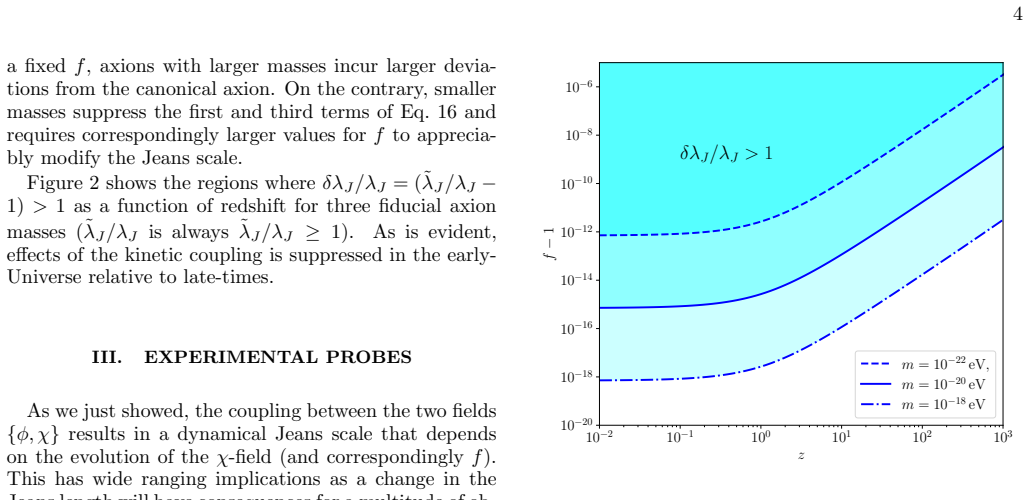
The central object is the modified Jeans scale for a kinetically coupled condensate, Eq. (16): $(\tilde{k}_J/a)^2 = \sqrt{F^2 + \frac{6H^2 m^2 \Omega_\phi}{f}} - F$ with $F = m^2(f-1)/(2f)$, which reduces to the canonical scale as $f \to 1$. It carries the argument because every observational bound is imposed through Eq. (22), $\tilde{\lambda}_J(m,\chi) \le \lambda_J(m_X)$, which requires the model's Jeans length not to exceed the canonical Jeans length of the mass limit from each probe. The exponential $f(\chi) = e^{\lambda\chi}$ is the quantity whose present value and history control the size of the effect, and the new friction term $d\ln f/d\eta$ in the Gross-Pitaevskii equation is what makes the Jeans scale dynamical rather than fixed.
What would settle it
Compute the full time-dependent linear matter power spectrum in the two-field system, evolving both fields, and compare the suppression scale with Lyman-$\alpha$ forest measurements at $z \approx 4$--$5$; if the suppression implied by $\chi > 10^2$ TeV is absent at those redshifts, or if the full-evolution Jeans scale disagrees with the $z=0$ mapping in Eq. (22), the central bound fails.
Extended reading notes
Core claim
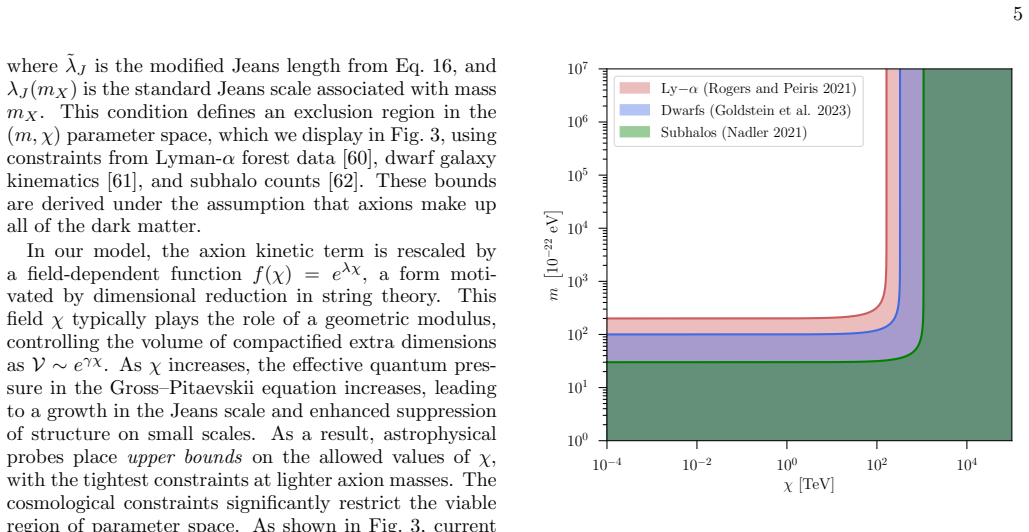
The central claim is that in a theory with action $S = \int d^4x \sqrt{-g}\left[-\frac{1}{2}(\partial\chi)^2 - \frac{1}{2}(\partial\phi)^2 f - V(\chi,\phi)\right]$ and $f = e^{\lambda\chi}$, the canonical fuzzy-dark-matter picture is modified: the non-relativistic limit yields a Gross-Pitaevskii equation with an extra friction term and potentials suppressed by $f$, and the resulting Jeans scale is $(\tilde{k}_J/a)^2 = \sqrt{F^2 + \frac{6H^2 m^2 \Omega_\phi}{f}} - F$ with $F = m^2(f-1)/(2f)$. The key mapping is Eq. (22): for each observational probe $X$, the model is excluded when the modified Jeans length exceeds the canonical Jeans length of the mass limit $m_X$ from that probe. Applying published bounds from the Lyman-$\alpha$ forest, dwarf galaxy kinematics, and subhalo counts, the paper finds that consistency requires $\chi \lesssim 10^2$ TeV at $z=0$, i.e. $\chi/M_{\rm pl} \lesssim 10^{-14}$, and argues this must hold throughout most of cosmic history under the assumption that axions make up all of the dark matter.
Load-bearing premise
The conversion of published fuzzy-dark-matter constraints into a bound on the moduli field assumes that the model's observable signature is fully captured by the instantaneous Jeans scale at $z=0$, with the moduli velocity $\chi'$ neglected, and that the $z=0$ bound applies throughout cosmic history even though the published constraints are integrated over structure formation and include time-dependent growth and nonlinear effects.
Editorial extensions
If this is right
- If the central claim is correct, kinetically coupled axion models with $\lambda = O(1/M_{\rm pl})$ cannot have moduli fields wandering near the Planck scale after recombination; the fields must be stabilized near the origin.
- The same bound rules out large-field quintessence models in which a moduli field kinetically coupled to axion dark matter drives dark energy, leaving only small-field dark energy dynamics compatible.
- Axions with $m > 10^{-21}$ eV are more strongly affected, so future probes of small-scale structure (21 cm, improved Lyman-$\alpha$) will either tighten the $\chi$ bound or detect the enlarged Jeans suppression.
- The coupling can make the effective dark energy equation of state appear phantom ($w_{\chi,\rm eff} < -1$) when $f < 1$, linking dark matter microphysics to current BAO data.
- If axions are only a fraction of dark matter, the bounds weaken proportionally, so the constraint is sharpest for axions constituting all of the dark matter.
Reading between the lines
- The paper's $z=0$ mapping likely understates the bound: if $\chi'$ is non-negligible, the friction term in Eq. (8) and the time-dependent $f$ can move the Jeans scale at earlier epochs, so a full transfer-function treatment could exclude even smaller values of $\chi$ than the $\sim 10^2$ TeV cap.
- A direct testable extension is to compute the modified soliton core radius--mass relation and compare it with dwarf galaxy observations; enhanced quantum pressure predicts larger cores at fixed halo mass than canonical fuzzy dark matter.
- The same machinery could be applied to self-interacting axions (retaining $g_\phi$), where the $f$-suppression of self-interactions would shift the balance between pressure and gravity in a different way.
- If $\chi$ is identified with a quintessence field, the bound $\chi \lesssim 10^2$ TeV implies that a kinetically coupled axion--dark-energy sector can only realize small-field dynamics, a prediction that future BAO and growth data could test.
Editorial analysis
A structured set of objections, weighed in public.
Referee Report
Summary. This paper considers a two-field dark matter model in which an ultralight axion ϕ has a field-dependent kinetic term f(χ)=e^{λχ} coupled to a moduli field χ, as motivated by string compactifications. The authors derive a modified Gross-Pitaevskii equation, a corresponding Madelung fluid system, and a claimed modified Jeans scale (Eq. 16). They then reinterpret existing lower bounds on canonical fuzzy dark matter masses from Lyman-α forest, dwarf galaxy kinematics, and subhalo counts as upper bounds on χ, concluding that χ≲10^2 TeV (χ/M_pl≲10^-14) throughout most of cosmic history. The central quantitative claim rests on Eq. 16 and the z=0 Jeans-length mapping of Eq. 22; the paper does not compute a time-dependent matter power spectrum or track the evolution of χ.
Significance. If correct, the paper would forge a concrete link between string-inspired kinetic couplings and small-scale structure probes, providing a sharp, falsifiable constraint on moduli field values. It is also clearly written and makes a sensible choice to use three independent observational datasets. However, the central result is not supported: the modified Jeans scale in Eq. 16 appears to contain a spurious homogeneous-potential contribution, and the mapping of Eq. 22 is not a valid translation of the published constraints. Because the headline exclusion χ≲10^2 TeV follows directly from Eq. 16, the paper's main claim is not established. The paper also provides no machine-checked derivations or numerical evolution; its strength is the qualitative identification that kinetic couplings modify the Euler equation through a 1/f factor.
major comments (3)
- [§II, Eq. (16)] The modified Jeans scale is stated without derivation and is not supported by the displayed fluid equations (12)-(13). In the absence of self-interactions, the only Jeans-relevant modification in those equations is the factor 1/f multiplying ∇Φ in the Euler equation, which yields (k_J/a)^2 = sqrt(6 H^2 m^2 Ω_ϕ / f). The additional F term in Eq. (16) appears to come from the homogeneous potential U = (ma/2)(1-1/f) in Eq. (8). Because χ is treated as a background field, U has no spatial gradient and no perturbed part; it only shifts the chemical potential and cannot contribute pressure. This is corroborated by the field rescaling φ → √f φ, which turns the action (1), for fixed χ, into a canonical axion of mass m/√f, whose Jeans scale is exactly the sqrt expression above, with no F term. The unphysical limit of Eq. (16) is f=2, m≫H, where it reduces to (k/a)^2 ≈ 6 H^2 Ω_ϕ, i.e., a Jeans length of order the Hubble scale independent of m. The claimed bound χ≲10^2 TeV therefore rests on an incorrect dispersion relation.
- [§IV, Eq. (22) and Fig. 3] The constraint mapping equates instantaneous Jeans lengths at z=0, but the input bounds from Lyman-α, dwarf galaxies, and subhalo counts are derived from the full matter power spectrum, including time-dependent growth and nonlinear effects over a range of redshifts. The paper does not compute the modified transfer function, does not evolve f(χ), and does not show that a z=0 Jeans-length comparison reproduces the published exclusion regions. Consequently, Eq. (22) is not a valid translation of those bounds, and the abstract's statement that χ/M_pl≪1 is required 'throughout most of cosmic history' is not supported by the analysis presented.
- [§II, Eqs. (8)-(13)] The paper's central qualitative claim is that the Jeans scale is 'dynamically dependent' on the moduli field's evolution, yet the derivation of Eq. (16) assumes χ' is negligible and treats χ as a fixed background. If χ evolves, the d ln f/dη term in the continuity equation (12) changes both the background density evolution and the perturbation growth, and the Klein-Gordon equation (10) couples χ to the axion dynamics. A complete treatment must include perturbations of χ and a time-dependent dispersion relation before any statement about 'most of cosmic history' can be made. The paper does not provide such a treatment.
minor comments (5)
- [§II, Eq. (2)] Eq. (2) drops the χ kinetic and potential terms with no explicit statement; please clarify that this is the axion-sector Lagrangian after separating the χ background.
- [Fig. 1 caption] The caption says the enhancement is evaluated 'at the redshift of recombination', but the surrounding text does not specify a redshift for Eq. (16); please define the evaluation epoch consistently with Eq. (22) and Fig. 3.
- [§IV] The statement χ/M_pl ≲ 10^-14 follows from χ ≲ 10^2 TeV only for a particular convention for M_pl; please state whether the reduced Planck mass is used.
- [Introduction] There is a typo: 'phenomology' should be 'phenomenology'.
- [§III, Eq. (19)] The approximate transfer-function ratio should define k̃_J^eq and clarify whether the parameter q is the standard fuzzy-dark-matter value or is modified by the kinetic coupling.
Circularity Check
No significant circularity: the modified Jeans scale and resulting chi bound are derived within the paper from the model's own equations and matched to external observational limits, not recycled from fitted inputs.
full rationale
The paper's central chain is: action (Eq. 1) -> non-relativistic Gross-Pitaevskii equation (Eq. 8) -> Madelung equations (Eqs. 12-13) -> modified Jeans scale (Eq. 16) -> constraint mapping (Eq. 22). Each step uses the model's own equations and external canonical-axion bounds; no parameter is fitted to the data and then renamed as a prediction. The f = e^{lambda chi} form and lambda = 1/M_pl are adopted inputs, stated as assumptions, not outputs of the analysis. The observational bounds [60]-[62] are external; only [61] involves an overlapping author (Koushiappas), but it is an independent observational analysis, not a self-citation carrying the theoretical load. The action form is attributed to [49,50,54,55]; [49] includes two of the present authors, but the same form is independently cited, and the phenomenological results do not depend on that citation. The skeptical concern about Eq. 16 (that the (1-1/f) term is a constant background potential and should cancel in linear perturbations) is a physics correctness issue; if correct, it would invalidate the central bound, but it is not a case of a prediction being identical to its input by construction. Therefore no circularity steps meet the evidentiary standard.
Assumptions & free parameters
free parameters (3)
- lambda (kinetic coupling constant) =
1/M_pl (assumed)
- axion mass m =
scanned over 10^-22 to 10^-15 eV in Fig. 3
- moduli potential parameters A, alpha =
not specified
assumptions (4)
- domain assumption The nonrelativistic mean-field Gross-Pitaevskii description applies, with chi treated as a spatially homogeneous background field.
- domain assumption chi' is negligible in the derivation of the modified Jeans scale, Eq. 16.
- ad hoc to paper Existing canonical fuzzy dark matter constraints can be reinterpreted by equating Jeans lengths at z = 0, Eq. 22.
- ad hoc to paper The moduli field value is approximately constant over the epochs relevant to the constraints.
Cite this review
Pith. "Pith review of Kinetically Coupled Dark Matter Condensates." pith.science (2026). https://pith.science/paper/OM3BLW4G
@misc{pith2026250608076,
  author       = {Pith},
  title        = {Pith review of: Kinetically Coupled Dark Matter Condensates},
  year         = {2026},
  howpublished = {\url{https://pith.science/paper/OM3BLW4G}},
  note         = {Machine review of arXiv:2506.08076}
}
abstract
Dark matter consisting of ultralight bosons can form a macroscopic Bose-Einstein condensate with distinctive observational signatures. While this possibility has been extensively studied for axions and axion-like particles $-$ pseudoscalars with masses protected by shift symmetry $-$ realistic models from string theory and other higher-dimensional theories predict more complex structures. Here we investigate a two-field generalization where an axion couples to a moduli field through its kinetic term, representing the phase and radial modes of a complex scalar field. We demonstrate that when this system forms a gravitationally bound Bose-Einstein condensate, the kinetic coupling produces dramatic modifications to cosmological evolution compared to the canonical single-field case. Most notably, the axion Jeans scale becomes dynamically dependent on the moduli field's evolution, fundamentally altering structure formation. By mapping existing observational constraints from canonical axion models to our two-field scenario, we identify regions of parameter space that are already excluded by current observations. In particular, consistency with observations requires that the moduli field must take on small field values, $\chi/M_{\rm pl} \ll 1$, throughout most of cosmic history for this class of axions to remain a viable description of all dark matter.
Figures

Forward citations
Cited by 1 Pith paper
-
Heterotic Warm Inflation
In a heterotic-string-inspired two-field warm inflation model, the axion drives inflation while thermal corrections from gauge fields block sustained dilaton-driven inflation.
Reference graph
Works this paper leans on
-
[1]
Morad Aaboud et al. Constraints on mediator-based dark matter and scalar dark energy models using√s= 13 TeV ppcollision data collected by the ATLAS detector.JHEP, 05:142, 2019
work page 2019
-
[2]
Albert M Sirunyan et al. Search for new physics in the monophoton final state in proton-proton collisions at √s= 13 TeV.JHEP, 10:073, 2017
work page 2017
-
[3]
A. K. Drukier, Katherine Freese, and D. N. Spergel. Detecting Cold Dark Matter Candidates.Phys. Rev., D33:3495–3508, 1986
work page 1986
-
[4]
Mark W. Goodman and Edward Witten. Detectability of Certain Dark Matter Candidates.Phys. Rev., D31:3059, 1985
work page 1985
-
[5]
D. S. Akerib et al. Results from a search for dark mat- ter in the complete LUX exposure.Phys. Rev. Lett., 118(2):021303, 2017
work page 2017
-
[6]
Dark Matter Results From 54-Ton-Day Exposure of PandaX-II Experiment.Phys
Xiangyi Cui et al. Dark Matter Results From 54-Ton-Day Exposure of PandaX-II Experiment.Phys. Rev. Lett., 119(18):181302, 2017
work page 2017
-
[7]
Aprile et al
E. Aprile et al. Dark Matter Search Results from a One Ton-Year Exposure of XENON1T.Phys. Rev. Lett., 121(11):111302, 2018
2018
-
[8]
Annual Modulation in Direct Dark Matter Searches.arXiv e-prints, page arXiv:2003.04545, March 2020
Francis Froborg and Alan R Duffy. Annual Modulation in Direct Dark Matter Searches.arXiv e-prints, page arXiv:2003.04545, March 2020
arXiv 2003
Show all 74 references
-
[9]
Limits on dark matter an- nihilation signals from the Fermi LAT 4-year measure- ment of the isotropic gamma-ray background
Fermi LAT Collaboration. Limits on dark matter an- nihilation signals from the Fermi LAT 4-year measure- ment of the isotropic gamma-ray background. JCAP, 2015(9):008, September 2015
2015
-
[10]
Koushiappas, and Matthew G
Alex Geringer-Sameth, Savvas M. Koushiappas, and Matthew G. Walker. Comprehensive search for dark mat- ter annihilation in dwarf galaxies. PhRvD, 91(8):083535, April 2015
2015
-
[11]
Albert et al
A. Albert et al. Dark Matter Limits From Dwarf Spheroidal Galaxies with The HA WC Gamma-Ray Ob- servatory.Astrophys. J., 853(2):154, 2018
2018
-
[12]
Archambault et al
S. Archambault et al. Dark Matter Constraints from a Joint Analysis of Dwarf Spheroidal Galaxy Observations with VERITAS.Phys. Rev. D, 95(8):082001, 2017
2017
-
[13]
Gamma-Ray Dark Matter Searches in Milky Way Satellites—A Comparative Review of Data Analysis Methods and Current Results.Galaxies, 8(1):25, March 2020
Javier Rico. Gamma-Ray Dark Matter Searches in Milky Way Satellites—A Comparative Review of Data Analysis Methods and Current Results.Galaxies, 8(1):25, March 2020
2020
-
[14]
M. L. Ahnen et al. Limits to Dark Matter Annihila- tion Cross-Section from a Combined Analysis of MAGIC and Fermi-LAT Observations of Dwarf Satellite Galaxies. JCAP, 02:039, 2016
2016
-
[15]
M. G. Aartsen et al. Search for Neutrinos from Dark Matter Self-Annihilations in the center of the Milky Way with 3 years of IceCube/DeepCore.Eur. Phys. J. C, 77(9):627, 2017
2017
-
[16]
Choi et al
K. Choi et al. Search for neutrinos from annihilation of captured low-mass dark matter particles in the Sun by Super-Kamiokande.Phys. Rev. Lett., 114(14):141301, 2015
2015
-
[17]
Du et al
N. Du et al. A Search for Invisible Axion Dark Matter with the Axion Dark Matter Experiment.Phys. Rev. Lett., 120(15):151301, 2018
2018
-
[18]
Graham, Igor G
Peter W. Graham, Igor G. Irastorza, Steven K. Lamore- aux, Axel Lindner, and Karl A. van Bibber. Experimen- tal Searches for the Axion and Axion-Like Particles.An- nual Review of Nuclear and Particle Science, 65:485–514, October 2015
2015
-
[19]
Dark Matter and the XENON1T electron recoil excess.arXiv e-prints, page arXiv:2006.10735, June 2020
Kristjan Kannike, Martti Raidal, Hardi Veerm¨ ae, Alessandro Strumia, and Daniele Teresi. Dark Matter and the XENON1T electron recoil excess.arXiv e-prints, page arXiv:2006.10735, June 2020
2006 arXiv
-
[20]
Buen-Abad, JiJi Fan, and John Shing Chau Leung
Jatan Buch, Manuel A. Buen-Abad, JiJi Fan, and John Shing Chau Leung. Galactic Origin of Relativis- tic Bosons and XENON1T Excess.arXiv e-prints, page arXiv:2006.12488, June 2020
2006 arXiv
-
[21]
Gary Steigman and Michael S. Turner. Cosmological Constraints on the Properties of Weakly Interacting Mas- sive Particles.Nucl. Phys. B, 253:375–386, 1985
1985
-
[22]
Wise, and Frank Wilczek
John Preskill, Mark B. Wise, and Frank Wilczek. Cos- mology of the Invisible Axion.Phys. Lett., B120:127–132,
-
[23]
L. F. Abbott and P. Sikivie. A Cosmological Bound on the Invisible Axion.Phys. Lett., B120:133–136, 1983. [,URL(1982)]
1982
-
[24]
The Not So Harmless Axion.Phys
Michael Dine and Willy Fischler. The Not So Harmless Axion.Phys. Lett., B120:137–141, 1983. [,URL(1982)]
1982
-
[25]
R. D. Peccei and Helen R. Quinn. CP Conservation in the Presence of Instantons.Phys. Rev. Lett., 38:1440–1443, 1977
1977
-
[26]
Problem of StrongPandTInvariance in the Presence of Instantons.Phys
Frank Wilczek. Problem of StrongPandTInvariance in the Presence of Instantons.Phys. Rev. Lett., 40:279–282, 1978
1978
-
[27]
A New Light Boson?Phys
Steven Weinberg. A New Light Boson?Phys. Rev. Lett., 40:223–226, 1978
1978
-
[28]
The landscape of QCD axion models
Luca Di Luzio, Maurizio Giannotti, Enrico Nardi, and Luca Visinelli. The landscape of QCD axion models. Phys. Rept., 870:1–117, 2020
2020
-
[29]
Michael S. Turner. Coherent Scalar Field Oscillations in an Expanding Universe.Phys. Rev. D, 28:1243, 1983
1983
-
[30]
Press, Barbara S
William H. Press, Barbara S. Ryden, and David N. Spergel. Single Mechanism for Generating Large Scale Structure and Providing Dark Missing Matter.Phys. Rev. Lett., 64:1084, 1990
1990
-
[31]
Late time cosmological phase transition and galactic halo as Bose liquid.Phys
Sang-Jin Sin. Late time cosmological phase transition and galactic halo as Bose liquid.Phys. Rev., D50:3650– 3654, 1994
1994
-
[32]
Cold and fuzzy dark matter.Phys
Wayne Hu, Rennan Barkana, and Andrei Gruzinov. Cold and fuzzy dark matter.Phys. Rev. Lett., 85:1158–1161, 2000
2000
-
[33]
Repulsive dark matter.New Astron., 5:103, 2000
Jeremy Goodman. Repulsive dark matter.New Astron., 5:103, 2000
2000
-
[34]
P. J. E. Peebles. Fluid dark matter.Astrophys. J. Lett., 534:L127, 2000
2000
-
[35]
Dark matter from an ultra-light pseudo-Goldsone-boson.Phys
Luca Amendola and Riccardo Barbieri. Dark matter from an ultra-light pseudo-Goldsone-boson.Phys. Lett. B, 642:192–196, 2006
2006
-
[36]
Cosmic Structure as the Quantum Interference of a Co- herent Dark Wave.Nature Phys., 10:496–499, 2014
Hsi-Yu Schive, Tzihong Chiueh, and Tom Broadhurst. Cosmic Structure as the Quantum Interference of a Co- herent Dark Wave.Nature Phys., 10:496–499, 2014
2014
-
[37]
Mass-radius relation of New- tonian self-gravitating Bose-Einstein condensates with short-range interactions: I
Pierre-Henri Chavanis. Mass-radius relation of New- tonian self-gravitating Bose-Einstein condensates with short-range interactions: I. Analytical results.Phys. Rev. D, 84:043531, 2011
2011
-
[38]
P. H. Chavanis and L. Delfini. Mass-radius relation of Newtonian self-gravitating Bose-Einstein condensates with short-range interactions: II. Numerical results. 8 Phys. Rev. D, 84:043532, 2011
2011
-
[39]
Gravitationally bound BCS state as dark matter.JCAP, 1704(04):005, 2017
Stephon Alexander and Sam Cormack. Gravitationally bound BCS state as dark matter.JCAP, 1704(04):005, 2017
2017
-
[40]
Stephon Alexander, Evan McDonough, and David N. Spergel. Chiral Gravitational Waves and Baryon Super- fluid Dark Matter.JCAP, 1805(05):003, 2018
2018
-
[41]
Field theory axiverse.Phys
Stephon Alexander, Tucker Manton, and Evan Mc- Donough. Field theory axiverse.Phys. Rev. D, 109(11):116019, 2024
2024
-
[42]
Ostriker, Scott Tremaine, and Ed- ward Witten
Lam Hui, Jeremiah P. Ostriker, Scott Tremaine, and Ed- ward Witten. Ultralight scalars as cosmological dark matter.Phys. Rev., D95(4):043541, 2017
2017
-
[43]
Elisa G. M. Ferreira. Ultra-light dark matter.Astron. Astrophys. Rev., 29(1):7, 2021
2021
-
[44]
Wave Interference in Self-Interacting Fuzzy Dark Matter
Christian Capanelli, Wayne Hu, and Evan McDonough. Wave Interference in Self-Interacting Fuzzy Dark Matter. 3 2025
2025
-
[45]
Tanja Rindler-Daller and Paul R. Shapiro. Angu- lar Momentum and Vortex Formation in Bose-Einstein- Condensed Cold Dark Matter Haloes.Mon. Not. Roy. Astron. Soc., 422:135–161, 2012
2012
-
[46]
Toomey, and Emanuele Usai
Stephon Alexander, Sergei Gleyzer, Evan McDonough, Michael W. Toomey, and Emanuele Usai. Deep Learning the Morphology of Dark Matter Substructure.Astrophys. J., 893:15, 2020
2020
-
[47]
Stephon Alexander, Christian Capanelli, Elisa G. M. Fer- reira, and Evan McDonough. Cosmic filament spin from dark matter vortices.Phys. Lett. B, 833:137298, 2022
2022
-
[48]
Bramburger, and Evan Mc- Donough
Stephon Alexander, Jason J. Bramburger, and Evan Mc- Donough. Dark Disk Substructure and Superfluid Dark Matter.Phys. Lett. B, 797:134871, 2019
2019
-
[49]
Stephon Alexander, Heliudson Bernardo, and Michael W. Toomey. Addressing the Hubble andS 8 Tensions with a Kinetically Mixed Dark Sector. 7 2022
2022
-
[50]
Towards a dark sector model from string theory
Heliudson Bernardo, Robert Brandenberger, and J¨ urg Fr¨ ohlich. Towards a dark sector model from string theory. JCAP, 09:040, 2022
2022
-
[51]
Philippe Brax, C. P. Burgess, and F. Quevedo. Axio- Chameleons: a novel string-friendly multi-field screening mechanism.JCAP, 03:015, 2024
2024
-
[52]
Abdul Karim et al
M. Abdul Karim et al. DESI DR2 Results II: Measure- ments of Baryon Acoustic Oscillations and Cosmological Constraints. 3 2025
2025
-
[53]
A. G. Adame et al. DESI 2024 VI: cosmological con- straints from the measurements of baryon acoustic oscil- lations.JCAP, 02:021, 2025
2024
-
[54]
Adam Smith, Maria Mylova, Philippe Brax, Carsten van de Bruck, C. P. Burgess, and Anne-Christine Davis. A Minimal Axio-dilaton Dark Sector. 10 2024
2024
-
[55]
C. P. Burgess, Danielle Dineen, and F. Quevedo. Yoga Dark Energy: natural relaxation and other dark im- plications of a supersymmetric gravity sector.JCAP, 03(03):064, 2022
2022
-
[56]
Guth, Mark P
Alan H. Guth, Mark P. Hertzberg, and C. Prescod- Weinstein. Do Dark Matter Axions Form a Conden- sate with Long-Range Correlation?Phys. Rev. D, 92(10):103513, 2015
2015
-
[57]
R. R. Caldwell, Rahul Dave, and Paul J. Steinhardt. Cos- mological imprint of an energy component with general equation of state.Phys. Rev. Lett., 80:1582–1585, 1998
1998
-
[58]
David J. E. Marsh and Pedro G. Ferreira. Ultra-Light Scalar Fields and the Growth of Structure in the Uni- verse.Phys. Rev. D, 82:103528, 2010
2010
-
[59]
Allali, Mark P
Itamar J. Allali, Mark P. Hertzberg, and Fabrizio Rompineve. Dark sector to restore cosmological concor- dance.Phys. Rev. D, 104(8):L081303, 2021
2021
-
[60]
Rogers and Hiranya V
Keir K. Rogers and Hiranya V. Peiris. Strong Bound on Canonical Ultralight Axion Dark Matter from the Lyman-Alpha Forest.Phys. Rev. Lett., 126(7):071302, 2021
2021
-
[61]
The constrained regions of parameter space are established by enforcing that the modified Jeans scale, Eq
(blue), and subhalo counts [62] (green). The constrained regions of parameter space are established by enforcing that the modified Jeans scale, Eq. 16, does not exceed that of a standard axion, Eq. 18, for the respective constraints. Notice that such a coupling strongly constr...
-
[62]
Goldstein, Savvas M
Isabelle S. Goldstein, Savvas M. Koushiappas, and Matthew G. Walker. Viability of ultralight bosonic dark matter in dwarf galaxies.Phys. Rev. D, 106(6):063010, 2022
2022
-
[63]
E. O. Nadler et al. Milky Way Satellite Census. III. Constraints on Dark Matter Properties from Observa- tions of Milky Way Satellite Galaxies.Phys. Rev. Lett., 126:091101, 2021
2021
-
[64]
Mikhail M. Ivanov. Lyman alpha forest power spectrum in effective field theory.Phys. Rev. D, 109(2):023507, 2024
2024
-
[65]
Ivanov, Michael W
Mikhail M. Ivanov, Michael W. Toomey, and Naim G¨ oksel Kara¸ caylı. Fundamental Physics with the Lyman-Alpha Forest: Constraints on the Growth of Structure and Neutrino Masses from SDSS with Effective Field Theory.Phys. Rev. Lett., 134(9):091001, 2025
2025
-
[66]
Slatyer, and Mark Vo- gelsberger
Wenzer Qin, Katelin Schutz, Aaron Smith, Enrico Garaldi, Rahul Kannan, Tracy R. Slatyer, and Mark Vo- gelsberger. Effective bias expansion for 21-cm cosmology in redshift space.Phys. Rev. D, 106(12):123506, 2022
2022
-
[67]
Is the Superstring Weakly Coupled?Phys
Michael Dine and Nathan Seiberg. Is the Superstring Weakly Coupled?Phys. Lett. B, 162:299–302, 1985
1985
-
[68]
Axion- Dilaton Destabilization and the Hubble Tension.Phys
Stephon Alexander and Evan McDonough. Axion- Dilaton Destabilization and the Hubble Tension.Phys. Lett. B, 797:134830, 2019
2019
-
[69]
Model-Independent Dark Energy Measurements from DESI DR2 and Planck 2015 Data
Yun Wang and Katherine Freese. Model-Independent Dark Energy Measurements from DESI DR2 and Planck 2015 Data. 5 2025
2015
-
[70]
Baryon Acoustic Oscillations from a Different Angle
George Efstathiou. Baryon Acoustic Oscillations from a Different Angle. 5 2025
2025
-
[71]
Goldstein and Louis E
Isabelle S. Goldstein and Louis E. Strigari. Kinematics of the Sagittarius Dwarf Spheroidal core: A 5D Analysis for a 6D Methodology with Gaia DR3. 1 2025
2025
-
[72]
Weltman et al
A. Weltman et al. Fundamental physics with the Square Kilometre Array.Publ. Astron. Soc. Austral., 37:e002, 2020
2020
-
[73]
Abdul Karim et al
M. Abdul Karim et al. DESI DR2 Results I: Baryon Acoustic Oscillations from the Lyman Alpha Forest. 3 2025
2025
-
[74]
Unveiling the Universe with emerging cosmological probes.Living Rev
Michele Moresco et al. Unveiling the Universe with emerging cosmological probes.Living Rev. Rel., 25(1):6, 2022
2022
Reviewed August 7, 2026 · model on record in the stance chip above.
Discussion (0). Sign in to comment.