REVIEW 3 major objections 4 minor 1 cited by
Composite Superconducting Orders and Magnetism in CeRh$_2$As$_2$
T0 review · 3 major / 4 minor · reviewed 2026-08-07 · deepseek-v4-flash
Pith's one-line read CeRh2As2's field-induced superconducting transition is a symmetry-preserving switch between coexistence phases.
desk verdict Solid symmetry analysis and a genuinely new proposal for the 4 T transition, but the phase-diagram predictions ride on a fitted Landau model with no robustness check. read the letter →
The pith
A machine-rendered reading of the paper's core claim, the machinery that carries it, and where it could break.
The reading
What carries the argument
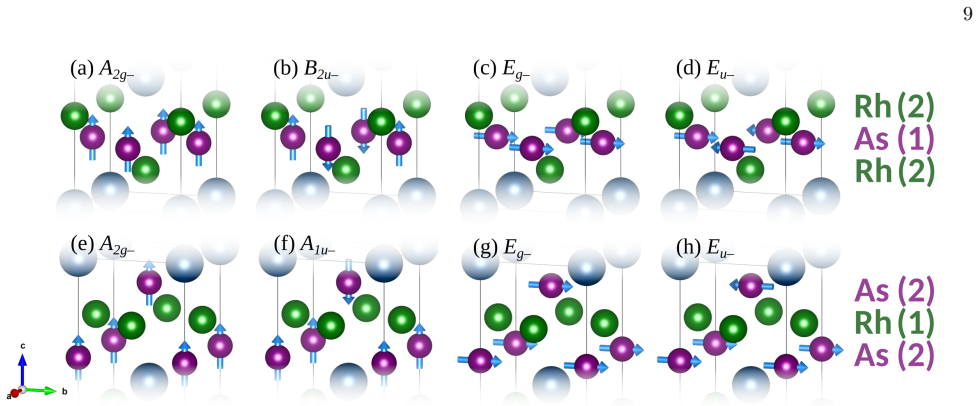
The argument runs on a Landau free-energy expansion in two effective superconducting order parameters, the even-parity $B_{1g}^+$ (primary at low field) and the odd-parity $B_{1u}^+$ (induced by magnetic order), plus the $A_{1u}^-$ magnetic order parameter, with the field-induced $B_{2g}^+$ and $B_{2u}^+$ components integrated out. The load-bearing structures are the trilinear invariants, $M i(\Delta_1^*\Delta_2 - \Delta_2^*\Delta_1)$ and its magnetic-field analogue $B_z i(\Delta_1^*\Delta_2 - \Delta_2^*\Delta_1)$, which force a third order parameter to appear whenever the other two are present and which can be shown in the pseudospin picture to favor the odd-parity pair at high field. A second mechanism carries the near-degeneracy argument: projecting the pairing states onto the low-energy band gives a gap renormalization factor, and unless intralayer spin-orbit coupling is the largest normal-state scale, the $B_{2u}^+$ gap is exponentially suppressed, which would eliminate the proposed high-field partner state.
What would settle it
Measure the band-structure ratio of intralayer spin-orbit coupling to interlayer hopping near the Fermi surface; if $c_1 \gtrsim c_3 = c_4$, the near-degeneracy is lost and the predicted high-field coexistence phase should not form. Alternatively, trace the first-order transition line in high-resolution specific-heat or susceptibility measurements: if it does not terminate in a critical endpoint and crossover near $T \approx 0.2$ K, the symmetry-preserving interpretation is falsified.
Extended reading notes
Core claim
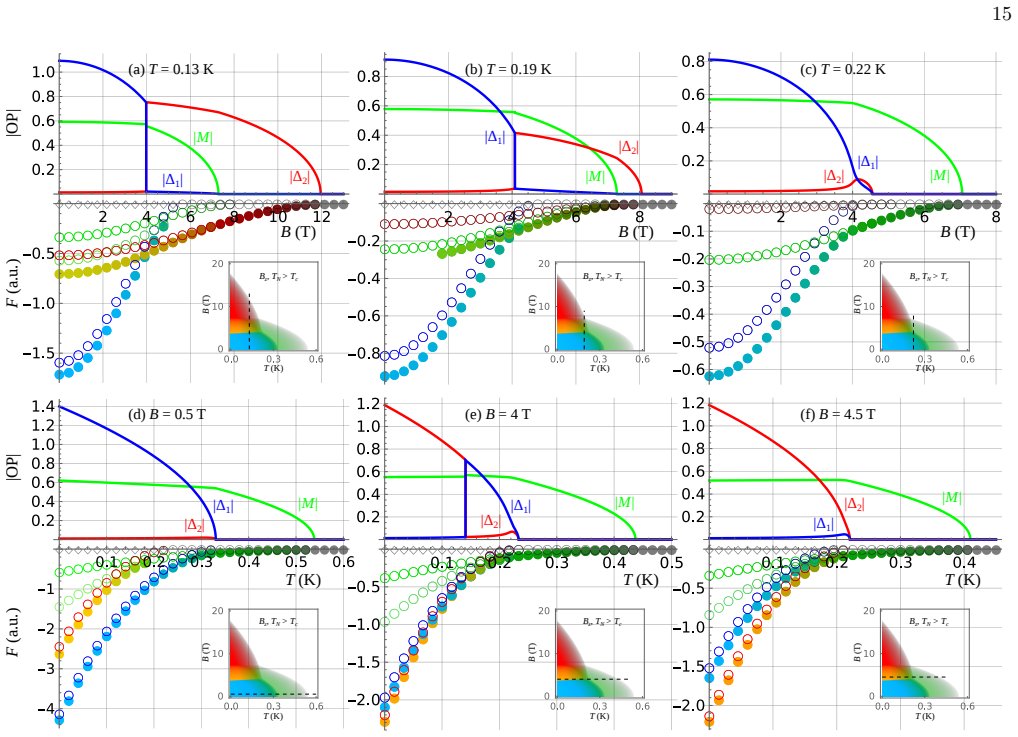
The central claim is that the low-field and high-field superconducting phases of CeRh2As2 are not distinct superconducting states in the symmetry sense. In the presence of the $A_{1u}^-$ antiferromagnetic order and a magnetic field along the $c$-axis, the superconducting condensate carries the same set of order parameters on both sides of the 4 T first-order transition: the even-parity, spin-singlet $B_{1g}^+$ and induced $B_{2g}^+$ components, and the odd-parity $B_{1u}^+$ and $B_{2u}^+$ components, with the $B_{2u}^+$ component gaining weight at high field. The transition is then a symmetry-preserving first-order transition between coexistence phases, driven by a trilinear Landau invariant that couples the magnetic order parameter to pairs of superconducting order parameters, together with Pauli limiting that suppresses the even-parity singlet component at high field. The paper predicts that the first-order line terminates in a critical endpoint below $T_c$, beyond which the two phases are connected by a crossover, and it shows that the same Landau theory reproduces the measured phase diagrams for both possible orderings of the magnetic and superconducting critical temperatures.
Load-bearing premise
The scenario collapses unless intralayer spin-orbit coupling is larger than interlayer hopping in CeRh2As2, since only then are the $B_{1g}^+$ and $B_{2u}^+$ pairing channels near degenerate instead of the $B_{2u}^+$ gap being exponentially suppressed.
Editorial extensions
If this is right
- The 4 T transition in CeRh2As2 is predicted to conserve all symmetries; the low- and high-field superconductors should show the same set of order parameters with different amplitudes.
- A critical endpoint should exist near $T \approx 0.21$ K and $B \approx 4$ T, with a crossover region instead of a transition above it; the endpoint should appear as a pronounced maximum in the specific heat and a smooth evolution of the susceptibility.
- The high-field phase avoids Pauli limiting because the odd-parity $B_{1u}^+$ and $B_{2u}^+$ components are pseudospin-triplet with in-plane $d$-vectors, explaining why superconductivity survives to fields near 14 T.
- The phase diagram for in-plane field should show no high-field superconducting phase, because the induced $E_u^+$ order parameter is not near-degenerate with the primary $B_{1g}^+$ order parameter.
- Both $T_N > T_c$ and $T_N < T_c$ phase diagrams follow from the same Landau functional with a single changed parameter, the magnetic critical temperature $T_M$.
Reading between the lines
- Because the mechanism only needs a nonzero trilinear coupling between a magnetic order parameter and two near-degenerate superconducting channels, symmetry-preserving first-order transitions of this kind may appear in other locally noncentrosymmetric superconductors, not just CeRh2As2.
- Re-analyzing existing specific-heat and susceptibility data near 0.2 K and 4 T with the predicted critical endpoint in mind could reveal the crossover region in already published measurements, since the paper notes that the predicted kink-like anomaly has actually been observed in one dataset.
- In-plane-field experiments that find a high-field superconducting phase would challenge the near-degeneracy assumption; conversely, a high-field phase with an out-of-plane $d$-vector component would be a distinctive signature of the induced $E_u^+$ component surviving.
Editorial analysis
A structured set of objections, weighed in public.
Referee Report
Summary. This manuscript develops a theoretical framework for CeRh2As2 based on symmetry analysis of a Bogoliubov–de Gennes Hamiltonian, a pseudospin projection of pairing states, and a Landau free energy with multiple order parameters. The authors identify B1g+ as the dominant low-field superconducting OP, B1u+ and B2u+ as important odd-parity contributions at high field, and A1u- magnetic order, and they argue from the pseudospin projection that near-degeneracy of B1g+ and B2u+ requires intralayer spin-orbit coupling to exceed interlayer hopping. A Landau free energy with two explicit superconducting OPs (B1g+, B1u+) and one magnetic OP (A1u-) is fitted to the experimental temperature-magnetic-field phase diagrams for both TN>Tc and TN<Tc and for field directions from [001] to [110]. The central claim is that the field-induced first-order superconductor-to-superconductor transition at about 4 T is a symmetry-preserving transition between two coexistence phases of the same OPs, and that this first-order line ends in a critical endpoint followed by a crossover. Susceptibility and specific-heat curves are computed and compared qualitatively with experiments.
Significance. If the central claim holds, the paper gives a concrete and falsifiable scenario for multicomponent superconductivity in CeRh2As2: the low-field and high-field superconducting phases share the same set of irreducible representations and differ only in OP amplitudes, which is a genuinely new proposal for this material. The symmetry classification in Secs. II–V is careful and internally consistent, and the pseudospin-projection analysis leading to the B1g+/B2u+ near-degeneracy condition is a substantive technical contribution. The predictions of a critical endpoint, a crossover region, and a specific-heat kink near the endpoint are experimentally testable. However, the phase-diagram results that support the headline prediction are obtained from a 16-coefficient Landau free energy fitted to the experimental phase diagrams, and the paper does not provide a robustness analysis showing that the predicted topology (two minima, critical endpoint, crossover) survives parameter variations. The manuscript itself acknowledges the parameter-count concern in Sec. VIII but responds with a qualitative argument rather than a quantitative sensitivity study.
major comments (3)
- [Sec. VI A and parameter list before Fig. 7; Sec. VIII] The predicted first-order transition between same-symmetry coexistence phases and its critical endpoint are the central claims, but they rest entirely on the fitted Landau coefficients (α'1=12, α'2=13, γ12=12, δ12M=0.55, λz1=0.08, etc.). No sensitivity or robustness analysis is provided. The statement in Sec. VIII that reproducing the three-dimensional phase diagrams 'strongly constrains the remaining parameters' is not demonstrated quantitatively, and the comparisons in Sec. VII are in arbitrary units and qualitative. A small change in γ12 or δ12M can eliminate the two-minimum structure or move the endpoint to T=0, so the reader cannot tell whether the critical endpoint is a robust prediction or an artifact of the chosen coefficients. I request a systematic parameter scan, or at least a discussion of the parameter ranges that preserve the topology of Fig. 5, including the endpoint temperature.
- [Sec. III B and Sec. VI A] There is a gap between the microscopic near-degeneracy argument and the Landau model. The paper argues in Sec. III B that B1g+ and B2u+ are nearly degenerate only if intralayer SOC exceeds interlayer hopping (c3=c4 >> c1), and this is the basis for avoiding fine-tuning. However, the Landau free energy of Sec. VI uses Δ1 of B1g+ symmetry and Δ2 of B1u+ symmetry, not B2u+, with bare critical temperatures T1=0.34 K and T2=0.24 K chosen by hand. The B2u+ OP is integrated out, but no expression is given for how the microscopic hierarchy translates into the effective Landau coefficients γ12, δ12M, and λz2. Thus the link between the microscopic hierarchy and the phase-diagram predictions remains qualitative, and the near-degeneracy that is central to the scenario is imposed through the fitted T1 and T2 rather than derived. This should be clarified, and ideally an estimate of the effective coupling constants from the pseudospin calculation should be provided.
- [Sec. V D and Sec. VII] The proposed high-field phase is predominantly pseudospin-triplet (B1u+ and B2u+), but the Knight-shift data of Ogata et al. [9] indicate a temperature-dependent Knight shift below Tc in both phases, which the authors themselves note is 'inconsistent with the authors' interpretation' if interpreted as pseudospin-singlet. The manuscript offers a qualitative resolution: a sizable pseudospin-singlet admixture and a small d_z component in the triplet OPs. Given that the high-field phase identity is load-bearing for the first-order transition, this resolution should be backed by a quantitative calculation of the Knight shift from the proposed OP admixtures, or at least by an explicit demonstration that the singlet weight remains sufficiently large at Bz = 4.5 T to explain the observed temperature dependence.
minor comments (4)
- [Appendix B, Eq. (B4)] The text says 'Solving dU/d|Δ| = 0 in terms of U yields' but the equation that follows is solved for |Δ| in terms of the interaction V; 'in terms of U' appears to be a typo and should be corrected.
- [Sec. V A, Eq. (40) paragraph] The word 'triliniear' is a typo for 'trilinear'.
- [Sec. VI A, coefficient discussion] The notation 'α′1,2 > α′M' is ambiguous; it should be written as α′1 > α′M and α′2 > α′M, or similar, to avoid confusion.
- [Figs. 5, 6, 8, 9] The RGB color mixing used to denote OP admixtures may be difficult to interpret in monochrome print; adding line styles, hatching, or labeled regions would improve accessibility.
Circularity Check
No circular reduction of the central prediction; the critical-endpoint and same-symmetry transition are emergent from a Landau model rather than being equivalent to its fitted inputs.
full rationale
The symmetry classification and group-theoretic steps are independent of the Landau fitting: the B1g+ low-field channel, the A1u- magnetic order, and the field-induced B1u/B2u admixtures follow from irreps and experimental constraints, not from the Landau parameters. The SOC-hierarchy argument in Sec. III B is derived from the normal-state Hamiltonian and Table V, with external band-structure support, not from a self-citation. The Landau coefficients are admittedly fitted to experimental phase diagrams, so reproducing the existing 4 T first-order transition is not independent prediction. However, the symmetry-preserving nature of that transition is already obtained in Sec. V A before the Landau model, and the critical endpoint/crossover is an emergent feature not used as a fitting target. The paper's later match to the specific-heat anomaly is a postdiction, not a fitted input renamed as prediction. The 'fitting an elephant' paragraph acknowledges parameter count but provides no sensitivity analysis; that is a robustness limitation, not circularity. Self-citations are methodological and do not import a uniqueness theorem or forbid alternatives. No equation reduces to its own input by construction. Score 2 reflects only the fit-input dependence of the Landau phase-diagram reproduction, not circular derivation of the central claims.
Assumptions & free parameters
free parameters (16)
- alpha'_1 =
12 (arbitrary units)
- alpha'_2 =
13 (arbitrary units)
- alpha'_M =
2.8 (arbitrary units)
- gamma_12 =
12 (arbitrary units)
- gamma_1M =
0.38 (arbitrary units)
- gamma_2M =
0.44 (arbitrary units)
- delta_12M =
0.55 (magnitude, arbitrary units)
- lambda_z1 =
0.08 (arbitrary units)
- lambda_z2 =
0.01 (arbitrary units)
- lambda_zM =
0.018 (arbitrary units)
- lambda_xy1 =
0.5 (arbitrary units)
- lambda_xy2 =
0.4 (arbitrary units)
- lambda_xyM =
-0.001 (arbitrary units)
- T1 =
0.34 K
- T2 =
0.24 K
- TM =
0.54 K for TN>Tc, 0.32 K for TN<Tc
assumptions (5)
- domain assumption The effective model with a single Kramers doublet per Ce site, the Gamma_7 (E3/2) doublet, captures the low-energy physics.
- ad hoc to paper The leading pairing interaction is in-plane nearest-neighbor, with on-site Hubbard repulsion suppressing local singlet pairing and no pi-junction between layers.
- domain assumption Magnetic order preserves translational symmetry and has A1u- symmetry.
- standard math The weak-coupling BCS relation between a gap renormalization factor eta and exponential suppression of the critical temperature applies.
- ad hoc to paper The Landau free energy truncated at fourth order, with the chosen hierarchy of coefficients, captures the topology of the phase diagram.
Cite this review
Pith. "Pith review of Composite Superconducting Orders and Magnetism in CeRh$_2$As$_2$." pith.science (2026). https://pith.science/paper/QPMLYTSS
@misc{pith2026250608097,
  author       = {Pith},
  title        = {Pith review of: Composite Superconducting Orders and Magnetism in CeRh$_2$As$_2$},
  year         = {2026},
  howpublished = {\url{https://pith.science/paper/QPMLYTSS}},
  note         = {Machine review of arXiv:2506.08097}
}
abstract
Locally noncentrosymmetric materials are attracting significant attention due to the unique phenomena associated with sublattice degrees of freedom. The recently discovered heavy-fermion superconductor CeRh$_2$As$_2$ has emerged as a compelling example of this class, garnering widespread interest for its remarkable temperature-magnetic-field phase diagram, which features a field-induced first-order superconductor-to-superconductor phase transition with nontrivial dependence on the field direction and high critical fields, as well as antiferromagnetic and potentially higher multipole orders. To investigate the complex interplay of the ordered phases in CeRh$_2$As$_2$, we develop a theoretical framework based on symmetry analysis applied to a Bogoliubov--de Gennes Hamiltonian and Landau methods. This approach allows us to propose probable symmetries of the superconducting states and elucidate their close relationship with magnetism. Among other results, we find that the near degeneracy of two pairing symmetries is naturally explained if and only if intralayer spin-orbit coupling is large compared to interlayer hopping. Intriguingly, we find that the first-order transition can be interpreted as a transition between coexistence phases of the same superconducting order parameters, albeit with distinct admixtures. This line may end in a critical end point below the superconducting critical temperature. Our approach accurately reproduces current experimental phase diagrams for varying temperature as well as out-of-plane and in-plane magnetic field, both if the transition to a magnetic phase occurs below the superconducting critical temperature and if it occurs above. Furthermore, we calculate the magnetic susceptibility and the specific heat and compare these quantities to recent experimental results.
Figures


Figures from the paper (10 more)




Forward citations
Cited by 1 Pith paper
-
Incommensurate modulation with $Q=0$ A-type Antiferromagnetic Order in CeRh$_2$As$_2$ revealed by NQR studies
NQR/NMR spectra of a high-quality CeRh2As2 crystal show that its antiferromagnetic order combines a Q=0 A-type structure with a 2D incommensurate in-plane modulation.
Reference graph
Works this paper leans on
-
[1]
M. H. Fischer, F. Loder, and M. Sigrist, Superconductiv- ity and local noncentrosymmetricity in crystal lattices, Phys. Rev. B84, 184533 (2011)
work page 2011
-
[9]
invoke a spatially modulated superconducting state in order to resolve the problem. In our scenario, the temperature-dependent Knight shift atB z = 4.5 T is naturally attributed to the coexistence of multiple su- perconducting OPs: there is still a sizable pseudospin- singlet contribution. In addition, thedvectors describing the pseudospin-triplet OPs do ...
-
[2]
D. Maruyama, M. Sigrist, and Y. Yanase, Locally non- centrosymmetric superconductivity in multilayer sys- tems, J. Phys. Soc. Jpn.81, 034702 (2012). 22
work page 2012
-
[3]
Sigrist, D
M. Sigrist, D. F. Agterberg, M. H. Fischer, J. Goryo, F. Loder, S.-H. Rhim, D. Maruyama, Y. Yanase, T. Yoshida, and S. J. Youn, Superconductors with stag- gered non-centrosymmetricity, J. Phys. Soc. Jpn.83, 061014 (2014)
2014
-
[4]
Yoshida, M
T. Yoshida, M. Sigrist, and Y. Yanase, Parity-mixed su- perconductivity in locally non-centrosymmetric system, J. Phys. Soc. Jpn.83, 013703 (2014)
2014
-
[5]
M. H. Fischer, M. Sigrist, D. F. Agterberg, and Y. Yanase, Superconductivity and Local Inversion- Symmetry Breaking, Annu. Rev. Condens. Matter Phys. 14, 040521 (2023)
work page 2023
-
[6]
S. Khim, J. F. Landaeta, J. Banda, N. Bannor, M. Brando, P. M. R. Brydon, D. Hafner, R. K¨ uchler, R. Cardoso-Gil, U. Stockert, A. P. Mackenzie, D. F. Agterberg, C. Geibel, and E. Hassinger, Field-induced transition within the superconducting state of CeRh2As2, Science373, 1012 (2021)
2021
-
[7]
J. F. Landaeta, P. Khanenko, D. C. Cavanagh, C. Geibel, S. Khim, S. Mishra, I. Sheikin, P. M. R. Brydon, D. F. Agterberg, M. Brando, and E. Hassinger, Field-Angle Dependence Reveals Odd-Parity Superconductivity in CeRh2As2, Phys. Rev. X12, 031001 (2022)
work page 2022
Show all 66 references
-
[8]
D. C. Cavanagh, T. Shishidou, M. Weinert, P. M. R. Brydon, and D. F. Agterberg, Nonsymmorphic symmetry and field-driven odd-parity pairing in CeRh 2As2, Phys. Rev. B105, L020505 (2022)
2022
-
[10]
B. K. Nally and P. M. R. Brydon, Phase diagram of strongly-coupled Rashba systems, New J. Phys.26, 093015 (2024)
2024
-
[11]
Hafner, P
D. Hafner, P. Khanenko, E.-O. Eljaouhari, R. K¨ uchler, J. Banda, N. Bannor, T. L¨ uhmann, J. F. Landaeta, S. Mishra, I. Sheikin, E. Hassinger, S. Khim, C. Geibel, G. Zwicknagl, and M. Brando, Possible Quadrupole Density Wave in the Superconducting Kondo Lattice CeRh2As2, Phys...
2022
-
[12]
Ogata, S
S. Ogata, S. Kitagawa, K. Kinjo, K. Ishida, M. Brando, E. Hassinger, C. Geibel, and S. Khim, Parity Transition of Spin-Singlet Superconductivity Using Sublattice De- grees of Freedom, Phys. Rev. Lett.130, 166001 (2023)
2023
-
[13]
Mishra, Y
S. Mishra, Y. Liu, E. D. Bauer, F. Ronning, and S. M. Thomas, Anisotropic magnetotransport properties of the heavy-fermion superconductor CeRh 2As2, Phys. Rev. B 106, L140502 (2022)
2022
-
[14]
Kibune, S
M. Kibune, S. Kitagawa, K. Kinjo, S. Ogata, M. Man- ago, T. Taniguchi, K. Ishida, M. Brando, E. Hassinger, H. Rosner, C. Geibel, and S. Khim, Observation of Anti- ferromagnetic Order as Odd-Parity Multipoles inside the Superconducting Phase in CeRh 2As2, Phys. Rev. Lett. 128, ...
2022
-
[15]
Khanenko, D
P. Khanenko, D. Hafner, K. Semeniuk, J. Banda, T. L¨ uhmann, F. B¨ artl, T. Kotte, J. Wosnitza, G. Zwick- nagl, C. Geibel, J. F. Landaeta, S. Khim, E. Hassinger, and M. Brando, Origin of the non-Fermi-liquid behavior in CeRh2As2, Phys. Rev. B111, 045162 (2025)
2025
-
[16]
S. Khim, O. Stockert, M. Brando, C. Geibel, C. Baines, T. J. Hicken, H. Luetkens, D. Das, T. Shiroka, Z. Guguchia, and R. Scheuermann, Coexistence of local magnetism and superconductivity in the heavy-fermion compound cerh 2as2 revealed byµSR studies, Phys. Rev. B111, 115134 (2025)
2025
-
[17]
Timm and A
C. Timm and A. Bhattacharya, Symmetry, nodal struc- ture, and Bogoliubov Fermi surfaces for nonlocal pairing, Phys. Rev. B104, 094529 (2021)
2021
-
[18]
Ogata, S
S. Ogata, S. Kitagawa, K. Kinjo, K. Ishida, M. Brando, E. Hassinger, C. Geibel, and S. Khim, Appearance of c- axis magnetic moment in odd-parity antiferromagnetic state in CeRh2As2 revealed by 75As-NMR, Phys. Rev. B 110, 214509 (2024)
2024
-
[19]
The corresponding form factors thus describe hopping over half-integer separations and therefore contain sine and cosine functions of half-integer multiples ofk x,k y, kz
The matricesh 1 andh 2 containτ x andτ y, respectively. The corresponding form factors thus describe hopping over half-integer separations and therefore contain sine and cosine functions of half-integer multiples ofk x,k y, kz. The matricesh 3,h 4, andh 5 containτ z and the co...
-
[20]
J. M. Link and I. F. Herbut, Bogoliubov-Fermi Surfaces in Noncentrosymmetric Multicomponent Superconduc- tors, Phys. Rev. Lett.125, 237004 (2020)
2020
-
[21]
A. Amin, H. Wu, T. Shishidou, and D. F. Agterberg, Kramers’ degenerate magnetism and superconductivity, Phys. Rev. B109, 024502 (2024)
2024
-
[22]
Zwicknagl, The utility of band theory in strongly cor- related electron systems, Rep
G. Zwicknagl, The utility of band theory in strongly cor- related electron systems, Rep. Progr. Phys.79, 124501 (2016)
2016
-
[23]
Nogaki, A
K. Nogaki, A. Daido, J. Ishizuka, and Y. Yanase, Topo- logical crystalline superconductivity in locally noncen- trosymmetric CeRh 2As2, Phys. Rev. Res.3, L032071 (2021)
2021
-
[24]
Zwicknagl, Quasi-particles in heavy fermion systems, Adv
G. Zwicknagl, Quasi-particles in heavy fermion systems, Adv. Phys.41, 203 (1992)
1992
-
[25]
Jakubczyk, A
F. Jakubczyk, A. Consiglio, D. Di Sante, R. Thomale, and C. Timm, Orbital-selective spin-triplet supercon- ductivity in infinite-layer LaNiO 2, Phys. Rev. B112, L100503 (2025)
2025
-
[26]
Strong AFM fluctuations may be present in CeRh 2As2 but these do not generally lead to triplet pairing, as seen for the cuprate and iron-pnictide superconductors
-
[27]
A. Ptok, K. J. Kapcia, P. T. Jochym, J. La˙ zewski, A. M. Ole´ s, and P. Piekarz, Electronic and dynamical properties of CeRh2As2: Role of Rh2As2 layers and expected orbital order, Phys. Rev. B104, L041109 (2021)
2021
-
[28]
D. F. Agterberg, P. M. R. Brydon, and C. Timm, Bo- goliubov Fermi Surfaces in Superconductors with Broken Time-Reversal Symmetry, Phys. Rev. Lett.118, 127001 (2017)
2017
-
[29]
P. M. R. Brydon, D. F. Agterberg, H. Menke, and C. Timm, Bogoliubov Fermi surfaces: General theory, magnetic order, and topology, Phys. Rev. B98, 224509 (2018)
2018
-
[30]
Fu, Parity-Breaking Phases of Spin-Orbit-Coupled Metals with Gyrotropic, Ferroelectric, and Multipolar Orders, Phys
L. Fu, Parity-Breaking Phases of Spin-Orbit-Coupled Metals with Gyrotropic, Ferroelectric, and Multipolar Orders, Phys. Rev. Lett.115, 026401 (2015)
2015
-
[31]
The averages c3 and c4 must be equal becausec 3(k) and c4(k) are basis functions of the two components ofE u
-
[32]
C. Lee, D. F. Agterberg, and P. M. R. Brydon, Uni- fied Picture of Superconductivity and Magnetism in CeRh2As2, Phys. Rev. Lett.135, 026003 (2025)
2025
-
[33]
T 0 order
using the fluctuation exchange approximation, by Nally and Brydon [10] from at–Jmodel treated within a mean-field approximation, and by Leeet al.[32] with a parquet renormalization-group approach. IV. MAGNETIC ORDERING Magnetic ordering in CeRh2As2 was first inferred from NQR ...
-
[34]
Sigrist and K
M. Sigrist and K. Ueda, Phenomenological theory of un- conventional superconductivity, Rev. Mod. Phys.63, 239 (1991)
1991
-
[35]
The moments in even-numbered and odd-numbered dou- ble layers could, in principle, be constrained by measur- ing the magnetic field at the Rh(1) sites
-
[36]
Note thatA 1u− magnetic order is odd under inversion and under TR but even under their product
have come to the same conclusion. Note thatA 1u− magnetic order is odd under inversion and under TR but even under their product. This is the case considered by Aminet al.[18]. On the other hand, the out-of-plane N´ eel vector of theA 1u− order seems to contradict the experime...
-
[37]
Nogaki and Y
K. Nogaki and Y. Yanase, Even-odd parity transition in strongly correlated locally noncentrosymmetric super- conductors: Application to CeRh2As2, Phys. Rev. B106, L100504 (2022)
2022
-
[38]
The field at the As(1) sites from breaking these constraints may be too weak to ob- 23 serve
Except for the double layers, these constraints rely on longer-range dipole fields. The field at the As(1) sites from breaking these constraints may be too weak to ob- 23 serve
-
[39]
A. L. Szab´ o and A. Ramires, Superconductivity-induced improper orders in nonsymmorphic systems, Phys. Rev. B110, L180503 (2024)
2024
-
[40]
Conversely,A 2g−,E g−, andE u− would lead to nonzero fields at all As sites,B 2u− to nonzero field only at As(1) sites, and all other TR-odd irreps to vanishing field at all As sites
-
[41]
Kitagawa, M
S. Kitagawa, M. Kibune, K. Kinjo, M. Manago, T. Taniguchi, K. Ishida, M. Brando, E. Hassinger, C. Geibel, and S. Khim, Two-Dimensional XY-Type Magnetic Properties of Locally Noncentrosymmetric Su- perconductor CeRh 2As2, J. Phys. Soc. Jpn.91, 043702 (2022)
2022
-
[42]
Khanenko, J
P. Khanenko, J. F. Landaeta, S. Ruet, T. L¨ uhmann, K. Semeniuk, M. Pelly, A. W. Rost, G. Chajewski, D. Kaczorowski, C. Geibel, S. Khim, E. Hassinger, and M. Brando, Phase diagram of CeRh 2As2 for out-of-plane magnetic field, Phys. Rev. B112, L060501 (2025)
2025
-
[43]
Smidman, M
M. Smidman, M. B. Salamon, H. Q. Yuan, and D. F. Agterberg, Superconductivity and spin–orbit coupling in non-centrosymmetric materials: a review, Rep. Prog. Phys.80, 036501 (2017)
2017
-
[44]
H. Waje, F. Jakubczyk, J. van den Brink, and C. Timm, Ginzburg-Landau theory for unconventional surface su- perconductivity in PtBi 2, arXiv:2507.02415
-
[45]
Machida, Violation of Pauli-Clogston limit in the heavy-fermion superconductor CeRh 2As2: Duality of itinerant and localized 4f electrons, Phys
K. Machida, Violation of Pauli-Clogston limit in the heavy-fermion superconductor CeRh 2As2: Duality of itinerant and localized 4f electrons, Phys. Rev. B106, 184509 (2022)
2022
-
[46]
The convention for the components is the same as for the doublets (σx, σy) and (B x, By) in the case ofE g and the same multiplied by anA 1u basis function in the case of Eu
-
[47]
A. L. Szab´ o, M. H. Fischer, and M. Sigrist, Effects of nucleation at a first-order transition between two super- conducting phases: Application to CeRh2As2, Phys. Rev. Res.6, 023080 (2024)
2024
-
[48]
E. G. Schertenleib, M. H. Fischer, and M. Sigrist, Un- usualH−Tphase diagram of CeRh 2As2: The role of staggered noncentrosymmetricity, Phys. Rev. Res.3, 023179 (2021)
2021
-
[49]
B. S. Chandrasekhar, A note on the maximum critical field of high-field superconductors, Appl. Phys. Lett.1, 7 (1962)
1962
-
[50]
A. M. Clogston, Upper Limit for the Critical Field in Hard Superconductors, Phys. Rev. Lett.9, 266 (1962)
1962
-
[51]
N. R. Werthamer, E. Helfand, and P. C. Hohenberg, Tem- perature and purity dependence of the superconducting critical field,H c2. III. Electron spin and spin-orbit effects, Phys. Rev.147, 295 (1966)
1966
-
[52]
Fulde and R
P. Fulde and R. A. Ferrell, Superconductivity in a Strong Spin-Exchange Field, Phys. Rev.135, A550 (1964)
1964
-
[53]
A. I. Larkin and Y. N. Ovchinnikov, Nonuniform state of superconductors, Sov. Phys. JETP20, 762 (1965)
1965
-
[54]
P. A. Frigeri, D. F. Agterberg, A. Koga, and M. Sigrist, Superconductivity without Inversion Symmetry: MnSi versus CePt3Si, Phys. Rev. Lett.92, 097001 (2004)
2004
-
[55]
J. R. Schrieffer,Theory of Superconductivity(Addison- Wesley, Redwood City, 1964)
1964
-
[56]
(38) would naively be forbidden by symmetry
If we were to write the free energy in terms ofB 1g+ andB 2u+ OPs, then the trilinear term in Eq. (38) would naively be forbidden by symmetry. At nonzeroB z, this trilinear term would be generated when theB 1u+ OP is integrated out. However, this mechanism does not work at zer...
-
[57]
Schmidt and P
B. Schmidt and P. Thalmeier, Anisotropic magnetic and quadrupolarH−Tphase diagram of CeRh 2As2, Phys. Rev. B110, 075154 (2024)
2024
-
[58]
We note that the inclusion of thus far disregarded po- tential in-plane (E g−) FM magnetic contributions and their couplings to the superconducting OPs could yield an alternative explanation
-
[59]
Chajewski and D
G. Chajewski and D. Kaczorowski, Discovery of Mag- netic Phase Transitions in Heavy-Fermion Superconduc- tor CeRh2As2, Phys. Rev. Lett.132, 076504 (2024)
2024
-
[60]
A. P. Schnyder and P. M. R. Brydon, Topological sur- face states in nodal superconductors, J. Phys.: Condens. Matter27, 243201 (2015)
2015
-
[61]
Hoshi, R
K. Hoshi, R. Kurihara, Y. Goto, M. Tokunaga, and Y. Mizuguchi, Extremely high upper critical field in BiCh2-based (Ch: S and Se) layered superconductor LaO0.5F0.5BiS2−xSex (x= 0.22 and 0.69), Sci. Rep.12, 288 (2022)
2022
-
[62]
P. A. Miles, S. J. Kennedy, G. J. McIntyre, G. D. Gu, G. J. Russell, and N. Koshizuka, Refinement of the in- commensurate structure of high quality Bi-2212 single crystals from a neutron diffraction study, Physica C: Su- percond.294, 275 (1998)
1998
-
[63]
Gotlieb, C.-Y
K. Gotlieb, C.-Y. Lin, M. Serbyn, W. Zhang, C. L. Small- wood, C. Jozwiak, H. Eisaki, Z. Hussain, A. Vishwanath, and A. Lanzara, Revealing hidden spin-momentum lock- ing in a high-temperature cuprate superconductor, Sci- ence362, 1271 (2018)
2018
-
[64]
W. A. Atkinson, Microscopic model for the hidden Rashba effect in YBa 2Cu3O6+x, Phys. Rev. B101, 024513 (2020)
2020
-
[65]
Lu and D
X. Lu and D. S´ en´ echal, Spin texture in a bilayer high- temperature cuprate superconductor, Phys. Rev. B104, 024502 (2021)
2021
-
[66]
For a parabolic band with effective massmand chemical potentialµ, one findsα=v uc(2m)3/2√µ/4π2, wherev uc is the unit-cell volume
Reviewed August 7, 2026 · model on record in the stance chip above.
Discussion (0). Sign in to comment.