REVIEW 3 major objections 5 minor 58 references
Operator theoretic causality analysis of fluid flows using linearized dynamics
T0 review · 3 major / 5 minor · reviewed 2026-08-07 · deepseek-v4-flash
Pith's one-line read The paper proposes that for linearized systems, the matrix exponential of the dynamics operator encodes which flow modes cause which at any future time.
desk verdict A sound operator-theoretic core wrapped in some overclaimed equivalence and a missing example; the Couette flow analysis is the strongest part. read the letter →
The pith
A machine-rendered reading of the paper's core claim, the machinery that carries it, and where it could break.
The reading
What carries the argument
The central object is the matrix exponential $e^{A\tau}$ of the linearized operator $A$, together with the global matrix $M=(\alpha I-|A|)^{-1}$ built from the elementwise absolute value of $A$. In the power series $e^{A\tau}=I+A\tau+\tfrac12 A^2\tau^2+\cdots$, the $k$-th term accounts for indirect causal pathways of length $k$; this is why a zero direct coupling can still yield delayed or global causality. $M$ is a Neumann-series upper bound on $\sum_k |A^k|$, so its zero entries are rigorous statements of causal disconnection across all times.
What would settle it
Take a two-variable linear system with known $A$ and deliberately correlated state variables, generate noise-forced data, and compare the Granger $F$-statistic with $([e^{A\Delta t}]_{ij})^2 \sigma_j^2/\sigma_{\epsilon,i}^2$. If $RSS_r-RSS_u$ differs from $([e^{A\Delta t}]_{ij})^2\sum_n c_j(t_{n-1})^2$ by an amount that grows with the correlation between $c_j$ and the other variable, then Eq. (3.6) is violated and LOCA and Granger will disagree exactly where the paper says they converge.
Extended reading notes
Core claim
For a system in canonical form $\dot{\mathbf{c}}=A\mathbf{c}$, the paper's central claim is that the matrix exponential $e^{A\tau}$ 'encapsulates the essential causal relations among the modes at any future time': entry $(i,j)$ is the counterfactual response of mode $i$ at time $\tau$ to an initial perturbation of mode $j$. Immediate causality is the direct coupling $A_{ij}\neq 0$; delayed causality is the corresponding entry of $e^{A\tau}$; and global causality is measured by $M=(\alpha I-|A|)^{-1}$, chosen so that a zero entry definitively rules out any causal path over all times. A modified $F$-statistic $F_{j\to i}=[e^{A\tau}]_{ij}^2 \sigma_j^2/\sigma_{\epsilon,i}^2$ weights these entries by state and error variances. The paper further shows that LOCA and Granger causality agree when state variables are uncorrelated, that transfer entropy agrees in the linear Gaussian case, and that a DMD-style estimate of the matrix exponential recovers the same causal structure from data.
Load-bearing premise
The load-bearing premise is that when a variable is omitted from the restricted regression, the remaining coefficients stay identical to those in the unrestricted model, so the omitted variable's contribution appears directly in the residual; in correlated systems least-squares refits the remaining coefficients and that identity no longer holds.
Editorial extensions
If this is right
- In linearized fluid systems, the cause-effect structure can be computed from the operator alone, without long time-series records, and interpreted physically through the underlying mechanisms.
- A zero entry in $M$ identifies modes that are causally disconnected, and this directly implies loss of controllability if the input acts on the cause mode and loss of observability if the measurement is of the effect mode.
- Granger causality and transfer entropy, in the linear Gaussian setting, measure essentially the squared matrix-exponential entries, so LOCA supplies the same information as data-driven causality analyses when variables are uncorrelated.
- Truncation of modes by energy (POD) can discard low-energy modes that carry dominant causal influence, whereas balanced truncation preserves the leading causal interactions.
- The DMD-based variant LOCA-DMD estimates the matrix exponential from data and reproduces the operator-based causality metric with short data records.
Reading between the lines
- Editorial extension: the equivalence with Granger causality rests on the restricted regression keeping its coefficients fixed when a variable is dropped; when variables are correlated the remaining coefficients re-fit, so the difference between LOCA and Granger should be quantifiable as a correlation-dependent correction term.
- Editorial extension: because $M$ bounds rather than equals $\sum_k |A^k|$, it certifies absence of causality but can overstate the strength of present causality; an exact global measure would require the generally unavailable closed form of the absolute-power series.
- Editorial extension: for nonlinear chaotic flows, LOCA describes infinitesimal perturbations, so its causal rankings may differ from finite-amplitude causal pathways; comparing LOCA with data-driven causality on the same chaotic attractor would test how far the linearized notion extends.
- Editorial extension: a practical diagnostic follows—when applying Granger or transfer entropy to fluid data, decorrelating variables first (e.g., with POD modes) should make the statistical estimate converge to the operator-based result, and the residual discrepancy measures correlation contamination.
Editorial analysis
A structured set of objections, weighed in public.
Referee Report
Summary. This paper introduces Linear Operator Causality Analysis (LOCA), a framework for quantifying causal interactions among modes of linearized dynamical systems. Causality is defined through the matrix exponential of the system matrix A, with immediate causality given by nonzero off-diagonal entries of A, delayed causality by entries of e^{Aτ}, and global causality by the Neumann-series bound M=(αI−|A|)^{-1}. The paper establishes formal connections between LOCA and Granger causality/transfer entropy, controllability/observability, and transitive closure in graph theory, and proposes a DMD-based data-driven estimator (LOCA-DMD). The methods are illustrated on a nilpotent toy problem and on linearized Couette flow, where LOCA is shown to capture direct and indirect causal pathways, to be robust to correlated variables when applied in POD coordinates, and to motivate balanced truncation for model reduction that preserves causal information.
Significance. The counterfactual definition of delayed causality via [e^{Aτ}]_{ij} is exact and well motivated for linear time-invariant systems, and the paper's distinction between immediate, delayed, and global causality is conceptually useful for fluid mechanics. The identification of the global causality metric with a transitive-closure-like bound, the connection to controllability/observability, and the demonstration that low-energy modes can be causally relevant (Figures 6 and 9) are valuable contributions. The paper also shows that balanced truncation outperforms POD truncation in preserving causal interactions, which is a practically important insight. However, the claim that LOCA is equivalent to Granger causality rests on a restrictive assumption (Eq. 3.6) that is not satisfied generically, and the global metric is misdescribed as 'integrated over all time.' These issues temper the generality of the results, but they do not invalidate the core operator-theoretic picture.
major comments (3)
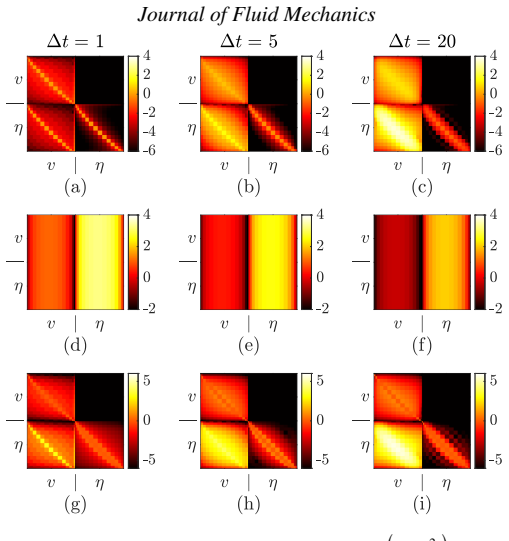
- [§3.1, Eq. (3.6)] The derivation of the Granger equivalence assumes that the restricted-model regression coefficients are identical to the unrestricted coefficients except for the omitted variable, so that the omitted term appears directly in the restricted residual. Under least-squares fitting this is generically false: by the Frisch–Waugh–Lovell theorem, the retained coefficients in the restricted regression shift to partially absorb the omitted variable unless the omitted regressor is uncorrelated with all retained regressors. Thus Eq. (3.6), and consequently the scaling result (3.11), holds only under an orthogonality condition that is not stated in the derivation. The paper's own results (Figures 2 and 5) confirm that LOCA and Granger agree only after transforming to POD coordinates, whose temporal coefficients are uncorrelated by construction. The equivalence claim in Section 3.1 should therefore be presented as conditional on such an orthogonality condition, or the derivation should be revised to account for the re-fitting of retained coefficients.
- [§2.3 and §6] The global causality metric M=(αI−|A|)^{-1} is described in the conclusions as providing 'a measure of global causality integrated over all time.' This is not mathematically accurate: M is an elementwise upper bound of the weighted Neumann series Σ |A|^k (and hence of Σ |A^k|), not the time integral of |e^{At}|. Indeed, for the nilpotent example in Eq. (2.16), |e^{At}|_{31}=t^2/2, whose integral over t diverges, while the corresponding entry of M is finite. M is better characterized as a transitive-closure-like indicator of whether any indirect causal path of any length exists, not as a time-integrated causal effect. The terminology in §2.3 and §6 should be corrected to avoid overstating the temporal interpretation.
- [Abstract and §5] The abstract states that the method is demonstrated on two fluid flow examples, 'linearized Couette flow, and a nonlinear wake flow featuring chaotic dynamics,' and that 'in both cases' the framework captures direct and indirect causal interactions. However, the manuscript body contains no section or results for a nonlinear wake flow; the only fluid application is linearized Couette flow (Section 5). This is a substantive discrepancy between the claimed and actual scope of the demonstrations. The abstract (and any related statements in the introduction) should be revised to match the content, or the missing nonlinear example should be added.
minor comments (5)
- [§2.2, Eq. (2.8)] The definition of F_{j→i} appears after the discussion of the error term in (2.7) and is then used to show agreement with Granger causality. It would be clearer to state explicitly that (2.8) is chosen as an operator-based analogue of the Granger F-statistic (as Eq. (3.11) demonstrates), so that the direction of the logical dependency is transparent.
- [§2.3, after Eq. (2.20)] The statement 'e^{At} exhibits no causality if the time lag is very small or close to 2' should be more precise: it is the (3,1) element that vanishes at t=2; other entries of e^{At} may be nonzero.
- [§3.1, Eq. (3.12)] The transfer entropy expression is introduced with a brief justification; it would be helpful to state explicitly that the same coefficient-constancy assumption underlying (3.6) applies here, and to provide a direct reference for the log-likelihood form of the Granger statistic.
- [§3.2, Eq. (3.16)] The choice of α in the global causality metric is left unspecified in the definition; the later choice α=1.05ρ(|A|) (used in Figure 10) should be mentioned in §3.2 for completeness, with a note that the zero pattern of M is independent of α.
- [Throughout] The paper alternates between 'linearised' and 'linearized'; consistency is recommended.
Circularity Check
Mild definitional circularity: the LOCA F-statistic in Eq. (2.8) is defined to match the Granger expression derived under Eq. (3.6), so the claimed equivalence is partly by construction; the core matrix-exponential causality measure is otherwise self-contained.
-
self definitional
[Section 2, Eq. (2.8); Section 3.1, Eqs. (3.6)-(3.11)]
"While our defined notion of causality is proportional to G^τ_{j→i}, we will ultimately modify this definition to account for the statistics of the state variables ... we define a modified F-statistic ... F_{j→i} = [e^{Aτ}]^2_{ij} σ^2_j / σ^2_{ε,i}. ... We can thus conclude that subject to the assumptions of this analysis (most notably that the restricted and unrestricted models share the same coefficients except for those involving the excluded variable), our notion of causality defined in (2.8) agrees with Granger analysis."
Equation (2.8) is introduced as a definition, not a prediction from the linearized equations: the ratio [e^{Aτ}]^2 σ^2_j / σ^2_{ε,i} is exactly what the Granger derivation (3.6)-(3.11) produces after dropping the sample-size factor. The claimed equivalence 'LOCA agrees with Granger' therefore holds by construction once the coefficient-invariance assumption in (3.6) is granted. The remaining content is the validity of that assumption, which is not established and is contradicted by the authors' own Couette results in the original (v,η) coordinates; agreement appears only in POD coordinates where temporal coefficients are uncorrelated by construction.
full rationale
The central causal object G^τ_{j→i} = [e^{Aτ}]_{ij} is a genuine counterfactual derivative for linear systems and is not fitted to data. The global metric M=(αI-|A|)^{-1} is derived from the Neumann series of |A| and is an independent mathematical bound, not a re-labeled empirical pattern. The DMD-based estimator in Section 4 is a standard least-squares companion to the operator and is tested against synthetic data, not used as an input to the theory. The only definitional circularity is the 'modified F-statistic' in Eq. (2.8), which is deliberately chosen to replicate the Granger scaling derived under the explicit but generally false assumption (3.6) that omitting a regressor leaves the other least-squares coefficients unchanged. Because the paper states this as an assumption and because the core operator-theoretic measure has independent content, the overall circularity is mild. The two self-citations (Lopez-Doriga et al. 2024, Martinez-Sanchez et al. 2023) appear in the literature review and are not load-bearing.
Assumptions & free parameters
free parameters (3)
- Error covariance matrix Q (σ_ε^2)
- Time horizon τ =
Δt = 1, 5, 20
- α in global metric M =
1.05 ρ(|A|) or 1.05|λ_1|
assumptions (4)
- domain assumption The error term ε in (2.7) is additive with known covariance Q, and state statistics are governed by the discrete Lyapunov equation (2.9).
- ad hoc to paper Restricted and unrestricted Granger models share all coefficients except the omitted variable's (Eq 3.6).
- standard math The error term ε_i is uncorrelated with the past of c_j, so the cross-term in Eq (3.9) vanishes.
- standard math Spectral radius condition α > ρ(|A|) ensures convergence of the series defining M.
Cite this review
Pith. "Pith review of Operator theoretic causality analysis of fluid flows using linearized dynamics." pith.science (2026). https://pith.science/paper/SDCAYHSQ
@misc{pith2026250608118,
  author       = {Pith},
  title        = {Pith review of: Operator theoretic causality analysis of fluid flows using linearized dynamics},
  year         = {2026},
  howpublished = {\url{https://pith.science/paper/SDCAYHSQ}},
  note         = {Machine review of arXiv:2506.08118}
}
read the original abstract
This paper presents an operator-theoretic framework, Linear Operator Causality Analysis (LOCA), for analyzing causality in linearized dynamical systems, focusing here on fluid flows. Our proposed approach, which can be characterized as a special case of Dynamic Causal Effect (DCE) analysis, utilizes the matrix exponential of linearized differential equations to determine causal relationships between system modes at any future time. We further develop an upper bound that quantifies the presence and extent of global causality across all time horizons. This approach provides a physics-based alternative to data-driven statistical and information-theoretic causality measures such as Granger causality and transfer entropy. Unlike these data-driven techniques that infer causality from time-series data, LOCA leverages the linearized governing equations, yielding a physically-motivated and interpretable measure of causal interactions. We identify the conditions under which LOCA gives equivalent results to data-driven causality analysis methods, and further discuss connections to key system properties such as controllability, observability, and graph-theoretic transitive closure. To complement this operator-based approach, we introduce a data-driven methodology akin to Dynamic Mode Decomposition (DMD) that estimates causal connections directly from time series data by approximating the matrix exponential. We argue that LOCA also mitigates common issues in data-driven causality analyses, such as misleading inferences due to correlated variables or state truncation. We demonstrate our method on two fluid flow examples: linearized Couette flow, and a nonlinear wake flow featuring chaotic dynamics. In both cases, we demonstrate how our framework captures both direct and indirect causal interactions among flow structures.
Figures


Figures from the paper (7 more)


Reference graph
Works this paper leans on
-
[1]
, " * write output.state after.block = add.period write newline
ENTRY address author booktitle chapter edition editor howpublished institution journal key month note number organization pages publisher school series title type volume year eprint label extra.label sort.label short.list INTEGERS output.state before.all mid.sentence after.sentence after.block FUNCTION init.state.consts #0 'before.all := #1 'mid.sentence ...
-
[2]
write newline
" write newline "" before.all 'output.state := FUNCTION n.dashify 't := "" t empty not t #1 #1 substring "-" = t #1 #2 substring "--" = not "--" * t #2 global.max substring 't := t #1 #1 substring "-" = "-" * t #2 global.max substring 't := while if t #1 #1 substring * t #2 global.max substring 't := if while FUNCTION word.in bbl.in capitalize " " * FUNCT...
-
[3]
Abreu, L.I. , Cavalieri, A.V.G. , Schlatter, P. , Vinuesa, R. & Henningson, D.S. 2020 Spectral proper orthogonal decomposition and resolvent analysis of near-wall coherent structures in turbulent pipe flows . J. Fluid Mech. 900 , A11
work page 2020
-
[4]
Baccal \'a , L.A. & Sameshima, K. 2001 Partial directed coherence: a new concept in neural structure determination . Biological Cybernetics 84 (6), 463--474
work page 2001
-
[5]
Bae, H.J. , Encinar, M.P. & Lozano-Dur \'a n, A. 2019 Causal analysis of self-sustaining processes in the logarithmic layer of wall-bounded turbulence . Journal of physics. Conference series 1001
work page 2019
-
[6]
Barnett, L.C. & Bossomaier, T.R.J. 2012 Transfer entropy as a log-likelihood ratio . Phys. Rev. Lett. 109 13 , 138105
work page 2012
-
[7]
Barnett, L. & Seth, A.K. 2014 The MVGC multivariate G ranger causality toolbox: a new approach to G ranger-causal inference . Journal of Neuroscience Methods 223 , 50--68
work page 2014
-
[8]
Barnett, L. & Seth, A.K. 2015 Granger causality for state-space models . Phys. Rev. E 91 (4), 040101
work page 2015
Show all 58 references
-
[9]
2003 A numerical algorithm to solve A^TX A-X = Q
Barraud, A.Y. 2003 A numerical algorithm to solve A^TX A-X = Q . IEEE Transactions on Automatic Control 22 (5), 883--885
2003
-
[10]
& Piersol, A.G
Bendat, J.S. & Piersol, A.G. 2011 Random data: analysis and measurement procedures\/ . John Wiley & Sons, Hoboken, New Jersey
2011
-
[11]
, Holmes, P
Berkooz, G. , Holmes, P. & Lumley, J. L. 1993 The proper orthogonal decomposition in the analysis of turbulent flows . Annual Review of Fluid Mechanics 25 (1), 539--575
1993
-
[12]
John Wiley & Sons, New York
Bollen, Kenneth A 1989 Structural equations with latent variables\/ . John Wiley & Sons, New York
1989
-
[13]
, Gallusser, F
Brodersen, K.H. , Gallusser, F. , Koehler, J. , Remy, N. & Scott, S.L. 2015 Inferring causal impact using B ayesian structural time-series models . The Annals of Applied Statistics pp. 247--274
2015
-
[14]
& Goldburg, W.I
Cerbus, R.T. & Goldburg, W.I. 2013 Information content of turbulence . Phys. Rev. E 88 (5), 053012
2013
-
[15]
& Jimenez, J
Del Alamo, J.C. & Jimenez, J. 2006 Linear energy amplification in turbulent channels . J. Fluid Mech. 559 , 205--213
2006
-
[16]
, Gaviglio, J.J
Favre, A.J. , Gaviglio, J.J. & Dumas, R. 1957 Space-time double correlations and spectra in a turbulent boundary layer . J. Fluid Mech. 2 (4), 313--342
1957
-
[17]
1969 Investigating causal relations by econometric models and cross-spectral methods
Granger, C.W.J. 1969 Investigating causal relations by econometric models and cross-spectral methods . Econometrica: Journal of the Econometric Society pp. 424--438
1969
-
[18]
1986 Excitation of direct resonances in plane P oiseuille flow
Gustavsson, L.H. 1986 Excitation of direct resonances in plane P oiseuille flow . Studies in Applied Mathematics 75 (3), 227--248
1986
-
[19]
1965 The environment and disease: association or causation?
Hill, A.B. 1965 The environment and disease: association or causation?
1965
-
[20]
, Lumley, J
Holmes, P. , Lumley, J. L. , Berkooz, G. & Rowley, C. W. 2012 Turbulence, coherent structures, dynamical systems and symmetry\/ . Cambridge University Press
2012
-
[21]
& Rowley, C.W
Ilak, M. & Rowley, C.W. 2008 Modeling of transitional channel flow using balanced proper orthogonal decomposition . Phys. Fluids. 20 , 034103
2008
-
[22]
& Rubin, D.B
Imbens, G.W. & Rubin, D.B. 2015 Causal inference in statistics, social, and biomedical sciences\/ . Cambridge University Press
2015
-
[23]
1927 La diffusion de la lumi\'ere par les atomes
Kramers, H.A. 1927 La diffusion de la lumi\'ere par les atomes . Atti del Congresso Internazionale dei Fisici 2 , 545
1927
-
[24]
1926 On the theory of dispersion of x-rays
de Kronig, R. 1926 On the theory of dispersion of x-rays . Journal of the Optical Society of America 12 (6), 547--556
1926
-
[25]
1975 Wave breakdown and turbulence
Landahl, M.T. 1975 Wave breakdown and turbulence . SIAM Journal on Applied Mathematics 28 (4), 735--756
1975
-
[26]
1973 Causation
Lewis, D. 1973 Causation . The Journal of Philosophy 70 (17), 556--567
1973
-
[27]
, Atzori, M
Lopez-Doriga, B. , Atzori, M. , Vinuesa, R. , Bae, H.J. , Srivastava, A. & Dawson, S.T.M. 2024 Linear and nonlinear G ranger causality analysis of turbulent duct flows. In Journal of Physics: Conference Series\/ , , vol. 2753 , p. 012017 . IOP Publishing
2024
-
[28]
& Arranz, G
Lozano-Dur \'a n, A. & Arranz, G. 2022 Information-theoretic formulation of dynamical systems: causality, modeling, and control . Phys. Rev. Research 4 (2), 023195
2022
-
[29]
, Bae, H.J
Lozano-Dur \'a n, A. , Bae, H.J. & Encinar, M.P. 2020 a\/ Causality of energy-containing eddies in wall turbulence . J. Fluid Mech. 882 , A2
2020
-
[30]
, Constantinou, N.C
Lozano-Dur \'a n, A. , Constantinou, N.C. , Nikolaidis, M.-A. & Karp, M. 2020 b\/ Cause-and-effect of linear mechanisms sustaining wall turbulence . J. Fluid Mech. 914
2020
-
[31]
, Darden, L
Machamer, P. , Darden, L. & Craver, C.F. 2000 Thinking about mechanisms . Philosophy of Science 67 (1), 1--25
2000
-
[32]
, Arranz, G
Mart \'i nez-S \'a nchez, \'A . , Arranz, G. & Lozano-Dur \'a n, A. 2024 Decomposing causality into its synergistic, unique, and redundant components . Nat. Commun. 15
2024
-
[33]
, L \'o pez, E
Mart \' nez-S \'a nchez, \'A . , L \'o pez, E. , Le Clainche, S. , Lozano-Dur \'a n, A. , Srivastava, A. & Vinuesa, R. 2023 Causality analysis of large-scale structures in the flow around a wall-mounted square cylinder . J. Fluid Mech. 967 , A1
2023
-
[34]
, Rezaeiravesh, S
Massaro, D. , Rezaeiravesh, S. & Schlatter, P. 2023 On the potential of transfer entropy in turbulent dynamical systems . Scientific Reports 13
2023
-
[35]
1990 Causality, feedback and directed information
Massey, J. 1990 Causality, feedback and directed information. In Proc. Int. Symp. Inf. Theory Applic.(ISITA-90)\/ , , vol. 2
1990
-
[36]
& Sharma, A.S
McKeon, B.J. & Sharma, A.S. 2010 A critical-layer framework for turbulent pipe flow . J. Fluid Mech. 658 , 336--382
2010
-
[37]
1981 Principal component analysis in linear systems: Controllability, observability, and model reduction
Moore, B.C. 1981 Principal component analysis in linear systems: Controllability, observability, and model reduction . IEEE transactions on automatic control 26 (1), 17--32
1981
-
[38]
Cambridge University Press
Pearl, J 2000 Causality: Models, reasoning and inference\/ . Cambridge University Press
2000
-
[39]
2014 Probabilistic reasoning in intelligent systems: networks of plausible inference\/
Pearl, J. 2014 Probabilistic reasoning in intelligent systems: networks of plausible inference\/ . Elsevier
2014
-
[40]
2005 Model reduction for fluids using balanced proper orthogonal decomposition
Rowley, C.W. 2005 Model reduction for fluids using balanced proper orthogonal decomposition. International Journal of Bifurcation and Chaos 15 (3), 997--1013
2005
-
[41]
& Dawson, S.T.M
Rowley, C.W. & Dawson, S.T.M. 2017 Model reduction for flow analysis and control . Annu. Rev. Fluid Mech. 49 (1), 387--417
2017
-
[42]
1974 Estimating causal effects of treatments in randomized and nonrandomized studies
Rubin, D.B. 1974 Estimating causal effects of treatments in randomized and nonrandomized studies. Journal of Educational Psychology 66 (5), 688
1974
-
[43]
2016 Information flow and causality as rigorous notions ab initio
San Liang , X. 2016 Information flow and causality as rigorous notions ab initio. Phys. Rev. E 94 , 052201
2016
-
[44]
2005 Information transfer between dynamical system components
San Liang , X & Kleeman, R. 2005 Information transfer between dynamical system components . Phys. Rev. Lett. 95 (24), 244101
2005
-
[45]
& Lozano-Dur \'a n, A
San Liang , X. & Lozano-Dur \'a n, A. 2016 A preliminary study of the causal structure in fully developed near-wall turbulence . CTR Proc. of the Summer Prog p. 233
2016
-
[46]
2010 Dynamic mode decomposition of numerical and experimental data
Schmid, P.J. 2010 Dynamic mode decomposition of numerical and experimental data . J. Fluid Mech. 656 , 5 -- 28
2010
-
[47]
& Hussain, F
Schoppa, W. & Hussain, F. 2002 Coherent structure generation in near-wall turbulence . J. Fluid Mech. 453 , 57--108
2002
-
[48]
2000 Measuring information transfer
Schreiber, T. 2000 Measuring information transfer . Phys. Rev. Lett. 85 (2), 461
2000
-
[49]
2020 Causality and passivity: From electromagnetism and network theory to metamaterials
Srivastava, A. 2020 Causality and passivity: From electromagnetism and network theory to metamaterials . Mechanics of Materials p. 103710
2020
-
[50]
, May, R
Sugihara, G. , May, R. , Ye, H. , Hsieh, C.-H. , Deyle, E. , Fogarty, M. & Munch, S. 2012 Detecting causality in complex ecosystems . Science 338 (6106), 496--500
2012
-
[51]
1973 A probabilistic theory of causality
Suppes, P. 1973 A probabilistic theory of causality . British Journal for the Philosophy of Science 24 (4)
1973
-
[52]
, Brunton, S
Taira, K. , Brunton, S. L. , Dawson, S. T. M. , Rowley, C. W. , Colonius, T. , McKeon, B. J. , Schmidt, O. T. , Gordeyev, S. , Theofilis, V. & Ukeiley, L. S. 2017 Modal analysis of fluid flows: An overview . arXiv preprint arXiv:1702.01453
2017 arXiv
-
[53]
1941 On the calculus of relations
Tarski, A. 1941 On the calculus of relations . The Journal of Symbolic Logic 6 (3), 73--89
1941
-
[54]
, Lozano-Dur \'a n, A
Tissot, G. , Lozano-Dur \'a n, A. , Cordier, L. , Jim \'e nez, J. & Noack, B.R. 2014 Granger causality in wall-bounded turbulence . Journal of Physics: Conference Series 506 , 012006
2014
-
[55]
Journal of Computational Dynamics 1 (2), 391--421
Tu, Jonathan H , Rowley, Clarence W , Luchtenburg, Dirk M , Brunton, Steven L & Kutz, J Nathan 2014 On dynamic mode decomposition: Theory and applications . Journal of Computational Dynamics 1 (2), 391--421
2014
-
[56]
1962 A theorem on B oolean matrices
Warshall, S. 1962 A theorem on B oolean matrices . J. ACM 9 , 11--12
1962
-
[57]
2001 Introduction to graph theory
West, D.B. 2001 Introduction to graph theory
2001
-
[58]
& Peraire, J
Willcox, K. & Peraire, J. 2002 Balanced model reduction via the proper orthogonal decomposition . AIAA J. 40 (11), 2323--2330
2002
Reviewed August 7, 2026 · model on record in the stance chip above.
Discussion (0). Sign in to comment.