The Riemann problem for three-phase foam flow in porous media
Pith reviewed 2026-05-22 00:09 UTC · model grok-4.3
The pith
A methodology classifies all solutions to the Riemann problem for three-phase foam flow when gas viscosity exceeds that of oil and water.
A machine-rendered reading of the paper's core claim, the machinery that carries it, and where it could break.
Core claim
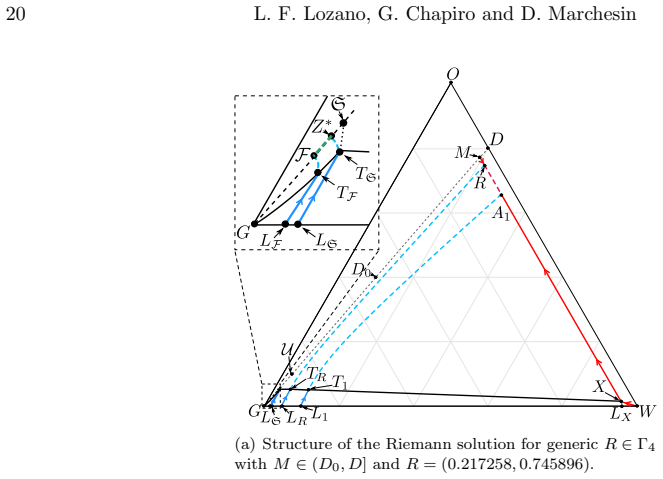
The authors present a methodology to solve the Riemann problem for three-phase foam displacement in porous media in the case when gas viscosity exceeds that of oil and water. Assuming foam in local equilibrium with a constant mobility reduction factor, they classify possible solutions for the injection of foamed gas and water mixtures under a wide range of initial conditions within the framework of non-classical conservation law theory. The work also identifies the conditions that result in oil bank formation and validates the analytical estimates by numerical simulation.
What carries the argument
Classification of admissible wave structures for the three-phase foam system with constant mobility reduction factor inside non-classical conservation law theory.
If this is right
- The classified solutions directly predict when an oil bank forms during foam injection.
- Analytical wave structures supply reference data for calibrating numerical simulators of foam flow.
- The results enable uncertainty quantification for recovery forecasts in applications that use foam.
- The classification advances the physical description of how foam controls gas mobility in porous rock.
Where Pith is reading between the lines
- The same classification approach could be tested on models that allow foam texture to evolve with time rather than stay fixed.
- Wave-structure results may guide the choice of injection rates that maximize oil-bank size in field-scale planning.
- Analogous Riemann-problem techniques could be applied to other multiphase systems that rely on mobility-control additives.
Load-bearing premise
The analysis rests on the assumption that foam remains in local equilibrium, which keeps the mobility reduction factor constant everywhere.
What would settle it
Numerical simulation of a foam injection problem with chosen initial saturations that produces wave speeds or structures different from those listed in the classification would show the method misses solutions.
Figures




read the original abstract
Gas injection in the context of the three-phase flow in porous media appears in applications such as Enhanced Oil Recovery, aquifer remediation, and carbon capture, utilization, and storage (CCUS). In general, this technique suffers from a difficulty related to excessive gas mobility, which can be circumvented by using foam. This study addresses the non-linear system of differential equations describing the three-phase foam flow based on Corey relative permeability functions. A major obstacle is an umbilic point, where the characteristic wave velocities for different families coincide, complicating the identification of stable wave structures. We developed a methodology to solve the Riemann problem describing the three-phase foam displacement in the case when the gas viscosity exceeds that of oil and water. To allow the analysis, we assume foam in local equilibrium (or maximum foam texture), resulting in a constant mobility reduction factor (MRF). These simplifications allowed the classification of possible solutions for the injection of foamed gas and water mixtures under a wide range of initial conditions within the framework of non-classical Conservation Law Theory. As a relevant industrial application of the proposed solution, we investigate the conditions resulting in oil bank formation. Besides improving the general physical understanding of foam flow in a porous medium, this analysis can be applied to calibrate numerical simulators and perform uncertainty quantification. Our analytical estimates were validated through numerical simulations.
Editorial analysis
A structured set of objections, weighed in public.
Referee Report
Summary. The manuscript develops a methodology for solving the Riemann problem in three-phase foam flow through porous media modeled by a 2x2 system of conservation laws with Corey-type relative permeabilities. Under the local-equilibrium assumption that fixes the mobility reduction factor (MRF) as a constant, the authors classify admissible wave structures for foamed-gas/water injection into a range of initial states, with emphasis on conditions that produce an oil bank; the classification is framed in non-classical conservation-law theory and is supported by numerical simulations.
Significance. If the local-equilibrium regime is representative, the explicit classification of Riemann solutions supplies concrete wave-curve constructions and admissible shock loci that can be used to benchmark simulators and to predict oil-bank formation in foam-assisted gas injection. The work therefore contributes a concrete analytical tool within the restricted modeling framework it adopts.
major comments (2)
- The central classification rests on the construction of wave curves through the umbilic point; however, the manuscript provides only a high-level description of this construction (see the paragraph following Eq. (3.2) and the discussion in §4). A step-by-step verification that the proposed rarefaction and shock curves satisfy the Liu entropy condition and the correct ordering of characteristic speeds at the umbilic point is required before the claimed completeness of the solution catalogue can be accepted.
- §5, numerical validation: the reported simulations use a fixed MRF value; it is not shown how the admissible wave sequences change when a small but non-zero foam-texture transport equation is restored. A single sensitivity test with a variable-MRF model would quantify the robustness of the oil-bank criterion derived under the constant-MRF assumption.
minor comments (2)
- Notation: the symbol for the constant MRF is introduced without an explicit equation reference; add a numbered display equation when it first appears.
- Figure 4: the phase-plane trajectories near the umbilic point are difficult to read at the printed scale; enlarge the inset or add a separate zoomed panel.
Simulated Author's Rebuttal
We thank the referee for the constructive comments and positive assessment of the manuscript's significance. We address each major comment point by point below, indicating where revisions will be made.
read point-by-point responses
-
Referee: The central classification rests on the construction of wave curves through the umbilic point; however, the manuscript provides only a high-level description of this construction (see the paragraph following Eq. (3.2) and the discussion in §4). A step-by-step verification that the proposed rarefaction and shock curves satisfy the Liu entropy condition and the correct ordering of characteristic speeds at the umbilic point is required before the claimed completeness of the solution catalogue can be accepted.
Authors: We agree that a more detailed verification is needed to substantiate the wave-curve constructions. In the revised manuscript we will expand §4 with an explicit step-by-step derivation of the rarefaction and shock curves through the umbilic point. This will include direct computation of the eigenvalues and eigenvectors, verification that the Liu entropy condition holds for the proposed shocks, and confirmation of the correct ordering of characteristic speeds at the umbilic point. revision: yes
-
Referee: §5, numerical validation: the reported simulations use a fixed MRF value; it is not shown how the admissible wave sequences change when a small but non-zero foam-texture transport equation is restored. A single sensitivity test with a variable-MRF model would quantify the robustness of the oil-bank criterion derived under the constant-MRF assumption.
Authors: The constant-MRF assumption is central to reducing the model to a 2×2 system of conservation laws and to the analytical classification we present. Restoring the full foam-texture transport equation would yield a larger, non-strictly hyperbolic system whose Riemann solutions lie outside the scope of the present work. We will add a concise discussion in the revised manuscript explaining this modeling choice and the expected qualitative robustness of the oil-bank criterion under small MRF perturbations, but we do not plan to perform a full variable-MRF sensitivity test. revision: no
Circularity Check
No circularity: classification follows directly from governing equations under stated local-equilibrium assumption
full rationale
The paper begins with the standard three-phase conservation laws using Corey relative permeabilities, then explicitly imposes the modeling assumption of local equilibrium (maximum foam texture) to fix the mobility reduction factor as a constant. This reduces the system to a 2x2 hyperbolic conservation law whose umbilic point and wave curves are analyzed via non-classical Riemann theory. The resulting classification of solutions for different injection and initial data follows from the simplified PDE system and standard admissibility criteria; no prediction is obtained by fitting to a subset of the target data, no uniqueness theorem is imported from self-citation, and no ansatz is smuggled in. The constant-MRF choice is presented as an enabling simplification rather than a derived result, leaving the derivation self-contained.
Axiom & Free-Parameter Ledger
free parameters (1)
- constant mobility reduction factor (MRF)
axioms (2)
- domain assumption Foam in local equilibrium resulting in constant MRF
- domain assumption Corey relative permeability functions for three-phase flow
Lean theorems connected to this paper
-
IndisputableMonolith/Cost/FunctionalEquation.leanwashburn_uniqueness_aczel unclear?
unclearRelation between the paper passage and the cited Recognition theorem.
To allow the analysis, we assume foam in local equilibrium (or maximum foam texture), resulting in a constant mobility reduction factor (MRF).
-
IndisputableMonolith/Foundation/AlexanderDuality.leanalexander_duality_circle_linking unclear?
unclearRelation between the paper passage and the cited Recognition theorem.
A major obstacle is an umbilic point, where the characteristic wave velocities for different families coincide
What do these tags mean?
- matches
- The paper's claim is directly supported by a theorem in the formal canon.
- supports
- The theorem supports part of the paper's argument, but the paper may add assumptions or extra steps.
- extends
- The paper goes beyond the formal theorem; the theorem is a base layer rather than the whole result.
- uses
- The paper appears to rely on the theorem as machinery.
- contradicts
- The paper's claim conflicts with a theorem or certificate in the canon.
- unclear
- Pith found a possible connection, but the passage is too broad, indirect, or ambiguous to say the theorem truly supports the claim.
Reference graph
Works this paper leans on
-
[1]
IPCC special report on carbon dioxide capture and storage
Metz, B., Davidson, O., De Coninck, H., Loos, M., Meyer, L. IPCC special report on carbon dioxide capture and storage. Prepared by Working Group III of the Intergovernmental Panel on Climate Change (Cambridge: Cambridge University Press, 2005)
work page 2005
-
[2]
Salimi, H., Wolf, K.-H., Bruining, J. The influence of capillary pressure on the phase equilibrium of the CO2–water system: Application to carbon sequestration combined with geothermal energy. International Journal of Greenhouse Gas Control 11, S47–S66 (2012)
work page 2012
-
[3]
S., Ahmed, S., Alameri, W., Froudakis, G
Iskandarov, J., Fanourgakis, G. S., Ahmed, S., Alameri, W., Froudakis, G. E., Karanikolos, G. N. Data-driven prediction of in situ CO2 foam strength for enhanced oil recovery and carbon sequestration. RSC advances 12, 35703–35711 (2022). 34 REFERENCES
work page 2022
-
[4]
Foam–oil interaction in porous media: implications for foam assisted enhanced oil recovery
Farajzadeh, R., Andrianov, A., Krastev, R., Hirasaki, G., Rossen, W. Foam–oil interaction in porous media: implications for foam assisted enhanced oil recovery. Advances in colloid and interface science 183, 154–197 (2012)
work page 2012
-
[5]
Modeling techniques for foam flow in porous media
Ma, K., Ren, G., Mateen, K., Morel, D., Cordelier, P. Modeling techniques for foam flow in porous media. SPE Journal 20, 453–470 (2015)
work page 2015
-
[6]
Hematpur, H., Mahmood, S. M., Nasr, N. H., Elraies, K. A. Foam flow in porous media: Concepts, models and challenges. Journal of Natural Gas Science and Engineering 53, 163–180 (2018)
work page 2018
-
[7]
Chen, Q., Gerritsen, M., Kovscek, A. R. Modeling foam displacement with the local-equilibrium approximation: theory and experimental verification. SPE Journal 15, 171–183 (2010)
work page 2010
-
[8]
F., Quinelato, T., Igreja, I., Chapiro, G
de Paula, F. F., Quinelato, T., Igreja, I., Chapiro, G. A Numerical Algorithm to Solve the Two- Phase Flow in Porous Media Including Foam Displacement in Computational Science – ICCS 2020 (Springer International Publishing, 2020), 18–31
work page 2020
-
[9]
F., Igreja, I., Quinelato, T., Chapiro, G
de Paula, F. F., Igreja, I., Quinelato, T., Chapiro, G. A numerical investigation into the influence of the surfactant injection technique on the foam flow in heterogeneous porous media. Advances in Water Resources 171, 104358 (2023)
work page 2023
-
[10]
F., Igreja, I., Quinelato, T., Chapiro, G
de Paula, F. F., Igreja, I., Quinelato, T., Chapiro, G. Numerical simulation of foam displacement impacted by kinetic and equilibrium surfactant adsorption. Advances in Water Resources 188, 104690 (2024)
work page 2024
-
[11]
Ashoori, E., Marchesin, D., Rossen, W. R. Roles of transient and local equilibrium foam behavior in porous media: Traveling wave. Colloids and Surfaces A: Physicochemical and Engineering Aspects 377, 228–242 (2011)
work page 2011
-
[12]
Zavala, R. Q., Lozano, L. F., Zitha, P. L. J., Chapiro, G. Analytical solution for the population- balance model describing foam displacement. Transport in Porous Media 144, 211–227 (2022)
work page 2022
-
[13]
Lozano, L. F., Zavala, R. Q., Chapiro, G. Mathematical properties of the foam flow in porous media. Computational Geosciences 25, 515–527 (2021)
work page 2021
-
[14]
Lozano, L. F., Cedro, J. B., Zavala, R. Q., Chapiro, G. How simplifying capillary effects can affect the traveling wave solution profiles of the foam flow in porous media. International Journal of Non-Linear Mechanics 139, 103867 (2022)
work page 2022
-
[15]
Chapiro, G., Lozano, L. F. Analytical Solution for the Population-Balance Model Describing Foam Displacement Considering Surfactant Dispersion in ECMOR 2022 2022 (2022), 1–12
work page 2022
-
[16]
Fritis, G. C., Paz, P. S., Lozano, L. F., Chapiro, G. On the Riemann problem for the foam displacement in porous media with linear adsorption. SIAM Journal on Applied Mathematics 84, 581–601 (2024)
work page 2024
-
[17]
The mathematical model and analysis of the nanoparticle- stabilized foam displacement
Danelon, T., Paz, P., Chapiro, G. The mathematical model and analysis of the nanoparticle- stabilized foam displacement. Applied Mathematical Modelling 125, 630–649 (2024)
work page 2024
-
[18]
Danelon, T., Farajzadeh, R., Bedrikovetsky, P., Chapiro, G. Modeling Nanoparticle-Stabilized Foam Flow in Porous Media Accounting for Particle Retention and Permeability Reduction. InterPore Journal 2, IPJ260225–3 (2025)
work page 2025
-
[19]
Mayberry, D. J., Afsharpoor, A, Kam, S. I. The use of fractional-flow theory for foam displace- ment in presence of oil. SPE Reservoir Evaluation & Engineering 11, 707–718 (2008)
work page 2008
-
[20]
Zanganeh, N. M., Kam, S. I., LaForce, T. C., Rossen, W. R. The method of characteristics applied to oil displacement by foam. SPE journal 16, 8–23 (2011)
work page 2011
-
[21]
Three-phase fractional flow analysis for foam-assisted non-aqueous phase liquid (NAPL) remediation
Lee, S, Lee, G, Kam, S. Three-phase fractional flow analysis for foam-assisted non-aqueous phase liquid (NAPL) remediation. Transport in porous media 101, 373–400 (2014)
work page 2014
-
[22]
Lee, S., Kam, S. I. MoC-Based Modeling and Simulation of Foam EOR Processes in Multi-Layered System in Offshore Technology Conference (2015), OTC–25716
work page 2015
-
[23]
Tang, J., Casta˜ neda, P., Marchesin, D., Rossen, W. R. Three-Phase Fractional-Flow Theory of Foam-Oil Displacement in Porous Media With Multiple Steady States.Water Resources Research 55, 10319–10339 (2019). REFERENCES 35
work page 2019
-
[24]
Tang, J., Castaneda, P., Marchesin, D., Rossen, W. R. Foam-Oil Displacements in Porous Me- dia: Insights from Three-Phase Fractional-Flow Theory in Abu Dhabi International Petroleum Exhibition and Conference (2022), D042S195R003
work page 2022
-
[25]
Lyu, X., Voskov, D., Tang, J., Rossen, W. R. Simulation of foam enhanced-oil-recovery processes using operator-based linearization approach. SPE Journal 26, 2287–2304 (2021)
work page 2021
-
[26]
Azevedo, A. V., de Souza, A. J., Furtado, F., Marchesin, D. Uniqueness of the Riemann Solution for Three-Phase Flow in a Porous Medium. SIAM J. Appl. Math. 74, 1967–1997 (2014)
work page 1967
-
[27]
Wave structure for a nonstrictly hyperbolic system of three conservation laws
De Souza, A. Wave structure for a nonstrictly hyperbolic system of three conservation laws. Mathematical and computer modelling 22, 1–29 (1995)
work page 1995
-
[28]
Azevedo, A. V., de Souza, A. J., Furtado, F., Marchesin, D., Plohr, B. The solution by the wave curve method of three-phase flow in virgin reservoirs. Transport in porous media 83, 99–125 (2010)
work page 2010
-
[29]
Guerrero, L. F. L., Marchesin, D. Diffusive Riemann Solutions for 3-phase flow in Porous Media. Proceeding Series of the Brazilian Society of Computational and Applied Mathematics 7 (2020)
work page 2020
-
[30]
ELI, Interactive Graphical Riemann Problem Solver
ELI. ELI, Interactive Graphical Riemann Problem Solver. https://eli.fluid.impa.br/, Accessed : 2025–06–08 (2025)
work page 2025
-
[31]
Diffusive effects in Riemann solutions for the three-phase flow in porous media in Ph.D
Lozano, L. Diffusive effects in Riemann solutions for the three-phase flow in porous media in Ph.D. thesis (2018)
work page 2018
-
[32]
Solution construction to a class of Riemann problems of multiphase flow in porous media
Mehrabi, M., Sepehrnoori, K., Delshad, M. Solution construction to a class of Riemann problems of multiphase flow in porous media. Transport in porous media 132, 241–266 (2020)
work page 2020
-
[33]
Analytical Investigation of the Three-Phase Foam Flow in Porous Media in ECMOR 2024 2024 (2024), 1–9
Lozano, L, Chapiro, G, Marchesin, D. Analytical Investigation of the Three-Phase Foam Flow in Porous Media in ECMOR 2024 2024 (2024), 1–9
work page 2024
-
[34]
Enhanced Oil Recovery (Englewood Cliffs, New Jersey: Prentice Hall, 1989)
Lake, L. Enhanced Oil Recovery (Englewood Cliffs, New Jersey: Prentice Hall, 1989)
work page 1989
-
[35]
Corey, A. T. The Interrelation Between Gas and Oil Relative Permeabilites. Producers Monthly 19, 38–41 (1954)
work page 1954
-
[36]
Zhou, Z., Rossen, W. Applying fractional-flow theory to foam processes at the “limiting capillary pressure”. SPE Advanced Technology Series 3, 154–162 (1995)
work page 1995
-
[37]
Marchesin, D., Plohr, B. J. Wave Structure in WAG Recovery. SPE Journal 6, 209–219 (2001)
work page 2001
-
[38]
Bressan, A. in Modelling and Optimisation of Flows on Networks: Cetraro, Italy 2009, Editors: Benedetto Piccoli, Michel Rascle 157–245 (Springer Berlin Heidelberg, Berlin, Heidelberg, 2013)
work page 2009
-
[39]
G., Marchesin, D., Paes-Leme, P
Shearer, M., Schaeffer, D. G., Marchesin, D., Paes-Leme, P. L. Solution of the Riemann problem for a prototype 2 × 2 system of non-strictly hyperbolic conservation laws. Arch. Ration. Mech. Anal. 97, 299–320 (1987)
work page 1987
-
[40]
Mederios, H. B. Stable hyperbolic singularities for three-phase flow models in oil reservoir simu- lation. Acta Applicandae Mathematica 28, 135–159 (1992)
work page 1992
-
[41]
Matos, V., Casta˜ neda, P., Marchesin, D. Classification of the umbilic point in immiscible three- phase flow in porous media in Proceedings of the 14th International Conference on Hyperbolic Problems: Theory, Numerics, Applications (Padova, Italy) (2012), 791–799
work page 2012
-
[42]
Schaeffer, D. G., Shearer, M. The classification of 2 × 2 systems of non-strictly hyperbolic conser- vation laws, with application to oil recovery. Communications on pure and applied mathematics 40, 141–178 (1987)
work page 1987
-
[43]
Isaacson, E., Marchesin, D., Plohr, B., Temple, J. B. Multiphase flow models with singular Riemann problems. Mat. Apl. Comput 11, 147–166 (1992)
work page 1992
-
[44]
Matos, V, Azevedo, A. V., Da Mota, J. C., Marchesin, D. Bifurcation under parameter change of Riemann solutions for nonstrictly hyperbolic systems. Z. fur Angew. Math. Phys. 66, 1413–1452 (2015)
work page 2015
-
[45]
Three-phase fluid displacement in a porous medium
Andrade, P., de Souza, A., Furtado, F., Marchesin, D. Three-phase fluid displacement in a porous medium. Journal of Hyperbolic Differential Equations 15, 731–753 (2018)
work page 2018
-
[46]
Lozano, L., de Souza, A., Furtado, F., Plohr, B. J., Marchesin, D. Displacement of three-phase flow for Heavy Oil: Riemann Solutions. in preparation, 1–57 (2024). 36 REFERENCES
work page 2024
-
[47]
Gassara, O., Douarche, F., Braconnier, B, Bourbiaux, B. Calibrating and scaling semi-empirical foam flow models for the assessment of foam-based EOR processes (in heterogeneous reservoirs). Transport in Porous Media 131, 193–221 (2020)
work page 2020
-
[48]
Displacement Theory of Low-Tension Gas Flooding
Mehrabi, M., Sepehrnoori, K., Delshad, M. Displacement Theory of Low-Tension Gas Flooding. Transport in Porous Media 142, 475–491 (2022)
work page 2022
-
[49]
Lax, P. D. Hyperbolic systems of conservation laws II. Comm. Pure Appl. Math. 10, 537–566 (1957)
work page 1957
-
[50]
The Riemann problem for general systems of conservation laws
Liu, T.-P. The Riemann problem for general systems of conservation laws. J. Differ. Equ. 18, 218–234 (1975)
work page 1975
-
[51]
Gel’fand, I. M. Some problems in the theory of quasilinear equation. Usp. Math. Nauk. 14. Eng. Trans. in Amer. Math. Soc. Trans. Ser. 2, 29, 295-381 (1963), 87–158 (1959)
work page 1963
-
[52]
Petrova, Y., Plohr, B. J., Marchesin, D. Vanishing adsorption limit of Riemann problem solutions for the polymer model. Journal of Hyperbolic Differential Equations 21, 299–327 (2024)
work page 2024
-
[53]
Schecter, S., Marchesin, D., Plohr, B. J. Structurally stable Riemann solutions. J. Differ. Equ. 126, 303–354 (1996)
work page 1996
-
[54]
Gomes, M. E. S. Riemann problems requiring a viscous profile entropy condition. Adv. Appl. Math. 10, 285–323 (1989)
work page 1989
-
[55]
Transitional waves for conservation laws
Isaacson, E., Marchesin, D., Plohr, B. Transitional waves for conservation laws. SIAM J. Math. Anal. 21, 837–866 (1990)
work page 1990
-
[56]
V., Marchesin, D., Plohr, B, Zumbrun, K
Azevedo, A. V., Marchesin, D., Plohr, B, Zumbrun, K. Capillary instability in models for three- phase flow. Zeitschrift f¨ ur angewandte Mathematik und Physik ZAMP 53, 713–746 (2002)
work page 2002
-
[57]
Lozano, L., Ledoino, I., Plohr, B. J., Marchesin, D. Structure of undercompressive shock waves in three-phase flow in porous media 2024. arXiv: 2412.04439 [math.AP]. https://arxiv.org/ abs/2412.04439
-
[58]
Ole ˘inik, O. A. On the uniqueness of the generalized solution of the Cauchy problem for a nonlinear system of equations occurring in mechanics. Usp. Mat. Nauk 12, 169–176 (1957)
work page 1957
-
[59]
Eschenazi, C. S., Lambert, W. J., L´ opez-Flores, M. M., Marchesin, D., Palmeira, C. F., Plohr, B. J. Solving Riemann problems with a topological tool. Journal of Differential Equations 416, 2134–2174 (2025)
work page 2025
-
[60]
Andrade, P. L., de Souza, A. J., Furtado, F, Marchesin, D. Oil displacement by water and gas in a porous medium: the Riemann problem. Bulletin of the Brazilian Mathematical Society, New Series 47, 77–90 (2016)
work page 2016
-
[61]
Mechanism of Water Flooding in the Presence of Free Gas
Kyte, J., Stanclift R.J., J., Stephan S.C., J., Rapoport, L. Mechanism of Water Flooding in the Presence of Free Gas. Transactions of the AIME 207, 215–221 (Dec. 1956)
work page 1956
-
[62]
Mathematics and numerics for balance partial differential-algebraic equations (pdaes)
Lambert, W., Alvarez, A., Ledoino, I., Tadeu, D., Marchesin, D., Bruining, J. Mathematics and numerics for balance partial differential-algebraic equations (pdaes). J. Sci. Comput. 84, 29 (2020)
work page 2020
-
[63]
Izadi, M., Nguyen, P. H., Fleifel, H., Maestre, D. O., Kam, S. I. An investigation of mechanistic foam modeling for optimum field development of CO2 foam EOR application. SPE Reservoir Evaluation & Engineering 24, 475–494 (2021). Luis Fernando Lozano Laboratory of Applied Mathematics Federal University of Juiz de Fora 36036-900 Juiz de Fora, MG Brazil e-m...
work page 2021
discussion (0)
Sign in with ORCID, Apple, or X to comment. Anyone can read and Pith papers without signing in.