REVIEW 3 major objections 5 minor 45 references
An In-situ Solid Fuel Ramjet Thrust Monitoring and Regulation Framework Using Neural Networks and Adaptive Control
T0 review · 3 major / 5 minor · reviewed 2026-08-07 · deepseek-v4-flash
Pith's one-line read This paper claims that neural-network thrust estimation from limited in-situ sensors, coupled with a retrospective-cost adaptive controller, can regulate a solid fuel ramjet's thrust in numerical simulation across multiple command types.
desk verdict A competent engineering extension — ANN + RCAC with variable-inlet actuation for a quasi-1D SFRJ model — publishable with revisions but not a breakthrough. read the letter →
The pith
A machine-rendered reading of the paper's core claim, the machinery that carries it, and where it could break.
The reading
What carries the argument
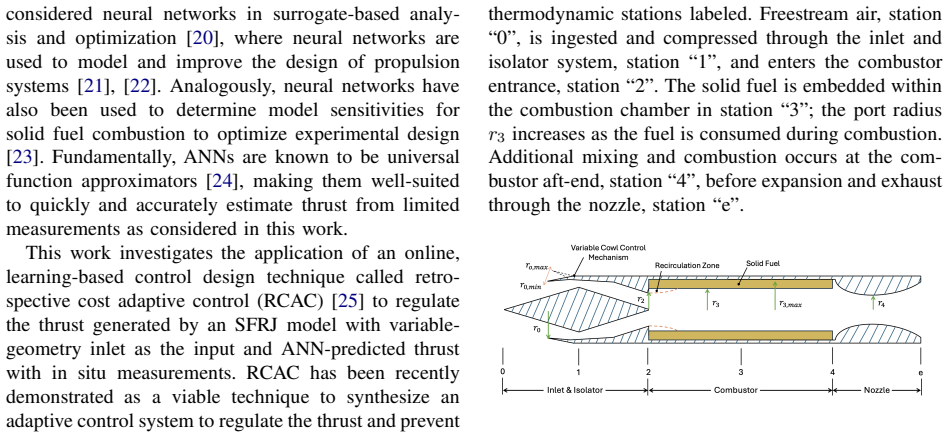
The framework's three coupled components are: (1) a quasi-one-dimensional SFRJ plant model whose inlet conditions come from curve fits to axisymmetric RANS simulations and whose fuel regression uses empirical constants, (2) a single-hidden-layer neural network (20 sigmoid neurons) that estimates thrust from altitude, total combustor pressure, exhaust CO fraction, and cowl radius, and (3) an RCAC-based adaptive PID controller whose gains are updated online by minimizing a retrospective cost using recursive least squares. The load-bearing link is that the controller treats the network's estimated thrust as the measured output, so the quality of the closed loop is bounded by the estimator's accuracy on the operating trajectory.
What would settle it
Compare the neural network's thrust estimates against direct load-cell thrust measurements on a ground-test SFRJ with the same geometry and cruise conditions; if the estimates deviate beyond the training tolerance under realistic sensor noise, the framework's in-situ monitoring claim fails.
Extended reading notes
Core claim
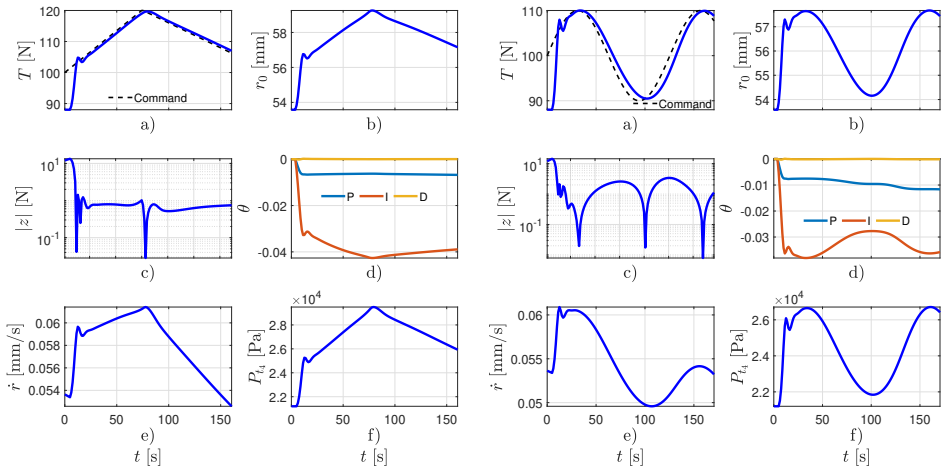
The central claim is that combining an artificial neural-network thrust estimator with a retrospective-cost adaptive controller yields effective thrust regulation for a solid fuel ramjet with variable-cowl inlet, using limited in-situ measurements instead of direct thrust measurement. The paper demonstrates this on a quasi-one-dimensional feed-forward SFRJ model, with the neural network trained on 125,000 synthetic samples spanning altitude, cowl radius, and port radius. The trained network maps the available on-board measurements to thrust, and the adaptive controller, an RCAC-optimized PID, recursively updates its gains from past tracking error and input data alone. In the reported simulations the closed loop follows step, doublet, ramp, and harmonic thrust commands without changing controller hyperparameters, and the response is insensitive to those hyperparameters over a tested range.
Load-bearing premise
The neural network and the controller are both built and tested on the same quasi-one-dimensional SFRJ model; if that model's inlet curve fits and regression-rate constants do not match a real engine, the thrust estimates and control actions will not transfer.
Editorial extensions
If this is right
- If the results hold, SFRJ thrust can be regulated using only sensors that can plausibly fly on a supersonic vehicle, avoiding a direct thrust sensor.
- The same controller, with fixed hyperparameters, tracks step, doublet, ramp, and harmonic commands, so no per-mission retuning is needed.
- The closed-loop response is robust over a range of RCAC hyperparameters, which helps in practice when plant conditions drift.
- The neural network's sensitivity analysis gives a simple guideline: hidden-layer width matters more than activation function or batch size for this thrust-estimation task.
Reading between the lines
- The natural next step is to train the network on experimental data (or a validated higher-fidelity model) and test on a hardware-in-the-loop rig; the current evidence is entirely synthetic, so transfer is not yet established.
- Because the estimator uses CO, the framework could be extended to estimate and regulate equivalence ratio or combustion efficiency, not just thrust, as long as the corresponding sensors exist.
- A robustness gap remains: sensor noise, bias, and time delays in real CO and pressure measurements are not modeled here, so the controller's margins under realistic sensing are an open question.
- The paper notes it only sketches the RCAC update proof due to page limits, so a complete stability analysis of the coupled NN-plus-RCAC loop is not provided.
Editorial analysis
A structured set of objections, weighed in public.
Referee Report
Summary. The paper proposes a framework for thrust monitoring and regulation of a quasi-one-dimensional solid fuel ramjet (SFRJ) model using a neural network (ANN) thrust estimator coupled with retrospective cost adaptive control (RCAC). The ANN maps in-situ measurements (cowl radius, combustor total pressure, CO mole fraction, altitude) to thrust, and is trained on 125,000 synthetic samples generated from the same quasi-1D model used as the plant. An adaptive PID controller, whose gains are updated online by RCAC, modulates the cowl radius to follow commanded thrust profiles. The paper presents simulations for step, doublet, ramp, and harmonic commands, and includes sensitivity studies for ANN hyperparameters and RCAC hyperparameters. The central claim is that the combined ANN+RCAC framework can regulate thrust using limited in-situ data, based on the numerical simulations.
Significance. If the central claim is fully supported, the paper offers a useful direction for SFRJ control without direct thrust measurement, which is difficult in flight. The strengths of the manuscript are its detailed description of the quasi-1D model and data-generation procedure, the explicit ANN architecture and training setup, the complete RCAC update equations, and the hyperparameter sensitivity studies. These elements make the synthetic-data portion of the work largely reproducible. The main weakness is that the simulation section does not unambiguously identify which feedback signal is used in the RCAC loop, and the missing testing loss and lack of baseline comparisons weaken the evidence for the ANN-based regulation claim. These issues are local and fixable within the manuscript's scope.
major comments (3)
- [Section IV-A, Eq. (11), and Fig. 4] The central claim that the closed-loop simulations use the ANN-predicted thrust as the feedback signal yk in Eq. (11) is not explicitly stated in the simulation section. Section III describes both an ideal scenario with true thrust feedback and a practical scenario with ANN-predicted thrust, and Fig. 4 shows the ANN in the loop, but Section IV-A does not identify which signal was used as yk for the RCAC update. Figures 5-8 plot 'commanded and generated thrust,' which could refer to the true model thrust T from Eq. (8) rather than the ANN estimate. The conclusion asserts that the ANN predictions were used as the proxy for thrust, but the simulation section must state this explicitly for each example and, ideally, provide a comparison of ANN-based feedback with direct thrust feedback. Without this, the reader cannot verify the central claim that the combined ANN+RCAC framework regulates thrust using in-situ measurements.
- [Section II-B, Fig. 3] The testing loss is explicitly omitted ('not shown for brevity'), but the text states that minimization of both training and testing loss was used to evaluate ANN performance and to select 100 epochs as a compromise against overfitting. Reporting only training loss does not support the claim that the final model generalizes to the closed-loop operating region. The authors should report the testing loss, at least as a table or as an additional line in Fig. 3, and state the final training and testing mean-squared error for the selected architecture.
- [Section IV-A, Figs. 5-8] The closed-loop results are reported only as time-history plots; there are no quantitative tracking metrics (e.g., RMS tracking error, settling time, overshoot) and no comparison with a baseline controller or with direct thrust feedback. The error plots on a log scale appear small, but summary statistics are needed to support the statement that the framework 'effectively regulates' thrust, especially for the ramp and harmonic commands where the tracking error may vary over time. A comparison of ANN-based feedback versus true-thrust feedback would directly address the main contribution of the paper.
minor comments (5)
- [Section II-A] The physical fidelity of the quasi-1D SFRJ model, including the inlet curve fits from Ref. [8] and the regression-rate constants from Ref. [35], is the load-bearing premise for transfer to a real engine. Because the ANN is trained on synthetic data from this same model and the closed-loop plant is the same model, the demonstration is self-consistent but inherits any model bias. This limitation should be stated explicitly in the conclusions, along with an indication of what experimental validation would be needed.
- [Section IV-A, Eq. (19)] The symbol r0 is used both for the cowl radius state and for the nominal value in the recurrence r0 = r0 + 0.001uk; using a different symbol for the nominal value would avoid confusion.
- [Section II-B] The statement that the sigmoid activation function is applied on all layers 'to return a normalized value of [0,1]' is only strictly correct for the output layer; hidden-layer sigmoid activations do not normalize the network output, and the sentence should be clarified.
- [Fig. 3] The three panels of Fig. 3 appear to lack axis labels, legends, and clear association with the hyperparameter cases in Table III, making it difficult to interpret the sensitivity study. Please add labels or a caption that maps each panel to a specific hyperparameter sweep.
- [Throughout] There are several typographical and notation issues: the title header contains 'Regulati on', Section IV reads 'In all subsequence examples', and 'P0 = 10 −5I3' should be typeset as 10^{-5} I_3. These should be corrected in revision.
Circularity Check
No significant circularity: RCAC adaptation is genuinely online, but the in-situ monitoring claim is self-referential (ANN fitted to the same model used as plant) and the feedback signal used in Eq. (11) is never specified.
-
fitted input called prediction
[Section V (Conclusions), cf. Sections II-B (Eqs. 8-9) and IV-A.1 (Eq. 11)]
"With the neural network predictions as the proxy for thrust generated by the SFRJ, numerical simulations demonstrated successful command following response for several thrust commands without the need to retune the adaptive controller."
The claim that the framework 'can effectively regulate the thrust produced by the SFRJ model using limited in-situ data' rests on simulations whose plant is the same quasi-1D model whose thrust output (Eq. 8) was the ANN's training label, fit via MSE (Eq. 9) on 125,000 synthetic points (Section II-B). Section V asserts the simulations used 'the neural network predictions as the proxy for thrust,' but Section IV never states whether yk in Eq. (11) was true thrust T or the ANN estimate. If T was used, the result contains no ANN and the central claim is unsupported; if the ANN estimate was used, in-situ monitoring reduces to the surrogate's in-distribution fit to the controlled plant, with testing loss withheld ('not shown for brevity') and no direct-vs-ANN comparison.
full rationale
The derivation chain is: (i) a quasi-1D SFRJ model with variable cowl (Section II-A) creates synthetic data; (ii) an ANN maps in-situ measurements (r0, Pt4, XCO, H) to model thrust (Section II-B, Eq. 9); (iii) RCAC adapts PID gains online (Section III, Eqs. 17-18); (iv) closed-loop simulations show command following (Section IV). The control result is not circular: RCAC gains are adapted online from measured data, the update law is a standard RLS specialization cited to external literature [45], and the closed-loop demonstration could have failed. No fitted parameter is renamed as a derived result, and no uniqueness theorem is imported from the authors' prior work. Self-citations [8], [11]-[13] are contextual: the prior SFRJ RCAC papers assumed heat-flux input and direct thrust measurement, which the paper explicitly distinguishes from the present variable-inlet, in-situ setup; the plant model from [8] is an input assumption, not the derived result. The genuinely self-referential element is that the ANN's training target and the closed-loop plant are the same quasi-1D model, so the in-situ monitoring capability is demonstrated only on the ANN's own training distribution. Per the reviewing rule, the following in-text limitations are flagged and weighed: the testing loss is omitted ('not shown for brevity') though hyperparameters were selected on it; the proof of Prop. 3.1 is only a sketch (but points to an external RLS reference); and Section IV never states whether yk was the true thrust or the ANN estimate, even though Section V asserts the proxy was used. These omissions weaken verifiability and make the monitoring claim partially reduce to the surrogate fit, but the central adaptive-control claim retains independent dynamical content, so the overall circularity is minor (score 2).
Assumptions & free parameters
free parameters (6)
- Regression rate constants alpha, a, b, c =
not given (from Ref. [35])
- Inlet isolator exit curve-fit coefficients =
not given (from Ref. [8])
- Combustion efficiency eta_c =
0.75
- Nozzle efficiency eta_n =
0.95
- RCAC hyperparameters P0 and N1 =
P0 = 10^-5 I3, N1 = 1
- ANN hyperparameters (nodes, activation, batch size, epochs) =
20 nodes, sigmoid, batch 100, 100 epochs
assumptions (6)
- domain assumption The SFRJ can be adequately represented by a static quasi-1D feed-forward model
- domain assumption Fuel regression follows the empirical power law of Eq. (1) with constants from Ref. [35]
- domain assumption Isolator exit conditions are curve-fitted functions of cowl radius r0 obtained from RANS
- domain assumption Equilibrium chemistry via CANTERA with the skeletal 1,3-butadiene mechanism gives accurate flame temperature and composition
- standard math The RLS recursion is valid for the RCAC cost function
- domain assumption The selected sensors (H, Pt4, XCO, r0) provide sufficient information to estimate thrust
Cite this review
Pith. "Pith review of An In-situ Solid Fuel Ramjet Thrust Monitoring and Regulation Framework Using Neural Networks and Adaptive Control." pith.science (2026). https://pith.science/paper/O7YXLTFS
@misc{pith2026250608157,
  author       = {Pith},
  title        = {Pith review of: An In-situ Solid Fuel Ramjet Thrust Monitoring and Regulation Framework Using Neural Networks and Adaptive Control},
  year         = {2026},
  howpublished = {\url{https://pith.science/paper/O7YXLTFS}},
  note         = {Machine review of arXiv:2506.08157}
}
read the original abstract
Controlling the complex combustion dynamics within solid fuel ramjets (SFRJs) remains a critical challenge limiting deployment at scale. This paper proposes the use of a neural network model to process in-situ measurements for monitoring and regulating SFRJ thrust with a learning-based adaptive controller. A neural network is trained to estimate thrust from synthetic data generated by a feed-forward quasi-one-dimensional SFRJ model with variable inlet control. An online learning controller based on retrospective cost optimization is integrated with the quasi-one-dimensional SFRJ model to regulate the thrust. Sensitivity studies are conducted on both the neural network and adaptive controller to identify optimal hyperparameters. Numerical simulation results indicate that the combined neural network and learning control framework can effectively regulate the thrust produced by the SFRJ model using limited in-situ data.
Figures


Figures from the paper (4 more)



Reference graph
Works this paper leans on
-
[8]
Augmentation of solid fuel ramjet performance using morphing inlet design,
R. D. DeBoskey, E. Cavanaugh, J. Liu, and V . Narayanaswamy, “Augmentation of solid fuel ramjet performance using morphing inlet design,” in AIAA SCITECH 2025 F orum
work page 2025
-
[35]
Investigati on of solid-fuel, dual-mode combustion ramjets,
C. V aught, M. Witt, D. Netzer, and A. Gany, “Investigati on of solid-fuel, dual-mode combustion ramjets,” Journal of Propul- sion and Power , vol. 8, no. 5, pp. 1004–1011, 1992
work page 1992
-
[1]
Fuel regression and flame stabilization stu dies of solid-fuel ramjets,
G. Schulte, “Fuel regression and flame stabilization stu dies of solid-fuel ramjets,” Journal of Propulsion and Power , vol. 2, pp. 301–304, 4 1986, ISSN : 07484658
work page 1986
-
[2]
Solid fuel ramjet combustor design,
S. Krishnan and P . George, “Solid fuel ramjet combustor design,” Progress in Aerospace Sciences , vol. 34, no. 3, pp. 219–256, 1998, ISSN : 0376-0421
work page 1998
-
[3]
Accomplishments and challenges in solid fuel ramjets and scramjets,
A. Gany, “Accomplishments and challenges in solid fuel ramjets and scramjets,” International Journal of Energetic Ma- terials and Chemical Propulsion , vol. 8, no. 5, pp. 421–446, 2009, ISSN : 2150-766X
work page 2009
-
[4]
R. G. V eraar, R. Oosthuisen, and K. Andersson, “Ramjet propulsion for projectiles - an overview of worldwide achie ve- ments and future opportunites,” International Journal of En- ergetic Materials and Chemical Propulsion , vol. 21, no. 5, pp. 1–61, 2022, ISSN : 2150-766X
work page 2022
-
[5]
Experimental investigation o f the effect of bypass air on boron combustion in a solid fuel ramjet,
B. Natan and D. W. Netzer, “Experimental investigation o f the effect of bypass air on boron combustion in a solid fuel ramjet,” International Journal of Energetic Materials and Chemical Propulsion, vol. 2, no. 1-6, 1993
work page 1993
-
[6]
Bypass-regulated solid f uel ramjet combustor in variable flight conditions,
D. Pelosi-Pinhas and A. Gany, “Bypass-regulated solid f uel ramjet combustor in variable flight conditions,” Journal of Propulsion and Power , vol. 19, no. 1, pp. 73–80, 2003
work page 2003
Show all 45 references
-
[7]
Performance of a solid-fuel ramjet combustor with bypass a ir addition,
J. V . Evans, W. C. Senior, R. M. Gejji, and C. D. Slabaugh, “Performance of a solid-fuel ramjet combustor with bypass a ir addition,” Journal of Propulsion and Power , vol. 39, no. 2, pp. 167–175, 2023. 90 100 110 120 Command 54 56 58 10-1 101 -0.04 -0.02 0 P I D 0 50 100 150...
2023
-
[9]
Ret- rospective cost adaptive thrust control of a 1d scramjet wit h mach number disturbance,
A. Goel, A. Xie, K. Duraisamy, and D. S. Bernstein, “Ret- rospective cost adaptive thrust control of a 1d scramjet wit h mach number disturbance,” in 2015 American Control Con- ference (ACC), IEEE, 2015, pp. 5551–5556
2015
-
[10]
Retrospect ive cost adaptive control of unstart in a model scramjet combus- tor,
A. Goel, K. Duraisamy, and D. S. Bernstein, “Retrospect ive cost adaptive control of unstart in a model scramjet combus- tor,” AIAA Journal, vol. 56, no. 3, pp. 1085–1096, 2018
2018
-
[11]
Learning-based adaptive thrust regulation of solid fuel ramjet,
P . Oveissi, A. Trivedi, A. Goel, O. Tumuklu, K. M. Hanqui st, A. Farahmandi, and D. Philbrick, “Learning-based adaptive thrust regulation of solid fuel ramjet,” in AIAA SCITECH 2023 F orum, 2023, p. 2533
2023
-
[12]
Adaptive Combustion Regulation in Solid Fuel Ramjet,
P . Oveissi, A. Goel, O. Tumuklu, and K. M. Hanquist, “Adaptive Combustion Regulation in Solid Fuel Ramjet,” in AIAA SCITECH 2024 F orum , AIAA Paper 2024-0743, 2024. Accessed: May 29, 2024
2024
-
[13]
Adaptive combustion regulation in high-fidelity computational model of solid fuel ramjet,
P . Oveissi, A. Dorsey, G. T. Khokhar, K. M. Hanquist, and A. Goel, “Adaptive combustion regulation in high-fidelity computational model of solid fuel ramjet,” in AIAA SciTech 2025 F orum, 2025, p. 0352
2025
-
[14]
Full flight envelope direct thrust measurement on a supersonic aircraft. washington, d c: Nasa,
T. R. Conners and R. L. Sims, “Full flight envelope direct thrust measurement on a supersonic aircraft. washington, d c: Nasa,” NASA TM-1998-206560, Tech. Rep., 1998
1998
-
[15]
Burning and flameholding charac- teristics of a miniature solid fuel ramjet combustor,
A. Netzer and A. Gany, “Burning and flameholding charac- teristics of a miniature solid fuel ramjet combustor,” Journal of Propulsion and Power , vol. 7, no. 3, pp. 357–363, 1991
1991
-
[16]
Sustained combustion limi ts of a central dump solid fuel ramjet combustor at high altitud e operational conditions,
R. G. V eraar and W. Wieling, “Sustained combustion limi ts of a central dump solid fuel ramjet combustor at high altitud e operational conditions,” in 2018 Joint Propulsion Conference , 2018, p. 4449
2018
-
[17]
Development and charac- terization of small-scale optically accessible solid fuel ramjet direct-connect facility,
R. D. DeBoskey, A. Sahoo, M. Khan, S. E. Gneuss, M. Fischer, and V . Narayanaswamy, “Development and charac- terization of small-scale optically accessible solid fuel ramjet direct-connect facility,” in AIAA SCITECH 2025 F orum
2025
-
[18]
Surrogate neural network for rapid flight performance evaluation of hybrid rocket engines,
A. Zavoli, P . Maria Zolla, L. Federici, M. Tindaro Migli orino, and D. Bianchi, “Surrogate neural network for rapid flight performance evaluation of hybrid rocket engines,” Journal of Spacecraft and Rockets , vol. 59, no. 6, pp. 2003–2016, 2022. 90 100 110 Command 54 55 56 57 ...
2003
-
[19]
Data-driven deep learning approach for thrust prediction of solid rocket motors,
W. Zhang, M. Xu, H. Y ang, X. Wang, S. Zheng, and X. Li, “Data-driven deep learning approach for thrust prediction of solid rocket motors,” Measurement, vol. 225, p. 114 051, 2024, ISSN : 0263-2241
2024
-
[20]
Surrogate-based analysis and optimization,
N. V . Queipo, R. T. Haftka, W. Shyy, T. Goel, R. V aidyanathan, and P . Kevin Tucker, “Surrogate-based analysis and optimization,” Progress in Aerospace Sciences , vol. 41, no. 1, pp. 1–28, 2005, ISSN : 0376-0421
2005
-
[21]
Glo bal design optimization for aerodynamics and rocket propulsio n components,
W. Shyy, N. Papila, R. V aidyanathan, and K. Tucker, “Glo bal design optimization for aerodynamics and rocket propulsio n components,” Progress in Aerospace Sciences , vol. 37, no. 1, pp. 59–118, 2001, ISSN : 0376-0421
2001
-
[22]
Neural network and response surface methodology for rocket engine component optimiza- tion,
R. Saidyanathan, N. Papila, W. Shyy, R. Hafka, N. Fitz- Coy, P . Tucker, and L. Griffin, “Neural network and response surface methodology for rocket engine component optimiza- tion,” in 8th Symposium on Multidisciplinary Analysis and Optimization
-
[23]
Numerical sensitivity analysis of htpb counterflow combus - tion using neural networks,
B. T. Bojko, C. M. Geipel, B. T. Fisher, and D. A. Kessler, “Numerical sensitivity analysis of htpb counterflow combus - tion using neural networks,” Combustion and Flame , vol. 271, p. 113 829, 2025, ISSN : 0010-2180
2025
-
[24]
Overview of artificial neural n et- works,
J. Zou, Y . Han, and S. So, “Overview of artificial neural n et- works,” Artificial Neural Networks: Methods and Application , pp. 14–22, 2009
2009
-
[25]
Retrospective cost adaptive control: Pole placement, frequency response , and connections with lqg control,
Y . Rahman, A. Xie, and D. S. Bernstein, “Retrospective cost adaptive control: Pole placement, frequency response , and connections with lqg control,” IEEE Control Systems Magazine, vol. 37, no. 5, pp. 28–69, 2017
2017
-
[26]
Output-const rained adaptive control for unstart prevention in a 2d scramjet com - bustor,
A. Goel, K. Duraisamy, and D. Bernstein, “Output-const rained adaptive control for unstart prevention in a 2d scramjet com - bustor,” in AIAA Scitech 2019 F orum , 2019, p. 0927
2019
-
[27]
U.S. standard atmosphere, 1976,
“ U.S. standard atmosphere, 1976,” National Oceanic et al., Technical Report NOAA-S/T-76-1562, 1976
1976
-
[28]
Wind-us simulations of the nasa 1507 inle t test case,
J. W. Slater, “Wind-us simulations of the nasa 1507 inle t test case,” in AIAA SCITECH 2024 F orum , 2024, p. 0981
2024
-
[29]
Design methodology and unsteady aerodynamic characteristics of a rectangular variable geo metry hypersonic inlet,
J. Teng and H. C. Y uan, “Design methodology and unsteady aerodynamic characteristics of a rectangular variable geo metry hypersonic inlet,” Applied Mechanics and Materials , vol. 275, pp. 433–441, 2013
2013
-
[30]
Performance anal ysis of variable-geometry scramjet inlets using a low-order model ,
D. Dalle, S. Torrez, and J. Driscoll, “Performance anal ysis of variable-geometry scramjet inlets using a low-order model ,” 90 95 100 90 95 100 0 20 40 60 80 100 120 140 160 90 95 100 105 Fig. 9. Effect of RCAC hyperparameters P0 and N1 on the closed- loop response of the SFR...
2011
-
[31]
Computation al analysis of unstart in variable-geometry inlet,
J. P . Reardon, J. A. Schetz, and K. T. Lowe, “Computation al analysis of unstart in variable-geometry inlet,” Journal of Propulsion and Power , vol. 37, no. 4, pp. 564–576, 2021
2021
-
[32]
Numerical investigation o n the assistant restarting method of variable geometry for high m ach number inlet,
Y . Liu, L. Wang, and Z. Qian, “Numerical investigation o n the assistant restarting method of variable geometry for high m ach number inlet,” Aerospace Science and Technology , vol. 79, pp. 647–657, 2018
2018
-
[33]
Experimental study on internal flowfield characteristics and start-unsta rt behaviour in a two-dimensional variable geometry inlet,
A. Ramprakash and T. M. Muruganandam, “Experimental study on internal flowfield characteristics and start-unsta rt behaviour in a two-dimensional variable geometry inlet,” i n 7th International Conference on Mechanical and Aerospace Engineering (ICMAE), IEEE , 2016, pp. 465–470
2016
-
[34]
V ariable geometry cowl sidewall fo r im- proving rectangular hypersonic inlet performance,
J. Teng and H. Y uan, “V ariable geometry cowl sidewall fo r im- proving rectangular hypersonic inlet performance,” Aerospace Science and Technology , vol. 42, pp. 128–135, 2015
2015
-
[36]
Fuel regression mechanism in a sol id fuel ramjet,
I. Hadar and A. Gany, “Fuel regression mechanism in a sol id fuel ramjet,” Propellants, Explosives, Pyrotechnics , vol. 17, pp. 70–76, 2 1992, ISSN : 15214087
1992
-
[37]
D. G. Goodwin, H. K. Moffat, I. Schoegl, R. L. Speth, and B. W. Weber, Cantera: An object-oriented software toolkit for chemical kinetics, thermodynamics, and transport process es, https://www.cantera.org, V ersion 3.0.0, 2023
2023
-
[38]
Csp- based chemical kinetics mechanisms simplification strateg y for non-premixed combustion: An application to hybrid rock et propulsion,
P . P . Ciottoli, R. M. Galassi, P . E. Lapenna, G. Leccese, D. Bianchi, F. Nasuti, F. Creta, and M. V alorani, “Csp- based chemical kinetics mechanisms simplification strateg y for non-premixed combustion: An application to hybrid rock et propulsion,” Combustion and Flame , vo...
2017
-
[39]
Development and evaluation of reduced kinetics models for 1, 3-butadien e– air combustion,
R. DeBoskey, D. A. Kessler, B. Bojko, R. F. Johnson, A. Kercher, E. Ching, and V . Narayanaswamy, “Development and evaluation of reduced kinetics models for 1, 3-butadien e– air combustion,” Journal of Propulsion and Power , pp. 1–20, 2025
2025
-
[40]
Numerical and exper- imental investigation of flame dynamics in opposed-flow soli d fuel burner,
R. DeBoskey, C. Geipel, D. Kessler, B. Bojko, B. Fisher, R. F. Johnson, and V . Narayanaswamy, “Numerical and exper- imental investigation of flame dynamics in opposed-flow soli d fuel burner,” Combustion and Flame , vol. 273, p. 113 960, 2025
2025
-
[41]
In situ combustion measurements of co with diode-laser absorption near 2.3 µm,
J. Wang, M. Maiorov, D. S. Baer, D. Z. Garbuzov, J. C. Con- nolly, and R. K. Hanson, “In situ combustion measurements of co with diode-laser absorption near 2.3 µm,” Applied Optics , vol. 39, no. 30, pp. 5579–5589, 2000
2000
-
[42]
In situ combustion measurements of co, co2, h2o and temperature using diode laser absorption sensors,
M. E. Webber, J. Wang, S. T. Sanders, D. S. Baer, and R. K. Hanson, “In situ combustion measurements of co, co2, h2o and temperature using diode laser absorption sensors,” Proceedings of the Combustion Institute , vol. 28, no. 1, pp. 407–413, 2000, ISSN : 1540-7489
2000
-
[43]
Tensorflow: Large-scale machine learning on heterogeneou s distributed systems,
M. Abadi, A. Agarwal, P . Barham, E. Brevdo, Z. Chen, C. Citro, G. S. Corrado, A. Davis, J. Dean, M. Devin, et al., “Tensorflow: Large-scale machine learning on heterogeneou s distributed systems,” arXiv preprint arXiv:1603.04467 , 2016
2016 arXiv
-
[44]
Adam: A method for stochastic optimization,
D. P . Kingma and J. Ba, “Adam: A method for stochastic optimization,” arXiv preprint arXiv:1412.6980 , 2014
2014 arXiv
-
[45]
Recursive least squa res for real-time implementation [lecture notes],
S. A. U. Islam and D. S. Bernstein, “Recursive least squa res for real-time implementation [lecture notes],” IEEE Control Systems Magazine , vol. 39, no. 3, pp. 82–85, 2019
2019
Reviewed August 7, 2026 · model on record in the stance chip above.
Discussion (0). Sign in to comment.