REVIEW 3 major objections 5 minor 29 references
FedGA-Tree: Federated Decision Tree using Genetic Algorithm
T0 review · 3 major / 5 minor · reviewed 2026-08-07 · deepseek-v4-flash
Pith's one-line read FedGA evolves shared tree skeletons while clients fit thresholds locally, and the paper reports it outperforms local-only trees and a differentially private federated-tree benchmark.
desk verdict First GA-based federated decision tree with personalization and regression support, but the headline empirical claim over local trees rests on an asymmetric evaluation protocol that needs fixing. read the letter →
The pith
A machine-rendered reading of the paper's core claim, the machinery that carries it, and where it could break.
The reading
What carries the argument
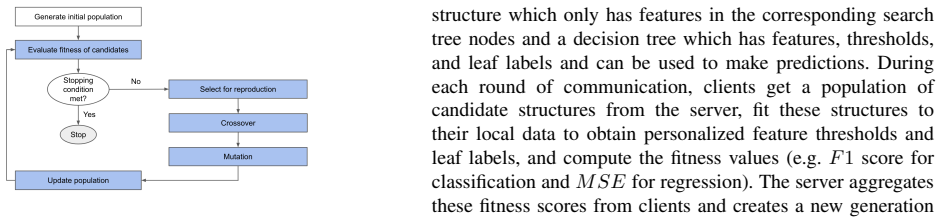
The central object is the search tree structure: a binary tree skeleton containing only hashed feature indices at decision nodes, encoded as a fixed-length integer string of length $2^d - 1$ via pre-order traversal, with nil padding for leaves and nonexistent nodes. Clients decode each candidate structure, use the CART procedure to fit thresholds and leaf labels on their local data, and report F1 or MSE fitness scores. The server aggregates these scores using noisy sample counts as weights, applies tournament-selection crossover and three mutation operators (node flip, node swap, substring swap) to evolve the population, and at the end each client keeps the structure with the best local fitness. This separation of shared skeleton from privately fitted thresholds is what enables personalization and, the paper argues, limits what the server can infer.
What would settle it
Run a membership-inference test on FedGA's communicated artifacts: for a client with n samples, train FedGA with and without one target sample, then ask an attacker to guess which run included it using only the reported fitness scores per generation and the final selected structure; if the attacker beats chance across clients, the privacy premise fails.
Extended reading notes
Core claim
The paper's central claim is that a federated genetic algorithm can build personalized binary decision trees in the horizontal federated setting by evolving only tree structures—which feature sits at which node—and letting each client fit thresholds and leaf labels locally. Because thresholds and labels never leave the client, the server sees only coarse aggregated signals: tree skeletons, fitness scores, noisy sample counts, locally optimized depths, and coefficients of variation. The final output is a per-client tree rather than one shared global tree, which the authors describe as the first personalized federated decision tree approach. They report that this method beats both client-local trees and a differentially private federated tree benchmark on classification, beats local trees on most regression datasets, and remains stable when only 10% to 50% of clients participate in a generation.
Load-bearing premise
The load-bearing premise is that the coarse information clients share—tree skeletons, fitness scores, noisy sample sizes, locally optimized depths, and coefficients of variation—cannot be combined to reconstruct sensitive thresholds or infer membership in client datasets; the paper argues this qualitatively but does not quantify it.
Editorial extensions
If this is right
- Federated tree training no longer requires categorical features or classification targets; numerical features and regression objectives are handled without pre-discretization.
- Each client receives a personalized tree whose thresholds, leaf labels, and final structure can differ from every other client's, unlike the single global tree produced by greedy differentially private methods.
- The protocol remains effective under partial client participation, keeping stable gains over local models when only 10% to 50% of clients are active per generation.
- Evolved FedGA trees tend to be less complex than locally trained trees, which the paper links to better generalization and to the reported F1 improvements.
- Because thresholds and leaf labels never leave clients, FedGA avoids the per-node differential-privacy budget splits that force shallow trees in greedy private tree methods.
Reading between the lines
- A quantitative privacy analysis could change the selling point: because the server sees fitness scores for many structures, an attacker may be able to rank feature importance or bracket optimal thresholds from fitness differences, so a membership-inference benchmark would show whether the coarse-metrics argument holds.
- The same skeleton/fitness separation extends naturally to ensembles: evolving several populations in parallel would produce a federated random forest with the same personalization property, since each client can fit its own thresholds for every tree.
- The experimentally tuned thresholds in the voting rules are likely dataset-dependent; a version that calibrates them from the observed coefficients of variation would remove manual tuning and make the method easier to deploy.
- Because local structures seed the initial population and the server's median depth caps all trees, heterogeneous local depth preferences could handicap some clients; competing multiple depths in the population is a natural fix.
Editorial analysis
A structured set of objections, weighed in public.
Referee Report
Summary. The paper proposes FedGA-Tree, a federated learning method that uses a genetic algorithm to evolve binary decision-tree structures (feature indices only) in a horizontal FL setting. Clients fit personalized thresholds and leaf labels locally, evaluate candidate structures, and send fitness scores and coarse statistics to a server, which aggregates scores and applies crossover/mutation. The authors claim this is the first GA-based federated decision-tree method, that it handles categorical and numerical data for both classification and regression, and that it outperforms locally trained trees and a DP-based IBM baseline across 28 datasets and varying numbers of clients and participation rates.
Significance. If the central claims hold, FedGA is a useful contribution: it is a genuinely different approach to federated decision trees, it provides personalization rather than a single global tree, and it extends beyond classification-only categorical settings. The empirical scope is broad (28 datasets, varied N and c, 10 runs per split with IQRs), and the paper explicitly discusses limitations in Section V. However, the headline 'superior to local trees' result is currently undermined by an asymmetric evaluation protocol, and the privacy contribution is asserted rather than quantified. These are load-bearing issues, not cosmetic ones.
major comments (3)
- [§IV-A.2, §IV-A.3, Algorithm 1 (lines 2, 28, 47), Table II] The comparison against local trees is confounded by an asymmetric evaluation protocol. For classification, FedGA fixes the client-side train ratio r=0.8 (Algorithm 1 line 2; Table II) and every fitness evaluation, including final tree selection, uses Evaluate(P, Di, r, f) with that r (lines 28 and 47). Section III-B states that the vote between r=0.8 and r=1.0 is applied only to regression (Algorithm 1 steps 14-18 and 23-24); classification therefore always fits thresholds and leaf labels on 80% of each client's local data and selects structures on the remaining 20%. The local-tree baseline in Section IV-A.2 is described as a CART tree whose maximum depth is chosen by 5-fold cross-validation, with no held-out split mentioned; the natural reading is that the local tree is trained on all local data after depth selection. FedGA's reported F1 gains and lower complexity could therefore reflect a validation-subset advantage rather than a benefit of federation. The authors should either train local trees under the same 80/20 protocol, evaluate FedGA structures with r=1.0 after selection, or report both settings.
- [§III-B (Eqs. 1-2), §IV-A.3, Table II] The thresholds phi*, theta*, and mu* are said to be 'obtained experimentally' (Section III-B), and the full hyperparameter set is said to be 'obtained from manual fine-tuning' (Section IV-A.3) on the same benchmark collection used for evaluation. Because these thresholds determine the regression evaluation strategy and the elitism rule, part of the measured improvement over baselines may reflect fitting design choices to the test bed rather than a general property of the method. The authors should provide either a derivation of these thresholds or, more practically, a sensitivity analysis showing that the reported results are stable over a range of threshold values and ideally on datasets not used for tuning.
- [§III-E, §V, Algorithm 1 (step 34)] The privacy claim is not quantified. Section III-E states that FedGA does not rely on differential privacy except for sample-size perturbation, because clients disclose only 'coarse aggregated information'; however, the server also receives per-client fitness scores for every candidate structure in every generation (Algorithm 1 step 34), along with local structures (steps 12 and 31), locally optimized depths, and coefficients of variation. The authors concede that the server can infer relative feature importance, and Section V defers a quantitative privacy assessment to future work. Since privacy is a central motivation of the paper, the claim 'we ensure the privacy of local data' (Section I) needs either a concrete attack analysis, a formal bound, or a clear downgrade to a heuristic argument. At minimum, the text should state which inferences are possible and why they are bounded.
minor comments (5)
- [§IV-A.2, §IV-B] The centralized tree is listed as a benchmark in Section IV-A.2, but no result for it appears in Section IV-B; without this comparison, readers cannot assess the accuracy cost of federation relative to non-private centralized training.
- [§IV-A.2, Appendix B] The IBM baseline uses a fixed maximum depth of 6 tuned on three datasets, whereas FedGA selects depth per dataset via the median of client cross-validation results (Algorithm 1 step 10). Appendix B partially mitigates this concern, but a per-dataset depth selection for the IBM baseline would make the comparison more direct.
- [§I] Reference [29] is duplicated in the sentence about decision nodes containing actual training values; the citation should appear once.
- [§III-B] The phrase 'The following applies only to regression and during the initialization phase' is ambiguous because the evaluation strategy for classification is never stated explicitly; please clarify whether r=0.8 always applies for classification and how thresholds and leaf labels are obtained in that case.
- [§IV-A.1, Eq. (3)] Because MSE is unbounded, the percentage change Delta defined in Eq. (3) can be skewed by a small number of clients with large errors; the authors acknowledge this in Section IV-B.2, but a robust alternative such as median Delta or a clipped version would make the reported averages more interpretable.
Circularity Check
The GA construction is self-contained, but the reported regression gains are partly fitted because the voting thresholds phi*, theta*, mu* are experimentally tuned on the same benchmark data used for evaluation.
-
fitted input called prediction
[Section III-B (Eq. 1), Section III-C (Eq. 2), Section IV-A.3 (Table II)]
"votei1 = ( 1 if ϕid < ϕ∗ and θi > θ∗, 0 otherwise. (1) ... where ϕ∗ and θ∗ are thresholds obtained experimentally. ... votei2 = ( 1 if µi > µ∗, 0 otherwise (2) where µ∗ is determined experimentally. ... We report the remaining hyperparameters of FedGA in Table II, which are obtained from manual fine-tuning."
The regression branch of FedGA is switched on or off by comparing per-dataset statistics (ϕ_id, θ_i, µ_i) to thresholds ϕ*, θ*, µ* that the paper states were 'obtained experimentally' / 'determined experimentally' and reports in the same table as all other 'manual fine-tuning' hyperparameters. The reported regression improvements over local trees (Figs. 8-10) are produced after choosing the evaluation strategy and elitism with these thresholds. The paper does not describe a separate meta-validation set for choosing ϕ*, θ*, µ*; Table I lists the same datasets used in the benchmarks. Hence the protocol that generates the reported Δ is itself a tuned input, and the measured regression gain is partly fitted to the evaluation bed rather than an independent test of the GA machinery.
full rationale
The paper's derivation chain is empirical rather than formal: FedGA evolves integer-encoded tree structures through genetic operators, with server-side weighted fitness aggregation and per-client threshold/label fitting. I found no equation where an output quantity is defined in terms of the target claim, and no load-bearing self-citations: the IBM baseline [25] is an external method, and no 'uniqueness theorem' or prior-work ansatz is imported from the authors. The GA operators (Section III-D) and encoding (Section III-A) are described directly and do not reduce to their inputs. The only concrete circularity-adjacent element is the regression voting mechanism. Equations (1)-(2) choose the training/evaluation strategy and elitism using thresholds ϕ*, θ*, µ*, which Section IV-A.3 identifies as part of the 'manual fine-tuning' hyperparameter set 'obtained experimentally'. Since the same regression datasets are used for the reported benchmarks, the choice of evaluation protocol is fitted to the evaluation bed; the reported Δ values are therefore not a fully independent test of the regression branch. This is a partial 'fitted input called prediction' issue, and it is why the score is not 0-2. The classification comparison asymmetry noted in the skeptic summary (r=0.8 with FedGA vs. full-data local trees) is a potential experimental confound, but it is not itself a circular derivation: FedGA's final tree is selected on a held-out local split and evaluated on a common test set, so the claim 'surpasses local trees' is not logically forced by that protocol. I therefore do not score it as a circular step. The Section V concession that a more rigorous privacy assessment is future work is a limitation, not a circularity. If the thresholds were fixed a priori or tuned on a separate meta-validation set, the paper would merit a 0-1; as written, the experimental protocol leaves a moderate fitted-component residue.
Assumptions & free parameters
free parameters (10)
- P (population size) =
20 (classification), 40 (regression)
- G (number of generations) =
100
- r (train ratio) =
0.8 default; can become 1.0 by vote
- rl (leaf node ratio) =
0.01
- s (tournament pressure) =
3
- m1, m2 (mutation rates) =
0.05 each
- phi* =
0.25
- theta* =
0.02
- mu* =
80
- epsilon =
1
assumptions (4)
- domain assumption Clients are honest-but-curious and do not collude.
- domain assumption The weighted average of fitness scores over clients is a sufficient signal for the GA to improve structures across generations.
- domain assumption Feature hashing to integers is consistent across all clients.
- ad hoc to paper The manually tuned hyperparameters in Table II (including phi*, theta*, mu*) transfer to new datasets.
Cite this review
Pith. "Pith review of FedGA-Tree: Federated Decision Tree using Genetic Algorithm." pith.science (2026). https://pith.science/paper/3ZBUVFCH
@misc{pith2026250608176,
  author       = {Pith},
  title        = {Pith review of: FedGA-Tree: Federated Decision Tree using Genetic Algorithm},
  year         = {2026},
  howpublished = {\url{https://pith.science/paper/3ZBUVFCH}},
  note         = {Machine review of arXiv:2506.08176}
}
read the original abstract
In recent years, with rising concerns for data privacy, Federated Learning has gained prominence, as it enables collaborative training without the aggregation of raw data from participating clients. However, much of the current focus has been on parametric gradient-based models, while nonparametric counterparts such as decision tree are relatively understudied. Existing methods for adapting decision trees to Federated Learning generally combine a greedy tree-building algorithm with differential privacy to produce a global model for all clients. These methods are limited to classification trees and categorical data due to the constraints of differential privacy. In this paper, we explore an alternative approach that utilizes Genetic Algorithm to facilitate the construction of personalized decision trees and accommodate categorical and numerical data, thus allowing for both classification and regression trees. Comprehensive experiments demonstrate that our method surpasses decision trees trained solely on local data and a benchmark algorithm.
Figures


Figures from the paper (5 more)


Reference graph
Works this paper leans on
-
[1]
A survey of evolutionary algorithms for decision-tree induction
Rodrigo Coelho Barros, M ´arcio Porto Basgalupp, Andre CPLF De Car- valho, and Alex A Freitas. A survey of evolutionary algorithms for decision-tree induction. IEEE Transactions on Systems, Man, and Cybernetics, Part C (Applications and Reviews) , 42(3):291–312, 2011
work page 2011
-
[2]
Practical privacy: the SuLQ framework
Avrim Blum, Cynthia Dwork, Frank McSherry, and Kobbi Nissim. Practical privacy: the SuLQ framework. In Proceedings of the 24th ACM SIGMOD-SIGACT-SIGART Symposium on Principles of Database Systems, pages 128–138, 2005
work page 2005
-
[3]
Classification and regression trees
Leo Breiman, Jerome Friedman, Richard A Olshen, and Charles J Stone. Classification and regression trees . Routledge, 2017
work page 2017
-
[4]
Fed-gbm: A cost- effective federated gradient boosting tree for non-intrusive load moni- toring
Xiaomin Chang, Wei Li, and Albert Y Zomaya. Fed-gbm: A cost- effective federated gradient boosting tree for non-intrusive load moni- toring. In Proceedings of the 13th ACM International Conference on Future Energy Systems , pages 63–75, 2022
work page 2022
-
[5]
Secureboost: A lossless federated learning framework
Kewei Cheng, Tao Fan, Yilun Jin, Yang Liu, Tianjian Chen, Dimitrios Papadopoulos, and Qiang Yang. Secureboost: A lossless federated learning framework. IEEE Intelligent Systems , 36(6):87–98, 2021
work page 2021
-
[6]
Dfedforest: Decentralized federated forest
Lucas Airam C de Souza, Gabriel Antonio F Rebello, Gustavo F Camilo, Lucas CB Guimar ˜aes, and Otto Carlos MB Duarte. Dfedforest: Decentralized federated forest. In 2020 IEEE International Conference on Blockchain, pages 90–97. IEEE, 2020
work page 2020
-
[7]
Building decision tree classifier on private data
Wenliang Du and Zhijun Zhan. Building decision tree classifier on private data. 2002
work page 2002
-
[8]
Differential privacy and robust statistics
Cynthia Dwork and Jing Lei. Differential privacy and robust statistics. In Proceedings of the 41st Annual ACM Symposium on Theory of Computing, pages 371–380, 2009
work page 2009
Show all 29 references
-
[9]
Data mining with differential privacy
Arik Friedman and Assaf Schuster. Data mining with differential privacy. In Proceedings of the 16th ACM SIGKDD International Conference on Knowledge Discovery and Data Mining , pages 493–502, 2010
2010
-
[10]
Privacy-preserving collaborative prediction using random forests
Irene Giacomelli, Somesh Jha, Ross Kleiman, David Page, and Kyongh- wan Yoon. Privacy-preserving collaborative prediction using random forests. AMIA Summits on Translational Science Proceedings, 2019:248, 2019
2019
-
[11]
Revisiting deep learning models for tabular data
Yury Gorishniy, Ivan Rubachev, Valentin Khrulkov, and Artem Babenko. Revisiting deep learning models for tabular data. Advances in Neural Information Processing Systems , 34:18932–18943, 2021
2021
-
[12]
Why do tree- based models still outperform deep learning on typical tabular data? Advances in Neural Information Processing Systems, 35:507–520, 2022
L ´eo Grinsztajn, Edouard Oyallon, and Ga ¨el Varoquaux. Why do tree- based models still outperform deep learning on typical tabular data? Advances in Neural Information Processing Systems, 35:507–520, 2022
2022
-
[13]
Generative model for decision trees
Riccardo Guidotti, Anna Monreale, Mattia Setzu, and Giulia V olpi. Generative model for decision trees. In Proceedings of the AAAI Conference on Artificial Intelligence , volume 38, pages 21116–21124, 2024
2024
-
[14]
Federated learning for mobile keyboard prediction
Andrew Hard, Kanishka Rao, Rajiv Mathews, Swaroop Ramaswamy, Franc ¸oise Beaufays, Sean Augenstein, Hubert Eichner, Chlo ´e Kiddon, and Daniel Ramage. Federated learning for mobile keyboard prediction. arXiv preprint arXiv:1811.03604 , 2018
2018 arXiv
-
[15]
Adaptation in natural and artificial systems: an introductory analysis with applications to biology, control, and artificial intelligence
John H Holland. Adaptation in natural and artificial systems: an introductory analysis with applications to biology, control, and artificial intelligence. MIT press, 1992
1992
-
[16]
Verifiable privacy- preserving scheme based on vertical federated random forest
Jinpeng Hou, Mang Su, Anmin Fu, and Yan Yu. Verifiable privacy- preserving scheme based on vertical federated random forest. IEEE Internet of Things Journal , 2021
2021
-
[17]
Cross-silo federated learning based decision trees
Saikishore Kalloori and Severin Klingler. Cross-silo federated learning based decision trees. In Proceedings of the 37th ACM/SIGAPP Sympo- sium on Applied Computing , pages 1117–1124, 2022
2022
-
[18]
Practical federated gradient boosting decision trees
Qinbin Li, Zeyi Wen, and Bingsheng He. Practical federated gradient boosting decision trees. In Proceedings of the AAAI Conference on Artificial Intelligence, volume 34, pages 4642–4649, 2020
2020
-
[19]
Federated forest
Yang Liu, Yingting Liu, Zhijie Liu, Yuxuan Liang, Chuishi Meng, Junbo Zhang, and Yu Zheng. Federated forest. IEEE Transactions on Big Data, 2020
2020
-
[20]
A comparison of bloat control methods for genetic programming
Sean Luke and Liviu Panait. A comparison of bloat control methods for genetic programming. Evolutionary Computation, 14(3):309–344, 2006
2006
-
[21]
Evaluating dif- ferentially private decision tree model over model inversion attack
Cheolhee Park, Dowon Hong, and Changho Seo. Evaluating dif- ferentially private decision tree model over model inversion attack. International Journal of Information Security , 21(3):1–14, 2022
2022
-
[22]
Ross Quinlan
J. Ross Quinlan. Induction of decision trees. Machine Learning, 1:81– 106, 1986. Fig. 11. ∆ in F 1 score across random train/test splits for IBM trees with different strategies for determining maximum depth
1986
-
[23]
Tabular data: Deep learning is not all you need
Ravid Shwartz-Ziv and Amitai Armon. Tabular data: Deep learning is not all you need. Information Fusion, 81:84–90, 2022
2022
-
[24]
Federboost: Private federated learning for GBDT
Zhihua Tian, Rui Zhang, Xiaoyang Hou, Jian Liu, and Kui Ren. Federboost: Private federated learning for GBDT. arXiv preprint arXiv:2011.02796, 2020
2011 arXiv
-
[25]
A hybrid approach to privacy- preserving federated learning
Stacey Truex, Nathalie Baracaldo, Ali Anwar, Thomas Steinke, Heiko Ludwig, Rui Zhang, and Yi Zhou. A hybrid approach to privacy- preserving federated learning. In Proceedings of the 12th ACM Workshop on Artificial Intelligence and Security , pages 1–11, 2019
2019
-
[26]
Scalable and provably accurate algorithms for differentially private distributed deci- sion tree learning
Kaiwen Wang, Travis Dick, and Maria-Florina Balcan. Scalable and provably accurate algorithms for differentially private distributed deci- sion tree learning. arXiv preprint arXiv:2012.10602 , 2020
2012 arXiv
-
[27]
An efficient and robust system for vertically federated random forest
Houpu Yao, Jiazhou Wang, Peng Dai, Liefeng Bo, and Yanqing Chen. An efficient and robust system for vertically federated random forest. arXiv preprint arXiv:2201.10761 , 2022
2022 arXiv
-
[28]
Inprivate digging: Enabling tree-based distributed data mining with differential privacy
Lingchen Zhao, Lihao Ni, Shengshan Hu, Yaniiao Chen, Pan Zhou, Fu Xiao, and Libing Wu. Inprivate digging: Enabling tree-based distributed data mining with differential privacy. In IEEE INFOCOM 2018-IEEE Conference on Computer Communications , pages 2087–
2018
-
[29]
Understanding privacy risk of publishing decision trees
Zutao Zhu and Wenliang Du. Understanding privacy risk of publishing decision trees. In IFIP Annual Conference on Data and Applications Security and Privacy , pages 33–48. Springer, 2010. APPENDIX A DATA PREPROCESSING For classification datasets with numerical features, we appl...
2010
Reviewed August 7, 2026 · model on record in the stance chip above.
Discussion (0). Sign in to comment.