REVIEW 4 major objections 5 minor 31 references
Image Demoir\'eing Using Dual Camera Fusion on Mobile Phones
T0 review · 4 major / 5 minor · reviewed 2026-08-07 · deepseek-v4-flash
Pith's one-line read Using the ultra-wide-angle photo from the same phone as a reference, the paper removes severe screen moiré from the wide-angle photo and beats previous single-image methods on a new 8,959-sample real-world benchmark.
desk verdict A solid dual-camera demoiréing dataset and method whose main weakness is evaluation breadth, not the core idea. read the letter →
The pith
A machine-rendered reading of the paper's core claim, the machinery that carries it, and where it could break.
The reading
What carries the argument
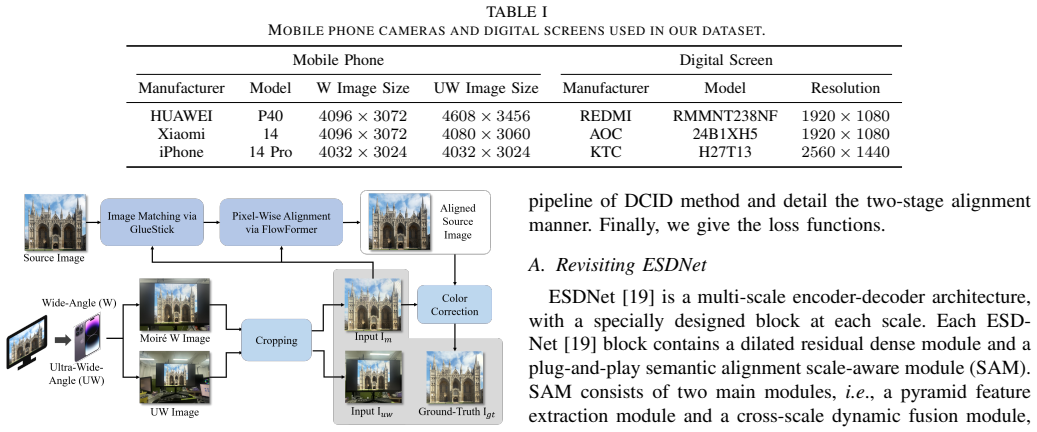
The machinery is a two-stage alignment between the wide-angle and ultra-wide-angle views. In the first stage, KMA (Keypoint Matching based Alignment) detects 256 keypoints with SuperPoint on downsampled images, matches them with LightGlue, and warps the UW image coarsely onto the W image. In the second stage, KPA (Kernel Prediction based Alignment) pools and concatenates the two encoders' multi-scale features, runs two convolutions, applies a softmax over weight groups, and combines learnable parameters to produce a content-adaptive convolution kernel that refines $\tilde{F}_{uw}$ from the aligned UW features; the fused feature is $F_m + \alpha \tilde{F}_{uw}$ with a learned per-channel coefficient. The same recipe is used to build the dataset: GlueStick keypoint/keyline matching followed by FlowFormer optical flow aligns the source screen image to the cropped W image, and a least-squares 3x3 color correction matrix computed on Gaussian-blurred images maps the source into the ground-truth color state. The alignment is the load-bearing part: it is what converts the UW image from a misaligned second view into usable moiré-free evidence, and the ablation shows that KMA+KPA gives the gain while optical flow or deformable convolution does not.
What would settle it
Measure moiré energy in the UW images of the released DCID dataset: if a substantial share of UW images show moiré comparable to their paired W images, the premise fails. A direct experiment would be to capture W/UW pairs on other phone models and screens at distances and angles where both sensors alias, then run the released model and check whether its PSNR advantage over single-image ESDNet disappears or turns negative.
Extended reading notes
Core claim
The central claim is that when severe frequency aliasing puts moiré on the wide-angle (W) sensor, the ultra-wide-angle (UW) sensor—having a different focal length and viewpoint—usually records the same screen with normal colors and textures, and that this UW image is a usable reference for removing moiré from the W image. To test this, the paper contributes the DCID dataset, about 8,959 real captures across three phone models and three monitors, with ground truth aligned to the cropped W image and color-corrected to the display's actual appearance. The method wraps the ESDNet demoiréing backbone with a lightweight UW encoder and aligns the two views first by keypoint matching (KMA) at the image level and then by predicted convolution kernels (KPA) at the feature level, fusing the features as $F_{fuse} = F_m + \alpha \tilde{F}_{uw}$. On the Xiaomi subset the paper reports PSNR 27.06 dB versus 26.14 dB for ESDNet, with similar gains on the Huawei and iPhone subsets and lower color error in every case. The authors conclude that the UW image supplies low-resolution but moiré-free texture and color information that a single degraded image cannot provide.
Load-bearing premise
The approach stands or falls on the assumption, reported as an observation rather than measured, that the ultra-wide-angle image is essentially moiré-free and color-faithful whenever the wide-angle image has severe moiré; if the UW camera also aliases with the screen under common conditions, or the two views cannot be aligned, the fusion has no reliable reference to add.
Editorial extensions
If this is right
- Screen photos taken on dual-camera phones can be demoiréd with better PSNR, SSIM, LPIPS, and ΔE than any single-image method compared, on all three phone subsets of the DCID dataset.
- Textures hidden under severe moiré—the paper's lamp-shade example—are recoverable from the UW view instead of being hallucinated by the network.
- The KMA+KPA alignment is what delivers the gain: replacing either stage with optical flow or deformable convolution lowers performance, and KMA+KPA adds only about 0.5 GFLOPs and 0.14 seconds over the ESDNet baseline.
- Perceptual loss weight $\lambda_p = 2.0$ is needed; without it the best PSNR drops by about 1 dB in the ablation.
- The released DCID dataset of 8,959 real samples gives future work a benchmark where severe, color-rich moiré is the target rather than light synthetic patterns.
Reading between the lines
- If UW moiré-freeness holds more broadly than the three phones tested, the same architecture could be applied to live screen capture or video, since the first alignment stage runs on downsampled images and the total inference time is under a second.
- The two-stage alignment is generic: the same KMA+KPA recipe could carry a clean reference view into other single-image restoration tasks where a second lens is available, such as glare removal or reflection suppression.
- The paper does not quantify how often or how strongly the UW image itself contains moiré; a direct test would be to measure moiré energy in UW images across distances, angles, and screen subpixel layouts, since the whole gain depends on that premise.
- Adapting existing methods to accept the UW image (the RRID and UnDeM variants in Table III) helps less than the purpose-built fusion, suggesting the alignment and fusion design, not merely the extra input, drives the improvement.
Editorial analysis
A structured set of objections, weighed in public.
Referee Report
Summary. The paper proposes DCID (Dual Camera fusion for Image Demoiréing), a method that uses the ultra-wide-angle (UW) image from a smartphone's secondary camera to assist the demoiréing of the wide-angle (W) image. The method integrates a lightweight UW encoder into the ESDNet backbone and introduces a two-stage alignment procedure: KMA (keypoint matching via SuperPoint and LightGlue) for coarse image-level alignment and KPA (content-adaptive kernel prediction) for fine feature-level alignment. The authors also construct a new dataset of approximately 9,000 real-world screen captures using three phones and three monitors, with ground truth generated by aligning the source image to the W image. Experiments on this dataset show consistent improvements over several single-image demoiréing methods, e.g., PSNR 27.06 vs. 26.14 dB for ESDNet on the Xiaomi subset, and ablations indicate that the two-stage alignment is responsible for the gains.
Significance. If the reported results hold, this is the first dual-camera fusion approach for image demoiréing on mobile phones and it establishes a new benchmark dataset (DCID) that the authors plan to release. The work is practically motivated, and the efficiency-oriented design (lightweight UW encoder, fast alignment) is well aligned with mobile deployment. The manuscript includes a relatively thorough ablation of alignment alternatives (optical flow, deformable convolution, KMA, KPA) and a sensitivity study for the perceptual loss weight. The dataset, code release, and the identification of a novel problem setting are valuable contributions. However, the evaluation is confined to the authors' own dataset, the improvements over the strongest baseline are modest, and the analysis lacks quantification of alignment accuracy and run-to-run variance.
major comments (4)
- [Section V.C, Table IV] The first row of Table IV (no alignment, no UW) reports PSNR 26.14, which is identical to the ESDNet baseline in Table II. This means the entire reported improvement (0.92 dB on the Xiaomi subset) comes from the KMA+KPA alignment stages, not from the presence of the UW image per se. The paper never measures alignment accuracy directly (e.g., keypoint inlier ratio, reprojection error, or SSIM between aligned UW and W images) and reports no failure cases. Given that the central claim is that UW-assisted fusion beats single-image demoiréing, the absence of any alignment-quality metric is a load-bearing gap. The authors should provide quantitative alignment accuracy statistics and a qualitative analysis of failure modes (e.g., low-texture screens, large parallax, or strong perspective differences).
- [Section III.B and Section V] The ground-truth generation pipeline in Section III.B uses GlueStick and FlowFormer to align the source image to the W image, while the proposed KMA uses SuperPoint and LightGlue for keypoint matching. This is not circular because the ground truth is derived from the source image, not from the UW image. However, the test set is drawn from the same three phones and three monitors used to build the dataset, and no evaluation is performed on existing benchmarks such as LCDMoiré, FHDMi, or UHDM. The paper claims state-of-the-art performance 'on our dataset,' but without cross-dataset or external validation, the generality of the method remains unsubstantiated. At minimum, the authors should report the performance of the ESDNet backbone on a standard benchmark to confirm that their training configuration is consistent with published numbers, and ideally discuss how the method would transfer to unseen devices or screen types.
- [Section V.C, Table IV] The ablation in Table IV does not include a trivial baseline in which the UW image is naively resized or cropped and concatenated or added to the W branch without any learned geometric alignment. The fact that the no-alignment row matches the ESDNet baseline exactly suggests that the UW encoder and adaptive fusion alone contribute nothing without alignment. A naive-baseline experiment would clarify whether the improvement is specifically attributable to the proposed KMA+KPA alignment or simply to the injection of additional information at the correct spatial location. The authors should add such a baseline (e.g., resize UW to W resolution and concatenate features) to support their attribution of the gains to the two-stage alignment.
- [Section V.B, Table II] The quantitative results in Table II are reported as point estimates from a single training run. The improvements over ESDNet are small (0.41 dB on HUAWEI, 0.63 dB on iPhone, 0.92 dB on Xiaomi), and no standard deviation, confidence interval, or significance test is provided. The text in Section V.B states that the method 'significantly outperforms' existing methods, but without repeated runs or statistical testing, this claim is unsupported. The authors should train the main models multiple times (e.g., at least three runs with different seeds) and report mean and standard deviation for all metrics, or at least for the primary PSNR comparison.
minor comments (5)
- [Section IV.A] In Section IV.A, ESDNet is cited as reference [19], but the correct reference is [6]; reference [19] is a different paper (Residual Dense Network for image super-resolution). The same citation error appears twice in that subsection.
- [Section IV.C, Eq. (2) and (6)] The notation is confusing: in Eq. (2), the symbol W' is used for the concatenated pooled features, but in Eq. (3)-(4), W denotes the kernel weights. Additionally, in Eq. (6), 'Ff use' should be typeset as F_fuse. Please clarify the notation to avoid ambiguity.
- [Section III.A] The dataset is described as 'diverse mobile phones and monitors,' but it contains only three phone models and three monitor models. The term 'diverse' is an overstatement; consider describing the dataset as containing three devices per category or adding more devices to support the claim.
- [Section V.B, Table III] The adaptations of RRID and UnDeM are described only briefly. For reproducibility, please specify the exact changes made: how the RGB input is provided to RRID (which expects RAW), how pseudo-moiré pairs are generated for UnDeM, and what training data is used for these adapted baselines.
- [Section V.C] The ablation study is conducted only on the Xiaomi camera subset. Since the improvements vary across subsets in Table II, please clarify whether the conclusions of the ablation (e.g., KMA+KPA being optimal) also hold for the HUAWEI and iPhone subsets, or add such ablations if feasible.
Circularity Check
No significant circularity: the central comparison is an empirical evaluation on a held-out split of a newly collected dataset, with ground truth generated by external alignment tools independent of the proposed model.
full rationale
The paper's central claim—that UW-assisted fusion outperforms single-image demoiréing on the DCID dataset—rests on a held-out train/test split and externally generated ground truth, not on fitted values or self-citation. Ground truth is created by aligning the displayed source image to the captured W image using GlueStick and FlowFormer and then applying a 3x3 least-squares color correction; these operations are independent of the proposed network and are applied identically to all compared methods. The compared baselines are retrained on the same dataset with the same configuration, so the reported PSNR/SSIM differences measure actual restoration behavior rather than construction artifacts. Ablation Table IV does show that fusion without alignment equals the ESDNet baseline, but this is an empirical ablation result, not a circular reduction; it simply indicates that the contribution of the UW input is realized through the alignment stages. The paper contains some self-citations (Refs. 11–15) and a reference-list inconsistency in Section IV-A (citing RDN [19] where ESDNet [6] is meant), but none of these is load-bearing for the main result. The unquantified premise that UW images are mostly moiré-free is an external-validity concern, not a circularity.
Assumptions & free parameters
free parameters (4)
- perceptual loss weight lambda_p =
2.0
- keypoint count for KMA =
256
- downsampling factor for keypoint detection =
x4
- KPA kernel size K and group count G
assumptions (4)
- domain assumption The UW image generally has less moiré than the W image due to different focal lengths and positions.
- domain assumption ESDNet is a valid and strong backbone for demoiréing, and its architecture as described in the cited reference can be reproduced.
- domain assumption Ground truth generated by Gluestick and FlowFormer alignment of the source image is sufficiently accurate for training and evaluation.
- domain assumption The linear 3x3 color correction matrix estimated from Gaussian-blurred images restores display color appearance without removing moiré-related color variation.
Cite this review
Pith. "Pith review of Image Demoir\'eing Using Dual Camera Fusion on Mobile Phones." pith.science (2026). https://pith.science/paper/S4PF3I5B
@misc{pith2026250608361,
  author       = {Pith},
  title        = {Pith review of: Image Demoir\'eing Using Dual Camera Fusion on Mobile Phones},
  year         = {2026},
  howpublished = {\url{https://pith.science/paper/S4PF3I5B}},
  note         = {Machine review of arXiv:2506.08361}
}
read the original abstract
When shooting electronic screens, moir\'e patterns usually appear in captured images, which seriously affects the image quality. Existing image demoir\'eing methods face great challenges in removing large and heavy moir\'e. To address the issue, we propose to utilize Dual Camera fusion for Image Demoir\'eing (DCID), \ie, using the ultra-wide-angle (UW) image to assist the moir\'e removal of wide-angle (W) image. This is inspired by two motivations: (1) the two lenses are commonly equipped with modern smartphones, (2) the UW image generally can provide normal colors and textures when moir\'e exists in the W image mainly due to their different focal lengths. In particular, we propose an efficient DCID method, where a lightweight UW image encoder is integrated into an existing demoir\'eing network and a fast two-stage image alignment manner is present. Moreover, we construct a large-scale real-world dataset with diverse mobile phones and monitors, containing about 9,000 samples. Experiments on the dataset show our method performs better than state-of-the-art methods. Code and dataset are available at https://github.com/Mrduckk/DCID.
Figures


Figures from the paper (1 more)

Reference graph
Works this paper leans on
-
[19]
Residual dense network for image super-resolution,
Yulun Zhang, Yapeng Tian, Yu Kong, Bineng Zhong, and Yun Fu, “Residual dense network for image super-resolution,” in CVPR, 2018
work page 2018
-
[6]
Towards efficient and scale-robust ultra-high-definition image demoir´eing,
Xin Yu, Peng Dai, Wenbo Li, Lan Ma, Jiajun Shen, Jia Li, and Xiaojuan Qi, “Towards efficient and scale-robust ultra-high-definition image demoir´eing,” in ECCV, 2022
work page 2022
-
[1]
Moir ´e pattern removal from texture images via low-rank and sparse matrix decomposition,
Fanglei Liu, Jingyu Yang, and Huanjing Yue, “Moir ´e pattern removal from texture images via low-rank and sparse matrix decomposition,” in IEEE VCIP , 2015
work page 2015
-
[2]
Textured image demoir ´eing via signal decomposition and guided filtering,
Jingyu Yang, Fanglei Liu, Huanjing Yue, Xiaomei Fu, Chunping Hou, and Feng Wu, “Textured image demoir ´eing via signal decomposition and guided filtering,” IEEE TIP , 2017
work page 2017
-
[3]
Mop moire patterns using mopnet,
Bin He, Ce Wang, Boxin Shi, and Ling-Yu Duan, “Mop moire patterns using mopnet,” in ICCV, 2019
work page 2019
-
[4]
Image demoireing with learnable bandpass filters,
Bolun Zheng, Shanxin Yuan, Gregory Slabaugh, and Ales Leonardis, “Image demoireing with learnable bandpass filters,” in CVPR, 2020
work page 2020
-
[5]
Fhde 2 net: Full high definition demoireing network,
Bin He, Ce Wang, Boxin Shi, and Ling-Yu Duan, “Fhde 2 net: Full high definition demoireing network,” in ECCV, 2020
work page 2020
-
[7]
Flowformer: A transformer architecture for optical flow,
Zhaoyang Huang, Xiaoyu Shi, Chao Zhang, Qiang Wang, Ka Chun Cheung, Hongwei Qin, Jifeng Dai, and Hongsheng Li, “Flowformer: A transformer architecture for optical flow,” in ECCV, 2022
work page 2022
Show all 31 references
-
[8]
Deformable convolutional networks,
Jifeng Dai, Haozhi Qi, Yuwen Xiong, Yi Li, Guodong Zhang, Han Hu, and Yichen Wei, “Deformable convolutional networks,” in ICCV, 2017
2017
-
[9]
Moir ´e photo restoration using multiresolution convolutional neural networks,
Yujing Sun, Yizhou Yu, and Wenping Wang, “Moir ´e photo restoration using multiresolution convolutional neural networks,” IEEE TIP , 2018
2018
-
[10]
Multiscale coarse-to- fine guided screenshot demoir ´eing,
Duong Hai Nguyen, Se-Ho Lee, and Chul Lee, “Multiscale coarse-to- fine guided screenshot demoir ´eing,” SPL, 2023
2023
-
[11]
Self-supervised learning for real-world super-resolution from dual zoomed observations,
Zhilu Zhang, Ruohao Wang, Hongzhi Zhang, Yunjin Chen, and Wang- meng Zuo, “Self-supervised learning for real-world super-resolution from dual zoomed observations,” in ECCV, 2022
2022
-
[12]
Self-supervised learning for real-world super-resolution from dual and multiple zoomed observations,
Zhilu Zhang, Ruohao Wang, Hongzhi Zhang, and Wangmeng Zuo, “Self-supervised learning for real-world super-resolution from dual and multiple zoomed observations,” IEEE TPAMI, 2024
2024
-
[13]
Robust reference- based super-resolution with similarity-aware deformable convolution,
Gyumin Shim, Jinsun Park, and In So Kweon, “Robust reference- based super-resolution with similarity-aware deformable convolution,” in CVPR, 2020
2020
-
[14]
Self-supervised image restoration with blurry and noisy pairs,
Zhilu Zhang, RongJian Xu, Ming Liu, Zifei Yan, and Wangmeng Zuo, “Self-supervised image restoration with blurry and noisy pairs,” NeurIPS, 2022
2022
-
[15]
Bracketing is all you need: Unifying image restoration and enhancement tasks with multi-exposure images,
Zhilu Zhang, Shuohao Zhang, Renlong Wu, Zifei Yan, and Wangmeng Zuo, “Bracketing is all you need: Unifying image restoration and enhancement tasks with multi-exposure images,” ICLR, 2025
2025
-
[16]
Self-adaptively learning to demoir ´e from focused and defocused image pairs,
Lin Liu, Shanxin Yuan, Jianzhuang Liu, Liping Bao, Gregory Slabaugh, and Qi Tian, “Self-adaptively learning to demoir ´e from focused and defocused image pairs,” NeurIPS, 2020
2020
-
[17]
Aim 2019 challenge on image demoireing: Dataset and study,
Shanxin Yuan, Radu Timofte, Gregory Slabaugh, and Ale ˇs Leonardis, “Aim 2019 challenge on image demoireing: Dataset and study,” in ICCV Workshops, 2019
2019
-
[18]
Gluestick: Robust image matching by sticking points and lines together,
R ´emi Pautrat, Iago Su ´arez, Yifan Yu, Marc Pollefeys, and Viktor Larsson, “Gluestick: Robust image matching by sticking points and lines together,” in ICCV, 2023
2023
-
[20]
Super- point: Self-supervised interest point detection and description,
Daniel DeTone, Tomasz Malisiewicz, and Andrew Rabinovich, “Super- point: Self-supervised interest point detection and description,” in CVPR Workshops, 2018
2018
-
[21]
Light- glue: Local feature matching at light speed,
Philipp Lindenberger, Paul-Edouard Sarlin, and Marc Pollefeys, “Light- glue: Local feature matching at light speed,” in ICCV, 2023
2023
-
[22]
Transxnet: learning both global and local dynamics with a dual dynamic token mixer for visual recognition,
Meng Lou, Hong-Yu Zhou, Sibei Yang, and Yizhou Yu, “Transxnet: learning both global and local dynamics with a dual dynamic token mixer for visual recognition,” IEEE TNNLS , 2025
2025
-
[23]
Very deep convolutional networks for large-scale image recognition,
K Simonyan and A Zisserman, “Very deep convolutional networks for large-scale image recognition,” in ICLR, 2015
2015
-
[24]
Wavelet-based dual-branch network for image demoir ´eing,
Lin Liu, Jianzhuang Liu, Shanxin Yuan, Gregory Slabaugh, Ale ˇs Leonardis, Wengang Zhou, and Qi Tian, “Wavelet-based dual-branch network for image demoir ´eing,” in ECCV, 2020
2020
-
[25]
Image quality assessment: from error visibility to structural similarity,
Zhou Wang, Alan C Bovik, Hamid R Sheikh, and Eero P Simoncelli, “Image quality assessment: from error visibility to structural similarity,” IEEE TIP , 2004
2004
-
[26]
The unreasonable effectiveness of deep features as a perceptual metric,
Richard Zhang, Phillip Isola, Alexei A Efros, Eli Shechtman, and Oliver Wang, “The unreasonable effectiveness of deep features as a perceptual metric,” in CVPR, 2018
2018
-
[27]
Real- time image demoireing on mobile devices,
Yuxin Zhang, Mingbao Lin, Xunchao Li, Han Liu, Guozhi Wang, Fei Chao, Shuai Ren, Yafei Wen, Xiaoxin Chen, and Rongrong Ji, “Real- time image demoireing on mobile devices,” ICLR, 2023
2023
-
[28]
Sgdr: Stochastic gradient descent with warm restarts,
Ilya Loshchilov and Frank Hutter, “Sgdr: Stochastic gradient descent with warm restarts,” ICLR, 2017
2017
-
[29]
Adam: A method for stochastic optimization,
Diederik P Kingma, “Adam: A method for stochastic optimization,” ICLR, 2015
2015
-
[30]
Image demoireing in raw and srgb domains,
Shuning Xu, Binbin Song, Xiangyu Chen, Xina Liu, and Jiantao Zhou, “Image demoireing in raw and srgb domains,” in ECCV, 2024
2024
-
[31]
Learning image demoir ´eing from unpaired real data,
Yunshan Zhong, Yuyao Zhou, Yuxin Zhang, Fei Chao, and Rongrong Ji, “Learning image demoir ´eing from unpaired real data,” in AAAI, 2024
2024
Reviewed August 7, 2026 · model on record in the stance chip above.
Discussion (0). Sign in to comment.