REVIEW 3 major objections 5 minor 31 references
SHIELD: Multi-task Multi-distribution Vehicle Routing Solver with Sparsity and Hierarchy
T0 review · 3 major / 5 minor · reviewed 2026-08-07 · deepseek-v4-flash
Pith's one-line read SHIELD claims a single neural solver can generalize across 16 VRP variants and nine real-world maps by learning when to spend computation and how to group customers.
desk verdict A solid empirical extension of multi-task VRP to realistic map distributions; the main issue is an underspecified data-generation step that needs clarification, not a fatal flaw. read the letter →
The pith
A machine-rendered reading of the paper's core claim, the machinery that carries it, and where it could break.
The reading
What carries the argument
The load-bearing mechanisms are two. First, Mixture-of-Depths (MoD) in the autoregressive decoder: each decoder layer's router scores every candidate node and only the top $\beta$ percentile of tokens (here 10%) is processed as query through the attention layer, while the rest skip via a residual connection, so the model dynamically decides how much computation each decision gets. Second, context-based soft clustering: an EM-inspired layer iteratively computes attention weights between node embeddings and five learnable cluster centers, with the cluster centers concatenated with a task-constraint prompt vector, then feeds the resulting centroids into the decoder and updates them by subtracting visited nodes. A Mixture-of-Experts encoder supplies task-adaptive node embeddings. These pieces together are what the paper argues create compact, shared representations and better out-of-task and out-of-distribution generalization.
What would settle it
Train SHIELD with the MoD router replaced by random token dropout at the same 10% budget, all else equal; if out-of-distribution gaps match SHIELD's, then the learned sparsity selection is not what drives the reported generalization.
Extended reading notes
Core claim
On its own terms, the paper's central claim is that learned sparsity and learned hierarchy, combined in one decoder, are the right inductive biases for a unified VRP solver. SHIELD trains a single policy with a Mixture-of-Experts encoder, a three-layer Mixture-of-Depths decoder that routes only the top 10% of query tokens through each layer, and a soft-clustering layer with five cluster centers that runs five expectation-maximization-style iterations using task-constraint prompts. The experiments compare against POMO-MTVRP, MVMoE, MVMoE-Light, and a deeper MVMoE-Deeper, and report that SHIELD achieves the best average optimality gaps in every aggregate block, in-task and out-task, in-distribution and out-distribution, for both N=50 and N=100, with zero-shot gains at N=200 and on CVRPLib Set-X. The authors interpret the compute savings from Mixture-of-Depths as a regularizer in the VC-dimension sense: less computation and fewer parameters push the model toward representations shared across tasks and distributions instead of overfit ones.
Load-bearing premise
The central argument assumes that sampling a subset of customers from a fixed map preserves that map's geographical structure; if the subset sampling instead changes the effective distribution, then the maps labeled out-of-distribution are not truly novel and the reported transfer gains are overstated.
Editorial extensions
If this is right
- A single SHIELD model trained on six tasks and three country maps can be applied zero-shot to ten unseen tasks and six unseen maps, with the reported gaps still below all compared baselines.
- Because MoD skips most tokens, a three-layer decoder is computationally feasible at N=100 where the dense deeper baseline runs out of memory, so depth is no longer the bottleneck for larger instances.
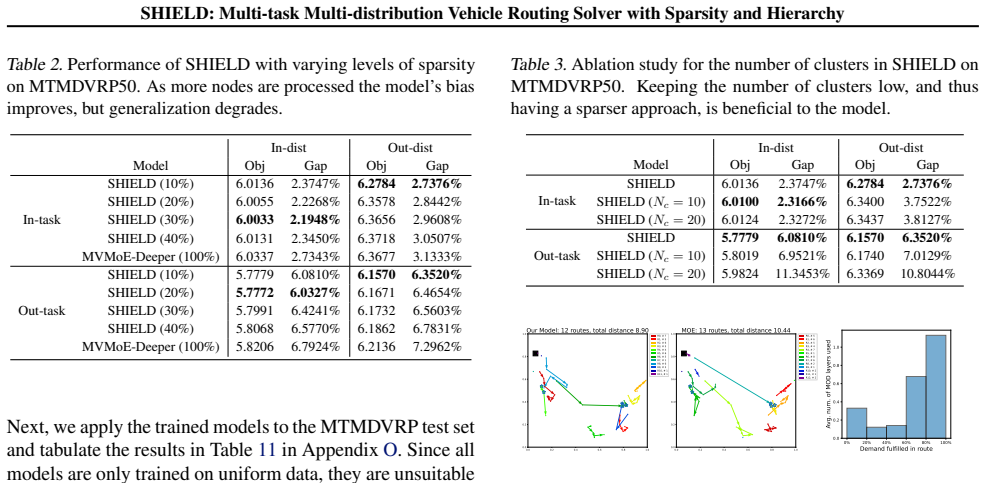
- The sparsity level acts as a regularization dial: raising the token budget from 10% to 40% improves in-distribution fit but degrades out-of-task and out-of-distribution gaps, so compute can be traded against transfer.
- Keeping the number of cluster centers small, five instead of 10 or 20, preserves the generalization benefit, meaning the hierarchy mechanism works by abstraction rather than by adding capacity.
- SHIELD also retains its advantage when reduced to a single task, CVRP, across distributions and when trained on the uniform MTVRP setting, so the design is not specific to the multi-task multi-distribution scenario.
Reading between the lines
- If the subset-sampling procedure preserves map geography, then the model's success implies a transferable notion of map motif: countries with similar density patterns should share router and cluster behavior; the paper's layer-usage heatmaps already hint that two similar maps behave alike, so one could test this by clustering maps by their learned layer-usage signatures.
- The MoD router scores could serve as an interpretable difficulty map of which customers require deeper reasoning, which the paper does not exploit; a planner could use those scores to flag unusual nodes or allocate human review.
- A natural stress test the paper does not run is temporal drift within one map: if a city's layout changes over years, the fixed-map training distribution becomes stale, and online adaptation of the cluster centers would be needed for SHIELD to remain reliable.
- The VC-dimension argument is invoked as motivation rather than proof; the practical claim that compute budget regularizes generalization would be strengthened if the paper provided a formal link between MoD's token dropout and a known complexity measure.
Editorial analysis
A structured set of objections, weighed in public.
Referee Report
Summary. The paper proposes a new problem setting, Multi-Task Multi-Distribution VRP (MTMDVRP), in which VRP instances are generated from real-world country maps rather than from a uniform distribution, and introduces SHIELD, a neural constructive solver that combines a Mixture-of-Experts encoder, a Mixture-of-Depths decoder with token-level sparsity, and a context-prompted soft clustering layer. The model is trained with REINFORCE on six VRP tasks from three country maps and evaluated on ten unseen tasks, six unseen maps, N=50/100, with additional zero-shot experiments on N=200 and CVRPLib. The paper claims state-of-the-art optimality gaps against POMO-MTVRP, MVMoE, MVMoE-Light, and MVMoE-Deeper in all four in-task/out-task by in-distribution/out-distribution groups, and attributes the gains to sparsity and hierarchy acting as regularizers.
Significance. If the empirical claims hold, the paper makes a useful contribution to the emerging foundation-model direction for neural routing: it broadens the MTVRP benchmark to realistic distributions and provides a concrete architectural recipe (MoD sparsity plus contextual clustering) that appears to improve both efficiency and zero-shot generalization. The experimental effort is substantial, covering 9 maps, 16 VRP variants, two training sizes, ablations of MoD capacity and cluster count, matched-epoch comparisons, a uniform-only training ablation, and size generalization to CVRPLib. The earlier-checkpoint comparison and the uniform-only ablation are valuable controls that partially address the concern that the gains come only from added capacity. The main weakness is that the data-generation protocol underlying the out-distribution claim is never defined, and the reported numbers are single-run point estimates without a validation protocol or variance information.
major comments (3)
- [Section 3.1, Appendix B] The load-bearing data-generation step for MTMDVRP is not specified. The text says only that instances are generated by "selecting smaller subsets of V from the fixed set of M locations such that the geographical characteristics of M are retained," and Appendix B adds only that coordinates are not drawn uniformly. If the subset is drawn i.i.d. from the M locations, the resulting N=50/100 point sets are sparse samples whose empirical density is dominated by sampling noise, so the claim that country geography is retained is not correct; if the subset is constructed to preserve density (e.g., via stratified sampling or cluster representatives), then the generator itself injects clustered structure, which is exactly the structure SHIELD's clustering layer is designed to exploit. The two readings have opposite implications for interpreting the out-distribution results in Table 1 and the size-generalization results in Tables 8-10. Please provide the exact sampling algorithm, including pseudo-code, seed, and (ideally) released code, and discuss which of these regimes the benchmark actually implements.
- [Section 4, Tables 2 and 3] The central claim that sparsity and hierarchy improve generalization is supported only by single-run point estimates, and the main hyperparameters (MoD capacity beta=10%, number of clusters Nc=5) appear to be selected on the MTMDVRP50 test set without a described validation split. Since the ablations in Tables 2 and 3 are evaluated on the same MTMDVRP50 setup used for model selection, the reported optimality gaps may be optimistic, and the conclusion that "sparsity is crucial" would be more convincing with a held-out validation protocol and with mean and standard deviation over at least three random seeds for the main comparisons and the ablations.
- [Table 1 and Tables 14-22] Several reported optimality gaps against OR-tools are negative (e.g., VRPL and VRPTW rows in Tables 14-22), which indicates that the OR-tools configuration used as the reference solver is not optimal on these instances. This does not invalidate the neural-solver-to-neural-solver comparisons, which are the primary claim, but the absolute gap numbers should be interpreted as gaps to a heuristic reference, not to an optimum. Please state this clearly when reporting the aggregate gaps or consider tightening the OR-tools configuration for the affected variants.
minor comments (5)
- [Equation (4)] There is a typesetting error in Equation (4): the text "rl ifi" appears inside the first case of the MoD update; this should presumably be a router score multiplied by the layer function, and should be rewritten for clarity.
- [Algorithm 1] In Algorithm 1, the residual connection "C_OUT = C_hat + C" is ambiguous because C is overwritten in the same loop iteration; please rename the quantities (e.g., C_old and C_new) so that the residual update, normalization, and the B-iteration loop are unambiguous.
- [Section 3.2] The VC-dimension theorem from Goldberg and Jerrum is used only as informal motivation, and the paper itself notes it is not strictly applicable to networks with exponential functions; this is acceptable, but the paragraph should be framed explicitly as heuristic rather than as a theoretical justification for the architecture.
- [Appendix M] In Table 8, one runtime entry for MVMoE is written as "45.23" without the "s" unit, and several tables (e.g., Tables 16-22) contain truncated model names such as "MVMoE-L"; these should be corrected for consistency.
- [General] The paper does not state whether code, trained models, or the MTMDVRP dataset will be released; given that the benchmark construction is central to the contribution, a release statement or a detailed data-generation appendix would substantially improve reproducibility.
Circularity Check
No circularity found: SHIELD's generalization claims rest on held-out maps/tasks, external baselines, and ablations; the only flagged item is an under-specified data-generation step, which is a reporting gap rather than a circular reduction.
full rationale
I walked the paper's claimed derivation chain: the MTMDVRP setup, the VC-dimension motivation, the MoD sparsity mechanism, the context-based clustering layer, and the empirical comparisons. No step reduces to its own inputs by construction. (1) The central claim is empirical: SHIELD is trained on 6 tasks and 3 distributions and evaluated on 10 unseen task combinations and 6 unseen country maps, plus CVRPLib instances, with optimality gaps measured against HGS and OR-tools. No test-set quantity is used to fit a parameter that is then reported as a prediction; the SHIELD-400Ep and SHIELD-600Ep checkpoints are earlier training checkpoints used as control points, not refits. (2) The architecture choices (MoD routing with 10% capacity, Nc=5 clusters) are design choices tested by ablations in Tables 2 and 3 and by the SHIELD-MoD variant; they are not fitted to the held-out gap. (3) The clustering mechanism is motivated by a self-citation, 'Goh et al. (2024) first showed that one can apply a form of soft-clustering to summarize the set of unvisited cities into a handful of representations' (Sec. 3.4), but the paper supplies its own equations and algorithm for the clustering (Eqs. 5-8, Algorithm 1) and validates it internally via SHIELD versus SHIELD-MoD, so the self-citation is not load-bearing. (4) The VC-dimension discussion cites an external theorem (Goldberg & Jerrum, 1993) and explicitly notes the theorem is not strictly applicable, so it is used only as motivation, not as a forced derivation. The one legitimate concern is not circularity: Section 3.1 says instances are generated 'by selecting smaller subsets of V from the fixed set of M locations such that the geographical characteristics of M are retained,' without specifying the subsampling algorithm. This under-specification affects reproducibility and the interpretation of out-of-distribution generalization, but it does not make any reported result an equation-level restatement of its inputs. I therefore find no significant circularity.
Assumptions & free parameters
free parameters (4)
- MoD capacity beta =
10%
- Number of cluster centers Nc =
5
- Number of clustering iterations B =
5
- Number of MoD decoder layers =
3
assumptions (4)
- standard math VC-dimension theorem of Goldberg and Jerrum (1993): VC-dim(C_{k,n}) = O(kt)
- domain assumption Sampling V points from a map's M locations preserves the map's spatial distribution
- domain assumption HGS and OR-tools provide reference solutions accurate enough for optimality gaps
- standard math REINFORCE with POMO-style augmentation and shared baseline is a valid training method
invented entities (2)
-
Context prompt vectors alpha_k
-
Soft cluster centers C
Cite this review
Pith. "Pith review of SHIELD: Multi-task Multi-distribution Vehicle Routing Solver with Sparsity and Hierarchy." pith.science (2026). https://pith.science/paper/C4IOAXPT
@misc{pith2026250608424,
  author       = {Pith},
  title        = {Pith review of: SHIELD: Multi-task Multi-distribution Vehicle Routing Solver with Sparsity and Hierarchy},
  year         = {2026},
  howpublished = {\url{https://pith.science/paper/C4IOAXPT}},
  note         = {Machine review of arXiv:2506.08424}
}
read the original abstract
Recent advances toward foundation models for routing problems have shown great potential of a unified deep model for various VRP variants. However, they overlook the complex real-world customer distributions. In this work, we advance the Multi-Task VRP (MTVRP) setting to the more realistic yet challenging Multi-Task Multi-Distribution VRP (MTMDVRP) setting, and introduce SHIELD, a novel model that leverages both sparsity and hierarchy principles. Building on a deeper decoder architecture, we first incorporate the Mixture-of-Depths (MoD) technique to enforce sparsity. This improves both efficiency and generalization by allowing the model to dynamically select nodes to use or skip each decoder layer, providing the needed capacity to adaptively allocate computation for learning the task/distribution specific and shared representations. We also develop a context-based clustering layer that exploits the presence of hierarchical structures in the problems to produce better local representations. These two designs inductively bias the network to identify key features that are common across tasks and distributions, leading to significantly improved generalization on unseen ones. Our empirical results demonstrate the superiority of our approach over existing methods on 9 real-world maps with 16 VRP variants each.
Figures


Figures from the paper (3 more)


Reference graph
Works this paper leans on
-
[1]
L., Almeida, D., Altenschmidt, J., Altman, S., Anadkat, S., et al
Achiam, J., Adler, S., Agarwal, S., Ahmad, L., Akkaya, I., Aleman, F. L., Almeida, D., Altenschmidt, J., Altman, S., Anadkat, S., et al. Gpt-4 technical report.arXiv preprint arXiv:2303.08774,
-
[4]
Goal: A generalist combinatorial optimization agent learner.arXiv preprint arXiv:2406.15079,
Drakulic, D., Michel, S., and Andreoli, J.-M. Goal: A generalist combinatorial optimization agent learner.arXiv preprint arXiv:2406.15079,
-
[6]
Performance of INViT and SHIELD on the MTMDVRP50 and MTMDVRP100 scenarios. INViT struggles with the complexity of the MTMDVRP compared to SHIELD despite using some form of sparse attention. MTMDVRP50 MTMDVRP100 In-dist Out-dist In-dist Out-dist Model Obj Gap Time Obj Gap Time Obj Gap Time Obj Gap Time In-task INViT 6.4082 9.1437% 66.48s 6.7462 9.0992% 66....
-
[7]
Ant colony sampling with gflownets for combinatorial optimization.arXiv preprint arXiv:2403.07041,
Kim, M., Choi, S., Son, J., Kim, H., Park, J., and Bengio, Y . Ant colony sampling with gflownets for combinatorial optimization.arXiv preprint arXiv:2403.07041,
-
[8]
SHIELD is the superior model even when tested on problem sizes larger than those it was trained on
Performance of trained MTMDVRP100 models on MTMDVRP200. SHIELD is the superior model even when tested on problem sizes larger than those it was trained on. MTMDVRP200 In-dist Out-dist Model Obj Gap Time Obj Gap Time In-task Solver 13.7525 - 943.23s 14.8228 - 921.81s POMO-MTVRP 14.5695 5.4613% 19.80s 15.9036 7.0430% 20.01s MVMoE 14.6137 5.8753% 44.25s 15.9...
-
[10]
Neural combinatorial optimization for real-world routing
Son, J., Zhao, Z., Berto, F., Hua, C., Kwon, C., and Park, J. Neural combinatorial optimization for real-world routing. arXiv preprint arXiv:2503.16159,
-
[11]
Sequence to sequence learning with neural networks.arXiv preprint arXiv:1409.3215,
Sutskever, I. Sequence to sequence learning with neural networks.arXiv preprint arXiv:1409.3215,
-
[14]
Related Work Generalization Study.Joshi et al
12 SHIELD: Multi-task Multi-distribution V ehicle Routing Solver with Sparsity and Hierarchy A. Related Work Generalization Study.Joshi et al. (2021) highlighted the generalization challenge faced by neural solvers, where their performance drops significantly on out-of-distribution (OOD) instances. Numerous studies have sought to improve generalization pe...
work page 2021
Show all 31 references
-
[15]
However, their methods are tailored to specific settings and cannot handle our MTMDVRP setup, which considers crossing tasks and realistic customer distributions
settings. However, their methods are tailored to specific settings and cannot handle our MTMDVRP setup, which considers crossing tasks and realistic customer distributions. While a recent work Goh et al. (2024) explores more realistic TSPs, their approach struggles with comple...
2024
-
[16]
Zhou et al
explored the training of a Multi-Task VRP solver across a range of VRP variants sharing a set of common features indicating the presence or absence of specific constraints. Zhou et al. (2024) enhanced the model architecture by introducing Mixture-of-Experts within the transfor...
2024
-
[17]
Alternatively, Berto et al
investigate this promising direction, but with different problem settings. Alternatively, Berto et al. (2024) improved convergence robustness by training on all tasks within a batch using a mixed environment. Single-task VRP Solver .Most research focuses on developing single-t...
2024
-
[19]
improved upon AM by considering the symmetry property of VRP solutions. More recently, a wave of studies has focused on further boosting either the performance (Kim et al., 2022; Drakulic et al., 2023; Chalumeau et al., 2023; Grinsztajn et al., 2023; Luo et al., 2023; Hottung et al.,
2022
-
[20]
or versatility (Kwon et al., 2021; Berto et al., 2023; Son et al.,
2021
-
[22]
construct matrices, such as heatmaps representing the probability of each edge being part of the optimal solution, to solve VRPs through complex post-hoc search. In contrast,improvement solvers(Chen & Tian, 2019; Lu et al., 2020; Hottung & Tierney, 2020; Costa et al., 2020; Wu...
2019
-
[23]
While constructive solvers can efficiently achieve desirable performance, improvement solvers have the potential to find near-optimal solutions given a longer time
typically learn more efficient and effective search components, often within the framework of classic heuristics or meta-heuristics, to iteratively refine an initial solution. While constructive solvers can efficiently achieve desirable performance, improvement solvers have th...
2021
-
[24]
For those interested, we refer readers to Bogyrbayeva et al
of neural VRP solvers, which are less related to our work. For those interested, we refer readers to Bogyrbayeva et al. (2024). Apart from such single-task VRP solvers, there are alternative approaches to complex routing problems, such as the PDP, where travel times change ove...
2024
-
[25]
To ensure feasible solutions, we ensure that all starting points are linehauls only unless all remaining nodes are backhauls
whereby routes can have a mix of linehauls and backhauls without any strict precedence. To ensure feasible solutions, we ensure that all starting points are linehauls only unless all remaining nodes are backhauls. Duration limit (L):The duration limit is fixed such that the ma...
2021
-
[27]
for CVRP and VRPTW instances, and Google’s OR-tools routing solver (Furnon & Perron) for the rest. For HGS, we use the default hyperparameters, while for OR-tools, we apply parallel cheapest insertion as the initial solution strategy and guided local search as the local search...
2020
-
[30]
We retain a similar layout to Table 1 but all distributions are considered out-of-distribution in this case
Performance of all models when trained on only Uniform data. We retain a similar layout to Table 1 but all distributions are considered out-of-distribution in this case. MTMDVRP50 MTMDVRP100 Model In-dist Out-dist In-dist Out-dist Obj Gap Obj Gap Obj Gap Obj Gap POMO-MTVRP (Un...
-
[31]
This suggests that while we can allocate more test time for inference, its effectiveness eventually saturates
As shown, as we increase the sampling width, the general performance of the model increases (lower gap is better) in a logarithmic fashion. This suggests that while we can allocate more test time for inference, its effectiveness eventually saturates. 24 SHIELD: Multi-task Mult...
-
[2014]
Llama 2: Open foundation and fine- tuned chat models.arXiv preprint arXiv:2307.09288,
Touvron, H., Martin, L., Stone, K., Albert, P., Almahairi, A., Babaei, Y ., Bashlykov, N., Batra, S., Bhargava, P., Bhosale, S., et al. Llama 2: Open foundation and fine- tuned chat models.arXiv preprint arXiv:2307.09288,
-
[2015]
and Yu, T
Wang, C. and Yu, T. Efficient training of multi-task com- binarotial neural solver with multi-armed bandits.arXiv preprint arXiv:2305.06361,
-
[2017]
The overall feasibility of solution can be managed by the use of masking, whereby invalid moves are masked away during the construction process
is popularly used, whereby attention scores govern the decision-making process in an autoregressive fashion. The overall feasibility of solution can be managed by the use of masking, whereby invalid moves are masked away during the construction process. Classically, neural con...
2014
-
[2018]
A major breakthrough in AR-based methods came with the Attention Model (AM) (Kool et al., 2018), which became a foundational approach for solving VRPs
in an autoregressive (AR) way. A major breakthrough in AR-based methods came with the Attention Model (AM) (Kool et al., 2018), which became a foundational approach for solving VRPs. The policy optimization with multiple optima (POMO) (Kwon et al.,
2018
-
[2019]
C., and Santoro, A
11 SHIELD: Multi-task Multi-distribution V ehicle Routing Solver with Sparsity and Hierarchy Raposo, D., Ritter, S., Richards, B., Lillicrap, T., Humphreys, P. C., and Santoro, A. Mixture-of-depths: Dynamically allocating compute in transformer-based lan- guage models.arXiv pr...
-
[2020]
PolyNet: Learn- ing diverse solution strategies for neural combinatorial optimization.arXiv preprint arXiv:2402.14048,
Hottung, A., Mahajan, M., and Tierney, K. PolyNet: Learn- ing diverse solution strategies for neural combinatorial optimization.arXiv preprint arXiv:2402.14048,
-
[2021]
Berto, F., Hua, C., Park, J., Luttmann, L., Ma, Y ., Bu, F., Wang, J., Ye, H., Kim, M., Choi, S., Zepeda, N. G., Hottung, A., Zhou, J., Bi, J., Hu, Y ., Liu, F., Kim, H., 9 SHIELD: Multi-task Multi-distribution V ehicle Routing Solver with Sparsity and Hierarchy Son, J., Kim, ...
-
[2022]
K., Laurent, T., and Bresson, X
Joshi, C. K., Laurent, T., and Bresson, X. An efficient graph convolutional network technique for the travelling salesman problem.arXiv preprint arXiv:1906.01227,
1906 arXiv
-
[2023]
G., Hottung, A., Wouda, N., Lan, L., Tierney, K., and Park, J
Berto, F., Hua, C., Zepeda, N. G., Hottung, A., Wouda, N., Lan, L., Tierney, K., and Park, J. Routefinder: Towards foundation models for vehicle routing problems.arXiv preprint arXiv:2406.15007,
-
[2024]
Multi-task learning for routing problem with cross-problem zero-shot generalization
Liu, F., Lin, X., Wang, Z., Zhang, Q., Xialiang, T., and Yuan, M. Multi-task learning for routing problem with cross-problem zero-shot generalization. InProceedings of the 30th ACM SIGKDD Conference on Knowledge Discovery and Data Mining, pp. 1898–1908,
1908
-
[2025]
of these solvers to handle more complex and varied problem instances. Beyond AR methods, non-autoregressive (NAR) constructive approaches (Joshi et al., 2019; Fu et al., 2021; Kool et al., 2022; Qiu et al., 2022; Sun & Yang, 2023; Min et al., 2023; Ye et al., 2023; Kim et al.,...
2019
Reviewed August 7, 2026 · model on record in the stance chip above.
Discussion (0). Sign in to comment.