REVIEW 4 major objections 6 minor 1 cited by
Thermodynamically Consistent Latent Dynamics Identification for Parametric Systems
T0 review · 4 major / 6 minor · reviewed 2026-08-07 · deepseek-v4-flash
Pith's one-line read A new neural reduced-order model enforces thermodynamic laws inside latent dynamics, reaching 3,528× speedups at 1–3% error.
desk verdict Useful structure-preserving ROM with a real but overstated thermodynamic claim: the GENERIC guarantee is latent-space formal, and the physical E/S correspondence is never validated. read the letter →
The pith
A machine-rendered reading of the paper's core claim, the machinery that carries it, and where it could break.
The reading
What carries the argument
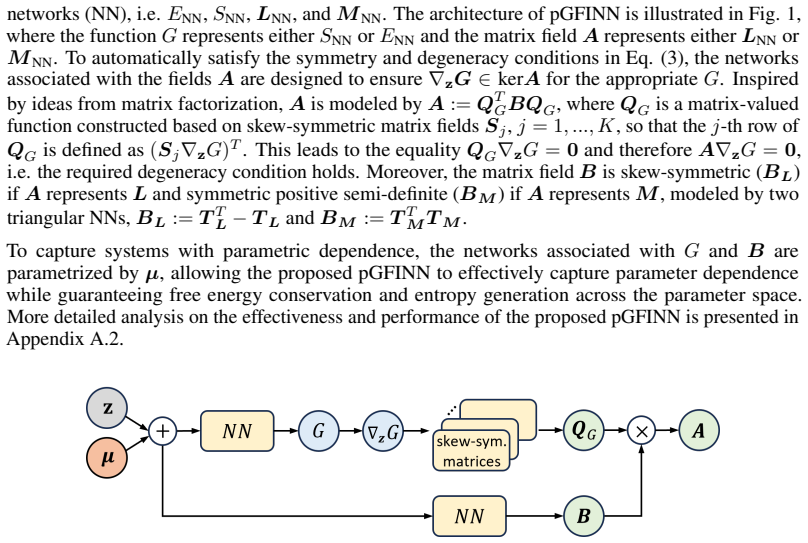
The load-bearing object is pGFINN, a parametric version of a GENERIC-formalism-informed neural network, which represents the latent dynamics as $\dot z = L_{\mathrm{NN}}(z,\mu)\nabla_z E_{\mathrm{NN}}(z,\mu) + M_{\mathrm{NN}}(z,\mu)\nabla_z S_{\mathrm{NN}}(z,\mu)$. The structural trick is to write $A := Q_G^{\top} B Q_G$, where the rows of $Q_G$ are $(S_j\nabla_z G)^{\top}$, so that $Q_G\nabla_z G=0$ and hence $A\nabla_z G=0$ automatically; this enforces the GENERIC degeneracy conditions at every training step, without a penalty term. The inner matrix $B$ is parameterized by triangular networks so that it is skew-symmetric when $A$ plays the role of $L$ and symmetric positive-semidefinite when $A$ plays the role of $M$. Making these blocks depend explicitly on the parameter $\mu$ ensures that the thermodynamic guarantees hold across the parameter domain. The other components are a standard autoencoder trained jointly through integration, reconstruction, Jacobian, and modeling losses, and a residual-based greedy active learning loop that adds the worst-scoring parameter to the training set during training.
What would settle it
For the Vlasov–Poisson case, compute the physical entropy of the reconstructed distribution from $S_{\mathrm{phys}}=-\int f\ln f\,dv\,dx$ or another independent entropy diagnostic and compare its time evolution with the learned latent entropy $S_{\mathrm{NN}}(z(t))$ at the same parameters; a systematic mismatch in growth times, monotonicity, or production-rate peaks would show the thermodynamic guarantee holds only for the latent coordinates, not the physical system. A simpler check is to track the total energy of the decoder-reconstructed solution under unseen parameters and see whether it remains constant, as the first law claim requires.
Extended reading notes
Core claim
The central claim is that free energy conservation and entropy generation can be guaranteed in the latent space of a reduced-order model across arbitrary variations in system parameters, by endowing the latent vector field with GENERIC structure. The paper's pGFINN builds the latent dynamics from four learned blocks—energy $E_{\mathrm{NN}}$, entropy $S_{\mathrm{NN}}$, a skew-symmetric Poisson operator $L_{\mathrm{NN}}$, and a symmetric positive-semidefinite friction operator $M_{\mathrm{NN}}$—and enforces the GENERIC degeneracy conditions $L_{\mathrm{NN}}\nabla_z S_{\mathrm{NN}}=0$ and $M_{\mathrm{NN}}\nabla_z E_{\mathrm{NN}}=0$ by construction, using a factorization $A=Q_G^{\top} B Q_G$ with $Q_G\nabla_z G=0$. Because these degeneracies are built into the network architecture, the latent ODE satisfies $\dot E_{\mathrm{NN}}=0$ and $\dot S_{\mathrm{NN}}\ge 0$ for every parameter value $\mu$, which the authors identify with the first and second laws. The paper embeds this pGFINN into tLaSDI, replacing the hyper-autoencoder of the prior framework with a standard autoencoder, and verifies the construction on Burgers' equation and a 1D/1V Vlasov–Poisson plasma problem, where the resulting model is up to 3,528× faster than the high-fidelity solver with average relative errors near 1–3%. The empirical case for physical relevance rests on the latent entropy's qualitative agreement with two-stream instability growth and on benchmark comparisons against operator-learning and hypernetwork-based baselines, which the pGFINN version matches or outperforms at lower training and inference cost.
Load-bearing premise
The learned quantities labeled energy and entropy are assumed to be the real physical energy and entropy of the system; if they are only convenient abstract coordinates, enforcing GENERIC structure in latent space does not guarantee that the physical model obeys thermodynamics.
Editorial extensions
If this is right
- Any parameter value drawn from the test domain yields latent trajectories with $\dot E_{\mathrm{NN}}=0$ and $\dot S_{\mathrm{NN}}\ge 0$, so extrapolation cannot break the two laws at the latent level.
- Replacing the hyper-autoencoder with a standard autoencoder plus pGFINN lowers training cost by 50–90% and inference cost by 57–61% on the two benchmarks.
- The Vlasov–Poisson surrogate runs up to 3,528× faster than the high-fidelity solver with 1–3% relative errors, and the reported average error of 1.66% is lower than the operator-learning baselines (2.87% and 2.20%) at comparable parameter counts.
- Greedy residual-based active learning improves generalization with fewer training samples than uniform sampling; in the gas-container and thermo-mechanical tests adaptive sampling reaches lower maximum errors with fewer parameter points.
- The learned latent entropy's production-rate peaks align with two-stream instability growth, suggesting latent thermodynamic variables can serve as diagnostics of physical-space dynamics.
Reading between the lines
- An immediate testable consequence not pursued in the paper: if $E_{\mathrm{NN}}$ and $S_{\mathrm{NN}}$ were replaced by invertible coordinate transformations of themselves, the structural guarantee would survive but the physical interpretation would not; comparing reconstructed-field entropy diagnostics with latent $S_{\mathrm{NN}}$ would separate the two readings.
- The same construction should transfer to parameters entering through boundary conditions, source terms, or material coefficients, since pGFINN takes $\mu$ as a direct input; the paper's initial-condition benchmarks are the simplest case, so the harder test is a parameter that shifts the system's attractor.
- Because the GENERIC structure imposes a metriplectic bracket, the latent vector field is constrained in a way that may also reduce the amount of training data needed; one could test this by fixing the autoencoder and measuring the data efficiency of pGFINN against a free-form latent ODE of the same size.
- In data-only settings where the high-fidelity solver is unavailable, the residual indicator cannot be evaluated directly; a Gaussian-process or weak-form residual estimator would be a natural substitute, and the active-learning benefit could be measured by end-to-end accuracy.
Editorial analysis
A structured set of objections, weighed in public.
Referee Report
Summary. The paper proposes pGFINN-based tLaSDI, a reduced-order modeling framework for parametric dynamical systems that couples an autoencoder with a latent-space dynamics model constrained to satisfy the GENERIC degeneracy conditions by construction. The method is tested on the inviscid Burgers equation and on the 1D/1V Vlasov-Poisson system, reporting 1–3% relative errors, up to 3,528× speedup over the high-fidelity solver, and reduced training/inference cost compared with the previous hypernetwork-based tLaSDI. The framework also includes a residual-based active learning strategy for parameter sampling. The central claim is that the learned latent dynamics are thermodynamically consistent, conserving free energy and generating entropy across the parameter space.
Significance. If the thermodynamic-consistency claim survives scrutiny, the paper offers a useful contribution: structure-preserving reduced-order models that respect GENERIC degeneracy conditions during latent evolution, with an error bound (Appendix A.1) and a reproducible framework (the authors provide code links and detailed hyperparameters). The speedup and accuracy numbers, if robust, would be practically valuable for parametric many-query problems. However, the paper's main conceptual load is the transfer of the formal GENERIC properties of the learned latent potentials to the physical system, and this transfer is not validated quantitatively. The claim that latent entropy dynamics reveal physical two-stream instability behavior is also only qualitative. These are correctable but currently block full acceptance.
major comments (4)
- [Sections 2.1, 3.2, and Conclusion] The architecture in Eq. (3) and Fig. 1 enforces dE_NN/dt=0 and dS_NN/dt>=0 for the learned latent variables, but the paper's abstract and conclusion interpret this as 'thermodynamically consistent latent dynamics' for the physical system. This transfer is valid only if the learned potentials approximates the physical energy and entropy (i.e., E_NN∘encoder and S_NN∘encoder correspond to the true E and S). The paper never checks this correspondence against physical measurements or known conservation laws. The issue is acute for the Vlasov-Poisson example: the collisionless plasma is a Hamiltonian system with no intrinsic dissipative entropy production in the exact dynamics, yet Fig. 7(c) shows nonzero learned entropy production. Interpreting that as physical entropy is unjustified. Please either (a) quantitatively validate the learned latent energy/entropy against physically defined quantities (or known Casimirs/invariants), or (b) explicitly restrict the guarantee to the latent-level surrogate structure, e.g., 'GENERIC-structured latent dynamics' rather than 'thermodynamically consistent physics.' As written, the central claim is overclaimed.
- [Section 3.2, Fig. 7] The statement that entropy production peaks at steps 15, 50, 75, 120, and 180 'correspond meaningfully to the growth rate of the two-stream instability' is based on visual inspection only. No quantitative correlation, reference curve, or error metric is provided. Furthermore, the notion of entropy for a collisionless Vlasov system is not defined in the manuscript; if the latent entropy is a model construct, its peaks cannot be claimed as physical insights without a precise definition. Please add a quantitative comparison (e.g., correlation of peak times with fitted growth rates) and state exactly what thermodynamic quantity, if any, the latent entropy represents.
- [Tables and all numerical results] All reported improvements (1.66% vs 2.18% average error, 50–90% training cost reduction, 57–61% inference reduction, 3,528× speedup) come from a single training run with no error bars, multiple seeds, or sensitivity analysis. Given the stochastic nature of neural network training and active learning, the claimed advantages over the hypernetwork variant and the dramatic speedup numbers are not statistically substantiated. Please report means and standard deviations over at least three random seeds, or explicitly state that the results are single-run demonstrations. This is needed to support the performance claims in the abstract and Table 1.
- [Appendix A.2.1] In the two-gas-container experiment, the sentence 'This prior knowledge can be embedded into pGFINN by defining E_NN:=E and S_NN:=E' must be a typo: it should read S_NN:=S. More importantly, this appendix shows that when the physical energy and entropy are known, the method embeds them exactly; in the Burgers and Vlasov experiments they are learned, making the latent potentials fit to data rather than identified as physical quantities. This contrast reinforces the need for the validation requested above.
minor comments (6)
- [Abstract and Section 2.1] The phrase 'free energy conservation' is used without definition; the GENERIC formalism conserves total energy E, not free energy. Please clarify whether the claim concerns total energy or a specific free-energy functional.
- [Section 3.1] The statement that active learning improves performance 'without increasing training cost' should be reconciled with the residual evaluations used to select points and with the different training-set sizes (8 adaptive vs 9 uniform). Clarify how training cost is measured.
- [Section 3.2, Fig. 7] The time axis is described only as 'steps'; specify the time step ∆t and time discretization used in the rollouts so the claimed peak locations are interpretable.
- [Conclusion] There are typos: 'Morevoew' should be 'Moreover' and 'tLAsDI' should be 'tLaSDI'.
- [Appendix A.3] The statement that FNO and DeepONet 'cannot directly account for parameter dependence' when parameters affect dynamics rather than initial conditions is too strong; one could append parameters to the input. The relevant point is that this would require modifying the operators, not that it is impossible.
- [Appendix A.4] The anonymous GitHub repository is helpful, but a versioned release or commit hash would improve reproducibility.
Circularity Check
No significant circularity: the GENERIC constraints are constructed explicitly, the error bound is proved in-text, and the numerical claims are measured against external benchmarks.
full rationale
The derivation chain is self-contained. In Section 2.1, the pGFINN ansatz is stated explicitly: the matrices L_NN and M_NN are built as A = Q_G^T B Q_G with row structure (S_j grad_z G)^T, so Q_G grad_z G = 0 and hence A grad_z G = 0; the claimed free-energy conservation and entropy generation are immediate algebraic consequences of this construction, not quantities inferred from or fitted to data. The latent dynamics are trained through Eqs. (4)-(12) against high-fidelity trajectory data, and the Appendix A.1 error bound is proved in the paper by Gronwall-type estimates in terms of the loss terms that are minimized, rather than imported from an unstated theorem. The headline numerical results (1-3% relative errors, up to 3,528x speedup, active-learning improvement) are evaluated on test parameter points against the HyPar solver and against DeepONet/FNO baselines, so they do not reduce to a fitted value or a self-citation. Citations to prior tLaSDI, GFINN, and LaSDI works include overlapping authors, but they are not load-bearing: the relevant architecture and loss are restated in the paper, and the comparative benchmarks are external. One caveat is that the thermodynamic guarantee applies by construction to the learned latent potentials E_NN and S_NN, and the paper does not quantitatively verify that these correspond to the physical energy and entropy; however, that is a validation and interpretability concern, not a circular derivation.
Assumptions & free parameters
free parameters (3)
- Loss weights λ_rec, λ_Jac, λ_mod =
1e-1, 1e-9/1e-6, 1e-7/1e-6
- Latent dimension =
5
- Active learning update period Nup =
3000 epochs
assumptions (4)
- standard math GENERIC formalism with L skew-symmetric, M symmetric positive semi-definite, and degeneracy conditions captures the dynamics of the target systems.
- domain assumption The latent dynamics can be faithfully represented by a GENERIC system with the same low dimension as the latent space.
- standard math The decoder Jacobian is bounded and Lipschitz continuous, and pGFINN predictions are bounded, for the error bound in Eq. (27).
- domain assumption The residual error indicator in Eq. (13) is positively correlated with the true approximation error.
invented entities (1)
-
Latent energy and entropy potentials E_NN, S_NN
Cite this review
Pith. "Pith review of Thermodynamically Consistent Latent Dynamics Identification for Parametric Systems." pith.science (2026). https://pith.science/paper/7WNDM6OO
@misc{pith2026250608475,
  author       = {Pith},
  title        = {Pith review of: Thermodynamically Consistent Latent Dynamics Identification for Parametric Systems},
  year         = {2026},
  howpublished = {\url{https://pith.science/paper/7WNDM6OO}},
  note         = {Machine review of arXiv:2506.08475}
}
read the original abstract
We propose an efficient thermodynamics-informed latent space dynamics identification (tLaSDI) framework for the reduced-order modeling of parametric nonlinear dynamical systems. This framework integrates autoencoders for dimensionality reduction with newly developed parametric GENERIC formalism-informed neural networks (pGFINNs), which enable efficient learning of parametric latent dynamics while preserving key thermodynamic principles such as free energy conservation and entropy generation across the parameter space. To further enhance model performance, a physics-informed active learning strategy is incorporated, leveraging a greedy, residual-based error indicator to adaptively sample informative training data, outperforming uniform sampling at equivalent computational cost. Numerical experiments on the Burgers' equation and the 1D/1V Vlasov-Poisson equation demonstrate that the proposed method achieves up to 3,528x speed-up with 1-3% relative errors, and significant reduction in training (50-90%) and inference (57-61%) cost. Moreover, the learned latent space dynamics reveal the underlying thermodynamic behavior of the system, offering valuable insights into the physical-space dynamics.
Figures


Figures from the paper (9 more)


Forward citations
Cited by 1 Pith paper
-
Variational Rank Reduction Autoencoders for Generative Thermal Design
VRRAE+DeepONet produces an 8D structured geometry code and predicts steady-state temperature gradients with reported NMSE around 5.5e-7 and a 100x speedup over Abaqus.
Reference graph
Works this paper leans on
-
[43]
Efficiently parameterized neural metriplec- tic systems,
A. Gruber, K. Lee, H. Lim, N. Park, and N. Trask, “Efficiently parameterized neural metriplec- tic systems,” in The Thirteenth International Conference on Learning Representations, 2025. [Online]. Available:https://openreview.net/forum?id=uL1H29dM0c
work page 2025
-
[1]
Verification and validation in computational fluid dynamics,
W. L. Oberkampf and T. G. Trucano, “Verification and validation in computational fluid dynamics,” Progress in aerospace sciences, vol. 38, no. 3, pp. 209–272, 2002
work page 2002
-
[2]
Thijssen, Computational physics
J. Thijssen, Computational physics. Cambridge university press, 2007
work page 2007
-
[3]
A. Bondeson, T. Rylander, and P. Ingelström,Computational electromagnetics. Springer, 2012
work page 2012
-
[4]
J. G. Lee, Computational materials science: an introduction. CRC press, 2016
work page 2016
-
[5]
Characterising the digital twin: A systematic literature review,
D. Jones, C. Snider, A. Nassehi, J. Yon, and B. Hicks, “Characterising the digital twin: A systematic literature review,” CIRP journal of manufacturing science and technology, vol. 29, pp. 36–52, 2020
2020
-
[6]
Review of digital twin about concepts, technologies, and industrial applications,
M. Liu, S. Fang, H. Dong, and C. Xu, “Review of digital twin about concepts, technologies, and industrial applications,” Journal of manufacturing systems, vol. 58, pp. 346–361, 2021
work page 2021
-
[7]
Topology optimization approaches: A comparative review,
O. Sigmund and K. Maute, “Topology optimization approaches: A comparative review,” Structural and multidisciplinary optimization, vol. 48, no. 6, pp. 1031–1055, 2013
work page 2013
Show all 56 references
-
[8]
A dual mesh method with adaptivity for stress-constrained topology optimization,
D. A. White, Y . Choi, and J. Kudo, “A dual mesh method with adaptivity for stress-constrained topology optimization,”Structural and Multidisciplinary Optimization, vol. 61, no. 2, pp. 749– 762, 2020
2020
-
[9]
Non-linear model reduction for uncertainty quantification in large-scale inverse problems,
D. Galbally, K. Fidkowski, K. Willcox, and O. Ghattas, “Non-linear model reduction for uncertainty quantification in large-scale inverse problems,” International journal for numerical methods in engineering, vol. 81, no. 12, pp. 1581– 1608, 2010
2010
-
[10]
A review of uncertainty quantification in deep learning: Techniques, applica- tions and challenges,
M. Abdar et al., “A review of uncertainty quantification in deep learning: Techniques, applica- tions and challenges,” Information fusion, vol. 76, pp. 243–297, 2021
2021
-
[11]
The proper orthogonal decomposition in the analysis of turbulent flows,
G. Berkooz, P. Holmes, and J. L. Lumley, “The proper orthogonal decomposition in the analysis of turbulent flows,” Annual review of fluid mechanics, vol. 25, no. 1, pp. 539–575, 1993
1993
-
[12]
Reduced basis approximation and a posteriori error estimation for parametrized partial differential equations,
A. T. Patera, G. Rozza, et al., “Reduced basis approximation and a posteriori error estimation for parametrized partial differential equations,” MIT Cambridge, 2007
2007
-
[13]
Component-wise reduced order model lattice-type structure design,
S. McBane and Y . Choi, “Component-wise reduced order model lattice-type structure design,” Computer methods in applied mechanics and engineering, vol. 381, p. 113 813, 2021
2021
-
[14]
LaSDI: Parametric latent space dynamics identification,
W. D. Fries, X. He, and Y . Choi, “LaSDI: Parametric latent space dynamics identification,” Computer Methods in Applied Mechanics and Engineering, vol. 399, p. 115 436, 2022
2022
-
[15]
Reducing the dimensionality of data with neural networks,
G. E. Hinton and R. R. Salakhutdinov, “Reducing the dimensionality of data with neural networks,” science, vol. 313, no. 5786, pp. 504–507, 2006. 11
2006
-
[16]
Latent-space dynamics for reduced deformable simulation,
L. Fulton, V . Modi, D. Duvenaud, D. I. Levin, and A. Jacobson, “Latent-space dynamics for reduced deformable simulation,” in Computer graphics forum, Wiley Online Library, vol. 38, 2019, pp. 379–391
2019
-
[17]
Model reduction of dynamical systems on nonlinear manifolds us- ing deep convolutional autoencoders,
K. Lee and K. T. Carlberg, “Model reduction of dynamical systems on nonlinear manifolds us- ing deep convolutional autoencoders,”Journal of Computational Physics, vol. 404, p. 108 973, 2020
2020
-
[18]
A fast and accurate physics- informed neural network reduced order model with shallow masked autoencoder,
Y . Kim, Y . Choi, D. Widemann, and T. Zohdi, “A fast and accurate physics- informed neural network reduced order model with shallow masked autoencoder,” Journal of Computational Physics, vol. 451, p. 110 841, 2022
2022
-
[19]
Reduced-order modeling of advection-dominated systems with recurrent neural networks and convolutional autoencoders,
R. Maulik, B. Lusch, and P. Balaprakash, “Reduced-order modeling of advection-dominated systems with recurrent neural networks and convolutional autoencoders,”Physics of Fluids, vol. 33, no. 3, 2021
2021
-
[20]
Parameterized neural ordinary differential equations: Applications to computational physics problems,
K. Lee and E. J. Parish, “Parameterized neural ordinary differential equations: Applications to computational physics problems,” Proceedings of the Royal Society A, vol. 477, no. 2253, p. 20 210 162, 2021
2021
-
[21]
Distilling free-form natural laws from experimental data,
M. Schmidt and H. Lipson, “Distilling free-form natural laws from experimental data,”science, vol. 324, no. 5923, pp. 81–85, 2009
2009
-
[22]
Discovering governing equa- tions from data by sparse identification of nonlinear dynamical systems,
S. L. Brunton, J. L. Proctor, and J. N. Kutz, “Discovering governing equa- tions from data by sparse identification of nonlinear dynamical systems,” Proceedings of the national academy of sciences, vol. 113, no. 15, pp. 3932–3937, 2016
2016
-
[23]
Data-driven operator inference for nonintrusive projection- based model reduction,
B. Peherstorfer and K. Willcox, “Data-driven operator inference for nonintrusive projection- based model reduction,”Computer Methods in Applied Mechanics and Engineering, vol. 306, pp. 196–215, 2016
2016
-
[24]
Weak sindy: Galerkin-based data-driven model selection,
D. A. Messenger and D. M. Bortz, “Weak sindy: Galerkin-based data-driven model selection,” Multiscale Modeling & Simulation, vol. 19, no. 3, pp. 1474–1497, 2021
2021
-
[25]
Weak sindy for partial differential equations,
D. A. Messenger and D. M. Bortz, “Weak sindy for partial differential equations,” Journal of Computational Physics, vol. 443, p. 110 525, 2021
2021
-
[26]
Data-driven discovery of coordinates and governing equations,
K. Champion, B. Lusch, J. N. Kutz, and S. L. Brunton, “Data-driven discovery of coordinates and governing equations,”Proceedings of the National Academy of Sciences, vol. 116, no. 45, pp. 22 445–22 451, 2019
2019
-
[27]
Lift & learn: Physics-informed machine learning for large-scale nonlinear dynamical systems,
E. Qian, B. Kramer, B. Peherstorfer, and K. Willcox, “Lift & learn: Physics-informed machine learning for large-scale nonlinear dynamical systems,” Physica D: Nonlinear Phenomena, vol. 406, p. 132 401, 2020
2020
-
[28]
Operator inference for non-intrusive model reduction of systems with non-polynomial nonlinear terms,
P. Benner, P. Goyal, B. Kramer, B. Peherstorfer, and K. Willcox, “Operator inference for non-intrusive model reduction of systems with non-polynomial nonlinear terms,” Computer Methods in Applied Mechanics and Engineering, vol. 372, p. 113 433, 2020
2020
-
[29]
gLaSDI: Parametric physics- informed greedy latent space dynamics identification,
X. He, Y . Choi, W. D. Fries, J. L. Belof, and J. -S. Chen, “gLaSDI: Parametric physics- informed greedy latent space dynamics identification,” Journal of Computational Physics, vol. 489, p. 112 267, 2023
2023
-
[30]
GPLaSDI: Gaussian process- based interpretable latent space dynamics identification through deep autoencoder,
C. Bonneville, Y . Choi, D. Ghosh, and J. L. Belof, “GPLaSDI: Gaussian process- based interpretable latent space dynamics identification through deep autoencoder,” Computer Methods in Applied Mechanics and Engineering, vol. 418, p. 116 535, 2024
2024
-
[31]
Weak-form latent space dy- namics identification,
A. Tran, X. He, D. A. Messenger, Y . Choi, and D. M. Bortz, “Weak-form latent space dy- namics identification,” Computer Methods in Applied Mechanics and Engineering, vol. 427, p. 116 998, 2024
2024
-
[32]
Physics-informed active learn- ing with simultaneous weak-form latent space dynamics identification,
X. He, A. Tran, D. M. Bortz, and Y . Choi, “Physics-informed active learn- ing with simultaneous weak-form latent space dynamics identification,” International Journal for Numerical Methods in Engineering, vol. 126, no. 1, e7634, 2025
2025
-
[33]
TLaSDI: Thermodynamics-informed latent space dynamics identification,
J. S. R. Park, S. W. Cheung, Y . Choi, and Y . Shin, “TLaSDI: Thermodynamics-informed latent space dynamics identification,” Computer Methods in Applied Mechanics and Engineering, vol. 429, p. 117 144, 2024
2024
-
[34]
Dynamics and thermodynamics of complex fluids. i. develop- ment of a general formalism,
M. Grmela and H. C. Öttinger, “Dynamics and thermodynamics of complex fluids. i. develop- ment of a general formalism,” Physical Review E, vol. 56, no. 6, p. 6620, 1997
1997
-
[35]
H. C. Öttinger, Beyond Equilibrium Thermodynamics. John Wiley & Sons, 2005. 12
2005
-
[36]
GFINNs: GENERIC formalism informed neural networks for deterministic and stochastic dynamical systems,
Z. Zhang, Y . Shin, and G. Em Karniadakis, “GFINNs: GENERIC formalism informed neural networks for deterministic and stochastic dynamical systems,” Philosophical Transactions of the Royal Society A, vol. 380, no. 2229, p. 20 210 207, 2022
2022
-
[37]
Hypernetworks,
D. Ha, A. M. Dai, and Q. V . Le, “Hypernetworks,” in International Conference on Learning Representations, 2017. [Online]. Available: https : //openreview.net/forum?id=rkpACe1lx
2017
-
[38]
A paradigm for joined hamiltonian and dissipative systems,
P. J. Morrison, “A paradigm for joined hamiltonian and dissipative systems,” Physica D: Nonlinear Phenomena, vol. 18, no. 1, pp. 410–419, 1986,ISSN: 0167-2789.DOI: https : / / doi . org / 10 . 1016 / 0167 - 2789(86 ) 90209 - 5[Online]. Available: https : //www.sciencedirect.co...
1986
-
[39]
Thoughts on brackets and dissipation: Old and new,
P. Morrison, “Thoughts on brackets and dissipation: Old and new,” in Journal of Physics: Conference Series, IOP Publishing, vol. 169, 2009, p. 012 006
2009
-
[40]
Energetically consistent model reduction for metriplectic systems,
A. Gruber, M. Gunzburger, L. Ju, and Z. Wang, “Energetically consistent model reduction for metriplectic systems,” Computer Methods in Applied Mechanics and Engineering, vol. 404, p. 115 709, 2023,ISSN: 0045-7825.DOI: https : / / doi . org / 10 . 1016 / j . cma . 2022 . 115709...
2023
-
[41]
Machine learning structure preserving brackets for forecasting irreversible processes,
K. Lee, N. Trask, and P. Stinis, “Machine learning structure preserving brackets for forecasting irreversible processes,” in Advances in Neural Information Processing Systems, M. Ranzato, A. Beygelzimer, Y . Dauphin, P. Liang, and J. W. Vaughan, Eds., vol. 34, Curran Associate...
2021
-
[42]
Reversible and irreversible bracket-based dynamics for deep graph neural networks,
A. Gruber, K. Lee, and N. Trask, “Reversible and irreversible bracket-based dynamics for deep graph neural networks,” in Thirty-seventh Conference on Neural Information Processing Systems, 2023. [Online]. Available:https://openreview.net/forum?id=4SoTUaTK8N
2023
-
[44]
A data-driven reduced-order model for stiff chemical kinetics using dynamics-informed training,
V . Vijayarangan et al., “A data-driven reduced-order model for stiff chemical kinetics using dynamics-informed training,” Energy and AI, vol. 15, p. 100 325, 2024
2024
-
[45]
HyPar Repository,https://bitbucket.org/deboghosh/hypar
-
[46]
A relativistic two-stream instability in an extremely low-density plasma,
S. Koide, M. Takahashi, and R. Takahashi, “A relativistic two-stream instability in an extremely low-density plasma,” Physics of Plasmas, vol. 30, no. 6, 2023
2023
-
[47]
Efficient neural architecture search via parameters sharing,
H. Pham, M. Guan, B. Zoph, Q. Le, and J. Dean, “Efficient neural architecture search via parameters sharing,” inInternational conference on machine learning, PMLR, 2018, pp. 4095– 4104
2018
-
[48]
A comprehensive survey of neural architecture search: Challenges and solutions,
P. Ren et al., “A comprehensive survey of neural architecture search: Challenges and solutions,” ACM Computing Surveys (CSUR), vol. 54, no. 4, pp. 1–34, 2021
2021
-
[49]
D. V . Schroeder, An introduction to thermal physics. Oxford University Press, 2020
2020
-
[50]
Deeponet: Learning nonlinear operators for iden- tifying differential equations based on the universal approximation theorem of operators,
L. Lu, P. Jin, and G. E. Karniadakis, “Deeponet: Learning nonlinear operators for iden- tifying differential equations based on the universal approximation theorem of operators,” arXiv preprint arXiv:1910.03193, 2019
1910 arXiv
-
[51]
A comprehensive and fair comparison of two neural operators (with practical extensions) based on fair data,
L. Lu et al., “A comprehensive and fair comparison of two neural operators (with practical extensions) based on fair data,” Computer Methods in Applied Mechanics and Engineering, vol. 393, p. 114 778, 2022
2022
-
[52]
Fourier neural operator for parametric partial differential equations,
Z. Li et al., “Fourier neural operator for parametric partial differential equations,” arXiv preprint arXiv:2010.08895, 2020
2010 arXiv
-
[53]
Adam: A method for stochastic optimization,
D. P. Kingma and J. Ba, “Adam: A method for stochastic optimization,” arXiv preprint arXiv:1412.6980, 2014
2014 arXiv
-
[54]
Pytorch: An imperative style, high-performance deep learning library,
A. Paszke, “Pytorch: An imperative style, high-performance deep learning library,” arXiv preprint arXiv:1912.01703, 2019
1912 arXiv
-
[55]
Efficient implementation of weighted ENO schemes,
G.-S. Jiang and C. -W. Shu, “Efficient implementation of weighted ENO schemes,” Journal of Computational Physics, vol. 126, no. 1, pp. 202–228, 1996,ISSN: 0021-9991.DOI: 10.1006/jcph.1996.0130 13 A Appendix A.1 Error Analysis This section provides a bound on the error of the t...
1996
-
[56]
A.4.1 One-dimensional Burgers’ Equation This section summarizes the implementation details corresponding to the results in Section 3.1
(MIT license, https://github.com/pjss1223/tLaSDI), fourier neural operator (MIT li- cense, https://github.com/raj-brown/fourier_neural_operator), deeponet-fno [50–52] (CC BY-NC-SA 4.0 license, https://github.com/lu-group/deeponet-fno ), and HyPar (MIT license,https://github.co...
Reviewed August 7, 2026 · model on record in the stance chip above.
Discussion (0). Sign in to comment.