REVIEW 1 major objections 5 minor 3 references
Flow-Lenia: Emergent evolutionary dynamics in mass conservative continuous cellular automata
T0 review · 1 major / 5 minor · reviewed 2026-08-07 · deepseek-v4-flash
Pith's one-line read One conserved quantity makes Lenia creatures evolve together
desk verdict Worth publishing as a model paper, but the evolutionary-dynamics claims need a neutral control before they should be trusted. read the letter →
The pith
A machine-rendered reading of the paper's core claim, the machinery that carries it, and where it could break.
The reading
What carries the argument
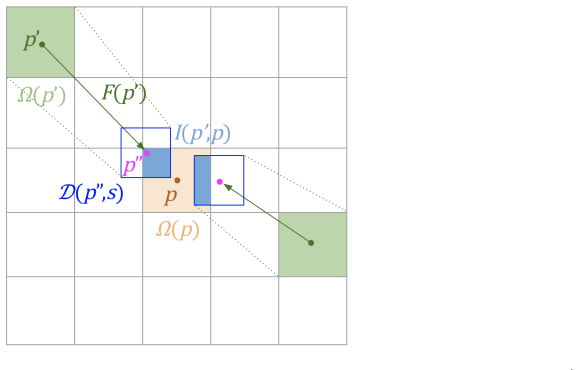
The carrying object is the parameter map $\mathcal{P}_t: L \to \Theta$, which attaches a local update-rule weight vector to every cell of matter and is transported with the matter during each reintegration-tracking step. Affinity scores are computed with the localized parameters via Eq. 7, and the stochastic mixing rule (Eq. 8) samples one incoming parameter set per cell with probability proportional to incoming mass, so lineages compete by converting each other's matter. The flow itself combines the affinity gradient with a concentration-gradient diffusion term weighted by $\alpha(x)$, and reintegration tracking (Eq. 6) moves matter while conserving total mass. This machinery turns "species" into unique points in parameter space and gives the system a heritable, selectable substrate.
What would settle it
Re-run the multispecies simulations with the same mass dynamics and mutation beams but replace the mass-proportional softmax sampling of Eq. 8 with a uniform random choice among the parameter vectors arriving in each cell. If evolutionary-activity measures and branching trees persist, selection on parameters is not needed for the observed dynamics; if they collapse to linear parameter growth, the mass-weighted competition is the causal mechanism claimed.
Extended reading notes
Core claim
The central claim is that Flow-Lenia's mass conservation does not merely stabilize Lenia but changes the kind of phenomena the system can exhibit. With total mass fixed and matter moving along the gradient of an affinity map via reintegration tracking, spatially localized patterns become the generic outcome rather than a rare search product, and the update rule itself can be embedded in the moving matter through a parameter map. The paper's parameter-mixing rule selects one incoming parameter vector with probability proportional to the mass arriving with it, which lets one creature convert another's matter and thus creates competition on heritable parameters. In simulations lasting 500,000 steps with mutation beams, the number of distinct parameters grows sublinearly with mutation rate, parameter trajectories project into branching tree-like structures, and count-based and non-neutral evolutionary activity follow power-law responses to mutation rate and differ systematically across the vanilla, dissipative, and food models. The authors read these observations as evidence of an intrinsic fitness landscape and of emergent evolutionary dynamics without any externally imposed fitness function.
Load-bearing premise
The load-bearing premise is that the stochastic softmax parameter-mixing rule and the mutation beams create genuine selection on heritable parameter vectors, so the branching trees and evolutionary-activity scores measure adaptation rather than neutral mixing or an artifact of the softmax competition.
Editorial extensions
If this is right
- Mass conservation alone acts as a regularizer: the same random parameter sets that mostly explode or vanish in Lenia produce spatially localized, sometimes complex patterns in Flow-Lenia.
- Simple evolution strategies suffice to optimize Flow-Lenia creatures for directed motion, angular motion, obstacle navigation, and chemotaxis, where the same optimization recipe on Lenia is unstable and yields exploding patterns.
- Embedding parameters in matter enables multispecies coexistence and competition; the sublinear growth of distinct parameter counts with mutation rate indicates that lineages compete rather than accumulate neutrally.
- Evolutionary-activity measures respond systematically to conditions: activity decays as a power law with mutation rate, and the dissipative and food variants alter activity and diversity, with mass-corrected measures reversing the raw ordering.
- If correct, Flow-Lenia offers a quantitative arena for testing theories about when dissipative dynamics or shared resources promote or hinder open-ended evolution.
Reading between the lines
- A neutral control that decouples mutation from mass-weighted selection would sharpen the paper's central distinction; I would expect the branching trees to depend on the softmax competition, which the current simulations do not directly test.
- The paper's provisional species definition, one species per unique parameter vector, likely undercounts biological species; redefining species as coherent clusters moving in parameter space, as the authors suggest, could change the evolutionary-activity numbers.
- The inverse dissipative result hints that predictions about dissipation as a driver of life may be model-dependent; varying beam rates and input-zone layouts could test whether any dissipation regime raises activity.
- A testable extension would be to let the embedded parameters include kernel or growth-function parameters beyond the weight vector, at the cost of losing fast Fourier convolution; the resulting phenotypes might show richer heritability.
Editorial analysis
A structured set of objections, weighed in public.
Referee Report
Summary. The manuscript introduces Flow-Lenia, a mass-conservative continuous cellular automaton extending Lenia. It claims that mass conservation makes spatially localized patterns (SLPs) the generic outcome of random parameter sampling, that update-rule parameters can be optimized with plain evolution strategies for directed motion, angular motion, obstacle navigation, and chemotaxis, and that embedding parameters within the dynamics enables multispecies simulations in which evolutionary activity, diversity, and parameter-space branching reveal emergent intrinsic evolutionary dynamics. The paper presents three model variants (vanilla, dissipative, and food) and analyzes them with count-based and non-neutral evolutionary activity metrics, with accompanying videos, a companion website, and open-source JAX code.
Significance. If the main claims hold, Flow-Lenia is a substantial contribution to artificial life: it addresses a known difficulty in Lenia, namely the scarcity of stable spatially localized patterns, by construction rather than by search, and it offers a concrete mechanism for local rule parameters to coexist and compete, which is a prerequisite for studying open-ended evolution in continuous cellular automata. The random-search and evolution-strategy results are convincing as qualitative evidence, and the paper's reproducibility assets (code, notebook, videos) are valuable. However, the intrinsic-evolution claim currently rests on metrics and species definitions that may not distinguish selection from neutral drift; the absence of a neutral control is the main threat to the central interpretation.
major comments (1)
- [§5.3, Fig. 10] The comparison between the three model variants is not robust because total mass is not conserved in the dissipative and food settings. The text first reports that these settings have significantly higher count-based and non-neutral activity (p < 10^-5), then acknowledges that dividing by total mass reverses the ordering. This is more than a nuisance: the corrected and uncorrected measures support opposite conclusions, and the Discussion's wording ('the EA of the dissipative and food conditions are lower than in the vanilla systems') appears to rely on the corrected measure while the Results headline relies on the uncorrected one. The paper should state one primary measure, justify why it is appropriate, and report both consistently when summarizing the findings.
minor comments (5)
- [Abstract] The abstract contains two typos: 'phenomenons' should be 'phenomena' and 'spatially-localized patters' should be 'spatially-localized patterns'.
- [§5.1, Fig. 3] The claim that most Flow-Lenia patterns are SLPs and that the same parameters mostly lead to empty or exploding patterns in Lenia would be stronger with a quantitative classification (for example, the fraction of runs yielding non-empty, bounded patterns) rather than visual inspection of 105 instances.
- [§3, Eq. (6)] The exact mass-conservation argument applies to the full sum over all cells L, but the implemented computation restricts source cells to a Chebyshev distance of less than 5; the authors should either state a boundedness assumption on dt·F that guarantees no mass is lost, or provide a numerical check that total mass drift is negligible over 500,000 steps.
- [§5.2, Fig. 5] For the directed-motion comparison with original Lenia, only a qualitative statement is given ('yellow curve', 'every Lenia optimized patterns are exploding ones'); reporting final fitness distributions or learning curves for both systems would make the optimization claim more precise and easier to verify.
- [§5.3, Figs. 9–10] The power-law fits and Mann-Whitney tests should specify the unit of analysis (per seed, per time step, or aggregated) and should report confidence intervals or effect sizes; with five seeds and long time series, the reported R² values alone are hard to evaluate.
Circularity Check
No significant circularity: the model dynamics, parameter-embedding mechanism, and evolutionary-activity measurements are defined independently and applied without fitting a target.
full rationale
Flow-Lenia's core construction (mass-conserving flow via reintegration tracking, Eq. 6) and parameter embedding (Eqs. 7-8) are model definitions, not results derived from the phenomena they are used to inspect. The directed-search results are optimized against external fitness functions with evolutionary strategies, and the random-search comparison with Lenia uses identical parameter sets, providing an external benchmark. The intrinsic-evolution section records parameter and mass trajectories and applies published evolutionary-activity metrics (Droop & Hickinbotham, 2012) without optimizing any parameter to make those metrics take particular values. The PCA visualization is descriptive, and the power-law and linear fits in Fig. 9 are data summaries, not predictions forced by the model's construction. The paper explicitly flags that its working definition of species as unique parameter points is provisional (Section 6) and that this could affect interpretation; that is an acknowledged limitation and a possible validity concern, not a circular step, because the metric values are computed from simulation logs rather than being equivalent to the inputs by definition. Self-citations to Plantec et al. (2023) supply additional methodological detail, but the described equations are given in the present paper, so the argument does not reduce to an unverified self-citation chain. No fitted parameter is renamed as a prediction, and no uniqueness theorem from the authors' prior work is invoked. The absence of a neutral control for the intrinsic-evolution experiments is a meaningful scientific limitation for the claim of adaptation, but the hard criterion for circularity -- exhibiting a specific reduction of a claimed result to its inputs -- is not met.
Assumptions & free parameters
free parameters (5)
- dt (time step) =
0.2
- s (temperature) =
0.65
- n (exponent in alpha weight) =
2
- mutation beam variance =
1
- pmut (mutation probability) =
varied (exact values not listed in text)
assumptions (5)
- domain assumption Reintegration tracking conserves total mass exactly.
- domain assumption Sobel-filtered gradients faithfully approximate the affinity gradient for the flow computation.
- domain assumption Evolutionary activity definitions are meaningful when species are unique parameter points.
- domain assumption Mutation beams model biologically meaningful genetic variation without confounding effects.
- domain assumption The parameter dynamics reflect an intrinsic fitness landscape rather than neutral drift.
Cite this review
Pith. "Pith review of Flow-Lenia: Emergent evolutionary dynamics in mass conservative continuous cellular automata." pith.science (2026). https://pith.science/paper/7PO6JGWJ
@misc{pith2026250608569,
  author       = {Pith},
  title        = {Pith review of: Flow-Lenia: Emergent evolutionary dynamics in mass conservative continuous cellular automata},
  year         = {2026},
  howpublished = {\url{https://pith.science/paper/7PO6JGWJ}},
  note         = {Machine review of arXiv:2506.08569}
}
read the original abstract
Central to the artificial life endeavour is the creation of artificial systems spontaneously generating properties found in the living world such as autopoiesis, self-replication, evolution and open-endedness. While numerous models and paradigms have been proposed, cellular automata (CA) have taken a very important place in the field notably as they enable the study of phenomenons like self-reproduction and autopoiesis. Continuous CA like Lenia have been showed to produce life-like patterns reminiscent, on an aesthetic and ontological point of view, of biological organisms we call creatures. We propose in this paper Flow-Lenia, a mass conservative extension of Lenia. We present experiments demonstrating its effectiveness in generating spatially-localized patters (SLPs) with complex behaviors and show that the update rule parameters can be optimized to generate complex creatures showing behaviors of interest. Furthermore, we show that Flow-Lenia allows us to embed the parameters of the model, defining the properties of the emerging patterns, within its own dynamics thus allowing for multispecies simulations. By using the evolutionary activity framework as well as other metrics, we shed light on the emergent evolutionary dynamics taking place in this system.
Figures


Figures from the paper (7 more)


Reference graph
Works this paper leans on
-
[1]
Adamatzky, A. (2010). Game of Life Cellular Automata. Adami, C., & Brown, C. T. (1994, May). Evolutionary Learning in the 2D Artificial Life System ”Avida”. https://doi.org/10.48550/arXiv.adap-org/9405003 Arbesman, S. (2022, December). Emergent Microcosms. Bartlett, S., & Wong, M. L. (2020). Defining Lyfe in the Universe: From Three Privileged Functions t...
work page Pith review arXiv doi:10.48550/arxiv.adap-org/9405003 2010
-
[42]
https://doi.org/10.3390/life10040042 Bedau, M., Snyder, E., Brown, C. T., & Packard, N. (1998). A Comparison of Evolutionary Activity in Artificial Evolving Systems and in the Biosphere. Bedau, M. A., & Packard, N. H. (1996). Measurement of Evolutionary Activity, Teleology, and Life. Beer, R. D. (2004). Autopoiesis and Cognition in the Game of Life. Artif...
arXiv 1998
-
[142]
https://doi.org/10.1007/s00018-023-04790-z 23 Maturana, H. R., & Varela, F. J. (1991, August).Autopoiesis and Cognition: The Realization of the Living . Springer Science & Business Media. Mordvintsev, A., Niklasson, E., & Randazzo, E. (2022, December). Particle Lenia and the energy-based formulation. Mordvintsev, A., Randazzo, E., Niklasson, E., & Levin, ...
arXiv 2020
Reviewed August 7, 2026 · model on record in the stance chip above.
Discussion (0). Sign in to comment.