REVIEW 2 major objections 4 minor 56 references
Semi-gradient DICE for Offline Constrained Reinforcement Learning
T0 review · 2 major / 4 minor · reviewed 2026-08-07 · deepseek-v4-flash
Pith's one-line read Semi-gradient DICE actually computes policy corrections, not stationary distribution corrections, so it cannot estimate costs; CORSDICE recovers the true distribution from the policy correction, restoring cost evaluation and constraint…
desk verdict A clear-eyed paper that correctly identifies the policy-correction nature of semi-gradient DICE and offers a practical extraction method; the theoretical gap at the function-approximation level is real but not fatal. read the letter →
The pith
A machine-rendered reading of the paper's core claim, the machinery that carries it, and where it could break.
The reading
What carries the argument
The load-bearing object is the distinction between the two corrections a DICE-style dual can output. A stationary distribution correction $w(s,a)=d(s,a)/d_D(s,a)$ satisfies the Bellman flow equality and supports off-policy evaluation of any reward or cost; a policy correction $w(a|s)=\pi(a|s)/\pi_D(a|s)$ satisfies the normalization $\sum_a w(a|s)\pi_D(a|s)=1$ instead. The mechanism that flips one into the other is the semi-gradient update: dropping the gradient through the next-state $\nu(s')$ and replacing the initial-state term with the dataset distribution makes $\nu$ lose its role as the Bellman-flow Lagrange multiplier, so the closed-form correction becomes a policy correction. CORSDICE then runs a second convex program — maximize $-\sum_s d_D(s)f(w(s))$ subject to the Bellman flow constraint with $w(a|s)$ held fixed — whose inner maximization over $w(s)$ has the closed form $w^*(s)=\max(0,(f')^{-1}(\mathbb{E}_{a\sim\pi_D}[w(a|s)e_\mu(s,a)]))$, and it removes single-sample bias from the dual by estimating the expectation inside the convex conjugate $f^*_0$ with an auxiliary network $A(s)$ (Proposition 5.1). The product $w(s)w(a|s)$ is the recovered stationary distribution correction that makes cost evaluation valid.
What would settle it
On a tabular MDP with known dynamics, run SemiDICE and its extraction step, then compare the extracted $w(s)w(a|s)$ against the exact stationary distribution correction of the policy $\pi = w(a|s)\pi_D$. If the normalized cost estimate $\mathbb{E}_{d_D}[w(s)w(a|s)c]$ systematically misses the true cost as dataset size shrinks, while $\sum_a w(a|s)\pi_D(a|s)$ drifts away from 1, the assumed exactness of the policy correction is the failure point. Conversely, the cleanest direct test is whether the equality-constrained extraction problem (15) ever becomes infeasible on a standard benchmark dataset with the learned $w(a|s)$; infeasibility would contradict the paper's reconstruction claim.
Extended reading notes
Core claim
The central claim, stated as Proposition 4.1, is that the object optimized by SemiDICE is not the object the DICE literature assumed. At the optimum of its $\nu$-loss, the closed-form correction $w^*(s,a)=\max(0,(f')^{-1}((Q(s,a)-\nu^*(s))/\alpha))$ violates the Bellman flow constraint, yet it satisfies $\sum_a w^*(s,a)\pi_D(a|s)=1$ and $w^*(s,a)\ge 0$ — exactly the defining conditions of a policy correction $w(a|s)=\pi(a|s)/\pi_D(a|s)$, not of a stationary distribution correction $w(s,a)=d(s,a)/d_D(s,a)$. It follows that treating $\mathbb{E}_{d_D}[w\,c]$ as a cost estimate is invalid, and the authors confirm the failure experimentally: on D4RL value prediction, SemiDICE's raw correction gives RMSE of 87.6–111.6, while the extracted stationary distribution gives 9.2–26.4. The paper additionally shows (Proposition 4.2) that SemiDICE is an approximate solver for a behavior-regularized MDP, which explains both the policy-correction structure and its strong offline RL performance, and proves (Corollary 4.3) that this structure avoids the state-sparsity failure that leaves OptiDICE with undefined actions in some states. The constructive half is CORSDICE: given the learned $w(a|s)$, it solves a convex program whose dual yields the missing state stationary distribution correction $w(s)$, debiased by an auxiliary approximator $A(s)$, and uses $w(s)w(a|s)$ for off-policy cost evaluation and the cost-constraint multiplier update.
Load-bearing premise
The method assumes the learned correction multiplying the data policy is a perfect probability ratio that sums to one at every state in the dataset, so that a well-defined state distribution obeying the flow of probability can be reconstructed; with finite data and neural networks this exactness is never guaranteed, and the algorithm neither enforces nor repairs it.
Editorial extensions
If this is right
- The policy correction itself is still usable for policy extraction: because $\pi^*(a|s)=w(a|s)\pi_D(a|s)$, weighted behavior cloning with $w(a|s)$ recovers the implicit policy, which is why SemiDICE-style methods work well as offline RL even though they cannot do evaluation.
- Using the raw semi-gradient correction for off-policy evaluation is invalid: on D4RL benchmarks SemiDICE's value-prediction RMSE is 87.6–111.6, while the extracted stationary distribution correction brings RMSE down to 9.2–26.4.
- Any constrained RL built on raw semi-gradient DICE will fail to honor cost limits because its cost estimate is not an expectation under any policy-induced distribution; the extraction step is what makes the Lagrangian multiplier update meaningful.
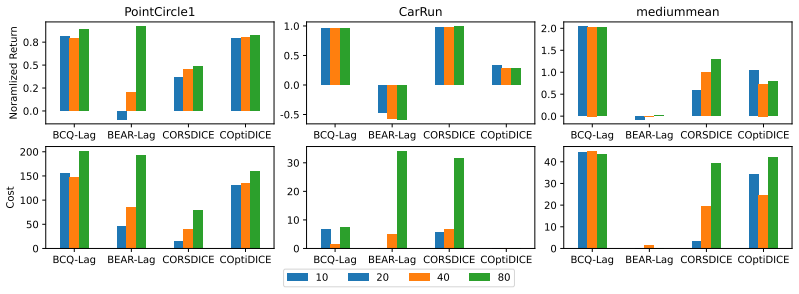
- On the DSRL benchmark, CORSDICE is the only method among the compared baselines that satisfies the cost constraint in every environment, records the best return among safe agents in 27 of 38 tasks, and uses less cost as the cost limit tightens; the diffusion-based D-CORSDICE also stays safe in all tasks while beating strong diffusion baselines on average return.
- The extraction procedure is not specific to costs: the authors note it can be attached to other DICE-based algorithms that need off-policy evaluation, such as return-on-investment maximization.
Reading between the lines
- If the Proposition 4.1 diagnosis is right, then the practical success of SQL, XQL, and f-DVL is best explained as behavior-regularized MDP solving, not as improved DICE; a direct test would be whether SemiDICE's returns match an explicit solver for the behavior-regularized MDP with the same f-divergence.
- The extraction step is structurally a Q-LP-style problem solved in-sample, so the same machinery should estimate the return of the implicit policy $\pi = w(a|s)\pi_D$, not just its cost — which would turn any semi-gradient DICE variant into a general off-policy evaluation tool for its own policies.
- Everything hangs on $w(a|s)$ being an exact policy correction, yet nothing in the algorithm enforces $\sum_a w(a|s)\pi_D(a|s)=1$ under function approximation; a robustness audit measuring this violation and the Bellman-flow residual of the extracted $w(s)w(a|s)$ product on the actual deep-RL datasets, and correlating them with cost-estimation bias, would settle how much the finite-sample assumptio
- The paper's bias-reduction idea handles both transition and policy bias inside the convex conjugate; the same trick could be ported back to full-gradient OptiDICE and COptiDICE, which only address transition bias, potentially making the full-gradient family viable in continuous domains.
Editorial analysis
A structured set of objections, weighed in public.
Referee Report
Summary. The paper studies semi-gradient DICE methods for offline constrained RL. It claims that semi-gradient variants (SemiDICE, f-DVL, ODICE) do not produce stationary distribution corrections but rather policy corrections satisfying \sum_a w(s,a)\pi_D(a|s)=1, and therefore cannot directly perform off-policy evaluation. The paper proposes CORSDICE, which first obtains a policy correction via SemiDICE and then extracts a state stationary distribution correction w(s) by solving a convex optimization dual, enabling cost evaluation for the Lagrange multiplier update in constrained RL. Empirical results are reported on finite MDP diagnostics, D4RL OPE tasks, and the DSRL constrained-RL benchmark, where CORSDICE and its diffusion variant D-CORSDICE achieve strong constraint satisfaction and return.
Significance. The paper identifies a genuinely important phenomenon: the correction produced by semi-gradient DICE is normalized as a policy ratio, not as a stationary-distribution ratio, which explains the OPE failures of prior semi-gradient DICE methods and their empirical success in unconstrained offline RL. The proposed extraction method is novel and empirically effective, substantially improving OPE RMSE on D4RL and achieving state-of-the-art cost-constrained performance on DSRL. The proofs of Proposition 4.1 (for a fixed Q at the coupled fixed point) and Proposition 5.1 (gradient equivalence when A(s) equals its exact target) are clean and well presented. If the representational and feasibility gaps discussed below are addressed, this will be a valuable contribution to offline constrained RL.
major comments (2)
- [Section 4, Proposition 4.1] The proposition claims that the SemiDICE correction w*(s,a) "violates the Bellman flow constraint" while satisfying the policy-correction condition. The proof, however, only establishes the policy-correction condition \sum_a w*(s,a)\pi_D(a|s)=1; it does not show that Bellman flow (Eq. 1b) is violated. The statement as written is false as a universal claim: in a single-state MDP with r=0 and a symmetric dataset policy, w*=1 satisfies both the normalization condition and Bellman flow. The paper should weaken the statement to "does not in general satisfy the Bellman flow constraint" or prove the violation under explicit additional assumptions. This matters because the paper uses the proposition to conclude that SemiDICE "fundamentally" cannot perform OPE; the proof as written only shows the correction has the policy-correction property, which does not logically preclude it from also being a stationary distribution correction in special cases.
- [Section 5, Eq. (15b) and Algorithm 1] The extraction step (15) is the linchpin of CORSDICE, and its theoretical guarantee requires the learned w(a|s) to be an exact policy correction with \sum_a w(a|s)\pi_D(a|s)=1 for every state in the dataset. Proposition 4.1 provides this only at the exact minimizer of the \nu-loss with a perfect Q(s,a). In the deep RL implementation, Q, \nu, A, and \mu are function approximators trained on finite samples, and the algorithm never projects onto (15b) or normalizes w(a|s). Consequently, the equality-constrained problem (15b) can become infeasible, strong duality invoked in Appendix D need not hold, and the recovered w(s)=max(0,(f')^{-1}(A(s))) is not guaranteed to satisfy the Bellman flow equality. The cost estimate in Eq. (14) and the subsequent \lambda update are then not guaranteed to be unbiased for E_{d_{\pi_w}}[c]. The limitation section (Sec. 7) mentions only increased complexity from the extra approximator, not this normalization/infeasibility issue. The paper should either add a projection or normalization step that enforces (or approximately enforces) the policy-correction condition, or explicitly discuss the bias incurred when (15b) is infeasible.
minor comments (4)
- [Section 5, Eq. (15)] The text says the |S| constraints (15b) "uniquely determine w(s), making the problem over-constrained." With |S| unknowns and |S| equality constraints, the system is not over-constrained when consistent; the real issue is potential inconsistency/infeasibility, which is exactly the point raised in the major comment on Eq. (15b). Rephrasing would avoid confusion.
- [Section 5, Proposition 5.1] The proposition shows equality of gradients at the fixed point where A(s) equals the exact conditional expectation E_{a,s'}[w(a|s)(\gamma\mu(s')-\mu(s))]. It does not establish convergence of the coupled A/\mu updates or provide a finite-sample bias bound. The paper should state clearly that the bias-reduction guarantee is asymptotic/fixed-point in nature and that the practical claim "bias is significantly smaller" rests on the empirical results in Section 6.2.
- [Table 1] The OPE comparison reports RMSE point estimates without standard errors or confidence intervals across seeds. Given the small number of tasks, the claim of superiority over DualDICE and IHOPE would be strengthened by reporting inter-seed variability.
- [Throughout] There are numerous typographical errors and ungrammatical phrases, e.g., "Despite being were adopted" (Section 1), "intital" (Section 4), "behvaior" (Section 6.1), "graident" (Appendix B.2), "staionary" (Section 5), "mdthods" (Appendix G.2), "Largrangian" (Section 6.3), and "Noramlized" (Appendix I.2). A careful proofread is needed.
Circularity Check
No significant circularity: SemiDICE's policy-correction analysis and CORSDICE's extraction step are proven from explicit objectives, and cost estimates are direct expectation evaluations rather than fitted to target returns.
full rationale
Proposition 4.1 is derived from the first-order condition of the SemiDICE objective (5), so the policy-correction property is a mathematical consequence of the loss, not an assumed input. The extraction step (15)-(19) constructs w(s) by imposing the Bellman flow equation; the equality E_{dD}[w(s)w(a|s)c] = E_{dπ_w}[c] holds by construction, and the reward/cost functions enter only as evaluation functionals, not as fitting labels. Proposition 5.1 gives an independent gradient-equivalence proof for the auxiliary A(s); the citations to Kim et al. [14] and other same-author works are inspirational/contextual and are not load-bearing. The D4RL OPE results and DSRL constrained-RL results are external benchmarks, not constants used to fit the method. The skeptic's concern that Eq. (15b) may be infeasible under finite-sample function approximation is a real correctness/robustness limitation, and the paper's limitation section indeed underplays it, but infeasibility under approximation is not circularity: the exact derivation does not presuppose its own conclusion. No load-bearing step in the claimed derivation chain reduces to its own inputs.
Assumptions & free parameters
free parameters (3)
- α (DICE regularization strength) =
tuned per task via random search in [0.001, 100.0]
- Guidance scale τ (D-CORSDICE) =
grid searched over {1.0, 2.0, 4.0}
- Number of inference actions (D-CORSDICE) =
grid searched over {1, 32, 64, 128}
assumptions (6)
- standard math Discounted infinite-horizon MDP with γ∈[0,1) and standard Bellman flow equations.
- standard math f is a valid convex f-divergence generator with f(1)=0, and its convex conjugate f*_0 is used to derive closed-form corrections.
- domain assumption Strong duality (Slater's condition) holds for the DICE primal and for the extraction optimization (15).
- domain assumption Dataset policy πD and optimized policy share the same initial state distribution p0, allowing replacement of (1-γ)p0(s) with dataset-flow terms.
- domain assumption The learned correction w(a|s) is an exact policy correction with Σ_a w(a|s)πD(a|s)=1.
- domain assumption The auxiliary network A(s) can represent, and the alternating updates converge to, the conditional expectation E_{a∼πD}[w(a|s)e_μ(s,a)].
Cite this review
Pith. "Pith review of Semi-gradient DICE for Offline Constrained Reinforcement Learning." pith.science (2026). https://pith.science/paper/TWYRDE7G
@misc{pith2026250608644,
  author       = {Pith},
  title        = {Pith review of: Semi-gradient DICE for Offline Constrained Reinforcement Learning},
  year         = {2026},
  howpublished = {\url{https://pith.science/paper/TWYRDE7G}},
  note         = {Machine review of arXiv:2506.08644}
}
read the original abstract
Stationary Distribution Correction Estimation (DICE) addresses the mismatch between the stationary distribution induced by a policy and the target distribution required for reliable off-policy evaluation (OPE) and policy optimization. DICE-based offline constrained RL particularly benefits from the flexibility of DICE, as it simultaneously maximizes return while estimating costs in offline settings. However, we have observed that recent approaches designed to enhance the offline RL performance of the DICE framework inadvertently undermine its ability to perform OPE, making them unsuitable for constrained RL scenarios. In this paper, we identify the root cause of this limitation: their reliance on a semi-gradient optimization, which solves a fundamentally different optimization problem and results in failures in cost estimation. Building on these insights, we propose a novel method to enable OPE and constrained RL through semi-gradient DICE. Our method ensures accurate cost estimation and achieves state-of-the-art performance on the offline constrained RL benchmark, DSRL.
Figures


Figures from the paper (2 more)


Reference graph
Works this paper leans on
-
[1]
Constrained Markov decision processes
Eitan Altman. Constrained Markov decision processes. Stochastic Modeling Series. Chapman & Hall/CRC, Philadelphia, PA, March 1999
work page 1999
-
[2]
Jimmy Lei Ba, Jamie Ryan Kiros, and Geoffrey E Hinton. Layer normalization. arXiv preprint arXiv:1607.06450, 2016
arXiv 2016
-
[3]
JAX: composable transformations of Python+NumPy programs, 2018
James Bradbury, Roy Frostig, Peter Hawkins, Matthew James Johnson, Chris Leary, Dougal Maclaurin, George Necula, Adam Paszke, Jake VanderPlas, Skye Wanderman-Milne, and Qiao Zhang. JAX: composable transformations of Python+NumPy programs, 2018. URL http://github.com/jax-ml/jax
2018
-
[4]
Decision transformer: Reinforcement learning via sequence modeling
Lili Chen, Kevin Lu, Aravind Rajeswaran, Kimin Lee, Aditya Grover, Misha Laskin, Pieter Abbeel, Aravind Srinivas, and Igor Mordatch. Decision transformer: Reinforcement learning via sequence modeling. Advances in neural information processing systems, 34:15084–15097, 2021
2021
-
[5]
Tree-based batch mode reinforcement learning
Damien Ernst, Pierre Geurts, and Louis Wehenkel. Tree-based batch mode reinforcement learning. Journal of Machine Learning Research, 6, 2005
2005
-
[6]
D4rl: Datasets for deep data-driven reinforcement learning
Justin Fu, Aviral Kumar, Ofir Nachum, George Tucker, and Sergey Levine. D4rl: Datasets for deep data-driven reinforcement learning. arXiv preprint arXiv:2004.07219, 2020
arXiv 2004
-
[7]
Off-policy deep reinforcement learning without exploration
Scott Fujimoto, David Meger, and Doina Precup. Off-policy deep reinforcement learning without exploration. In International conference on machine learning , pages 2052–2062. PMLR, 2019
2019
-
[8]
Extreme q-learning: Maxent RL without entropy
Divyansh Garg, Joey Hejna, Matthieu Geist, and Stefano Ermon. Extreme q-learning: Maxent RL without entropy. In The Eleventh International Conference on Learning Representations,
Show all 56 references
-
[9]
A theory of regularized markov decision processes
Matthieu Geist, Bruno Scherrer, and Olivier Pietquin. A theory of regularized markov decision processes. In International Conference on Machine Learning, pages 2160–2169. PMLR, 2019
2019
-
[10]
Bullet-safety-gym: A framework for constrained reinforcement learning
Sven Gronauer. Bullet-safety-gym: A framework for constrained reinforcement learning. Technical report, mediaTUM, 2022
2022
-
[11]
Idql: Implicit q-learning as an actor-critic method with diffusion policies.arXiv preprint arXiv:2304.10573, 2023
Philippe Hansen-Estruch, Ilya Kostrikov, Michael Janner, Jakub Grudzien Kuba, and Sergey Levine. Idql: Implicit q-learning as an actor-critic method with diffusion policies.arXiv preprint arXiv:2304.10573, 2023
2023 arXiv
-
[12]
Denoising diffusion probabilistic models
Jonathan Ho, Ajay Jain, and Pieter Abbeel. Denoising diffusion probabilistic models. Advances in neural information processing systems, 33:6840–6851, 2020
2020
-
[13]
Safety gymnasium: A unified safe reinforce- ment learning benchmark
Jiaming Ji, Borong Zhang, Jiayi Zhou, Xuehai Pan, Weidong Huang, Ruiyang Sun, Yiran Geng, Yifan Zhong, Josef Dai, and Yaodong Yang. Safety gymnasium: A unified safe reinforce- ment learning benchmark. In Thirty-seventh Conference on Neural Information Processing Systems Datase...
2023
-
[14]
Relaxed stationary distribution correction estimation for improved offline policy optimization
Woosung Kim, Donghyeon Ki, and Byung-Jun Lee. Relaxed stationary distribution correction estimation for improved offline policy optimization. In Proceedings of the AAAI Conference on Artificial Intelligence, volume 38, pages 13185–13192, 2024
2024
-
[15]
Roidice: Offline return on investment maximization for efficient decision making
Woosung Kim, Hayeong Lee, Jongmin Lee, and Byung-Jun Lee. Roidice: Offline return on investment maximization for efficient decision making. In The Thirty-eighth Annual Conference on Neural Information Processing Systems, 2024
2024
-
[16]
Adam: A method for stochastic optimization
Diederik P Kingma. Adam: A method for stochastic optimization. arXiv preprint arXiv:1412.6980, 2014
2014 arXiv
-
[17]
Stabilizing off- policy q-learning via bootstrapping error reduction
Aviral Kumar, Justin Fu, Matthew Soh, George Tucker, and Sergey Levine. Stabilizing off- policy q-learning via bootstrapping error reduction. Advances in neural information processing systems, 32, 2019. 10
2019
-
[18]
Safe policy improvement with baseline bootstrapping
Romain Laroche, Paul Trichelair, and Remi Tachet Des Combes. Safe policy improvement with baseline bootstrapping. In International conference on machine learning, pages 3652–3661. PMLR, 2019
2019
-
[19]
Batch rein- forcement learning with hyperparameter gradients
Byungjun Lee, Jongmin Lee, Peter Vrancx, Dongho Kim, and Kee-Eung Kim. Batch rein- forcement learning with hyperparameter gradients. In International Conference on Machine Learning, pages 5725–5735. PMLR, 2020
2020
-
[20]
Optidice: Offline policy optimization via stationary distribution correction estimation
Jongmin Lee, Wonseok Jeon, Byungjun Lee, Joelle Pineau, and Kee-Eung Kim. Optidice: Offline policy optimization via stationary distribution correction estimation. In International Conference on Machine Learning, pages 6120–6130. PMLR, 2021
2021
-
[21]
Coptidice: Offline constrained reinforcement learning via stationary distribution correction estimation
Jongmin Lee, Cosmin Paduraru, Daniel J Mankowitz, Nicolas Heess, Doina Precup, Kee-Eung Kim, and Arthur Guez. Coptidice: Offline constrained reinforcement learning via stationary distribution correction estimation. In International Conference on Learning Representations, 2021
2021
-
[22]
Metadrive: Composing diverse driving scenarios for generalizable reinforcement learning
Quanyi Li, Zhenghao Peng, Lan Feng, Qihang Zhang, Zhenghai Xue, and Bolei Zhou. Metadrive: Composing diverse driving scenarios for generalizable reinforcement learning. IEEE transactions on pattern analysis and machine intelligence, 45(3):3461–3475, 2022
2022
-
[23]
Safe offline reinforcement learning with real-time budget constraints
Qian Lin, Bo Tang, Zifan Wu, Chao Yu, Shangqin Mao, Qianlong Xie, Xingxing Wang, and Dong Wang. Safe offline reinforcement learning with real-time budget constraints. In International Conference on Machine Learning, pages 21127–21152. PMLR, 2023
2023
-
[24]
Breaking the curse of horizon: Infinite-horizon off-policy estimation
Qiang Liu, Lihong Li, Ziyang Tang, and Dengyong Zhou. Breaking the curse of horizon: Infinite-horizon off-policy estimation. Advances in neural information processing systems, 31, 2018
2018
-
[25]
Constrained decision transformer for offline safe reinforcement learning
Zuxin Liu, Zijian Guo, Yihang Yao, Zhepeng Cen, Wenhao Yu, Tingnan Zhang, and Ding Zhao. Constrained decision transformer for offline safe reinforcement learning. In International Conference on Machine Learning, pages 21611–21630. PMLR, 2023
2023
-
[26]
Datasets and benchmarks for offline safe reinforcement learning
Zuxin Liu, Zijian Guo, Haohong Lin, Yihang Yao, Jiacheng Zhu, Zhepeng Cen, Hanjiang Hu, Wenhao Yu, Tingnan Zhang, Jie Tan, and Ding Zhao. Datasets and benchmarks for offline safe reinforcement learning. Journal of Data-centric Machine Learning Research, 2024
2024
-
[27]
Decoupled weight decay regularization
Ilya Loshchilov and Frank Hutter. Decoupled weight decay regularization. arXiv preprint arXiv:1711.05101, 2017
2017 arXiv
-
[28]
Dpm-solver: A fast ode solver for diffusion probabilistic model sampling in around 10 steps
Cheng Lu, Yuhao Zhou, Fan Bao, Jianfei Chen, Chongxuan Li, and Jun Zhu. Dpm-solver: A fast ode solver for diffusion probabilistic model sampling in around 10 steps. Advances in Neural Information Processing Systems, 35:5775–5787, 2022
2022
-
[29]
Diffusion-dice: In- sample diffusion guidance for offline reinforcement learning
Liyuan Mao, Haoran Xu, Xianyuan Zhan, Weinan Zhang, and Amy Zhang. Diffusion-dice: In- sample diffusion guidance for offline reinforcement learning. arXiv preprint arXiv:2407.20109, 2024
2024 arXiv
-
[30]
Odice: Revealing the mystery of distribution correction estimation via orthogonal-gradient update
Liyuan Mao, Haoran Xu, Weinan Zhang, and Xianyuan Zhan. Odice: Revealing the mystery of distribution correction estimation via orthogonal-gradient update. In International Conference on Learning Representations, 2024
2024
-
[31]
Benchmarking safe deep re- inforcement learning in aquatic navigation
Enrico Marchesini, Davide Corsi, and Alessandro Farinelli. Benchmarking safe deep re- inforcement learning in aquatic navigation. CoRR, abs/2112.10593, 2021. URL https: //arxiv.org/abs/2112.10593
2021 arXiv
-
[32]
Reinforcement learning via fenchel-rockafellar duality.arXiv preprint arXiv:2001.01866, 2020
Ofir Nachum and Bo Dai. Reinforcement learning via fenchel-rockafellar duality.arXiv preprint arXiv:2001.01866, 2020
2001 arXiv
-
[33]
Dualdice: Behavior-agnostic estimation of discounted stationary distribution corrections
Ofir Nachum, Yinlam Chow, Bo Dai, and Lihong Li. Dualdice: Behavior-agnostic estimation of discounted stationary distribution corrections. Advances in Neural Information Processing Systems, 32, 2019. 11
2019
-
[34]
Revisiting the linear- programming framework for offline rl with general function approximation
Asuman E Ozdaglar, Sarath Pattathil, Jiawei Zhang, and Kaiqing Zhang. Revisiting the linear- programming framework for offline rl with general function approximation. In International Conference on Machine Learning, pages 26769–26791. PMLR, 2023
2023
-
[35]
Constrained offline policy optimization
Nicholas Polosky, Bruno C Da Silva, Madalina Fiterau, and Jithin Jagannath. Constrained offline policy optimization. In International Conference on Machine Learning, pages 17801–17810. PMLR, 2022
2022
-
[36]
U-net: Convolutional networks for biomedical image segmentation
Olaf Ronneberger, Philipp Fischer, and Thomas Brox. U-net: Convolutional networks for biomedical image segmentation. In Medical image computing and computer-assisted intervention–MICCAI 2015: 18th international conference, Munich, Germany, October 5-9, 2015, proceedings, part ...
2015
-
[37]
Dual rl: Unification and new methods for reinforcement and imitation learning
Harshit Sikchi, Qinqing Zheng, Amy Zhang, and Scott Niekum. Dual rl: Unification and new methods for reinforcement and imitation learning. In Sixteenth European Workshop on Reinforcement Learning, 2023
2023
-
[38]
Score-based generative modeling through stochastic differential equations
Yang Song, Jascha Sohl-Dickstein, Diederik P Kingma, Abhishek Kumar, Stefano Ermon, and Ben Poole. Score-based generative modeling through stochastic differential equations. arXiv preprint arXiv:2011.13456, 2020
2011 arXiv
-
[39]
Responsive safety in reinforcement learning by pid lagrangian methods
Adam Stooke, Joshua Achiam, and Pieter Abbeel. Responsive safety in reinforcement learning by pid lagrangian methods. InInternational Conference on Machine Learning, pages 9133–9143. PMLR, 2020
2020
-
[40]
Reinforcement Learning: An Introduction
Richard S Sutton and Andrew G Barto. Reinforcement Learning: An Introduction . Adap- tive Computation and Machine Learning series. Bradford Books, Cambridge, MA, 2 edition, November 2018
2018
-
[41]
Revisiting the minimalist approach to offline reinforcement learning
Denis Tarasov, Vladislav Kurenkov, Alexander Nikulin, and Sergey Kolesnikov. Revisiting the minimalist approach to offline reinforcement learning. Advances in Neural Information Processing Systems, 36, 2024
2024
-
[42]
Diffusion policies as an expressive policy class for offline reinforcement learning
Zhendong Wang, Jonathan J Hunt, and Mingyuan Zhou. Diffusion policies as an expressive policy class for offline reinforcement learning. arXiv preprint arXiv:2208.06193, 2022
2022 arXiv
-
[43]
Offline rl with no ood actions: In-sample learning via implicit value regularization
Haoran Xu, Li Jiang, Jianxiong Li, Zhuoran Yang, Zhaoran Wang, Victor Wai Kin Chan, and Xianyuan Zhan. Offline rl with no ood actions: In-sample learning via implicit value regularization. In The Eleventh International Conference on Learning Representations, 2022
2022
-
[44]
An optimal discrimina- tor weighted imitation perspective for reinforcement learning
Haoran Xu, Shuozhe Li, Harshit Sikchi, Scott Niekum, and Amy Zhang. An optimal discrimina- tor weighted imitation perspective for reinforcement learning. arXiv preprint arXiv:2504.13368, 2025
2025 arXiv
-
[45]
Off-policy evaluation via the regularized lagrangian
Mengjiao Yang, Ofir Nachum, Bo Dai, Lihong Li, and Dale Schuurmans. Off-policy evaluation via the regularized lagrangian. Advances in Neural Information Processing Systems, 33:6551– 6561, 2020
2020
-
[46]
Offline reinforcement learning with realizability and single-policy concentrability
Wenhao Zhan, Baihe Huang, Audrey Huang, Nan Jiang, and Jason Lee. Offline reinforcement learning with realizability and single-policy concentrability. In Conference on Learning Theory, pages 2730–2775. PMLR, 2022
2022
-
[47]
Safe and efficient: A primal-dual method for offline convex cmdps under partial data coverage
Haobo Zhang, Xiyue Peng, Honghao Wei, and Xin Liu. Safe and efficient: A primal-dual method for offline convex cmdps under partial data coverage. In The Thirty-eighth Annual Conference on Neural Information Processing Systems, 2024
2024
-
[48]
Safe offline reinforcement learning with feasibility-guided diffusion model
Yinan Zheng, Jianxiong Li, Dongjie Yu, Yujie Yang, Shengbo Eben Li, Xianyuan Zhan, and Jingjing Liu. Safe offline reinforcement learning with feasibility-guided diffusion model. arXiv preprint arXiv:2401.10700, 2024. A OptiDICE and COptiDICE In this section, we provide full de...
2024 arXiv
-
[50]
Difficulty in choosing an appropriate η: It is challenging to determine a sufficiently large η that ensures the equal convergence point of orthogonal and full gradient descent
-
[51]
Bias in the objective function: ODICE is based on the biased objective (37), where the expectation over the transition probability T appears outside the convex function f ∗ 0 (x). This implies that unless the transition probability is deterministic for all states and actions, ...
-
[52]
XQL is an instance of semi- gradient DICE with initial state distribution replacement, where the f-divergence is the reverse KL divergence
Mismatch in the gradients: In (37), the first term replaces the initial state distribution p0(s) with the dataset distribution dD. This substitution can be interpreted as the application of a semi-gradient method, as demonstrated in the derivation of SemiDICE from (36). Conse-...
-
[53]
Convexity of f (x) in its domain: • f (θx + (1 − θ)y) ≤ θf (x) + (1 − θ)f (y), with 0 ≤ θ ≤ 1, ∀x, y∈ dom f
-
[54]
We define c = θx + (1 − θ)y
f (1) = 0 and strict convexity of f (x) at 1 • If θx + (1 − θ)y = 1, f (1) = f (θx + (1 − θ)y) < θf(x) + (1 − θ)f (y), with 0 ≤ θ ≤ 1, ∀x, y∈ dom f We show that g(x) = xf (1/x) also satisfies these properties by using the properties of f. We define c = θx + (1 − θ)y
-
[55]
Convexity of g(x) in its domain: • g(θx + (1− θ)y) = cf (1/c) = cf ( θx c 1 x + (1−θ)y c 1 y ) ≤ θg(x) + (1− θ)g(y), with 0 ≤ θ ≤ 1, ∀x, y∈ dom g
-
[56]
U (s) + X a π∗(a|s)(Q(s, a) − U (s)) # − X s dD(s)
g(1) = 0 and strict convexity of g(x) at 1 • g(1) = f (1) = 0 • If c = 1, g(1) = f (1) = f ( θx 1 1 x + (1−θ)y 1 1 y ) < θg(x) + (1 − θ)g(y), with 0 ≤ θ ≤ 1, ∀x, y∈ dom g As f-divergence characterized byg(x) is a valid f-divergence, we now show their reverse relationship. Df (...
-
[2023]
URL https://openreview.net/forum?id=SJ0Lde3tRL
Reviewed August 7, 2026 · model on record in the stance chip above.
Discussion (0). Sign in to comment.