REVIEW 3 major objections 4 minor 56 references
Light-induced localized vortices in multicomponent Bose-Einstein condensates
T0 review · 3 major / 4 minor · reviewed 2026-08-07 · deepseek-v4-flash
Pith's one-line read Two laser beams in a Λ-type configuration can pin a tightly localized vortex inside a second, non-rotating condensate component, and moving the beams moves the vortex and measures the superfluid critical velocity.
desk verdict Solid stationary-state result with a moving-vortex protocol whose diagnostics need one more quantity. read the letter →
The pith
A machine-rendered reading of the paper's core claim, the machinery that carries it, and where it could break.
The reading
What carries the argument
The load-bearing object is the dark-state manifold of the Λ system and the artificial gauge potentials it produces. The key ratio is $\zeta=\Omega_1/\Omega_2=(\rho/a)^\nu e^{i\nu\phi}$ of the two Rabi frequencies; it defines the dark state and, through the geometric potentials, generates an azimuthal vector potential $\mathbf A$ and a scalar potential $U$. The argument is carried by the cancellation condition $l=-\nu$: when the dark-state wave function carries phase $e^{-i\nu\phi}$, the vector-potential contribution to the velocity field vanishes, making the localized-vortex state the lowest-energy solution of the dark-state Gross–Pitaevskii equation in the small-$a$ regime. The same ratio also sets the localization length $a$ and the population imbalance between the two condensate components.
What would settle it
Track the excited-state population, norm loss, or heating rate while sweeping the beams at speeds just below the sound speed: if the vortex distorts, atoms leave the dark state, or heating appears already at low speed, the adiabatic assumption fails. A second decisive check is to vary the localization parameter $a$ and look for the predicted switch from the $l=-\nu$ localized-vortex ground state in the small-$a$ regime to the $l=0$ filled-core profile as $a$ approaches the condensate radius.
Extended reading notes
Core claim
The central claim is that continuous illumination of a two-component condensate by a Laguerre–Gaussian beam and a Gaussian beam in a Λ scheme creates a stationary vortex whose location, size, and motion are controlled by light rather than by atomic interactions. The atoms adiabatically follow the dark state $|D\rangle=(|1\rangle-\zeta|2\rangle)/\sqrt{1+|\zeta|^2}$, with $\zeta=\Omega_1/\Omega_2\propto(\rho/a)^\nu e^{i\nu\phi}$. This state generates the geometric vector and scalar potentials $\mathbf A$ and $U$; for $a\ll R$ the vector potential approaches $-\hbar\nu/\rho\,\mathbf e_\varphi$, and choosing the dark-state phase $\psi=f(\rho)e^{-i\nu\phi}$ cancels the vector potential in the velocity field. As a result, component 1 carries a vortex of vorticity $-\nu$ while component 2 has zero vorticity and surrounds it, with the vortex density concentrated on the scale set by $a$. The paper verifies these stationary states by solving the full three-component Gross–Pitaevskii equations with rubidium-87 parameters, and shows that sweeping the beams in a circle leaves the vortex intact below roughly $0.8 v_s$, with the excited-state population below $10^{-7}$ and the total norm conserved.
Load-bearing premise
The argument assumes atoms stay in the non-decaying dark state while the beams move, with no general proof that faster or more complicated beam motion will not excite the bright or excited states and spoil the loss-free vortex probe.
Editorial extensions
If this is right
- In the small-$a$ regime, the ground state of the dark-state manifold is the localized vortex with component 1 in vorticity $-\nu$ and component 2 vortex-free, so the vortex forms without stirring or phase imprinting.
- Because the vortex is pinned by the laser beams, it cannot break free from the beam center, and moving the beams below roughly the sound speed transports it without creating extra vortices in the surrounding component.
- For vortex beams with higher winding number $\nu=2$, the same scheme creates localized vortices of vorticity $-2$, so the mechanism generalizes beyond unit winding.
- The heating rate of the surrounding condensate follows $\kappa(v)=\kappa_0+b\max(v^2-v_c^2,0)$ with $v_c\simeq 0.8 v_s$, providing a practical protocol for measuring the superfluid critical velocity with a localized, nearly dissipation-free impurity.
Reading between the lines
- Because the vortex is created and steered purely by the beam geometry, the same dark-state mechanism could be extended to non-circular or time-dependent beam paths, letting one write and erase vortex trajectories at will; the paper only demonstrates circular sweeps.
- The reported $v_c\simeq 0.8 v_s$ is specific to the chosen impurity size, circular trajectory, and two-dimensional geometry, so a natural testable extension is to map how the measured critical velocity depends on $a$ and on the beam speed.
- If the adiabatic protection holds beyond the simulated trajectories, this scheme is a candidate for a long-lived, loss-free vortex probe that could be used to shuttle angular momentum between components or to study quantum turbulence; the paper itself stops at stirring and critical-velocity measurement.
Editorial analysis
A structured set of objections, weighed in public.
Referee Report
Summary. The paper studies a trapped two-component BEC driven by two co-propagating light fields in a Λ configuration, one of which is a Laguerre–Gaussian beam with vorticity ν. It derives the effective dark-state GPE with geometric vector and scalar potentials A and U, and analyzes stationary vortex solutions of the form f_i(ρ)e^{il_iφ}. In the small-a regime (a much smaller than the trap radius), the analytic argument in Sec. III A2 predicts that the lowest-energy dark-state solution has l=-ν, so that the first component is a vortex localized near the origin while the second component is vortex-free and surrounds it. Full three-component GPE simulations in Sec. III B confirm this ordering for ν=1 and ν=2, and also show the 'inverted' core-filled states at larger a. The paper then moves the laser beams on circular trajectories and reports that the vortex follows the beams; from the heating rate of the second component it extracts a critical velocity v_c=0.8v_s. The central stationary-state prediction is well supported, but the dynamical critical-velocity claim is not fully substantiated.
Significance. If correct, the paper provides a concrete and rather elegant way to create a stable, pinned, localized vortex whose position is controlled by laser beams, and to use it as a stirring impurity for measuring the superfluid critical velocity. The analytic small-a argument in Sec. III A2 is transparent and the full three-component GPE numerics in Sec. III B support the existence and energy ordering of the stationary states; the comparison between the dark-state reduction and the full calculation is a particular strength. The localized-vortex ground state for ν=1 and ν=2 is a falsifiable prediction that should be testable in current Λ-system BEC experiments. However, the dynamical part of the paper—the claim that the moving vortex remains a dark-state object and that the extracted v_c characterizes the superfluid—rests on diagnostics that are not sufficient, and the fit that yields v_c has no reported uncertainty. These gaps prevent the manuscript from being accepted in its present form.
major comments (3)
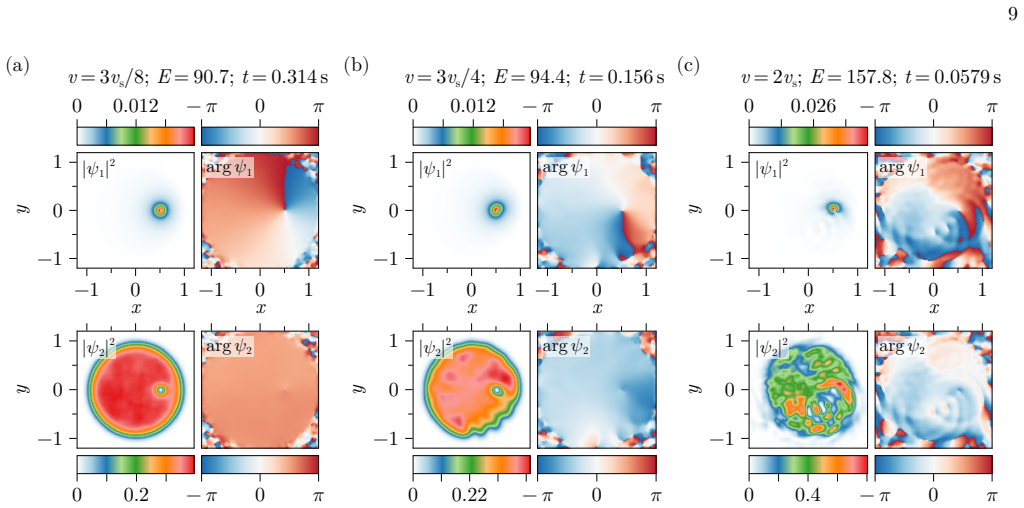
- [Sec. IV, Eqs. (12)–(13) and Fig. 6] The moving-beam simulations monitor only |Φ3|^2 (reported as essentially zero) and total norm, but these diagnostics do not establish that the system remains in the dark-state manifold. The bright state |B⟩ defined in Eq. (6) contains no |3⟩ component, so a state with a significant bright-state admixture can have Φ3≈0 at a given instant. Moreover, the decoupling of ΦD from ΦB and Φ3 in Eqs. (12)–(13) is derived for static beams and equal scattering lengths; for a beam speed v the relevant non-adiabatic coupling is of order (v/a)/Ω, and the paper provides no bound on the induced bright-state population. The authors should report the time-resolved population of the bright-state component, obtained by projecting the full GPE solution onto |D⟩ and |B⟩, or otherwise bound the non-adiabatic transition probability. Without this, the heating rate shown in Fig. 7 and the extracted v_c=0.8v_s cannot be unambiguously attributed to stirring by the dark-state vortex, because bright-state admixture followed by decay through |3⟩ would produce heating and atom loss of the same qualitative kind.
- [Sec. IV, Eq. (20) and Fig. 7] The critical-velocity claim v_c=0.8v_s rests on a three-parameter fit of the empirical form κ(v)=κ0+b max(v^2-v_c^2,0) to simulation data with no reported error bars, no number of independent runs, and no residuals or goodness-of-fit measure. The paper should provide confidence intervals for κ0, b, and v_c, or at least demonstrate the sensitivity of v_c to the choice of fit function and to the fixed simulation duration of 0.1 s. As it stands, the abstract's statement that the system allows one to 'determine the superfluid flow's critical velocity' is not quantitatively supported by the presented analysis.
- [Sec. III B, Figs. 3–5] The stationary-state search is restricted to the axisymmetric ansatz Φ_i=f_i(ρ)e^{il_iφ}. The imaginary-time evolution uses trial functions with a fixed angular momentum l, and the paper notes that states with different l are orthogonal, so the algorithm cannot find a lower-energy state with a different symmetry or a deformed (off-axis) vortex. While cylindrical symmetry makes the axisymmetric ground state plausible, the claim that the localized vortex state is the lowest-energy state of the dark-state manifold would be stronger if the authors performed at least one fully two-dimensional imaginary-time run with a symmetry-breaking initial condition or random noise, to exclude non-axisymmetric competitors.
minor comments (4)
- [Sec. II C and Appendix, Eq. (A1)] The same symbol ∆ is used for both the Laplacian and the single-photon detuning; in the dimensionless equations this is confusing. Please use distinct symbols, such as ∇² and Δ_L.
- [Sec. IV, Fig. 7] The figure showing the heating rate as a function of velocity would be much more informative with error bars or at least markers on the individual data points, so the reader can assess the scatter around the fitted curve.
- [Introduction and Sec. III A2] The introduction states that the localized-vortex state becomes the ground state when the 'relative strength' of the two beams exceeds a threshold, but the threshold is never defined in terms of the physical parameters; the small-a limit is clear, but a brief quantitative statement of the crossover would help.
- [Sec. III A2 and Conclusions] The conclusion that the vortex density 'falls off as [1+(ρ/a)^2]^{-1/2}' appears to be stated for the envelope of |Φ1|^2 through Eq. (17); a direct derivation or a reference to the relevant equation would avoid ambiguity.
Circularity Check
No significant circularity: the localized-vortex ground state follows from minimizing the dark-state gauge kinetic term and is confirmed by full-GPE numerics; the only self-referential input is a standard self-cited gauge-potential formula.
full rationale
The central prediction (small-a ground state has l=-nu, so component 1 carries a localized vortex and component 2 is vortex-free) is derived internally. In Sec. III A 2 the paper starts from Eq. (19) and observes that for rho >> a the vector-potential term rho A_phi tends to -nu, so the centrifugal term (l - rho A_phi)^2 is minimized by l = -nu, giving the J0 Bessel solution; Eq. (17) then fixes the component vorticities. The inputs are the beam profile (Eq. (1)), the dark-state definition (Eq. (4)), and the dark-state GPE (Eq. (13)). The dark-state GPE and the gauge potentials A and U are attributed to Refs. [27,28], which include current authors, but that cited work is an independent, parameter-free derivation of effective magnetic fields from OAM beams and does not contain the stationary-state ground-state result; hence no conclusion is imported by construction. The full three-component numerical solutions are obtained with trial functions seeded by the dark-state solution, but the energies are evaluated from the full GPE system (Eq. (10)) and the ground state is selected by energy ordering, not by enforcing the predicted vorticity. The critical velocity v_c = 0.8 v_s is obtained by fitting the heating-rate data to Eq. (20); it is an empirical extraction used for characterization, not a fitted parameter fed back into the vortex-state derivation. The dynamical section monitors only the excited-state population |Phi_3|^2 and does not report the bright-state fraction; that is a validation gap for the moving-beam protocol, but it is a correctness risk, not a circular step.
Assumptions & free parameters
free parameters (4)
- a =
0.02 R (0.3 micrometers)
- v_c =
0.8 v_s (about 320 micrometers/s)
- kappa_0 and b =
fit parameters in Eq. (20)
- trap parameters V0, b_trap, rho_0 =
V0=1000, b=17, rho_0=0.7
assumptions (6)
- domain assumption Rotating wave approximation and two-photon resonance epsilon=0
- domain assumption Adiabatic following of the dark state: bright and excited state populations negligible
- domain assumption Equal intra- and inter-component scattering lengths g11=g12=g22
- domain assumption Thomas-Fermi approximation along z, reducing the system to 2D
- domain assumption Beam waist term e^{-rho^2/w0^2} can be set to unity
- ad hoc to paper The trial-state ansatz restricts the search to f_i(rho) e^{i l_i phi} with a few l values
Cite this review
Pith. "Pith review of Light-induced localized vortices in multicomponent Bose-Einstein condensates." pith.science (2026). https://pith.science/paper/65DQMN3O
@misc{pith2026250608683,
  author       = {Pith},
  title        = {Pith review of: Light-induced localized vortices in multicomponent Bose-Einstein condensates},
  year         = {2026},
  howpublished = {\url{https://pith.science/paper/65DQMN3O}},
  note         = {Machine review of arXiv:2506.08683}
}
abstract
We study continuous interaction of a trapped two-component Bose-Einstein condensate with light fields in a $\Lambda$-type configuration. Using light beams with orbital angular momentum, we theoretically show how to create a stable, pinned vortex configuration, where the rotating component is confined to the region surrounded by the second, non-rotating component. The atoms constituting this vortex can be localized in volumes much smaller than the volume occupied by the second component. We also show that the vortex position can be changed dynamically by moving the laser beams, provided the beams' movement speed remains below the speed of sound. This allows us to use the localized vortex to stir the second component, and to determine the superfluid flow's critical velocity.
Figures


Figures from the paper (4 more)



Reference graph
Works this paper leans on
-
[1]
Large a First, we consider the case when the distancea is large compared to the system radiusR, so thatρ≪a. Then, according to Eq. (15), forl̸= 0 one can neglect the term ρAφ ≈ −(ρ/a)2νν in comparison with l in Eq. (19), whereas forl = 0 this term may be disregarded because A2 φ≪µ. In a similar way, the geometric scalar potential U is small in comparison ...
-
[2]
Small a Now let us consider the case when the distancea is small compared to the system radius,a≪ R. In that case, one hasρ≫a for most of the area occupied by the condensate, except for a small area close to the center, ρ ⪅a in which the geometric scalar and vector potentials are concentrated. For ρ≫ a, it follows from Eq. (15) that ρAφ(ρ)→− ν. The ground...
-
[3]
M. T. Reeves, K. Goddard-Lee, G. Gauthier, O. R. Stockdale, H. Salman, T. Edmonds, X. Yu, A. S. Bradley, M. Baker, H. Rubinsztein-Dunlop, M. J. Davis, and T. W. Neely, Turbulent relaxation to equilibrium in a two-dimensional quantum vortex gas, Phys. Rev. X12, 011031 (2022)
2022
-
[4]
Light-induced localized vortices in multicomponent Bose-Einstein condensates
and the structure of neutron stars [5]. A key challenge in the study of BEC vortices is their controlled creation and manipulation. Typically, the vor- tices are produced by transferring angular momentum to the atoms using optical means: through phase imprinting [6], stirring [7, 8], or using beams carrying orbital angular momentum, such as Laguerre–Gauss...
work page Pith review arXiv 2025
-
[5]
= 400 µm/s. Moving the vortex at twice the speed,v2 = 2v1, results in setting the whole of the second component in circular motion. The distortion of the density is apparent in Fig. 6(b). Finally, the case of supersonic movement is studied in Fig. 6(c) corresponding to the movement speedv3 = 2vs. The density profiles of both components are strongly dis- t...
-
[6]
A. L. Fetter and A. A. Svidzinsky, Vortices in a trapped dilute Bose-Einstein condensate, J. Phys.: Condens. Matter 13, R135 (2001)
work page 2001
-
[7]
M. Tsubota, M. Kobayashi, and H. Takeuchi, Quantum hydrodynamics, Phys. Rep.522, 191 (2013)
work page 2013
- [8]
Show all 56 references
-
[9]
Magierski, A
P. Magierski, A. Barresi, A. Makowski, D. Pęcak, and G. Wlazłowski, Quantum vortices in fermionic superflu- ids: From ultracold atoms to neutron stars., Eur. Phys. J. A 60, 186 (2024)
2024
-
[10]
Dobrek, M
Ł. Dobrek, M. Gajda, M. Lewenstein, K. Sengstock, G. Birkl, and W. Ertmer, Optical generation of vortices in trapped Bose-Einstein condensates, Phys. Rev. A60, R3381 (1999)
1999
-
[11]
K. W. Madison, F. Chevy, W. Wohlleben, and J. Dal- ibard, Vortex formation in a stirred Bose-Einstein con- densate, Phys. Rev. Lett.84, 806 (2000)
2000
-
[12]
J. R. Abo-Shaeer, C. Raman, J. M. Vogels, and W. Ket- terle, Observation of vortex lattices in Bose-Einstein con- densates, Science 292, 476 (2001)
2001
-
[13]
Marzlin, W
K.-P. Marzlin, W. Zhang, and E. M. Wright, Vortex cou- pler for atomic Bose-Einstein condensates, Phys. Rev. Lett. 79, 4728 (1997)
1997
-
[14]
R. Dum, J. I. Cirac, M. Lewenstein, and P. Zoller, Cre- ation of dark solitons and vortices in Bose-Einstein con- densates, Phys. Rev. Lett.80, 2972 (1998)
1998
-
[15]
Nandi, R
G. Nandi, R. Walser, and W. P. Schleich, Vortex creation in a trapped Bose-Einstein condensate by stimulated Ra- man adiabatic passage, Phys. Rev. A69, 063606 (2004)
2004
-
[16]
K. T. Kapale and J. P. Dowling, Vortex phase qubit: Generating arbitrary, counterrotating, coherent superpo- sitions in Bose-Einstein condensates via optical angular momentum beams, Phys. Rev. Lett.95, 173601 (2005)
2005
-
[17]
Juzeli¯ unas and P
G. Juzeli¯ unas and P. Öhberg, Creation of an effective magnetic field in ultracold atomic gases using electro- magnetically induced transparency, Opt. Spectrosc.99, 357 (2005)
2005
-
[18]
M. F. Andersen, C. Ryu, P. Cladé, V. Natarajan, A. Vaziri, K. Helmerson, and W. D. Phillips, Quantized rotation of atoms from photons with orbital angular mo- mentum, Phys. Rev. Lett.97, 170406 (2006). 12
2006
-
[19]
K. C. Wright, L. S. Leslie, and N. P. Bigelow, Optical control of the internal and external angular momentum of a Bose-Einstein condensate, Phys. Rev. A77, 041601 (2008)
2008
-
[20]
K. C. Wright, L. S. Leslie, A. Hansen, and N. P. Bigelow, Sculpting the vortex state of a spinor BEC, Phys. Rev. Lett. 102, 030405 (2009)
2009
-
[21]
Majumder, Dynamics of the creation of a ro- tatingBose–EinsteincondensationbytwophotonRaman transition using a Laguerre–Gaussian laser pulse, Atoms 9, 14 (2021)
K.Mukherjee, S.Bandyopadhyay, D.Angom, A.M.Mar- tin, and S. Majumder, Dynamics of the creation of a ro- tatingBose–EinsteincondensationbytwophotonRaman transition using a Laguerre–Gaussian laser pulse, Atoms 9, 14 (2021)
2021
-
[22]
Juzeli¯ unas, J
G. Juzeli¯ unas, J. Ruseckas, P. Öhberg, and M. Fleis- chhauer, Formation of solitons in atomic Bose–Einstein condensates by dark-state adiabatic passage, Lith. J. Phys. 47, 351 (2007)
2007
-
[23]
A. V. Gorshkov, L. Jiang, M. Greiner, P. Zoller, and M. D. Lukin, Coherent quantum optical control with subwavelength resolution, Phys. Rev. Lett.100, 093005 (2008)
2008
-
[24]
Dark State
M. Łącki, M. A. Baranov, H. Pichler, and P. Zoller, Nanoscale “Dark State” optical potentials for cold atoms, Phys. Rev. Lett.117, 233001 (2016)
2016
-
[25]
Gvozdiovas, I
E. Gvozdiovas, I. B. Spielman, and G. Juzeli¯ unas, Interference-induced anisotropy in a two-dimensional dark-state optical lattice, Phys. Rev. A 107, 033328 (2023)
2023
-
[26]
H. R. Hamedi, G. Žlabys, V. Ahufinger, T. Halfmann, J. Mompart, and G. Juzeli¯ unas, Spatially strongly con- fined atomic excitation via a two dimensional stimu- lated Raman adiabatic passage, Opt. Express30, 13915 (2022)
2022
-
[27]
Dutton and J
Z. Dutton and J. Ruostekoski, Transfer and storage of vortex states in light and matter waves, Phys. Rev. Lett. 93, 193602 (2004)
2004
-
[28]
Thanvanthri, K
S. Thanvanthri, K. T. Kapale, and J. P. Dowling, Ar- bitrary coherent superpositions of quantized vortices in Bose-Einstein condensates via orbital angular momen- tum of light, Phys. Rev. A77, 053825 (2008)
2008
-
[29]
Dum and M
R. Dum and M. Olshanii, Gauge structures in atom-laser interaction: Bloch oscillations in a dark lattice, Phys. Rev. Lett. 76, 1788 (1996)
1996
-
[30]
Juzeli¯ unas and P
G. Juzeli¯ unas and P. Öhberg, Slow light in degenerate Fermi gases, Phys. Rev. Lett.93, 033602 (2004)
2004
-
[31]
Juzeli¯ unas, P
G. Juzeli¯ unas, P. Öhberg, J. Ruseckas, and A. Klein, Ef- fectivemagneticfieldsindegenerateatomicgasesinduced by light beams with orbital angular momenta, Phys. Rev. A 71, 053614 (2005)
2005
-
[32]
G.Juzeli¯ unas, J.Ruseckas,andP.Öhberg,Effectivemag- netic fields induced by EIT in ultra-cold atomic gases, J. Phys. B: At. Mol. Opt. Phys.38, 4171 (2005)
2005
-
[33]
Jendrzejewski, S
F. Jendrzejewski, S. Eckel, T. G. Tiecke, G. Juzeli¯ unas, G. K. Campbell, L. Jiang, and A. V. Gorshkov, Subwavelength-width optical tunnel junctions for ultra- cold atoms, Phys. Rev. A94, 063422 (2016)
2016
-
[34]
M. O. Scully and M. S. Zubairy,Quantum Optics(Cam- bridge University Press, Cambridge, 1997)
1997
-
[35]
L. P. Pitaevskii and S. Stringari,Bose-Einstein Conden- sation and Superfluidity (Oxford University Press, Ox- ford, 2016)
2016
-
[36]
A. L. Gaunt, T. F. Schmidutz, I. Gotlibovych, R. P. Smith, and Z. Hadzibabic, Bose-Einstein condensation of atoms in a uniform potential, Phys. Rev. Lett.110, 200406 (2013)
2013
-
[37]
R. F. Gutterres, C. Amiot, A. Fioretti, C. Gabbanini, M. Mazzoni, and O. Dulieu, Determination of the87Rb 5pstatedipolematrixelementandradiativelifetimefrom the photoassociation spectroscopy of theRb2 0− g (P 3/2) long-range state, Phys. Rev. A66, 024502 (2002)
2002
-
[38]
Egorov, B
M. Egorov, B. Opanchuk, P. Drummond, B. V. Hall, P. Hannaford, and A. I. Sidorov, Measurement ofs-wave scatteringlengthsinatwo-componentBose-Einsteincon- densate, Phys. Rev. A87, 053614 (2013)
2013
-
[39]
Patrick, A
S. Patrick, A. Gupta, R. Gregory, and C. F. Barenghi, Stability of quantized vortices in two-component conden- sates, Phys. Rev. Res.5, 033201 (2023)
2023
-
[40]
Richaud, G
A. Richaud, G. Lamporesi, M. Capone, and A. Recati, Mass-driven vortex collisions in flat superfluids, Phys. Rev. A 107, 053317 (2023)
2023
-
[41]
Ao and S
P. Ao and S. T. Chui, Binary Bose-Einstein condensate mixtures in weakly and strongly segregated phases, Phys. Rev. A 58, 4836 (1998)
1998
-
[42]
Timmermans, Phase separation of Bose-Einstein con- densates, Phys
E. Timmermans, Phase separation of Bose-Einstein con- densates, Phys. Rev. Lett.81, 5718 (1998)
1998
-
[43]
L. Wen, W. M. Liu, Y. Cai, J. M. Zhang, and J. Hu, Controlling phase separation of a two-component Bose- Einstein condensate by confinement, Phys. Rev. A85, 043602 (2012)
2012
-
[44]
Di, Y.-H
X. Di, Y.-H. Nie, and T. Yang, Manipulating vortices with a rotating laser beam in Bose–Einstein condensates, Laser Phys. 33, 085501 (2023)
2023
-
[45]
C. J. Pethick and H. Smith,Bose–Einstein Condensation in Dilute Gases, 2nd ed. (Cambridge University Press, Cambridge, 2008)
2008
-
[46]
Raman, M
C. Raman, M. Köhl, R. Onofrio, D. S. Durfee, C. E. Kuklewicz, Z. Hadzibabic, and W. Ketterle, Evidence for a critical velocity in a Bose-Einstein condensed gas, Phys. Rev. Lett. 83, 2502 (1999)
1999
-
[47]
Onofrio, C
R. Onofrio, C. Raman, J. M. Vogels, J. R. Abo-Shaeer, A. P. Chikkatur, and W. Ketterle, Observation of super- fluid flow in a Bose-Einstein condensed gas, Phys. Rev. Lett. 85, 2228 (2000)
2000
-
[48]
Desbuquois, L
R. Desbuquois, L. Chomaz, T. Yefsah, J. Léonard, J. Beugnon, C. Weitenberg, and J. Dalibard, Superfluid behaviour of a two-dimensional Bose gas, Nat. Phys.8, 645 (2012)
2012
-
[49]
Luick, L
W.Weimer, K.Morgener, V.P.Singh, J.Siegl, K.Hueck, N. Luick, L. Mathey, and H. Moritz, Critical velocity in the BEC-BCS Crossover, Phys. Rev. Lett.114, 095301 (2015)
2015
-
[50]
Luick, H
V.P.Singh, W.Weimer, K.Morgener, J.Siegl, K.Hueck, N. Luick, H. Moritz, and L. Mathey, Probing superfluid- ity of Bose-Einstein condensates via laser stirring, Phys. Rev. A 93, 023634 (2016)
2016
-
[51]
V. P. Singh, C. Weitenberg, J. Dalibard, and L. Mathey, Superfluidity and relaxation dynamics of a laser-stirred two-dimensional Bose gas, Phys. Rev. A 95, 043631 (2017)
2017
-
[52]
Kiehn, V
H. Kiehn, V. P. Singh, and L. Mathey, Superfluidity of a laser-stirred Bose-Einstein condensate, Phys. Rev. A 105, 043317 (2022)
2022
-
[53]
G. E. Astrakharchik and L. P. Pitaevskii, Motion of a heavy impurity through a Bose-Einstein condensate, Phys. Rev. A70, 013608 (2004)
2004
-
[54]
Antoine and R
X. Antoine and R. Duboscq, GPELab, a Matlab toolbox to solve Gross–Pitaevskii equations I: Computation of stationary solutions, Comput. Phys. Commun.185, 2969 13 (2014)
2014
-
[55]
Antoine and R
X. Antoine and R. Duboscq, GPELab, a Matlab tool- box to solve Gross–Pitaevskii equations II: Dynamics and stochastic simulations, Comput. Phys. Commun.193, 95 (2015)
2015
-
[56]
Danisch and J
S. Danisch and J. Krumbiegel, Makie.jl: Flexible high- performance data visualization for Julia, J. Open Source Soft. 6, 3349 (2021)
2021
Reviewed August 7, 2026 · model on record in the stance chip above.
Discussion (0). Sign in to comment.