REVIEW 2 major objections 5 minor 55 references
Confidence Boosts Trust-Based Resilience in Cooperative Multi-Robot Systems
T0 review · 2 major / 5 minor · reviewed 2026-08-07 · deepseek-v4-flash
Pith's one-line read A confidence parameter that decays to zero lets a multi-robot consensus protocol tolerate any number of malicious agents while staying provably close to the adversary-free consensus.
desk verdict A genuinely useful refinement of trust-based consensus with a real speed/accuracy knob, but the main deviation bound has a repairable expectation-exchange gap in Appendix C. read the letter →
The pith
A machine-rendered reading of the paper's core claim, the machinery that carries it, and where it could break.
The reading
What carries the argument
The load-bearing object is the pair $(\beta_{ij}(t),\lambda_t)$: the aggregate trust score $\beta_{ij}(t)=\sum_{s=0}^t(\alpha_{ij}(s)-1/2)$ decides whether neighbor $j$ is trusted at time $t$, and the confidence parameter $\lambda_t=c e^{-\gamma t}$ decides how much the robot relies on its own initial state rather than on the trusted-neighbor average. The proof decomposes the trajectory into a legitimate contribution and a malicious contribution using the transition matrices $W^L_{t,\mathrm{aut}}$, $W^L_{t,\mathrm{in}}$, and $W^M_{k,t}$; it then invokes the almost-sure finiteness of the final classification time $T_f$ to replace learned weights by true weights after $T_f$, and uses a Jordan decomposition of the nominal weight matrix $W^L$ to quantify convergence. The exponential decay of misclassification probability from Lemma 1 is what makes the eventual classification argument work.
What would settle it
Run the platoon-merging experiment from Section VI for many Monte Carlo trials, estimate $\mathbb{E}[T_f]$ and $\mathbb{E}[T_M]$ from the Beta-distributed trust observations, compute $u_L+u_M$, and compare the empirical frequency of final deviations above $\epsilon$ with $(\eta/\epsilon)(u_L+u_M)$; a violation for a fixed $\epsilon$ would contradict Theorem 1. A sharper probe is to test a channel model with positively correlated trust observations across time (block fading) that still satisfies Assumption 2; if $\beta_{ij}(t)$ then fails to converge to the correct sign or $T_f$ is not almost surely finite, the independence implicit in Lemma 1 is the actual load-bearing assumption.
Extended reading notes
Core claim
The central discovery is that confidence, implemented as a decaying self-anchor $\lambda_t$, converts an uncertain trust signal into a formal resilience guarantee. Proposition 1 shows that under Assumptions 1 and 2 and $\lambda_t\to 0$, the legitimate robots reach consensus almost surely even with arbitrarily many malicious robots. Theorem 1 bounds the chance that the final consensus deviates from the no-attack value by more than $\epsilon$ as $\mathbb{P}[\lim_{t\to\infty}\tilde{x}_t^i>\epsilon]\le (\eta/\epsilon)(u_L+u_M)$, where $\eta$ bounds all states and $u_L$, $u_M$ are explicit functions of the expected final classification times $\mathbb{E}[T_f]$, $\mathbb{E}[T_M]$, the trust statistics $E_L$, $E_M$, the graph degrees, and the decay rate $\gamma$. The paper also derives a finite-time convergence-rate bound (Theorem 2) whose expectation is controlled by the tail of the misclassification time through $p(k)$. Numerical experiments with spoofed vehicles in merging platoons illustrate the speed-deviation tradeoff.
Load-bearing premise
The load-bearing premise is that trust scores are informative in expectation—legitimate transmissions average above $1/2$ and malicious below $1/2$—and that permanently correct classification of all neighbors happens in finite time almost surely; if the expected final classification time is enormous, the deviation guarantee becomes too weak to matter for any realistic mission.
Editorial extensions
If this is right
- Legitimate robots can begin cooperating immediately at time zero; no synchronization or pre-agreed observation window is required.
- For fixed channel statistics and network, the designer can tune $\gamma$ in $\lambda_t=c e^{-\gamma t}$ to move along the tradeoff: smaller $\gamma$ shrinks the expected deviation bound at the price of slower convergence, and larger $\gamma$ does the reverse.
- The steady-state guarantee degrades as $\mathbb{E}[T_f]$ and $\mathbb{E}[T_M]$ grow, so slow-to-classify channels push the guaranteed accuracy down, while clearly identifiable malicious transmissions (large $|E_M|$) improve it.
- After the final classification time, the protocol behaves approximately like standard consensus on the true legitimate weights, so the classical Perron-vector intuition applies to the final value.
- The expected finite-time error bound in Theorem 2 gives a way to choose a deployment horizon based on the channel statistics.
Reading between the lines
- The same proof structure should carry to vector-valued states and per-robot confidence schedules, since the state bound and weight matrices act componentwise; the constants would need recomputation.
- One can view $\lambda_t$ as a regularization schedule in online distributed optimization: the deviation bound plays the role of optimization error and the convergence bound the role of convergence time, suggesting the tradeoff is fundamental to any trust-based scheme with uncertain classification.
- A testable design rule suggested by the bounds is to choose $\gamma$ comparable to the misclassification decay rates $2E_L^2$ or $2E_M^2$, so the self-anchor fades on the same timescale as trust scores become reliable.
- The bounds are Markov-inequality bounds and are therefore likely loose; the numerical tradeoff curves are flatter than the theory, meaning practical deployments may tolerate faster decay than the guarantees suggest.
Editorial analysis
A structured set of objections, weighed in public.
Referee Report
Summary. This paper proposes a distributed resilient consensus protocol (RES) for multi-robot networks. Each legitimate robot updates its scalar state by combining an anchoring term λ_t x_i(0) with a weighted average of trusted neighbors' states, where λ_t is a time-varying confidence parameter chosen as λ_t = c e^{-γ t}. Trust observations from the physical layer are aggregated into scores β_ij(t), and communication weights are assigned to neighbors with nonnegative cumulative scores. The main analytical claims are: (i) Proposition 1: legitimate robots reach consensus almost surely for any vanishing λ_t; (ii) Propositions 2 and 3 bound the expected steady-state deviation from the nominal no-attack consensus, respectively due to legitimate and malicious contributions; (iii) Theorem 1 converts these into a probabilistic deviation bound P(limsup_t ˜x_i^t > ε) ≤ (η/ε)(u_L + u_M); (iv) Proposition 4 and Theorem 2 give finite-time convergence-rate bounds. Numerical experiments on vehicular platooning with spoofed vehicles illustrate the predicted speed-deviation tradeoff and compare with the step-window protocol of [14].
Significance. If the main theorem held, the paper would provide a valuable extension of trust-based resilient consensus: it removes the initial observation window of [14], handles uncertain channel-derived trust through a time-varying confidence parameter, and recovers exact consensus (not merely bounded disagreement) under a vanishing λ_t. The explicit bounds on deviation and convergence rate offer concrete design guidance, and the platooning simulations support the qualitative tradeoff. The appendices contain substantial original technical work, including Jordan-block estimates for the convergence rate and tail bounds for classification times. However, the headline quantitative guarantee rests on a single invalid expectation interchange in Appendix C; as written, Theorem 1 is not proven. The issue appears repairable by extending the relevant sum to infinity, but the resulting bound will differ from Eq. (36), so the proof needs to be redone before the results can be relied upon.
major comments (2)
- [Appendix C, Eq. (C.5)] The step E[η Σ_{k=0}^{TM(t)-1} a_k Y_k] = η Σ_{k=0}^{TM(t)-1} a_k E[Y_k], with a_k = (1-λ_{k+1})(1-λ_k) and Y_k = max_i [W^M_k 1]_i, is invalid because TM(t) is a random stopping index defined through the same trust-observation process that determines Y_k. The events {k < TM(t)} are not independent of Y_k, so the expectation of the product does not factor as written. This is the exact point at which the proof of Proposition 3, and hence the term u_M in Theorem 1, relies on an unproven interchange.
- [Appendix C, Eqs. (C.8)-(C.10), and Theorem 1, Eq. (37)] Because of the invalid interchange in Eq. (C.5), the subsequent computation E[ξ(TM)] ≤ D_M Σ_k ξ(k) e^{-2E_M^2 k} = D_M ζ in Eq. (C.10) does not follow, and the claimed bound u_M = D_M^2 ζ / 2 in Eq. (36) is not established. A correct and readily available route is to extend the sum to infinity and use Tonelli's theorem to justify E[Σ_{k=0}^∞ a_k Y_k] ≤ Σ_{k=0}^∞ a_k E[Y_k]; this produces a valid but different closed-form bound. Since the deviation bound (37) is the paper's headline quantitative guarantee, the proof of Proposition 3 and the statement of Theorem 1 must be revised.
minor comments (5)
- [Assumption 2 and Lemma 1] The exponential tail bounds in Eq. (5) require independence of the trust observations α_ij(t) across time and across links, but this independence assumption is not stated explicitly; please add it.
- [Appendix E, Eq. (E.13)] In the union-bound expression for P[T_f = k], the subscripts in the exponentials appear swapped: the term involving D_L should decay with E_L^2 and the term involving D_M should decay with E_M^2.
- [Proposition 4, Eqs. (40)-(44)] The notation bm is ambiguous: it is not clear whether this is a product b·m or a single constant. Please define the constant explicitly and write it as b m or with a subscript.
- [Appendix B, Eq. (B.8)] The definition of s(x) is typeset in a confusing way; Eq. (21) indicates the intended form s(x) = 1 + (1-x)/x ln(1-x), which should be stated directly.
- [Section VI] The description of the '2-nearest neighbor topology' should specify whether the communication graph is directed and how the cross-platoon leader links are chosen, since Assumption 1 depends on the structure of the resulting matrix W^L.
Circularity Check
No significant circularity: the paper's analytical results are derived from first-principles assumptions and explicit bounds; self-citations provide independent supporting lemmas.
full rationale
The paper proves consensus (Proposition 1), deviation bounds (Propositions 2-3 and Theorem 1), and convergence rates (Proposition 4 and Theorem 2) directly from the proposed update rule (RES), the trust-based weights (4), and Assumptions 1-4. The quantities uL and uM are closed-form functions of the assumed channel statistics, classification times, and design constants, not fitted values or redefinitions of the target bounds. Cited prior results, including the Chernoff classification bounds from [14], the diminishing Friedkin-Johnsen identity from [16], and Lemma 2 of [43], are independent mathematical lemmas with assumptions that do not already contain the paper's consensus or deviation conclusions. Some cited works share authors, but they are not used as a self-referential justification of the main results. The proof step in Appendix C that exchanges an expectation with a sum whose random upper limit is TM(t) is a potential correctness gap, but it is an analysis error rather than a circular derivation, so it does not constitute circularity.
Assumptions & free parameters
assumptions (4)
- domain assumption Assumption 1: W_L is primitive; Perron eigenvector v exists.
- domain assumption Assumption 2: Trust observations are informative on average (E_L > 0, E_M < 0).
- domain assumption Assumption 3: Bounded initial legitimate states and all malicious transmissions (η).
- ad hoc to paper Assumption 4: lim λ_t = 0.
invented entities (1)
-
Confidence parameter λ_t with exponential schedule λ_t = c e^{-γ t}
Cite this review
Pith. "Pith review of Confidence Boosts Trust-Based Resilience in Cooperative Multi-Robot Systems." pith.science (2026). https://pith.science/paper/5CNXHECI
@misc{pith2026250608807,
  author       = {Pith},
  title        = {Pith review of: Confidence Boosts Trust-Based Resilience in Cooperative Multi-Robot Systems},
  year         = {2026},
  howpublished = {\url{https://pith.science/paper/5CNXHECI}},
  note         = {Machine review of arXiv:2506.08807}
}
read the original abstract
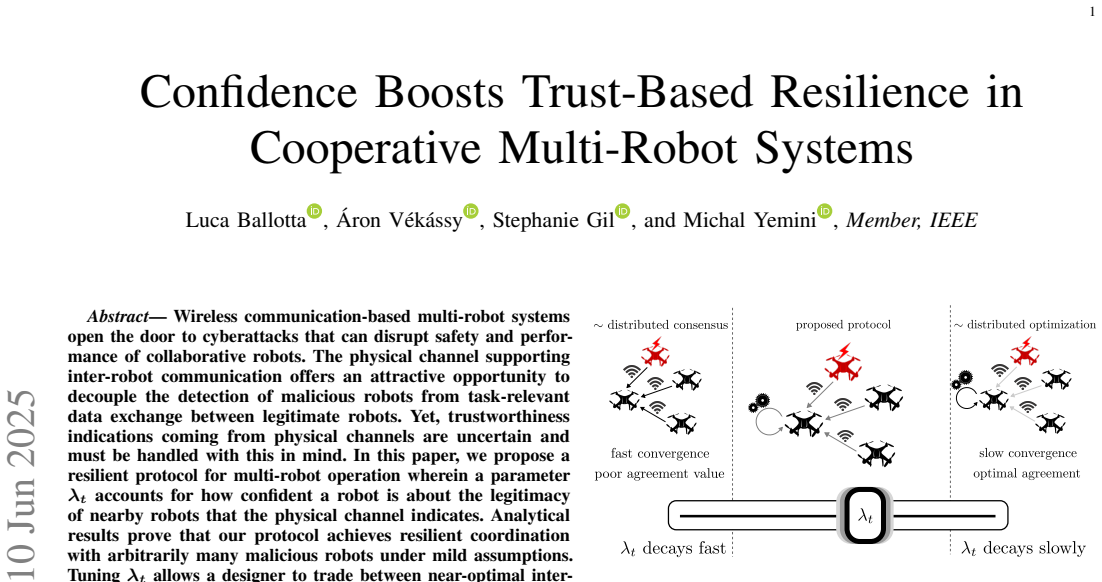
Wireless communication-based multi-robot systems open the door to cyberattacks that can disrupt safety and performance of collaborative robots. The physical channel supporting inter-robot communication offers an attractive opportunity to decouple the detection of malicious robots from task-relevant data exchange between legitimate robots. Yet, trustworthiness indications coming from physical channels are uncertain and must be handled with this in mind. In this paper, we propose a resilient protocol for multi-robot operation wherein a parameter {\lambda}t accounts for how confident a robot is about the legitimacy of nearby robots that the physical channel indicates. Analytical results prove that our protocol achieves resilient coordination with arbitrarily many malicious robots under mild assumptions. Tuning {\lambda}t allows a designer to trade between near-optimal inter-robot coordination and quick task execution; see Fig. 1. This is a fundamental performance tradeoff and must be carefully evaluated based on the task at hand. The effectiveness of our approach is numerically verified with experiments involving platoons of autonomous cars where some vehicles are maliciously spoofed.
Figures


Figures from the paper (2 more)


Reference graph
Works this paper leans on
-
[14]
Characterizing Trust and Resilience in Distributed Consensus for Cyberphysical Systems,
M. Yemini, A. Nedi ´c, A. J. Goldsmith, and S. Gil, “Characterizing Trust and Resilience in Distributed Consensus for Cyberphysical Systems,” IEEE Trans. Robot. , vol. 38, no. 1, pp. 71–91, 2022
work page 2022
-
[16]
Friedkin-Johnsen Model With Diminishing Competition,
L. Ballotta, Á. Vékássy, S. Gil, and M. Yemini, “Friedkin-Johnsen Model With Diminishing Competition,” IEEE Control Syst. Lett. , vol. 8, pp. 2679–2684, 2024
work page 2024
-
[1]
Energy-efficient communication for UA V-enabled mobile relay networks,
˙I. Ba¸ stürk, “Energy-efficient communication for UA V-enabled mobile relay networks,” Computer Networks, vol. 213, p. 109071, 2022
work page 2022
-
[2]
Multirobot Coordination for Space Exploration,
L. Yliniemi, A. K. Agogino, and K. Tumer, “Multirobot Coordination for Space Exploration,” AI Mag., vol. 35, no. 4, pp. 61–74, 2014
work page 2014
-
[3]
Robotized and Automated Warehouse Systems: Review and Recent Developments,
K. Azadeh, R. De Koster, and D. Roy, “Robotized and Automated Warehouse Systems: Review and Recent Developments,” Transp. Sci., vol. 53, no. 4, pp. 917–945, 2019
work page 2019
-
[4]
M. Baglioni and A. Jamshidnejad, “A Novel MPC Formulation for Dynamic Target Tracking with Increased Area Coverage for Search-and- Rescue Robots,” J. Intell. Robot. Syst. , vol. 110, no. 4, p. 140, 2024
work page 2024
-
[5]
A Two- Stage Optimization-Based Motion Planner for Safe Urban Driving,
F. Eiras, M. Hawasly, S. V . Albrecht, and S. Ramamoorthy, “A Two- Stage Optimization-Based Motion Planner for Safe Urban Driving,” IEEE Trans. Robot., vol. 38, no. 2, pp. 822–834, 2022
work page 2022
-
[6]
Consensus-based fast and energy-efficient multi-robot task allocation,
P. Mahato, S. Saha, C. Sarkar, and Md. Shaghil, “Consensus-based fast and energy-efficient multi-robot task allocation,” Robot. Auton. Syst. , vol. 159, p. 104270, 2023
work page 2023
Show all 55 references
-
[7]
Byzantine Resilient Distributed Learning in Multirobot Systems,
J. Li, W. Abbas, M. Shabbir, and X. Koutsoukos, “Byzantine Resilient Distributed Learning in Multirobot Systems,” IEEE Trans. Robot., vol. 38, no. 6, pp. 3550–3563, 2022
2022
-
[8]
Decentralized rigidity maintenance control with range measurements for multi-robot systems,
D. Zelazo, A. Franchi, H. H. Bülthoff, and P. Robuffo Giordano, “Decentralized rigidity maintenance control with range measurements for multi-robot systems,” Int. J. Robot. Res. , vol. 34, no. 1, pp. 105–128, 2015
2015
-
[9]
Coordinated Control of Multi-Robot Systems: A Survey,
J. Cortés and M. Egerstedt, “Coordinated Control of Multi-Robot Systems: A Survey,” SICE J. Control Meas. Syst. Integr. , vol. 10, no. 6, pp. 495– 503, 2017
2017
-
[10]
Distributed Opti- mization Methods for Multi-Robot Systems: Part 2—A Survey,
O. Shorinwa, T. Halsted, J. Yu, and M. Schwager, “Distributed Opti- mization Methods for Multi-Robot Systems: Part 2—A Survey,” IEEE Robot. Autom. Mag. , vol. 31, no. 3, pp. 154–169, 2024
2024
-
[11]
Guaranteeing spoof-resilient multi-robot networks,
S. Gil, S. Kumar, M. Mazumder, D. Katabi, and D. Rus, “Guaranteeing spoof-resilient multi-robot networks,” Auton. Robots, vol. 41, no. 6, pp. 1383–1400, 2017
2017
-
[12]
State-Secrecy Codes for Networked Linear Systems,
A. Tsiamis, K. Gatsis, and G. J. Pappas, “State-Secrecy Codes for Networked Linear Systems,” IEEE Trans. Autom. Control, vol. 65, no. 5, pp. 2001–2015, 2020
2001
-
[13]
Switching Topology for Resilient Consensus using Wi-Fi Signals,
T. Wheeler, E. Bharathi, and S. Gil, “Switching Topology for Resilient Consensus using Wi-Fi Signals,” in Proc. Int. Conf. Robot. Autom. , 2019, pp. 2018–2024
2019
-
[15]
Can Competition Outperform Collaboration? The Role of Misbehaving Agents,
L. Ballotta, G. Como, J. S. Shamma, and L. Schenato, “Can Competition Outperform Collaboration? The Role of Misbehaving Agents,” IEEE Trans. Autom. Control, vol. 69, no. 4, pp. 2308–2323, 2024. 15
2024
-
[17]
The Role of Confidence for Trust-Based Resilient Consensus,
L. Ballotta and M. Yemini, “The Role of Confidence for Trust-Based Resilient Consensus,” in Proc. American Control Conf. , 2024, pp. 2822– 2829
2024
-
[18]
Beyond Robustness: A Taxonomy of Approaches towards Resilient Multi-Robot Systems,
A. Prorok, M. Malencia, L. Carlone, G. S. Sukhatme, B. M. Sadler, and V . Kumar, “Beyond Robustness: A Taxonomy of Approaches towards Resilient Multi-Robot Systems,” 2021
2021
-
[19]
Resilient Asymptotic Consensus in Robust Networks,
H. J. LeBlanc, H. Zhang, X. Koutsoukos, and S. Sundaram, “Resilient Asymptotic Consensus in Robust Networks,” IEEE J. Sel. Areas Commun., vol. 31, no. 4, pp. 766–781, 2013
2013
-
[20]
Resilient Distributed Averaging,
S. M. Dibaji, M. Safi, and H. Ishii, “Resilient Distributed Averaging,” in Proc. American Control Conf. , 2019, pp. 96–101
2019
-
[21]
Graph-theoretic approaches for analyzing the resilience of distributed control systems: A tutorial and survey,
M. Pirani, A. Mitra, and S. Sundaram, “Graph-theoretic approaches for analyzing the resilience of distributed control systems: A tutorial and survey,” Automatica, vol. 157, p. 111264, 2023
2023
-
[22]
Triangular Networks for Resilient Formations,
D. Saldaña, A. Prorok, M. F. M. Campos, and V . Kumar, “Triangular Networks for Resilient Formations,” in Distrib. Auton. Robot. Syst.: 13th Int. Symp., 2018, pp. 147–159
2018
-
[23]
Formations for Resilient Robot Teams,
L. Guerrero-Bonilla, A. Prorok, and V . Kumar, “Formations for Resilient Robot Teams,” IEEE Robot. Autom. Lett. , vol. 2, no. 2, pp. 841–848, 2017
2017
-
[24]
Design Guarantees for Resilient Robot Formations on Lattices,
L. Guerrero-Bonilla, D. Saldaña, and V . Kumar, “Design Guarantees for Resilient Robot Formations on Lattices,” IEEE Robot. Autom. Lett. , vol. 4, no. 1, pp. 89–96, 2019
2019
-
[25]
Multi-Robot Adversarial Resilience using Control Barrier Functions,
M. Cavorsi, B. Capelli, L. Sabattini, and S. Gil, “Multi-Robot Adversarial Resilience using Control Barrier Functions,” in Proc. Robot. Sci. Syst. , vol. 18, 2022
2022
-
[26]
Resilient Leader-Follower Consensus to Arbitrary Reference Values in Time-Varying Graphs,
J. Usevitch and D. Panagou, “Resilient Leader-Follower Consensus to Arbitrary Reference Values in Time-Varying Graphs,”IEEE Trans. Autom. Control, vol. 65, no. 4, pp. 1755–1762, 2020
2020
-
[27]
Resiliency in dynamic leader–follower multiagent systems,
H. Rezaee, T. Parisini, and M. M. Polycarpou, “Resiliency in dynamic leader–follower multiagent systems,” Automatica, vol. 125, p. 109384, 2021
2021
-
[28]
Dynamic Resilient Containment Control in Multirobot Systems,
M. Santilli, M. Franceschelli, and A. Gasparri, “Dynamic Resilient Containment Control in Multirobot Systems,” IEEE Trans. Robot., vol. 38, no. 1, pp. 57–70, 2022
2022
-
[29]
Resilient Real-Valued Consensus in Spite of Mobile Malicious Agents on Directed Graphs,
Y . Wang, H. Ishii, F. Bonnet, and X. Défago, “Resilient Real-Valued Consensus in Spite of Mobile Malicious Agents on Directed Graphs,” IEEE Trans. Parallel Distrib. Syst. , vol. 33, no. 3, pp. 586–603, 2022
2022
-
[30]
Resilient Consensus Through Event-Based Communication,
Y . Wang and H. Ishii, “Resilient Consensus Through Event-Based Communication,” IEEE Trans. Control Netw. Syst. , vol. 7, no. 1, pp. 471–482, 2020
2020
-
[31]
A Sample- Based Algorithm for Approximately Testing r-Robustness of a Digraph,
Y . Yi, Y . Wang, X. He, S. Patterson, and K. H. Johansson, “A Sample- Based Algorithm for Approximately Testing r-Robustness of a Digraph,” in Proc. IEEE Conf. Decis. Contol , 2022, pp. 6478–6483
2022
-
[32]
Finite-Time Consensus on the Median Value With Robustness Properties,
M. Franceschelli, A. Giua, and A. Pisano, “Finite-Time Consensus on the Median Value With Robustness Properties,” IEEE Trans. Autom. Control, vol. 62, no. 4, pp. 1652–1667, 2017
2017
-
[33]
Median-Based Resilient Consensus Over Time-Varying Random Networks,
Y . Shang, “Median-Based Resilient Consensus Over Time-Varying Random Networks,” IEEE Trans. Circuits Syst. II , vol. 69, no. 3, pp. 1203–1207, 2022
2022
-
[34]
Trust is the Cure to Distributed Consensus with Adversaries,
J. S. Baras and X. Liu, “Trust is the Cure to Distributed Consensus with Adversaries,” in Proc. Mediterranean Conf. Control Autom. , Akko, Israel, 2019, pp. 195–202
2019
-
[35]
Resilient Consensus Based on Evidence Theory and Weight Correction,
V . Bonagura, C. Fioravanti, G. Oliva, and S. Panzieri, “Resilient Consensus Based on Evidence Theory and Weight Correction,” in Proc. American Control Conf. , 2023, pp. 393–398
2023
-
[36]
Improving Network Con- nectivity and Robustness Using Trusted Nodes With Application to Resilient Consensus,
W. Abbas, A. Laszka, and X. Koutsoukos, “Improving Network Con- nectivity and Robustness Using Trusted Nodes With Application to Resilient Consensus,” IEEE Trans. Control Netw. Syst. , vol. 5, no. 4, pp. 2036–2048, 2018
2018
-
[37]
Resilient Consensus with Mobile Detectors Against Malicious Attacks,
C. Zhao, J. He, and J. Chen, “Resilient Consensus with Mobile Detectors Against Malicious Attacks,” IEEE Trans. Signal Inf. Process. Netw. , vol. 4, no. 1, pp. 60–69, 2018
2018
-
[38]
SecureArray: Improving wifi security with fine-grained physical-layer information,
J. Xiong and K. Jamieson, “SecureArray: Improving wifi security with fine-grained physical-layer information,” in Proc. Annu. Int. Conf. Mobile Comput. Netw., ser. MobiCom ’13. New York, NY , USA: Association for Computing Machinery, 2013, pp. 441–452
2013
-
[39]
Trust modeling in multi-robot patrolling,
C. Pippin and H. Christensen, “Trust modeling in multi-robot patrolling,” in Proc. Int. Conf. Robot. Autom. , 2014, pp. 59–66
2014
-
[40]
How Physicality Enables Trust: A New Era of Trust-Centered Cyberphysical Systems,
S. Gil, M. Yemini, A. Chorti, A. Nedi ´c, H. V . Poor, and A. J. Goldsmith, “How Physicality Enables Trust: A New Era of Trust-Centered Cyberphysical Systems,” 2023
2023
-
[41]
Trustworthy Distributed Average Consensus,
C. N. Hadjicostis and A. D. Domínguez-García, “Trustworthy Distributed Average Consensus,” in Proc. IEEE Conf. Decis. Contol , 2022, pp. 7403– 7408
2022
-
[42]
Resilience to Malicious Activity in Distributed Optimization for Cyberphysical Systems,
M. Yemini, A. Nedi ´c, S. Gil, and A. J. Goldsmith, “Resilience to Malicious Activity in Distributed Optimization for Cyberphysical Systems,” in Proc. IEEE Conf. Decis. Contol , 2022, pp. 4185–4192
2022
-
[43]
Resilient Distributed Optimization for Multi-Agent Cyberphysical Systems,
M. Yemini, A. Nedi ´c, A. J. Goldsmith, and S. Gil, “Resilient Distributed Optimization for Multi-Agent Cyberphysical Systems,” IEEE Trans. Autom. Control, 2025
2025
-
[44]
Crowd Vetting: Rejecting Adversaries via Collaboration With Application to Multirobot Flocking,
F. Mallmann-Trenn, M. Cavorsi, and S. Gil, “Crowd Vetting: Rejecting Adversaries via Collaboration With Application to Multirobot Flocking,” IEEE Trans. Robot. , vol. 38, no. 1, pp. 5–24, 2022
2022
-
[45]
Consensus and Cooper- ation in Networked Multi-Agent Systems,
R. Olfati-Saber, J. A. Fax, and R. M. Murray, “Consensus and Cooper- ation in Networked Multi-Agent Systems,” Proc. IEEE, vol. 95, no. 1, pp. 215–233, 2007
2007
-
[46]
Noise Resilient Distributed Average Consensus Over Directed Graphs,
V . Khatana and M. V . Salapaka, “Noise Resilient Distributed Average Consensus Over Directed Graphs,” IEEE Trans. Signal Inf. Process. Netw., vol. 9, pp. 770–785, 2023
2023
-
[47]
Competition- Based Resilience in Distributed Quadratic Optimization,
L. Ballotta, G. Como, J. S. Shamma, and L. Schenato, “Competition- Based Resilience in Distributed Quadratic Optimization,” in Proc. IEEE Conf. Decis. Contol , 2022, pp. 6454–6459
2022
-
[48]
Social influence and opinions,
N. E. Friedkin and E. C. Johnsen, “Social influence and opinions,” J. Math. Sociol., vol. 15, no. 3-4, pp. 193–206, 1990
1990
-
[49]
Opinion evolution in time-varying social influence networks with prejudiced agents,
A. V . Proskurnikov, R. Tempo, M. Cao, and N. E. Friedkin, “Opinion evolution in time-varying social influence networks with prejudiced agents,” IFAC-PapersOnLine, vol. 50, no. 1, pp. 11 896–11 901, 2017
2017
-
[50]
Convergence in Multiagent Coordination, Consensus, and Flocking,
V . Blondel, J. Hendrickx, A. Olshevsky, and J. Tsitsiklis, “Convergence in Multiagent Coordination, Consensus, and Flocking,” in Proc. IEEE Conf. Decis. Contol , 2005, pp. 2996–3000
2005
-
[51]
Distributed Average Consensus with Time-Varying Metropolis Weights,
L. Xiao, S. Boyd, and S. Lall, “Distributed Average Consensus with Time-Varying Metropolis Weights,” Automatica, 2006
2006
-
[52]
A Consensus-Based Approach for Platooning with Intervehicular Communications and Its Validation in Realistic Scenarios,
S. Santini, A. Salvi, A. S. Valente, A. Pescapé, M. Segata, and R. Lo Cigno, “A Consensus-Based Approach for Platooning with Intervehicular Communications and Its Validation in Realistic Scenarios,” IEEE Trans. Veh. Technol., vol. 66, no. 3, pp. 1985–1999, 2017
1985
-
[53]
Vehicular Platoon Communication: Architecture, Security Threats and Open Challenges,
S. J. Taylor, F. Ahmad, H. N. Nguyen, and S. A. Shaikh, “Vehicular Platoon Communication: Architecture, Security Threats and Open Challenges,” Sensors, vol. 23, no. 1, p. 134, 2022
2022
-
[54]
Conditional Convergence of Infinite Products,
W. F. Trench, “Conditional Convergence of Infinite Products,” American Math. Monthly, vol. 106, no. 7, pp. 646–651, 1999
1999
-
[55]
C. D. Meyer, Matrix Analysis and Applied Linear Algebra, Second Edition. Philadelphia, PA: Society for Industrial and Applied Mathematics, 2023
2023
Reviewed August 7, 2026 · model on record in the stance chip above.
Discussion (0). Sign in to comment.