REVIEW 4 major objections 7 minor 47 references
Cavity-Mediated Gas-Liquid Transition
T0 review · 4 major / 7 minor · reviewed 2026-08-07 · deepseek-v4-flash
Pith's one-line read A cavity can herald the gas-liquid transition of a Bose-Einstein condensate through its own field.
desk verdict Clever cavity/droplet hybrid with a new readout, but the LHY input is asserted and needs verification before the numbers are trusted. read the letter →
The pith
A machine-rendered reading of the paper's core claim, the machinery that carries it, and where it could break.
The reading
What carries the argument
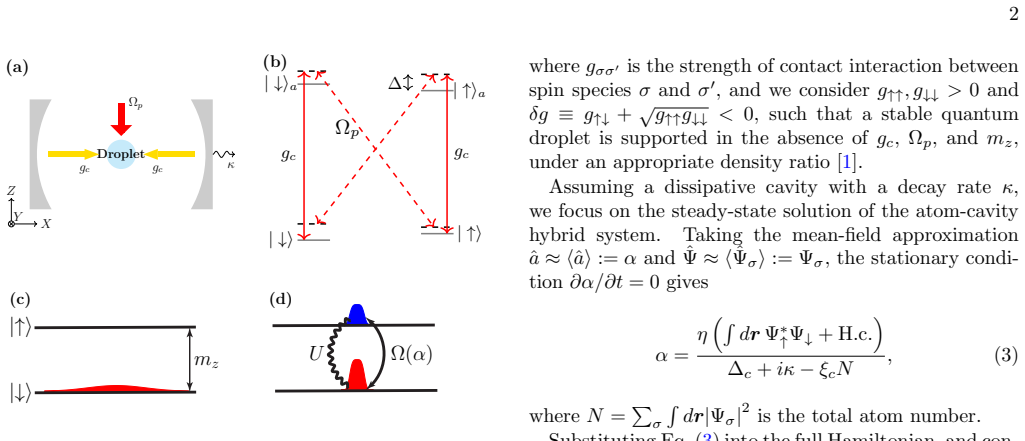
The central object is the cavity-assisted Raman coupling $\Omega = -2\eta\operatorname{Re}[\alpha]$, which is not an external parameter but is set by the cavity field $\alpha$ itself. Through the stationary condition $\alpha = \eta(\int \Psi_\uparrow^*\Psi_\downarrow + \mathrm{c.c.})/(\Delta_c + i\kappa - \xi_c N)$, the cavity field is slaved to the spin-mixing order parameter $\int \Psi_\uparrow^*\Psi_\downarrow$, so any change in the density ratio $R = n_\uparrow/n_\downarrow$ is reflected in $\alpha$. The abrupt jump in $R$ at the first-order gas-liquid transition therefore becomes an abrupt jump in the cavity field, while the fixed droplet ratio $R_P = \sqrt{g_{\downarrow\downarrow}/g_{\uparrow\uparrow}}$ turns the cavity field into a linear function of the pumping strength $\eta$ in the liquid phase. The critical Zeeman field is obtained by balancing the Zeeman energy cost of spin mixing against the energy gain from droplet formation, with the generalized Lee-Huang-Yang correction providing the droplet stabilization energy.
What would settle it
In a $^{39}$K binary condensate with the paper's parameters, hold the Zeeman field below $m_c^z$ and sweep the pumping strength from zero: the claim predicts the cavity field turns on immediately and grows linearly with pumping while a droplet core appears at the trap center. A finite threshold or the absence of the droplet core would falsify the enhanced-superradiance picture.
Extended reading notes
Core claim
The central claim is that quantum fluctuations, the Zeeman field, and cavity-assisted Raman coupling together produce a critical Zeeman field $m_c^z$ below which superradiance is enhanced by simultaneous droplet formation. In this regime the spin mixing needed for a droplet costs Zeeman energy, but the droplet's beyond-mean-field energy gain outweighs that cost, so even an infinitesimal pumping strength stabilizes a superradiant cavity with a self-bound droplet. Above $m_c^z$, the system must first become superradiant and only then, at finite pumping, undergo a first-order gas-liquid transition into the droplet. The paper derives $m_c^z$ analytically by equating the Zeeman energy cost with the droplet formation energy gain, and confirms the resulting phase diagram by numerical minimization in a harmonic trap. At the gas-liquid boundary the density ratio $R=n_\uparrow/n_\downarrow$ jumps, so the cavity field $\alpha$ jumps; inside the droplet phase the fixed ratio $R_P=\sqrt{g_{\downarrow\downarrow}/g_{\uparrow\uparrow}}$ makes $\alpha$ grow linearly with the pumping strength.
Load-bearing premise
The whole phase diagram rests on the generalized Lee-Huang-Yang quantum-fluctuation correction that includes the cavity-assisted Raman coupling $\Omega$; if that correction is inaccurate, the predicted critical Zeeman field and the droplet phase boundary shift.
Editorial extensions
If this is right
- Below $m_c^z$, the cavity turns superradiant at arbitrarily small pumping and the superradiance is accompanied by formation of a self-bound droplet, so the two phenomena are inseparable.
- Above $m_c^z$, the system passes through a polarized gas, then a superradiant gas, and finally a droplet, with the gas-liquid transition occurring only after superradiance is established.
- At the gas-liquid transition, the first-order jump in the density ratio produces an abrupt jump in the cavity field, giving a sharp experimental signal of droplet formation.
- In the liquid phase, the fixed density ratio of the droplet makes the cavity field scale linearly with pumping strength, providing a second unambiguous signature.
- The analytical expression for $m_c^z$ matches the numerically computed phase boundary, identifying the parameter regime in which enhanced superradiance should be observed.
Reading between the lines
- Editorial inference: because the cavity field is slaved to the spin-mixing order parameter, ramping the pumping strength up and down should reveal hysteresis of the cavity field across the first-order gas-liquid transition, which the paper's steady-state treatment does not address.
- Editorial inference: the fixed-density-ratio argument suggests the linear scaling of the cavity field is a generic signature of a droplet phase whose composition is pinned by interactions, so it may carry over to other self-bound quantum fluids coupled to a cavity.
- Editorial inference: the paper's analytical $m_c^z$ inherits any error in the generalized Lee-Huang-Yang correction; checking that correction against the known $\Omega = 0$, $\delta = 0$ droplet limit would make the predicted phase boundary testable before the full experiment is built.
Editorial analysis
A structured set of objections, weighed in public.
Referee Report
Summary. The paper studies a binary Bose-Einstein condensate of 39K whose two hyperfine spin components are coupled by cavity-assisted Raman processes in a pumped microwave cavity. The authors introduce a mean-field energy functional (Eq. (4)) that includes the cavity field, the Zeeman term, and a generalized Lee-Huang-Yang (LHY) correction derived in the Supplemental Material for finite Raman coupling. They identify three phases: a polarized gas (I), a superradiant partially polarized gas (II), and a superradiant self-bound droplet (III). The central predictions are (i) below a critical Zeeman field mc_z ≈ 1.14E0, infinitesimal pumping suffices to make the system superradiant because droplet formation lowers the energy; (ii) above mc_z, increasing pump power yields a superradiant transition followed by a first-order gas-liquid transition; (iii) at that transition the cavity field jumps discontinuously; and (iv) in the liquid phase the cavity field scales linearly with pump strength, owing to the fixed droplet density ratio. The analytic estimate of mc_z (Eq. (10)) agrees with the numerical phase diagram (Fig. 3), including a trapped calculation.
Significance. Strengths: the model is explicit, the analytic results follow transparently from Eqs. (3)-(10), the critical-field estimate is parameter-free in the sense that all couplings are taken from prior 39K experiments and stated cavity parameters, the numerical and analytic values of mc_z agree (1.13 vs 1.14 E0), and the predicted signatures (zero-threshold superradiance, cavity-field jump, linear scaling) are concrete and falsifiable. The usefulness of the paper hinges on the unverified generalized LHY correction in the SM, which is load-bearing for both the analytic and the numerical quantitative results: the Omega = 0, delta = 0 limit is not checked, and the handling of the unstable spin branch in the droplet regime is unspecified. If the LHY functional is confirmed or properly referenced, the conclusions are significant: they provide a cavity-based detection scheme for the gas-liquid transition and a new route to droplet-enhanced superradiance. The paper does not ship code, but the analytic formulas are sufficiently explicit to be checked independently.
major comments (4)
- [Supplemental Material, Eqs. (S3)-(S8)] The generalized Lee-Huang-Yang energy is the load-bearing input for the central quantitative claims: it enters the energy functional (4), the numerical phase diagram of Fig. 3, and the analytic estimate (10). The derivation in the SM is only sketched and contains an internal inconsistency in presentation: the final paragraph of the SM states that Eq. (S8) 'explicitly incorporates the effects of both the cavity-assisted Raman coupling Omega and the Zeeman shift delta', yet delta appears only in the Hamiltonian (S1) and is absent from the Bogoliubov matrix (S3), the spectrum (S6), and the energy (S8). If delta drops out after the chemical potentials are fixed by the Gross-Pitaevskii equations, this elimination should be shown explicitly; otherwise the statement is misleading. As printed, the SM does not give the reader enough information to reproduce epsilon_LHY.
- [Supplemental Material, Eqs. (S6)-(S8); main text Eq. (9)] The Omega = 0, delta = 0 limit of (S6)-(S8) is never checked against the standard Petrov formula quoted in Eq. (9). This is not a formality: the prefactor of the LHY energy and the counterterm structure must be verified by evaluating the momentum integral, and Eq. (9) corresponds to a specific treatment of the two Bogoliubov branches (keeping only the stable plus branch). Given that Eq. (10) and the numerical eta_c and m_c^z values in Fig. 3 all inherit this functional, the authors should either present the full diagonalization and integral, or state explicitly that (S6)-(S8) reduce to Eq. (9) in that limit and give a reference for the Rabi-coupled generalization.
- [Supplemental Material, Eq. (S8); 39K scattering parameters in the main text] For the quoted 39K scattering lengths (a_upup = 74.9834 a0, a_downdown = 33.5 a0, a_updown = -53.1418 a0), one has |g_updown| > sqrt(g_upup g_downdown), so the 'minus' branch of Eq. (S6) has an imaginary low-momentum dispersion at every density, including the droplet phase. The standard droplet functional (Eq. (9)) keeps only the stable 'plus' branch, whereas Eq. (S8), as written, sums both branches. The SM does not state how the numerical LHY energy is evaluated in the regime where E_-,k is imaginary (real part, analytic continuation, or dropping the unstable branch). Without this prescription, the numerical results in the droplet phase are not unambiguously defined.
- [Main text, 'Analytical results in the homogeneous case'; linear-scaling discussion after Fig. 2] The fixed density ratio R_P = sqrt(g_downdown/g_upup) of the liquid phase is asserted for finite Raman coupling Omega and finite Zeeman field m_z (see the paragraph introducing the liquid phase before Eq. (8) and the discussion of Fig. 2(c)). In the presence of Omega and m_z, the mean-field optimum ratio of a homogeneous mixture is shifted away from R_P, and the paper provides no derivation or numerical demonstration that R remains equal to R_P inside phase III to the accuracy needed for the linear |alpha|-eta scaling. Since that linear scaling is advertised as a central detection signal of the gas-liquid transition, this assumption should be justified or its robustness quantified (for example, by showing R versus eta inside phase III).
minor comments (7)
- [Eq. (5)] In going from Eq. (3) to Eq. (5), the cavity detuning Delta_c and loss rate kappa are dropped without stating the condition; the paper should state that this requires xi_c N >> |Delta_c|, kappa, and note that the quoted parameters (xi_c = 4E0, N = 2.95e5, Delta_c = -80E0, kappa = 4e3E0) indeed satisfy it.
- [Fig. 2 caption] The caption of Fig. 2 does not state whether the calculation is homogeneous or trapped; since the transition values at the same m_z differ from those in Fig. 3 (for example, eta_c = 0.81E0 in Fig. 2(c) versus 1.08E0 in Fig. 3(c) at m_z = 1.6E0), the setup of Fig. 2 should be stated explicitly.
- [Phase-diagram discussion, 'Notably, under intermediate m_z'] The sentence 'under intermediate m_z, superradiance is still enhanced, where an infinitesimally small pumping strength would drive the system into a partially polarized gas with superradiant cavity (phase II)' is difficult to reconcile with the finite eta_c reported in Fig. 2(c) and Fig. 3(c) at m_z = 1.6E0; please clarify the parameter window in which eta_c tends to zero.
- [Supplemental Material, Eqs. (S2) and (S8)] The expression Omega(n_up + n_down) sqrt(n_up n_down) is dimensionally inconsistent as printed; it should presumably be Omega(n_up + n_down)/sqrt(n_up n_down) (or an equivalent combination), and the notation should be corrected.
- [Notation throughout] The Zeeman energy is denoted m_z in the main text (e.g., Eq. (1)) and delta in Eq. (4) and in the SM; please state the identification delta = m_z once and use it consistently.
- [Typos] There are typographical errors, for example 'cavity-assited' in the caption of Fig. 1 and 'cavity-meidated' in the paragraph on the critical Zeeman field.
- [Eq. (10)] The derivation of Eq. (10) compares a homogeneous gas at the fixed density n_g with a homogeneous droplet at its equilibrium density; since the trapped calculation is spatially inhomogeneous, a sentence spelling out this approximation (which is then verified a posteriori by the numerics) would improve the presentation.
Circularity Check
No significant circularity: the analytic mc_z, phase boundaries, cavity-field jump, and linear scaling are model consequences of an externally anchored energy functional (Petrov LHY plus experimental scattering lengths); the only circular feature is that the numerical confirmation of mc_z reuses the same energy functional, making the 1.13/1.14 E0 agreement an internal consistency check.
-
other
[Analytical results in the homogeneous case (Eq. 10) vs. Phase diagram within a harmonic trap (Fig. 3(a)); SM Eqs. (S8)-(S9)]
"with the Lee-Huang-Yang correction [1] Ed_LHY(nd)/N = ... (9). Thus, the critical Zeeman field is mc_z = ((RP+1)/(2RP))(1/2 g↓↓ng − Ed_min/N) (10). ... we have mc_z = 1.14E0 ... Consistent with the analysis in the homogeneous case, the phase diagram is separated into two distinct regions by a critical Zeeman field mc_z ≈ 1.13E0 (close to the previously estimated value 1.14E0)."
The numerical phase diagram (Fig. 3) minimizes the same energy functional, Eq. (4), with the same Lee-Huang-Yang correction (SM Eq. (S8) under the local density approximation) and the same 39K parameters used for the analytic estimate; the analytic mc_z of Eq. (10) is the homogeneous, η→0 limit of that same functional, with the droplet LHY taken from the Petrov formula Eq. (9). The agreement 1.14 vs 1.13 E0 is therefore a consistency check between the homogeneous analytic approximation and the trapped-LDA numerics of one model, not a test against external data.
full rationale
Assessment: no significant circularity. Central inputs are external: the droplet LHY energy (Eq. 9, Ref. [1] Petrov), the fixed droplet density ratio RP = sqrt(g↓↓/g↑↑), experimental 39K scattering lengths (a↑↑ = 74.9834 a0, a↓↓ = 33.5 a0, a↑↓ = −53.1418 a0), and the standard cavity-assisted Raman effective Hamiltonian (Eq. 1, derivation sketched in-paper via adiabatic elimination; the cited Ref. [45] is a same-group work, but the result is a standard scheme, not a contested uniqueness claim). The analytic mc_z of Eq. (10) is a direct algebraic consequence of equating the polarized-gas energy (Eq. 7) with the minimum droplet energy (Eqs. 8–9), yielding an unpinned number (1.14 E0) from external parameters, so the 'enhanced superradiance below mc_z' claim is not definitionally forced. The cavity-field jump and the linear scaling with pumping strength are read off the stationary condition Eq. (5), |α| ≈ 2 sqrt(R)/(ξc(1+R)) η, with R = RP fixed in the droplet phase; they are genuine model consequences, not renamed or fitted results. The only mild circularity is that the numerical 'confirmation' of mc_z reuses the same energy functional, LHY correction, and parameters, so the 1.13/1.14 E0 agreement validates internal consistency (homogeneous vs trapped-LDA; Petrov-limit vs generalized Ω-dependent LHY) rather than the model against external data. Rigor gaps exist but are correctness risks, not circularity: the SM derivation of the generalized LHY (S6)–(S8) is only outlined, is not checked against the Ω=0, δ=0 Petrov limit, and δ appears in (S1) but not in (S3)–(S8); if that correction is inaccurate, the predicted boundaries shift. Self-citations ([23], [45], [46]) are not load-bearing for the central droplet physics, which rests on the external Petrov result, so they do not raise the circularity score beyond 1.
Assumptions & free parameters
assumptions (4)
- domain assumption The Lee-Huang-Yang correction for a two-component BEC remains valid in the presence of the cavity-assisted Raman coupling Ω as given by SM Eqs. (S6)-(S8).
- domain assumption The cavity field can be treated as a classical mean-field parameter α with the steady-state condition Eq. (3), neglecting photon-number fluctuations.
- ad hoc to paper In the liquid phase, the density ratio is fixed at R_P = sqrt(g↓↓/g↑↑) even for finite Raman coupling Ω; this is used to derive the linear scaling of |α| with η.
- standard math Standard Bogoliubov-Petrov LHY treatment and local density approximation apply; the gas is dilute and weakly interacting.
Cite this review
Pith. "Pith review of Cavity-Mediated Gas-Liquid Transition." pith.science (2026). https://pith.science/paper/UY6SMYGA
@misc{pith2026250608830,
  author       = {Pith},
  title        = {Pith review of: Cavity-Mediated Gas-Liquid Transition},
  year         = {2026},
  howpublished = {\url{https://pith.science/paper/UY6SMYGA}},
  note         = {Machine review of arXiv:2506.08830}
}
read the original abstract
We study the gas-liquid transition in a binary Bose-Einstein condensate, where the two Zeeman-shifted hyperfine spin components are coupled by cavity-assisted Raman processes. Below a critical Zeeman field, the cavity becomes superradiant for an infinitesimally small pumping strength, where the enhanced superradiance is facilitated by the simultaneous formation of quantum droplet, a self-bound liquid phase stabilized by quantum fluctuations. Above the critical Zeeman field, the gas-liquid transition only takes place at a finite pumping strength after the system becomes superradiant. As the back action of the gas-liquid transition, the superradiant cavity field undergoes an abrupt jump at the first-order transition point. Furthermore, as a result of the fixed density ratio of the quantum droplet, the cavity field exhibits a linear scaling with the pumping strength in the liquid phase. These features serve as prominent signals for the cavity-mediated gas-liquid transition and coexistence, which derive from the interplay of Zeeman field, cavity-assisted spin mixing, and quantum fluctuations.
Figures


Figures from the paper (1 more)

Reference graph
Works this paper leans on
-
[1]
D. S. Petrov, Phys. Rev. Lett. 115, 155302 (2015)
2015
- [2]
-
[3]
Schmitt, M
M. Schmitt, M. Wenzel, F. B¨ ottcher, I. Ferrier-Barbut, and T. Pfau, Nature 539, 259 (2016)
2016
-
[4]
Ferrier-Barbut, H
I. Ferrier-Barbut, H. Kadau, M. Schmitt, M. Wenzel, and T. Pfau, Phys. Rev. Lett. 116, 215301 (2016)
2016
-
[5]
F. B¨ ottcher, J. Schmidt, M. Wenzel, J. Hertkorn, M. Y. Guo, T. Langen, and T. Pfau, Phys. Rev. X 9, 011051 (2019)
work page 2019
-
[6]
Semeghini, G
G. Semeghini, G. Ferioli, L. Masi, C. Mazzinghi, L. Wol- swijk, F. Minardi, M. Modugno, G. Modugno, M. Ingus- cio, and M. Fattori, Phys. Rev. Lett. 120, 235301 (2018)
2018
-
[7]
D’Errico, A
C. D’Errico, A. Burchianti, M. Prevedelli, L. Salasnich, F. Ancilotto, M. Modugno, F. Minardi, and C. Fort, Phys. Rev. Res. 1, 033155 (2019)
2019
-
[8]
Z. Guo, F. Jia, L. Li, Y. Ma, J. M. Hutson, X. Cui, and D. Wang, Phys. Rev. Res. 3, 033247 (2021)
work page 2021
Show all 47 references
-
[9]
Chomaz, D
L. Chomaz, D. Petter, P. Ilzh¨ ofer, G. Natale, A. Traut- mann, C. Politi, G. Durastante, R. M. W. van Bijnen, A. Patscheider, M. Sohmen, M. J. Mark, and F. Ferlaino, Phys. Rev. X 9, 021012 (2019)
2019
-
[10]
C. R. Cabrera, L. Tanzi, J. Sanz, B. Naylor, P. Thomas, P. Cheiney, and L. Tarruell, Science 359, 301 (2018)
2018
-
[11]
Cheiney, C
P. Cheiney, C. R. Cabrera, J. Sanz, B. Naylor, L. Tanzi, and L. Tarruell, Phys. Rev. Lett. 120, 135301 (2018)
2018
-
[12]
Boudjemˆ aa, Phys
A. Boudjemˆ aa, Phys. Rev. A98, 033612 (2018)
2018
-
[13]
R. N. Bisset, L. A. Pe˜ na Ardila, and L. Santos, Phys. Rev. Lett. 126, 025301 (2021)
2021
-
[14]
J. C. Smith, D. Baillie, and P. B. Blakie, Phys. Rev. Lett. 126, 025302 (2021)
2021
-
[15]
Gallem ´ ı and L
A. Gallem ´ ı and L. Santos, Phys. Rev. A 106, 063301 (2022)
2022
-
[16]
Tanzi, E
L. Tanzi, E. Lucioni, F. Fam` a, J. Catani, A. Fioretti, C. Gabbanini, R. N. Bisset, L. Santos, and G. Modugno, Phys. Rev. Lett. 122, 130405 (2019)
2019
-
[17]
Gu and L
Q. Gu and L. Yin, Phys. Rev. B 102, 220503 (2020)
2020
-
[18]
Zhang and L
F. Zhang and L. Yin, Chin. Phys. Lett. 39, 060301 (2022)
2022
-
[19]
Y. C. Xiong and L. Yin, Phys. Rev. A 105, 053305 (2022)
2022
-
[20]
Zhang and L
F. Zhang and L. Yin, Chin. Phys. Lett. 42, 010302 (2025)
2025
-
[21]
Hu and X
H. Hu and X. J. Liu, Phys. Rev. Lett.125, 195302 (2020)
2020
-
[22]
Y. Wang, L. F. Guo, S. Yi, and T. Shi, Phys. Rev. Res. 2, 043074 (2020)
2020
-
[23]
L. He, H. W. Li, W. Yi, and Z. Q. Yu, Phys. Rev. Lett. 130, 193001 (2023)
2023
-
[24]
Gu and X
Q. Gu and X. L. Cui, Phys. Rev. A 107, L031303 (2023)
2023
-
[25]
Mithun, A
T. Mithun, A. Maluckov, K. Kasamatsu, B. A. Malomed, and A. Khare, Symmetry 12, 174 (2020)
2020
-
[26]
T. A. Flynn, L. Parisi, T. P. Billam, and N. G. Parker, Phys. Rev. Res. 5, 033167 (2023). 6
2023
-
[27]
M. N. Tengstrand and S. M. Reimann, Phys. Rev. A105, 033319 (2022)
2022
-
[28]
Tanzi, S
L. Tanzi, S. M. Roccuzzo, E. Lucioni, F. Fam` a, A. Fioretti, C. Gabbanini, G. Modugno, A. Recati, and S. Stringari, Nature 574, 382 (2019)
2019
-
[29]
M. Y. Guo, F. B¨ ottcher, J. Hertkorn, J. N. Schmidt, M. Wenzel, H. P. B¨ uchler, T. Langen, and T. Pfau, Na- ture 574, 386 (2019)
2019
-
[30]
B¨ uhler, T
C. B¨ uhler, T. Ilg, and H. P. B¨ uchler, Phys. Rev. Res.5, 033092 (2023)
2023
-
[31]
Wenzel, F
M. Wenzel, F. B¨ ottcher, T. Langen, I. Ferrier-Barbut, and T. Pfau, Phys. Rev. A 96, 053630 (2017)
2017
-
[32]
Hertkorn, J
J. Hertkorn, J. N. Schmidt, M. Guo, F. B¨ ottcher, K. S. H. Ng, S. D. Graham, P. Uerlings, T. Langen, M. Zwierlein, and T. Pfau, Phys. Rev. Res. 3, 033125 (2021)
2021
-
[33]
B. T. E. Ripley, D. Baillie, and P. B. Blakie, Phys. Rev. A 108, 053321 (2023)
2023
-
[34]
Y. C. Zhang, F. Maucher, and T. Pohl, Phys. Rev. Lett. 123, 015301 (2019)
2019
-
[35]
Hepp and E
K. Hepp and E. H. Lieb, Ann Phys-new York 76, 360 (1973)
1973
-
[36]
Y. K. Wang and F. T. Hioe, Phys. Rev. A 7, 831 (1973)
1973
-
[37]
Larson and E
J. Larson and E. K. Irish, J. Phys. A-Math. 50, 174002 (2017)
2017
-
[38]
D. Nagy, G. K´ onya, G. Szirmai, and P. Domokos, Phys. Rev. Lett. 104, 130401 (2010)
2010
-
[39]
Y. Chen, Z. H. Yu, and H. Zhai, Phys. Rev. Lett. 112, 143004 (2014)
2014
-
[40]
Keeling, M
J. Keeling, M. J. Bhaseen, and B. D. Simons, Phys. Rev. Lett. 112, 143002 (2014)
2014
-
[41]
Piazza and P
F. Piazza and P. Strack, Phys. Rev. Lett. 112, 143003 (2014)
2014
-
[42]
Mivehvar, F
F. Mivehvar, F. Piazza, and H. Ritsch, Phys. Rev. Lett. 119, 063602 (2017)
2017
-
[43]
Baumann, C
K. Baumann, C. Guerlin, F. Brennecke, and T. Esslinger, Nature 464, 1301 (2010)
2010
-
[44]
X. T. Zhang, Y. Chen, Z. Wu, J. Wang, J. Fan, S. Deng, and H. Wu, Science 373, 1359 (2021)
2021
-
[45]
J. S. Pan, X. J. Liu, W. Zhang, W. Yi, and G. C. Guo, Phys. Rev. Lett. 115, 045303 (2015)
2015
-
[47]
Masalaeva, H
N. Masalaeva, H. Ritsch, and F. Mivehvar, Phys. Rev. Lett. 131, 173401 (2023)
2023
-
[48]
L. Mixa, M. Radonji´ c, A. Pelster, and M. Thorwart, Phys. Rev. Res. 7, 023204 (2025). 7 Supplemental Material In this Supplemental Material, we provide details on the derivation of the Lee-Huang-Yang corrections in the presence of Raman coupling Ω and Zeeman field δ. LEE-HUAN...
2025
Reviewed August 7, 2026 · model on record in the stance chip above.
Discussion (0). Sign in to comment.