REVIEW 4 major objections 5 minor 6 references
Designing toroidal cavities for quantum computation
T0 review · 4 major / 5 minor · reviewed 2026-08-07 · deepseek-v4-flash
Pith's one-line read Toroidal cavities hide a wall-free mode that could store quantum information for seconds.
desk verdict Useful toroidal mode catalog, but the dark-mode high-Q quantum memory claim is unsupported because conductor loss tracks wall H, not wall E. read the letter →
The pith
A machine-rendered reading of the paper's core claim, the machinery that carries it, and where it could break.
The reading
What carries the argument
The central machinery is the universal spectral-flow diagram built from dimensionless mode functions $F_{knm}(\epsilon)=f_{knm}(\epsilon)d/c$ on the aspect ratio $\epsilon=r/R$; each eigenmode is a curve anchored at a Bessel-zero point $z_{kn}=p_{kn}/\pi$ or $z'_{kn}=p'_{kn}/\pi$ as $\epsilon\to0$. Toroidal frequencies are approximated by $(F^{TE\pm}_{knm})^2=z'^2_{kn}+\alpha^\pm_m(\epsilon/\pi)^2+O(\epsilon^4)$ with $\alpha^\pm_m=m^2\mp1/4$ and $(F^{TM}_{knm})^2=z^2_{kn}+\alpha_m(\epsilon/\pi)^2+O(\epsilon^4)$ with $\alpha_m=m^2+3/4$, coefficients that encode the curvature corrections absent in cylinders. The dark mode TM010 is the named object that carries the quantum-memory proposal: $\mathbf{E}=0$ on the wall, field support on a nested torus, and maximum spectral isolation near $\epsilon\simeq1$.
What would settle it
Compute the tangential magnetic field of the TM010 mode on the toroidal wall and estimate its surface-resistance loss; if its surface-weighted field is comparable to an ordinary mode, the ultrahigh-Q claim is false. The direct experiment is a millikelvin measurement of the internal Q of TM010 in a quasi-nodal torus compared with neighbouring TE modes: a dark mode with roughly equal Q would refute the central claim.
Extended reading notes
Core claim
Toroidal cavities support a class of modes the paper calls dark modes, defined by $\mathbf{E}=0$ on the entire conducting boundary. The lowest dark mode, TM010, has its electric field concentrated on a smaller torus nested inside the cavity, so for a quasi-nodal torus ($\epsilon=r/R\to1$) it never touches the wall; the paper argues this makes it an ultrahigh-Q mode that can store microwave photons for seconds. The paper also establishes a universal spectral-flow diagram in which every toroidal resonance is a curve $F_{knm}(\epsilon)=f_{knm}d/c$ that degenerates to a Bessel zero as $\epsilon\to0$, including new parity-split TE modes $TE^{\pm}_{knm}$ that have no cylindrical analogue. Matching room-temperature VNA measurements to simulation confirms the mode classification, and the TM010 frequency is reproduced with a custom azimuthal antenna.
Load-bearing premise
The load-bearing premise is that a mode whose electric field vanishes at the wall has very small wall loss; conductor loss actually depends on the magnetic field at the surface, and the paper never computes or measures that field for TM010.
Editorial extensions
If this is right
- If the dark-mode Q estimate is right, a polished superconducting torus could hold a photon for seconds at millikelvin temperatures, roughly a million transmon coherence lifetimes.
- Because dark modes are invisible to radial antennas, they are naturally isolated from the environment; information can be written and read through a dedicated azimuthal port, so the memory is protected by geometry rather than active control.
- The spectral-flow diagram turns toroidal cavity design into a lookup problem: choose a desired frequency and gap, read off the major and minor radii, and machine a cavity with predictable modes.
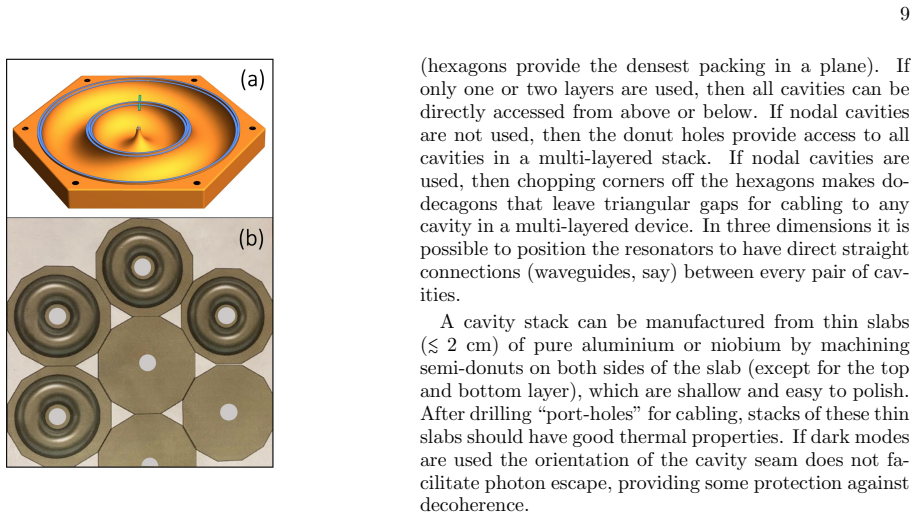
- A few hundred compact toroidal cavities could fit in a standard cryostat, potentially hosting many logical qubits encoded in bosonic states without requiring thousands of physical qubits per logical qubit.
- More manufactured tori with different aspect ratios would populate the universal diagram with experimental points, extending its predictive power to any toroidal resonator geometry.
Reading between the lines
- Beyond the paper, the wall-loss question can be settled directly: compute the surface integral of the tangential magnetic field of TM010, because conductor loss scales with the magnetic field at the wall, and a dark mode with comparable wall $\mathbf{B}$ would not be ultrahigh-Q.
- Beyond the paper, the same spectral-flow method could be applied to other curved geometries such as spheroids or reentrant cavities to search for wall-free modes, since the paper observes that dark modes appear in several curved-boundary cavities even though tori are best suited.
- Beyond the paper, the nested-torus support of TM010 suggests a concrete coupling recipe: a small loop antenna placed on the nested torus, or an azimuthal probe, should excite the mode while preserving its isolation, with coupling strength tuned by probe intrusion.
- Beyond the paper, if shallow semi-doughnut fabrication genuinely simplifies superconducting RF-style surface processing, toroidal cavities could reach ultrahigh Q at lower cost than elliptical SRF cavities, making the quantum-memory application practical rather than merely possible.
Editorial analysis
A structured set of objections, weighed in public.
Referee Report
Summary. The paper presents a numerical and experimental study of microwave eigenmodes in toroidal cavities, building a universal 'spectral flow diagram' that maps dimensionless resonance frequencies against the aspect ratio ε = r/R. The authors classify TE± and TM modes, identify a set of 'dark nodal modes' (TM010) whose electric field appears to vanish on the cavity boundary, and propose that these modes have ultrahigh internal Q values, making the cavities suitable for long-term bosonic quantum memory. The numerical mode chart is validated against one room-temperature VNA spectrum of an aluminium cavity, after applying a −22 MHz shift attributed to a ≈25 μm fabrication error, and against the exact cylindrical limit for ε → 0.
Significance. If the dark-mode high-Q claim were established, the toroidal cavity would be an attractive hardware platform for bosonic quantum memories: it is machinable and polishable, and the spectral flow diagram provides a practical design tool for choosing aspect ratios with well-separated mode frequencies. The paper also gives a useful taxonomy of toroidal modes, including parity-split TE pairs that do not exist in cylinders. However, the central mechanism underpinning the quantum-memory proposal—that vanishing electric field at the boundary implies ultrahigh Q—is not supported by the physics of conductor loss, and the paper lacks the needed magnetic-field analysis or direct Q measurement. The frequency validation is weakened by an ad hoc shift and missing uncertainties. The contributions are therefore conditional: the mode catalogue and spectral design tool are promising, but the paper's headline application is not yet demonstrated.
major comments (4)
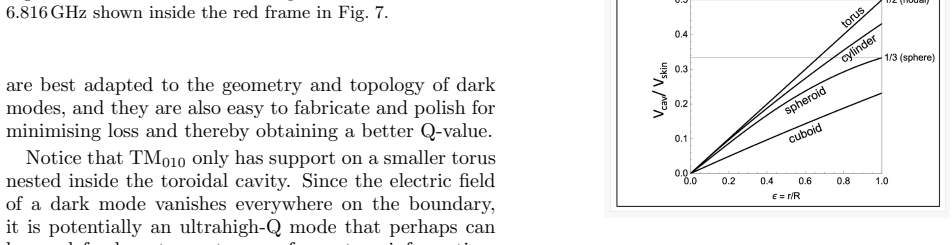
- [Section III and IV] The claim that a dark mode is 'potentially an ultrahigh-Q mode' because its electric field vanishes on the boundary is not justified. In a microwave cavity, conductor loss is governed by the tangential magnetic field at the wall, P_loss = (R_s/2)∮|H_t|² dA, not by the electric field. The paper never plots H on the cavity walls, never computes the surface integral of |H_t|², and never measures Q. Figure 9 is a mode-independent V/(δA) geometric estimate, and the Q values in Figure 10 are presented without describing the loss model or simulation details. Without a quantitative demonstration that |H_t| is small on the boundary of the TM010 dark mode, the quantum-memory proposal in Section V is unsupported. Please add the H-field distribution, a surface-loss integral, and ideally a cryogenic Q measurement, or temper the ultrahigh-Q claims accordingly.
- [Fig. 6 and Section III] The agreement between the simulated and experimental spectra is obtained after shifting the simulated frequencies by −22 MHz, attributed to a δr ≈ 25 μm error in the minor radius. Since this shift is chosen to make the data agree and no uncertainties are reported on either side, the comparison provides only weak validation of the simulation. The paper should state the uncertainties in the measured frequencies and in the machining tolerances, and should show the unshifted comparison or justify the radius correction by an independent measurement of the cavity dimensions.
- [Equations (3)–(4) and Section II.B] The O(ε²) expansion coefficients α_m^P = m² − P/4 and α_m = m² + 3/4 are quoted from a private communication [2] with no derivation or independent verification. Since these coefficients are used to draw the analytical dashed curves in Figure 3 and are presented as part of the 'universal mode functions', the paper needs to supply a self-contained derivation or a transparent numerical extraction that does not rely on an unreviewed private result. The same applies to the statement that no TEM modes exist in toroidal cavities.
- [Section III and Figure 8] For a non-zero eigenmode of the vector Helmholtz equation with perfect-conductor boundary conditions, the electric field cannot vanish identically on the entire boundary; unique continuation would force the field to vanish throughout the cavity. The 'speckled surface texture' in Figure 8 therefore indicates numerically small, but not exactly zero, boundary fields. The paper should quantify the actual residual electric field and, more importantly, the corresponding magnetic field at the boundary, since only the latter determines the conductor loss. This also affects the claim that dark modes are 'minimally coupled' to the environment: coupling to antennas can proceed through both E and H, so a vanishing E at the wall does not by itself ensure decoupling.
minor comments (5)
- [Section IV] There is a typo: 'much larger the the skin depth' should read 'much larger than the skin depth.'
- [Section II.B] The notation for the parity split could be made clearer: the text writes TE±_knm but also refers to 'TEP_k,n,m = P|k,n,m>'; please define the relationship between the superscript ± and the parity eigenvalue P consistently.
- [Figure 3] The caption lists 667 solid plot markers, but the legend and labels are dense and difficult to read at the printed size; consider separating the experimental crosses and the analytical dashed curves into an inset or a companion figure for better legibility.
- [Section V] The lifetime estimate τ ≈ Q × 10^{-10} s uses the formula τ = Q/(2πf) with f in GHz and c in m/s; the derivation is implicit. Please spell out the unit conversion and the assumed mode frequency so that the 'seconds' estimate is reproducible.
- [References] Reference [2] is a private communication; because it carries a nontrivial analytical result used in the main text, the authors should either replace it with a public source or include the derivation in an appendix.
Circularity Check
The dark-mode ultrahigh-Q prediction is definitional; the frequency-mode catalog itself is independently supported.
-
self definitional
[Section I (introduction of dark modes) and Section III (Toroidal cavities, dark-mode Q argument)]
"curved cavities may support “dark modes” (DM), whose electric fields by definition are completely decoupled from the environment in the absence of antennae, and may therefore have exceptionally high internal Q-values... Since the electric field of a dark mode vanishes everywhere on the boundary, it is potentially an ultrahigh-Q mode"
The paper's central quantum-memory claim depends on TM010 having ultrahigh internal Q. The only support offered is that TM010 is a 'dark mode,' which the paper defines as a mode whose electric field is 'completely decoupled from the environment' and, in the same sentence, asserts therefore has exceptionally high internal Q-values. The later statement 'Since the electric field of a dark mode vanishes everywhere on the boundary, it is potentially an ultrahigh-Q mode' then unpacks this definition and presents it as the predicted result. No calculation of the actual wall-loss channel (the tangential magnetic field at the cavity surface) is provided, and no measured Q is reported.
full rationale
The numerical mode-frequency work is largely self-contained: the toroidal spectra are computed with COMSOL, checked against the exact cylindrical limit at epsilon->0, and compared with one independently measured cavity spectrum. The experimental comparison uses a single small physically motivated correction (delta r ~ 25 um, -22 MHz) rather than a free fit of the predicted quantities, and the dark-mode frequency was measured separately with a custom antenna, so the mode catalogue does not reduce to its inputs. However, the paper's most consequential claim—that a dark nodal mode is an ultrahigh-Q cavity for long-term quantum information storage—is not derived from a loss calculation. It follows directly from the way 'dark mode' is defined: a mode whose electric field is decoupled from the environment is immediately said to have exceptionally high internal Q, and this defining property is then cited as the basis for the ultrahigh-Q prediction. Since conductor loss is governed by the tangential magnetic field at the wall, and the paper never evaluates that quantity, the high-Q result is effectively asserted by construction. This is a self-definitional circular step in the central proposal, while the frequency catalogue remains independent; hence a partial circularity score of 6.
Assumptions & free parameters
free parameters (2)
- Minor radius correction delta_r =
about 25 microns (simulated spectrum shift -22 MHz)
- Toroidal expansion coefficients alpha_P^m and alpha_m =
alpha_P^m = m^2 - P/4, alpha_m = m^2 + 3/4 (from private communication [2])
assumptions (4)
- domain assumption COMSOL finite-element solutions of Maxwell's equations in a toroidal PEC cavity give converged eigenfrequencies and field patterns.
- ad hoc to paper The ansatz in Eqs. (3)-(4) is the correct expansion form for toroidal eigenfrequencies to O(epsilon^2).
- ad hoc to paper Private communication [2] is correct on the absence of TEM modes and on the alpha coefficients.
- domain assumption Zero electric field on the cavity wall implies high internal Q.
Cite this review
Pith. "Pith review of Designing toroidal cavities for quantum computation." pith.science (2026). https://pith.science/paper/F3ZIQ5DZ
@misc{pith2026250608880,
  author       = {Pith},
  title        = {Pith review of: Designing toroidal cavities for quantum computation},
  year         = {2026},
  howpublished = {\url{https://pith.science/paper/F3ZIQ5DZ}},
  note         = {Machine review of arXiv:2506.08880}
}
read the original abstract
Toroidal microwave cavities are investigated for potential use in quantum information storage and computation. Since exact analytical results are not available for this geometry, extensive numerical simulation has been used to develop a universal phenomenological model ("spectral flow diagram"). This model is needed to guide the non-trivial design of toroidal resonators. A host of new modes that do not exist in cylindrical cavities are classified, including novel counter-intuitive ground states, and "dark nodal modes" that are decoupled from the environment in the absence of antennae. Numerical results are found to be in good agreement with experimental data. The existence of dark nodal modes in a shallow smooth cavity geometry that offers easy access for high quality surface treatment, suggests that high-Q toroidal cavities may be exploited for long-term storage of quantum information used in quantum processors.
Figures


Figures from the paper (8 more)



Reference graph
Works this paper leans on
- [2]
-
[1]
D. M. Pozar,Microwave Engineering(John Wiley and Sons Inc, 2012) 4th ed., ISBN 978-0-470-63155-3
work page 2012
-
[3]
A. Romanenko, R. Pilipenko, S. Zorzetti, D. Frolov, M. Awida, S. Belomestnykh, S. Posen, and A. Grassellino, Phys. Rev. Appl.13, 034032 (2020)
work page 2020
- [4]
-
[5]
D. Lachance-Quirion, M.-A. Lemonde, J. O. Simoneau, L. St-Jean, P. Lemieux, S. Turcotte, W. Wright, A. Lacroix, J. Frechette-Viens, R. Shillito, F. Hopfmueller, M. Tremblay, N. E. Frattini, J. Camirand-Lemyre, and P. St-Jean, Phys. Rev. Lett.132, 150607 (2024)
work page 2024
-
[6]
M.-A. Lemonde, D. Lachance-Quirion, G. Duclos- Cianciand, N. E. Frattini, F. Hopfmueller, C. Gauvin- Ndiaye, J. Camirand-Lemyre, and P. St-Jean, “Hardware- Efficient Fault Tolerant Quantum Computing with Bosonic Grid States in Superconducting Circuits,” (2024), arXiv:2409.05813v1
arXiv 2024
Reviewed August 7, 2026 · model on record in the stance chip above.
Discussion (0). Sign in to comment.