REVIEW 3 major objections 4 minor 61 references
Closing objectivity loophole in Bell tests on a public quantum computer
T0 review · 3 major / 4 minor · reviewed 2026-08-07 · deepseek-v4-flash
Pith's one-line read Public quantum computers pass a Bell test in which three unanimous observers at each side must confirm the outcome.
desk verdict Honest, careful three-friend Bell test on cloud hardware, but the central passing claim is undercut by unquantified signaling that could explain the violations. read the letter →
The pith
A machine-rendered reading of the paper's core claim, the machinery that carries it, and where it could break.
The reading
What carries the argument
The central object is the extended CHSH expression (4), $B = \langle A_0B_0\rangle - \langle A_1B_0\rangle - \langle A_0B_1\rangle - \langle A_1B_1\rangle$, evaluated with the unanimity rule: each side's observable is $\bar A = |000\rangle\langle 000| - |111\rangle\langle 111|$, so an event counts only if all three friend qubits on a side read the same value. The state is prepared as an entangled pair $|00\rangle - i|11\rangle$ between $A_0$ and $B_0$, the setting is encoded by local rotations $S_\alpha$ and $S_\beta$, and information is copied to the friends by controlled-X gates before measurement, keeping the measurement fixed while varying the local state so that exactly the same information reaches all three observers. This machinery turns the Bell test into an objectivity test: a violation with unanimity means the outcome is collectively confirmed by several independent copies, and the same circuit simultaneously tests no-signaling through the differences in friend-outcome probabilities under the two settings.
What would settle it
Use the measured signaling differences to build an explicit local realistic model in which one party's setting shifts the other party's outcome distribution, optimize that shift to maximize the CHSH combination, and check whether the maximum reaches the observed values such as 2.569 or the reported IBM numbers; if it does, the violation can be reproduced without entanglement.
Extended reading notes
Core claim
The central claim is that the CHSH-Bell inequality, strengthened by an objectivity condition in which three unanimous simulated observers at each party must confirm the outcome, is violated on public superconducting and trapped-ion quantum computers. The violation is achieved by applying a setting-dependent rotation $S_\alpha, S_\beta$ to the shared entangled pair before copying the information to the friends with controlled-X gates, then reading only the unanimous patterns $000$ and $111$ and assigning $0$ to non-unanimous ones. The measured Bell numbers reach values such as $2.569 \pm 0.0024$ on IonQ and exceed the classical bound 2 by more than 10 standard deviations in most tested qubit groups on the newest IBM device, ibm_kingston. The paper interprets this as evidence that entanglement is spread across the tested qubit chains with sufficient quality to pass the objectivity-style test, while acknowledging that communication loopholes remain open and that residual signaling is present and statistically significant.
Load-bearing premise
The measured signaling is not itself generating the Bell violation: no model or bound is given showing that the signaling contribution to the CHSH combination stays below 2, so if the crosstalk is even partially responsible the pass would not demonstrate entanglement or objectivity.
Editorial extensions
If this is right
- If the devices pass the unanimity-required Bell test, entanglement can be generated and measured across a chain of at least seven qubits on a superconducting processor, making the test a practical benchmark of entanglement spread.
- A violation of CHSH under the objectivity condition with no detectable signaling, as on ibm_kingston, would certify nonclassical correlations without the usual postselection-based detection loophole, since all events are recorded.
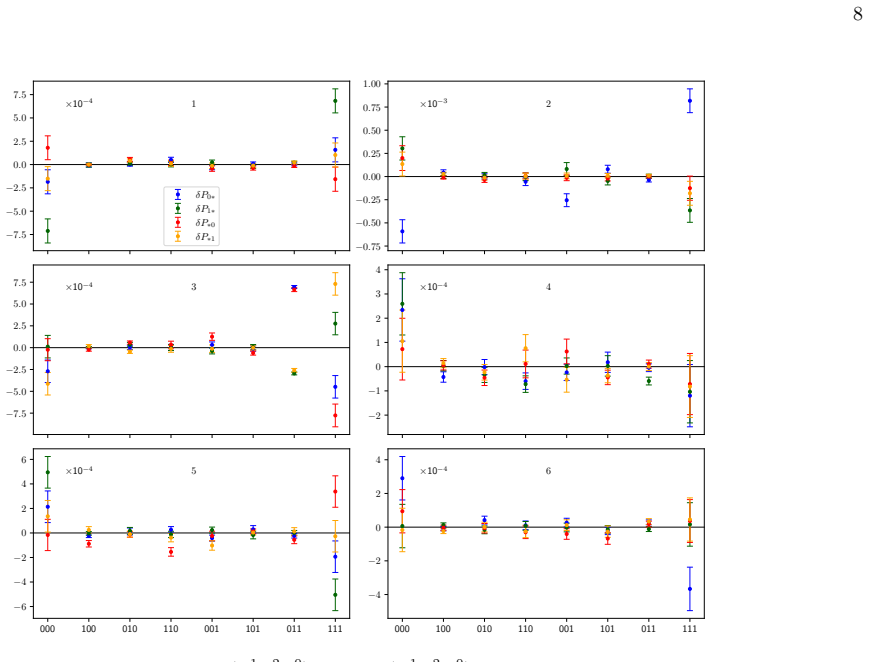
- The statistically significant signaling on ibm_brisbane, ibm_sherbrooke, and IonQ means those particular results cannot be read as demonstrating no-signaling-compatible nonlocality, and the devices need crosstalk countermeasures.
- The test can be extended to more than three friends per party, setting limits on how many observers can confirm the same outcome before the violation degrades.
Reading between the lines
- A non-unanimous outcome is assigned 0 rather than discarded, so this is not postselection in the usual sense; but the trit encoding still lets a classical signaling model concentrate its outputs on the unanimous patterns, so the strength of the no-signaling check is what separates a genuine Bell violation from a communication artifact.
- The objectivity framing makes the Bell test a device benchmark: the same data that certify entanglement also expose crosstalk, so the protocol could serve as a standard diagnostic for how publicly accessible quantum processors handle multi-qubit information broadcasting.
- A natural extension is to test with four or more friends per party and longer qubit chains; one would predict a monotone decrease of the Bell number with chain length, and the crossover point would map the device's useful entanglement range.
Editorial analysis
A structured set of objections, weighed in public.
Referee Report
Summary. The paper reports an extended Bell-type test on IBM Quantum (ibm_brisbane, ibm_sherbrooke, ibm_torino, ibm_kingston) and IonQ Forte, in which each of the two parties is represented by three 'friend' qubits and an outcome is counted only when all three friends agree (unanimity condition). The ideal-state derivation in Section II shows that the CHSH combination (4) should reach 2√2 under the unanimity rule. The measurements give CHSH values above 2 with reported statistical errors of order 3e-4 in several qubit groups, and all six groups on ibm_kingston violate the inequality; the IonQ run gives B = 2.569 ± 0.0024. The same data show statistically significant no-signaling violations in many groups and on IonQ. The authors conclude that public quantum devices are sufficiently accurate to pass an objectivity-extended Bell-type test, while acknowledging communication loopholes and residual signaling.
Significance. If the central claim were fully established, this would be a useful benchmark: it would show that entanglement can survive a three-observer unanimity cut across a seven-qubit chain on current cloud quantum hardware, and the public scripts and data [52] are a reproducible resource. The ideal-state calculation in Section II is simple and parameter-free, and no free parameters are fitted to the data. However, the paper's interpretation of the Bell violations in signaling-affected groups is not yet justified: without a bound on how much the detected signaling can contribute to the CHSH functional, a classical model with signaling can reproduce B > 2. Only the signaling-free ibm_kingston groups currently escape this concern. For those groups the result is a genuine, if modest, demonstration; for the remaining groups the 'pass' claim is conditional on an untested assumption.
major comments (3)
- [Section IV, Tables IV and V, Figs. 8-12] The paper never quantifies the maximum contribution that the detected signaling could inject into the CHSH combination (4). The statement that signaling is 'much smaller than Bell violation' compares marginal-probability differences to the Bell value, but the relevant object is the largest CHSH excess achievable by any classical model whose signaling is constrained by the observed marginal distributions; this is the kind of bound provided by Hall (refs. [39,40]), which is cited but never applied here. For example, sherbrooke group 3 has B = 2.176 ± 0.0026 (Table IV) while Fig. 9 shows δP values up to about 3e-2. Without an explicit bound showing that the signaling-induced contribution to (4) is below 2, the observed B > 2 in that group does not demonstrate entanglement. The pass claim in the abstract should therefore either be restricted to groups with no detected signaling (at minimum ibm_kingston) or supplemented by a Hall-type bound for every group with significant signaling, including the IonQ result in Section V.
- [Section IV, Table IV] The text states that the inequality was violated by more than 10 standard deviations in 2 groups on ibm_brisbane, but Table IV lists three groups above 2 + 10ΔB: group 1 (2.259 ± 2.75e-4), group 4 (2.034 ± 2.67e-4), and group 6 (2.194 ± 2.79e-4). This discrepancy affects the quantitative summary of the main result and should be corrected or explained.
- [Section II, Eq. (17) and Eq. (21)] The statistical treatment of the signaling estimators is incompletely specified. Eq. (21) gives the single-shot Bernoulli variance P(1−P), but the quantities δPa∗(A) and δP∗b(B) defined in Eq. (17) are differences of two sample proportions, so their standard errors involve sums of P(1−P)/N terms, possibly with different N for the two settings. The text says results are 'scaled by the number of repetitions,' but the formula as written does not display this scaling or the difference structure. Please give the explicit estimator and standard error, and state whether any multiple-comparison correction was used in flagging violations 'beyond 5 standard deviations' in Tables IV and V.
minor comments (4)
- [Section III, first paragraph] The sentence 'For single qubit rotation we can essentially use (7) which is realize natively' contains a grammar error and should read 'is realized natively'; similar typos appear elsewhere (e.g., 'we tak' in Section III).
- [Section II, Eq. (4)] The displayed inequality appears as '... − ⟨A1B1⟩11 ≤ 2'; the stray '11' should be removed.
- [Tables IV and V captions] The symbols A→B, A←B, and A↔B are used but not defined in the captions; please specify which marginal difference and which direction each symbol denotes.
- [References] References [39] and [40] appear to be the same paper; one duplicate should be removed. Also, the Zenodo reference [52] should include the direct dataset identifier if possible.
Circularity Check
No circularity: the Bell and no-signaling statistics are direct measurements with no fitted parameters, and the cited self-work is contextual rather than load-bearing.
full rationale
The paper's central claim is an experimental result: raw count statistics from fixed circuits are converted via Born-rule probabilities (Eq. 15) into the CHSH combination (Eq. 4), and the measured Bell values in Tables IV and V are compared with the classical bound 2. No parameter is fitted to the data and no 'prediction' is generated from a fitted input, so the derivation is self-contained. The objectivity criterion is an operational definition (unanimity among three friends, Eq. 11), not a conclusion imported from prior work; the identity of the multi-observer correlation with the standard CHSH expression follows from the explicit state (Eq. 10) and the stated projection rule. Self-citations to the authors' earlier objectivity framework (refs. [26,27,59,60,61]) and to a prior no-signaling study (ref. [43]) provide background and motivation, but the pass/fail verdict does not depend on the correctness or uniqueness of those works. The acknowledged residual signaling is a validity limitation — the paper states 'we are unable to point out a direct cause' — and the skeptic's concern that signaling might contaminate the CHSH functional is a loophole/correctness issue, not a circular reduction, because the signaling magnitudes are also direct measurements. The derivation chain from circuit to Bell value is therefore not equivalent to its inputs.
Assumptions & free parameters
assumptions (4)
- standard math The Born rule for projective measurements and the CHSH inequality are used to derive the ideal probabilities (Eq. 15) and the classical bound 2.
- domain assumption Computational-basis readout of the cloud quantum processors realizes the projective measurements in Eq. (15) without state-dependent detector bias.
- domain assumption Unanimity among the three friend qubits is a faithful operational implementation of the objectivity condition (mapping (11)).
- domain assumption Runs are independent Bernoulli trials, so the error formulas (20) and (21) apply.
Cite this review
Pith. "Pith review of Closing objectivity loophole in Bell tests on a public quantum computer." pith.science (2026). https://pith.science/paper/2BAMKIYE
@misc{pith2026250608940,
  author       = {Pith},
  title        = {Pith review of: Closing objectivity loophole in Bell tests on a public quantum computer},
  year         = {2026},
  howpublished = {\url{https://pith.science/paper/2BAMKIYE}},
  note         = {Machine review of arXiv:2506.08940}
}
read the original abstract
We have constructed and run a Bell test of local realism focusing on the objectivity criterion. The objectivity means that the outcomes are confirmed macroscopically by a few observers at each party. The IBM Quantum and IonQ devices turn out to be sufficiently accurate to pass such an extended Bell-type test, although at the price of communication loopholes and residual but statistically significant signaling. The test also serves as the benchmark of entanglement spread across larger sets of qubits.
Figures


Figures from the paper (13 more)




Reference graph
Works this paper leans on
-
[52]
European Organization For Nuclear Research and Open AIRE, Zenodo, CERN, 2021, https://doi.org/10.5281/zenodo.15633320
-
[1]
A. Einstein, B. Podolsky, N. Rosen, Can Quantum- Mechanical Description of Physical Reality Be Consid- ered Complete?, Phys. Rev.47, 777 (1935)
work page 1935
-
[2]
Bell, On the Einstein Podolsky Rosen paradox, Physics (Long Island City, N.Y.)1, 195 (1964); A
J.S. Bell, On the Einstein Podolsky Rosen paradox, Physics (Long Island City, N.Y.)1, 195 (1964); A. Shi- mony, Bell’s Theorem, plato.stanford.edu/entries/bell- theorem/
work page 1964
-
[3]
J.F. Clauser, M.A. Horne, A. Shimony and R.A. Holt, Proposed Experiment to Test Local Hidden-Variable Theories Phys. Rev. Lett.23, 880(1969)
work page 1969
- [4]
- [5]
- [6]
-
[7]
Scheidlet al., Violation of local realism with free- dom of choice, Proc
T. Scheidlet al., Violation of local realism with free- dom of choice, Proc. Natl. Acad. Sci. U.S.A.107, 19708 (2010)
work page 2010
Show all 61 references
-
[8]
Garg and N
A. Garg and N. D. Mermin, Detector inefficiencies in the Einstein-Podolsky-Rosen experiment, Phys. Rev. D 35, 3831 (1987)
1987
-
[9]
Pearle, Hidden-Variable Example Based upon Data Rejection, Phys
P.M. Pearle, Hidden-Variable Example Based upon Data Rejection, Phys. Rev. D2, 1418 (1970)
1970
-
[10]
Santos, Critical analysis of the empirical tests of local hidden-variable theories, Phys
E. Santos, Critical analysis of the empirical tests of local hidden-variable theories, Phys. Rev. A46, 3646 (1992)
1992
-
[11]
Larsson, Loopholes in Bell inequality tests of local realism, J Phys
J.-A. Larsson, Loopholes in Bell inequality tests of local realism, J Phys. A47, 424003 (2014)
2014
-
[12]
Hofmannet al., Heralded entanglement between widely separated atoms, Science337, 72 (2012)
J. Hofmannet al., Heralded entanglement between widely separated atoms, Science337, 72 (2012)
2012
-
[13]
Roweet al., Experimental violation of a Bell’s in- equality with efficient detection, Nature409, 791 (2001)
M.A. Roweet al., Experimental violation of a Bell’s in- equality with efficient detection, Nature409, 791 (2001)
2001
-
[14]
Matsukevich, P
D.N. Matsukevich, P. Maunz, D.L. Moehring, S. Olm- schenk, C. Monroe, Bell Inequality Violation with Two Remote Atomic Qubits, Phys. Rev. Lett.100, 150404 (2008)
2008
-
[15]
Ansmannet al., Violation of Bell’s inequality in Josephson phase qubits, Nature461, 504 (2009)
A. Ansmannet al., Violation of Bell’s inequality in Josephson phase qubits, Nature461, 504 (2009)
2009
-
[16]
Hensen,et al., Loophole-free Bell inequality violation using electron spins separated by 1.3 kilometres, Nature 526, 682 (2015)
B. Hensen,et al., Loophole-free Bell inequality violation using electron spins separated by 1.3 kilometres, Nature 526, 682 (2015)
2015
-
[17]
Shalmet al., Strong Loophole-Free Test of Local 12 Realism, Phys
L.K. Shalmet al., Strong Loophole-Free Test of Local 12 Realism, Phys. Rev. Lett.115, 250402 (2015)
2015
-
[18]
Giustinaet al., Significant-Loophole-Free Test of Bell’sTheoremwithEntangledPhotons, Phys.Rev.Lett
M. Giustinaet al., Significant-Loophole-Free Test of Bell’sTheoremwithEntangledPhotons, Phys.Rev.Lett. 115, 250401 (2015)
2015
-
[19]
Rosenfeldet al., Event-Ready Bell Test Using Entan- gled Atoms Simultaneously Closing Detection and Local- ity Loopholes, Phys
W. Rosenfeldet al., Event-Ready Bell Test Using Entan- gled Atoms Simultaneously Closing Detection and Local- ity Loopholes, Phys. Rev. Lett.119, 010402 (2017)
2017
-
[20]
Storzet al., Loophole-free Bell inequality violation with superconducting circuits, Nature617, 265 (2023)
S. Storzet al., Loophole-free Bell inequality violation with superconducting circuits, Nature617, 265 (2023)
2023
-
[21]
R.F.StreaterandA.S.Wightman, PCT,spinandstatis- tics, and all that (Benjamin, New York, 1964)
1964
-
[22]
Wigner, Remarks on the mind-body question, The Scientist Speculates (ed
E.P. Wigner, Remarks on the mind-body question, The Scientist Speculates (ed. I.J. Good) 284�302 (Heine- mann, 1961)
1961
-
[23]
D.Ding, C.Wang, Y.He, T.Hou, T.Gao, F.Yan, Ascal- able tripartite Wigner’s friend scenario arXiv:2109.02298 Phys. Scr. 98 (2023) 075104
2023 arXiv
-
[24]
K. Bong, A. Utreras-Alarcon, F. Ghafari, Y. Liang, N. Tischler, E. G. Cavalcanti, G. J. Pryde, H. M. Wiseman, A strong no-go theorem on the Wigner’s friend paradox, Nature Physics volume 16, pages 1199ďż˝1205 (2020), arXiv:1907.05607
2020 arXiv
-
[25]
Brukner, Generalized probability rules from a timeless formulation of Wigner’s friend scenarios, Quantum 5, 524 (2021) arXiv:1911.09696
V.Baumann, F.DelSanto, A.R.H.Smith, F.Giacomini, E.Castro-Ruiz, C. Brukner, Generalized probability rules from a timeless formulation of Wigner’s friend scenarios, Quantum 5, 524 (2021) arXiv:1911.09696
2021 arXiv
-
[26]
Korbicz, P
J.K. Korbicz, P. Horodecki, R. Horodecki, Objectivity in a Noisy Photonic Environment through Quantum State Information Broadcasting, Phys. Rev. Lett. 112, 120402 (2014)
2014
-
[27]
Horodecki, J
R. Horodecki, J. K. Korbicz, and P. Horodecki, Quantum origins of objectivity, Phys. Rev. A 91, 032122 (2015)
2015
-
[28]
W. J. Zeng, F. Labib, V. Russo, Towards violations of Local Friendliness with quantum computers, arXiv:2409.15302
-
[29]
Eidmann, M
L. Eidmann, M. Alteg, Experimental Test of Local Observer-Independence Using IBM’s Quantum Com- puter, https://urn.kb.se/resolve?urn=urn:nbn:se:kth:diva- 275738 (2020) [similar test with single friends on IBM – lower statistics, missing raw data]
2020
-
[30]
Proietti, A
M. Proietti, A. Pickston, F. Graffitti, P. Barrow, D. Kundys, C. Branciard, M. Ringbauer, A. Fedrizzi, Experimental test of local observer-independence, arXiv:1902.05080 Sci. Adv.5, eaaw9832 (2019) [similar test with single friends on photons – postselection]
2019 arXiv
-
[31]
IBM Quantum Platform, quantum.ibm.com
-
[32]
https://qiskit.org/textbook
-
[33]
Alsina, I
D. Alsina, I. Latorre, Experimental test of Mermin in- equalities on a five-qubit quantum computer, Phys. Rev. A94, 012314 (2016)
2016
-
[34]
Garcia-Martin and G
D. Garcia-Martin and G. Sierra, Five Experimental Tests on the 5-Qubit IBM Quantum Computer, J. Appl. Math. and Phys.6, 1460 (2018)
2018
-
[35]
IBM Quantum Learning, Tutorial: CHSH Inequality, learning.quantum.ibm.com/tutorial/chsh-inequality
-
[36]
Brody, R
J. Brody, R. Avram, Testing a Bell Inequality with a Re- mote Quantum Processor, Phys. Teach.61, 218 (2023)
2023
-
[37]
Maria Violaris, A Physics Lab Inside Your Head: Quan- tum Thought Experiments as an Educational Tool, arXiv:2312.078402023IEEEInternationalConferenceon Quantum Computing and Engineering (QCE), 2023, pp. 58
2023 arXiv
-
[38]
D. A. Chisholm, G. Garcia-Perez, M. A. C. Rossi, S. Maniscalco, G. M. Palma, Witnessing Objectivity on a Quantum Computer, Quantum Sci. Technol. 7 015022 (2022) arXiv:2110.06243
2022 arXiv
-
[39]
Michael J. W. Hall, Complementary contributions of indeterminism and signalling to quantum correlations, Phys. Rev. A 82, 062117 (2010)
2010
-
[40]
M. J.W. Hall, Complementary contributions of indeter- minism and signalling to quantum correlations, Phys. Rev. A 82, 062117 (2010) arXiv:1006.3680
2010 arXiv
-
[41]
Svetlichny, Phys
G. Svetlichny, Phys. Rev. D 35, 3066 (1987)
1987
-
[42]
N. D. Mermin, Phys . Rev. Lett. 65, 1838 (1990)
1990
-
[43]
Rybotycki, T
T. Rybotycki, T. Białecki ,Josep Batle, Adam Bednorz, Violation of no-signaling on a public quantum computer, Adv. Quantum Technol. 2400661 (2025)
2025
-
[44]
Ketterer, T
A. Ketterer, T. Wellens, Characterizing crosstalk of su- perconducting transmon processors, Phys. Rev. Applied 20, 034065 (2023)
2023
-
[45]
IonQ documentation, docs.ionq.com
-
[46]
Figgatt, Building and Programming a Univer- sal Ion Trap Quantum Computer, PhD thesis, 2018, duke.app.box.com/s/l5xqv2njo06avkow2rl0jqz5165946ah
C. Figgatt, Building and Programming a Univer- sal Ion Trap Quantum Computer, PhD thesis, 2018, duke.app.box.com/s/l5xqv2njo06avkow2rl0jqz5165946ah
2018
-
[47]
Wright, Manipulation of the Quantum Motion of Trapped Atomic Ions via Stimu- lated Raman Transitions, PhD Thesis 2017, duke.app.box.com/s/qy7yalogjlwkc84lzy1urr4q556opwhh
K. Wright, Manipulation of the Quantum Motion of Trapped Atomic Ions via Stimu- lated Raman Transitions, PhD Thesis 2017, duke.app.box.com/s/qy7yalogjlwkc84lzy1urr4q556opwhh
2017
-
[48]
Egan, Scaling Quantum Computers with Long Chains of Trapped Ions, PhD thesis 2021, duke.app.box.com/s/1t8vdf34v60rgso101d8fpjmptl752ch
L. Egan, Scaling Quantum Computers with Long Chains of Trapped Ions, PhD thesis 2021, duke.app.box.com/s/1t8vdf34v60rgso101d8fpjmptl752ch
2021
-
[49]
S.Debnath, A Programmable Five Qubit Quantum Computer using Trapped Atomic Ions, PhD thesis 2016, duke.app.box.com/s/b7hr7z069q4bddgo8ep3w2f1avphy368
2016
-
[50]
Landsman, Construction, Optimiza- tion, and Applications of a Small Trapped- Ion Quantum Computer, PhD thesis 2019, duke.box.com/s/qigghzotrws9fiqgmo6i7e6gvjvrek9p
K. Landsman, Construction, Optimiza- tion, and Applications of a Small Trapped- Ion Quantum Computer, PhD thesis 2019, duke.box.com/s/qigghzotrws9fiqgmo6i7e6gvjvrek9p
2019
-
[51]
G. N. Nop, D. Paudyal, and J. D. H. Smith, Ytterbium ion trap quantum computing: The current state-of-the- art, AVS Quantum Sci. 3, 044101 (2021)
2021
-
[53]
J. Koch, T. M. Yu, J. Gambetta, A. A. Houck, D. I. Schuster, J. Majer, A. Blais, M. H. Devoret, S. M. Girvin, R. J. Schoelkopf, Charge-insensitive qubit design derived from the Cooper pair box, Phys. Rev. A76, 042319 (2007)
2007
-
[54]
J. M. Gambetta, J. M. Chow, and M. Steffen,Building logical qubits in a superconducting quantum computing systemnpj Quantum Inf.3, 2 (2017)
2017
-
[55]
Krantz, M
P. Krantz, M. Kjaergaard, F. Yan, T.P. Orlando, S. Gus- tavsson. and W.D. Oliver, A quantum engineer’s guide to superconducting qubits, Appl. Phys. Rev. 6, 021318 (2019)
2019
-
[56]
Alexander, N
T. Alexander, N. Kanazawa, D. J. Egger, L. Capel- luto, C. J. Wood, A. Javadi-Abhari, and D. C. McKay, Qiskit pulse: programming quantum computers through the cloud with pulses, Quantum Sci. Technol. 5, 044006 (2020)
2020
-
[57]
Malekakhlagh, E
M. Malekakhlagh, E. Magesan, and D. C. McKay. First- principles analysis of cross-resonance gate operation, Phys. Rev. A102, 042605 (2020)
2020
-
[58]
Magesan and J
E. Magesan and J. M. Gambetta, Effective Hamiltonian models of the cross-resonance gate, Phys. Rev. A101, 052308 (2020). 13
2020
-
[59]
Zurek, Decoherence and Quantum Darwinism (Cambridge University Press, Cambridge, 2025)
W.H. Zurek, Decoherence and Quantum Darwinism (Cambridge University Press, Cambridge, 2025)
2025
-
[60]
Korbicz, Roads to objectivity: Quantum Darwin- ism, Spectrum Broadcast Structures, and Strong quan- tum Darwinism - a review, Quantum 5, 571 (2021)
J.K. Korbicz, Roads to objectivity: Quantum Darwin- ism, Spectrum Broadcast Structures, and Strong quan- tum Darwinism - a review, Quantum 5, 571 (2021)
2021
-
[61]
J. K. Korbicz, E. A. Aguilar, P. Ćwikliński, and P. Horodecki, Phys. Rev. A 96, 032124 (2017)
2017
Reviewed August 7, 2026 · model on record in the stance chip above.
Discussion (0). Sign in to comment.