REVIEW 3 major objections 4 minor 50 references
Equivalence of Optical Theorems
T0 review · 3 major / 4 minor · reviewed 2026-08-07 · deepseek-v4-flash
Pith's one-line read The optical theorem is a family: any detector that radiates the complex-conjugated probing field measures the same extinction power.
desk verdict The exact vector OT-detector equivalence is sound and new; the approximate and limited-view claims need quantitative support before the paper is fully reliable. read the letter →
The pith
A machine-rendered reading of the paper's core claim, the machinery that carries it, and where it could break.
The reading
What carries the argument
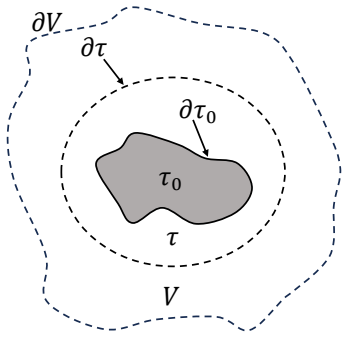
The load-bearing object is the identity $P_e = \frac{1}{2}\Re(w)$ with $w=\int_{\bar V} d\mathbf r\,[\mathbf J^{(OT)}\cdot \mathbf E_s - \mathbf M^{(OT)}\cdot \mathbf H_s]$, in which the optical-theorem (OT) detectors $(\mathbf J^{(OT)},\mathbf M^{(OT)})$ are any sources that radiate the complex-conjugated probing fields $(\mathbf E_i^*, -\mathbf H_i^*)$ into the region of interest. All explicit detector realizations in the paper—surface currents from Love's equivalence, backpropagation from a single plane, a two-plane pair, and minimum-energy multipole sources—are instances of this c.c.-field condition. The identity converts a global power budget into a local projective measurement and, because the inverse source problem for fields inside the ROI has many solutions, it makes the detector nonunique.
What would settle it
Place a small resonant dielectric sphere half a wavelength from a dipole source, and compute $P_e$ three ways: the exact surface integral (12), the two-plane detector (28)-(29), and the multipole expression (48); if the three disagree beyond numerical integration error, the claimed equivalence fails. For the approximate forms, repeat with the source moved closer: the single-plane result (22) should deviate from the exact surface result once evanescent content in the ROI is non-negligible, and the distance at which deviation appears tests the paper's qualitative 'few wavelengths' criterion.
Extended reading notes
Core claim
The paper's central claim is that the electromagnetic optical theorem is not tied to plane-wave illumination or forward-scattering amplitudes: for any probing field generated outside the scattering region, the extinction power $P_e$ equals $\frac{1}{2}\Re$ of the projection of the scattered field onto any detector that, when radiating, synthesizes the complex-conjugated probing field in the target region. The authors prove this by reciprocity, deriving an exact surface-detector form valid for arbitrary near-field probing sources, a two-plane planar form that also reproduces evanescent components, and multipole-domain forms for spherical and cylindrical scanning; for sources far enough away that evanescent content is absent in the region of interest, single-plane and backpropagation forms approximate the same quantity. They further show that all these forms share a common inner-product structure and imply inequalities relating extinction to scattered power for lossless and passive scatterers.
Load-bearing premise
The approximate single-surface and single-plane detectors assume the probing source is far enough from the target that the incident field in the target region contains no significant evanescent content, so one sensing surface can regenerate the complex-conjugated probing field; the paper offers no error bound tying source distance to measurement accuracy.
Editorial extensions
If this is right
- A closed sensing surface around the target yields the exact extinction power even when the probing source is in the near field, so far-field forward-amplitude measurements are not required.
- Planar aperture detectors give exact extinction measurements when two sensing planes are used, and approximate measurements when a single plane suffices because the source is far enough away that evanescent content in the target region is negligible.
- In spherical and cylindrical scanning geometries, extinction power is recovered directly from the multipole moments of the incident and scattered fields, with no surface integral over a physical detector.
- For lossless scatterers the derived identity reduces to $-\Re\langle\psi_i|\psi_s\rangle = \|\psi_s\|^2$; for passive scatterers the left side is at least the right side, which in limited-view sensing bounds the detectable extinction from below.
- All derived OT detectors share one structure: extinction power is the real part of an inner product of the scattered field with a reference vector fixed by the probing field, so the same formalism adapts to different geometries.
Reading between the lines
- The authors do not derive time-domain or inhomogeneous-background analogues, but the mechanism they identify—nonuniqueness of sources radiating a prescribed field in a region—is representation-independent; deriving c.c.-field detectors for layered or time-varying backgrounds would be a direct test of the idea's scope.
- The detector freedom could be used for noise engineering: among all equivalent OT detectors one could minimize the variance of the estimated $P_e$ under sensor noise, with the minimum-energy source (49) as a natural starting point; this optimization is not carried out in the paper.
- The limited-view bound of Eq. (77) implies that an OT-based measurement can estimate total extinction even from a small aperture, which could be tested in a single-pixel or digital-holography experiment by comparing the OT estimate against a full-view reference measurement.
Editorial analysis
A structured set of objections, weighed in public.
Referee Report
Summary. The paper presents a vector electromagnetic generalization of the optical theorem framed in terms of projective measurements of scattered fields onto 'OT detectors' that, when radiating, generate the complex conjugate of the probing field in the region of interest. The central relation P_e = (1/2) Re(w), with w defined by Eq. (8), is used to derive exact detector forms: a closed-surface detector (Eq. (12)), a two-plane planar detector (Eqs. (28)-(29)), and spherical/cylindrical multipole detectors (Eqs. (47)-(48), (60)-(63)). It also gives approximate single-surface and single-plane forms (Eqs. (14)-(15), (21)-(27)) and limited-view corollaries (Eqs. (75)-(77)). The paper argues that the nonuniqueness of these detectors follows from the nonuniqueness of the inverse source problem.
Significance. If the central equivalence is correct, the paper provides a useful, parameter-free unification of optical theorem formulations for vector electromagnetic fields, including exact near-field measurement schemes that do not require far-field assumptions. The core derivation is coherent, and the exact surface, two-plane, and multipole results are nontrivial and worth publishing. The main weakness is that the paper's approximate and limited-view claims, which are advertised as practically important, lack quantitative validity conditions.
major comments (3)
- [Sections 3.2-3.3, Eqs. (14)-(15), (21)-(23)] The approximate OT detectors are introduced with only qualitative conditions ('typically a few wavelengths away', Section 3.3). The paper does not provide an error bound relating source-to-ROI distance, ROI size, evanescent decay, aperture extent/truncation, and the error in the measured P_e. Since these approximate forms are part of the paper's claimed equivalence and are used for practical sensing, the authors should state precise validity conditions or explicitly mark these forms as heuristic with a quantitative error estimate.
- [Section 3.6, Eq. (75)] Eq. (75) asserts that the limited-view projection approximates the full projection, -Re<ψ̃_i|ψ̃_s> ≈ -Re<ψ_i|ψ_s>, but this is not derived and is not generally true for arbitrary limited apertures; a limited aperture generally cannot synthesize the full complex-conjugate probing field in the ROI. This unproved equality underlies the bound in Eq. (77) and the limited-view detection applications. The authors need to derive the conditions under which Eq. (75) holds or remove/recast the corollary.
- [Section 3.3, Eqs. (24)-(27)] The pure-electric and pure-magnetic planar detectors obtained by image theory are described as 'equally valid' without stating their validity domain. In particular, the statement that the scattered field can contain arbitrary evanescent components at the sensing plane does not by itself justify these forms when the complex-conjugate probing field is only approximately synthesized; the same far-source limitation as in Eqs. (14)-(15) must be quantified for each image-theory variant.
minor comments (4)
- [Conclusion] The word 'expresssions' in the concluding paragraph should be corrected to 'expressions'.
- [Section 3.5, Eq. (54)] The notation for the addition theorem is typeset incorrectly as 'ρ < = min(ρ, ρ′)' and 'ρ > = max(ρ, ρ′)'; it should read ρ_< = min(ρ, ρ′) and ρ_> = max(ρ, ρ′).
- [Section 3.4, Eq. (32)] The spherical Hankel function in Eq. (32) is split by a line break as 'h(+ l(kr)'; it should be typeset as h_l^{(+)}(kr) for consistency with Eq. (30).
- [Section 3.2, Eq. (16)] The free-space impedance η is used in Eq. (16) before being defined; please define η = sqrt(μ/ε) at first use, either in Section 2 or near this equation.
Circularity Check
No significant circularity: the central Poynting-reciprocity derivation is self-contained, and self-citations are contextual rather than load-bearing.
full rationale
The core result, Eqs. (4)-(8), is derived directly from Poynting's theorem and reciprocity: the extinction power is defined by the interaction of the induced scatterer sources with the incident field, and the general measurement is shown to equal that interaction when the detector radiates the c.c. probing field. This is a reciprocity identity, not a fitted or definitionally self-referential relation. Each subsequent realization (surface, backpropagation, planar, multipole) independently reproduces the same projection via equivalence principles or modal expansions, and no parameter is calibrated to data and no predicted quantity is used to define itself. The cited inverse-source results [41], [43], [45], [46] support the nonuniqueness interpretation and minimum-energy synthesis, but the extinction-power equality survives even if those citations are removed, so they are not load-bearing circularity. The approximate limited-view statements such as Eq. (75) and the far-source approximations in Sections 3.2 and 3.3 are asserted without quantitative error bounds, and this is a correctness or scope limitation rather than a circular reduction. The score is therefore low, reflecting only minor self-citation that does not drive the central claim.
Assumptions & free parameters
assumptions (6)
- domain assumption Lorentz reciprocity for time-harmonic fields in the lossless homogeneous background medium (convolution-type reciprocity leading to Eq. (6))
- domain assumption The background medium is homogeneous and lossless (Eq. (1) and Section 2)
- standard math Surface equivalence principle and Love's equivalence principle (Balanis, cited ref [42])
- domain assumption Nonuniqueness of the inverse source problem (nonradiating currents can be added without changing exterior fields)
- standard math Completeness and orthogonality of vector spherical harmonics, and Wronskian identities for spherical Bessel/Hankel functions (e.g., Eq. (38), ref [43])
- domain assumption Backpropagation: a radiated field with negligible evanescent content can be regenerated approximately from an enclosing surface via c.c. surface sources
Cite this review
Pith. "Pith review of Equivalence of Optical Theorems." pith.science (2026). https://pith.science/paper/XXTCA4KA
@misc{pith2026250608943,
  author       = {Pith},
  title        = {Pith review of: Equivalence of Optical Theorems},
  year         = {2026},
  howpublished = {\url{https://pith.science/paper/XXTCA4KA}},
  note         = {Machine review of arXiv:2506.08943}
}
read the original abstract
We demonstrate, in the full vector formulation of electromagnetic fields, that the well-known optical theorem pertinent for the characterization of a scatterer's extinction power and associated cross section can be expressed in a multitude of alternative equivalent forms. These alternatives involve different forms of projective field measurements or detectors. The inherent nonuniqueness of such optical-theorem-based detectors stems from the nonuniqueness of an associated inverse source problem, and can be interpreted via well-known equivalence principles. Some of the multiple ways in which the extinction of power due to the interaction of a scattering body with a probing field can be measured remotely are derived and interpreted for a number of canonical frameworks. This includes detectors and their corresponding optical theorems synthesized in the contexts of surface-confined sensors for near-field sensing, surface sensors based on backpropagation-based imaging, a number of planar aperture realizations dealt with through classical diffraction theory, as well as detectors based on multipole representations. General aspects of the derived optical theorems are discussed in the context of envisioned practical applications.
Figures


Figures from the paper (3 more)


Reference graph
Works this paper leans on
-
[1]
Max Born and Emil Wolf.Principles of Optics: Electromagnetic Theory of Propagation, Interference and Diffraction of Light. Elsevier, 2013
work page 2013
-
[2]
Springer Science & Business Media, 2013
Roger G Newton.Scattering Theory of Waves and Particles. Springer Science & Business Media, 2013
work page 2013
-
[3]
G´ erard Gouesbet and Philip L Marston. Failures of the classical optical theorem under arbitrary- shaped beam incidence in electromagnetism, acoustics, and quantum mechanics: motivation and a review.Frontiers in Physics, 11:1271555, 2023
work page 2023
-
[4]
G Gouesbet. On the optical theorem and non-plane-wave scattering in quantum mechanics.Journal of mathematical physics, 50(11), 2009
work page 2009
-
[5]
James A Lock, Joseph T Hodges, and G´ erard Gouesbet. Failure of the optical theorem for gaussian- beam scattering by a spherical particle.Journal of the Optical Society of America A, 12(12):2708–2715, 1995
work page 1995
-
[6]
Alexey V Krasavin, Paulina Segovia, Rostyslav Dubrovka, Nicolas Olivier, Gregory A Wurtz, Pavel Ginzburg, and Anatoly V Zayats. Generalization of the optical theorem: experimental proof for radially polarized beams.Light: Science & Applications, 7(1):36, 2018
work page 2018
-
[7]
P Scott Carney, Emil Wolf, and Girish S Agarwal. Statistical generalizations of the optical cross- section theorem with application to inverse scattering.Journal of the Optical Society of America A, 14(12):3366–3371, 1997
work page 1997
-
[8]
Generalized optical theorem for propagation invariant beams.Optik, 137:17–24, 2017
Irving Rond´ on-Ojeda and Francisco Soto-Egu ´ ıbar. Generalized optical theorem for propagation invariant beams.Optik, 137:17–24, 2017
work page 2017
Show all 50 references
-
[9]
FG Mitri. Generalization of the optical theorem for monochromatic electromagnetic beams of arbitrary wavefront in cylindrical coordinates.Journal of Quantitative Spectroscopy and Radiative Transfer, 166:81–92, 2015
2015
-
[10]
Acoustic scattering and “failure” of the optical theorem.The Journal of the Acoustical Society of America, 156(5):3496–3501, 2024
PA Martin. Acoustic scattering and “failure” of the optical theorem.The Journal of the Acoustical Society of America, 156(5):3496–3501, 2024
2024
-
[11]
An analytical approximation to measure the extinction cross-section using: Localized waves.Journal of Physics Communications, 6(1):015003, 2022
Irving Rond´ on. An analytical approximation to measure the extinction cross-section using: Localized waves.Journal of Physics Communications, 6(1):015003, 2022. 16
2022
-
[12]
Generalized optical theorem to a multipole source excitation in the scattering theory.Russian journal of mathematical physics, 24:207–215, 2017
Yu A Eremin and AG Sveshnikov. Generalized optical theorem to a multipole source excitation in the scattering theory.Russian journal of mathematical physics, 24:207–215, 2017
2017
-
[13]
Optical theorem for acoustic non-diffracting beams and application to radiation force and torque.Biomedical optics express, 4(9):1610–1617, 2013
Likun Zhang and Philip L Marston. Optical theorem for acoustic non-diffracting beams and application to radiation force and torque.Biomedical optics express, 4(9):1610–1617, 2013
2013
-
[14]
Generalized optical theorem for scattering in inhomogeneous media
Dalcio K Dacol and Dilip G Roy. Generalized optical theorem for scattering in inhomogeneous media. Physical Review E—Statistical, Nonlinear, and Soft Matter Physics, 72(3):036609, 2005
2005
-
[15]
DR Lytle, P Scott Carney, John C Schotland, and Emil Wolf. Generalized optical theorem for reflec- tion, transmission, and extinction of power for electromagnetic fields.Physical Review E—Statistical, Nonlinear, and Soft Matter Physics, 71(5):056610, 2005
2005
-
[16]
A unified optical theorem for scalar and vectorial wave fields.The Journal of the Acoustical Society of America, 131(5):3611–3626, 2012
Kees Wapenaar and Huub Douma. A unified optical theorem for scalar and vectorial wave fields.The Journal of the Acoustical Society of America, 131(5):3611–3626, 2012
2012
-
[17]
Optical theorem for transmission lines.Progress In Electromagnetics Research B, 61:253–268, 2014
Edwin A Marengo and Jing Tu. Optical theorem for transmission lines.Progress In Electromagnetics Research B, 61:253–268, 2014
2014
-
[18]
On the time-domain version of the optical theorem.Technical Report LUTEDX/(TEAT-7077)/1-10/(1998), 1998
Anders Karlsson. On the time-domain version of the optical theorem.Technical Report LUTEDX/(TEAT-7077)/1-10/(1998), 1998
1998
-
[19]
Some results extracted from the time domain version of the optical theorem.Radio Science, 37(2):1–10, 2002
Anders Karlsson. Some results extracted from the time domain version of the optical theorem.Radio Science, 37(2):1–10, 2002
2002
-
[20]
The time-domain optical theorem in antenna theory.IEEE Antennas and Wireless Propagation Letters, 14:895–897, 2014
Martin ˇStumpf and Ioan E Lager. The time-domain optical theorem in antenna theory.IEEE Antennas and Wireless Propagation Letters, 14:895–897, 2014
2014
-
[21]
Generalized optical theorem in the time domain.Progress In Electro- magnetics Research B, 65:1–18, 2016
Edwin A Marengo and Jing Tu. Generalized optical theorem in the time domain.Progress In Electro- magnetics Research B, 65:1–18, 2016
2016
-
[22]
A new theory of the generalized optical theorem in anisotropic media.IEEE Transactions on Antennas and Propagation, 61(4):2164–2179, 2012
Edwin A Marengo. A new theory of the generalized optical theorem in anisotropic media.IEEE Transactions on Antennas and Propagation, 61(4):2164–2179, 2012
2012
-
[23]
Optical theorem for nonlinear media.Physical Review A, 92(4):043824, 2015
Wei Li and John C Schotland. Optical theorem for nonlinear media.Physical Review A, 92(4):043824, 2015
2015
-
[24]
Inverse design of invisibility cloaks using the optical theorem.Photonics Research, 10(4):974–979, 2022
Brian Slovick and Josh Hellhake. Inverse design of invisibility cloaks using the optical theorem.Photonics Research, 10(4):974–979, 2022
2022
-
[25]
How does zero forward-scattering in magnetodielectric nanoparticles comply with the optical theorem?Journal of Nanophotonics, 4(1):041590, 2010
Andrea Alu and Nader Engheta. How does zero forward-scattering in magnetodielectric nanoparticles comply with the optical theorem?Journal of Nanophotonics, 4(1):041590, 2010
2010
-
[26]
Energy budget and optical theorem for scattering of source-induced fields.Physical Review A, 99(5):053824, 2019
Alexander E Moskalensky and Maxim A Yurkin. Energy budget and optical theorem for scattering of source-induced fields.Physical Review A, 99(5):053824, 2019
2019
-
[27]
Optical theorem of an infinite circular cylinder in weakly absorbing media.Physical Review A, 105(2):023516, 2022
Shangyu Zhang, Wenjie Zhang, Jian Dong, and Linhua Liu. Optical theorem of an infinite circular cylinder in weakly absorbing media.Physical Review A, 105(2):023516, 2022
2022
-
[28]
Generalization of the optical theorem for light scattering from a particle at a planar interface.Journal of the Optical Society of America A, 30(12):2519–2525, 2013
Alex Small, Jerome Fung, and Vinothan N Manoharan. Generalization of the optical theorem for light scattering from a particle at a planar interface.Journal of the Optical Society of America A, 30(12):2519–2525, 2013
2013
-
[29]
Multipole analysis of the extinction cross section and circular dichroism of chiral metamolecules with optical theorem.Advanced Optical Materials, 11(9):2202677, 2023
Guodong Zhu, Zhiguang Sun, Jiayi Liu, and Yurui Fang. Multipole analysis of the extinction cross section and circular dichroism of chiral metamolecules with optical theorem.Advanced Optical Materials, 11(9):2202677, 2023
2023
-
[30]
Guodong Zhu, Haonan Wei, Zhiguang Sun, Jiayi Liu, Xinran Wei, Yuzhang Liang, Wei Peng, and Yurui Fang. Quantitative analysis of circular dichroism at higher-order resonance of extrinsic plasmonic chiral nanostructures using multipole decomposition combined with the optical the...
2023
-
[31]
Generalization of the optical theorem to an arbitrary multipole excitation of a particle near a transparent substrate.Mathematics, 9(24):3244, 2021
Yuri A Eremin and Thomas Wriedt. Generalization of the optical theorem to an arbitrary multipole excitation of a particle near a transparent substrate.Mathematics, 9(24):3244, 2021
2021
-
[32]
Generalization of the optical theorem to multipole sources in the scattering theory of electromagnetic waves.Computational Mathematics and Mathematical Physics, 57:1173–1180, 2017
Yu A Eremin and Aleksei Georgievich Sveshnikov. Generalization of the optical theorem to multipole sources in the scattering theory of electromagnetic waves.Computational Mathematics and Mathematical Physics, 57:1173–1180, 2017
2017
-
[33]
Generalization of the optical theorem for an arbitrary multipole in the presence of a transparent half-space.Acoustical Physics, 63:378–384, 2017
Yu A Eremin and AG Sveshnikov. Generalization of the optical theorem for an arbitrary multipole in the presence of a transparent half-space.Acoustical Physics, 63:378–384, 2017
2017
-
[34]
Generalization of the optical theorem to the multipole source exci- tation.Journal of Quantitative Spectroscopy and Radiative Transfer, 185:22–26, 2016
Yuri Eremin and Thomas Wriedt. Generalization of the optical theorem to the multipole source exci- tation.Journal of Quantitative Spectroscopy and Radiative Transfer, 185:22–26, 2016
2016
-
[35]
Understanding the optical theorem of scattering: Scattering surface area against scattering cross section, an example with ellipsoidal scattering.Europhysics Letters, 2025
Youning Li. Understanding the optical theorem of scattering: Scattering surface area against scattering cross section, an example with ellipsoidal scattering.Europhysics Letters, 2025
2025
-
[36]
Yu V Gulyaev, Yu N Barabanenkov, M Yu Barabanenkov, and SA Nikitov. Optical theorem for electro- magnetic field scattering by dielectric structures and energy emission from the evanescent wave.Physical Review E—Statistical, Nonlinear, and Soft Matter Physics, 72(2):026602, 2005
2005
-
[37]
Measuring extinction with digital holography: nonspherical particles and experimental validation.Optics letters, 42(5):1011–1014, 2017
Matthew J Berg, Nava R Subedi, and Peter A Anderson. Measuring extinction with digital holography: nonspherical particles and experimental validation.Optics letters, 42(5):1011–1014, 2017
2017
-
[38]
Measuring extinction with digital holography: noisy holograms.Optics Express, 31(26):43213–43223, 2023
Matthew J Berg, Killian Aleau, and Romain Ceolato. Measuring extinction with digital holography: noisy holograms.Optics Express, 31(26):43213–43223, 2023
2023
-
[39]
Measuring spectral extinction with digital holog- raphy.Applied optics, 63(7):B134–B142, 2024
Matthew J Berg, Killian Aleau, and Romain Ceolato. Measuring spectral extinction with digital holog- raphy.Applied optics, 63(7):B134–B142, 2024
2024
-
[40]
Optical-theorem-based holography for target detec- tion and tracking.Sensors, 25(7):2203, 2025
Mohammadrasoul Taghavi and Edwin A Marengo. Optical-theorem-based holography for target detec- tion and tracking.Sensors, 25(7):2203, 2025
2025
-
[41]
Nonuniqueness of optical theorem detectors.Journal of the Optical Society of America A, 32(11):1936–1942, 2015
Edwin A Marengo. Nonuniqueness of optical theorem detectors.Journal of the Optical Society of America A, 32(11):1936–1942, 2015
1936
-
[42]
John Wiley & Sons, 2024
Constantine A Balanis.Balanis’ Advanced Engineering Electromagnetics. John Wiley & Sons, 2024
2024
-
[43]
A new procedure for specifying nonradiating current distributions and the fields they produce.Journal of Mathematical Physics, 41(2):845–866, 2000
Edwin A Marengo and Richard W Ziolkowski. A new procedure for specifying nonradiating current distributions and the fields they produce.Journal of Mathematical Physics, 41(2):845–866, 2000
2000
-
[44]
John Wiley & Sons, 1990
Robert E Collin.Field Theory of Guided Waves. John Wiley & Sons, 1990
1990
-
[45]
The inverse source problem of electromagnetics: Linear inversion formulation and minimum energy solution.IEEE Transactions on Antennas and Propagation, 47(2):410–412, 1999
Edwin A Marengo and Anthony J Devaney. The inverse source problem of electromagnetics: Linear inversion formulation and minimum energy solution.IEEE Transactions on Antennas and Propagation, 47(2):410–412, 1999
1999
-
[46]
Inverse source problem with reactive power constraint.IEEE Transactions on Antennas and Propagation, 52(6):1586–1595, 2004
Edwin A Marengo, Anthony J Devaney, and Fred K Gruber. Inverse source problem with reactive power constraint.IEEE Transactions on Antennas and Propagation, 52(6):1586–1595, 2004
2004
-
[47]
John Wiley & Sons, 2021
John David Jackson.Classical Electrodynamics. John Wiley & Sons, 2021
2021
-
[48]
Optical-theorem- aided data-driven radar imaging
Edwin A Marengo, Mohammadrasoul Taghavi, Daniel P Chu, and James L Vedral. Optical-theorem- aided data-driven radar imaging. In2024 4th URSI Atlantic Radio Science Meeting (AT-RASC), pages 1–4. IEEE, 2024
2024
-
[49]
Change detection algorithms for ad hoc distributed radar
Edwin A Marengo and James Vedral. Change detection algorithms for ad hoc distributed radar. In Radar Sensor Technology XXVIII, volume 13048, pages 70–84. SPIE, 2024
2024
-
[50]
Optical-theorem-based coherent scatterer detection in complex environments.International Journal of Antennas and Propagation, 2013(1):231729, 2013
Edwin A Marengo and Fred K Gruber. Optical-theorem-based coherent scatterer detection in complex environments.International Journal of Antennas and Propagation, 2013(1):231729, 2013. 18
2013
Reviewed August 7, 2026 · model on record in the stance chip above.
Discussion (0). Sign in to comment.