REVIEW 3 major objections 4 minor 1 cited by
A New Spectral Class of Brown Dwarfs at the Bottom of the IMF in IC 348
T0 review · 3 major / 4 minor · reviewed 2026-08-07 · deepseek-v4-flash
Pith's one-line read Brown dwarfs found down to about 2 Jupiter masses in IC 348
desk verdict Careful JWST survey of IC 348 that delivers nine new brown dwarfs and a plausible new 'H' spectral class; the ~2 MJup masses are provisional because the mass scale relies on models that don't include the 3.4 μm opacity. read the letter →
The pith
A machine-rendered reading of the paper's core claim, the machinery that carries it, and where it could break.
The reading
What carries the argument
The load-bearing observations are NIRSpec PRISM spectra covering 0.6–5.3 microns: H2O bands, triangular H-band continua, and weak CO bands establish youth and late spectral type, while the 3.4 micron fundamental band of an aliphatic hydrocarbon marks the proposed H class. The mass scale is carried by a luminosity-to-mass conversion: bolometric luminosities are estimated by flux-calibrating the spectra with NIRCam photometry, extrapolating outside the covered wavelengths with model spectra, and then comparing with Chabrier et al. (2023) evolutionary tracks at an assumed cluster age of 5 Myr. The 3.4 micron band is the named spectral marker that defines the new class.
What would settle it
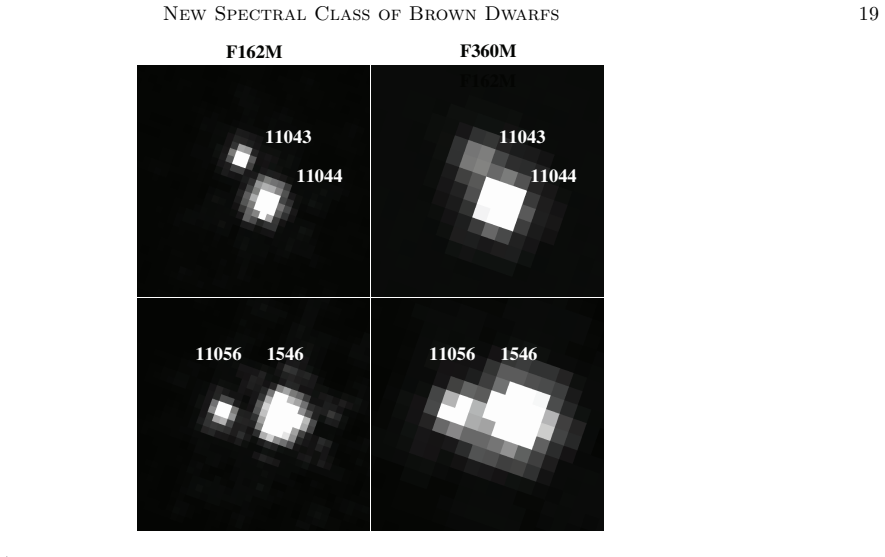
A dynamical mass measurement of either wide binary pair in IC 348 (LRL 11043/11044 or LRL 11056/1546), from continued astrometry or radial velocities and compared with the 5-Myr model luminosities, would directly test the mass scale, since the paper cautions that models below ~0.05 $M_\odot$ can carry roughly 50% errors. Spectroscopy of the two faintest unobserved candidates would also settle whether the IMF extends toward ~1 $M_{\rm Jup}$ or whether those candidates are background galaxies.
Extended reading notes
Core claim
On the paper's own terms, the central discovery is that the substellar population of IC 348 continues to at least ~2 $M_{\rm Jup}$ and that its coolest members do not look like the coolest field brown dwarfs. Nine candidates observed with NIRSpec are young late-type cluster members; after flux-calibrating the 0.6–5.3 micron spectra with NIRCam photometry and integrating with model-based extrapolations, the faintest have bolometric luminosities that the Chabrier et al. (2023) models at 5 Myr convert to masses of ~2 $M_{\rm Jup}$. Eleven cluster members now show the 3.4 micron fundamental band of an unidentified aliphatic hydrocarbon, and the band strength correlates with faintness, tracing a spectral sequence from normal young L dwarfs to objects with strong hydrocarbon absorption and re-emergent TiO/VO. The paper proposes that this absorption defines a new spectral class, H, and notes that the coolest newborn brown dwarfs show this hydrocarbon rather than the methane expected at similar temperatures. Two of the new members also show disk excess emission, making the fainter one the least massive known brown dwarf with evidence of a disk.
Load-bearing premise
The mass estimates assume that the Chabrier et al. (2023) 5-Myr evolutionary models correctly predict the luminosity of objects below about 0.05 solar masses, even though the paper notes those models lack observational tests from dynamical masses; if the models or the assumed cluster age are wrong, the headline masses shift, though the detections of the objects themselves stand.
Editorial extensions
If this is right
- The initial mass function of IC 348 is now traced down to ~2 $M_{\rm Jup}$, so the minimum mass of star formation is at least as low as a few Jupiter masses, and could reach ~1 $M_{\rm Jup}$ if the two faintest unobserved candidates are members.
- The 3.4 micron hydrocarbon band becomes a classification tool: any young, very low-mass brown dwarf showing it would be assigned spectral class H, and atmospheric models must explain why methane is absent where it was expected.
- A ~2 $M_{\rm Jup}$ brown dwarf with a circumstellar disk demonstrates that planet-forming raw materials can exist around objects near the bottom of the mass function.
- Proper motions from two NIRCam epochs strengthen the membership of the previously discovered L24 brown dwarfs, tying the new mass estimates to the cluster's kinematics.
- The bump in the luminosity histograms at the onset of the H sequence suggests that errors in atmospheric and evolutionary models, rather than real structure, may explain the apparent dip in the substellar mass function.
- The new IMF sample extends from 5 $M_\odot$ down to ~2 $M_{\rm Jup}$ with spectral classifications for all members, making it one of the most complete young-cluster mass functions in this range.
Reading between the lines
- If the 3.4 micron feature strength is a monotonic temperature or gravity diagnostic, the same band could be used to identify planetary-mass members in other star-forming regions without full spectral typing, extending IMF censuses beyond IC 348.
- The blueward slope reversal that accompanies the hydrocarbon onset resembles the L/T transition in field dwarfs, hinting that the hydrocarbon, like methane, marks a major opacity change; if so, the bolometric corrections for H-class objects may be the largest source of mass uncertainty, not the evolutionary tracks themselves.
- Confirmation that the two ~1 $M_{\rm Jup}$ photometric candidates are members would suggest the IMF does not stop at 2 $M_{\rm Jup}$ and would strengthen the case for a continuum between brown dwarfs and giant planets.
- The presence of the hydrocarbon in eleven objects but not in slightly warmer L dwarfs suggests a sharp atmospheric transition near ~900 K in newborn substellar objects, which could be tested by searching for the band in similar young clusters like NGC 1333.
Editorial analysis
A structured set of objections, weighed in public.
Referee Report
Summary. This manuscript presents JWST/NIRCam imaging and NIRSpec spectroscopy of brown dwarf candidates in IC 348, extending the Cycle 1 survey of L24 to a larger field. The authors identify 39 NIRCam brown dwarf candidates, obtain spectra for 15 of them, and classify nine as new substellar members. They report that eight of the nine new members and one previously known member show the 3.4 micron aliphatic hydrocarbon feature, define a new spectral class 'H' based on that feature, and estimate masses for the faintest new members near 2 MJup using Chabrier et al. (2023) evolutionary models at 5 Myr. They use these estimates to claim the faintest members are the least massive spectroscopically classified brown dwarfs, providing a new constraint on the minimum mass of the IMF. The paper also reports disk excesses in two members, two wide brown dwarf binary candidates, and an independent reanalysis of NIRCam data in NGC 2024.
Significance. If the mass estimates and the proposed 'H' class hold, the results are significant: they push spectroscopically confirmed substellar masses in a star-forming region down to roughly 2 MJup, provide a rare constraint on the minimum mass of the IMF, and identify a new spectral regime in young brown dwarfs characterized by an unidentified aliphatic hydrocarbon. The paper is careful in its data reduction, provides machine-readable photometry and astrometry, reproduces the NGC 2024 candidates from public data (thereby addressing a reproducibility concern with De Furio et al. 2025), and explicitly acknowledges that evolutionary models below 0.05 Msun lack dynamical calibration. The spectral sequence from normal L dwarfs to strong hydrocarbon-bearing objects is clearly presented and is testable with future observations. However, the headline minimum-mass claim rests on an unquantified systematic: the bolometric luminosities of exactly the H-class objects are computed with atmospheric models that do not include the 3.4 micron hydrocarbon opacity, and the quoted luminosity errors do not include this model mismatch or the assumed extinction.
major comments (3)
- [Section 5.1.3, Table 2] The luminosity estimates for the H-class members are obtained by flux-calibrating the NIRSpec data and extrapolating at the wavelength endpoints with Tremblin et al. (2015, 2017) and Petrus et al. (2023) model spectra, which do not include the 3.4 micron hydrocarbon opacity that defines these objects. The models are therefore known to be invalid for the SEDs being integrated, and the resulting error enters directly into L_bol and hence into the derived masses. Please quantify this systematic: for example, recompute L_bol using the observed spectrum alone over 0.6-5.3 microns, or with a simple opacity correction over 3.3-3.6 microns, and state how the inferred masses of the faintest H members (LRL 11037 and LRL 11040) change. The statement that 50% mass errors would not qualitatively matter does not address this source of error, because the error is correlated with the H feature rather than random; a 0.2-0.3 dex overestimate in L_bol would shift the faintest masses from ~2 to ~3-4 MJup, making the improvement over the L24 object marginal.
- [Section 5.1.3, Table 2] The text states that luminosities were computed for both no extinction and an extinction correction of AK = 0.4, but Table 2 lists a single luminosity per source with no indication of which extinction case is adopted. It is also unclear whether the AK = 0.2 +/- 0.2 assumed for hydrocarbon-bearing objects in Section 5.1.2 is consistent with the values used in the luminosity estimates. Please specify the adopted extinction for each quoted log L and propagate the extinction uncertainty, along with the distance uncertainty, into the final masses. As written, the quoted errors appear to reflect only random/photometric uncertainties, so the '~2 MJup' headline carries no quoted systematic error.
- [Section 4.3] The new 'H' spectral class is defined solely by the presence of the 3.4 micron feature, whose carrier is unidentified, and all current detections are in a single cluster (11 objects in IC 348). To make the 'new spectral class' claim robust, the paper should either provide a quantitative classification criterion (for example, an equivalent-width threshold relative to the young L-dwarf sequence) and test it against existing spectra of other young clusters (NGC 1333, Taurus, Upper Sco) or explicitly present 'H' as a provisional, cluster-specific nomenclature. Without such a test, the conclusion that the hydrocarbon is a 'natural constituent of the coolest newborn brown dwarfs' (Section 6, item 4) goes beyond the present data.
minor comments (4)
- [References] Two entries are both labeled Luhman et al. 2005a (ApJ 631, L69 and ApJ 618, 810); the duplicate year labels should be corrected to 2005a and 2005b or given distinct letters.
- [Section 2.3] The text describes LRL 11043 as a 'possible secondary companion' of LRL 11044, but Table 2 lists both objects as spectroscopically confirmed new members; the wording should be updated to reflect the NIRSpec confirmation.
- [Figure 10] The correlation between the 3.4 micron feature strength and apparent magnitude is the main evidence that the hydrocarbon is physically tied to the coolest objects; it would be more direct to plot the feature strength against estimated bolometric luminosity or temperature, since apparent magnitude includes extinction and distance effects.
- [Section 5.3] The mass estimates for the LRL 11056/LRL 1546 pair are given as ~8/18 MJup even though LRL 11056 lacks spectroscopy and its membership is photometric; this should be stated more explicitly in the multiplicity discussion.
Circularity Check
No significant circularity: the new spectral class and the ~2 MJup mass claims rest on new NIRCam/NIRSpec observations and external evolutionary/atmospheric models, with self-citations providing context rather than forcing the results.
full rationale
The paper's derivation chain is observational: photometric candidate selection, NIRSpec spectroscopy, membership classification via youth diagnostics, definition of the H class from the detected 3.4 micron band, bolometric luminosity estimates from flux-calibrated spectra, and mass estimates from Chabrier et al. (2023) evolutionary models. No step reduces, by construction, to its own input. The H class is explicitly definitional, not a derived prediction. The faintest-member mass claim (~2 MJup) is based on spectroscopically confirmed members, not on the internal m444-luminosity calibration used for unconfirmed photometric candidates; that calibration is a standard empirical estimate and is not presented as an independent prediction. Self-citations (L24, L16, Luhman 2025) supply the prior census, the initial hydrocarbon detection, and the adopted age/mass framework, but they are not load-bearing in the sense of a uniqueness theorem or an unverified ansatz that by itself forces the new detections or classifications. The paper explicitly acknowledges that evolutionary models below 0.05 Msun lack dynamical calibration and that atmospheric models do not predict the 3.4 micron hydrocarbon features; these are correctness and systematic-uncertainty risks, not circularity. The analysis is self-contained against new JWST data, so no circular step is established.
Assumptions & free parameters
free parameters (1)
- AK for hydrocarbon-bearing members =
0.2 +/- 0.2 mag
assumptions (6)
- domain assumption IC 348 is at a distance of 313 pc and an age of ~5 Myr.
- domain assumption The Chabrier et al. (2023) and Baraffe et al. (2015) evolutionary models are valid for converting luminosities to masses at young ages down to ~1-2 MJup.
- domain assumption The youth diagnostics (triangular H-band continuum, weak CO absorption) reliably distinguish young cluster members from field dwarfs.
- domain assumption The extinction-limited sample with AJ < 1.5 is complete and unbiased in mass within the NIRCam field.
- domain assumption All new JWST members have extinctions within the AJ < 1.5 limit.
- domain assumption The 3.4 micron absorption arises in the brown dwarf atmospheres rather than in foreground material.
invented entities (1)
-
H spectral class
independent evidence
Cite this review
Pith. "Pith review of A New Spectral Class of Brown Dwarfs at the Bottom of the IMF in IC 348." pith.science (2026). https://pith.science/paper/7ICEELP3
@misc{pith2026250608969,
  author       = {Pith},
  title        = {Pith review of: A New Spectral Class of Brown Dwarfs at the Bottom of the IMF in IC 348},
  year         = {2026},
  howpublished = {\url{https://pith.science/paper/7ICEELP3}},
  note         = {Machine review of arXiv:2506.08969}
}
abstract
In a previous study, we used JWST to identify three new brown dwarfs in the center of a nearby star-forming cluster, IC 348. The faintest object had an estimated mass of 3-4 $M_{\rm Jup}$, making it a contender for the least massive brown dwarf confirmed with spectroscopy. Two of the new brown dwarfs also exhibited absorption features from an unidentified aliphatic hydrocarbon, which were not predicted by atmospheric models and were not previously detected in atmospheres outside of the solar system. We have used JWST to perform a deeper survey for brown dwarfs across a larger field in IC 348. We have identified 39 brown dwarf candidates in NIRCam images and have obtained spectra for 15 of them with NIRSpec, nine of which are classified as substellar members of the cluster. The faintest new members have mass estimates of $\sim2$ $M_{\rm Jup}$, providing a new constraint on the minimum mass of the IMF. Two new members ($\sim2$ and 10 $M_{\rm Jup}$) exhibit large excess emission from circumstellar disks, demonstrating that they harbor the raw materials for planet formation. Finally, eight of the nine new brown dwarfs and one known member that is newly observed with NIRSpec show the aforementioned hydrocarbon features. Among the total of 11 brown dwarfs in IC 348 that have hydrocarbon detections, the features are stronger at fainter magnitudes, indicating that the hydrocarbon is a natural constituent of the atmospheres of the coolest newborn brown dwarfs. We propose a new spectral class "H" that is defined by the presence of the 3.4 $\mu$m fundamental band of the hydrocarbon.
Figures

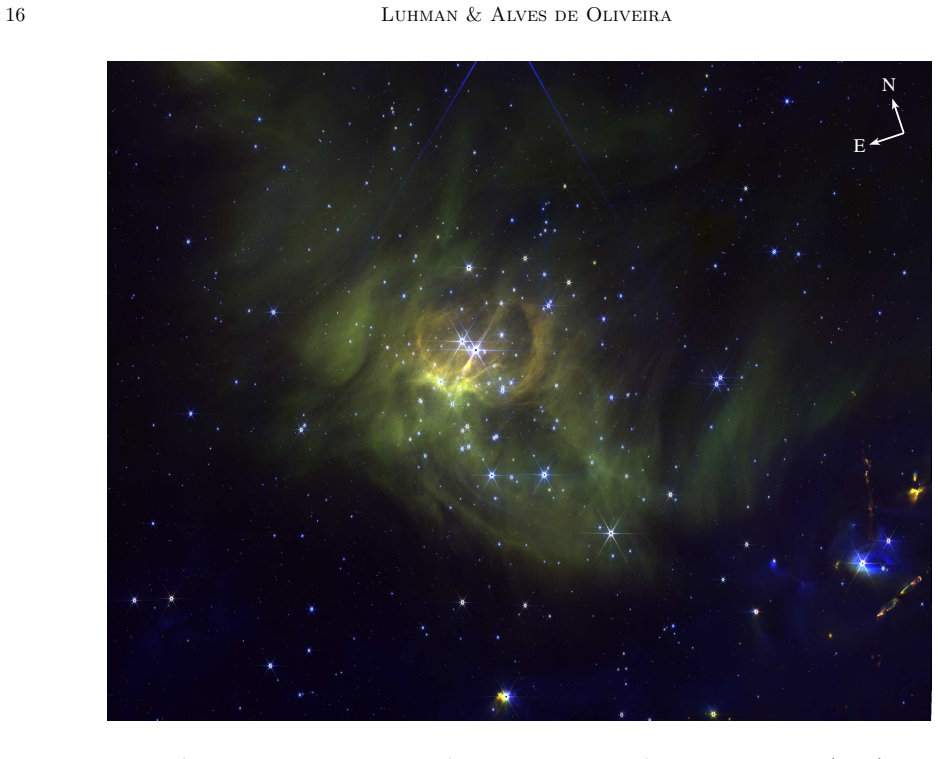

Figures from the paper (10 more)



Forward citations
Cited by 1 Pith paper
-
Spectroscopy of Free-Floating Planetary-Mass Objects and their disks with JWST
Six of eight young free-floating planetary-mass objects observed with JWST show silicate emission from disks, one shows photospheric silicate absorption, and several show hydrocarbon emission lines.
Reference graph
Works this paper leans on
- [1]
-
[2]
Alves de Oliveira, C., Birkmann, S. M., B \"o ker, T., et al. 2018, SPIE, 10704, 107040Q
work page 2018
-
[3]
Alves de Oliveira, C., Moraux, E., Bouvier, J., et al. 2013, , 549, A123
work page 2013
-
[4]
Baraffe, I., Hormeier, D., Allard, F., & Chabrier, G. 2015, , 577, 42
work page 2015
- [5]
- [6]
-
[7]
Burgasser, A. J., Geballe, T. R., Leggett, S. K., Kirkpatrick, J. D., & Golimowski, D. A. 2006, , 637, 1067
work page 2006
-
[8]
Burgasser, A. J., Kirkpatrick, J. D., Brown, M. E., et al. 2002a, , 564, 421
Show all 80 references
-
[9]
J., Marley, M
Burgasser, A. J., Marley, M. S., Ackerman, A. S., et al. 2002b, , 571, L151
-
[10]
J., Reid, I
Burgasser, A. J., Reid, I. N., Siegler, N., et al. 2007, in Protostars and Planets V, ed. V. B. Reipurth, D. Jewitt, & K. Keil (Tucson, AZ: Univ. Arizona Press), 427
2007
-
[11]
2023, , 671, A119
Chabrier, G., Baraffe, I., Phillips, M., & Debras, F. 2023, , 671, A119
2023
-
[12]
2004, , 425, L29
Chauvin, G., Lagrange, A.-M., Dumas, C., et al. 2004, , 425, L29
2004
-
[13]
L., Kirkpatrick, J
Cruz, K. L., Kirkpatrick, J. D., & Burgasser, A. J. 2009, , 137, 3345
2009
-
[14]
C., Kirkpatrick, J
Cushing, M. C., Kirkpatrick, J. D., Gelino, C. R., et al. 2011, , 743, 50
2011
-
[15]
C., Harris, H
Dahn, C. C., Harris, H. C., Vrba, F. J., et al. 2002, , 124, 1170
2002
-
[16]
R., Green, T., et al
De Furio, M., Meyer, M. R., Green, T., et al. 2025, , 981, L34
2025
-
[17]
J., & Liu, M
Dupuy, T. J., & Liu, M. C. 2012, , 201, 19
2012
-
[18]
L., & Luhman, K
Esplin, T. L., & Luhman, K. L. 2017, , 154, 134
2017
-
[19]
2022, , 661, A81
Ferruit, P., Jakobsen, P., Giardino, G., et al. 2022, , 661, A81
2022
-
[20]
R., De Furio, M., et al
Fontanive, C., Bedin, L. R., De Furio, M., et al. 2023, , 526, 1783
2023
-
[21]
Gaia Collaboration, Brown, A. G. A., Vallenari, A., et al. 2021, , 649, A1
2021
-
[22]
Gaia Collaboration, Prusti, T., de Bruijne, J. H. J., et al. 2016, , 595, A1
2016
-
[23]
Gaia Collaboration, Vallenari, A., Brown, A. G. A., et al. 2023, , 674, A1
2023
-
[24]
P., Mather, J
Gardner, J. P., Mather, J. C., Abbott, R., et al. 2023, , 135, 068001
2023
-
[25]
R., Knapp, G
Geballe, T. R., Knapp, G. R., Leggett, S. K., et al. 2002, , 564, 466
2002
-
[26]
1986, , 303, 336
Gehrels, N. 1986, , 303, 336
1986
-
[27]
Herbig, G. H. 1998, , 497, 736
1998
-
[28]
2008, in Handbook of Star Forming Regions, Vol
Herbst, W. 2008, in Handbook of Star Forming Regions, Vol. 1, ed. B. Reipurth (San Francisco, CA: ASP), 372
2008
-
[29]
Hillenbrand, L. A. 1997, , 113, 1733
1997
-
[30]
2022, , 661, A80
Jakobsen, P., Ferruit, P., Alves de Oliveira, C., et al. 2022, , 661, A80
2022
-
[31]
Kirkpatrick, J. D. 2005, , 43, 195
2005
-
[32]
D., Reid, I
Kirkpatrick, J. D., Reid, I. N., Liebert, J., et al. 1999, , 519, 802
1999
-
[33]
A., & Lada, C
Lada, E. A., & Lada, C. J. 1995, , 109, 1682
1995
-
[34]
J., Muench, A
Lada, C. J., Muench, A. A., Luhman, K. L., et al. 2006, , 131, 1574
2006
-
[35]
A., et al
Lalchand, B., Chen, W.-P., Biller, B. A., et al. 2022, , 164, 125
2022
-
[36]
B., Scholz, A., Mu z i \'c , K., et al
Langeveld, A. B., Scholz, A., Mu z i \'c , K., et al. 2024, , 168, 179
2024
-
[37]
W., Roche, P
Lucas, P. W., Roche, P. F., Allard, F., & Hauschildt, P. H. 2001, , 326, 695
2001
-
[38]
Luhman, K. L. 1999, , 525, 466
1999
-
[39]
Luhman, K. L. 2024, , 168, 230
2024
-
[40]
Luhman, K. L. 2025, , in press
2025
-
[41]
L., Alves de Oliveira, C., Baraffe, I., et al
Luhman, K. L., Alves de Oliveira, C., Baraffe, I., et al. 2024, , 167, 19
2024
-
[42]
L., Esplin, T
Luhman, K. L., Esplin, T. E., & Loutrel, N. P. 2016, , 827, 52
2016
-
[43]
L., & Hapich, C
Luhman, K. L., & Hapich, C. J. 2020, , 160, 57
2020
-
[44]
L., Lada, E
Luhman, K. L., Lada, E. A., Hartmann, L., et al. 2005a, , 631, L69
-
[45]
L., Lada, E
Luhman, K. L., Lada, E. A., Muench, A. A., & Elston, R. J. 2005a, , 618, 810
-
[46]
L., Liebert, J., & Rieke, G
Luhman, K. L., Liebert, J., & Rieke, G. H. 1997, , 489, L165
1997
-
[47]
L., Mamajek, E
Luhman, K. L., Mamajek, E. E., Shukla, S. J., & Loutrel, N. P. 2017, , 153, 46
2017
-
[48]
L., McLeod, K
Luhman, K. L., McLeod, K. K., & Goldenson, N. 2005c, , 623, 1141
-
[49]
L., Rieke, G
Luhman, K. L., Rieke, G. H., Lada, C. J., & Lada, E. A. 1998, , 508, 347
1998
-
[50]
L., Stauffer, J
Luhman, K. L., Stauffer, J. R., Muench, A. A., et al. 2003, , 593, 1093
2003
-
[51]
L., Tremblin, P., Birkmann, S
Luhman, K. L., Tremblin, P., Birkmann, S. M., et al. 2023, , 949, L36
2023
-
[52]
L., Basri, G., Delfosse, X., & Forveille, T
Mart \' n, E. L., Basri, G., Delfosse, X., & Forveille, T. 1997, , 327, L29
1997
-
[53]
M., Dartois, E., et al
Matrajt, G., Mu \ n oz Caro, G. M., Dartois, E., et al. 2005, , 433, 979
2005
-
[54]
R., Flaherty, K., Levine, J
Meyer, M. R., Flaherty, K., Levine, J. L., et al. 2008, in Handbook of Star Forming Regions, Vol. 1, ed. B. Reipurth (San Francisco, CA: ASP), 662
2008
-
[55]
A., Lada, C
Muench, A. A., Lada, C. J., Luhman, K. L., Muzerolle, J., & Young, E. 2007, , 134, 411
2007
-
[56]
R., Kulkarni, S
Nakajima, T., Oppenheimer, B. R., Kulkarni, S. R., et al. 1995, , 378, 463
1995
-
[57]
G., Faherty, J., et al
Opitz, D., Tinney, C. G., Faherty, J., et al. 2016, , 819, 17
2016
-
[58]
R., Kulkarni, S
Oppenheimer, B. R., Kulkarni, S. R., Nakajima, T., & Matthews, K. 1995, Science, 270, 1478
1995
-
[59]
J., & Allamandola, L
Pendleton, Y. J., & Allamandola, L. J. 2002, , 138, 75
2002
-
[60]
J., Sandford, S
Pendleton, Y. J., Sandford, S. A., Allamandola, L. J., Tielens, A. G. G. M., & Sellgren, K. 1994, , 437, 683
1994
-
[61]
2023, , 670, L9
Petrus, S., Chauvin, G., Bonnefoy, M., et al. 2023, , 670, L9
2023
-
[62]
L., Basri, G., et al
Rebolo, R., Mart \' n, E. L., Basri, G., et al. 1996, , 469, L53
1996
-
[63]
R., & Mart \' n, E
Rebolo, R., Zapatero Osorio, M. R., & Mart \' n, E. L. 1995, , 377, 129
1995
-
[64]
J., Kelly, D
Rieke, M. J., Kelly, D. M., & Horner, S. 2005, SPIE, 5904, 590401
2005
-
[65]
J., Kelly, D
Rieke, M. J., Kelly, D. M., Misselt, K., et al. 2023, , 135, 028001
2023
-
[66]
2024, , 960, 49
Robberto, M., Gennaro, M., Da Rio, N., et al. 2024, , 960, 49
2024
-
[67]
C., Reyl \'e , C
Robin, A. C., Reyl \'e , C. Derri \`e re, S., & Picaud, S. 2003, , 409, 523
2003
-
[68]
A., Allamandola, L
Sandford, S. A., Allamandola, L. J., Tielens, A. G. G. M., et al. 1991, , 371, 607
1991
-
[69]
F., Meisner, A
Schlafly, E. F., Meisner, A. M., Stutz, A. M., et al. 2016, , 821, 78
2016
-
[70]
H., & Scholz, A
Seo, H. H., & Scholz, A. 2025, , 537, 2579
2025
-
[71]
T., Russell, R
Soifer, B. T., Russell, R. W., & Merrill, K. M. 1976, , 207, L83
1976
-
[72]
R., Hamilton, D., & Probst, R
Stauffer, J. R., Hamilton, D., & Probst, R. G. 1994, , 108, 155
1994
-
[73]
G., Burgasser, A
Tinney, C. G., Burgasser, A. J., & Kirkpatrick, J. D. 2003, , 126, 975
2003
-
[74]
L., & McLeod, K
Todorov, K., Luhman, K. L., & McLeod, K. K. 2010, , 714, L84
2010
-
[75]
L., Konopacky, Q
Todorov, K., Luhman, K. L., Konopacky, Q. M., et al. 2014, , 788, 40
2014
-
[76]
S., Mourier, P., et al
Tremblin, P., Amundsen, D. S., Mourier, P., et al. 2015, , 804, L17
2015
-
[77]
2017, , 850, 46
Tremblin, P., Chabrier, G., Baraffe, I., et al. 2017, , 850, 46
2017
-
[78]
J., Henden, A
Vrba, F. J., Henden, A. A., Luginbuhl, C. B., et al. 2004, , 127, 2948
2004
-
[79]
J., Flickinger G
Wdowiak, T. J., Flickinger G. C., & Cronin J. R. 1988, , 328, L75
1988
-
[80]
Zhang, Z., Molli\' e re, P., Fortney, J., & Marley, M. S. 2025, , submitted
2025
Reviewed August 7, 2026 · model on record in the stance chip above.
Discussion (0). Sign in to comment.