REVIEW 3 major objections 4 minor 2 cited by
Eigenstate Thermalization Hypothesis and Random Matrix Theory Universality in Few-Body Systems
T0 review · 3 major / 4 minor · reviewed 2026-08-07 · deepseek-v4-flash
Pith's one-line read Observables of a chaotic few-body system, when cut down to a small energy window, behave like samples from a random unitary ensemble, and this random-matrix universality disappears in near-integrable systems.
desk verdict Solid numerical study of ETH in the Feingold-Peres model, undercut by an internal inconsistency: the central UIE criterion says Δ_k ∝ δE^k in Eq. (37), but the figures and Appendix C use and observe δE^{k−1}. read the letter →
The pith
A machine-rendered reading of the paper's core claim, the machinery that carries it, and where it could break.
The reading
What carries the argument
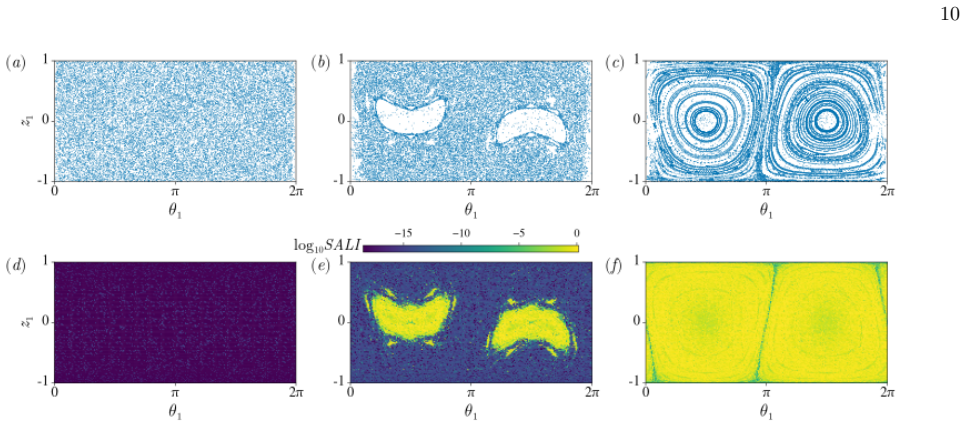
Two objects carry the argument. The first is the microcanonical truncation $O_{\Delta E}=P_{\Delta E}OP_{\Delta E}$, where $P_{\Delta E}$ projects onto the eigenstates with energies within $\Delta E$ of a chosen center; the question is whether this truncated matrix looks like a Haar-random rotation of a fixed seed operator for small $\Delta E$. The second is the sequence of free cumulants $\Delta_k$ of the even narrower operator $O_{\delta E}$, built from moments $M_k\equiv \frac{1}{d}\mathrm{Tr}[O^k]$ through the iterative relation $\Delta_k=M_k-\sum_{j=1}^{k-1}\Delta_j\sum_{a_1+\cdots+a_j=k-j}M_{a_1}\cdots M_{a_j}$. Under a free-compression assumption, these cumulants should collapse onto a universal power law in the window width; observing that collapse, together with the distributional identity for diagonal and off-diagonal elements, identifies the truncated operator as a sample from the unitary invariant ensemble. The Feingold-Peres model provides the testbed, with $\hbar_{\rm eff}=1/(j+1/2)$ controlling the semiclassical limit and the two parameter values $\lambda=0$ and $\lambda=0.75$ separating chaotic from near-integrable dynamics.
What would settle it
One calculation would settle it: on the chaotic-case data of Fig. 6, fit $\log\Delta_k$ versus $\log(\hbar_{\rm eff}\delta E)$ for $k=2,\ldots,10$; if the slopes equal $k-1$ rather than $k$, the paper's UIE criterion Eq. (37) is not the correct free-compression prediction, and the claim would need revision even if the qualitative UIE picture remains.
Extended reading notes
Core claim
The central claim is that a chaotic few-body system with a classical limit shows random-matrix universality at two levels. At the conventional ETH level, the matrix elements of observables obey $\delta O_{\alpha\alpha}\propto \hbar_{\rm eff}^{1/2}$ and $|O_{\alpha\beta}|^2(E,\omega)\approx \hbar_{\rm eff}\,g^2(E,\omega/\hbar_{\rm eff})$ with Gaussian $r_{\alpha\beta}$, confirming the ansatz $f(E,\omega)=\hbar_{\rm eff}^{-1/2}g(E,\omega/\hbar_{\rm eff})$. At the general-ETH level, the truncated operator $O_{\Delta E}=P_{\Delta E}OP_{\Delta E}$ is claimed to be describable, for $\Delta E$ below a unitary energy scale $\Delta E_U$, by a sample from a unitary invariant ensemble: statistically the same as $UO^*U^\dagger$ with $U$ Haar-random. The paper takes the free-cumulant power law $\Delta_k\propto(\delta E)^k$ as its UIE indicator, and also uses the distributional relation $P((O_{\alpha\alpha}-O_{\beta\beta})/2)=P(O_{\alpha\beta})$ to identify emergent unitary symmetry in the chaotic case and its absence in the near-integrable case.
Load-bearing premise
The UIE conclusion depends on treating the projection of an observable onto a narrower energy window as a free compression, so that its free cumulants obey the stated power law; if the correct exponent is $k-1$ rather than $k$, as the paper's own guiding lines and Haar-ensemble tests suggest, the criterion as stated does not follow.
Editorial extensions
If this is right
- Conventional ETH in chaotic few-body systems is tied to the effective Planck constant: diagonal fluctuations vanish as $\hbar_{\rm eff}^{1/2}$ and the off-diagonal envelope scales as $\hbar_{\rm eff}^{-1/2}g(E,\omega/\hbar_{\rm eff})$.
- The energy scale $\Delta E_U$ below which a truncated observable becomes UIE-like is much smaller than the scale at which conventional ETH applies.
- The UIE description is specific to chaotic dynamics: in the near-integrable regime the free-cumulant power law and the diagonal-versus-off-diagonal distribution equality both fail.
- Free cumulants of microcanonically truncated operators offer a practical numerical probe for emergent unitary symmetry in other quantum chaotic systems.
- Deviations from the UIE prediction at extremely small window widths are finite-size effects, since the same deviations occur for a genuine Haar-random ensemble when the subspace dimension is small.
Reading between the lines
- If the correct free-compression exponent is $k-1$ rather than the paper's stated $k$, the UIE criterion $\Delta_k\propto(\delta E)^k$ needs restatement; the paper's own guides and its Haar-ensemble test point to $k-1$, so the qualitative UIE conclusion may survive even though the diagnostic does not.
- The same free-cumulant machinery could be run on kicked Floquet systems such as the kicked top, to test whether the emergent unitary symmetry requires a classical chaotic limit or only quantum ergodicity.
- Because the model belongs to the orthogonal symmetry class, a natural extension is to compare the unitary energy scale $\Delta E_U$ across the Wigner-Dyson symmetry classes and ask whether it depends on the symmetry class.
- The semiclassical connection between the ETH envelope and the classical autocorrelation spectrum suggests that $\Delta E_U$ might be predictable from classical relaxation or Lyapunov time scales, a link the paper does not pursue.
Editorial analysis
A structured set of objections, weighed in public.
Referee Report
Summary. The paper studies the Feingold-Peres model, a paradigmatic few-body system with a classical limit, and addresses two questions. First, it examines the conventional ETH ansatz for observables, focusing on the dependence of diagonal and off-diagonal matrix-element fluctuations on the effective Planck constant \hbar_eff. The numerics support \delta O_{\alpha\alpha} \propto \hbar_eff^{1/2} and |O_{\alpha\beta}|^2 \propto \hbar_eff g^2(E, \omega/\hbar_eff) in the chaotic regime, with Gaussian off-diagonal statistics, while deviations appear in a near-integrable case. Second, it investigates the emergence of unitary symmetry in microcanonically truncated operators, claiming that below a scale \Delta E_U the truncated observable can be described by a sample from a unitary invariant ensemble (UIE). The main evidence is the scaling of free cumulants \Delta_k with the microcanonical window width \delta E, which the paper reports as a power law in the chaotic case but not in the near-integrable case. The central claim is stated in Section V: in few-body systems with chaotic limits, below certain energy scales, the truncated operator exhibits RMT universality in the UIE sense.
Significance. If the UIE claim is correct, the paper bridges the conventional semiclassical ETH picture for few-body systems with the modern free-probability framework of general ETH, and it provides a concrete model in which the emergence of unitary symmetry can be studied systematically. The numerical evidence covers a wide range of system sizes (j up to 5000), two distinct observables, and both chaotic and near-integrable regimes, and the scaling predictions are explicit and falsifiable. The diagonal-ETH scaling and the data collapse for off-diagonal elements are clean and constitute useful quantitative results. However, the main-text criterion for UIE is stated with an incorrect exponent, and the paper's own figures and appendix use a different exponent; this inconsistency must be resolved before the central claim can be accepted as stated.
major comments (3)
- [Section IV B, Eqs. (35)-(37) versus Figs. 6-9 and Appendix C] The main text states the UIE free-cumulant criterion as \Delta_k(\delta E) = (d_{\delta E}/d_U)^k \Delta^U_k \propto \delta E^k (Eqs. (35) and (37)), and later asserts that 'the power-law dependence \Delta_k \propto \delta E^k is present only in the chaotic case.' However, the correct free-compression scaling for the kth free cumulant is \Delta_k \propto (d_{\delta E}/d_U)^{k-1}, because the normalization change from d_U to d_{\delta E} removes one factor of the ratio. The paper itself uses the k-1 law in Appendix C (Eq. (C1): \Delta^d_k = \alpha^{k-1} \Delta^U_k) and in the guide lines of Figs. 6-9 (\Delta_k \propto \delta E^{k-1}). Thus the main-text derivation and the numerical analysis invoke two incompatible statements of the same prediction. The central UIE claim depends on which exponent is correct, so the main text must be corrected and the data should be re-examined against the k-1 law.
- [Figs. 6-9 and Fig. 14] The power-law agreement is only qualitative. The dashed lines in Figs. 6-9 are fixed-slope guide lines (\Delta_k \propto \delta E^{k-1}), not fits, and no error bars or quantitative goodness-of-fit measures are provided. Given that the central conclusion rests on distinguishing k from k-1 (or k-1 from other exponents), the paper should extract the exponents from the data or at least show residuals, so the reader can assess whether the reported scaling is actually verified. This is particularly important in the small-\delta E regime where deviations are discussed.
- [Appendix B] The semiclassical derivation of the ETH scaling f(E,\omega) \sim \hbar_eff^{-1/2} g(E,\omega/\hbar_eff) relies on Eq. (B2), which states that C(t) \simeq C_{cl}(t) in the semiclassical limit, without specifying the time range over which this approximation holds. For chaotic systems, classical-quantum correspondence in correlation functions is generically limited to times short compared to the Ehrenfest time, while the Fourier transform in Eq. (B4) samples all times. The derivation as presented is therefore incomplete. The numerical verification of the off-diagonal scaling in Section IV A is independent, but the semiclassical derivation should be qualified or supplemented with a discussion of its regime of validity.
minor comments (4)
- [Section IV A and IV B] There are several typos: 'violence of ETH' should be 'violation of ETH'; 'In contract' should be 'In contrast'; 'Ackowledges' in the acknowledgements should be 'acknowledges'; and 'UIM prediction' in Appendix C should be 'UIE prediction'.
- [Section IV B, Eq. (37)] The sentence 'This is the main criterion we employ as indicator for the emergence of unitary symmetry' refers to Eq. (37), but if the exponent is corrected to k-1, Eq. (37) should be revised accordingly; the current wording makes the main-text criterion inconsistent with the figures and appendix.
- [Section IV B, Figs. 10-11] The comparison of P((O_{\alpha\alpha}-O_{\beta\beta})/2) with P(O_{\alpha\beta}) is presented as further evidence for unitary symmetry, but the agreement is judged only by eye, for a single operator and a single system size. A quantitative distance measure (e.g., Kolmogorov-Smirnov) or a multi-size scaling check would strengthen this evidence.
- [General] The SALI chaos threshold (SALI \le 10^{-8} at t=180) and the coarse-graining widths \epsilon, \epsilon' used in the density-of-states and matrix-element averaging are fixed without a sensitivity analysis. A short discussion of how the results depend on these choices would increase confidence that the reported scalings are robust.
Circularity Check
No significant circularity: the UIE claim is tested against independently checked free-compression predictions and the ETH f-scaling appendix is a consistency check, not a circular reduction; the main issue is an exponent inconsistency, not circularity.
full rationale
The paper's derivation chain is largely self-contained. The conventional-ETH scaling in Eq. (17) is an ansatz taken from prior literature and tested against numerical data; Appendix B derives the hbar_eff dependence of f(E,omega) by inserting Eq. (17a) into the autocorrelation function and equating the result to the semiclassical autocorrelation. This is a consistency check rather than an independent first-principles derivation, but it is not a circular reduction: the result f ~ hbar_eff^{-1/2} follows from the classical autocorrelation together with the ETH decomposition and would fail if the decomposition were wrong. For the UIE claim, Eq. (35) is credited to the authors' own Ref. [51], a self-citation, but the free-compression law is independently reproduced in Appendix C by explicit Haar-random unitary ensembles, and the additional distributional criterion Eq. (38) is an independent necessary condition from Ref. [32]. Thus the self-citation is not the sole load-bearing evidence. I find no equation whose 'prediction' is equivalent to its input by construction. A genuine defect is the internal inconsistency between Eq. (37), which states Delta_k proportional to deltaE^k, and the scaling Delta_k proportional to deltaE^{k-1} used in the figures and derived in Appendix C (Eq. C1). That is a correctness issue to be corrected, not a circularity. Therefore the circularity score is 0.
Assumptions & free parameters
free parameters (3)
- SALI chaos threshold =
SALI <= 10^{-8} at t=180
- unitary energy scale Delta_E_U =
not quoted numerically; indicated by vertical dotted lines in Figs 6-7
- coarse-graining widths epsilon, epsilon' =
epsilon=0.0425 for DOS; other widths not specified
assumptions (5)
- domain assumption Quantum-to-classical correspondence: coherent-state expectation values of the rescaled angular momentum operators converge to the classical Hamiltonian as hbar_eff tends to zero.
- domain assumption Semiclassical autocorrelation equality C(t) approximately equal to C_cl(t) and ergodicity of the classical dynamics in the chaotic region.
- domain assumption The ETH ansatz structure of Eq (17a) holds, with r_alpha_beta being zero-mean unit-variance random variables.
- standard math Free compression formula for truncated operators from free probability, as given in Ref [51].
- domain assumption Density of states is approximately constant within the small microcanonical window Delta_E_U.
Cite this review
Pith. "Pith review of Eigenstate Thermalization Hypothesis and Random Matrix Theory Universality in Few-Body Systems." pith.science (2026). https://pith.science/paper/AJGTTYMS
@misc{pith2026250609011,
  author       = {Pith},
  title        = {Pith review of: Eigenstate Thermalization Hypothesis and Random Matrix Theory Universality in Few-Body Systems},
  year         = {2026},
  howpublished = {\url{https://pith.science/paper/AJGTTYMS}},
  note         = {Machine review of arXiv:2506.09011}
}
read the original abstract
In this paper, we study the Feingold-Peres model as an example, which is a well-known paradigm of quantum chaos. Using semiclassical analysis and numerical simulations, we study the statistical properties of observables in few-body systems with chaotic classical limits and the emergence of random matrix theory universality. More specifically, we focus on: 1) the applicability of the eigenstate thermalization hypothesis in few-body systems and the dependence of its form on the effective Planck constant and 2) the existence of a universal random matrix theory description of observables when truncated to a small microcanonical energy window. Our results provide new insights into the established field of few-body quantum chaos and help bridge it to modern perspectives, such as the general eigenstate thermalization hypothesis (ETH).
Figures


Figures from the paper (9 more)




Forward citations
Cited by 2 Pith papers
-
Anomalous rate of eigenstate thermalisation at singularities of the density of states
For correlated mean-field random matrices, eigenvector overlaps fluctuate at the Haar scale 1/N in the bulk and at regular edges, and at N^{-1/2} variance near cubic-root cusps, disproving the Feingold–Peres inverse-d...
-
Refinements of the Eigenstate Thermalization Hypothesis under Local Rotational Invariance via Free Probability
Under local rotational invariance, the leading factorization of ETH matrix-element correlations is refined by local free cumulants attached to neighboring non-crossing partitions, confirmed numerically in a Floquet sp...
Reference graph
Works this paper leans on
-
[1]
The rest of the paper is organized as follows: In Sec
the form of ETH, especially the dependence of fluctu- ations of diagonal and off-diagonal elements on the effec- tive Planck constant, and 2) the existence of a unitary energy scale below which a truncate operator can be de- scribed by a sample of UIE. The rest of the paper is organized as follows: In Sec. II, we introduce the Feingold-Peres model and its...
-
[2]
Haake,Quantum signatures of chaos(Springer, 1991)
F. Haake,Quantum signatures of chaos(Springer, 1991)
1991
- [3]
-
[4]
M. V. Berry,Quantizing a classically ergodic system: Sinai’s billiard and the kkr method, Annals of Physics 131, 163–216 (1981)
work page 1981
-
[5]
M. V. Berry,Semiclassical theory of spectral rigidity, Pro- ceedings of the Royal Society of London. A. Mathemati- cal and Physical Sciences400, 229–251 (1985)
work page 1985
-
[6]
M. Sieber and K. Richter,Correlations between periodic orbits and their role in spectral statistics, Physica Scripta 2001, 128 (2001)
work page 2001
-
[7]
S. W. McDonald and A. N. Kaufman,Spectrum and eigenfunctions for a hamiltonian with stochastic trajec- tories, Phys. Rev. Lett.42, 1189–1191 (1979)
work page 1979
-
[8]
S. M¨ uller, S. Heusler, P. Braun, F. Haake, and A. Alt- land,Semiclassical foundation of universality in quantum chaos, Phys. Rev. Lett.93, 014103 (2004)
work page 2004
Show all 53 references
-
[9]
M¨ uller, S
S. M¨ uller, S. Heusler, P. Braun, F. Haake, and A. Al- tland,Periodic-orbit theory of universality in quantum chaos, Phys. Rev. E72, 046207 (2005)
2005
-
[10]
E. P. Wigner,Characteristic vectors of bordered matrices 12 with infinite dimensions, Annals of Mathematics62, 548– 564 (1955)
1955
-
[11]
M. V. Berry,Regular and irregular semiclassical wave- functions, Journal of Physics A: Mathematical and Gen- eral10, 2083 (1977)
1977
-
[12]
V. Buch, R. B. Gerber, and M. A. Ratner,Distributions of energy spacings and wave function properties in vi- brationally excited states of polyatomic molecules. I. Nu- merical experiments on coupled Morse oscillators, The Journal of Chemical Physics76, 5397–5404 (1982)
1982
-
[13]
Benet, J
L. Benet, J. Flores, H. Hern´ andez-Salda˜ na, F. M. Izrailev, F. Leyvraz, and T. H. Seligman,Fluctuations of wavefunctions about their classical average, Journal of Physics A: Mathematical and General36, 1289 (2003)
2003
-
[14]
Benet, F
L. Benet, F. Izrailev, T. Seligman, and A. Su´ arez- Moreno,Semiclassical properties of eigenfunctions and occupation number distribution for a model of two inter- acting particles, Physics Letters A277, 87–93 (2000)
2000
-
[15]
D. C. Meredith, S. E. Koonin, and M. R. Zirnbauer, Quantum chaos in a schematic shell model, Phys. Rev. A37, 3499–3513 (1988)
1988
-
[16]
D. N. Page,Average entropy of a subsystem, Phys. Rev. Lett.71, 1291–1294 (1993)
1993
-
[17]
Wang and W.-g
J. Wang and W.-g. Wang,Characterization of random features of chaotic eigenfunctions in unperturbed basis, Phys. Rev. E97, 062219 (2018)
2018
-
[18]
Srednicki,Chaos and quantum thermalization, Phys
M. Srednicki,Chaos and quantum thermalization, Phys. Rev. E50, 888–901 (1994)
1994
-
[19]
J. M. Deutsch,Quantum statistical mechanics in a closed system, Phys. Rev. A43, 2046–2049 (1991)
1991
-
[20]
Rigol, V
M. Rigol, V. Dunjko, and M. Olshanii,Thermalization and its mechanism for generic isolated quantum systems, Nature452, 854–858 (2008)
2008
-
[21]
Villase˜ nor, S
D. Villase˜ nor, S. Pilatowsky-Cameo, M. A. Bastarrachea- Magnani, S. Lerma-Hern´ andez, L. F. Santos, and J. G. Hirsch,Chaos and thermalization in the spin-boson dicke model, Entropy25(2023)
2023
-
[22]
Wang and W.-g
X. Wang and W.-g. Wang,Semiclassical study of diagonal and offdiagonal functions in the eigenstate thermalization hypothesis, arXiv preprint arXiv:2210.13183 (2022)
2022 arXiv
-
[23]
Srednicki,Thermal fluctuations in quantized chaotic systems, Journal of Physics A: Mathematical and General 29, L75 (1996)
M. Srednicki,Thermal fluctuations in quantized chaotic systems, Journal of Physics A: Mathematical and General 29, L75 (1996)
1996
-
[24]
A. Chan, A. De Luca, and J. T. Chalker,Eigenstate cor- relations, thermalization, and the butterfly effect, Phys. Rev. Lett.122, 220601 (2019)
2019
-
[25]
Brenes, S
M. Brenes, S. Pappalardi, M. T. Mitchison, J. Goold, and A. Silva,Out-of-time-order correlations and the fine structure of eigenstate thermalization, Phys. Rev. E104, 034120 (2021)
2021
-
[26]
Murthy and M
C. Murthy and M. Srednicki,Bounds on chaos from the eigenstate thermalization hypothesis, Phys. Rev. Lett. 123, 230606 (2019)
2019
-
[27]
Richter, A
J. Richter, A. Dymarsky, R. Steinigeweg, and J. Gemmer, Eigenstate thermalization hypothesis beyond standard in- dicators: Emergence of random-matrix behavior at small frequencies, Phys. Rev. E102, 042127 (2020)
2020
-
[28]
J. Wang, M. H. Lamann, J. Richter, R. Steinigeweg, A. Dymarsky, and J. Gemmer,Eigenstate thermalization hypothesis and its deviations from random-matrix theory beyond the thermalization time, Phys. Rev. Lett.128, 180601 (2022)
2022
-
[29]
Dymarsky,Bound on eigenstate thermalization from transport, Phys
A. Dymarsky,Bound on eigenstate thermalization from transport, Phys. Rev. Lett.128, 190601 (2022)
2022
-
[30]
Foini and J
L. Foini and J. Kurchan,Eigenstate thermalization hy- pothesis and out of time order correlators, Phys. Rev. E 99, 042139 (2019)
2019
-
[31]
Pappalardi, F
S. Pappalardi, F. Fritzsch, and T. Prosen,General eigen- state thermalization via free cumulants in quantum lattice systems, arXiv preprint arXiv:2303.00713 (2023)
2023 arXiv
-
[32]
Pappalardi, L
S. Pappalardi, L. Foini, and J. Kurchan,Microcanonical windows on quantum operators, Quantum8, 1227 (2024)
2024
-
[33]
Foini and J
L. Foini and J. Kurchan,Eigenstate thermalization and rotational invariance in ergodic quantum systems, Phys. Rev. Lett.123, 260601 (2019)
2019
-
[34]
M. Fava, J. Kurchan, and S. Pappalardi,Designs via free probability, Phys. Rev. X15, 011031 (2025)
2025
-
[35]
Feingold and A
M. Feingold and A. Peres,Regular and chaotic motion of coupled rotators, Physica D: Nonlinear Phenomena9, 433–438 (1983)
1983
-
[36]
Peres,New conserved quantities and test for regular spectra, Physical Review Letters53, 1711 (1984)
A. Peres,New conserved quantities and test for regular spectra, Physical Review Letters53, 1711 (1984)
1984
-
[37]
Peres,Stability of quantum motion in chaotic and reg- ular systems, Physical Review A30, 1610 (1984)
A. Peres,Stability of quantum motion in chaotic and reg- ular systems, Physical Review A30, 1610 (1984)
1984
-
[38]
Feingold and A
M. Feingold and A. Peres,Distribution of matrix ele- ments of chaotic systems, Physical Review A34, 591 (1986)
1986
-
[39]
Y. Fan, S. Gnutzmann, and Y. Liang,Quantum chaos for nonstandard symmetry classes in the feingold-peres model of coupled tops, Physical Review E96, 062207 (2017)
2017
-
[40]
Altland and M
A. Altland and M. R. Zirnbauer,Nonstandard symme- try classes in mesoscopic normal-superconducting hybrid structures, Physical Review B55, 1142 (1997)
1997
-
[41]
T. Guhr, A. M¨ uller-Groeling, and H. A. Weidenm¨ uller, Random-matrix theories in quantum physics: common concepts, Physics Reports299, 189–425 (1998)
1998
-
[42]
J. R. Klauder and B.-S. Skagerstam,Coherent states: ap- plications in physics and mathematical physics(World scientific, 1985)
1985
-
[43]
Zhang, R
W.-M. Zhang, R. Gilmore,et al.,Coherent states: Theory and some applications, Reviews of Modern Physics62, 867 (1990)
1990
-
[44]
Brack and R
M. Brack and R. Bhaduri,Semiclassical physics(CRC press, 2018)
2018
-
[45]
Oganesyan and D
V. Oganesyan and D. A. Huse,Localization of interacting fermions at high temperature, Phys. Rev. B75, 155111 (2007)
2007
-
[46]
Yan,Spacing ratios in mixed-type systems, Physical Review E111, 054213 (2025)
H. Yan,Spacing ratios in mixed-type systems, Physical Review E111, 054213 (2025)
2025
-
[47]
Main and G
J. Main and G. Wunner,Semiclassical non-trace-type for- mulas for matrix-element fluctuations and weighted den- sities of states, Phys. Rev. E60, 1630–1638 (1999)
1999
-
[48]
Eckhardt and J
B. Eckhardt and J. Main,Semiclassical form factor of matrix element fluctuations, Phys. Rev. Lett.75, 2300– 2303 (1995)
1995
-
[49]
Wilkinson,A semiclassical sum rule for matrix ele- ments of classically chaotic systems, Journal of Physics A: Mathematical and General20, 2415 (1987)
M. Wilkinson,A semiclassical sum rule for matrix ele- ments of classically chaotic systems, Journal of Physics A: Mathematical and General20, 2415 (1987)
1987
-
[50]
Srednicki,The approach to thermal equilibrium in quantized chaotic systems, Journal of Physics A: Mathe- matical and General32, 1163 (1999)
M. Srednicki,The approach to thermal equilibrium in quantized chaotic systems, Journal of Physics A: Mathe- matical and General32, 1163 (1999)
1999
-
[51]
Hortikar and M
S. Hortikar and M. Srednicki,Trace formula for products of diagonal matrix elements in chaotic systems, Phys. Rev. E61, R2180–R2183 (2000)
2000
-
[52]
J. Wang, J. Richter, M. H. Lamann, R. Steinigeweg, J. Gemmer, and A. Dymarsky,Emergence of unitary symmetry of microcanonically truncated operators in chaotic quantum systems, Phys. Rev. E110, L032203 13 (2024)
2024
-
[53]
Pappalardi, L
S. Pappalardi, L. Foini, and J. Kurchan,Eigenstate ther- malization hypothesis and free probability, Phys. Rev. Lett.129, 170603 (2022)
2022
Reviewed August 7, 2026 · model on record in the stance chip above.
Discussion (0). Sign in to comment.