REVIEW 2 major objections 5 minor 1 cited by
Mitigating errors in state preparation and measurement with noncomputational states
T0 review · 2 major / 5 minor · reviewed 2026-08-07 · deepseek-v4-flash
Pith's one-line read Measuring the $|1\rangle$–$|2\rangle$ Rabi oscillation of a transmon pins down the state-preparation error, fully constraining measurement noise models and separating preparation, gate, and readout mitigation.
desk verdict RabiEF-anchored SPAM splitting is a real advance for dynamic-circuit error mitigation; the protocol holds up in simulation, and the hardware evidence is suggestive but not complete. read the letter →
The pith
A machine-rendered reading of the paper's core claim, the machinery that carries it, and where it could break.
The reading
What carries the argument
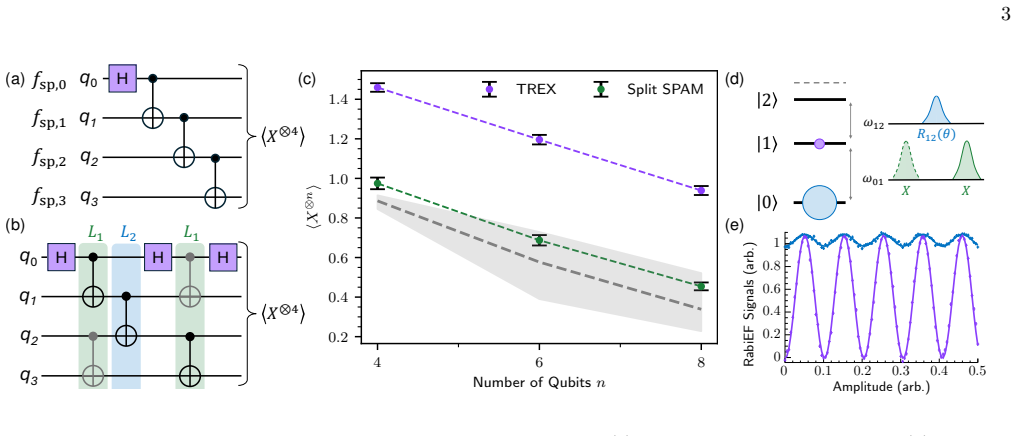
The load-bearing mechanism is the RabiEF experiment on the non-computational $|1\rangle$–$|2\rangle$ subspace. A thermal state with population $p_{\rm sp}$ in $|1\rangle$ is driven by an $R_{12}(\theta)$ rotation between $|1\rangle$ and $|2\rangle$; executing the sequence with and without an initial pi-pulse yields two oscillating signals whose fitted amplitudes give $p_{\rm sp} = a_{\rm A}/(a_{\rm A}+a_{\rm B})$, where A and B label the no-pi and pi signals. Because readout assignment errors affect both amplitudes in the same way, the ratio is first-order insensitive to measurement noise, giving a direct estimate of the state-preparation error. This estimate enters the measurement-cycle-benchmarking fit as the known fidelity $f_{\rm sp}$, splitting the product $f_{\rm sp}f_s f_a$ in Eq. (10) into individually learned factors. The twirled measurement model, with the classical bit represented as a second qubit in the Pauli transfer matrix, together with the RabiEF anchor, converts an underdetermined noise model into a fully specified one.
What would settle it
Prepare a qubit state with an independently calibrated state-preparation error, for example by a verified coherent excitation pulse, run RabiEF on it, and check that the estimated $p_{\rm sp}$ matches the calibrated value within the reported uncertainty; a mismatch, or a systematic drift of the estimate when the readout assignment error is deliberately varied, would show the anchor is biased.
Extended reading notes
Core claim
The paper's central claim is that non-computational states break the no-go result for noise learning in the computational subspace: when the qubit is allowed to visit its $|1\rangle$ and $|2\rangle$ levels, the state-preparation error $p_{\rm sp}$ becomes directly measurable instead of being entangled with readout noise. Concretely, the measurement noise model written as a Pauli transfer matrix product $\Gamma_m = \Gamma_{\rm CX}\Gamma_{\rm s}\Gamma_{\rm a}\Gamma_{\rm c}$, and the full measurement cycle benchmarking expression of Eq. (10), contain only products of fidelities such as $f_a f_s$ and $f_a f_s f_{\rm sp}$; cycle benchmarking alone can learn the products but not the individual factors. The authors show that a RabiEF experiment supplies $p_{\rm sp}$, and therefore $f_{\rm sp}=1-2p_{\rm sp}$, as an independent anchor. With that anchor, the remaining fidelities $f_a$, $f_s$, and $f_c$ are separately determined, the combined state-preparation and measurement (SPAM) error is split in mitigation, and the same noise model applies to mid-circuit measurements. Hardware data on a GHZ-type stabilizer show that joint SPAM mitigation over-corrects the global observable $X^{\otimes n}$ because state-preparation errors affect only a subset of qubits, while the split mitigation restores physical expectation values consistent with the learned gate noise.
Load-bearing premise
The load-bearing premise is that the RabiEF amplitude ratio estimates $p_{\rm sp}$ without significant bias from readout assignment errors, gate errors, or shot-to-shot state fluctuations, and that the same $p_{\rm sp}$ describes the initial state in the RabiEF, measurement cycle benchmarking, and mitigation circuits; the paper supports this with numerical simulations and calls for an analytical error analysis.
Editorial extensions
If this is right
- Joint SPAM mitigation no longer over-corrects global observables: the split mitigator restores expectation values consistent with the learned gate noise in circuits where joint TREX mitigation produces unphysical values.
- Measurement noise models for both final and mid-circuit measurements become fully specified, so probabilistic error cancellation can mitigate dynamic circuits with classical feedforward, as demonstrated on a noisy teleportation circuit.
- Fast active qutrit resets are sufficient in place of slow thermal resets; simulations show the RabiEF estimate of $p_{\rm sp}$ stays within about five percent relative error when the $|2\rangle$ population is actively reset.
- The approach generalizes to other hardware platforms that have accessible non-computational states, such as spin qutrits and trapped ions.
- The paper's random-X amplification procedure keeps the RabiEF anchor usable as state-preparation fidelities improve and $p_{\rm sp}$ becomes very small.
Reading between the lines
- If the RabiEF ratio carries a small bias from gate errors or state fluctuations, the split noise model inherits that bias; a full analytical error-propagation treatment, which the authors call for, would turn the current numerical support into a bound on the final mitigation error.
- The same anchoring idea could be extended to a full qutrit readout model, making leakage and $|2\rangle$ populations learnable rather than assumed negligible.
- Combining this anchor with self-consistent gate-set Pauli-noise learning, the paper's stated outlook, would let one calibrated noise model predict errors for circuits whose gate structures were never individually benchmarked.
- The amplification trick from Appendix G could double as an independent consistency check: comparing the amplified and unamplified RabiEF estimates would expose state-preparation instabilities between shots.
Editorial analysis
A structured set of objections, weighed in public.
Referee Report
Summary. The paper proposes using non-computational states of superconducting transmons (the |1⟩ and |2⟩ levels) to measure the state-preparation error p_sp with a RabiEF experiment, then uses this value to split the SPAM fidelity products that arise in a twirled measurement cycle benchmarking (MCB) protocol. Section II motivates the problem by showing that TREX over-corrects a global X⊗n observable when state-preparation and measurement errors are jointly mitigated. Section III C derives a Pauli-transfer-matrix model of noisy (mid-circuit) measurements with state, assignment, and correlated errors, and shows that with an external anchor f_sp the model is fully specified. Section IV reports simulations: RabiEF with fast qutrit resets, MCB noise learning with relative errors below 0.1%, SPAM mitigation of a stabilizer circuit, and PEC mitigation of a three-qubit teleportation circuit. The hardware demonstration in Section II is presented as motivation; the four-qubit point lies outside the predicted CNOT-noise range. The central claim is that non-computational states overcome no-go theorems for SPAM noise learning.
Significance. If the RabiEF anchor can be rigorously established, this is a valuable contribution: the PTM model in Sec. III C is explicit and self-consistent, and the simulated MCB experiments recover f_a, f_s, f_c, and f_sp with relative errors below 0.1% (Table II), including a second MCB pass that separates a fast-reset fidelity. The teleportation simulation in Sec. IV D demonstrates a concrete use of the split SPAM model with PEC, and the paper is honest about the n=4 hardware outlier and the non-convexity of the CNOT-noise bound. The main weakness is the numerical support for the RabiEF anchor, which is load-bearing for the central claim.
major comments (2)
- [Appendix A2, Eq. (A1)] The simulation does not test the claimed insensitivity of RabiEF to assignment errors. Because the |1⟩ and |2⟩ states are mapped to the same Gaussian N(μ=1, σ_m), the no-pi signal s_notpi(θ) is independent of θ; the R12(θ) gate only redistributes population between states that are detected identically, so the fitted amplitude a_notpi is sampling noise rather than a thermal-population signal. The observed centering of the estimates in Fig. 9 therefore does not support the ratio in Eq. (A1) as an unbiased estimator of α. This matters because Eq. (10) uses p_sp from RabiEF to split the products f_s f_c and f_s f_sp, so any bias in \hat p_sp propagates directly into the mitigated observables. Please provide either a corrected simulation with distinct |1⟩ and |2⟩ readout responses, or the analytical treatment called for in Sec. V, before the ground-truth claim is taken as established.
- [Sec. II and Fig. 1; Appendix C] The hardware demonstration is incomplete because the four-qubit point in the SPAM-mitigation plot lies outside the shaded CNOT-noise range, and that range is computed by solving non-convex optimization problems whose global optimality is not certified (Appendix C). The authors' attribution to out-of-model errors is plausible, but as presented the quantitative support for the claim that the split-mitigated values are consistent with the CNOT noise levels is weaker for n=4 than for n=6,8. Please quantify the systematic error using the framework of Ref. [38], or report the spread of the shaded region over many optimization restarts, and state explicitly whether the four-qubit outlier is compatible with that uncertainty.
minor comments (5)
- [Secs. II and III B] The TREX and split-SPAM results are referenced as Fig. 1(e), but the caption identifies the SPAM error mitigation plot as Fig. 1(c). Please correct the cross-references.
- [Sec. IV A] The phrase "true p_sp of 0.01206%" should read "true p_sp of 0.01206" (i.e., 1.206%), since p_sp is a probability rather than a percentage.
- [Sec. III C] The sentence introducing the learned products uses the same symbol f for two different quantities, namely f = f_a sqrt(f_c f_s) and f = f_c f_s. Please use distinct symbols to avoid ambiguity.
- [Appendix C] The constraint that Pauli fidelities remain physical should be stated as −1 ≤ λ ≤ 1, not only λ ≤ 1.
- [Appendix A2 and Eq. (A1)] The fit function is written as a sin²(θ+c)+b in Eq. (A1) but as a sin²(bθ)+c in the Fig. 1 caption; the offset and phase notation should be harmonized. Also, the text contains a doubled word in "The the normalization constraint" after Eq. (11).
Circularity Check
No significant circularity: the RabiEF f_sp anchor is an independent external measurement, and the MCB fidelity-splitting in Eq. (10) is algebraic with that anchor supplied from outside the fit.
full rationale
Walking the derivation chain, the central move is to measure f_sp = 1 - 2 p_sp with a RabiEF experiment and use it as an external anchor to split the products f_a f_s f_sp, f_a sqrt(f_c f_s), and f_c f_s learned from measurement cycle benchmarking (Eqs. 7-10). This splitting is algebraically underdetermined without f_sp, and the paper supplies f_sp from an independent experiment (Sec. III A and Appendix A), not from the MCB decay fits. The mitigation formula Eq. (1) likewise uses independently measured f_sp values, so the corrected observable is not an output reinserted as an input. The no-go/gauge discussion cites external learnability results [29, 31], and those are used as background facts rather than as self-referential justification. There are minor self-citations ([13], [32], [43]) for background context and simulation methodology, but none carries the load-bearing step: the f_sp anchor is established by RabiEF with external references [35, 36] and by the hardware data in the paper. One non-circular caveat is that Appendix A2's numerical support maps |1> and |2> to a single readout Gaussian, which would suppress the RabiEF oscillation, so the claimed insensitivity to assignment errors is not as strongly tested as stated; the authors themselves call for an analytical treatment in Sec. V. This is a correctness or evidence concern, not a circularity, because the estimator is neither defined in terms of the MCB model nor fitted to the mitigated observables. Overall the derivation is self-contained against external benchmarks, and no specific circular reduction can be exhibited.
Assumptions & free parameters
free parameters (2)
- psp_i (state-preparation error probability per qubit) =
Hardware RabiEF: 2.79% to 8.75% (Table III); simulation: 1.946% slow reset, 1.206% fast qutrit reset
- f_c (correlated-error fidelity in simulations) =
0.995
assumptions (7)
- domain assumption State-preparation errors are bit flips (X errors) on the qubit.
- domain assumption Measurement errors after twirling are bit flips, i.e., Pauli strings with only I or X.
- domain assumption Noise occurs before measurements without loss of generality.
- domain assumption The transmon stays within its first three levels, and the |2>-state population is negligible for slow passive resets.
- domain assumption The RabiEF amplitude ratio yields psp with first-order insensitivity to readout assignment and gate errors.
- domain assumption The prepared initial state is the same diagonal thermal state across RabiEF, MCB, and mitigation circuits.
- domain assumption Measurement noise is Markovian and described by the three channels Lambda_s, Lambda_a, Lambda_c.
Cite this review
Pith. "Pith review of Mitigating errors in state preparation and measurement with noncomputational states." pith.science (2026). https://pith.science/paper/VZPLYBBU
@misc{pith2026250609145,
  author       = {Pith},
  title        = {Pith review of: Mitigating errors in state preparation and measurement with noncomputational states},
  year         = {2026},
  howpublished = {\url{https://pith.science/paper/VZPLYBBU}},
  note         = {Machine review of arXiv:2506.09145}
}
read the original abstract
Error mitigation has enabled quantum computing applications with over one hundred qubits and deep circuits. Many error mitigation methods are noise-aware, relying on a faithful characterization of the noise channels of the hardware. However, fundamental limitations lead to unlearnable degrees of freedom of the underlying noise models when considering qubits. Here, we show how to leverage non-computational states as an additional resource to learn state-preparation errors in superconducting qubits. This allows one to fully constrain the noise models. We can thus independently and accurately mitigate state-preparation errors, gate errors and measurement errors. Our proposed method is also applicable to dynamic circuits with mid-circuit measurements. This work opens the door to improved error mitigation for measurements, both at the end of the circuit and mid-circuit.
Figures


Figures from the paper (8 more)


Forward citations
Cited by 1 Pith paper
-
Drift-resilient mid-circuit measurement and state preparation error mitigation for dynamic circuits
Parity of repeated measurements realizes an amplified readout-error channel, enabling drift-resilient, characterization-free mitigation of mid-circuit and terminating measurement and preparation errors.
Reference graph
Works this paper leans on
-
[38]
Dis- ambiguating pauli noise in quantum computers,
Edward H. Chen, Senrui Chen, Laurin E. Fischer, An- drew Eddins, Luke C. G. Govia, Brad Mitchell, Andre He, Youngseok Kim, Liang Jiang, and Alireza Seif, “Dis- ambiguating pauli noise in quantum computers,” (2025), arXiv:2505.22629
arXiv 2025
-
[1]
1 which is taken on qubits 114 to 121 on the IBM Quantum device ibm pinguino3
Thermal state populations Here, we discuss the experimental thermal state data presented in Fig. 1 which is taken on qubits 114 to 121 on the IBM Quantum device ibm pinguino3. The thermal populations of these qubits are measured with RabiEF after a 10 ms passive reset. The resulting |1⟩ state pop- ulation α ranges from 3 .06 to 8 .75 %, see Tab. III, and ...
-
[2]
RabiEF and assignment errors We provide numerical evidence that the RabiEF mea- surement of α is accurate despite measurement assign- ment errors. We construct a three level model with states 11 0.1 0.2 0.3 0.4 0.5 0.6 0.7 0.8 Measurement standard deviation m 0.5 1.0 1.5 2.0 2.5Thermal popuation (%) Ideal value Measured value 0.1 0.2 0.3 0.4 0.5 0.6 0.7 0...
-
[3]
Qutrit simulations for RabiEF To simulate the RabiEF experiments while taking into account the |2⟩-state population, we implemented a qutrit simulator with Qiskit [ 60]. All qubit instructions are em- bedded as ideal gates in SU (3), and thus do not interact with the |2⟩ state. Only the R12(θ) and X12 gates, noise channels, and measurements interact with ...
-
[4]
Assignment error fidelities for qutrits Errors in final measurements can be specified as a readout assignment errormatrix where entry j, kis the probability qjk to misclassify state |k⟩ as |j⟩. The 3 × 3 qutrit readout assignment matrix R= q00 q01 q02 q10 q11 q12 q20 q21 q22 (F5) used in the RabiEF simulation is based on existing hard- ware experi...
-
[5]
Qubit simulation setup for noise learning and mitigation This section covers the setup for simulations in Secs. IV B to IV D. We used Qiskit Aer [ 48] to simulate MCB and the mitigation circuits. We insert additional dummy gates to engineer the noise model in Sec. III C. As Qiskit Aer applies noise before measurements, implement- ing state errors requires...
-
[6]
IV D is simulated with density matrices using Qiskit Aer [ 48]
Error mitigation of the teleportation circuit The teleportation circuit in Sec. IV D is simulated with density matrices using Qiskit Aer [ 48]. State-preparation and measurement noise are mitigated with probabilistic error cancellation [ 16, 26]. The simulation is carried out as follows. (i) We generate N = 128 teleportation circuit realizations where the...
-
[7]
Evidence for the utility of quantum computing before fault tolerance,
Youngseok Kim, Andrew Eddins, Sajant Anand, Ken Xuan Wei, Ewout Van Den Berg, Sami Rosen- blatt, Hasan Nayfeh, Yantao Wu, Michael Zaletel, Kris- tan Temme,et al., “Evidence for the utility of quantum computing before fault tolerance,” Nature618, 500–505 (2023)
2023
Show all 68 references
-
[8]
Dynamical simulations of many- body quantum chaos on a quantum computer,
Laurin E. Fischer, Matea Leahy, Andrew Eddins, Nathan Keenan, Davide Ferracin, Matteo A. C. Rossi, Youngseok Kim, Andre He, Francesca Pietracaprina, Boris Sokolov, Shane Dooley, Zolt´ an Zimbor´ as, Francesco Tacchino, Sabrina Maniscalco, John Goold, Guillermo Garc ´ ıa-P´ ere...
2024
-
[9]
Improved quantum computation using operator backpropagation,
Bryce Fuller, Minh C Tran, Danylo Lykov, Caleb Johnson, Max Rossmannek, Ken Xuan Wei, Andre He, Youngseok Kim, DinhDuy Vu, Kunal Sharma,et al., “Improved quantum computation using operator backpropagation,” arXiv preprint arXiv:2502.01897 (2025)
2025 arXiv
-
[10]
Myths around quantum computation before full fault tol- erance: What no-go theorems rule out and what they don’t,
Zolt´ an Zimbor´ as, B´ alint Koczor, Zo¨ e Holmes, Elsi-Mari Borrelli, Andr´ as Gily´ en, Hsin-Yuan Huang, Zhenyu Cai, Antonio Ac ´ ın, Leandro Aolita, Leonardo Banchi, Fer- nando G. S. L. Brand˜ ao, Daniel Cavalcanti, Toby Cubitt, Sergey N. Filippov, Guillermo Garc ´ ıa-P´ e...
2025 arXiv
-
[11]
Error mitigation for universal gates on encoded qubits,
Christophe Piveteau, David Sutter, Sergey Bravyi, Jay M. Gambetta, and Kristan Temme, “Error mitigation for universal gates on encoded qubits,” Phys. Rev. Lett.127, 200505 (2021)
2021
-
[12]
On the Importance of Error Mitigation for Quantum Computation,
Dorit Aharonov, Ori Alberton, Itai Arad, Yosi Atia, Eyal Bairey, Zvika Brakerski, Itsik Cohen, Omri Golan, Ilya Gurwich, Oded Kenneth, Eyal Leviatan, Netanel H. Lind- ner, Ron Aharon Melcer, Adiel Meyer, Gili Schul, and Maor Shutman, “On the Importance of Error Mitigation for ...
2025 arXiv
-
[13]
Efficient long-range entangle- ment using dynamic circuits,
Elisa B¨ aumer, Vinay Tripathi, Derek S. Wang, Patrick Rall, Edward H. Chen, Swarnadeep Majumder, Alireza Seif, and Zlatko K. Minev, “Efficient long-range entangle- ment using dynamic circuits,” PRX Quantum5, 030339 (2024)
2024
-
[14]
Exploiting dynamic quantum circuits in a quantum al- gorithm with superconducting qubits,
A. D. C´ orcoles, Maika Takita, Ken Inoue, Scott Lekuch, Zlatko K. Minev, Jerry M. Chow, and Jay M. Gambetta, “Exploiting dynamic quantum circuits in a quantum al- gorithm with superconducting qubits,” Phys. Rev. Lett. 127, 100501 (2021)
2021
-
[15]
Quantum fourier transform using dynamic circuits,
Elisa B¨ aumer, Vinay Tripathi, Alireza Seif, Daniel Lidar, and Derek S. Wang, “Quantum fourier transform using dynamic circuits,” Phys. Rev. Lett.133, 150602 (2024)
2024
-
[16]
Ap- proximate quantum fourier transform in logarithmic depth on a line,
Elisa B¨ aumer, David Sutter, and Stefan Woerner, “Ap- proximate quantum fourier transform in logarithmic depth on a line,” (2025), arXiv:2504.20832
2025 arXiv
-
[17]
Circuit knitting with classical communication,
Christophe Piveteau and David Sutter, “Circuit knitting with classical communication,” IEEE Transactions on Information Theory , 1–1 (2023)
2023
-
[18]
Optimal wire cutting with classical communication,
Lukas Brenner, Christophe Piveteau, and David Sutter, “Optimal wire cutting with classical communication,” (2023), arXiv:2302.03366
2023
-
[19]
Combining quantum processors with real-time classical communication,
Almudena Carrera Vazquez, Caroline Tornow, Diego Rist` e, Stefan Woerner, Maika Takita, and Daniel J. Egger, “Combining quantum processors with real-time classical communication,” Nature636, 75–79 (2024)
2024
-
[20]
Constructing a virtual two-qubit gate by sampling single-qubit operations,
Kosuke Mitarai and Keisuke Fujii, “Constructing a virtual two-qubit gate by sampling single-qubit operations,” New J. Phys.23, 023021 (2021)
2021
-
[21]
Experimental demonstration of a high-fidelity virtual two-qubit gate,
Akhil Pratap Singh, Kosuke Mitarai, Yasunari Suzuki, Kentaro Heya, Yutaka Tabuchi, Keisuke Fujii, and Ya- sunobu Nakamura, “Experimental demonstration of a high-fidelity virtual two-qubit gate,” Phys. Rev. Res.6, 013235 (2024)
2024
-
[22]
Probabilistic error cancellation with sparse pauli–lindblad models on noisy quantum proces- sors,
Ewout Van Den Berg, Zlatko K Minev, Abhinav Kandala, and Kristan Temme, “Probabilistic error cancellation with sparse pauli–lindblad models on noisy quantum proces- sors,” Nat. Phys.19, 1116–1121 (2023)
2023
-
[23]
Benchmarking Quantum Processor Performance at Scale,
David C. McKay, Ian Hincks, Emily J. Pritchett, Mal- colm Carroll, Luke C. G. Govia, and Seth T. Merkel, “Benchmarking Quantum Processor Performance at Scale,” (2023), arXiv:2311.05933
2023 arXiv
-
[24]
Characterizing large-scale quantum com- puters via cycle benchmarking,
Alexander Erhard, Joel J. Wallman, Lukas Postler, Michael Meth, Roman Stricker, Esteban A. Martinez, Philipp Schindler, Thomas Monz, Joseph Emerson, and Rainer Blatt, “Characterizing large-scale quantum com- puters via cycle benchmarking,” Nat. Commun.10, 5347 (2019)
2019
-
[25]
Purification of noisy entanglement and faith- ful teleportation via noisy channels,
Charles H. Bennett, Gilles Brassard, Sandu Popescu, Ben- jamin Schumacher, John A. Smolin, and William K. Wootters, “Purification of noisy entanglement and faith- ful teleportation via noisy channels,” Phys. Rev. Lett.76, 722–725 (1996)
1996
-
[26]
Fault-tolerant postselected quantum com- putation: Threshold analysis,
E. Knill, “Fault-tolerant postselected quantum com- putation: Threshold analysis,” (2004), arXiv:quant- ph/0404104
2004
-
[27]
Noise tailoring for scalable quantum computation via randomized compiling,
Joel J. Wallman and Joseph Emerson, “Noise tailoring for scalable quantum computation via randomized compiling,” Phys. Rev. A94, 052325 (2016)
2016
-
[28]
Model-free readout-error mitigation for quantum expectation values,
Ewout van den Berg, Zlatko K. Minev, and Kristan Temme, “Model-free readout-error mitigation for quantum expectation values,” Phys. Rev. A105, 032620 (2022)
2022
-
[29]
Pauli noise learning for mid-circuit measurements,
Jordan Hines and Timothy Proctor, “Pauli noise learning for mid-circuit measurements,” Phys. Rev. Lett.134, 020602 (2025)
2025
-
[30]
Generalized cycle benchmarking algorithm for characterizing midcircuit measurements,
Zhihan Zhang, Senrui Chen, Yunchao Liu, and Liang Jiang, “Generalized cycle benchmarking algorithm for characterizing midcircuit measurements,” PRX Quantum 6, 010310 (2025)
2025
-
[31]
Benchmarking the readout of a superconducting qubit for repeated measure- ments,
S. Hazra, W. Dai, T. Connolly, P. D. Kurilovich, Z. Wang, L. Frunzio, and M. H. Devoret, “Benchmarking the readout of a superconducting qubit for repeated measure- ments,” Phys. Rev. Lett.134, 100601 (2025). 17
2025
-
[32]
Probabilistic error cancellation for dynamic quantum cir- cuits,
Riddhi S Gupta, Ewout Van Den Berg, Maika Takita, Diego Riste, Kristan Temme, and Abhinav Kandala, “Probabilistic error cancellation for dynamic quantum cir- cuits,” Phys. Rev. A109, 062617 (2024)
2024
-
[33]
Readout error mitigation for mid-circuit measurements and feedforward,
Jin Ming Koh, Dax Enshan Koh, and Jayne Thompson, “Readout error mitigation for mid-circuit measurements and feedforward,” (2025), arXiv:2406.07611
2025
-
[34]
Quasiprob- abilistic readout correction of midcircuit measurements for adaptive feedback via measurement randomized com- piling,
Akel Hashim, Arnaud Carignan-Dugas, Larry Chen, Christian J¨ unger, Neelay Fruitwala, Yilun Xu, Gang Huang, Joel J. Wallman, and Irfan Siddiqi, “Quasiprob- abilistic readout correction of midcircuit measurements for adaptive feedback via measurement randomized com- piling,” PR...
2025
-
[35]
The learnability of Pauli noise,
Senrui Chen, Yunchao Liu, Matthew Otten, Alireza Seif, Bill Fefferman, and Liang Jiang, “The learnability of Pauli noise,” Nat. Commun.14, 52 (2023)
2023
-
[36]
Efficient separate quan- tification of state preparation errors and measurement errors on quantum computers and their mitigation,
Hongye Yu and Tzu-Chieh Wei, “Efficient separate quan- tification of state preparation errors and measurement errors on quantum computers and their mitigation,” Quan- tum9, 1724 (2025)
2025
-
[37]
Efficient self-consistent learning of gate set Pauli noise,
Senrui Chen, Zhihan Zhang, Liang Jiang, and Steven T. Flammia, “Efficient self-consistent learning of gate set Pauli noise,” (2024), arXiv:2410.03906
2024
-
[39]
A quantum engineer’s guide to superconducting qubits,
P. Krantz, M. Kjaergaard, F. Yan, T. P. Orlando, S. Gus- tavsson, and W. D. Oliver, “A quantum engineer’s guide to superconducting qubits,” Appl. Phys. Rev.6, 021318 (2019)
2019
-
[40]
Feedback control of a solid-state qubit using high-fidelity projective measurement,
D. Rist` e, C. C. Bultink, K. W. Lehnert, and L. DiCarlo, “Feedback control of a solid-state qubit using high-fidelity projective measurement,” Phys. Rev. Lett.109, 240502 (2012)
2012
-
[41]
Thermal and residual excited-state population in a 3D transmon qubit,
X. Y. Jin, A. Kamal, A. P. Sears, T. Gudmundsen, D. Hover, J. Miloshi, R. Slattery, F. Yan, J. Yoder, T. P. Orlando, S. Gustavsson, and W. D. Oliver, “Thermal and residual excited-state population in a 3D transmon qubit,” Phys. Rev. Lett.114, 240501 (2015)
2015
-
[42]
Demonstrating a driven reset protocol for a superconduct- ing qubit,
K. Geerlings, Z. Leghtas, I. M. Pop, S. Shankar, L. Frun- zio, R. J. Schoelkopf, M. Mirrahimi, and M. H. Devoret, “Demonstrating a driven reset protocol for a superconduct- ing qubit,” Phys. Rev. Lett.110, 120501 (2013)
2013
-
[43]
Here, g and e stand for ground and excited, respectively
The E and F in RabiEF come from an alternative trans- mon level naming where the states |0⟩, |1⟩, and |2⟩ are labeled by |g⟩, |e⟩, and |f⟩ , respectively. Here, g and e stand for ground and excited, respectively
-
[44]
Bounding the systematic error in quan- tum error mitigation due to model violation,
L.C.G. Govia, S. Majumder, S.V. Barron, B. Mitchell, A. Seif, Y. Kim, C.J. Wood, E.J. Pritchett, S.T. Merkel, and D.C. McKay, “Bounding the systematic error in quan- tum error mitigation due to model violation,” PRX Quan- tum6, 010354 (2025)
2025
-
[45]
Random- ized compiling for subsystem measurements,
Stefanie J. Beale and Joel J. Wallman, “Random- ized compiling for subsystem measurements,” (2023), arXiv:2304.06599
2023 arXiv
-
[46]
Nielsen and Isaac L
Michael A. Nielsen and Isaac L. Chuang,Quantum Com- putation and Quantum Information(Cambridge Univer- sity Press, 2000)
2000
-
[47]
Ancilla-free implementation of generalized measurements for qubits embedded in a qudit space,
Laurin E. Fischer, Daniel Miller, Francesco Tacchino, Panagiotis Kl. Barkoutsos, Daniel J. Egger, and Ivano Tavernelli, “Ancilla-free implementation of generalized measurements for qubits embedded in a qudit space,” Phys. Rev. Res.4, 033027 (2022)
2022
-
[48]
Control and tomography of a three level superconducting artificial atom,
R. Bianchetti, S. Filipp, M. Baur, J. M. Fink, C. Lang, L. Steffen, M. Boissonneault, A. Blais, and A. Wallraff, “Control and tomography of a three level superconducting artificial atom,” Phys. Rev. Lett.105, 223601 (2010)
2010
-
[49]
Leakage in restless quantum gate calibration,
Conrad J. Haupt and Daniel J. Egger, “Leakage in restless quantum gate calibration,” Phy. Rev. A108, 022614 (2023)
2023
-
[50]
Optimal qubit reuse for near-term quantum computers,
Sebastian Brandhofer, Ilia Polian, and Kevin Krsulich, “Optimal qubit reuse for near-term quantum computers,” in2023 IEEE International Conference on Quantum Com- puting and Engineering (QCE)(IEEE Computer Society, Los Alamitos, CA, USA, 2023) pp. 859–869
2023
-
[51]
Transmon qubit readout fidelity at the threshold for quantum error correction without a quantum-limited amplifier,
Liangyu Chen, Hang-Xi Li, Yong Lu, Christopher W. War- ren, Christian J. Kriˇ zan, Sandoko Kosen, Marcus Rom- mel, Shahnawaz Ahmed, Amr Osman, Janka Bizn´ arov´ a, Anita Fadavi Roudsari, Benjamin Lienhard, Marco Ca- puto, Kestutis Grigoras, Leif Gr¨ onberg, Joonas Govenius, An...
2023
-
[52]
Qutrit state discrimination with mid-circuit measure- ments,
Naoki Kanazawa, Haruki Emori, and David C. McKay, “Qutrit state discrimination with mid-circuit measure- ments,” (2023), 2309.11303
2023 arXiv
-
[53]
However, this is not the case in our simulations as the initial state changes from shot to shot
This argumentation holds for an initial state with non- negligible |2⟩-state population which is the same for each shot. However, this is not the case in our simulations as the initial state changes from shot to shot. This manifests as large standard deviations in psp and p(2)...
-
[54]
Qiskit/qiskit-aer: Qiskit Aer 0.16.0,
Qiskit Aer Contributors, “Qiskit/qiskit-aer: Qiskit Aer 0.16.0,” (2025), https://github.com/Qiskit/ qiskit-aer
2025
-
[55]
Hardware-efficient leakage-reduction scheme for quantum error correction with superconducting transmon qubits,
F. Battistel, B.M. Varbanov, and B.M. Terhal, “Hardware-efficient leakage-reduction scheme for quantum error correction with superconducting transmon qubits,” PRX Quantum2, 030314 (2021)
2021
-
[56]
Overcoming leakage in quantum error correction,
Kevin C. Miao, Matt McEwen, Juan Atalaya, Dvir Kafri, Leonid P. Pryadko, Andreas Bengtsson, Alex Oprem- cak, Kevin J. Satzinger, Zijun Chen, Paul V. Klimov, Chris Quintana, Rajeev Acharya, Kyle Anderson, Markus Ansmann, Frank Arute,et al., “Overcoming leakage in quantum error ...
2023
-
[57]
Measurement- induced state transitions in a superconducting qubit: Within the rotating-wave approximation,
Mostafa Khezri, Alex Opremcak, Zijun Chen, Kevin C. Miao, Matt McEwen, Andreas Bengtsson, Theodore White, Ofer Naaman, Daniel Sank, Alexander N. Ko- rotkov, Yu Chen, and Vadim Smelyanskiy, “Measurement- induced state transitions in a superconducting qubit: Within the rotating-...
2023
-
[58]
Escape of a driven quantum joseph- son circuit into unconfined states,
Rapha¨ el Lescanne, Lucas Verney, Quentin Ficheux, Michel H. Devoret, Benjamin Huard, Mazyar Mirrahimi, and Zaki Leghtas, “Escape of a driven quantum joseph- son circuit into unconfined states,” Phys. Rev. Appl.11, 014030 (2019)
2019
-
[59]
Experimental investigation of quantum correlations in a two-qutrit spin system,
Yue Fu, Wenquan Liu, Xiangyu Ye, Ya Wang, Chengjie Zhang, Chang-Kui Duan, Xing Rong, and Jiangfeng Du, 18 “Experimental investigation of quantum correlations in a two-qutrit spin system,” Phys. Rev. Lett.129, 100501 (2022)
2022
-
[60]
Single-shot readout of a solid-state electron spin qutrit,
Yuhang Guo, Wentao Ji, Xi Kong, Mengqi Wang, Haoyu Sun, Jingyang Zhou, Zihua Chai, Xing Rong, Fazhan Shi, Ya Wang, and Jiangfeng Du, “Single-shot readout of a solid-state electron spin qutrit,” Phys. Rev. Lett.132, 060601 (2024)
2024
-
[61]
Qutrit quantum computer with trapped ions,
A. B. Klimov, R. Guzm´ an, J. C. Retamal, and C. Saave- dra, “Qutrit quantum computer with trapped ions,” Phys. Rev. A67, 062313 (2003)
2003
-
[62]
Enhancing quantum noise characterization via extra energy levels,
Senrui Chen, Akel Hashim, Noah Goss, Alireza Seif, Ir- fan Siddiqi, and Liang Jiang, “Enhancing quantum noise characterization via extra energy levels,” (2025), in prepa- ration
2025
-
[63]
Efficient lindblad synthesis for noise model construction,
Moein Malekakhlagh, Alireza Seif, Daniel Puzzuoli, Luke C. G. Govia, and Ewout van den Berg, “Efficient lindblad synthesis for noise model construction,” arXiv preprint arXiv:2502.03462 (2025)
2025
-
[64]
Multi-Layer Cycle Benchmark- ing for high-accuracy error characterization,
Alessio Calzona, Miha Papiˇ c, Pedro Figueroa-Romero, and Adrian Auer, “Multi-Layer Cycle Benchmark- ing for high-accuracy error characterization,” (2024), arXiv:2412.09332
2024
-
[65]
Introduction to quantum gate set tomography,
Daniel Greenbaum, “Introduction to quantum gate set tomography,” (2015), arXiv:1509.02921
2015 arXiv
-
[66]
Quantum computing with Qiskit,
Ali Javadi-Abhari, Matthew Treinish, Kevin Krsulich, Christopher J. Wood, Jake Lishman, Julien Gacon, Simon Martiel, Paul D. Nation, Lev S. Bishop, Andrew W. Cross, Blake R. Johnson, and Jay M. Gambetta, “Quantum computing with Qiskit,” (2024), arXiv:2405.08810
2024 arXiv
-
[67]
Qiskit Dynamics: A Python package for simulating the time dynamics of quantum systems,
Daniel Puzzuoli, Christopher J. Wood, Daniel J. Egger, Benjamin Rosand, and Kento Ueda, “Qiskit Dynamics: A Python package for simulating the time dynamics of quantum systems,” Journal of Open Source Software8, 5853 (2023)
2023
-
[68]
Performance Stabilization of High-Coherence Superconducting Qubits,
Andrew Dane, Karthik Balakrishnan, Brent Wacaser, Li-Wen Hung, H. J. Mamin, Daniel Rugar, Robert M. Shelby, Conal Murray, Kenneth Rodbell, and Jeffrey Sleight, “Performance Stabilization of High-Coherence Superconducting Qubits,” (2025), 2503.12514
2025 arXiv
Reviewed August 7, 2026 · model on record in the stance chip above.
Discussion (0). Sign in to comment.