REVIEW 3 major objections 5 minor 73 references
Electromagnetic signatures from pulsar remnants of binary neutron star mergers: prospects for unique identification using multi-wavelength signatures
T0 review · 3 major / 5 minor · reviewed 2026-08-07 · deepseek-v4-flash
Pith's one-line read A neutron star merger that leaves behind a magnetar should emit a distinctive multi-wavelength signal, visible out to gigaparsec distances and identifiable against supernovae, kilonovae, and GRB afterglows.
desk verdict Solid, honest extension of the authors' magnetar-nebula model, but the multi-Gpc horizon claim is not robust across the advertised field range, and the unique-identification scheme is qualitative. read the letter →
The pith
A machine-rendered reading of the paper's core claim, the machinery that carries it, and where it could break.
The reading
What carries the argument
The machinery is a one-zone pulsar-wind nebula model: a magnetar with dipole field $B_d \sim 10^{13}$--$10^{15}$ G and spin period $P_i \sim 3$ ms loses rotational energy to a wind of $e^+e^-$ pairs; the pairs inject non-thermal electrons as a broken power law $dN/d\gamma_e \propto \gamma_e^{-1.5}$ for $\gamma_e < 10^3$ and $\gamma_e^{-2.5}$ above, and the steady-state electron population radiates through synchrotron and inverse Compton scattering off thermal photons. The observable spectrum is shaped by three attenuation layers: synchrotron self-absorption and $\gamma\gamma$ pair production inside the nebula, plus a frequency-dependent ejecta opacity ($\kappa_{ej} = 10\ {\rm cm}^2\,{\rm g}^{-1}$ in the optical, scaling as $E^{1.16}$ into X-rays, with bound-free, Compton, and Bethe-Heitler terms at higher energies). The key output is the band-by-band peak time, such as $t_{pk} \approx \sqrt{3 M_{ej} \kappa / 4\pi v_0^2}$ for X-ray transparency, which produces the identifying sequence of peaks.
What would settle it
For a BNS merger within roughly 100 Mpc, the model predicts 1 GeV gamma-rays that rise to a peak about ten days after the merger and then decline; a campaign that detects the radio, optical, and X-ray counterparts but sees no such gamma-ray rise would falsify the magnetar-nebula emission scenario. A cheaper test uses the X-ray peak time $t_{pk} \approx (3 M_{ej} \kappa / 4\pi v_0^2)^{1/2}$: a measured soft-X-ray peak that does not track this scaling with independently estimated ejecta mass, opacity, and velocity would contradict the ejecta-transparency mechanism.
Extended reading notes
Core claim
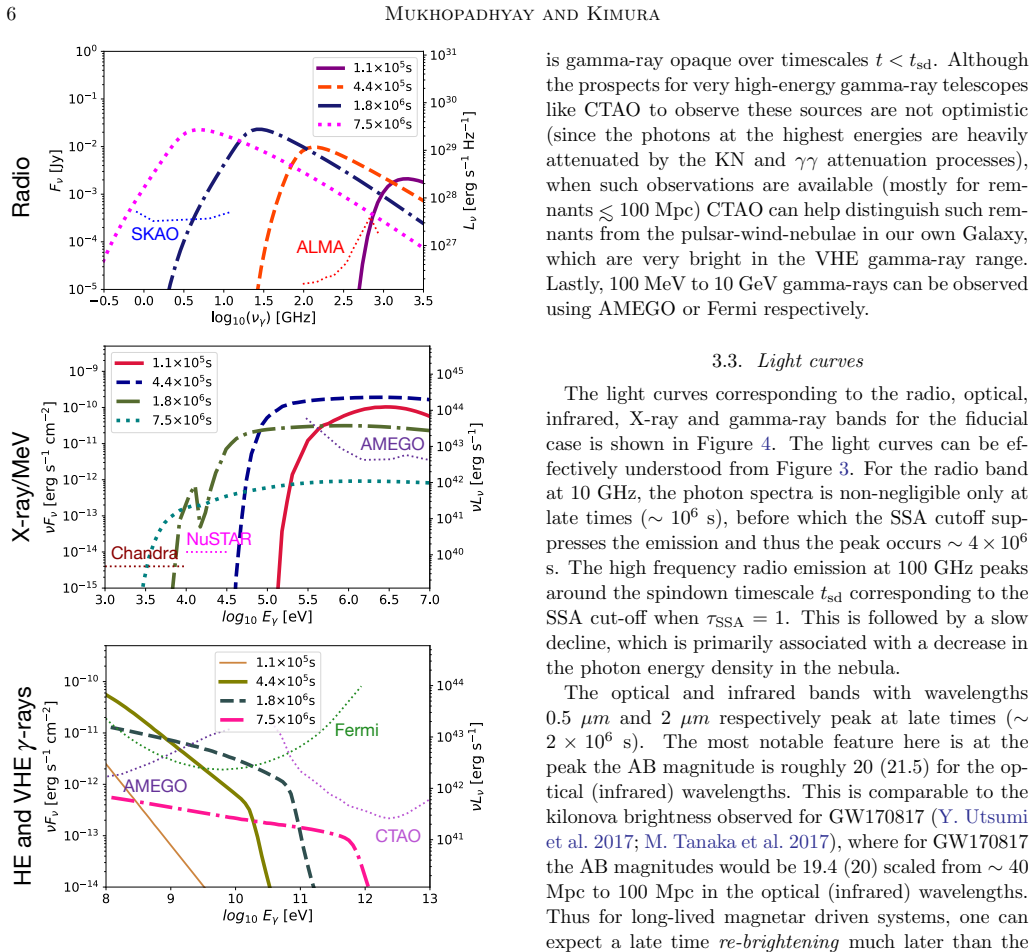
The central claim is that magnetar-powered transients from BNS mergers are not only detectable in principle but identifiable in practice. The fingerprint is a temporal sequence: a rising 100 GHz radio plateau that peaks near the spin-down timescale, an optical/IR rebrightening at AB magnitude roughly 20 to 21.5 peaking around $2\times10^6$ s, and a late rise of soft (5 keV) and hard (10 keV) X-rays peaking when the r-process ejecta becomes transparent, with MeV and GeV gamma-rays appearing on top for nearby events. The paper shows that gamma-ray emission is the decisive separator: within about 100 Mpc, a rising MeV-to-GeV light curve distinguishes the remnant from on-axis GRBs and off-axis afterglows, while at about 1 Gpc the multi-band sequence separates it from supernovae, kilonovae, and galactic X-ray transients. These conclusions are quantified as redshift-dependent horizon distances, for example roughly 24 Gpc for SKAO, 3.7 Gpc for Roman, 2.4 Gpc for Chandra, and 0.11 Gpc for Fermi-LAT in the fiducial case.
Load-bearing premise
The predictions rest on an assumed electron injection spectrum, a broken power law with break at Lorentz factor $10^3$, and an assumed ejecta opacity law that is set to $10\ {\rm cm}^2\,{\rm g}^{-1}$ in the optical and scaled as $E^{1.16}$ into the X-rays rather than derived from a radiative-transfer calculation. If either assumption is off by a significant factor, the peak times and horizon distances shift, and the claimed unique identification weakens.
Editorial extensions
If this is right
- A BNS merger at distances up to about 1 Gpc that leaves a long-lived magnetar should show an observable counterpart in radio, optical/IR, and X-rays within weeks, with the 100 GHz radio plateau and late X-ray rise distinguishing it from supernovae and kilonovae.
- For nearby mergers within about 100 Mpc, MeV-to-GeV gamma-rays that rise rather than fade over roughly one week to one month after the gravitational-wave trigger are a decisive discriminator against on-axis GRB light curves and off-axis afterglows.
- Survey telescopes SKAO, Roman, Rubin, and EP-FXT reach horizon distances of roughly 0.9 to 24 Gpc in the fiducial scenario, so these transients can be found without deep targeted searches, while the gamma-ray horizon (Fermi-LAT about 0.11 Gpc, CTAO about 0.07 Gpc) limits the gamma-ray identifier to nearby events.
- The optical/IR rebrightening peaks at AB magnitude roughly 20 to 21.5 about $2\times10^6$ s after the merger, comparable to the GW170817 kilonova brightness scaled to 100 Mpc, enabling late-time identification of a surviving remnant.
- At the fiducial BNS merger rate of about 300 Gpc$^{-3}$ yr$^{-1}$ and a 10 percent magnetar fraction, about two to three such remnants should have been detectable by Fermi-LAT over 15 years of operation.
Reading between the lines
- Beyond the paper's explicit conclusions, the same horizon calculation implies that if the magnetar fraction is closer to a few tens of percent, next-generation radio arrays should find these transients in large numbers without requiring a gravitational-wave trigger.
- An implication left implicit is that existing archival kilonova follow-up data could be re-searched for the predicted late-time rebrightening, offering a near-term test of the model before new gravitational-wave detections arrive.
- If the ejecta mass or opacity is independently constrained from the kilonova light curve, the X-ray peak time $t_{pk} \approx (3 M_{ej} \kappa / 4\pi v_0^2)^{1/2}$ becomes a consistency probe connecting the merger parameters inferred from gravitational waves to the electromagnetic transient.
- A further testable extension would be to use the predicted peak ordering as a classifier on untriggered survey streams; a candidate with a different ordering, such as X-rays peaking before the radio plateau, would point to a different central engine.
Editorial analysis
A structured set of objections, weighed in public.
Referee Report
Summary. This paper studies the multi-wavelength electromagnetic emission from a long-lived magnetar remnant formed in a binary neutron star merger. The model consists of an expanding pulsar-wind nebula surrounded by r-process-enriched ejecta; nonthermal electrons are injected as a broken power law, cool by synchrotron and inverse Compton processes, and produce photons that are attenuated by synchrotron self-absorption, gamma-gamma pair production, and ejecta opacity. The authors compute nebular photon spectra, observed spectra, light curves, and horizon distances for a set of current and upcoming telescopes, for two parameter sets termed fiducial and optimistic. They report horizon distances above about 1 Gpc for most bands and propose a qualitative multi-wavelength strategy, involving a 100 GHz plateau, optical/IR re-brightening, late X-ray rise, and MeV/GeV gamma-ray emission, to uniquely identify such transients and associate them with gravitational-wave events.
Significance. If the quantitative claims are robust, the paper is a useful guide for follow-up observations of BNS mergers: it gives concrete telescope-specific detection horizons, analytic scalings for the IC peak, the KN and gamma-gamma cutoffs, and peak times derived from tau = 1 conditions, and it makes falsifiable predictions for late-time re-brightening. The forward-model character means the light curves are not fit to the target observables, so there is no circularity in the detection claim. The main limitations are that the headline horizon statements are computed for only two parameter sets, one of which sits at the high-luminosity end of the advertised magnetar range, and that the uniqueness claim is not supported by a quantitative false-alarm analysis. The analytic estimates in Section 3.1 and Equation (4) are explicit and checkable, which strengthens the paper's usefulness.
major comments (3)
- [Section 4.1, Table 1; Abstract] The abstract's headline claim that survey and follow-up observations have horizon distances of about 1 Gpc or more for most wavebands is not demonstrated for the parameter range advertised in the same abstract. Table 1 and Figure 5 are computed only for the fiducial case (B_d = 10^14 G, P_i = 3 ms) and the optimistic case (B_d = 2.5 x 10^13 G, P_i = 1 ms). Since L_sd is proportional to B_d^2 P_i^{-4} as used in Equation (1), a magnetar at the lower advertised field, B_d = 10^13 G with P_i = 3 ms, has L_sd smaller by a factor of 100 than the fiducial case. For a flux-limited search dlim scales roughly as the square root of L_sd, so every horizon in Table 1 shrinks by about an order of magnitude: SKAO 24 to 2.4 Gpc, Roman 3.7 to 0.37 Gpc, Rubin 0.93 to 0.09 Gpc, EP-FXT 0.48 to 0.05 Gpc, AMEGO 0.37 to 0.04 Gpc, Fermi 0.11 to 0.01 Gpc, CTAO 0.07 to 0.007 Gpc, Chandra 2.43 to 0.24 Gpc, JWST 6.67 to 0.67 Gpc. The statement that most wavebands have horizons above 1 Gpc then fails, and the Section 4.2 gamma-ray smoking gun within about 100 Mpc is unavailable for exactly the distances at which GW170817-like events are detected. The authors should either present a pessimistic parameter case or restrict the horizon-distance claim to the parameter sets actually modeled.
- [Section 4.2, Table 2] The central claim that multi-wavelength signatures can uniquely identify magnetar-powered BNS merger remnants is supported only by a qualitative feature list. Section 4.2 itself opens by saying the discussion is qualitative, and Table 2 summarizes strategies without any estimate of contamination. Given the authors' own numbers, with GW localization areas of O(10-100) deg^2 and Rubin discovering O(10^2) supernovae per day, a list of distinguishing features is insufficient to establish uniqueness. The paper needs a quantitative false-alarm or confusion analysis showing how often supernovae, off-axis GRBs, TDEs, and kilonovae produce the same temporal sequence of a 100 GHz plateau, optical/IR re-brightening, late X-ray rise, and MeV/GeV gamma-ray emission. Without such an analysis, the title's and abstract's unique identification language overstates what Section 4.2 demonstrates.
- [Section 3.1, Equation (4), Section 2] The quantitative predictions, including peak times, light-curve ordering, and hence Table 1 horizons, depend on assumed microphysics that is not varied or tested. The electron injection is a broken power law with gamma_br = 10^3 and spectral indices 1.5 and 2.5, the nebular magnetization is taken from the earlier model, and the ejecta opacity is parameterized as kappa_ej = 10 cm^2/g for 0.1-10 eV, kappa_ej proportional to E^{1.16} from 10 eV to 1 keV, with X-ray mass attenuation coefficients at higher energies. Peak times scale as the square root of kappa_ej in Equation (4), and the flux levels scale with the injected electron distribution; a factor-of-few change in kappa_ej or a different injection break can shift the waveband ordering on which Section 4.2 relies. A sensitivity study over these parameters, or a clear statement of the ranges over which the conclusions hold, is needed to make the horizon distances and the unique-identification sequence robust.
minor comments (5)
- [Section 3.1, after Equation (4)] The opacity for 1 MeV photons is written as 0.06 cm^{-2} s^{-1}; the units should be cm^2 g^{-1}.
- [Abstract and Section 1] The word neubla appears in the abstract and should be nebula.
- [Footnote 8, Section 4.1] The neglect of extragalactic background light absorption should be quantified, since the CTAO 100 GeV channel is the only very-high-energy channel discussed and EBL attenuation is not completely negligible at 100 Mpc for energies near 100 GeV.
- [Section 4.1, Table 1] The text says MeV and high-energy gamma-rays can be identified approximately a week post merger using AMEGO and Fermi LAT, whereas Table 1 gives t(dlim_max) = 12 days and 10 days for those telescopes; the wording is slightly optimistic.
- [Table 1] Table 1 reports dlim values as large as 65.6 Gpc for ngVLA; at such distances the BNS merger rate and the absence of a gravitational-wave trigger should be mentioned, because these horizons are far beyond the gravitational-wave detection range and the identification strategy in Section 4.2 assumes a GW distance estimate.
Circularity Check
No significant circularity: the light curves and horizon distances are forward-model predictions from stated physical assumptions, with no fitted target data and no self-citation chain forcing the conclusions.
full rationale
The paper is a forward-modeling study. The horizon distances in Table 1 and Figure 5 are obtained by numerically solving Equation 5 using model spectra from Section 3; no parameter is fitted to the target EM observables, and no detected magnetar transient is used as calibration. The electron injection spectrum, ejecta opacity law, and fiducial/optimistic parameter sets are stated assumptions, inherited from Mukhopadhyay et al. (2024a) but explicitly restated and used as inputs rather than disguised as predictions. The optical and infrared light curves are compared with the external GW170817 kilonova brightness, providing an independent benchmark. The multi-wavelength identification criteria in Section 4.2 are model predictions contrasted with known background classes such as GRBs, supernovae, and kilonovae; they are not definitions that equate the model input with the output. Dependencies on assumed parameters such as Bd, gamma_br, and kappa_ej are model-robustness or parameter-coverage concerns, not circular reasoning. The self-citations concern the previous neutrino model and are not used to forbid alternative models or to import an unverified uniqueness theorem. Therefore no significant circularity is present.
Assumptions & free parameters
free parameters (6)
- Spin period Pi =
fiducial 3 ms, optimistic 1 ms
- Equatorial dipole field Bd =
fiducial 1e14 G, optimistic 2.5e13 G
- Ejecta mass Mej =
fiducial 0.03 solar masses, optimistic 0.1 solar masses
- Ejecta initial velocity v0 =
fiducial 0.2c, optimistic 0.1c
- Electron injection spectral indices and break =
s1 = 1.5, s2 = 2.5, gamma_br = 1e3
- Ejecta opacity normalization =
kappa_ej = 10 cm^2/g for 0.1 to 10 eV, kappa proportional to E^1.16 for 10 eV to 1 keV
assumptions (5)
- domain assumption A BNS merger can leave a long-lived stable magnetar remnant rather than collapsing promptly to a black hole.
- domain assumption The spindown luminosity is injected isotropically into the nebula with no jet.
- domain assumption The nebula can be treated as a single zone with steady-state electron transport and EM cascades.
- domain assumption The ejecta is composed of r-process elements with opacity tables from Tanaka et al. 2020 and Fujibayashi et al. 2020.
- standard math Standard radiative processes such as synchrotron, inverse Compton, gamma-gamma, and synchrotron self-absorption apply.
Cite this review
Pith. "Pith review of Electromagnetic signatures from pulsar remnants of binary neutron star mergers: prospects for unique identification using multi-wavelength signatures." pith.science (2026). https://pith.science/paper/B2DLLZTP
@misc{pith2026250609157,
  author       = {Pith},
  title        = {Pith review of: Electromagnetic signatures from pulsar remnants of binary neutron star mergers: prospects for unique identification using multi-wavelength signatures},
  year         = {2026},
  howpublished = {\url{https://pith.science/paper/B2DLLZTP}},
  note         = {Machine review of arXiv:2506.09157}
}
abstract
Binary neutron star (BNS) mergers can result in the formation of long-lived magnetar remnants which can enhance neutrino and electromagnetic (EM) emissions. In this work, we study the resulting multi-wavelength EM emissions and the prospects of their detectability in the current and upcoming EM telescopes. We model the pulsar-wind neubla system where the long-lived pulsar with dipolar magnetic fields of $10^{13} - 10^{15}$ G (magnetar) spins down and is surrounded by an outward expanding nebula and kilonova ejecta. Although at early times post the merger, the EM signatures are unobservable due to heavy attenuation, they become observable on timescales of $\mathcal{O}(1 - 10)$ days after the merger. We find that the survey and follow-up observations have horizon distances $\gtrsim 1\ \rm Gpc$ for most of the wavebands and conclude that the detection prospects for such long-lived remnants in the electromagnetic channel are promising. This is of crucial importance for multi-messenger observations from BNS mergers to constrain the physical parameters of the remnants. Furthermore, we highlight how observations across the electromagnetic band can uniquely identify magnetar-powered transients resulting from BNS mergers and establish concrete associations of the detected gravitational wave signatures with such transients.
Figures


Figures from the paper (7 more)




Reference graph
Works this paper leans on
-
[1]
Abbott, B. P., et al. 2017a, Phys. Rev. Lett., 119, 161101, doi: 10.1103/PhysRevLett.119.161101
-
[2]
Abbott, B. P., et al. 2017b, Astrophys. J. Lett., 848, L13, doi: 10.3847/2041-8213/aa920c
-
[3]
Abbott, B. P., et al. 2017c, Astrophys. J. Lett., 848, L12, doi: 10.3847/2041-8213/aa91c9
-
[4]
Abbott, R., et al. 2023, Phys. Rev. X, 13, 011048, doi: 10.1103/PhysRevX.13.011048
-
[5]
Akgun, T., Reisenegger, A., Mastrano, A., & Marchant, P. 2013, Mon. Not. Roy. Astron. Soc., 433, 2445, doi: 10.1093/mnras/stt913
-
[6]
Bower, G. C., Metzger, B. D., Cenko, S. B., Silverman, J. M., & Bloom, J. S. 2013, Astrophys. J., 763, 84, doi: 10.1088/0004-637X/763/2/84
- [7]
-
[8]
Cendes, Y., et al. 2024, Astrophys. J., 971, 185, doi: 10.3847/1538-4357/ad5541
Show all 73 references
-
[9]
2017, Astrophys
Chornock, R., et al. 2017, Astrophys. J. Lett., 848, L19, doi: 10.3847/2041-8213/aa905c
2017 doi
-
[10]
A., et al
Coulter, D. A., et al. 2017, Science, 358, 1556, doi: 10.1126/science.aap9811 D’Avanzo, P., et al. 2018, Astron. Astrophys., 613, L1, doi: 10.1051/0004-6361/201832664
2017 doi
-
[11]
D., & Menon, G
Dermer, C. D., & Menon, G. 2009, High Energy Radiation from Black Holes: Gamma Rays, Cosmic Rays, and Neutrinos (Princeton University Press)
2009
-
[12]
2022, Astrophys
Domoto, N., Tanaka, M., Kato, D., et al. 2022, Astrophys. J., 939, 8, doi: 10.3847/1538-4357/ac8c36
2022 doi
- [13]
-
[14]
2024, Astrophys
DuPont, M., & MacFadyen, A. 2024, Astrophys. J. Lett., 971, L24, doi: 10.3847/2041-8213/ad66d2
2024 doi
-
[15]
2008, Front
Fan, Y.-Z., & Piran, T. 2008, Front. Phys. China, 3, 306, doi: 10.1007/s11467-008-0033-z
2008 doi
-
[16]
Fang, K., Kotera, K., Murase, K., & Olinto, A. V. 2014, Phys. Rev. D, 90, 103005, doi: 10.1103/PhysRevD.90.103005
2014 doi
-
[17]
Fang, K., & Metzger, B. D. 2017, Astrophys. J., 849, 153, doi: 10.3847/1538-4357/aa8b6a
2017 doi
-
[18]
D., Murase, K., Bartos, I., & Kotera, K
Fang, K., Metzger, B. D., Murase, K., Bartos, I., & Kotera, K. 2019, Astrophys. J., 878, 34, doi: 10.3847/1538-4357/ab1b72
2019 doi
-
[19]
2020, Astrophys
Fujibayashi, S., Wanajo, S., Kiuchi, K., et al. 2020, Astrophys. J., 901, 122, doi: 10.3847/1538-4357/abafc2
2020 doi
-
[20]
2013, Phys
Gao, H., Zhang, B., Wu, X.-F., & Dai, Z.-G. 2013, Phys. Rev. D, 88, 043010, doi: 10.1103/PhysRevD.88.043010
2013 doi
-
[21]
2019, Science, 363, 968, doi: 10.1126/science.aau8815
Ghirlanda, G., et al. 2019, Science, 363, 968, doi: 10.1126/science.aau8815
2019 doi
-
[22]
2013, Astrophys
Giacomazzo, B., & Perna, R. 2013, Astrophys. J. Lett., 771, L26, doi: 10.1088/2041-8205/771/2/L26
2013 doi
- [23]
-
[24]
2022, Galaxies, 10, 74, doi: 10.3390/galaxies10030074
Gill, R., & Granot, J. 2022, Galaxies, 10, 74, doi: 10.3390/galaxies10030074
2022 doi
-
[25]
2019, Astrophys
Gill, R., Nathanail, A., & Rezzolla, L. 2019, Astrophys. J., 876, 139, doi: 10.3847/1538-4357/ab16da
2019 doi
-
[26]
2017, Astrophys
Goldstein, A., et al. 2017, Astrophys. J. Lett., 848, L14, doi: 10.3847/2041-8213/aa8f41
2017 doi
-
[27]
2019, https://arxiv.org/abs/1903.12597
Goldstein, A., et al. 2019, https://arxiv.org/abs/1903.12597
2019 arXiv
-
[28]
J., et al
Haggard, D., Nynka, M., Ruan, J. J., et al. 2017, Astrophys. J. Lett., 848, L25, doi: 10.3847/2041-8213/aa8ede
2017 doi
-
[29]
2017, Science, 358, 1579, doi: 10.1126/science.aap9855
Hallinan, G., et al. 2017, Science, 358, 1579, doi: 10.1126/science.aap9855
2017 doi
-
[30]
2023, Mon
Hotokezaka, K., Tanaka, M., Kato, D., & Gaigalas, G. 2023, Mon. Not. Roy. Astron. Soc., 526, L155, doi: 10.1093/mnrasl/slad128
2023 doi
-
[31]
H., & Seltzer, S
Hubbell, J. H., & Seltzer, S. M. 2004, Tables of X-Ray Mass Attenuation Coefficients and Mass Energy-Absorption Coefficients (version 1.4, July 12, 2004),, http://physics.nist.gov/xaamdi
2004
-
[32]
Kierans, C. A. 2020, Proc. SPIE Int. Soc. Opt. Eng., 11444, 1144431, doi: 10.1117/12.2562352
2020 doi
- [33]
-
[34]
2024, Nature Astron., 8, 298, doi: 10.1038/s41550-024-02194-y
Kiuchi, K., Reboul-Salze, A., Shibata, M., & Sekiguchi, Y. 2024, Nature Astron., 8, 298, doi: 10.1038/s41550-024-02194-y
2024 doi
-
[35]
J., et al
Levan, A. J., et al. 2024, Nature, 626, 737, doi: 10.1038/s41586-023-06759-1 EM signatures from pulsar remnants of BNS mergers 13
2024 doi
-
[36]
M., et al
Lipunov, V. M., et al. 2017, Astrophys. J. Lett., 850, L1, doi: 10.3847/2041-8213/aa92c0
2017 doi
-
[37]
2017, Astrophys
Margutti, R., et al. 2017, Astrophys. J. Lett., 848, L20, doi: 10.3847/2041-8213/aa9057
2017 doi
-
[38]
2022, Galaxies, 10, 66, doi: 10.3390/galaxies10030066
Miceli, D., & Nava, L. 2022, Galaxies, 10, 66, doi: 10.3390/galaxies10030066
2022 doi
-
[39]
S., & Metzger, B
Mukhopadhyay, M., Kimura, S. S., & Metzger, B. D. 2024a, Astrophys. J. https://arxiv.org/abs/2407.04767
-
[40]
S., & Murase, K
Mukhopadhyay, M., Kimura, S. S., & Murase, K. 2024b, Phys. Rev. D, 109, 043053, doi: 10.1103/PhysRevD.109.043053
-
[41]
Kimura, S. S. 2024c, Phys. Rev. D, 110, 063004, doi: 10.1103/PhysRevD.110.063004
-
[42]
2015, Astrophys
Murase, K., Kashiyama, K., Kiuchi, K., & Bartos, I. 2015, Astrophys. J., 805, 82, doi: 10.1088/0004-637X/805/1/82
2015 doi
-
[43]
2009, Phys
Murase, K., Meszaros, P., & Zhang, B. 2009, Phys. Rev. D, 79, 103001, doi: 10.1103/PhysRevD.79.103001
2009 doi
-
[44]
A., & Ofek, E
Murase, K., Thompson, T. A., & Ofek, E. O. 2014, Mon. Not. Roy. Astron. Soc., 440, 2528, doi: 10.1093/mnras/stu384
2014 doi
-
[45]
2011, Astrophys
Murase, K., Toma, K., Yamazaki, R., & Meszaros, P. 2011, Astrophys. J., 732, 77, doi: 10.1088/0004-637X/732/2/77
2011 doi
-
[46]
W., Fang, K., et al
Murase, K., Toomey, M. W., Fang, K., et al. 2018, Astrophys. J., 854, 60, doi: 10.3847/1538-4357/aaa48a
2018 doi
-
[47]
Noda, K., & Parsons, R. D. 2022, Galaxies, 10, 7, doi: 10.3390/galaxies10010007
2022 doi
-
[48]
Omand, C. M. B., Sarin, N., & Lamb, G. P. 2025, Mon. Not. Roy. Astron. Soc., 539, 1908, doi: 10.1093/mnras/staf565
2025 doi
-
[49]
2017, Nature, 551, 67, doi: 10.1038/nature24298
Pian, E., et al. 2017, Nature, 551, 67, doi: 10.1038/nature24298
2017 doi
-
[50]
2019, Mon
Piro, L., et al. 2019, Mon. Not. Roy. Astron. Soc., 483, 1912, doi: 10.1093/mnras/sty3047
2019 doi
-
[51]
C., & Grossan, B
Pooley, D., Kumar, P., Wheeler, J. C., & Grossan, B. 2018, Astrophys. J. Lett., 859, L23, doi: 10.3847/2041-8213/aac3d6
2018 doi
-
[52]
2006, Science, 312, 719, doi: 10.1126/science.1125201
Price, D., & Rosswog, S. 2006, Science, 312, 719, doi: 10.1126/science.1125201
2006 doi
-
[53]
2018, Mon
Radice, D., Perego, A., Bernuzzi, S., & Zhang, B. 2018, Mon. Not. Roy. Astron. Soc., 481, 3670, doi: 10.1093/mnras/sty2531
2018 doi
-
[54]
2022, Mon
Ren, J., & Dai, Z.-G. 2022, Mon. Not. Roy. Astron. Soc., 512, 5572, doi: 10.1093/mnras/stac797
2022 doi
-
[55]
B., & Lightman, A
Rybicki, G. B., & Lightman, A. P. 1986, Radiative Processes in Astrophysics
1986
-
[56]
Sarin, N., & Lasky, P. D. 2021, Gen. Rel. Grav., 53, 59, doi: 10.1007/s10714-021-02831-1
2021 doi
-
[57]
Sarin, N., Omand, C. M. B., Margalit, B., & Jones, D. I. 2022, Mon. Not. Roy. Astron. Soc., 516, 4949, doi: 10.1093/mnras/stac2609
2022 doi
-
[58]
2017, Astrophys
Savchenko, V., et al. 2017, Astrophys. J. Lett., 848, L15, doi: 10.3847/2041-8213/aa8f94
2017 doi
-
[59]
J., Murphy, E
Selina, R. J., Murphy, E. J., McKinnon, M., et al. 2018, The Next Generation Very Large Array: A Technical Overview, https://arxiv.org/abs/1806.08405
2018 arXiv
- [60]
-
[61]
2019, Ann
Shibata, M., & Hotokezaka, K. 2019, Ann. Rev. Nucl. Part. Sci., 69, 41, doi: 10.1146/annurev-nucl-101918-023625
2019 doi
-
[62]
2019, Phys
Shibata, M., Zhou, E., Kiuchi, K., & Fujibayashi, S. 2019, Phys. Rev. D, 100, 023015, doi: 10.1103/PhysRevD.100.023015
2019 doi
- [63]
-
[64]
2017, Astrophys
Soares-Santos, M., et al. 2017, Astrophys. J. Lett., 848, L16, doi: 10.3847/2041-8213/aa9059
2017 doi
-
[65]
2020, Mon
Tanaka, M., Kato, D., Gaigalas, G., & Kawaguchi, K. 2020, Mon. Not. Roy. Astron. Soc., 496, 1369, doi: 10.1093/mnras/staa1576
2020 doi
-
[66]
2017, Publ
Tanaka, M., et al. 2017, Publ. Astron. Soc. Jap., 69, psx12, doi: 10.1093/pasj/psx121
2017 doi
-
[67]
2017, Nature, 551, 71, doi: 10.1038/nature24290
Troja, E., et al. 2017, Nature, 551, 71, doi: 10.1038/nature24290
2017 doi
-
[68]
2017, Publ
Utsumi, Y., et al. 2017, Publ. Astron. Soc. Jap., 69, 101, doi: 10.1093/pasj/psx118
2017 doi
-
[69]
J., Yang, S., et al
Valenti, S., Sand, D. J., Yang, S., et al. 2017, Astrophys. J. Lett., 848, L24, doi: 10.3847/2041-8213/aa8edf
2017 doi
-
[70]
J., Haggard, D., et al
Vieira, N., Ruan, J. J., Haggard, D., et al. 2023, Astrophys. J., 944, 123, doi: 10.3847/1538-4357/acae72
2023 doi
-
[71]
J., Haggard, D., et al
Vieira, N., Ruan, J. J., Haggard, D., et al. 2024, Astrophys. J., 962, 33, doi: 10.3847/1538-4357/ad1193
2024 doi
-
[72]
O., Kushnir, D., & Gal-Yam, A
Waxman, E., Ofek, E. O., Kushnir, D., & Gal-Yam, A. 2018, Mon. Not. Roy. Astron. Soc., 481, 3423, doi: 10.1093/mnras/sty2441
2018 doi
-
[73]
2022, Astropart
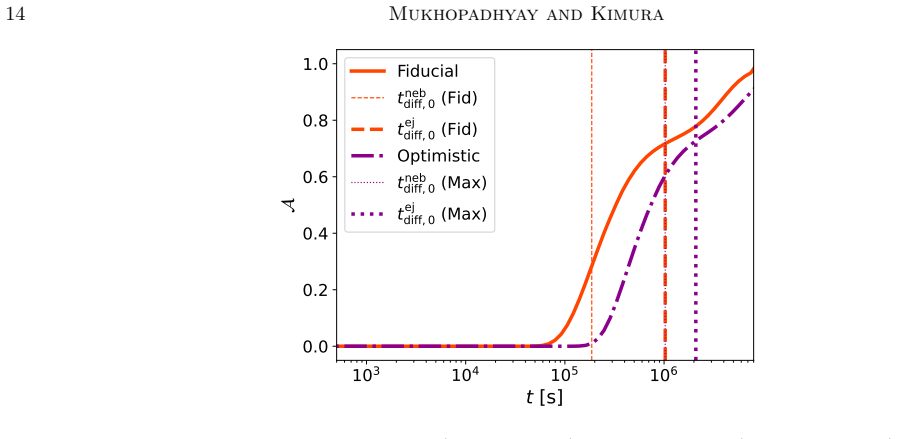
Zhang, J., et al. 2022, Astropart. Phys., 137, 102668, doi: 10.1016/j.astropartphys.2021.102668 14 Mukhopadhyay and Kimura 103 104 105 106 t [s] 0.0 0.2 0.4 0.6 0.8 1.0 Fiducial tneb diff, 0 (Fid) tej diff, 0 (Fid) Optimistic tneb diff, 0 (Max) tej diff, 0 (Max) Figure 6. Time...
2022
Reviewed August 7, 2026 · model on record in the stance chip above.
Discussion (0). Sign in to comment.