REVIEW 4 major objections 5 minor 43 references
Safe Screening Rules for Group SLOPE
T0 review · 4 major / 5 minor · reviewed 2026-08-07 · deepseek-v4-flash
Pith's one-line read The paper introduces the first safe screening rule for Group SLOPE, provably discarding inactive feature groups during training so batch and stochastic solvers return the same solution much faster.
desk verdict A legitimate extension of safe screening to Group SLOPE, but the algorithms omit the dual iterate and the finite-screening proof doesn't match the running threshold; fixable, worth a serious look. read the letter →
The pith
A machine-rendered reading of the paper's core claim, the machinery that carries it, and where it could break.
The reading
What carries the argument
The central object is the decoupling transformation $X_{I_i} = U_i R_i$, which converts the block-nonseparable group-effect penalty $J_\lambda(W\llbracket X\beta\rrbracket_I)$ into $J_\lambda(\llbracket b\rrbracket_I)$ on transformed variables, together with the screening inequality $\|X_{I_i}^T\theta\|_2 + \|X_{I_i}\|_2\sqrt{2G(b,\theta)} < \lambda_{|A|}$, which guarantees $b^*_{I_i}=0$. The left-hand side tightens as the duality gap $G(b,\theta)$ shrinks along the optimization trajectory; the right-hand side rises as the active set is iteratively refined and the smallest unused $\lambda$ weights are assigned to screened groups. This pair of moving bounds is what makes the rule doubly dynamic, and it carries the proof of safeness and finite-time screening.
What would settle it
Construct a design where one group has more features than samples or contains linearly dependent columns, solve the original Group SLOPE problem and the transformed problem in Eq. (5) on the same data, and compare their solutions; any difference in the objective value or in which groups have zero coefficients would show the equivalence and the safety guarantee do not hold in that setting.
Extended reading notes
Core claim
The paper's central claim is that Group SLOPE can be equivalently rewritten by factorizing each group's design submatrix, $X_{I_i} = U_i R_i$, so the penalty acts on decoupled variables $\eta_{I_i} = R_i \beta_{I_i}$ with group norms $\|\eta_{I_i}\|_2$. In this form, the dual optimality condition yields a screening test: if $\|X_{I_i}^T\theta^*\|_2 < \lambda_{|A^*|}$, then group $i$ is inactive, meaning $b^*_{I_i} = 0$. Since $\theta^*$ and $|A^*|$ are unknown during training, the paper derives computable bounds: an upper bound on $\|X_{I_i}^T\theta^*\|_2$ from the duality gap using strong concavity of the dual, and a lower bound on $\lambda_{|A^*|}$ by iteratively shrinking the active set and assigning the smallest $\lambda$ values to screened groups. This doubly dynamic screening region expands as training proceeds, and Theorem 1 asserts every truly inactive group is screened out in finitely many iterations. The paper concludes the rule is safe for any iterative solver that maintains primal--dual iterates, and it demonstrates the resulting speedups on four benchmark datasets without accuracy loss.
Load-bearing premise
The argument's load-bearing premise is that each feature group's design submatrix can be factored into as many orthogonal columns as the group has variables, which requires full column rank and group size no larger than the sample size; the paper does not state or verify this, and if it fails, the transformed problem is not equivalent to the original Group SLOPE problem.
Editorial extensions
If this is right
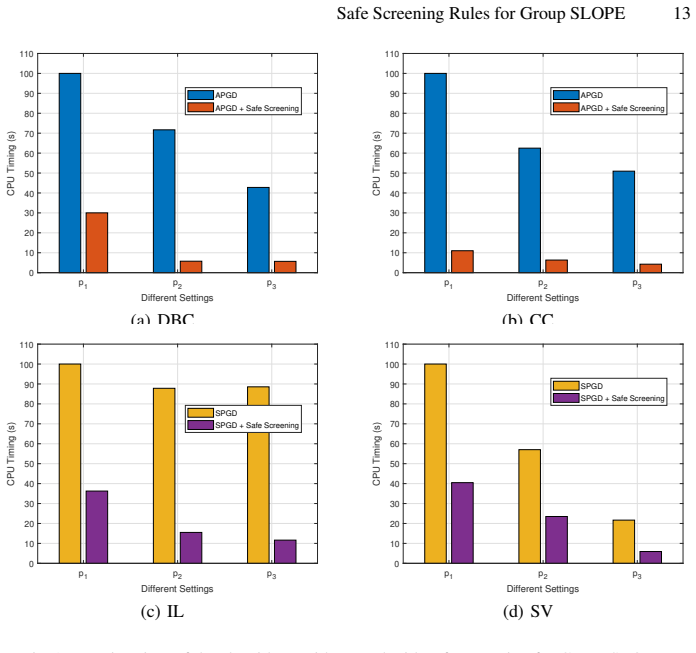
- Batch APGD solvers for Group SLOPE can run 3--14$\times$ faster on $n \ll d$ datasets, and stochastic SPGD solvers 2.5--8$\times$ faster on large-scale datasets, while returning the original Group SLOPE solution.
- Memory usage drops because only active groups are stored and updated after screening, and in sparse high-dimensional settings the active dimension $d_k$ is much smaller than $d$.
- If the solver already computes the duality gap for its stopping criterion, the screening test adds only $O(d_k)$ overhead per iteration.
- Because Group Lasso and SLOPE are special cases of Group SLOPE, the same rule supplies safe screening for those models as well.
- Theorem 1 implies the active set stabilizes after finitely many iterations, so subsequent training runs on a much smaller problem with the same final solution.
Reading between the lines
- The equivalence step requires each $X_{I_i}$ to have full column rank, so a natural extension is a rank-revealing factorization that handles rank-deficient or oversized groups, at the cost of redefining groups or accepting a different penalty.
- In genuine mini-batch stochastic training, the duality gap entering the screening test would typically be estimated from batches; a practical extension is to evaluate the gap only periodically or on a full pass, since the strong-concavity bound is stated for the true dual objective.
- The iterative assignment of the smallest unused $\lambda$ values to screened groups is an ordering heuristic justified by active-set stabilization; a testable extension is to compare alternative orderings on problems where the active set does not shrink monotonically.
- Because the construction uses only convexity and the ordered-weight structure, the same doubly dynamic screening idea could plausibly be adapted to other ordered weighted $\ell^1$ group models, though the paper does not claim this.
Editorial analysis
A structured set of objections, weighed in public.
Referee Report
Summary. The paper proposes a safe screening rule for Group SLOPE, a sparse regression model whose non-separable group penalty has previously blocked screening-based acceleration. The authors introduce a transformation intended to decouple the group-effect penalty, derive a dual problem and a screening test based on the duality gap, and claim that the resulting rule can be integrated into APGD and SPGD solvers while preserving exact solutions. They provide a finite-time screening theorem and report large speedups on four datasets. The core claims are that the screening rule is safe, that it provably discards every inactive group in finitely many iterations, and that it is seamlessly implementable in existing first-order solvers.
Significance. If the claims were correct, this would be the first safe screening rule for Group SLOPE and would meaningfully extend the line of gap-based safe screening methods to a model with ordered, non-separable group penalties. The paper also attempts a doubly dynamic rule that tightens both sides of the screening test over iterations. However, the central derivation contains a fundamental error in the dual reformulation, the proposed algorithms do not construct the dual quantities required by the screening test, and the paper's own experimental design violates the rank assumption behind the decoupling transformation. These issues invalidate the main theoretical and algorithmic claims as stated, so the contribution is not currently usable.
major comments (4)
- [Section 2.1, Eqs. (2)-(5)] The decoupling step assumes that each group submatrix X_Ii admits a QR factorization X_Ii = U_i R_i with U_i having |I_i| orthogonal columns and R_i being full-row rank. This requires rank(X_Ii) = |I_i| and |I_i| <= n, which is not stated in the paper and fails for collinear columns or for groups larger than the sample size. The equivalence between problems (1) and (5) is therefore not established in general. This is not merely a technical gap: Section 4.1 says that each feature group is formed by duplicating each feature, so any group with |I_i| > 1 consists of identical columns and has rank 1, making the transformation in Eq. (2) invalid for the paper's own experimental setup.
- [Section 2.2, Eqs. (7)-(9)] The dual derivation replaces the ordered group penalty J_lambda(||b||_I) with the separable term sum_i lambda_i ||b_{I[i]}||_2. These are not equal: J_lambda sorts the group norms and applies the lambda_i to the sorted values, whereas the separable sum assigns each lambda_i to a fixed group. Consequently, the minimization over b in Eq. (9) is not the correct infimal convolution for the Group SLOPE penalty, and the dual feasible set Delta together with the optimality conditions (10)-(14) do not follow from the primal problem (6). The screening condition (14) is therefore derived from an incorrect dual problem.
- [Section 2.4 and Theorem 1] Algorithm 1 and Algorithm 2 evaluate the screening test (22) with the current active-set size |A|, i.e., with threshold lambda_{|A_k|}. However, the proof of Theorem 1 establishes screening with respect to the fixed threshold lambda_{|A*|} of the final active set. The paper asserts that lambda_{|A_k|} rises to lambda_{|A*|} as the active set shrinks, but no proof is given that the running threshold eventually reaches the final threshold. The step in Section 2.4 that assigns the m - m_k zero-valued groups 'any permutation' of the smallest lambda values is also not justified by the sorted structure of the penalty. Thus the finite-time screening guarantee for the algorithm actually implemented does not follow from Theorem 1.
- [Section 3.1 and Section 2.3] Corollary 1 bounds ||theta - theta*|| by sqrt(2G(b, theta)) only for a dual-feasible point theta, and the screening test (22) requires a well-defined theta and duality gap G(b, theta). However, Algorithms 1 and 2 maintain only primal iterates b_k, hat-b_k, and t_k; they never construct a dual-feasible theta_k. The statement in Section 2.3 that theta is 'directly available during each iteration of standard proximal gradient methods' is not correct for the APGD and SPGD methods cited in Section 3.1, and the natural residual y - X hat-b_k is generally not feasible for Delta. Consequently, the screening rule as specified cannot be evaluated inside these algorithms, and Property 1 and Theorem 1 are not connected to the proposed procedures.
minor comments (5)
- [Section 2.3, Corollary 1 proof] Equation (19) states ||theta - theta*|| <= sqrt(D(theta*) - D(theta)), but the preceding inequality (16) gives ||theta - theta*||^2 <= 2(D(theta*) - D(theta)), so the missing factor sqrt(2) should appear already in Eq. (19).
- [Section 2.1, Eq. (15)] The notation ||XIi||_2 is used for the spectral norm of the matrix X_Ii, while ||X_Ii^T theta||_2 is an Euclidean norm; the two norms should be distinguished explicitly.
- [Section 2.2, Eqs. (7)-(9)] The symbol beta is used both for the primal coefficient vector and as the optimization variable in the inner product beta^T X^T theta inside the dual derivation, which is confusing and should be renamed.
- [Section 2.4] The sentence 'The remaining m - m_k groups can then be assigned any permutation of lambda_{m_k+1}, ..., lambda_m' is vague; a formal statement about which groups receive which lambda values would clarify why the threshold lambda_{|A|} is valid at intermediate iterations.
- [Section 3, Properties 1 and 2] Properties 1 and 2 are stated without proof; if they are intended to follow from Theorem 1, this should be stated explicitly, otherwise they need their own arguments.
Circularity Check
No significant circularity: the screening test is derived from primal-dual optimality conditions and the duality gap, not from the inactive set it predicts; self-citations are peripheral rather than load-bearing.
full rationale
The derivation chain is self-contained against external mathematical facts. The screening condition in Eq. (14) is obtained from the Fermat/KKT optimality condition (10) of the Group SLOPE dual, so the rule is not defined in terms of the inactive groups it aims to predict. Corollary 1's bound on ||theta - theta*|| uses strong concavity of the dual objective, cited to the external Blitz paper [22], together with strong duality; no fitted constant enters the bound. The right-hand threshold in Eqs. (22)-(24) follows from monotonicity of the lambda sequence and from the structural fact that zero-valued group effects occupy the smallest positions in the sorted group-effect order; the iterative replacement of |A*| by the current active-set size is a conservative inductive lower bound, not a circular estimate of the target. Although references [2]-[5] include prior papers by the same authors, those citations appear only as related-work pointers; the load-bearing ingredients are the external dualization result [22] and the proximal-gradient algorithms from [10] and [17]. The implementability concern that Algorithms 1 and 2 never explicitly construct the dual iterate theta_k required by Eq. (22) is a correctness or completeness gap, not a circularity: the screening predicate is still derived from the primal-dual gap and is not statistically or definitionally forced by the groups it discards. Likewise, the QR decoupling rank assumption in Section 2.1 affects whether the transformation is valid in high-dimensional settings, but it does not make the argument circular. No step reduces, by the paper's own equations or by self-citation, to the quantity being predicted. Therefore no circular step can be exhibited and the paper should not receive an elevated circularity score.
Assumptions & free parameters
assumptions (4)
- domain assumption Each group submatrix X_Ii has full column rank, so a QR decomposition with |I_i| orthogonal columns exists.
- standard math The optimal dual variable theta* is unique.
- standard math The screening condition ||X_Ii^T theta*|| < lambda_{|A*|} implies b*_Ii = 0.
- ad hoc to paper The running active-set size m_k in Section 2.4 eventually equals |A*|, so the threshold lambda_{m_k} rises to lambda_{|A*|}.
Cite this review
Pith. "Pith review of Safe Screening Rules for Group SLOPE." pith.science (2026). https://pith.science/paper/DTR4BBKS
@misc{pith2026250609451,
  author       = {Pith},
  title        = {Pith review of: Safe Screening Rules for Group SLOPE},
  year         = {2026},
  howpublished = {\url{https://pith.science/paper/DTR4BBKS}},
  note         = {Machine review of arXiv:2506.09451}
}
read the original abstract
Variable selection is a challenging problem in high-dimensional sparse learning, especially when group structures exist. Group SLOPE performs well for the adaptive selection of groups of predictors. However, the block non-separable group effects in Group SLOPE make existing methods either invalid or inefficient. Consequently, Group SLOPE tends to incur significant computational costs and memory usage in practical high-dimensional scenarios. To overcome this issue, we introduce a safe screening rule tailored for the Group SLOPE model, which efficiently identifies inactive groups with zero coefficients by addressing the block non-separable group effects. By excluding these inactive groups during training, we achieve considerable gains in computational efficiency and memory usage. Importantly, the proposed screening rule can be seamlessly integrated into existing solvers for both batch and stochastic algorithms. Theoretically, we establish that our screening rule can be safely employed with existing optimization algorithms, ensuring the same results as the original approaches. Experimental results confirm that our method effectively detects inactive feature groups and significantly boosts computational efficiency without compromising accuracy.
Figures

Reference graph
Works this paper leans on
-
[4]
Safe Screening Rules for Group OWL Models
Bao, R., Lu, Q., Zhang, Y .: Safe screening rules for group o wl models. arXiv preprint arXiv:2504.03152 (2025)
work page Pith review arXiv 2025
-
[1]
In: 2019 IEEE Internatio nal Conference on Data Mining (ICDM)
Bao, R., Gu, B., Huang, H.: Efficient approximate solution path algorithm for order weight l_1-norm with accuracy guarantee. In: 2019 IEEE Internatio nal Conference on Data Mining (ICDM). pp. 958–963. IEEE (2019) 16 Runxue Bao ( /A0 ), Quanchao Lu, and Yanfu Zhang
work page 2019
-
[2]
In: Inter- national conference on machine learning
Bao, R., Gu, B., Huang, H.: Fast oscar and owl regression vi a safe screening rules. In: Inter- national conference on machine learning. pp. 653–663. PMLR (2020)
work page 2020
-
[3]
In: Proceedings of the 31st A CM International Conference on Information & Knowledge Management
Bao, R., Gu, B., Huang, H.: An accelerated doubly stochast ic gradient method with faster explicit model identification. In: Proceedings of the 31st A CM International Conference on Information & Knowledge Management. pp. 57–66 (2022)
work page 2022
-
[5]
In: The 31st International Joint Conference on Artificial Intelligence (IJCAI 2022) (2022)
Bao, R., Wu, X., Xian, W., Huang, H.: Doubly sparse asynchr onous learning. In: The 31st International Joint Conference on Artificial Intelligence (IJCAI 2022) (2022)
work page 2022
-
[6]
Bauschke, H.H., Combettes, P .L., et al.: Convex analysis and monotone operator theory in Hilbert spaces, vol. 408. Springer (2011)
work page 2011
-
[7]
Statistical appli- cations in genetics and molecular biology 10(1) (2011)
Bergersen, L.C., Glad, I.K., Lyng, H.: Weighted lasso wit h data integration. Statistical appli- cations in genetics and molecular biology 10(1) (2011)
work page 2011
-
[8]
The annals of applied st atistics 9(3), 667–698 (2015)
Bogdan, M., V an Den Berg, E., Sabatti, C., Su, W., Candès, E .J.: Slope—adaptive variable selection via convex optimization. The annals of applied st atistics 9(3), 667–698 (2015)
work page 2015
Show all 43 references
-
[9]
IEEE T ransactions on Signal Processing 63(19), 5121–5132 (2015)
Bonnefoy, A., Emiya, V ., Ralaivola, L., Gribonval, R.: Dy namic screening: Accelerating first-order algorithms for the lasso and group-lasso. IEEE T ransactions on Signal Processing 63(19), 5121–5132 (2015)
2015
-
[10]
Journal of the American Statistical Associa tion 114(525), 419–433 (2019)
Brzyski, D., Gossmann, A., Su, W., Bogdan, M.: Group slop e–adaptive selection of groups of predictors. Journal of the American Statistical Associa tion 114(525), 419–433 (2019)
2019
-
[11]
ACM transactions on intelligent systems and technology (TIST) 2(3), 1–27 (2011)
Chang, C.C., Lin, C.J.: Libsvm: A library for support vec tor machines. ACM transactions on intelligent systems and technology (TIST) 2(3), 1–27 (2011)
2011
-
[12]
Dua, D., Graff, C.: UCI machine learning repository (201 7)
-
[13]
In: International Conference on Machine Learning
Fercoq, O., Gramfort, A., Salmon, J.: Mind the duality ga p: safer rules for the lasso. In: International Conference on Machine Learning. pp. 333–342 (2015)
2015
-
[14]
arXiv preprint arXiv:2405.15357 (2024)
Feser, F., Evangelou, M.: Strong screening rules for gro up-based slope models. arXiv preprint arXiv:2405.15357 (2024)
2024 arXiv
-
[15]
In: International Conference on Learning Represent ations (2018)
Frankle, J., Carbin, M.: The lottery ticket hypothesis: Finding sparse, trainable neural net- works. In: International Conference on Learning Represent ations (2018)
2018
-
[16]
IEEE/ACM transactions on computational biology and bioinformatics 15(4), 1066–1078 (2017)
Gossmann, A., Cao, S., Brzyski, D., Zhao, L.J., Deng, H.W ., Wang, Y .P .: A sparse regres- sion method for group-wise feature selection with false dis covery rate control. IEEE/ACM transactions on computational biology and bioinformatics 15(4), 1066–1078 (2017)
2017
-
[17]
In: Proceedings of the 6th A CM Conference on Bioinfor- matics, Computational Biology and Health Informatics
Gossmann, A., Cao, S., Wang, Y .P .: Identification of sign ificant genetic variants via slope, and its extension to group slope. In: Proceedings of the 6th A CM Conference on Bioinfor- matics, Computational Biology and Health Informatics. pp. 232–240 (2015)
2015
-
[18]
Advances in neural information processing systems 28 (2015)
Han, S., Pool, J., Tran, J., Dally, W.: Learning both weig hts and connections for efficient neural network. Advances in neural information processing systems 28 (2015)
2015
-
[19]
In: Proceedings of the 26th annual international conference on machine lear ning
Jacob, L., Obozinski, G., V ert, J.P .: Group lasso with overlap and graph lasso. In: Proceedings of the 26th annual international conference on machine lear ning. pp. 433–440 (2009)
2009
-
[20]
The Journal of Machine Learning Research 12, 2777–2824 (2011)
Jenatton, R., Audibert, J.Y ., Bach, F.: Structured vari able selection with sparsity-inducing norms. The Journal of Machine Learning Research 12, 2777–2824 (2011)
2011
-
[21]
In: Advances in neural information processing s ystems
Johnson, R., Zhang, T.: Accelerating stochastic gradie nt descent using predictive variance reduction. In: Advances in neural information processing s ystems. pp. 315–323 (2013)
2013
-
[22]
In: International Conference on Machine Learning
Johnson, T., Guestrin, C.: Blitz: A principled meta-alg orithm for scaling sparse optimization. In: International Conference on Machine Learning. pp. 1171 –1179 (2015)
2015
-
[23]
In: Proceedings of the 27th International Conference on International Conference on Machine Learning
Kim, S., Xing, E.P .: Tree-guided group lasso for multi-t ask regression with structured spar- sity. In: Proceedings of the 27th International Conference on International Conference on Machine Learning. pp. 543–550 (2010)
2010
-
[24]
Advances in neural information processing systems 33, 14592–14603 (2020) Safe Screening Rules for Group SLOPE 17
Larsson, J., Bogdan, M., Wallin, J.: The strong screenin g rule for slope. Advances in neural information processing systems 33, 14592–14603 (2020) Safe Screening Rules for Group SLOPE 17
2020
-
[25]
Pacific Journal of Optimization 8, 667–698 (2012)
Laurent El Ghaoui, Vivian Viallon, T.R.: Safe feature el imination in sparse supervised learn- ing. Pacific Journal of Optimization 8, 667–698 (2012)
2012
-
[26]
arXiv preprint arXiv:2412.14426 (2024)
Lu, L., Wang, Z., Bao, R., Wang, M., Li, F., Wu, Y ., Jiang, W ., Xu, J., Wang, Y ., Gao, S.: All-in-one tuning and structural pruning for domai n-specific llms. arXiv preprint arXiv:2412.14426 (2024)
2024 arXiv
-
[27]
In: Advances in Neural Information Processing Syste ms
Ndiaye, E., Fercoq, O., Gramfort, A., Salmon, J.: Gap saf e screening rules for sparse-group lasso. In: Advances in Neural Information Processing Syste ms. pp. 388–396 (2016)
2016
-
[28]
In: Internati onal Conference on Machine Learn- ing
Oswal, U., Cox, C., Lambon-Ralph, M., Rogers, T., Nowak, R.: Representational similarity learning with application to brain networks. In: Internati onal Conference on Machine Learn- ing. pp. 1041–1049 (2016)
2016
-
[29]
In: International Conference on Machine Lea rning
Rakotomamonjy, A., Gasso, G., Salmon, J.: Screening rul es for lasso with non-convex sparse regularizers. In: International Conference on Machine Lea rning. pp. 5341–5350 (2019)
2019
-
[30]
: Simultaneous safe screening of features and samples in doubly sparse modeling
Shibagaki, A., Karasuyama, M., Hatano, K., Takeuchi, I. : Simultaneous safe screening of features and samples in doubly sparse modeling. In: Interna tional Conference on Machine Learning. pp. 1577–1586 (2016)
2016
-
[31]
Journal of compu- tational and graphical statistics 22(2), 231–245 (2013)
Simon, N., Friedman, J., Hastie, T., Tibshirani, R.: A sp arse-group lasso. Journal of compu- tational and graphical statistics 22(2), 231–245 (2013)
2013
-
[32]
Jo urnal of the Royal Statistical Soci- ety: Series B (Statistical Methodology) 74(2), 245–266 (2012)
Tibshirani, R., Bien, J., Friedman, J., Hastie, T., Simo n, N., Taylor, J., Tibshirani, R.J.: Strong rules for discarding predictors in lasso-type problems. Jo urnal of the Royal Statistical Soci- ety: Series B (Statistical Methodology) 74(2), 245–266 (2012)
2012
-
[33]
In: Advances in Neural Information Processing Systems
Wang, J., Ye, J.: Two-layer feature reduction for sparse -group lasso via decomposition of convex sets. In: Advances in Neural Information Processing Systems. pp. 2132–2140 (2014)
2014
-
[34]
In: Advances in Neural Information Processing Systems
Wang, J., Ye, J.: Multi-layer feature reduction for tree structured group lasso via hierarchical projection. In: Advances in Neural Information Processing Systems. pp. 1279–1287 (2015)
2015
-
[35]
In: Advances in neural information processing system s
Wang, J., Zhou, J., Liu, J., Wonka, P ., Ye, J.: A safe scree ning rule for sparse logistic regres- sion. In: Advances in neural information processing system s. pp. 1053–1061 (2014)
2014
-
[36]
In: Advances in neural information processing systems
Wang, J., Zhou, J., Wonka, P ., Ye, J.: Lasso screening rul es via dual polytope projection. In: Advances in neural information processing systems. pp. 107 0–1078 (2013)
2013
-
[37]
In: Proceedings of the IEEE/CVF Conference on Computer Vision and Pattern Reco gnition
Wu, X., Gao, S., Zhang, Z., Li, Z., Bao, R., Zhang, Y ., Wang , X., Huang, H.: Auto-train- once: Controller network guided automatic network pruning from scratch. In: Proceedings of the IEEE/CVF Conference on Computer Vision and Pattern Reco gnition. pp. 16163–16173 (2024)
2024
-
[38]
IEEE transactions on pattern analysis and machine intelligence 39(5), 1008–1027 (2016)
Xiang, Z.J., Wang, Y ., Ramadge, P .J.: Screening tests fo r lasso problems. IEEE transactions on pattern analysis and machine intelligence 39(5), 1008–1027 (2016)
2016
-
[39]
SIAM Journal on Optimization 24(4), 2057–2075 (2014)
Xiao, L., Zhang, T.: A proximal stochastic gradient meth od with progressive variance reduc- tion. SIAM Journal on Optimization 24(4), 2057–2075 (2014)
2014
-
[40]
Jour- nal of the Royal Statistical Society: Series B (Statistical Methodology) 68(1), 49–67 (2006)
Y uan, M., Lin, Y .: Model selection and estimation in regression with grouped variables. Jour- nal of the Royal Statistical Society: Series B (Statistical Methodology) 68(1), 49–67 (2006)
2006
-
[41]
Zhang, D., Wang, H., Figueiredo, M., Balzano, L.: Learni ng to share: Simultaneous parame- ter tying and sparsification in deep learning (2018)
2018
-
[42]
The Annals of Statistics 37(6A), 3468–3497 (2009)
Zhao, P ., Rocha, G., Y u, B.: The composite absolute penal ties family for grouped and hierar- chical variable selection. The Annals of Statistics 37(6A), 3468–3497 (2009)
2009
-
[43]
IEEE transactions on neural networks and learning systems 23(9), 1436–1447 (2012)
Zhong, L.W., Kwok, J.T.: Efficient sparse modeling with a utomatic feature grouping. IEEE transactions on neural networks and learning systems 23(9), 1436–1447 (2012)
2012
Reviewed August 7, 2026 · model on record in the stance chip above.
Discussion (0). Continue with ORCID to comment.