REVIEW 4 major objections 5 minor 61 references
TinySplat: Feedforward Approach for Generating Compact 3D Scene Representation
T0 review · 4 major / 5 minor · reviewed 2026-08-07 · deepseek-v4-flash
Pith's one-line read TinySplat claims a training-free pipeline can shrink feedforward 3D Gaussian scene representations by over 100x while keeping rendering quality nearly unchanged.
desk verdict Solid training-free codec for feedforward 3DGS; the 100x claim is dataset-dependent and the VABR view-direction assumption is real but not fatal. read the letter →
The pith
A machine-rendered reading of the paper's core claim, the machinery that carries it, and where it could break.
The reading
What carries the argument
The two load-bearing mechanisms are VPT and VABR. VPT is a reversible coordinate transformation that exploits the pixel-aligned structure of feedforward Gaussians: each Gaussian center $\mu$ is projected into the input view's camera space via the intrinsic matrix $K$ and extrinsic rotation $R$ and translation $T$, yielding a depth value $z$ and pixel-center offsets $(x,y)$; rotations are rotated into the camera frame and scales are divided by $z$ (with focal length $f$), and all steps are invertible so rendering is unchanged. VABR is a basis reduction for spherical-harmonic color coefficients: it computes per-basis visibility weights $\lambda_l^m = \frac{1}{N_s}\sum_{i=1}^{N_s}|Y_l^m(\omega_i)|$ from $N_s$ directions $\omega_i$ sampled through a 3x3 grid of rays per input view, weights the SH bases by these values, and extracts the principal components of the visibility-scaled coefficient covariance, retaining $k=6$ dimensions. The remaining machinery is per-channel 14-bit quantization with standard-deviation-based steps plus independent HEVC encoding of each quantized feature plane as a grayscale image.
What would settle it
Render the same compressed scene from novel views placed at increasing angular offsets beyond the input camera frustum (for example, 10, 20, and 30 degrees away) and compare PSNR against the uncompressed feedforward model; if the quality gap grows sharply with angle while a baseline compressor stays flat, the 3x3 ray sampling has mis-ordered the spherical-harmonic bases.
Extended reading notes
Core claim
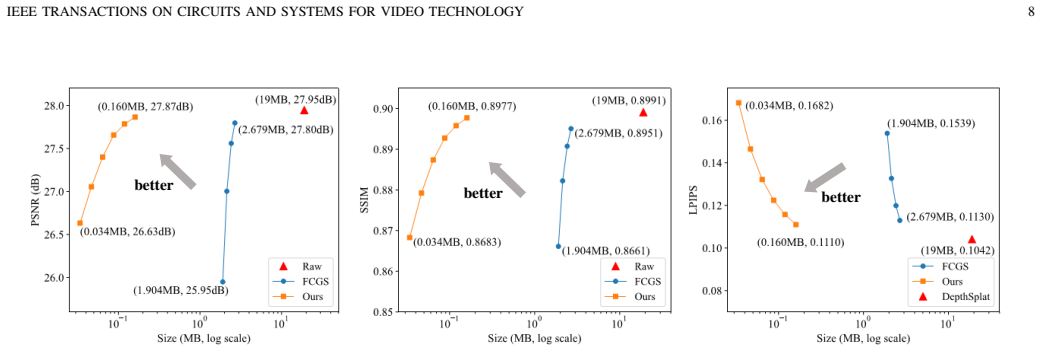
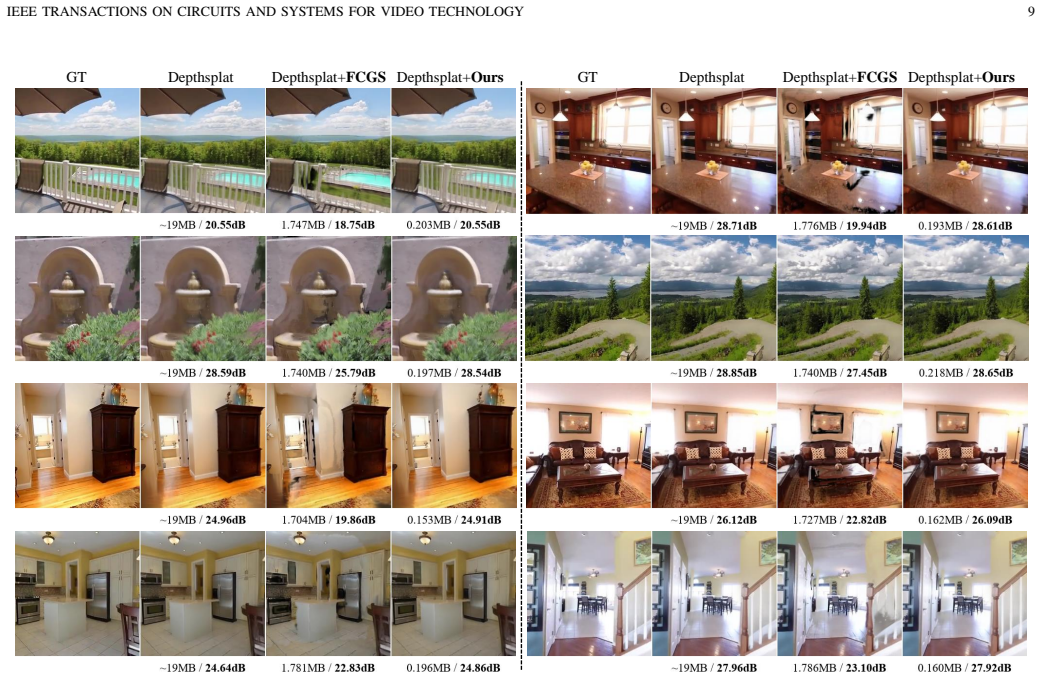
TinySplat claims that a feedforward-generated 3D Gaussian representation is a structured, image-like tensor whose redundancy can be removed by a training-free, fully reversible pipeline. The View-Projection Transform (VPT) maps Gaussian centers into the input camera space using the input camera intrinsics and extrinsics, so that positions become a depth map plus small offsets from pixel centers and scales are divided by depth; after this reversible mapping, the geometric channels are far more locally correlated and compress better. The Visibility-Aware Basis Reduction (VABR) handles color: it assigns each spherical-harmonic basis function a visibility weight by Monte Carlo sampling viewing directions through a 3x3 grid of rays per input view, scales the SH bases by those weights, and then keeps the top $k=6$ principal components of the scaled coefficient covariance matrix. The transformed features are quantized to 14-bit integers and each channel is encoded independently as a grayscale image with an off-the-shelf HEVC codec, with the inverse transforms restoring the original parameters exactly on the decoder side. On RealEstate10K and ACID with two input views, this reduces DepthSplat models from 19 MB to 0.166–0.181 MB and MVSplat models from 43 MB to 0.216–0.229 MB, with PSNR dropping no more than 0.08 dB.
Load-bearing premise
Everything VABR gains depends on the assumption that the viewing directions sampled by a sparse 3x3 grid of rays through each input image are representative of every viewpoint a user will actually render, so that the spherical-harmonic bases it discards are truly invisible.
Editorial extensions
If this is right
- Feedforward 3DGS models can be stored and transmitted at roughly one-hundredth of their original size with rendering quality within 0.1 dB of the uncompressed model.
- Because compression does not require training, the same framework can wrap any pixel-aligned feedforward 3DGS method, as demonstrated with DepthSplat and MVSplat.
- Encoding a scene takes about one second and decoding about 42 milliseconds, which brings compressed feedforward 3DGS close to real-time interactive use.
- Color coefficients consume the largest share of the bitstream at every quality level, so future compression gains should target the appearance model.
- The compression ratio remains above 50x with 4 and 6 input views on DL3DV, so adding views does not undermine the framework.
Reading between the lines
- A likely consequence the paper leaves implicit is that wide-baseline novel views will stress VABR, since its visibility weights are estimated from input-view rays; a direct test would measure rate-distortion as target views move beyond the input frustum.
- TinySplat's entropy analysis suggests a joint optimization of the inference network's output distribution could shrink the compressed size further, potentially by an order of magnitude, by making feature maps more codec-friendly rather than using generic HEVC.
- Treating each feature channel as an independent grayscale video leaves inter-channel correlations, especially among the six color basis channels, unexploited; a codec that models cross-channel dependencies should improve rate-distortion beyond what is reported.
- The fixed $k=6$ color dimension may be scene-dependent; scenes with highly multi-modal view distributions might need a larger $k$, and an adaptive $k$ per scene could trade size and quality more flexibly.
Editorial analysis
A structured set of objections, weighed in public.
Referee Report
Summary. TinySplat proposes a training-free compression framework for feedforward 3D Gaussian Splatting (3DGS) representations. Starting from per-view Gaussian feature maps generated by networks such as MVSplat and DepthSplat, the method applies (i) a View-Projection Transform (VPT) that maps geometric parameters into input camera space, (ii) a Visibility-Aware Basis Reduction (VABR) that computes scene-adaptive SH bases weighted by visibility over sampled view directions, and (iii) quantization plus HEVC encoding of each feature plane. The paper reports that on RealEstate10K and ACID, TinySplat reduces MVSplat/DepthSplat models to roughly 0.17–0.23 MB with PSNR drops of 0.04–0.08 dB, and that it surpasses the optimization-free FCGS baseline in storage and runtime. Ablations and additional DL3DV experiments are presented.
Significance. If the results hold, TinySplat is a practically important contribution: it is the first feedforward-compatible, optimization-free codec that exploits the peculiar pixel-aligned structure of feedforward 3DGS, with extremely low encode/decode overhead and a simple, reproducible design. The PCA-based VABR is an interesting idea, and the paper includes component ablations and rate-distortion comparisons. The main significance caveat is that the headline compression ratio is dataset-dependent: the claimed 'over 100x' is not achieved on DL3DV, and the VABR premise about valid view directions is only tested in the easy near-input-view regime.
major comments (4)
- [Abstract; Table III] The abstract and conclusion claim 'over 100x compression for 3D Gaussian data generated by feedforward methods', but Table III reports DL3DV results with ratios of only about 53.7x (33 MB to 0.615 MB), 51.8x (66 MB to 1.275 MB), and 52.9x (100 MB to 1.892 MB). The 100x claim is only supported by the Re10K/ACID numbers in Table I (e.g., DepthSplat Re10K: 19 MB to 0.166 MB). The claim should be qualified per dataset and per inference model, or the abstract should state that 100x is achieved specifically on Re10K/ACID.
- [Fig. 7; Section IV.C] The component-wise ablation disables VPT and VABR separately, but it does not include a control with both transforms disabled and only HEVC quantization/coding. Without this baseline, the reader cannot attribute the rate-distortion improvement to VPT and VABR versus the HEVC encoding itself. Please add a no-transform baseline to Fig. 7 and report the corresponding rates and PSNR.
- [Section III.D, Eq. (8)] VABR reduces the SH color space (e.g., 27 channels to k=6) based on visibility weights computed by casting rays through a coarse 3x3 grid over each input view. The paper itself states that the valid-direction region D is 'challenging to rigorously define', and all benchmarks place target views close to the input views. If novel views move well outside the sampled directions, the discarded SH dimensions can carry visible color variation, so the claim of 'negligible loss' is conditional on near-input viewing direction. Please provide an experiment with target views substantially displaced from the input frusta, or an analysis of how the rate-distortion tradeoff degrades with view displacement.
- [Table I; Section IV.A] No error bars or variance statistics are reported for the LPI/P S N R measures. The asserted quality advantage over FCGS is often small (e.g., PSNR differences of 0.1 dB or less), and without repeated experiments or per-scene standard deviations it is unclear whether these differences are meaningful. Please report standard deviations or significance tests over the test scenes.
minor comments (5)
- [Fig. 3; Fig. 4; Fig. 7] Several figures contain garbled or unreadable symbols (e.g., the SH function labels in Fig. 4 and the axes in Fig. 7), likely due to PDF font issues. These should be regenerated with standard math fonts.
- [Section III.D, Eq. (10)] The forward/inverse pair in Eq. (10) is not invertible when k<d, since W is d×k and W^T W is I_k while W W^T is a projection. The text should explicitly state that this is a lossy dimensionality reduction rather than a reversible transform, to avoid confusion with the invertible VPT.
- [Section IV.A, Table I] LPIPS for TinySplat is sometimes slightly worse than the raw model (e.g., DepthSplat ACID: 0.1501 vs 0.1417), while PSNR is nearly unchanged. The 'negligible loss' claim should be supported by discussing all three metrics together, not only PSNR.
- [Section IV, Implementation details; Table II] The values of alpha and Q_c are hand-tuned per channel. The 'training-free' claim is accurate in the sense of no learned parameters, but the paper should acknowledge more clearly that these hyperparameters are manually configured and may not generalize across datasets without retuning.
- [Reproducibility] The paper uses official implementations of MVSplat, DepthSplat, and FCGS, but does not provide code for TinySplat itself. Releasing the implementation would substantially strengthen the reproducibility of the reported bitrates and runtime numbers.
Circularity Check
No significant circularity: TinySplat is an adaptive transform codec with external evaluation, and VABR's basis is per-scene PCA rather than a fitted prediction.
full rationale
TinySplat is a training-free transform codec applied to feedforward 3D Gaussian representations. VPT is an invertible coordinate change (Eqs. 4-6) whose benefit is demonstrated empirically through distributions and ablations, not asserted by construction. VABR computes visibility weights from input-view ray directions (Eq. 8) and then forms a PCA-style basis from the weighted SH coefficient matrix (Eqs. 9-10), transmitting the basis as metadata. This is standard adaptive transform coding: the transform is derived from the data being compressed and is not a prediction fitted to the evaluation targets. The claimed compression ratios and quality are measured against external uncompressed models and the external FCGS baseline on standard benchmarks, so no fitted parameter is renamed as a prediction. The paper itself notes that the valid-direction region D is 'challenging to rigorously define' and approximates it with a 3x3 ray grid; that is an untested generalization assumption about novel-view distribution, not a circular derivation. The only apparent self-citation, [23] in the related-work list, is a non-load-bearing pointer. No circular step can be exhibited from the paper's equations or citation chain.
Assumptions & free parameters
free parameters (5)
- Reserved color feature dimension k =
6
- Quantization scale factor alpha per channel =
depth: 2048, xy: 256, scale: 256, rotation: 256, color: 1024, opacity: 256
- Per-channel QP offsets Q_c =
-4, 12, 0, 9, 3, 0
- Visibility sampling grid =
3x3 rays per input view
- Global QP Q_g =
0 for main results, varied in Fig. 5
assumptions (5)
- domain assumption Feedforward 3DGS networks (DepthSplat, MVSplat) produce pixel-aligned Gaussian feature maps where each output pixel corresponds to one Gaussian primitive in the input camera frustum.
- domain assumption The VPT rotation and scale approximations (Eq. 5-6) are reversibly invertible, so decoded parameters in world space are recovered exactly before quantization error.
- domain assumption Novel views in target applications are close to the input views, so visibility weights computed from input-view rays are representative.
- domain assumption The top-k principal components of the visibility-weighted SH coefficient covariance matrix preserve perceptually important color information.
- domain assumption HEVC intra coding of quantized feature maps as grayscale images is an effective spatial redundancy remover for the transformed Gaussian maps.
Cite this review
Pith. "Pith review of TinySplat: Feedforward Approach for Generating Compact 3D Scene Representation." pith.science (2026). https://pith.science/paper/VGNBPZLZ
@misc{pith2026250609479,
  author       = {Pith},
  title        = {Pith review of: TinySplat: Feedforward Approach for Generating Compact 3D Scene Representation},
  year         = {2026},
  howpublished = {\url{https://pith.science/paper/VGNBPZLZ}},
  note         = {Machine review of arXiv:2506.09479}
}
read the original abstract
The recent development of feedforward 3D Gaussian Splatting (3DGS) presents a new paradigm to reconstruct 3D scenes. Using neural networks trained on large-scale multi-view datasets, it can directly infer 3DGS representations from sparse input views. Although the feedforward approach achieves high reconstruction speed, it still suffers from the substantial storage cost of 3D Gaussians. Existing 3DGS compression methods relying on scene-wise optimization are not applicable due to architectural incompatibilities. To overcome this limitation, we propose TinySplat, a complete feedforward approach for generating compact 3D scene representations. Built upon standard feedforward 3DGS methods, TinySplat integrates a training-free compression framework that systematically eliminates key sources of redundancy. Specifically, we introduce View-Projection Transformation (VPT) to reduce geometric redundancy by projecting geometric parameters into a more compact space. We further present Visibility-Aware Basis Reduction (VABR), which mitigates perceptual redundancy by aligning feature energy along dominant viewing directions via basis transformation. Lastly, spatial redundancy is addressed through an off-the-shelf video codec. Comprehensive experimental results on multiple benchmark datasets demonstrate that TinySplat achieves over 100x compression for 3D Gaussian data generated by feedforward methods. Compared to the state-of-the-art compression approach, we achieve comparable quality with only 6% of the storage size. Meanwhile, our compression framework requires only 25% of the encoding time and 1% of the decoding time.
Figures


Figures from the paper (6 more)



Reference graph
Works this paper leans on
-
[1]
Reducing the memory footprint of 3d gaussian splatting,
P. Papantonakis, G. Kopanas, B. Kerbl, A. Lanvin, and G. Drettakis, “Reducing the memory footprint of 3d gaussian splatting,” inProceed- ings of the ACM on Computer Graphics and Interactive Techniques, vol. 7, no. 1, 2024, pp. 1–17
work page 2024
-
[2]
Compact 3d gaussian representation for radiance field,
J. C. Lee, D. Rho, X. Sun, J. H. Ko, and E. Park, “Compact 3d gaussian representation for radiance field,” inProceedings of the IEEE/CVF Conference on Computer Vision and Pattern Recognition, 2024, pp. 21 719–21 728
2024
-
[3]
Lapisgs: Layered progressive 3d gaussian splatting for adaptive streaming,
Y . Shi, G. Morin, S. Gasparini, and W. T. Ooi, “Lapisgs: Layered progressive 3d gaussian splatting for adaptive streaming,”arXiv preprint arXiv:2408.14823, 2024
arXiv 2024
-
[4]
End-to- end rate-distortion optimized 3d gaussian representation,
H. Wang, H. Zhu, T. He, R. Feng, J. Deng, J. Bian, and Z. Chen, “End-to- end rate-distortion optimized 3d gaussian representation,” inComputer Vision–ECCV 2024. Springer, 2024, pp. 76–92. IEEE TRANSACTIONS ON CIRCUITS AND SYSTEMS FOR VIDEO TECHNOLOGY 11
work page 2024
-
[5]
Lightgaussian: Unbounded 3d gaussian compression with 15x reduction and 200+ fps,
Z. Fan, K. Wang, K. Wen, Z. Zhu, D. Xu, and Z. Wang, “Lightgaussian: Unbounded 3d gaussian compression with 15x reduction and 200+ fps,” inAdvances in Neural Information Processing Systems, A. Globerson, L. Mackey, D. Belgrave, A. Fan, U. Paquet, J. Tomczak, and C. Zhang, Eds., vol. 37. Curran Associates, Inc., 2024, pp. 140 138–140 158
work page 2024
-
[6]
Scaffold-gs: Structured 3d gaussians for view-adaptive rendering,
T. Lu, M. Yu, L. Xu, Y . Xiangli, L. Wang, D. Lin, and B. Dai, “Scaffold-gs: Structured 3d gaussians for view-adaptive rendering,” in Proceedings of the IEEE/CVF Conference on Computer Vision and Pattern Recognition, 2024, pp. 20 654–20 664
2024
-
[7]
Hicom: Hierarchical coherent motion for dynamic streamable scenes with 3d gaussian splat- ting,
Q. Gao, J. Meng, C. Wen, J. Chen, and J. Zhang, “Hicom: Hierarchical coherent motion for dynamic streamable scenes with 3d gaussian splat- ting,” inAdvances in Neural Information Processing Systems, vol. 37, 2024, pp. 80 609–80 633
work page 2024
-
[8]
Compressing streamable free-viewpoint videos to 0.1 mb per frame,
L. Tang, J. Yang, R. Peng, Y . Zhai, S. Shen, and R. Wang, “Compressing streamable free-viewpoint videos to 0.1 mb per frame,” inProceedings of the AAAI Conference on Artificial Intelligence, vol. 39, no. 7, 2025, pp. 7257–7265
work page 2025
Show all 61 references
-
[9]
HAC: Hash-grid assisted context for 3d gaussian splatting compression,
Y . Chen, Q. Wu, W. Lin, M. Harandi, and J. Cai, “HAC: Hash-grid assisted context for 3d gaussian splatting compression,” inComputer Vision–ECCV 2024. Springer, 2024, pp. 422–438
2024
-
[10]
Contextgs: Compact 3d gaussian splatting with anchor level context model,
Y . Wang, Z. Li, L. Guo, W. Yang, A. Kot, and B. Wen, “Contextgs: Compact 3d gaussian splatting with anchor level context model,” in Advances in Neural Information Processing Systems, vol. 37, 2024, pp. 51 532–51 551
2024
-
[11]
Fast feedforward 3d gaussian splatting compression,
Y . Chen, Q. Wu, M. Li, W. Lin, M. Harandi, and J. Cai, “Fast feedforward 3d gaussian splatting compression,”arXiv preprint arXiv:2410.08017, 2024
2024 arXiv
-
[12]
Depthsplat: Connecting gaussian splatting and depth,
H. Xu, S. Peng, F. Wang, H. Blum, D. Barath, A. Geiger, and M. Pollefeys, “Depthsplat: Connecting gaussian splatting and depth,” arXiv preprint arXiv:2410.13862, 2024
2024 arXiv
-
[13]
Nerf: Representing scenes as neural radiance fields for view synthesis,
B. Mildenhall, P. P. Srinivasan, M. Tancik, J. T. Barron, R. Ramamoorthi, and R. Ng, “Nerf: Representing scenes as neural radiance fields for view synthesis,”Communications of the ACM, vol. 65, no. 1, pp. 99–106, 2021
2021
-
[14]
Instant neural graphics primitives with a multiresolution hash encoding,
T. M ¨uller, A. Evans, C. Schied, and A. Keller, “Instant neural graphics primitives with a multiresolution hash encoding,”ACM Transactions on Graphics, vol. 41, no. 4, pp. 1–15, 2022
2022
-
[15]
Direct voxel grid optimization: Super- fast convergence for radiance fields reconstruction,
C. Sun, M. Sun, and H.-T. Chen, “Direct voxel grid optimization: Super- fast convergence for radiance fields reconstruction,” inProceedings of the IEEE/CVF Conference on Computer Vision and Pattern Recognition, 2022, pp. 5459–5469
2022
-
[16]
Plenoxels: Radiance fields without neural networks,
S. Fridovich-Keil, A. Yu, M. Tancik, Q. Chen, B. Recht, and A. Kanazawa, “Plenoxels: Radiance fields without neural networks,” inProceedings of the IEEE/CVF Conference on Computer Vision and Pattern Recognition, 2022, pp. 5501–5510
2022
-
[17]
K-planes: Explicit radiance fields in space, time, and appearance,
S. Fridovich-Keil, G. Meanti, F. R. Warburg, B. Recht, and A. Kanazawa, “K-planes: Explicit radiance fields in space, time, and appearance,” inProceedings of the IEEE/CVF Conference on Computer Vision and Pattern Recognition, 2023, pp. 12 479–12 488
2023
-
[18]
Tensorf: Tensorial radiance fields,
A. Chen, Z. Xu, A. Geiger, J. Yu, and H. Su, “Tensorf: Tensorial radiance fields,” inComputer Vision–ECCV 2022, 2022, pp. 333–350
2022
-
[19]
Plenoctrees for real-time rendering of neural radiance fields,
A. Yu, R. Li, M. Tancik, H. Li, R. Ng, and A. Kanazawa, “Plenoctrees for real-time rendering of neural radiance fields,” inProceedings of the IEEE/CVF International Conference on Computer Vision, 2021, pp. 5752–5761
2021
-
[20]
3d gaussian splatting for real-time radiance field rendering
B. Kerbl, G. Kopanas, T. Leimk ¨uhler, and G. Drettakis, “3d gaussian splatting for real-time radiance field rendering.”ACM Transactions on Graphics, vol. 42, no. 4, pp. 139–1, 2023
2023
-
[21]
Colmap- free 3d gaussian splatting,
Y . Fu, S. Liu, A. Kulkarni, J. Kautz, A. A. Efros, and X. Wang, “Colmap- free 3d gaussian splatting,” inProceedings of the IEEE/CVF Conference on Computer Vision and Pattern Recognition, 2024, pp. 20 796–20 805
2024
-
[22]
3dgs- avatar: Animatable avatars via deformable 3d gaussian splatting,
Z. Qian, S. Wang, M. Mihajlovic, A. Geiger, and S. Tang, “3dgs- avatar: Animatable avatars via deformable 3d gaussian splatting,” in Proceedings of the IEEE/CVF Conference on Computer Vision and Pattern Recognition, 2024, pp. 5020–5030
2024
-
[23]
Mirror- 3dgs: Incorporating mirror reflections into 3d gaussian splatting,
J. Meng, H. Li, Y . Wu, Q. Gao, S. Yang, J. Zhang, and S. Ma, “Mirror- 3dgs: Incorporating mirror reflections into 3d gaussian splatting,” in Proceedings of the IEEE International Conference on Visual Communi- cations and Image Processing. IEEE, 2024, pp. 1–5
2024
-
[24]
Mip-splatting: Alias-free 3d gaussian splatting,
Z. Yu, A. Chen, B. Huang, T. Sattler, and A. Geiger, “Mip-splatting: Alias-free 3d gaussian splatting,” inProceedings of the IEEE/CVF Conference on Computer Vision and Pattern Recognition, 2024, pp. 19 447–19 456
2024
-
[25]
Regnerf: Regularizing neural radiance fields for view synthesis from sparse inputs,
M. Niemeyer, J. T. Barron, B. Mildenhall, M. S. Sajjadi, A. Geiger, and N. Radwan, “Regnerf: Regularizing neural radiance fields for view synthesis from sparse inputs,” inProceedings of the IEEE/CVF Conference on Computer Vision and Pattern Recognition, 2022, pp. 5480–5490
2022
-
[26]
Sparf: Neural radiance fields from sparse and noisy poses,
P. Truong, M.-J. Rakotosaona, F. Manhardt, and F. Tombari, “Sparf: Neural radiance fields from sparse and noisy poses,” inProceedings of the IEEE/CVF Conference on Computer Vision and Pattern Recognition, 2023, pp. 4190–4200
2023
-
[27]
Cor-gs: sparse-view 3d gaussian splatting via co-regularization,
J. Zhang, J. Li, X. Yu, L. Huang, L. Gu, J. Zheng, and X. Bai, “Cor-gs: sparse-view 3d gaussian splatting via co-regularization,” inComputer Vision–ECCV 2024. Springer, 2024, pp. 335–352
2024
-
[28]
Dngaussian: Optimizing sparse-view 3d gaussian radiance fields with global-local depth normalization,
J. Li, J. Zhang, X. Bai, J. Zheng, X. Ning, J. Zhou, and L. Gu, “Dngaussian: Optimizing sparse-view 3d gaussian radiance fields with global-local depth normalization,” inProceedings of the IEEE/CVF Conference on Computer Vision and Pattern Recognition, 2024, pp. 20 775–20 785
2024
-
[29]
Binocular-guided 3d gaussian splatting with view consistency for sparse view synthesis,
L. Han, J. Zhou, Y .-S. Liu, and Z. Han, “Binocular-guided 3d gaussian splatting with view consistency for sparse view synthesis,”arXiv preprint arXiv:2410.18822, 2024
2024 arXiv
-
[30]
pixelsplat: 3d gaussian splats from image pairs for scalable generalizable 3d recon- struction,
D. Charatan, S. L. Li, A. Tagliasacchi, and V . Sitzmann, “pixelsplat: 3d gaussian splats from image pairs for scalable generalizable 3d recon- struction,” inProceedings of the IEEE/CVF Conference on Computer Vision and Pattern Recognition, 2024, pp. 19 457–19 467
2024
-
[31]
Mvsnerf: Fast generalizable radiance field reconstruction from multi-view stereo,
A. Chen, Z. Xu, F. Zhao, X. Zhang, F. Xiang, J. Yu, and H. Su, “Mvsnerf: Fast generalizable radiance field reconstruction from multi-view stereo,” inProceedings of the IEEE/CVF International Conference on Computer Vision, 2021, pp. 14 124–14 133
2021
-
[32]
Explicit correspondence matching for generalizable neural radiance fields,
Y . Chen, H. Xu, Q. Wu, C. Zheng, T.-J. Cham, and J. Cai, “Explicit correspondence matching for generalizable neural radiance fields,”arXiv preprint arXiv:2304.12294, 2023
2023 arXiv
-
[33]
Flash3d: Feed-forward gener- alisable 3d scene reconstruction from a single image,
S. Szymanowicz, E. Insafutdinov, C. Zheng, D. Campbell, J. F. Hen- riques, C. Rupprecht, and A. Vedaldi, “Flash3d: Feed-forward gener- alisable 3d scene reconstruction from a single image,”arXiv preprint arXiv:2406.04343, 2024
2024 arXiv
-
[34]
Murf: multi-baseline radiance fields,
H. Xu, A. Chen, Y . Chen, C. Sakaridis, Y . Zhang, M. Pollefeys, A. Geiger, and F. Yu, “Murf: multi-baseline radiance fields,” inPro- ceedings of the IEEE/CVF Conference on Computer Vision and Pattern Recognition, 2024, pp. 20 041–20 050
2024
-
[35]
Mvsplat: Efficient 3d gaussian splatting from sparse multi-view images,
Y . Chen, H. Xu, C. Zheng, B. Zhuang, M. Pollefeys, A. Geiger, T.-J. Cham, and J. Cai, “Mvsplat: Efficient 3d gaussian splatting from sparse multi-view images,” inComputer Vision–ECCV 2024. Springer, 2024, pp. 370–386
2024
-
[36]
No pose, no problem: Surprisingly simple 3d gaussian splats from sparse unposed images,
B. Ye, S. Liu, H. Xu, X. Li, M. Pollefeys, M.-H. Yang, and S. Peng, “No pose, no problem: Surprisingly simple 3d gaussian splats from sparse unposed images,”arXiv preprint arXiv:2410.24207, 2024
2024 arXiv
-
[37]
Cat3d: Create anything in 3d with multi-view diffusion models,
R. Gao, A. Holynski, P. Henzler, A. Brussee, R. Martin-Brualla, P. Srini- vasan, J. T. Barron, and B. Poole, “Cat3d: Create anything in 3d with multi-view diffusion models,”arXiv preprint arXiv:2405.10314, 2024
2024 arXiv
-
[38]
Reconfusion: 3d reconstruction with diffusion priors,
R. Wu, B. Mildenhall, P. Henzler, K. Park, R. Gao, D. Watson, P. P. Srinivasan, D. Verbin, J. T. Barron, B. Pooleet al., “Reconfusion: 3d reconstruction with diffusion priors,” inProceedings of the IEEE/CVF Conference on Computer Vision and Pattern Recognition, 2024, pp. 21 551–21 561
2024
-
[39]
Gs-lrm: Large reconstruction model for 3d gaussian splatting,
K. Zhang, S. Bi, H. Tan, Y . Xiangli, N. Zhao, K. Sunkavalli, and Z. Xu, “Gs-lrm: Large reconstruction model for 3d gaussian splatting,” inComputer Vision–ECCV 2024. Springer, 2024, pp. 1–19
2024
-
[40]
3dgs-enhancer: Enhancing unbounded 3d gaussian splatting with view-consistent 2d diffusion priors,
X. Liu, C. Zhou, and S. Huang, “3dgs-enhancer: Enhancing unbounded 3d gaussian splatting with view-consistent 2d diffusion priors,” in Advances in Neural Information Processing Systems, vol. 37, 2024, pp. 133 305–133 327
2024
-
[41]
One-2-3-45++: Fast single image to 3d objects with consistent multi-view generation and 3d diffusion,
M. Liu, R. Shi, L. Chen, Z. Zhang, C. Xu, X. Wei, H. Chen, C. Zeng, J. Gu, and H. Su, “One-2-3-45++: Fast single image to 3d objects with consistent multi-view generation and 3d diffusion,” inProceedings of the IEEE/CVF Conference on Computer Vision and Pattern Recognition, 20...
2024
-
[42]
Mvsplat360: Feed-forward 360 scene synthesis from sparse views,
Y . Chen, C. Zheng, H. Xu, B. Zhuang, A. Vedaldi, T.-J. Cham, and J. Cai, “Mvsplat360: Feed-forward 360 scene synthesis from sparse views,”arXiv preprint arXiv:2411.04924, 2024
2024 arXiv
-
[43]
Splatter image: Ultra- fast single-view 3d reconstruction,
S. Szymanowicz, C. Rupprecht, and A. Vedaldi, “Splatter image: Ultra- fast single-view 3d reconstruction,” inProceedings of the IEEE/CVF Conference on Computer Vision and Pattern Recognition, 2024, pp. 10 208–10 217
2024
-
[44]
Lgm: Large multi-view gaussian model for high-resolution 3d content creation,
J. Tang, Z. Chen, X. Chen, T. Wang, G. Zeng, and Z. Liu, “Lgm: Large multi-view gaussian model for high-resolution 3d content creation,” in Computer Vision–ECCV 2024. Springer, 2024, pp. 1–18
2024
-
[45]
Gps-gaussian+: Generalizable pixel-wise 3d gaussian splatting for real-time human-scene rendering from sparse views,
B. Zhou, S. Zheng, H. Tu, R. Shao, B. Liu, S. Zhang, L. Nie, and Y . Liu, “Gps-gaussian+: Generalizable pixel-wise 3d gaussian splatting for real-time human-scene rendering from sparse views,”arXiv preprint arXiv:2411.11363, 2024. IEEE TRANSACTIONS ON CIRCUITS AND SYSTEMS FOR ...
2024 arXiv
-
[46]
Gps-gaussian: Generalizable pixel-wise 3d gaussian splatting for real- time human novel view synthesis,
S. Zheng, B. Zhou, R. Shao, B. Liu, S. Zhang, L. Nie, and Y . Liu, “Gps-gaussian: Generalizable pixel-wise 3d gaussian splatting for real- time human novel view synthesis,” inProceedings of the IEEE/CVF Conference on Computer Vision and Pattern Recognition, 2024, pp. 19 680–19 690
2024
-
[47]
Grm: Large gaussian reconstruction model for efficient 3d reconstruction and generation,
Y . Xu, Z. Shi, W. Yifan, H. Chen, C. Yang, S. Peng, Y . Shen, and G. Wetzstein, “Grm: Large gaussian reconstruction model for efficient 3d reconstruction and generation,” inComputer Vision–ECCV 2024. Springer, 2024, pp. 1–20
2024
-
[48]
Lara: Effi- cient large-baseline radiance fields,
A. Chen, H. Xu, S. Esposito, S. Tang, and A. Geiger, “Lara: Effi- cient large-baseline radiance fields,” inComputer Vision–ECCV 2024. Springer, 2024, pp. 338–355
2024
-
[49]
Latentsplat: Autoencoding variational gaussians for fast generalizable 3d reconstruc- tion,
C. Wewer, K. Raj, E. Ilg, B. Schiele, and J. E. Lenssen, “Latentsplat: Autoencoding variational gaussians for fast generalizable 3d reconstruc- tion,” inComputer Vision–ECCV 2024. Springer, 2024, pp. 456–473
2024
-
[50]
Epipolar-free 3d gaus- sian splatting for generalizable novel view synthesis,
Z. Min, Y . Luo, J. Sun, and Y . Yang, “Epipolar-free 3d gaus- sian splatting for generalizable novel view synthesis,”arXiv preprint arXiv:2410.22817, 2024
2024 arXiv
-
[51]
Pref3r: Pose-free feed-forward 3d gaussian splatting from variable-length image sequence,
Z. Chen, J. Yang, and H. Yang, “Pref3r: Pose-free feed-forward 3d gaussian splatting from variable-length image sequence,”arXiv preprint arXiv:2411.16877, 2024
2024 arXiv
-
[52]
Gaussian graph network: Learning efficient and generalizable gaussian representations from multi-view images,
S. Zhang, X. Fei, F. Liu, H. Song, and Y . Duan, “Gaussian graph network: Learning efficient and generalizable gaussian representations from multi-view images,” inAdvances in Neural Information Processing Systems, vol. 37, 2024, pp. 50 361–50 380
2024
-
[53]
Compgs: Smaller and faster gaussian splatting with vector quantization,
K. Navaneet, K. Pourahmadi Meibodi, S. Abbasi Koohpayegani, and H. Pirsiavash, “Compgs: Smaller and faster gaussian splatting with vector quantization,” inComputer Vision–ECCV 2024. Springer, 2024, pp. 330–349
2024
-
[54]
Compact 3d scene representation via self-organizing gaussian grids,
W. Morgenstern, F. Barthel, A. Hilsmann, and P. Eisert, “Compact 3d scene representation via self-organizing gaussian grids,” inComputer Vision–ECCV 2024. Springer, 2024, pp. 18–34
2024
-
[55]
Compression of 3d gaussian splatting with optimized feature planes and standard video codecs,
S. Lee, F. Shu, Y . Sanchez, T. Schierl, and C. Hellge, “Compression of 3d gaussian splatting with optimized feature planes and standard video codecs,”arXiv preprint arXiv:2501.03399, 2025
2025 arXiv
-
[56]
HAC++: To- wards 100X Compression of 3D Gaussian Splatting,
Y . Chen, Q. Wu, W. Lin, M. Harandi, and J. Cai, “HAC++: To- wards 100X Compression of 3D Gaussian Splatting,”arXiv preprint arXiv:2501.12255, 2025
2025 arXiv
-
[57]
Stereo magnification: Learning view synthesis using multiplane images,
T. Zhou, R. Tucker, J. Flynn, G. Fyffe, and N. Snavely, “Stereo magnification: Learning view synthesis using multiplane images,”arXiv preprint arXiv:1805.09817, 2018
2018 arXiv
-
[58]
Infinite nature: Perpetual view generation of natural scenes from a single image,
A. Liu, R. Tucker, V . Jampani, A. Makadia, N. Snavely, and A. Kanazawa, “Infinite nature: Perpetual view generation of natural scenes from a single image,” inProceedings of the IEEE/CVF Inter- national Conference on Computer Vision, 2021, pp. 14 458–14 467
2021
-
[59]
A highly parallelized H.265/HEVC real-time UHD software encoder,
T. K. Heng, W. Asano, T. Itoh, A. Tanizawa, J. Yamaguchi, T. Matsuo, and T. Kodama, “A highly parallelized H.265/HEVC real-time UHD software encoder,” inProceedings of the IEEE International Conference on Image Processing. IEEE, 2014, pp. 1213–1217
2014
-
[60]
Algorithm and architecture design of the h.265/hevc intra encoder,
G. Pastuszak and A. Abramowski, “Algorithm and architecture design of the h.265/hevc intra encoder,”IEEE Transactions on Circuits and Systems for Video Technology, vol. 26, no. 1, pp. 210–222, 2016
2016
-
[61]
HEVC Complexity and Implementation Analysis,
F. Bossen, B. Bross, K. Suhring, and D. Flynn, “HEVC Complexity and Implementation Analysis,”IEEE Transactions on Circuits and Systems for Video Technology, vol. 22, no. 12, pp. 1685–1696, 2012
2012
Reviewed August 7, 2026 · model on record in the stance chip above.
Discussion (0). Sign in to comment.