REVIEW 2 major objections 5 minor 31 references
Generalized Gaussian Entropy Model for Point Cloud Attribute Compression with Dynamic Likelihood Intervals
T0 review · 2 major / 5 minor · reviewed 2026-08-07 · deepseek-v4-flash
Pith's one-line read Replacing Gaussian and Laplacian latent models with a learned-shape generalized Gaussian and dynamically adjusted likelihood intervals cuts average bitrate by up to 11.46 percent in three point-cloud attribute codecs.
desk verdict A solid, incremental compression paper whose main modeling worry disappears on inspection; the remaining issues are empirical reproducibility and a few specification gaps. read the letter →
The pith
A machine-rendered reading of the paper's core claim, the machinery that carries it, and where it could break.
The reading
What carries the argument
The load-bearing object is the generalized Gaussian entropy model $G(\mu_i,\sigma_i,\beta_i)$, where $\beta$ controls the tail shape ($\beta=1$ is Laplacian, $\beta=2$ is Gaussian), together with the Mean Error Discriminator $d_{\mathrm{me}}$, which outputs $\pi_i = P(\hat{y}_i = \lfloor \mu_i \rceil)$ from context and entropy parameters. The discriminator's output feeds Eq. 25 to compute the central interval width $\delta_i$, and Eq. 26 translates neighboring intervals, thereby defining the discrete likelihood table used by arithmetic coding. This dynamic interval mechanism is what allows a single continuous density to assign more probability to informative integer outcomes.
What would settle it
Compute $S=\sum_{n\in\mathbb{Z}} [G(\mu,\sigma,\beta)\ast \mathrm{LI}(\mu,\sigma,\pi)](n)$ over a grid of $(\mu,\sigma,\pi)$ using the interval definitions of Eqs. 23-26; any $S\neq 1$ invalidates the arithmetic-coding distribution and would break the reported results under a correct implementation.
Extended reading notes
Core claim
The paper establishes that the mean and scale emitted by an entropy network are themselves unused predictions: the optimal scale for a latent is close to the absolute residual between the latent and the mean, so a large scale flags a failed mean prediction. The paper exploits this by modeling latents with a generalized Gaussian density, using a second context module to predict the shape parameter, and using a Mean Error Discriminator to estimate the probability that the latent equals its rounded mean. That probability sets a scaling factor that narrows or widens the central likelihood interval and shifts all other integer intervals toward or away from the center, producing a discrete probability table better matched to the true latent distribution. On the three tested codecs the combination improves rate-distortion performance, with the largest gains on the weakest baseline.
Load-bearing premise
The scheme assumes the scaled and translated likelihood intervals in Eqs. 23-26 partition the number line, so the discrete probabilities sum to one and arithmetic coding is well-defined; if that partition fails, the codec is invalid no matter the reported gains.
Editorial extensions
If this is right
- A VAE-based point cloud codec can be upgraded by adding a shape-prediction branch and a Mean Error Discriminator branch while keeping the pre-trained autoencoder frozen, so the method is a drop-in entropy-coding improvement.
- The gains imply that the half-unit likelihood interval used by standard learned codecs is itself a rate bottleneck, separate from the choice of the continuous density.
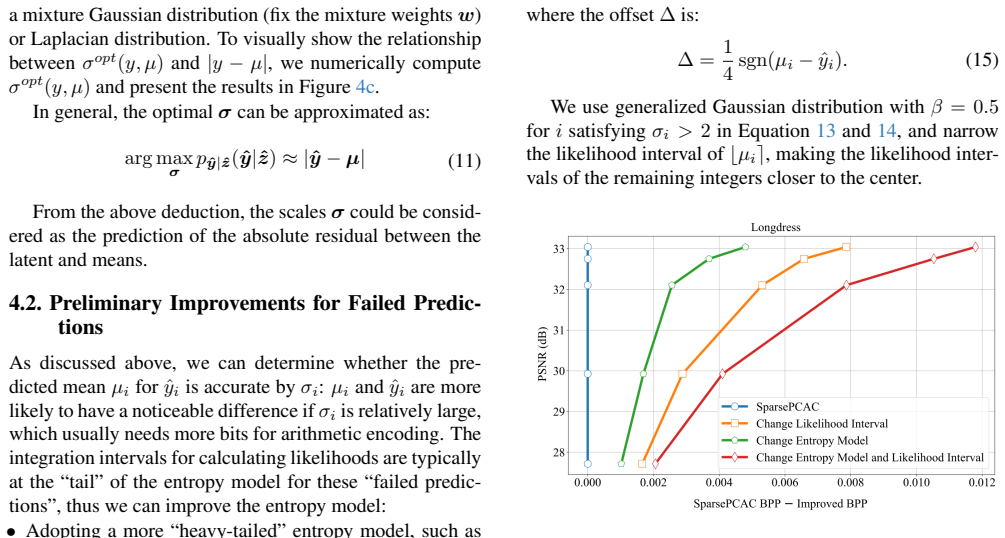
- On SparsePCAC the two mechanisms are roughly additive in the ablations, with about 5.6 percent from the generalized Gaussian alone and 6.8 percent from dynamic intervals alone, suggesting both should be kept.
- Because the generalized Gaussian contains the Laplacian and Gaussian as special cases, the model can degrade gracefully to baseline behavior when the learned shape is uninformative.
Reading between the lines
- A testable extension the paper leaves implicit is to apply the interval-scaling rule to image or video latents using only existing mean and scale predictions, which would isolate how much of the gain comes from the Mean Error Discriminator versus the scaling rule itself.
- The paper's finding that optimal scale approximates the absolute residual suggests a broader design principle: entropy parameters could be trained as explicit predictors of error magnitude, possibly replacing the second context network with a single residual-prediction head.
- The reported ordering of gains across baselines, largest for the weakest entropy model, suggests the benefit should shrink as base entropy models improve; verifying this on a stronger codec would test whether the method's headroom is tied to entropy-estimation quality.
Editorial analysis
A structured set of objections, weighed in public.
Referee Report
Summary. This paper proposes a generalized Gaussian entropy model for learned point cloud attribute compression, in which the shape parameter β is predicted from context, and a Mean Error Discriminator (MED) that dynamically scales the likelihood interval of the rounded mean based on a predicted accuracy measure π. The method is applied to three VAE-based baselines—SparsePCAC, TSC-PCAC, and SPAC—and the authors report average BD-BR reductions of 11.46% for SparsePCAC, 9.51% for TSC-PCAC, and 6.11% for SPAC, with ablations showing both the generalized Gaussian model and the dynamic likelihood intervals contribute to the gains.
Significance. If the reported results are correct, the paper makes a useful contribution to learned point cloud attribute compression: it shows that a more flexible entropy model and data-dependent likelihood intervals can improve arithmetic coding, and the gains are consistent across three baselines. The proposed modules are lightweight and the two-step training strategy is a practical way to retrofit existing codecs. However, the manuscript lacks a precise definition of the training-time likelihood used in Eq. (28), and the exploratory experiment in Section 4 is evaluated on the same test sequences later used for the final tables, which introduces a risk of selection bias. These issues must be resolved before the empirical claims are fully supported.
major comments (2)
- [Section 5.4 / Eq. (28)] The loss is written with yhat_i continuous during training, since Section 3.1 says quantization is replaced by adding U(-1/2,1/2) noise. But the dynamic likelihood intervals LI(n|...) in Eqs. (23)-(26) are defined only for integer n and are not a shift-invariant convolution kernel. Therefore [G * LI](yhat_i) is not a well-defined density for non-integer yhat_i under the standard convolution convention in Eq. (21). If the intended evaluation is the integral over the interval I_n that contains yhat_i, the objective is piecewise constant in yhat_i and provides no gradient to the encoder; if a smooth surrogate is used, it is not described. Please specify exactly how Eq. (28) is computed during training and justify that it is a valid surrogate for the discrete arithmetic-coding table used at test time. Without this, the reported rate-distortion gains are not reproducible from the paper.
- [Section 4 / Figure 5] The preliminary experiment hand-sets the threshold sigma_i > 2, the generalized Gaussian shape beta = 0.5, and the interval offset Delta = 1/4 by inspecting performance on the same nine test sequences that are later used for Tables 3 and 4, with no separate validation set. Because the final architecture and design decisions are motivated by this experiment, the final average gains may include selection bias. Please either reserve a validation set for design choices or report the sensitivity of the final results to the preliminary hand-set hyperparameters.
minor comments (5)
- [Section 5.2 / Eq. (25)] The sentence after Eq. (25) is inconsistent with the equation: for pi_i >= 1/2, Eq. (25) gives delta_i >= 1, i.e., the central interval is stretched, while the text says it is shortened. Please reverse the wording for the two cases.
- [Section 5.2 / Eqs. (21)-(26)] The notation U(a,b)(n) is nonstandard: it is used as if it means the integral over [n+a, n+b] of the entropy density. Please define this convention explicitly near Eq. (21). With that convention, I checked the concern that the dynamic intervals fail to partition the real line: the intervals in Eqs. (23)-(26) are contiguous and cover R, so the arithmetic-coding distribution is valid.
- [Section 6.6 / Table 5] Table 5 shows that encoding and decoding times are roughly doubled for SparsePCAC and SPAC, yet Section 6.6 says the method does not significantly affect parallelism. This understates the computational overhead; please describe the overhead more precisely.
- [Section 5.1 / Eqs. (17)-(22)] Please specify how beta_i and pi_i are constrained to their valid ranges (e.g., beta_i > 0 and pi_i in [0,1]) and whether d_me receives any supervision or is trained purely through the rate-distortion loss.
- [Throughout] Minor typographical issues include 'Datastes' and 'traning' in Section 6.1, 'Methos' in the Table 5 caption, and 'Scool' in the author affiliation. Please proofread.
Circularity Check
No significant circularity: the dynamic-interval scheme is a genuine partition, and the RD gains are measured on held-out sequences.
full rationale
The paper's central claim—that a learned generalized Gaussian entropy model and MED-based dynamic likelihood intervals improve RD performance on three VAE-based point cloud attribute codecs—does not reduce to its inputs by construction. The entropy parameters (μ,σ) are inherited from each baseline, β is estimated by a separate context model h_ep, and π is estimated by MED d_me; none of these is defined in terms of the final bitrate or the reported BD-BR gains. The dynamic interval formulas (Eqs. 23–26) define disjoint, contiguous intervals: for k=⌊μ⌉, I_k=[k−δ/2,k+δ/2]; for n>k, I_n=[n+δ/2−1,n+δ/2]; for n<k, I_n=[n−δ/2,n−δ/2+1]. Since δ_i>0 by Eq. 24, these tile R and the probabilities sum to ∫G(y)dy=1, so the arithmetic-coding distribution is well-defined; the prose after Eq. 25 reverses stretch/squeeze, but the equations govern. The two-step training evaluates on nine held-out 8iVFBv2/MVUB sequences, so the improvements are measured rather than baked in. The self-citations ([7], [14], [15], [21]) appear only as related-work or standard references and do not carry the derivation of the new entropy model or interval scheme. No fitted parameter is renamed as a prediction, and no equation is equivalent to the reported RD result by construction.
Assumptions & free parameters
free parameters (4)
- Preliminary failure threshold (sigma_i > 2) =
2
- Preliminary generalized Gaussian shape beta =
0.5
- Preliminary interval offset Delta =
1/4
- Dynamic interval scaling bounds =
1/(1+sigma_i) to 1/(1-exp(-sigma_i))
assumptions (5)
- domain assumption Latents y are modeled by a generalized Gaussian distribution G(mu, sigma, beta) whose parameters are estimated by neural networks from hyperpriors and context.
- domain assumption Quantization can be approximated by additive uniform noise U(-1/2, 1/2) during training.
- domain assumption The entropy model scale sigma approximates the optimal scale |y-mu|, so larger sigma indicates less accurate mean prediction.
- ad hoc to paper The likelihood intervals defined in Eq 26 form a valid probability partition for every (mu, sigma, pi).
- domain assumption Shape beta and interval probability pi for latent i can be estimated from previously decoded latents only (context |y-mu|_{<i}), keeping the coding causal.
invented entities (1)
-
Mean Error Discriminator (d_me)
Cite this review
Pith. "Pith review of Generalized Gaussian Entropy Model for Point Cloud Attribute Compression with Dynamic Likelihood Intervals." pith.science (2026). https://pith.science/paper/PACNKYYA
@misc{pith2026250609510,
  author       = {Pith},
  title        = {Pith review of: Generalized Gaussian Entropy Model for Point Cloud Attribute Compression with Dynamic Likelihood Intervals},
  year         = {2026},
  howpublished = {\url{https://pith.science/paper/PACNKYYA}},
  note         = {Machine review of arXiv:2506.09510}
}
read the original abstract
Gaussian and Laplacian entropy models are proved effective in learned point cloud attribute compression, as they assist in arithmetic coding of latents. However, we demonstrate through experiments that there is still unutilized information in entropy parameters estimated by neural networks in current methods, which can be used for more accurate probability estimation. Thus we introduce generalized Gaussian entropy model, which controls the tail shape through shape parameter to more accurately estimate the probability of latents. Meanwhile, to the best of our knowledge, existing methods use fixed likelihood intervals for each integer during arithmetic coding, which limits model performance. We propose Mean Error Discriminator (MED) to determine whether the entropy parameter estimation is accurate and then dynamically adjust likelihood intervals. Experiments show that our method significantly improves rate-distortion (RD) performance on three VAE-based models for point cloud attribute compression, and our method can be applied to other compression tasks, such as image and video compression.
Figures


Figures from the paper (6 more)



Reference graph
Works this paper leans on
-
[1]
8i voxelized full bodies version 2 – a voxelized point cloud dataset
8i Labs. 8i voxelized full bodies version 2 – a voxelized point cloud dataset. ISO/IEC JTC1/SC29 Joint WG11/WG1 (MPEG/JPEG) input document, 2017. 1, 6
work page 2017
-
[2]
Variational image compression with a scale hyperprior.arXiv preprint arXiv:1802.01436,
Johannes Ball ´e, David Minnen, Saurabh Singh, Sung Jin Hwang, and Nick Johnston. Variational image compression with a scale hyperprior.arXiv preprint arXiv:1802.01436,
-
[3]
Vincent Poor, and Shlomo Shamai
Ronit Bustin, H. Vincent Poor, and Shlomo Shamai. Analyt- ical properties of generalized gaussian distributions.Journal of Statistical Distributions and Applications, 5(1):6, 2018. 3
work page 2018
-
[4]
Chang, Thomas Funkhouser, Leonidas J
Angel X. Chang, Thomas Funkhouser, Leonidas J. Guibas, Pat Hanrahan, Qixing Huang, Zimo Li, Silvio Savarese, Manolis Savva, Shuran Song, Hao Su, Jianxiong Xiao, Li Yi, and Fisher Yu. ShapeNet: An Information-Rich 3D Model Repository. Technical Report Tech Report, Stanford Univer- sity, 2015. 6
work page 2015
-
[5]
Learned image compression with discretized gaussian mixture likelihoods and attention modules
Zhengxue Cheng, Heming Sun, Masaru Takeuchi, and Jiro Katto. Learned image compression with discretized gaussian mixture likelihoods and attention modules. InProceedings of the IEEE/CVF conference on computer vision and pattern recognition, pages 7939–7948, 2020. 2
2020
-
[6]
Dandan Ding, Junzhe Zhang, Jianqiang Wang, and Zhan Ma. Carnet: Compression artifact reduction for point cloud at- tribute.arXiv preprint arXiv:2209.08276, 2022. 2
arXiv 2022
-
[7]
Oc- tattention: Octree-based large-scale contexts model for point cloud compression
Chunyang Fu, Ge Li, Rui Song, Wei Gao, and Shan Liu. Oc- tattention: Octree-based large-scale contexts model for point cloud compression. InProceedings of the AAAI conference on artificial intelligence, pages 625–633, 2022. 1
work page 2022
-
[8]
Zixi Guo, Yun Zhang, Linwei Zhu, Hanli Wang, and Gangyi Jiang. Tsc-pcac: V oxel transformer and sparse convolution- based point cloud attribute compression for 3d broadcasting. IEEE Transactions on Broadcasting, 2024. 2, 7
work page 2024
Show all 31 references
-
[9]
Checkerboard context model for effi- cient learned image compression
Dailan He, Yaoyan Zheng, Baocheng Sun, Yan Wang, and Hongwei Qin. Checkerboard context model for effi- cient learned image compression. InProceedings of the IEEE/CVF Conference on Computer Vision and Pattern Recognition, pages 14771–14780, 2021. 2
2021
-
[10]
Elic: Efficient learned image compres- sion with unevenly grouped space-channel contextual adap- tive coding
Dailan He, Ziming Yang, Weikun Peng, Rui Ma, Hongwei Qin, and Yan Wang. Elic: Efficient learned image compres- sion with unevenly grouped space-channel contextual adap- tive coding. InProceedings of the IEEE/CVF Conference on Computer Vision and Pattern Recognition, pages 5718...
2022
-
[11]
Mlic++: Linear complexity multi-reference entropy modeling for learned image compression.arXiv preprint arXiv:2307.15421, 2023
Wei Jiang, Jiayu Yang, Yongqi Zhai, Feng Gao, and Rong- gang Wang. Mlic++: Linear complexity multi-reference entropy modeling for learned image compression.arXiv preprint arXiv:2307.15421, 2023
2023
-
[12]
Mlic: Multi-reference entropy model for learned image compression
Wei Jiang, Jiayu Yang, Yongqi Zhai, Peirong Ning, Feng Gao, and Ronggang Wang. Mlic: Multi-reference entropy model for learned image compression. InProceedings of the 31st ACM International Conference on Multimedia, pages 7618–7627, 2023. 2
2023
-
[13]
Auto-encoding variational bayes.arXiv preprint arXiv:1312.6114, 2013
Diederik P Kingma. Auto-encoding variational bayes.arXiv preprint arXiv:1312.6114, 2013. 1
2013 arXiv
-
[14]
Mpeg geometry-based point cloud compression (g-pcc) standard
Ge Li, Wei Gao, and Wen Gao. Mpeg geometry-based point cloud compression (g-pcc) standard. InPoint Cloud Com- pression: Technologies and Standardization, pages 135–165. Springer, 2024. 1
2024
-
[15]
Mpeg video-based point cloud compression (v-pcc) standard
Ge Li, Wei Gao, and Wen Gao. Mpeg video-based point cloud compression (v-pcc) standard. InPoint Cloud Com- pression: Technologies and Standardization, pages 199–218. Springer, 2024. 1
2024
-
[16]
Belongie, Lubomir D
Tsung-Yi Lin, Michael Maire, Serge J. Belongie, Lubomir D. Bourdev, Ross B. Girshick, James Hays, Pietro Perona, Deva Ramanan, Piotr Doll´ar, and C. Lawrence Zitnick. Microsoft COCO: Common Objects in Context.CoRR, abs/1405.0312,
-
[17]
Spac: Sampling-based pro- gressive attribute compression for dense point clouds.arXiv preprint arXiv:2409.10293, 2024
Xiaolong Mao, Hui Yuan, Tian Guo, Shiqi Jiang, Raouf Hamzaoui, and Sam Kwong. Spac: Sampling-based pro- gressive attribute compression for dense point clouds.arXiv preprint arXiv:2409.10293, 2024. 2, 7
2024 arXiv
-
[18]
V oxelized Upper Bodies – A V oxelized Point Cloud Dataset
Microsoft. V oxelized Upper Bodies – A V oxelized Point Cloud Dataset. ISO/IEC JTC1/SC29 Joint WG11/WG1 (MPEG/JPEG) input document, 2016. 1, 6
2016
-
[19]
Channel-wise autoregres- sive entropy models for learned image compression
David Minnen and Saurabh Singh. Channel-wise autoregres- sive entropy models for learned image compression. In2020 IEEE International Conference on Image Processing (ICIP), pages 3339–3343. IEEE, 2020. 2
2020
-
[20]
Joint autoregressive and hierarchical priors for learned im- age compression.Advances in neural information processing systems, 31, 2018
David Minnen, Johannes Ball ´e, and George D Toderici. Joint autoregressive and hierarchical priors for learned im- age compression.Advances in neural information processing systems, 31, 2018. 2
2018
-
[21]
Laplacian matrix learning for point cloud attribute compression with ternary search-based adaptive block partition
Changhao Peng and Wei Gao. Laplacian matrix learning for point cloud attribute compression with ternary search-based adaptive block partition. InProceedings of the 32nd ACM In- ternational Conference on Multimedia, pages 10412–10420,
-
[22]
Introduction to Arithmetic Coding – Theory and Practice
Amir Said. Introduction to Arithmetic Coding – Theory and Practice. Technical Report cs/2302.00819, arXiv, 1999. 2
1999 arXiv
-
[23]
Attribute compression of 3d point clouds using laplacian sparsity optimized graph transform
Yiting Shao, Zhaobin Zhang, Zhu Li, Kui Fan, and Ge Li. Attribute compression of 3d point clouds using laplacian sparsity optimized graph transform. In2017 IEEE Visual Communications and Image Processing (VCIP), pages 1–4. IEEE, 2017. 2
2017
-
[24]
Fine-grained correlation representation for graph-based point cloud attribute compression
Fei Song, Ge Li, Xiaodong Yang, Wei Gao, and Thomas H Li. Fine-grained correlation representation for graph-based point cloud attribute compression. In2022 IEEE Interna- tional Conference on Multimedia and Expo (ICME), pages 1–6. IEEE, 2022. 2
2022
-
[25]
Efficient hier- archical entropy model for learned point cloud compression
Rui Song, Chunyang Fu, Shan Liu, and Ge Li. Efficient hier- archical entropy model for learned point cloud compression. InProceedings of the IEEE/CVF Conference on Computer Vision and Pattern Recognition, pages 14368–14377, 2023. 1
2023
-
[26]
Sparse tensor-based multi- scale representation for point cloud geometry compression
Jianqiang Wang, Dandan Ding, Zhu Li, Xiaoxing Feng, Chuntong Cao, and Zhan Ma. Sparse tensor-based multi- scale representation for point cloud geometry compression. IEEE Transactions on Pattern Analysis and Machine Intelli- gence, 45(7):9055–9071, 2022. 1, 2, 6, 7
2022
-
[27]
A versatile point cloud compressor using universal multiscale conditional coding – part ii: Attribute
Jianqiang Wang, Ruixiang Xue, Jiaxin Li, Dandan Ding, Yi Lin, and Zhan Ma. A versatile point cloud compressor using universal multiscale conditional coding – part ii: Attribute. IEEE Transactions on Pattern Analysis and Machine Intelli- gence, 2024. 2
2024
-
[28]
Image quality assessment: From error visibility to structural similarity.IEEE Transactions on Image Process- ing, 13(4):600–612, 2004
Zhou Wang, Alan C Bovik, Hamid R Sheikh, and Eero P Si- moncelli. Image quality assessment: From error visibility to structural similarity.IEEE Transactions on Image Process- ing, 13(4):600–612, 2004. 3
2004
-
[29]
Pointatme: efficient 3d point cloud labeling in vir- tual reality
Florian Wirth, Jannik Quehl, Jeffrey Ota, and Christoph Stiller. Pointatme: efficient 3d point cloud labeling in vir- tual reality. In2019 IEEE Intelligent Vehicles Symposium (IV), pages 1693–1698. IEEE, 2019. 1
2019
-
[30]
A lidar point cloud generator: from a virtual world to autonomous driving
Xiangyu Yue, Bichen Wu, Sanjit A Seshia, Kurt Keutzer, and Alberto L Sangiovanni-Vincentelli. A lidar point cloud generator: from a virtual world to autonomous driving. In Proceedings of the 2018 ACM on International Conference on Multimedia Retrieval, pages 458–464, 2018. 1
2018
-
[31]
Scalable point cloud attribute compression.IEEE Trans- actions on Multimedia, 2023
Junteng Zhang, Jianqiang Wang, Dandan Ding, and Zhan Ma. Scalable point cloud attribute compression.IEEE Trans- actions on Multimedia, 2023. 2
2023
Reviewed August 7, 2026 · model on record in the stance chip above.
Discussion (0). Sign in to comment.