REVIEW 3 major objections 4 minor 1 cited by
Majorana Signatures in the Tripartite Uncertainty Relations with Quantum Memory
T0 review · 3 major / 4 minor · reviewed 2026-08-07 · deepseek-v4-flash
Pith's one-line read The paper proves that in a two-quantum-dot device connected through a topological superconductor, the entropic uncertainty of spin measurements reaches the minimal lower bound, and that a two-step spin measurement can indirectly reveal…
desk verdict The EUR calculation is a legitimate, if modest, analytic result, but the quantum-witness section has a real error in the channel definition and the saturation claim is overstated. read the letter →
The pith
A machine-rendered reading of the paper's core claim, the machinery that carries it, and where it could break.
The reading
What carries the argument
The central object is the tripartite quantum-memory-assisted entropic uncertainty relation $S(X|B)+S(Z|C)\ge\log_2(1/c)+\max\{0,\delta\}+\frac{1}{2}(S(A|B)+S(A|C))$. The calculation rides on the exactly solvable low-energy Hamiltonian of two Anderson-type quantum dots coupled to the Majorana operators $\hat\gamma_1,\hat\gamma_2$ with overlap $\varepsilon_M$, and on the resulting pure ground state $\hat\rho_{ABC}=|e_1\rangle\langle e_1|$. Substituting the derived marginals and Holevo quantities turns every term into a function of $A=\xi_+^2-\eta_+^2$, and the bound collapses into the equality $\log_2 2=1$; the quantum witness $W$, built from trace-preserving measurement maps, supplies the separate direct-versus-sequential measurement signature.
What would settle it
In a minimal Kitaev chain of coupled quantum dots operated in the strong-overlap regime $\varepsilon_M\gg\lambda$, compare the spin statistics of the second dot measured directly with those measured after first measuring the first dot: the paper predicts a difference of up to $1/4$ in the spin probabilities, so a null difference would refute the indirect-observation claim.
Extended reading notes
Core claim
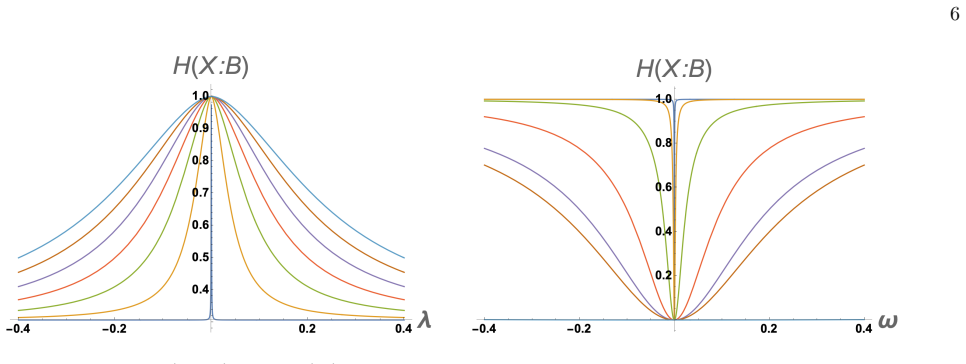
Within a specific exactly solvable parameter set (dot energies $\varepsilon=0$, couplings $\lambda_1=-\lambda_2=\sqrt{2}\,\lambda$), the paper derives closed-form expressions for all conditional entropies, mutual informations, and Holevo quantities entering the tripartite entropic uncertainty relation. It finds that both sides of the inequality reduce to the same function of $A=\xi_+^2-\eta_+^2$, so the relation collapses to the equality $\log_2 2=1$: the uncertainty of the spin measurements sits exactly at the lower bound for arbitrary $\lambda$ and any finite $\varepsilon_M$. The residual uncertainty scales as $1+\frac{\lambda^2}{4\ln(2)\,\varepsilon_M^2}\left(1+\ln\frac{4\varepsilon_M^2}{\lambda^2}\right)$ in the large-overlap limit and approaches two bits in the weak-overlap limit. For indirect observation, the quantum witness $W=\frac{1}{4}\frac{(\omega+\Delta)^2}{4\lambda^2+(\omega+\Delta)^2}$ quantifies the difference between direct and sequential spin measurements and reaches $1/4$ when $\varepsilon_M=2\omega\gg\lambda$.
Load-bearing premise
All entropy calculations start from the pure state $\hat\rho_{ABC}=|e_1\rangle\langle e_1|$, one of two degenerate ground states, and there is no argument for why the device would occupy that state rather than the other one or a superposition; if the actual ground state differs, the saturation and the monotonic decrease with overlap need not hold.
Editorial extensions
If this is right
- In the solved regime, spin measurements on the first quantum dot exhibit exactly the minimal entropic uncertainty, so no additional noise beyond the fundamental quantum limit is required to explain the data.
- The Majorana overlap acts as a control knob: for $\varepsilon_M\gg\lambda$ the uncertainty sits near its floor, while for $\varepsilon_M\ll\lambda$ it rises toward two bits.
- Sequential versus direct spin measurement on the second dot differs by up to $1/4$ in the strong-overlap limit, a concrete signature searchable in hybrid nanowire devices.
- The predictions depend only on the dot–Majorana coupling $\lambda$ and the Majorana overlap $\varepsilon_M$, so they can be compared with transport or spectroscopy measurements without free parameters.
Reading between the lines
- The paper assumes the pure ground state $|e_1\rangle$ with no mechanism selecting it over the degenerate partner $|e_2\rangle$; if a device occupies $|e_2\rangle$ or a superposition, saturation need not survive, so the universality claim is tied to that state choice.
- Saturation of the entropic uncertainty relation is the condition for optimal guessing games, so the same device could serve as a testbed for quantum key distribution or certified randomness, applications the paper does not discuss.
- Because the quantum witness approaches $1/4$ only when $\varepsilon_M\gg\lambda$ and vanishes in the opposite limit, the protocol could be used to calibrate the Majorana overlap in a fabricated device, not merely to detect the modes.
- The monotonic reduction of uncertainty with overlap hints that tuning $\varepsilon_M$ could suppress measurement noise in long-distance entanglement distribution, though the paper does not model decoherence or finite temperature.
Editorial analysis
A structured set of objections, weighed in public.
Referee Report
Summary. The paper studies a tripartite hybrid system in which two quantum dots are coupled through a topological superconducting nanowire hosting Majorana boundary modes. It makes two central claims. First, in Sec. IV it proposes a 'quantum witness' protocol: comparing direct and indirect spin measurements on the second dot should yield different probabilities, providing indirect evidence for Majorana modes. Second, in Sec. V it uses the tripartite quantum-memory-assisted entropic uncertainty relation (EUR) for the state rho_ABC = |e1><e1| and claims that the Majorana quasiparticles allow the measurement uncertainty to saturate the lower bound, with the bound reaching its minimal value in the strong-overlap regime. The EUR part is an algebraic consistency check on a model-specific pure state, while the quantum-witness part is intended as an experimentally testable signature.
Significance. If the quantum-witness derivation were valid, the proposed two-measurement protocol would be a useful and relatively simple experimental tool for indirect Majorana detection, and the two-parameter dependence of the EUR bound on the Majorana overlap and dot-Majorana coupling would be an appealing quantitative prediction. The entropy calculations in Sec. V are internally consistent for the assumed state: with the corrected algebra, S(X|B)+S(Z|C) equals the right-hand side of Eq. (9), so the EUR is indeed tight for that state. However, the significance is limited by the fact that the result is derived for a single chosen eigenstate |e1> with no discussion of state preparation or robustness, and the paper's strongest experimental claim in Sec. IV rests on a Kraus map that is not trace-preserving. The manuscript also contains an incorrect summary statement about Eq. (39). These issues materially affect the two headline claims, so the paper needs revision before the results can be relied upon.
major comments (3)
- [Sec. IV, Eqs. (6)-(8)] The quantum-witness derivation is invalid as written because the map F[rho] = sum_alpha L_alpha rho L_alpha^dagger is not trace-preserving. With L1 = sqrt(mu1)|1><0|_1 (x) |0><1|_2 and L2 = sqrt(mu2)|0><1|_1 (x) |1><0|_2, one obtains sum_alpha L_alpha^dagger L_alpha = mu1 P_{01} + mu2 P_{10}, where P_{01} = |0><0|_1 (x) |1><1|_2 and P_{10} = |1><1|_1 (x) |0><0|_2. For mu1=mu2=1/2 this is (1/2)(P_{01}+P_{10}), which is not the identity on the two-qubit space. Acting on the reduced state in Eq. (7), which contains |00><00| and |11><11| components from |Phi^->, the map annihilates those components, so Tr F[rho] < 1. Consequently the quantities P and Q in Eq. (6) are not normalized probabilities, and Eq. (8) is not a valid difference of probabilities. The claimed indirect-Majorana experimental signature is therefore unsupported by the derivation; the authors must either construct a genuine trace-preserving map with the same intended phenomenology or substantially revise the witness claim.
- [Sec. V, Eq. (39) and the surrounding text] The statement that 'for any A, Eq. (39) converts into equality log2 2 = 1' is not correct. For the model parameters one has A >= 0, and the right-hand side of Eq. (39) equals 1 + delta, where delta = -((1-A)/2) log2((1-A)/2) - ((1+A)/2) log2((1+A)/2). Thus Eq. (39) is indeed an equality, but the common value is 1 + delta, not 1. The value 1 is reached only in the limit A -> 1, i.e. epsilon_M >> lambda. The paper's universal claim that 'the topological Majorana quasiparticles enabled the uncertainties to reach their minimal lower bound value' for arbitrary finite overlap is therefore overstated: at finite overlap the saturated bound is 1 + delta > 1. This is a load-bearing point for the abstract and the concluding claims, and the wording of the statement after Eq. (39) should be corrected.
- [Sec. V, choice of state rho_ABC = |e1><e1|] All entropy and uncertainty results in Sec. V are computed for the single pure state rho_ABC = |e1><e1|. The manuscript does not state how this state is prepared or why the device should occupy it rather than another eigenstate or a mixture involving higher-energy states. Since the claimed monotonic decrease of uncertainty with increasing Majorana overlap is a property of this particular state, some justification (e.g., zero-temperature initialization in the ground state) and ideally a robustness check against small thermal admixtures or superpositions should be provided before the result is presented as a general prediction of the setup.
minor comments (4)
- [Eqs. (7) and (8)] The reduced state in Eq. (7) is written with |Psi^-_d>, whereas the eigenstate |e1> is defined with |Psi^+_d>. This sign discrepancy should be corrected, as it affects the subsequent application of the Kraus operators.
- [Eq. (24)] The expression for rho_{C|1} = rho_{C|2} contains a typo: it should be eta_+^2 |1><1|_C + xi_+^2 |0><0|_C, not eta_+^2 |1><1|_C + xi_+^2 |1><1|_C. As printed, the two terms sum to |1><1|_C, which would make H(Z:C) nonzero and inconsistent with the following line H(Z:C)=0.
- [Sec. V, derivations] The paper repeatedly refers to 'cumbersome calculations' and 'lengthy calculations' without showing the intermediate steps for Eqs. (19)-(39) and Eq. (8). Given the typographical issues already present, an appendix with the key algebraic steps would substantially improve verifiability.
- [Fig. 2 and Fig. 3] The figure captions say 'from above' with parameter lists, but the ordering of the curves is not indicated in the panels themselves. Please add labels or a legend so the reader can identify which curve corresponds to which parameter value.
Circularity Check
No significant circularity: the EUR saturation is an exact algebraic property of the explicitly stated eigenstate, and the Majorana-overlap dependence is a derived consequence, not a fitted prediction.
full rationale
The central derivation is self-contained. The tripartite EUR in Eq. (9) is an external inequality taken from Refs. [4,50,51], not derived from the model, so checking that a particular state saturates it is a genuine calculation rather than a definitional tautology. The entropies in Section V are computed directly from the explicitly stated state rho_ABC = |e1><e1|, and Eq. (39) reduces algebraically to S(rho_X^AB) = 1 + delta by the paper's own formulas (Eqs. (26) and (40)); this equality is a property of the chosen state, not an input. The claimed dependence of uncertainty on the Majorana overlap epsilon_M follows from the algebraic expression for A = xi_+^2 - eta_+^2 and is not obtained by fitting any parameter to data. The self-citation to Ref. [14] for 'technical details' (eigenstates and basis) is not load-bearing circularity: the eigenstates are reproduced in the present text and are algebraic consequences of the stated Hamiltonian, and they do not presuppose the EUR saturation. A separate correctness concern, unrelated to circularity, is that in Section IV the map F is claimed to be trace-preserving, but for the given Kraus operators Sigma_alpha L_alpha^dagger L_alpha = mu_1 P_01 + mu_2 P_10, which is not the identity; this affects whether P and Q in Eq. (8) are normalized probabilities, but it does not make the derivation circular. Overall, no step reduces to its own input or to a fitted parameter, so the circularity score is 0.
Assumptions & free parameters
free parameters (4)
- λ (QD-Majorana coupling) =
not fitted
- ω = ε_M/2 (Majorana overlap) =
not fitted
- ε_iσ (QD on-site energies) =
0
- U (Coulomb repulsion) =
0
assumptions (4)
- standard math Tripartite entropic uncertainty relation (Eq. 9) from Ref. [4]
- domain assumption Low-energy model Hamiltonian (Eq. 5) for QDs coupled to Majorana modes
- ad hoc to paper The system is prepared in the pure state |e1>, one of two degenerate ground states
- ad hoc to paper Kraus map F in Section IV is trace-preserving with the given L1, L2
Cite this review
Pith. "Pith review of Majorana Signatures in the Tripartite Uncertainty Relations with Quantum Memory." pith.science (2026). https://pith.science/paper/WF2NBFAX
@misc{pith2026250609621,
  author       = {Pith},
  title        = {Pith review of: Majorana Signatures in the Tripartite Uncertainty Relations with Quantum Memory},
  year         = {2026},
  howpublished = {\url{https://pith.science/paper/WF2NBFAX}},
  note         = {Machine review of arXiv:2506.09621}
}
read the original abstract
Quantumness imposes a fundamental limit on measurement accuracy. The paradigmatic cases are Heisenberg's uncertainty relation in the original formulation, Robertson's formulation, and improved uncertainty relations. However, the more universal measures are given in terms of quantum entropies. Uncertainties of measurements done on one quantum system correlated with another quantum system constitute a more intriguing question. Quantum correlations can influence the lower bound of uncertainties, and the reason for this is the quantum memory. In this article, we study uncertainties of measurements performed on one quantum dot correlated with the second one through the superconductor, hosting the Majorana boundary modes. We prove that the Majorana quasiparticles allow the uncertainties to reach the minimal possible lower bound. By rigorous theoretical considerations, we obtain the result of experimental relevance expressed in terms of only two parameters: the overlap between Majorana modes and their coupling strength with the quantum dots. We show that the overlap between Majorana modes reduces quantum uncertainties, which is a general result of fundamental importance. We also propose the protocol to measure spins in both quantum dots, consecutively, and demonstrate that the result of the second measurement would depend on the presence of Majorana quasiparticles. This could serve as an indirect tool for their empirical observation, which is of importance for the ongoing discussions concerning unambiguous detection of the Majorana quasiparticles in nanoscopic hybrid structures.
Figures


Forward citations
Cited by 1 Pith paper
-
Entanglement dynamics in minimal Kitaev chains
Two- and three-site Kitaev chains can dynamically generate maximally entangled two-qubit and GHZ-type three-qubit states, while a pure W state is forbidden by parity conservation.
Reference graph
Works this paper leans on
-
[1]
P. J. Coles, M. Berta, M. Tomamichel, and S. Wehner, Entropic uncertainty relations and their applications, Rev. Mod. Phys.89, 015002 (2017)
2017
-
[2]
Technical de- tails can be found in Ref
We introduce the occupancy representation|nf,nd1 ,nd2 ⟩, enumerating the basis vectors as follows|φ 1⟩=|0,0,0⟩,|φ 2⟩=|1,0,0⟩, |φ3⟩=|0,1,0⟩,|φ 4⟩=|1,1,0⟩,|φ 5⟩=|0,0,1⟩,|φ 6⟩= |1,0,1⟩,|φ 7⟩=|0,1,1⟩,|φ 8⟩=|1,1,1⟩. Technical de- tails can be found in Ref. [14]. For the sake of ana- lytic study we consider the parameter set:ε 1↑,↓ = 0, ε2↑,↓ = 0,U= 0,ε M = 2ω,...
work page 2022
-
[3]
Berta, M
M. Berta, M. Christandl, R. Colbeck, J. M. Renes, and R. Renner, The uncertainty principle in the presence of quantum memory, Nature Physics6, 659 (2010)
2010
-
[4]
D. Wang, F. Ming, M.-L. Hu, and L. Ye, Quantum- memory-assisted entropic uncertainty relations, Annalen der Physik531, 1900124 (2019)
work page 2019
-
[5]
F. Ming, D. Wang, X.-G. Fan, W.-N. Shi, L. Ye, and J.- L. Chen, Improved tripartite uncertainty relation with quantum memory, Phys. Rev. A102, 012206 (2020)
2020
-
[7]
B. Bergh and M. Gärttner, Entanglement detection in quantum many-body systems using entropic uncertainty relations, Phys. Rev. A103, 052412 (2021)
work page 2021
-
[8]
B.-F. Xie, F. Ming, D. Wang, L. Ye, and J.-L. Chen, Op- timized entropic uncertainty relations for multiple mea- surements, Phys. Rev. A104, 062204 (2021)
2021
-
[9]
L. Chotorlishvili, A. Gudyma, J. Wätzel, A. Ernst, and J. Berakdar, Spin-orbit-coupled quantum memory of a double quantum dot, Phys. Rev. B100, 174413 (2019)
work page 2019
Show all 61 references
-
[10]
Song, L.-J
M.-L. Song, L.-J. Li, X.-K. Song, L. Ye, and D. Wang, Environment-mediated entropic uncertainty in charging quantum batteries, Phys. Rev. E106, 054107 (2022)
2022
-
[11]
Zhu, Zero uncertainty states in the presence of quan- tum memory, npj Quantum Information7, 47 (2021)
H. Zhu, Zero uncertainty states in the presence of quan- tum memory, npj Quantum Information7, 47 (2021)
2021
-
[12]
Kurashvili and L
P. Kurashvili and L. Chotorlishvili, Quantum discord and entropic measures of two relativistic fermions, Journal of Physics A: Mathematical and Theoretical55, 495303 (2022)
2022
-
[13]
Kurashvili, L
P. Kurashvili, L. Chotorlishvili, K. A. Kouzakov, A. G. Tevzadze, and A. I. Studenikin, Quantum witness and in- vasiveness of cosmic neutrino measurements, Phys. Rev. D103, 036011 (2021)
2021
-
[14]
V. K. Vimal and J. Cayao, Entanglement measures of Majorana bound states, Phys. Rev. B110, 224510 (2024)
2024
-
[15]
Jasiukiewicz, A
C. Jasiukiewicz, A. Sinner, I. Weymann, T. Domański, and L. Chotorlishvili, Entanglement between quantum dots transmitted via a majorana wire: Insights from the fermionic negativity, concurrence, and quantum mutual information, Phys. Rev. B111, 075415 (2025)
2025
-
[16]
Beenakker, Search for majorana fermions in super- conductors, Annu
C. Beenakker, Search for majorana fermions in super- conductors, Annu. Rev. Condens. Matter Phys.4, 113 (2013)
2013
-
[17]
S. R. Elliott and M. Franz, Colloquium: Majorana fermionsinnuclear, particle, andsolid-statephysics,Rev. Mod. Phys.87, 137 (2015)
2015
-
[18]
T. D. Stanescu, R. M. Lutchyn, and S. Das Sarma, Ma- jorana fermions in semiconductor nanowires, Phys. Rev. B84, 144522 (2011)
2011
-
[19]
Prada, P
E. Prada, P. San-Jose, M. W. A. de Moor, A. Geresdi, E.J.H.Lee, J.Klinovaja, D.Loss, J.Nygard, R.Aguado, and L. P. Kouwenhoven, From Andreev to Majorana bound states in hybrid superconductor–semiconductor nanowires, Nature Rev. Phys.2, 575 (2020)
2020
-
[20]
Flensberg, F
K. Flensberg, F. von Oppen, and A. Stern, Engineered platforms for topological superconductivity and Majo- rana zero modes, Nature Rev. Materials6, 944 (2021)
2021
-
[21]
Rachel and R
S. Rachel and R. Wiesendanger, Majorana quasiparticles in atomic spin chains on superconductors, Physics Rep. 1099, 1 (2025)
2025
-
[22]
W.-K. Zou, Q. Wang, and H.-K. Zhao, Dynamic heat and charge transports through double-quantum-dot- interferometer modulated by majorana bound states and time-oscillating aharonov-bohm flux, Journal of Physics: Condensed Matter35, 165303 (2023)
2023
-
[23]
M. Gau, R. Egger, A. Zazunov, and Y. Gefen, Driven dissipative majorana dark spaces, Phys. Rev. Lett.125, 147701 (2020)
2020
-
[24]
M. Gau, R. Egger, A. Zazunov, and Y. Gefen, Towards dark space stabilization and manipulation in driven dis- sipative majorana platforms, Phys. Rev. B102, 134501 (2020)
2020
-
[25]
Smirnov, Thermoelectric fluctuations of interfering majoranaboundstates,Phys.Rev.B111,125402(2025)
S. Smirnov, Thermoelectric fluctuations of interfering majoranaboundstates,Phys.Rev.B111,125402(2025)
2025
-
[26]
Smirnov, Nonequilibrium finite frequency resonances in differential quantum noise driven by majorana inter- ference, Phys
S. Smirnov, Nonequilibrium finite frequency resonances in differential quantum noise driven by majorana inter- ference, Phys. Rev. B109, 195410 (2024)
2024
-
[27]
Smirnov, Revealing universal majorana fractionaliza- tion using differential shot noise and conductance in nonequilibrium states controlled by tunneling phases, Phys
S. Smirnov, Revealing universal majorana fractionaliza- tion using differential shot noise and conductance in nonequilibrium states controlled by tunneling phases, Phys. Rev. B105, 205430 (2022)
2022
-
[28]
Mishra, R
S. Mishra, R. Das, and C. Benjamin, Majorana ther- moelectrics and refrigeration, Journal of Applied Physics 136(2024)
2024
-
[29]
W.-K. Zou, Q. Wang, and H.-K. Zhao, Aharonov-bohm oscillations in the majorana fermion modulated charge and heat transports through a double-quantum-dot in- terferometer, Physics Letters A443, 128219 (2022)
2022
-
[30]
Smirnov, Majorana ensembles with fractional entropy and conductance in nanoscopic systems, Phys
S. Smirnov, Majorana ensembles with fractional entropy and conductance in nanoscopic systems, Phys. Rev. B 104, 205406 (2021)
2021
-
[31]
Smirnov, Majorana entropy revival via tunneling phases, Phys
S. Smirnov, Majorana entropy revival via tunneling phases, Phys. Rev. B103, 075440 (2021)
2021
-
[32]
M. M. Wilde,Quantum information theory(Cambridge university press, 2013)
2013
-
[33]
Kulig, P
M. Kulig, P. Kurashvili, C. Jasiukiewicz, M. In- glot, S. Wolski, S. Stagraczyński, T. Masłowski, T. Szczepański, R. Stagraczyński, V. K. Dugaev, and L. Chotorlishvili, Topological insulator and quantum memory, Phys. Rev. B108, 134411 (2023)
2023
-
[34]
A. Y. Kitaev, Unpaired majorana fermions in quantum wires, Physics-uspekhi44, 131 (2001)
2001
-
[35]
J. D. Sau, R. M. Lutchyn, S. Tewari, and S. Das Sarma, Generic new platform for topological quantum compu- tation using semiconductor heterostructures, Phys. Rev. Lett.104, 040502 (2010)
2010
-
[36]
Alicea, New directions in the pursuit of Majorana fermions in solid state systems, Rep
J. Alicea, New directions in the pursuit of Majorana fermions in solid state systems, Rep. Prog. Phys.75, 076501 (2012)
2012
-
[37]
Vijay and L
S. Vijay and L. Fu, Teleportation-based quantum infor- mation processing with Majorana zero modes, Phys. Rev. B94, 235446 (2016)
2016
-
[38]
T. Goto, M. Sugeta, T. Mizushima, and S. Fujimoto, Tolerance of Majorana teleportation in mesoscopic topo- logical superconductors, J. Phys. Soc. Japan93, 063704 (2024). 8
2024
-
[39]
Leijnse and K
M. Leijnse and K. Flensberg, Scheme to measure majo- rana fermion lifetimes using a quantum dot, Phys. Rev. B84, 140501 (2011)
2011
-
[40]
D. E. Liu and H. U. Baranger, Detecting a majorana- fermion zero mode using a quantum dot, Phys. Rev. B 84, 201308 (2011)
2011
-
[41]
M.-T. Deng, S. Vaitiek˙ enas, E. Prada, P. San-Jose, J. Nygård, P. Krogstrup, R. Aguado, and C. M. Mar- cus, Nonlocality of Majorana modes in hybrid nanowires, Phys. Rev. B98, 085125 (2018)
2018
-
[42]
K. P. Wójcik, T. Domański, and I. Weymann, Signatures of kondo-majorana interplay in ac response, Phys. Rev. B109, 075432 (2024)
2024
-
[43]
Taranko, K
R. Taranko, K. Wrześniewski, I. Weymann, and T. Do- mański, Transient effects in quantum dots contacted via topological superconductor, Phys. Rev. B110, 035413 (2024)
2024
-
[44]
Steffen, M
M. Steffen, M. Ansmann, R. C. Bialczak, N. Katz, E. Lucero, R. McDermott, M. Neeley, E. M. Weig, A. N. Cleland, and J. M. Martinis, Measurement of the entan- glement of two superconducting qubits via state tomog- raphy, Science313, 1423 (2006)
2006
-
[45]
T. Dvir, G. Wang, N. van Loo, C.-X. Liu, G. P. Mazur, A. Bordin, S. L. Ten Haaf, J.-Y. Wang, D. van Driel, F. Zatelli,et al., Realization of a minimal kitaev chain in coupled quantum dots, Nature614, 445 (2023)
2023
-
[46]
Meunier, I
T. Meunier, I. T. Vink, L. H. Willems van Beveren, F. H. L. Koppens, H. P. Tranitz, W. Wegscheider, L. P. Kouwenhoven, and L. M. K. Vandersypen, Nondestruc- tive measurement of electron spins in a quantum dot, Phys. Rev. B74, 195303 (2006)
2006
-
[47]
Schild and C
G. Schild and C. Emary, Maximum violations of the quantum-witness equality, Phys. Rev. A92, 032101 (2015)
2015
-
[48]
C.-M. Li, N. Lambert, Y.-N. Chen, G.-Y. Chen, and F. Nori, Witnessing quantum coherence: from solid-state to biological systems, Scientific reports2, 885 (2012)
2012
-
[49]
Buffoni, A
L. Buffoni, A. Solfanelli, P. Verrucchi, A. Cuccoli, and M. Campisi, Quantum measurement cooling, Phys. Rev. Lett.122, 070603 (2019)
2019
-
[50]
Kofler and i
J. Kofler and i. c. v. Brukner, Condition for macroscopic realism beyond the leggett-garg inequalities, Phys. Rev. A87, 052115 (2013)
2013
-
[51]
Dolatkhah, S
H. Dolatkhah, S. Haseli, S. Salimi, and A. S. Khorashad, Tightening the tripartite quantum-memory-assisted en- tropic uncertainty relation, Phys. Rev. A102, 052227 (2020)
2020
-
[52]
L. Wu, L. Ye, and D. Wang, Tighter generalized entropic uncertainty relations in multipartite systems, Phys. Rev. A106, 062219 (2022)
2022
-
[53]
Mathew, S
G. Mathew, S. L. L. Silva, A. Jain, A. Mohan, D. T. Adroja, V. G. Sakai, C. V. Tomy, A. Banerjee, R. Goreti, A. V. N., R. Singh, and D. Jaiswal-Nagar, Experimen- tal realization of multipartite entanglement via quantum Fisher information in a uniform antiferromagnetic quan- tu...
2020
-
[54]
Scheie, P
A. Scheie, P. Laurell, A. M. Samarakoon, B. Lake, S. E. Nagler, G. E. Granroth, S. Okamoto, G. Alvarez, and D. A. Tennant, Witnessing entanglement in quantum magnets using neutron scattering, Phys. Rev. B103, 224434 (2021)
2021
-
[55]
Laurell, A
P. Laurell, A. Scheie, C. J. Mukherjee, M. M. Koza, M. Enderle, Z. Tylczynski, S. Okamoto, R. Coldea, D. A. Tennant, and G. Alvarez, Quantifying and controlling en- tanglement in the quantum magnetcs2cocl4, Phys. Rev. Lett.127, 037201 (2021)
2021
-
[56]
D. R. Baykusheva, M. H. Kalthoff, D. Hofmann, M. Claassen, D. M. Kennes, M. A. Sentef, and M. Mi- trano, Witnessing nonequilibrium entanglement dynam- ics in a strongly correlated fermionic chain, Phys. Rev. Lett.130, 106902 (2023)
2023
-
[57]
Laurell, A
P. Laurell, A. Scheie, D. A. Tennant, S. Okamoto, G. Al- varez, and E. Dagotto, Magnetic excitations, nonclassi- cality, and quantum wake spin dynamics in the hubbard chain, Phys. Rev. B106, 085110 (2022)
2022
-
[58]
T. Ren, Y. Shen, S. F. R. TenHuisen, J. Sears, W. He, M. H. Upton, D. Casa, P. Becker, M. Mitrano, M. P. M. Dean, and R. M. Konik, Witnessing quantum entangle- ment using resonant inelastic x-ray scattering (2024), arXiv:2404.05850 [cond-mat.str-el]
2024
-
[59]
T. Liu, L. Xu, J. Liu, and Y. Wang, Entanglement wit- ness for indistinguishable electrons using solid-state spec- troscopy (2024), arXiv:2408.04876 [cond-mat.str-el]
2024 arXiv
-
[60]
Scheie, P
A. Scheie, P. Laurell, W. Simeth, E. Dagotto, and D. A. Tennant, Tutorial: Extracting entanglement signatures from neutron spectroscopy, Materials Today Quantum5, 100020 (2025)
2025
-
[61]
Laurell, A
P. Laurell, A. Scheie, E. Dagotto, and D. A. Tennant, Witnessing entanglement and quantum correlations in condensed matter: A review, Adv. Quantum Technol. n/a, 2400196 (2024)
2024
-
[62]
Nishikawa and T
Y. Nishikawa and T. Yoshioka, Quantum entanglement in a pure state of strongly correlated quantum impurity systems, Phys. Rev. B111, 035112 (2025)
2025
Reviewed August 7, 2026 · model on record in the stance chip above.
Discussion (0). Sign in to comment.