REVIEW 4 major objections 5 minor 34 references
R-CARLA: High-Fidelity Sensor Simulations with Interchangeable Dynamics for Autonomous Racing
T0 review · 4 major / 5 minor · reviewed 2026-08-07 · deepseek-v4-flash
Pith's one-line read R-CARLA, a CARLA extension, claims to shrink the sim-to-real gap for autonomous racing by 42% for vehicle dynamics and by 82% for sensor simulation, unifying accurate dynamics with high-fidelity perception in one platform.
desk verdict Useful open-source racing simulator integration, but the headline 42%/82% Sim-to-Real reductions are not supported by the experiments as reported. read the letter →
The pith
A machine-rendered reading of the paper's core claim, the machinery that carries it, and where it could break.
The reading
What carries the argument
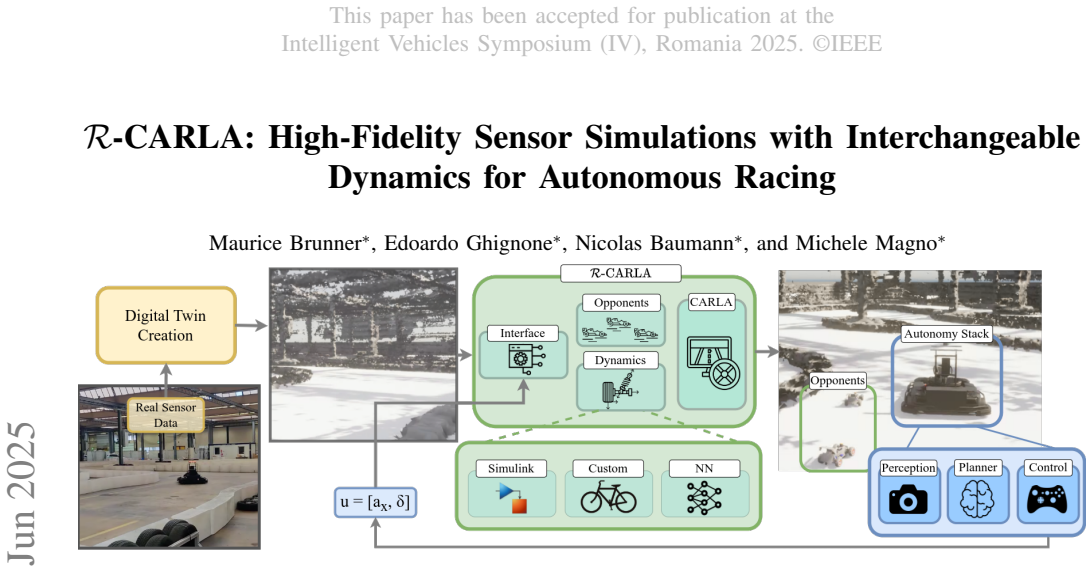
The load-bearing pieces are (1) a modular dynamics interface implemented in ROS that replaces CARLA's physics with any external state-update function; (2) a dynamic single-track vehicle model, a two-wheel bicycle model that includes tire slip through Pacejka tire-force curves, which lets the same code simulate a 1:10 F1TENTH car and a 1:2 gokart; and (3) a digital-twin creation pipeline that turns a LiDAR point cloud into an Unreal Engine map via outlier rejection, Poisson-disk sampling, and ball-pivoting meshing. Opponent simulation, which advances NPCs along waypoint trajectories, rounds out the closed-loop test capability.
What would settle it
Replay the gokart's real recorded LiDAR scans through the same SLAM localization used for the synthetic data in the digital-twin map; if the resulting RMSE is substantially larger than 0.164 m, the claimed closeness of synthetic and real sensors would not survive a direct real-data test. Alternatively, computing a point-cloud-to-point-cloud distance between synthetic and real scans at identical poses would settle it directly.
Extended reading notes
Core claim
The central claim is that R-CARLA, by disabling CARLA's default urban vehicle dynamics and injecting an external dynamics model through a ROS interface, makes CARLA a faithful full-stack simulator for autonomous racing. The proposed dynamic single-track model with Pacejka tire forces reproduces real lap times and lateral deviations more closely than CARLA's built-in dynamics, and the digital-twin maps built from real LiDAR point clouds support LiDAR localization with errors within 1.74 cm of those obtained with real data. This leads the authors to report a 42% average reduction in the sim-to-real gap for dynamics across all tested metrics, and an 82% reduction for the sensor-simulation or holistic-testing scenario (stated as 81% in the conclusion).
Load-bearing premise
The sensor-simulation improvement is measured with synthetic LiDAR scans localized against a map built from real LiDAR, which is a proxy for matching real sensor data, not a direct comparison of synthetic and real point clouds.
Editorial extensions
If this is right
- Autonomous racing teams could develop and validate an entire perception-to-control stack in R-CARLA, since the simulator now claims to reproduce both vehicle handling and sensor behavior faithfully.
- Scaled platforms like F1TENTH, which CARLA's stock dynamics cannot simulate at all, become testable in a high-fidelity visual environment for the first time.
- A digital twin of a real track, built from one LiDAR pass, can serve as a deployment rehearsal environment for the same racestack software.
- Holistic closed-loop testing (planner plus controller plus state estimation) shows smaller sim-to-real deviations than testing dynamics alone, suggesting that sensor fidelity and dynamics interact when validating full stacks.
- The open-source release makes these capabilities reproducible and extensible by other racing and research groups.
Reading between the lines
- The 82% sensor-fidelity claim is not yet a direct test of whether simulated LiDAR matches real LiDAR; it rests on the proxy that synthetic scans localize as well in a real-built map as real scans do, so a direct point-cloud-to-point-cloud distance comparison at matched poses would be a stronger falsifier.
- If the digital-twin environments truly reproduce real tracks, reinforcement-learning and simulator-to-real transfer methods for racing could use them directly, potentially improving sample efficiency on real vehicles.
- The modular dynamics interface makes R-CARLA a natural testbed for learned dynamics models, which could further shrink the remaining 58% dynamics gap by adapting to friction changes online.
- The same pipeline could be applied beyond racing, e.g., to autonomous warehouse or search-and-rescue vehicles, wherever high-fidelity sensing and custom dynamics both matter.
Editorial analysis
A structured set of objections, weighed in public.
Referee Report
Summary. The paper presents R-CARLA, a CARLA-based simulation framework for autonomous racing that combines custom vehicle dynamics, a digital-twin pipeline built from real LiDAR point clouds, and opponent simulation to enable full-stack perception-to-control testing. The central claim is that R-CARLA reduces the Sim-to-Real gap by 42% for vehicle dynamics and by 81-82% for sensor simulation. The evaluation uses two real racing platforms (a 1:10 F1TENTH car and a 1:2 gokart) and compares lap-time and lateral-error differences in simulation versus real-world laps, plus a SLAM localization accuracy experiment in a digital-twin map.
Significance. The framework addresses a real need: no existing open simulator for autonomous racing simultaneously provides high-fidelity sensor rendering and user-defined vehicle dynamics. The modular dynamics interface, open-source release, and the demonstration that CARLA's default dynamics cannot operate at 1:10 scale are valuable contributions. However, the headline quantitative claims are not adequately supported by the experiments as presented, and the paper's strongest numbers appear in the abstract rather than in a reproducible experimental result.
major comments (4)
- [Section IV-C, Table IV] The claimed 81-82% sensor-simulation Sim-to-Real reduction is not measured by the experiments described here. Both rows of Table IV use synthetic LiDAR data for localization: the 'Synthetic' row builds and localizes in the same synthetic map, while the 'Real' row localizes the same synthetic scans in a map built from real LiDAR. No real LiDAR data is ever passed through the SLAM localization pipeline, so the 1.74 cm difference is a measure of map-transfer consistency, not of sensor fidelity. This does not support the abstract's claim of an 82% reduction in the sensor-simulation gap.
- [Abstract, Introduction, Section IV, Conclusions] The headline numbers are internally inconsistent: the abstract reports 82% for sensor simulation, the introduction reports 81% 'by testing holistically', Section IV-A reports an 81% lap-time reduction on one gokart track, Section IV-B reports an average 81% lap-time reduction for F1TENTH, and the conclusion attributes 81% to digital-twin/sensor simulation. With the quantities defined differently in different places, the 82% figure cannot be traced to a single calculation and should be restated with a clear, consistent definition.
- [Section III-C1 and Section IV-A] The proposed dynamics model requires Pacejka tire parameters (B, C, D, E) per vehicle, but the paper does not report their values, the system-identification procedure, or the data used to fit them. Without this information, the 42% average reduction relative to CARLA dynamics is a comparison between a calibrated model and an uncalibrated one, and it is not possible to judge how much of the improvement is due to the model architecture. The authors should report the fitting procedure and an independent validation split.
- [Section IV-A, Table II] The 42% average reduction for car dynamics is computed only from the gokart row, because the CARLA baseline is marked n/a for the F1TENTH. The 'across various testing scenarios' phrasing therefore overstates the evidence: the dynamics comparison covers one vehicle platform, one track, and three metrics. This single-platform limitation should be stated explicitly, and per-metric results should be reported with lap-to-lap variability.
minor comments (5)
- [Section IV-C, Table IV] The sentence describing 'a discrepancy of only 1.74 cm' should be rephrased: 1.74 cm is the difference between two RMSE values, not the position accuracy of either system.
- [Section III-B] The parameters of the outlier rejection, Poisson-disk sampling, and ball-pivoting steps are not reported; adding them would improve reproducibility.
- [Section III-C1] Equation (2) is attributed to [33] (CommonRoad), but a reference to the original single-track model derivation would be more appropriate; also, the sign convention of the v_y terms in the first two rows should be checked.
- [Section IV-A] Only single-lap comparisons are reported, so it is unclear whether the reported differences are within normal lap-to-lap variability; adding repeated runs or variance estimates would strengthen the claims.
- [Figures 2 and 3] The subfigures in Figures 2 and 3 appear to overlap or duplicate content; the captions should describe each panel distinctly.
Circularity Check
The sensor-simulation Sim-to-Real reduction is partially self-referential: Section IV-C compares synthetic LiDAR against a real-built map, never against real LiDAR, and the 81/82% 'sensor' figure is a downstream lap-time reduction relabelled as a sensor gap.
-
renaming known result
[Section IV-C, Table IV]
"This configuration represents a best-case scenario for the SLAM system, as the data used for mapping and localization are identical. The accuracy of this setup was evaluated by computing the RMSE ... Additionally, the synthetic data was used to perform localization in a map created from the original real-world data. The errors resulting from this process are labeled as real."
Both rows of Table IV feed the identical synthetic CARLA LiDAR into the SLAM system; they differ only in whether the map is built from synthetic or real scans. No real sensor data is ever localized. The 'Synthetic' condition is explicitly defined by using identical data for mapping and localization, making it a self-consistency upper bound. Because the synthetic scans are rendered from a digital-twin mesh reconstructed from the same real-world point cloud that generated the 'real' map, the 1.74 cm closeness is a closed-loop reconstruction-consistency check. Presenting it as validating sensor simulation against real data reduces an external-fidelity claim to an internal self-comparison.
-
renaming known result
[Section IV-B, last paragraph; Conclusions]
"the differences in lap time are significantly lower with a reduction of 69%, 92%, and 87% over all F1TENTH racetracks resulting in an average of 81%. This shows that simulating the entire pipeline holistically is meaningful ... Moreover, it highlights the realism of the simulated sensor data, as any significant divergence from real-life data would have resulted in an increased difference in the used metrics."
The headline 'sensor simulation' reduction of 81%/82% is this lap-time reduction between two simulated scenarios ('Ours no SE' using ground-truth state and 'Ours' using full state estimation on synthetic sensors). It is a downstream closed-loop metric, not a sensor-to-real-sensor fidelity measurement. The conclusion relabels this downstream improvement as the sensor Sim-to-Real gap, so the central sensor claim is an inference from a proxy rather than an independent measurement.
full rationale
The dynamics contribution retains independent content: the gokart comparison against standard CARLA dynamics is a real closed-loop experiment, even though the Pacejka parameters are not reported. The full-stack/digital-twin engineering is also not circular in itself. However, the sensor-fidelity validation in Section IV-C is self-referential: both 'synthetic' and 'real' conditions use the same generated LiDAR, and the 'real' map is built from the same source point cloud used to construct the digital twin, so the 1.74 cm agreement is a consistency check, not an external validation against real sensor output. The 81%/82% abstract figure is likewise a renamed downstream lap-time improvement, not a direct sensor Sim-to-Real measurement. These issues do not make the whole framework circular, but they make the central sensor-simulation claim partially reduce to its own construction, hence the moderate score.
Assumptions & free parameters
free parameters (4)
- Pacejka tire force parameters (B, C, D, E) for each vehicle =
Not reported
- Outlier rejection radius r and minimum neighbors m =
Not reported
- Poisson-disk sampling density / simplified point count =
25898 points from 1750112 after simplification
- Ball-pivoting algorithm radius =
Not reported
assumptions (5)
- domain assumption The dynamic single-track model from CommonRoad [33] is an accurate representation of vehicle motion for racing platforms.
- domain assumption The Pacejka tire model [34] captures tire forces adequately at the operating conditions of the two test vehicles.
- domain assumption CARLA's sensor simulation faithfully reproduces real LiDAR, IMU, and camera behavior.
- domain assumption Cartographer SLAM produces accurate maps and localization estimates in both real and synthetic environments.
- domain assumption A mesh generated by Poisson-disk sampling and ball-pivoting preserves the geometry needed for racing and LiDAR simulation.
Cite this review
Pith. "Pith review of R-CARLA: High-Fidelity Sensor Simulations with Interchangeable Dynamics for Autonomous Racing." pith.science (2026). https://pith.science/paper/6YFEA265
@misc{pith2026250609629,
  author       = {Pith},
  title        = {Pith review of: R-CARLA: High-Fidelity Sensor Simulations with Interchangeable Dynamics for Autonomous Racing},
  year         = {2026},
  howpublished = {\url{https://pith.science/paper/6YFEA265}},
  note         = {Machine review of arXiv:2506.09629}
}
read the original abstract
Autonomous racing has emerged as a crucial testbed for autonomous driving algorithms, necessitating a simulation environment for both vehicle dynamics and sensor behavior. Striking the right balance between vehicle dynamics and sensor accuracy is crucial for pushing vehicles to their performance limits. However, autonomous racing developers often face a trade-off between accurate vehicle dynamics and high-fidelity sensor simulations. This paper introduces R-CARLA, an enhancement of the CARLA simulator that supports holistic full-stack testing, from perception to control, using a single system. By seamlessly integrating accurate vehicle dynamics with sensor simulations, opponents simulation as NPCs, and a pipeline for creating digital twins from real-world robotic data, R-CARLA empowers researchers to push the boundaries of autonomous racing development. Furthermore, it is developed using CARLA's rich suite of sensor simulations. Our results indicate that incorporating the proposed digital-twin framework into R-CARLA enables more realistic full-stack testing, demonstrating a significant reduction in the Sim-to-Real gap of car dynamics simulation by 42% and by 82% in the case of sensor simulation across various testing scenarios.
Figures


Figures from the paper (2 more)


Reference graph
Works this paper leans on
-
[1]
Indy autonomous challenge-autonomous race cars at the handling limits,
A. Wischnewski, M. Geisslinger, J. Betz, T. Betz, F. Fent, A. Heilmeier, L. Hermansdorfer, T. Herrmann, S. Huch, P. Karleet al., “Indy autonomous challenge-autonomous race cars at the handling limits,” in12th International Munich Chassis Symposium 2021: chassis. tech plus. Springer, 2022, pp. 163–182
2021
-
[2]
Emergent ecosystem for radical innovation: Entrepreneurial probing at formula e,
S. Jarvenpaa and W. Standaert, “Emergent ecosystem for radical innovation: Entrepreneurial probing at formula e,” in Proceedings of the 50th HICSS, 2017
work page 2017
-
[3]
From accelerated advertising to fanboost: mediatized motorsport,
M. Finn, “From accelerated advertising to fanboost: mediatized motorsport,”Sport in Society, vol. 24, no. 6, pp. 937–953, 2021. [Online]. Available: https://doi.org/10.1080/17430437.2019.1710131
-
[4]
Autonomous vehicles on the edge: A survey on autonomous vehicle racing
J. Betz, H. Zheng, A. Liniger, U. Rosolia, P. Karle, M. Behl, V . Krovi, and R. Mangharam, “Autonomous vehicles on the edge: A survey on autonomous vehicle racing.” [Online]. Available: https://arxiv.org/abs/2202.07008
-
[5]
Tum autonomous motorsport: An autonomous racing software for the indy autonomous challenge,
J. Betz, T. Betz, F. Fent, M. Geisslinger, A. Heilmeier, L. Hermansdorfer, T. Herrmann, S. Huch, P. Karle, M. Lienkamp, B. Lohmann, F. Nobis, L. ¨Ogretmen, M. Rowold, F. Sauerbeck, T. Stahl, R. Trauth, F. Werner, and A. Wischnewski, “Tum autonomous motorsport: An autonomous racing software for the indy autonomous challenge,”Journal of Field Robotics, vol....
-
[6]
er.autopilot 1.1: A software stack for autonomous racing on oval and road course tracks,
A. Raji, D. Caporale, F. Gatti, A. Toschi, N. Musiu, M. Veruc- chi, F. Prignoli, D. Malatesta, A. F. Jesus, A. Finazzi, F. Amerotti, F. Bagni, E. Mascaro, P. Musso, and M. Bertogna, “er.autopilot 1.1: A software stack for autonomous racing on oval and road course tracks,”IEEE Transactions on Field Robotics, vol. 1, pp. 332–359, 2024
work page 2024
-
[7]
An autonomous racing system: Design, implementation, and analysis; team KAIST at the IAC,
C. Jung, A. Finazzi, H. Seong, D. Lee, S. Lee, B. Kim, G. Kang, and H. Shim, “An autonomous racing system: Design, implementation, and analysis; team KAIST at the IAC,”Field Robotics, vol. 3, no. 1, pp. 766–800, Jan. 2023. [Online]. Available: https://doi.org/10.55417/fr.2023024
-
[8]
AMZ driverless: The full autonomous racing system,
J. Kabzan, M. I. Valls, V . J. F. Reijgwart, H. F. C. Hendrikx, C. Ehmke, M. Prajapat, A. B ¨uhler, N. Gosala, M. Gupta, R. Sivanesan, A. Dhall, E. Chisari, N. Karnchanachari, S. Brits, M. Dangel, I. Sa, R. Dub ´e, A. Gawel, M. Pfeiffer, A. Liniger, J. Lygeros, and R. Siegwart, “AMZ driverless: The full autonomous racing system,”J. field robot., no. rob.2...
work page 2020
Show all 34 references
-
[9]
Forzaeth race stack—scaled autonomous head- to-head racing on fully commercial off-the-shelf hardware,
N. Baumann, E. Ghignone, J. K ¨uhne, N. Bastuck, J. Becker, N. Imholz, T. Kr¨anzlin, T. Y . Lim, M. L¨otscher, L. Schwarzen- bachet al., “Forzaeth race stack—scaled autonomous head- to-head racing on fully commercial off-the-shelf hardware,” Journal of Field Robotics, 2024
2024
-
[10]
F1tenth: An open-source evaluation environment for contin- uous control and reinforcement learning,
M. O’Kelly, H. Zheng, D. Karthik, and R. Mangharam, “F1tenth: An open-source evaluation environment for contin- uous control and reinforcement learning,” inNeurIPS 2019 Competition and Demonstration Track. PMLR, 2020, pp. 77–89
2019
-
[11]
How simulation helps autonomous driving: A survey of sim2real, digital twins, and parallel intelligence,
X. Hu, S. Li, T. Huang, B. Tang, R. Huai, and L. Chen, “How simulation helps autonomous driving: A survey of sim2real, digital twins, and parallel intelligence,”IEEE Transactions on Intelligent Vehicles, vol. 9, no. 1, pp. 593–612, 2024
2024
-
[12]
Siegwart and I
R. Siegwart and I. R. Nourbakhsh,Introduction to autonomous mobile robots. MIT Press, 2004, vol. 1
2004
-
[13]
What lies in the shadows? safe and computation-aware motion planning for autonomous vehicles using intent-aware dynamic shadow re- gions,
Y . Nager, A. Censi, and E. Frazzoli, “What lies in the shadows? safe and computation-aware motion planning for autonomous vehicles using intent-aware dynamic shadow re- gions,” in2019 International Conference on Robotics and Automation (ICRA), 2019, pp. 5800–5806
2019
-
[14]
CARLA: An open urban driving simulator,
A. Dosovitskiy, G. Ros, F. Codevilla, A. Lopez, and V . Koltun, “CARLA: An open urban driving simulator,” inProceedings of the 1st Annual Conference on Robot Learning, 2017, pp. 1–16
2017
-
[15]
End-to-end autonomous driving: Challenges and frontiers,
L. Chen, P. Wu, K. Chitta, B. Jaeger, A. Geiger, and H. Li, “End-to-end autonomous driving: Challenges and frontiers,” IEEE Transactions on Pattern Analysis and Machine Intelli- gence, vol. 46, no. 12, pp. 10 164–10 183, 2024
2024
-
[16]
Anti-carla: An adversarial testing framework for autonomous vehicles in carla,
S. Ramakrishna, B. Luo, C. B. Kuhn, G. Karsai, and A. Dubey, “Anti-carla: An adversarial testing framework for autonomous vehicles in carla,” in2022 IEEE 25th International Conference on Intelligent Transportation Systems (ITSC), 2022, pp. 2620– 2627
2022
-
[17]
Carla-gear: A dataset generator for a systematic eval- uation of adversarial robustness of deep learning vision mod- els,
F. Nesti, G. Rossolini, G. D’Amico, A. Biondi, and G. But- tazzo, “Carla-gear: A dataset generator for a systematic eval- uation of adversarial robustness of deep learning vision mod- els,”IEEE Transactions on Intelligent Transportation Systems, vol. 25, no. 8, pp. 9840–9851, 2024
2024
-
[18]
Ad perdevkit: An autonomous driving perception development kit using carla simulator and ros,
J. de la Pe ˜na, L. M. Bergasa, M. Antunes, F. Arango, C. G´omez-Hu´elamo, and E. L ´opez-Guill´en, “Ad perdevkit: An autonomous driving perception development kit using carla simulator and ros,” in2022 IEEE 25th International Confer- ence on Intelligent Transportation Systems...
2022
-
[19]
Multimodal end-to-end autonomous driving,
Y . Xiao, F. Codevilla, A. Gurram, O. Urfalioglu, and A. M. L´opez, “Multimodal end-to-end autonomous driving,”IEEE Transactions on Intelligent Transportation Systems, vol. 23, no. 1, pp. 537–547, 2022
2022
-
[20]
Carla-autoware-bridge: Facilitating autonomous driv- ing research with a unified framework for simulation and module development,
G. Kaljavesi, T. Kerbl, T. Betz, K. Mitkovskii, and F. Dier- meyer, “Carla-autoware-bridge: Facilitating autonomous driv- ing research with a unified framework for simulation and module development,” in2024 IEEE Intelligent Vehicles Sym- posium (IV), 2024, pp. 224–229
2024
-
[21]
A simulation benchmark for autonomous racing with large-scale human data,
A. Remonda, N. Hansen, A. Raji, N. Musiu, M. Bertogna, E. E. Veas, and X. Wang, “A simulation benchmark for autonomous racing with large-scale human data,” 2024
2024
-
[22]
A super-human vision-based rein- forcement learning agent for autonomous racing in Gran Turismo,
M. Vasco, T. Seno, K. Kawamoto, K. Subramanian, P. R. Wurman, and P. Stone, “A super-human vision-based rein- forcement learning agent for autonomous racing in Gran Turismo,”Reinforcement Learning Journal, vol. 4, pp. 1674– 1710, 2024
2024
-
[23]
Super-human performance in gran turismo sport using deep reinforcement learning,
F. Fuchs, Y . Song, E. Kaufmann, D. Scaramuzza, and P. D ¨urr, “Super-human performance in gran turismo sport using deep reinforcement learning,”IEEE Robotics and Automation Let- ters, vol. 6, no. 3, pp. 4257–4264, 2021
2021
-
[24]
Deepracing: A framework for au- tonomous racing,
T. Weiss and M. Behl, “Deepracing: A framework for au- tonomous racing,” in2020 Design, Automation and Test in Europe Conference and Exhibition (DATE), 2020, pp. 1163– 1168
2020
-
[25]
Autodrive simulator: A simulator for scaled autonomous vehicle research and education,
T. V . Samak, C. V . Samak, and M. Xie, “Autodrive simulator: A simulator for scaled autonomous vehicle research and education,” in2021 2nd International Conference on Control, Robotics and Intelligent System, ser. CCRIS’21. New York, NY , USA: Association for Computing Machin...
2021 doi
-
[26]
f1tenth. dev-an open-source ros based f1/10 autonomous racing simulator,
V . S. Babu and M. Behl, “f1tenth. dev-an open-source ros based f1/10 autonomous racing simulator,” in2020 IEEE 16th International Conference on Automation Science and Engineering (CASE). IEEE, 2020, pp. 1614–1620
2020
-
[27]
Learning dynamics models for velocity estimation in au- tonomous racing,
J. Wegrzynowski, G. Czechmanowski, P. Kicki, and K. Walas, “Learning dynamics models for velocity estimation in au- tonomous racing,” in2024 IEEE/RSJ International Conference on Intelligent Robots and Systems (IROS), 2024, pp. 972–979
2024
-
[28]
First, learn what you don’t know: Active information gathering for driving at the limits of handling,
A. Davydov, F. Djeumou, M. Greiff, M. Suminaka, M. Thompson, J. Subosits, and T. Lew, “First, learn what you don’t know: Active information gathering for driving at the limits of handling,” 2024. [Online]. Available: https://arxiv.org/abs/2411.00107
2024 arXiv
-
[29]
Anycar to anywhere: Learning universal dynamics model for agile and adaptive mobility,
W. Xiao, H. Xue, T. Tao, D. Kalaria, J. M. Dolan, and G. Shi, “Anycar to anywhere: Learning universal dynamics model for agile and adaptive mobility,” 2024. [Online]. Available: https://arxiv.org/abs/2409.15783
2024 arXiv
-
[30]
Real-time loop closure in 2d lidar slam,
W. Hess, D. Kohler, H. Rapp, and D. Andor, “Real-time loop closure in 2d lidar slam,” inProceedings - IEEE International Conference on Robotics and Automation, vol. 2016-June, 2016
2016
-
[31]
Dithering with blue noise,
R. A. Ulichney, “Dithering with blue noise,”Proceedings of the IEEE, vol. 76, no. 1, pp. 56–79, 1988
1988
-
[32]
The ball-pivoting algorithm for surface recon- struction,
F. Bernardini, J. Mittleman, H. Rushmeier, C. Silva, and G. Taubin, “The ball-pivoting algorithm for surface recon- struction,”IEEE Transactions on Visualization and Computer Graphics, vol. 5, no. 4, pp. 349–359, 1999
1999
-
[33]
Commonroad: Composable benchmarks for motion planning on roads,
M. Althoff, M. Koschi, and S. Manzinger, “Commonroad: Composable benchmarks for motion planning on roads,” in 2017 IEEE Intelligent Vehicles Symposium (IV), 2017, pp. 719–726
2017
-
[34]
Shear force development by pneumatic tyres in steady state conditions: a review of modelling aspects,
H. B. Pacejka and R. S. Sharp, “Shear force development by pneumatic tyres in steady state conditions: a review of modelling aspects,”Vehicle system dynamics, vol. 20, no. 3-4, pp. 121–175, 1991
1991
Reviewed August 7, 2026 · model on record in the stance chip above.
Discussion (0). Sign in to comment.