REVIEW 3 major objections 6 minor 60 references
Electron Acceleration via Trapping inside Ion Mirror-mode Structures within A Large-scale Magnetic Flux Rope
T0 review · 3 major / 6 minor · reviewed 2026-08-07 · deepseek-v4-flash
Pith's one-line read Magnetic mirror structures inside a flux rope can trap electrons and keep Fermi acceleration running, producing power-law energetic electrons.
desk verdict A careful MMS case study with a genuinely new observation of mirror structures in a flux rope, but the claim that they continuously accelerate electrons goes beyond what the Eulerian acceleration rates can prove. read the letter →
The pith
A machine-rendered reading of the paper's core claim, the machinery that carries it, and where it could break.
The reading
What carries the argument
The central objects are the ion mirror-mode structures: magnetic cavities where |B| falls from about 41.5 nT to about 10 nT and the ion temperature anisotropy satisfies the mirror instability condition $k = T_{i\perp}/T_{i\parallel} - (1 + 1/\beta_{i\perp}) > 0$. Electrons are considered trapped when their pitch angle lies between $\theta_{tr}$ and $180^\circ - \theta_{tr}$, where $\theta_{tr} = \sin^{-1}(\sqrt{|B|/|B_{max}|})$ is the trapping-passing boundary that defines the two mirror points. The acceleration argument is carried by local guiding-center rates: the Fermi rate $\partial_t W_f = (P_{e\parallel} + n_e m_e v_\parallel^2)\,\mathbf{v}_{E\times B}\cdot(\hat{b}\cdot\nabla\hat{b})$ and the betatron rate, integrated along the spacecraft path as $W_f = \int \partial_t W_f\,dt$. A positive slope in $W_f$ marks an acceleration region, and the mirror structures are found inside that positive region on the trailing side of the flux rope, which is exactly what allows sustained Fermi energization.
What would settle it
Look for a flux-rope crossing in which well-resolved mirror structures are present but the integrated Fermi rate $W_f$ inside the mirrors is zero or negative; under the paper's claim, trapped >10 keV electrons there should show no net gain. A stronger test would track phase-space density of a trapped electron population between two encounters with the same mirror structure and check that its energy content increases while inside the trap.
Extended reading notes
Core claim
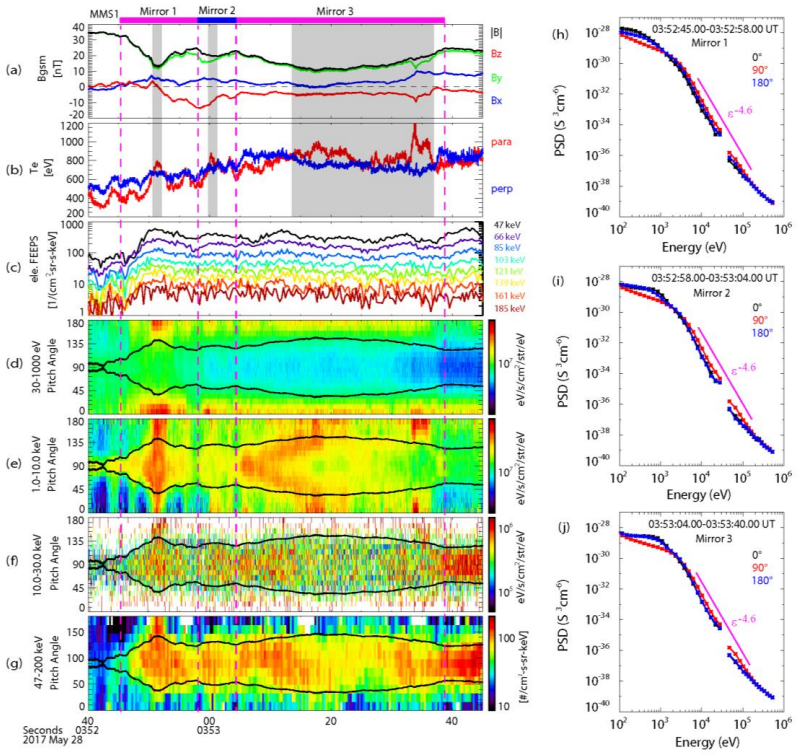
The central claim is that magnetic mirror structures generated by the ion mirror instability can confine electrons within the Fermi acceleration region of a flux rope, overcoming the finite-contraction limitation on Fermi acceleration. In the observed event, three mirror cavities inside a roughly 6 Earth-radius flux rope coincide with peaks in >47 keV electron flux, and electrons from 1 to 200 keV are mostly trapped between the pitch-angle trapping-passing boundaries set by the local-to-maximum field ratio. The integrated local acceleration rates show the trailing side of the flux rope is the Fermi acceleration region while the leading side decelerates, so the mirror structures convert the usual symmetric acceleration-deceleration pattern into a net energy gain. The authors conclude that the mirror-trapped electrons are continuously accelerated by the Fermi mechanism near the center of the flux rope and produce the observed power-law distribution, independent of location.
Load-bearing premise
The single-spacecraft trajectory through the mirror structures yields local Eulerian acceleration rates that, when integrated, represent the net energy change of electrons bouncing within the mirrors; if those rates are not representative, the observed energetic electrons could have been energized elsewhere and merely trapped here.
Editorial extensions
If this is right
- A flux rope that has stopped contracting can still act as an electron accelerator, provided mirror structures grow in the region where the Fermi rate is positive.
- Stronger mirrors, with smaller $|B|/|B_{max}|$, widen the trapping-passing boundary and therefore trap a larger fraction of the electron population.
- The observed location-independent power-law index of -4.6 implies a quasi-adiabatic acceleration process that should produce similar spectra in other reconnection outflows.
- Whistler waves generated by the trapped electrons' perpendicular anisotropy can pitch-angle scatter particles, so the final electron spectrum reflects a competition between Fermi acceleration and wave scattering.
- Because mirror-like structures can be produced by many instabilities besides the ion mirror instability, the trapping-acceleration mechanism is not limited to the magnetotail and may operate wherever flux ropes and mirror perturbations coexist.
Reading between the lines
- If the trapping logic is general, the highest electron energy a flux rope can supply should be governed by the mirror ratio $|B_{max}|/|B_{min}|$ rather than by the rope's contraction speed or length, because that ratio sets the trapped pitch-angle range and the energy at which electrons escape.
- A direct simulation test would be to run a 3-D reconnection setup with open axial boundaries and seed a mirror-mode perturbation near the flux-rope center; the perturbed run should show a higher yield of trapped energetic electrons than the identical run without the perturbation.
- The same argument applied to solar flares would predict that hard X-ray or microwave sources associated with flux ropes should be spatially correlated with mirror-mode cavities in the reconnection outflow.
Editorial analysis
A structured set of objections, weighed in public.
Referee Report
Summary. The paper reports MMS observations of ion mirror-mode structures inside a large-scale flux rope in the magnetotail reconnection outflow on 28 May 2017. It shows that these mirror structures are associated with enhanced electron temperatures, trapped energetic electrons (as inferred from pitch angle distributions), and power-law energy spectra with index about -4.6. Using guiding-center equations, the authors compute local Fermi and betatron acceleration rates (Eqs. 2-3) and integrate them along the spacecraft interval to identify acceleration regions. They conclude that the mirror structures act as 'electron catchers' that keep electrons in a Fermi acceleration region, enabling sustained energization despite the finite contraction of the flux rope. The manuscript includes a detailed event overview, mirror instability analysis, and whistler wave observations.
Significance. If the central claim holds, this is a novel and broadly applicable mechanism: mirror structures inside flux ropes would trap electrons and sustain Fermi acceleration, potentially explaining power-law energetic electron spectra in reconnection outflows. The paper's strengths are its use of established methods: the ion mirror instability criterion (Fig. 1k), four-spacecraft MDD analysis for the mirror axis, FPI/FEEPS spectral analysis, and direct computation of local acceleration rates from measured fields and moments rather than from fitted parameters. The observed coincidence of the mirror structures with a region of positive local Fermi acceleration rate is a valuable and nontrivial observational result. However, the step from local, Eulerian rates to the claim of continuous energization of trapped electrons is not yet demonstrated, and this is the load-bearing part of the conclusion.
major comments (3)
- [Local Electron Acceleration Rates (Eqs. 2-3, Fig. 4c-4d)] The combined use of Eqs. (2)-(3) and the integrated quantity W_f = ∫ ∂t W_f dt in Fig. 4d measures the local energy-change rate along the spacecraft trajectory, not along electron orbits. A trapped electron bounces between mirror points and samples a finite field-line segment with bounce-time weighting; its net Fermi energy gain is not generally equal to the spacecraft-frame integral. The Discussion's claim that electrons are 'continuously accelerated' inside the mirror structures therefore needs a bounce-averaged calculation or test-particle tracing along a model flux rope field. As written, the data show only that the spacecraft crossed a region where the local Eulerian rate is positive, not that the observed trapped electrons gain net energy.
- [Fig. 4d and mirror structure 1] Mirror structure 1 straddles the Bz reversal (magenta dashed line), and the integrated W_f shows a large negative peak in its leading part and a positive excursion in its trailing part. Since a trapped electron's bounce motion samples both sides of the structure, the net Fermi gain for electrons in this mirror is ambiguous without knowing the location of the mirror points relative to the deceleration region and the fraction of the bounce orbit spent in positive-rate regions. The paper should quantify this fraction or explicitly exclude mirror 1 from the sustained-acceleration claim if the mirror points do not confine electrons to the positive-rate side.
- [Abstract and conclusion point 2] The phrase 'energetic electrons were produced' in the abstract and in conclusion point 2 is stronger than what the observations establish. The power-law spectra inside the mirrors show that energetic electrons are present and possibly trapped, but they do not prove local production; the electrons may have been accelerated elsewhere in the reconnection outflow and subsequently trapped by the mirror structures. Please rephrase to 'energetic electrons are observed with a power-law distribution' or provide additional evidence for local production, such as a comparison of spectra inside and outside the mirrors or a source-rate estimate.
minor comments (6)
- [Fig. 1 caption and Eq. (1)] The caption of Fig. 1k defines k = T_i⊥/T_i∥ - (1 + 1/β_i⊥), but the text defines β_i⊥ and the instability condition without explicitly labeling the equation; for consistency, number Eq. (1) and use identical notation in the caption and text.
- [Fig. 3 caption] The caption of Fig. 3c says '45-200 keV' while the text on the same figure says '≥47 keV'; these energy ranges should be harmonized.
- [Length estimate of mirror structures] In the estimate L = 2Δ|B| / ∇|B|_Y^max, the factor of 2 is not explained; state whether it accounts for the distance from the mirror center to the mirror point on both sides, and clarify how the gradient value is averaged over the interval.
- [Eqs. (2)-(4)] Please define P_e⊥ and P_e∥ explicitly as the perpendicular and parallel components of the electron pressure tensor (trace vs. diagonal component) and state the units of ∂t W (eV/s·cm³ appears in the figure; the text should specify the normalization).
- [Fig. 4b uncertainty] The text mentions E|| 'and the uncertainties measured by MMS1' but does not state how the uncertainty is computed; add a sentence describing the error estimate.
- [Typographical and notation issues] There are several notation inconsistencies: in the abstract 'effectivel y' and 'contracti on' are split due to hyphenation; in the text 'β_i⊥' is sometimes written without subscript; and in the reference list, page ranges such as '112, n/a-n/a' should be completed or standardized.
Circularity Check
No significant circularity: acceleration rates, trapping boundaries, and power-law spectra are computed from independent observations and standard equations, not from fitted parameters or self-citation chains.
full rationale
The paper's central chain is observational: MMS measured fields, plasma moments, and electron distributions; mirror structures are identified from an independently stated ion-mirror instability criterion (k = T_iperp/T_ipar - (1 + 1/beta_iperp) > 0); trapping is diagnosed from pitch-angle distributions relative to the observed loss cone theta_tr = sin^-1(sqrt(|B|/|B_max|)); and acceleration is estimated with standard guiding-center formulas (Eqs. 2-4) applied to measured E, B, and plasma moments. The energetic-electron spectra are observed outputs, not predictions produced by fitting the acceleration model, and the power-law index (-4.6) is reported as an independent measurement. Self-citations (e.g., Zhong et al., Zhou et al.) are used for context, method precedent, or comparison, but the load-bearing equations are standard and externally grounded in guiding-center theory; no uniqueness theorem or fitted parameter is imported from the authors' prior work to force the conclusion. The main interpretive gap - that Eulerian acceleration rates along the spacecraft trajectory may not equal the bounce-averaged net energy gain of trapped electrons - is a physical-support limitation, not a circular reduction. It does not make the derivation equivalent to its inputs; it only means the causal claim of continuous acceleration goes beyond what the local-rate integral alone establishes. The paper also acknowledges a limiting factor (whistler scattering may reduce Fermi acceleration efficiency), which further indicates the interpretation is not being forced circularly. No step was found where an equation equals an input by construction or where a fitted parameter is renamed as a prediction. Therefore the circularity score is 0.
Assumptions & free parameters
assumptions (6)
- standard math Guiding-center approximation is valid for the measured electron and ion populations.
- domain assumption Frozen-in condition holds so that E×B drift approximates the perpendicular bulk velocity.
- domain assumption Ion temperature anisotropy k > 0 identifies ion mirror instability.
- domain assumption Four-spacecraft gradient, MVA, and MDD yield reliable structure axes.
- domain assumption Local Eulerian acceleration rates represent the energy change of trapped electrons.
- domain assumption The spacecraft trajectory samples the mirror structures representatively.
Cite this review
Pith. "Pith review of Electron Acceleration via Trapping inside Ion Mirror-mode Structures within A Large-scale Magnetic Flux Rope." pith.science (2026). https://pith.science/paper/NXOXPBIC
@misc{pith2026250609754,
  author       = {Pith},
  title        = {Pith review of: Electron Acceleration via Trapping inside Ion Mirror-mode Structures within A Large-scale Magnetic Flux Rope},
  year         = {2026},
  howpublished = {\url{https://pith.science/paper/NXOXPBIC}},
  note         = {Machine review of arXiv:2506.09754}
}
read the original abstract
Fermi acceleration is believed as a crucial process for the acceleration of energetic electrons within flux ropes (FRs) during magnetic reconnection. However, in finite-length FRs with a large core field, the finite contracting and the escaping of electrons along the axis can significantly limit the efficiency of Fermi acceleration. Using observations from the Magnetospheric Multiscale mission in the magnetotail, we demonstrate that magnetic mirror structures inside the FR can effectively prevent the escape of energetic electrons and overcome the limitation of finite contraction. Energetic electrons were produced and formed a power-law energy distribution in these mirror structures. By evaluating the acceleration rates, we show that these energetic electrons can be continuously accelerated within the mirror structures near the central region of the FR. These results unveil a novel mechanism that is universally applicable to electron acceleration within FRs in space, laboratory, and astrophysical plasmas.
Figures


Figures from the paper (1 more)

Reference graph
Works this paper leans on
-
[1]
The axes of these mirror structures are approximately aligned with the axial orientation of the FR
Magnetic mirror structures generated by ion mirror instability are first observed in a large -scale FR in the magnetotail. The axes of these mirror structures are approximately aligned with the axial orientation of the FR
-
[2]
The energetic electrons show a power -law energy distribution with an index of - 4.6 within the magnetic mirror structures. These electrons were trapped by the mirror structures in the FR, which prevented them from escaping along the axial field of the FR
-
[3]
The mirror structures are located in the electron acceleration region inside the FR, thereby facilitating the acceleration of the energetic electrons by Fermi mechanism and overcoming the limitation imposed by the finite contraction of the FR. The mirror structures developed inside the acceleration region within the FR offer a novel scenario for electron ...
-
[4]
Hesse, M. & Cassak, P. A. Magnetic Reconnection in the Space Sciences: Past, Present, and Future. J. Geophys. Res. Space Phys. 125, (2020)
work page 2020
-
[5]
Liu, Y .-H. et al. First-principles theory of the rate of magnetic reconnection in magnetospheric and solar plasmas. Commun. Phys. 5, 97 (2022)
work page 2022
-
[6]
Zhao, Z. et al. Laboratory observation of plasmoid-dominated magnetic reconnection in hybrid collisional-collisionless regime. Commun. Phys. 5, 247 (2022)
work page 2022
-
[7]
Holman, G. D., Sui, L., Schwartz, R. A. & Emslie, A. G. Electron Bremsstrahlung Hard X-Ray Spectra, Electron Distributions, and Energetics in the 2002 July 23 Solar Flare. Astrophys. J. 595, L97–L101 (2003)
work page 2003
-
[8]
Lin, R. P. et al. RHESSI Observations of Particle Acceleration and Energy Release in an Intense Solar Gamma-Ray Line Flare. Astrophys. J. 595, L69–L76 (2003)
work page 2003
Show all 60 references
-
[9]
Zhou, M. et al. Statistics of energetic electrons in the magnetotail reconnection. J. Geophys. Res. Space Phys. 121, 3108–3119 (2016)
2016
-
[10]
Cluster observations of earthward flowing plasmoid in the tail
Zong, Q.-G. Cluster observations of earthward flowing plasmoid in the tail. Geophys. Res. Lett. 31, L18803 (2004)
2004
-
[11]
Chen, L.-J. et al. Observation of energetic electrons within magnetic islands. Nat. Phys. 4, 19– 23 (2008)
2008
-
[12]
Retinò, A. et al. Cluster observations of energetic electrons and electromagnetic fields within a reconnecting thin current sheet in the Earth’s magnetotail: ENERGETIC ELECTRONS IN CURRENT SHEET. J. Geophys. Res. Space Phys. 113, n/a-n/a (2008)
2008
-
[13]
Huang, S. Y . et al. Electron acceleration in the reconnection diffusion region: Cluster observations: ELECTRON ACCELERATION OBSERV ATIONS. Geophys. Res. Lett. 39, n/a- n/a (2012)
2012
-
[14]
& Wang, S
Wang, R., Lu, Q., Du, A. & Wang, S. In Situ Observations of a Secondary Magnetic Island in an Ion Diffusion Region and Associated Energetic Electrons. Phys. Rev. Lett. 104, 175003 (2010)
2010
-
[15]
V ., Angelopoulos, V
Lu, S., Artemyev, A. V ., Angelopoulos, V . & Pritchett, P. L. Energetic Electron Acceleration by Ion-scale Magnetic Islands in Turbulent Magnetic Reconnection: Particle -in-cell Simulations and ARTEMIS Observations. Astrophys. J. 896, 105 (2020)
2020
-
[16]
Zhong, Z. H. et al. Direct Evidence for Electron Acceleration Within Ion‐Scale Flux Rope. Geophys. Res. Lett. 47, (2020)
2020
-
[17]
F., Swisdak, M., Che, H
Drake, J. F., Swisdak, M., Che, H. & Shay, M. A. Electron acceleration from contracting magnetic islands during reconnection. Nature 443, 553–556 (2006)
2006
-
[18]
T., Drake, J
Dahlin, J. T., Drake, J. F. & Swisdak, M. The mechanisms of electron heating and acceleration during magnetic reconnection. Phys. Plasmas 21, 092304 (2014)
2014
-
[19]
Zhou, M. et al. Suprathermal Electron Acceleration in a Reconnecting Magnetotail: Large‐ Scale Kinetic Simulation. J. Geophys. Res. Space Phys. 123, 8087–8108 (2018)
2018
-
[20]
T., Drake, J
Dahlin, J. T., Drake, J. F. & Swisdak, M. The role of three -dimensional transport in driving enhanced electron acceleration during magnetic reconnection. Phys. Plasmas 24, 092110 (2017)
2017
-
[21]
T., Drake, J
Dahlin, J. T., Drake, J. F. & Swisdak, M. Electron acceleration in three-dimensional magnetic reconnection with a guide field. Phys. Plasmas 22, 100704 (2015)
2015
-
[22]
Zhang, Q., Guo, F., Daughton, W., Li, H. & Li, X. Efficient Nonthermal Ion and Electron Acceleration Enabled by the Flux -Rope Kink Instability in 3D Nonrelativistic Magnetic Reconnection. Phys. Rev. Lett. 127, 185101 (2021)
2021
-
[23]
L., Moore, T
Burch, J. L., Moore, T. E., Torbert, R. B. & Giles, B. L. Magnetospheric Multiscale Overview and Science Objectives. Space Sci. Rev. 199, 5–21 (2016)
2016
-
[24]
A., Sun, W
Akhavan‐Tafti, M., Slavin, J. A., Sun, W. J., Le, G. & Gershman, D. J. MMS Observations of Plasma Heating Associated With FTE Growth. Geophys. Res. Lett. 46, 12654–12664 (2019)
2019
-
[25]
Jiang, K. et al. Statistical Properties of Current, Energy Conversion, and Electron Acceleration in Flux Ropes in the Terrestrial Magnetotail. Geophys. Res. Lett. 48, (2021)
2021
-
[26]
Russell, C. T. et al. The Magnetospheric Multiscale Magnetometers. Space Sci. Rev. 199, 189– 256 (2016)
2016
-
[27]
Pollock, C. et al. Fast Plasma Investigation for Magnetospheric Multiscale. Space Sci. Rev. 199, 331–406 (2016)
2016
-
[28]
Ergun, R. E. et al. The Axial Double Probe and Fields Signal Processing for the MMS Mission. Space Sci. Rev. 199, 167–188 (2016)
2016
-
[29]
Lindqvist, P.-A. et al. The Spin-Plane Double Probe Electric Field Instrument for MMS. Space Sci. Rev. 199, 137–165 (2016)
2016
-
[30]
Le Contel, O. et al. The Search-Coil Magnetometer for MMS. Space Sci. Rev. 199, 257–282 (2016)
2016
-
[31]
Blake, J. B. et al. The Fly’s Eye Energetic Particle Spectrometer (FEEPS) Sensors for the Magnetospheric Multiscale (MMS) Mission. Space Sci. Rev. 199, 309–329 (2016)
2016
-
[32]
Mauk, B. H. et al. The Energetic Particle Detector (EPD) Investigation and the Energetic Ion Spectrometer (EIS) for the Magnetospheric Multiscale (MMS) Mission. Space Sci. Rev. 199, 471–514 (2016)
2016
-
[33]
Zhou, M. et al. Observations of Secondary Magnetic Reconnection in the Turbulent Reconnection Outflow. Geophys. Res. Lett. 48, (2021)
2021
-
[34]
Jin, R., Zhou, M., Pang, Y ., Deng, X. & Yi, Y . Characteristics of Turbulence Driven by Transient Magnetic Reconnection in the Terrestrial Magnetotail. Astrophys. J. 925, 17 (2022)
2022
-
[35]
Li, X. et al. Three-dimensional network of filamentary currents and super -thermal electrons during magnetotail magnetic reconnection. Nat. Commun. 13, 3241 (2022)
2022
-
[36]
Lu, S. et al. Particle-in-cell Simulations of Secondary Magnetic Islands: Ion-scale Flux Ropes and Plasmoids. Astrophys. J. 900, 145 (2020)
2020
-
[37]
Zhang, H. et al. Modulation of Whistler Mode Waves by Ultra‐Low Frequency Wave in a Macroscale Magnetic Hole: MMS Observations. Geophys. Res. Lett. 48, (2021)
2021
-
[38]
Drift Mirror Instability in the Magnetosphere
Hasegawa, A. Drift Mirror Instability in the Magnetosphere. Phys. Fluids 12, 2642 (1969)
1969
-
[39]
& Raeder, J
Ahmadi, N., Germaschewski, K. & Raeder, J. Simulation of magnetic holes formation in the magnetosheath. Phys. Plasmas 24, 122121 (2017)
2017
-
[40]
& Feng, X
Zhang, L., He, J., Zhao, J., Yao, S. & Feng, X. Nature of Magnetic Holes above Ion Scales: A Mixture of Stable Slow Magnetosonic and Unstable Mirror Modes in a Double -polytropic Scenario? Astrophys. J. 864, 35 (2018)
2018
-
[41]
Zhong, Z. H. et al. Stacked Electron Diffusion Regions and Electron Kelvin –Helmholtz V ortices within the Ion Diffusion Region of Collisionless Magnetic Reconnection. Astrophys. J. Lett. 926, L27 (2022)
2022
-
[42]
Shi, Q. Q. et al. Dimensional analysis of observed structures using multipoint magnetic field measurements: Application to Cluster: STRUCTURE DIMENSIONALITY DETERMINA TION. Geophys. Res. Lett. 32, n/a-n/a (2005)
2005
-
[43]
Breuillard, H. et al. The Properties of Lion Roars and Electron Dynamics in Mirror Mode Waves Observed by the Magnetospheric MultiScale Mission. J. Geophys. Res. Space Phys. 123, 93–103 (2018)
2018
-
[44]
Ahmadi, N. et al. Generation of Electron Whistler Waves at the Mirror Mode Magnetic Holes: MMS Observations and PIC Simulation. J. Geophys. Res. Space Phys. 123, 6383–6393 (2018)
2018
-
[45]
S., Khotyaintsev, Y u
Fu, H. S., Khotyaintsev, Y u. V ., Vaivads, A., Retinò, A. & André, M. Energetic electron acceleration by unsteady magnetic reconnection. Nat. Phys. 9, 426–430 (2013)
2013
-
[46]
Ergun, R. E. et al. Observations of Particle Acceleration in Magnetic Reconnection –driven Turbulence. Astrophys. J. 898, 154 (2020)
2020
-
[47]
Imada, S. et al. Energetic electron acceleration in the downstream reconnection outflow region: ENERGETIC ELECTRONS AND LARGE B z . J. Geophys. Res. Space Phys. 112, n/a-n/a (2007)
2007
-
[48]
Northrop, T. G. Adiabatic charged-particle motion. Rev. Geophys. 1, 283 (1963)
1963
-
[49]
T., Drake, J
Dahlin, J. T., Drake, J. F. & Swisdak , M. Parallel electric fields are inefficient drivers of energetic electrons in magnetic reconnection. Phys. Plasmas 23, 120704 (2016)
2016
-
[50]
& Deng, X
Ma, W., Zhou, M., Zhong, Z. & Deng, X. Electron Acceleration Rate at Dipolarization Fronts. Astrophys. J. 903, 84 (2020)
2020
-
[51]
& Deng, X
Ma, W., Zhou, M., Zhong, Z. & Deng, X. Contrasting the Mechanisms of Reconnection-driven Electron Acceleration with In Situ Observations from MMS in the Terrestrial Magnetotail. Astrophys. J. 931, 135 (2022)
2022
-
[52]
Zhang, H. et al. Modeling a force-free flux transfer event probed by multiple Time History of Events and Macroscale Interactions during Substorms (THEMIS) spacecraft: MODELING A FORCE-FREE FTE. J. Geophys. Res. Space Phys. 113, n/a-n/a (2008)
2008
-
[53]
T., Riedler, W., Schwingenschuh, K
Russell, C. T., Riedler, W., Schwingenschuh, K. & Yeroshenko, Ye. Mirror instability in the magnetosphere of comet Halley. Geophys. Res. Lett. 14, 644–647 (1987)
1987
-
[54]
Huang, S. Y . et al. Magnetospheric Multiscale Observations of Electron V ortex Magnetic Hole in the Turbulent Magnetosheath Plasma. Astrophys. J. 836, L27 (2017)
2017
-
[55]
Yao, S. T. et al. Observations of kinetic‐size magnetic holes in the magnetosheath. J. Geophys. Res. Space Phys. 122, 1990–2000 (2017)
2017
-
[56]
Yao, S. T. et al. Electron Mirror-mode Structure: Magnetospheric Multiscale Observations. Astrophys. J. 881, L31 (2019)
2019
-
[57]
Zhang, H. et al. Observations of Whistler -mode Waves and Large -amplitude Electrostatic Waves Associated with a Dipolarization Front in the Bursty Bulk Flow. Astrophys. J. 933, 105 (2022)
2022
-
[58]
Zhong, Z. H. et al. Observations of a Kinetic‐Scale Magnetic Hole in a Reconnection Diffusion Region. Geophys. Res. Lett. 46, 6248–6257 (2019)
2019
-
[59]
Yao, S. T. et al. Waves in Kinetic‐Scale Magnetic Dips: MMS Observations in the Magnetosheath. Geophys. Res. Lett. 46, 523–533 (2019)
2019
-
[60]
Kitamura, N. et al. Observations of the Source Region of Whistler Mode Waves in Magnetosheath Mirror Structures. J. Geophys. Res. Space Phys. 125, (2020). Figures Figure 1. Top: Overview of the magnetotail reconnection observed by MMS1 on May 28, 2017. (a) three component s of...
2020
Reviewed August 7, 2026 · model on record in the stance chip above.
Discussion (0). Continue with ORCID to comment.