REVIEW 3 major objections 5 minor 48 references
Faster-than-Nyquist Signaling is Good for Single-Carrier ISAC: An Analytical Study
T0 review · 3 major / 5 minor · reviewed 2026-08-07 · deepseek-v4-flash
Pith's one-line read Faster-than-Nyquist signaling—packing symbols tighter than the classical rate—improves both spectral efficiency over multipath channels and sensing reliability, because it avoids the spectral aliasing that practical Nyquist pulses suffer.
desk verdict The sensing-side analysis is genuinely new and holds up; the communication-side 'FTN is good' claim needs to be scoped to the equal-PSD normalization, but this is a fixable scoping issue, not a fatal flaw. read the letter →
The pith
A machine-rendered reading of the paper's core claim, the machinery that carries it, and where it could break.
The reading
What carries the argument
The load-bearing objects are the folded spectrum $|H_{\mathrm{fo}}(f)|^2$ and the twisted folded spectrum $|H_{\mathrm{tfo}}(f)|^2$, two extreme cases of what happens when the periodic aliasing of the pulse spectrum is constructive or destructive; they coincide with the pulse spectrum $|H_p(f)|^2$ exactly when $\xi \leq \xi_0 = 1/(WT)$, which is the no-aliasing regime the whole argument exploits. On the communication side, the machinery is the observation that the effective channel matrices $G_l$ and their cross terms are asymptotically Hermitian Toeplitz, so Szegő's theorem converts the mutual-information determinant into a one-dimensional frequency integral whose integrand is an SNR per frequency component, with the folded spectra providing the bounds on that SNR. On the sensing side, the machinery is the decomposition of the expected squared ambiguity function into a squared-mean (iceberg) term and a variance term, together with the squared Dirichlet kernel $A(\Delta f, N, \xi) = \sin^2(\pi N \Delta f \xi T)/\sin^2(\pi \Delta f \xi T)$ that appears in the accumulated ISI function $X(\tau)$ and in the periodic Doppler variation function $Y(\nu)$; whether the kernel's peaks at multiples of $1/(\xi T)$ fall inside the pulse's frequency support is exactly what spectral aliasing decides.
What would settle it
Repeat the paper's spectral-efficiency comparison of $\xi = 1$ versus $\xi = 0.75$ with a root-raised-cosine pulse ($\beta = 0.3$, $T = 1$) under a fixed peak-power or per-symbol-energy budget instead of the equal-PSD rule $E_s = P \xi T$: if the Nyquist signal then matches or beats FTN, the communication-side advantage holds only under the paper's normalization. As a separate check of the mechanism, sharply filter the transmitted pulse so that the Nyquist-rate signal has no spectral aliasing and observe whether the predicted Doppler peaks at multiples of $1/(\xi T)$ disappear at $\xi = 1$.
Extended reading notes
Core claim
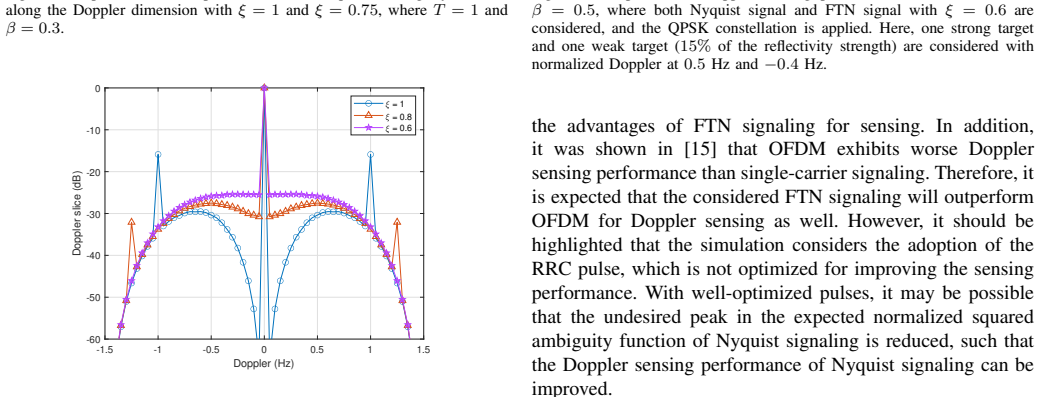
The paper's central claim is that a single-carrier ISAC waveform that transmits faster than the Nyquist rate is strictly better than its Nyquist counterpart in both functionalities, and that the cause is the removal of spectral aliasing. Concretely, the paper proves that the effective channel matrices of FTN are asymptotically Hermitian Toeplitz, which lets Szegő's theorem turn the constrained capacity into a frequency integral of a per-frequency SNR; the upper and lower bounds on that integral are expressed through the folded spectrum and the twisted folded spectrum, which capture constructive and destructive superposition of aliased spectrum copies, and the bounds coincide exactly when $1/(\xi T) \geq W$, the regime where the SNR variation induced by multipath delay vanishes and the system degrees of freedom are maximal. On the sensing side, the paper derives the expected squared ambiguity function of FTN and shows that its delay slice fluctuates less than the Nyquist one, while the Doppler slice of Nyquist signaling carries undesired peaks at multiples of $1/(\xi T)$ that appear precisely because of spectral aliasing and disappear for FTN with $\xi \leq \xi_0$. The conclusion the authors draw is that a single FTN signal, with the same power spectral density and the same time-frequency footprint as a Nyquist baseline, offers simultaneously higher spectral efficiency and more reliable range and Doppler estimation.
Load-bearing premise
The load-bearing premise is the fairness convention that FTN and Nyquist signals share the same power spectral density and the same time-frequency footprint, enforced by $E_s = P \xi T$; if one instead compares at equal per-symbol energy or equal peak power, the claimed spectral-efficiency ordering is not proven and could reverse, though the sensing conclusions do not depend on this normalization.
Editorial extensions
If this is right
- In the regime $\xi \leq 1/(WT)$ the derived spectral-efficiency bounds coincide, giving an exact rate expression: the multipath-induced SNR variation vanishes and the system attains its maximum degrees of freedom (pre-log factor).
- The gap between the upper and lower spectral-efficiency bounds at the Nyquist rate is a direct quantitative measure of the SNR uncertainty that channel delay injects through spectral aliasing, and it shrinks as the symbol rate grows.
- FTN ranging benefits from a less fluctuated delay slice of the expected squared ambiguity function, which the paper identifies with the accumulated ISI function's weaker oscillation at high symbol rates.
- At or below the saturation threshold there are no undesired peaks in the Doppler slice, so a weak target at a nearby Doppler is not masked by periodic ambiguity; the numerical Doppler estimation confirms FTN's mean squared error decreases with SNR while Nyquist's does not.
- The analysis holds for any band-limited pulse for which the folded and twisted folded spectra are defined, and becomes exact for systems with a cyclic prefix longer than the delay spread, where Toeplitz matrices become circulant.
Reading between the lines
- A design choice the paper stops short of recommending: operate at the saturation threshold $\xi = \xi_0$ itself, rather than below it, since smaller $\xi$ buys no additional aliasing avoidance and only raises equalization complexity.
- Because the spurious Doppler peaks sit on a squared Dirichlet kernel, their width scales as $1/(N\xi T)$: longer coherent integration does not remove the Nyquist ambiguity but sharpens it into narrow spikes, an effect the paper's formulas imply but do not quantify.
- Under the paper's equal-PSD normalization the FTN advantage should widen with the roll-off factor $\beta$, since $W = (1+\beta)/T$ makes the aliasing-prone excess bandwidth grow; this scaling is visible in $\xi_0 = 1/(1+\beta)$ but is not drawn out.
- The ranging gap between FTN and Nyquist is likely to shrink when the pulse is optimized for sensing, but the Doppler-side advantage should persist, because the peak mechanism is the symbol-rate/bandwidth mismatch rather than the pulse's sidelobe structure.
Editorial analysis
A structured set of objections, weighed in public.
Referee Report
Summary. The paper provides an analytical study of single-carrier faster-than-Nyquist (FTN) signaling for integrated sensing and communications (ISAC). On the communications side, it models the effective channel matrix as asymptotically Hermitian Toeplitz, applies Szegő's theorem, and derives spectral-efficiency expressions with upper and lower bounds for time-invariant multipath channels; in the no-aliasing regime where the symbol rate is at least the pulse bandwidth, the bounds coincide and an exact formula is given. On the sensing side, the paper derives the expected squared ambiguity function for random symbols, defines an accumulated ISI function for ranging and a periodic Doppler variation function, and argues that FTN avoids the Doppler-dimension peaks caused by spectral aliasing in Nyquist signaling with excess bandwidth. Numerical simulations of spectral efficiency, delay slices, Doppler slices, and two-target Doppler estimation support the analytical claims.
Significance. If the claims are taken in their stated scope, the paper is a valuable analytical contribution: it gives parameter-free spectral-efficiency bounds, an exact no-aliasing formula, and a crisp explanation of FTN's sensing benefit through avoidance of spectral aliasing. The Doppler peak-avoidance prediction is falsifiable and is verified in simulation. The derivation is mostly self-contained, with the main tools being Toeplitz asymptotics, Szegő's theorem, and the fourth-order moment expansion of the ambiguity function. The equal-PSD comparison convention is stated explicitly and is standard in the FTN literature. The main weakness is that the title and abstract claim a general 'FTN is good for ISAC' advantage, whereas the communication-side result is proven only under an equal-average-power/equal-PSD normalization, and the ranging advantage is supported more by numerical evidence than by a formal theorem.
major comments (3)
- [II-B and Theorem 1] The communication-side advantage is established only under the equal-PSD/average-power convention Es=PξT. Under a per-symbol-energy or peak-power constraint, FTN would consume more average power or face an unmodeled PAPR increase, so the ordering in Theorem 1 is not proven for those operating points. The title and abstract state 'FTN is advantageous for ISAC' without this qualification. Because the 'good' in the title rests on this comparison, I ask the authors to scope the claims explicitly, or to add an analysis (or at least a discussion) of the alternative normalizations.
- [IV-A] The claim that FTN signals 'generally enjoy a more robust ranging performance' is not proven. The analysis of the accumulated ISI function X(τ) shows that its fluctuation is reduced when ξ≤ξ0, but the normalized delay slice of the expected squared ambiguity function also contains the term N²|AF_p(-τ,0)|² and a kurtosis-dependent term, and no analytical ordering of the normalized slice is derived. The numerical comparison in Fig. 6 shows similar behavior rather than a general advantage. Please either prove a formal statement about the normalized ambiguity function or weaken the claim to the observed fluctuation property of X(τ).
- [IV-B] The contribution bullet states that 'spectral aliasing will introduce undesired peaks' along the Doppler dimension, but the analysis of Y(ν) in (44) only shows that the Dirichlet kernel has peaks at multiples of 1/(ξT). An actual peak in E|AF_s(0,ν)|² requires AF_p(0,ν) to be nonzero at those Doppler offsets; this is not proven for general p(t) and is only demonstrated numerically for the RRC pulse. A sufficient condition (e.g., RRC with β>0 and 1/(ξT)<W) should be stated and proved, or the claim should be restricted to the pulse family for which the condition holds.
minor comments (5)
- [Eq. (35)] Equation (35) appears to contain a typo: the expression should be |E[AF_s(τ,ν)]|² = E_s² |Σ_{n=1}^N e^{-j2πnνξT}|² |AF_p(-τ,ν)|². As printed it lacks the absolute square and mislabels the expectation, which is inconsistent with the decomposition in (33)-(36).
- [Fig. 2] The legend in Fig. 2 appears to list 'ξ=0.75, achievable rate' three times; please check and correct the legend entries.
- [Footnote 2] The wording of the Nyquist no-ISI theorem in footnote 2 is confusing; for the two-sided bandwidth W used in the paper, the no-ISI condition is 1/T ≤ W, and the text should state this explicitly.
- [Section II-B, Eq. (15)] The approximation in (15) is stated without quantifying its accuracy; a brief comment on when the ratio of expectations is a good approximation to the expectation of the ratio would be helpful.
- [Section IV-A] The phrase 'oscillated values' should read 'oscillatory values'.
Circularity Check
No circularity: the central communication and sensing derivations follow from the stated model and definitions; self-citations are technical references, not load-bearing assumptions.
full rationale
No circular step can be exhibited. The communication result (Theorem 1) is derived from the system model in Eq. (6) by proving the relevant matrices are asymptotically Hermitian Toeplitz, applying Szegő's theorem, and evaluating the DTFTs via Poisson summation in Appendix A. The no-aliasing expression in Eq. (35) follows from the bandwidth-support condition 1/(ξT) ≥ W, which is exactly the definition of the saturation threshold ξ0; this is a consequence of the pulse being band-limited, not a quantity fitted to the conclusion. The equal-PSD normalization Es = PξT is an explicitly stated comparison convention in Section II-B, and the rate expression is evaluated under those stated assumptions, so the FTN gain is not an input-output tautology. The sensing analysis is likewise self-contained: Section IV computes E[|AF_s(τ,ν)|^2] directly from the definition of the ambiguity function and the fourth moments of the constellation, obtaining Eq. (33) without fitting any parameter; the Doppler peaks in Y(ν) and their absence for ξ≤ξ0 follow from the Dirichlet-kernel periodicity and the support of |AF_p(0,ν)|^2. Self-citations to [16] for the 'Iceberg' mean-variance label and to [42] for folded-spectrum bounds and DTFT identities are used as technical references, but the needed identities are either re-derived in the appendices or are published, parameter-free results whose assumptions do not include the paper's conclusion; they are therefore not load-bearing in a circular sense. The main caveat is scoping, not circularity: the headline advantage is established under the equal-PSD/resource convention and against RRC Nyquist signaling, and the paper is transparent about that normalization.
Assumptions & free parameters
assumptions (8)
- domain assumption Shaping pulse p(t) is real, energy-normalized, strictly band-limited with two-sided bandwidth W, and its spectrum satisfies |Hp(f)|² = |Hp(-f)|².
- domain assumption Constellation A is rotational symmetric, zero-mean, unit-power, with E[a_i]=0, E[a_i²]=0, E[|a_i|²]=1.
- domain assumption The transmitted symbols x_n are i.i.d. circularly symmetric Gaussian for the spectral-efficiency derivation.
- standard math Asymptotic regime N→∞: effective channel matrices are Hermitian Toeplitz, Szegő's theorem applies, and G0 is positive definite as shown in [41].
- domain assumption The communication channel is time-invariant with L discrete paths, each characterized by delay τ_l and coefficient h_l.
- domain assumption The normalized ambiguity-function expectation is approximated as E[|AF|²/|AF(0,0)|²] ≈ E[|AF|²]/E[|AF(0,0)|²].
- domain assumption Sensing performance is evaluated with the squared ambiguity function of the transmitted signal and a matched-filter receiver, independent of a specific sensing channel.
- domain assumption For the Doppler peak-avoidance claim, the pulse is band-limited so |AF_p(0,ν)| has support within [-W,W]; hence a Dirichlet peak at 1/(ξT) is suppressed when 1/(ξT) ≥ W.
Cite this review
Pith. "Pith review of Faster-than-Nyquist Signaling is Good for Single-Carrier ISAC: An Analytical Study." pith.science (2026). https://pith.science/paper/A4AP3B5B
@misc{pith2026250609931,
  author       = {Pith},
  title        = {Pith review of: Faster-than-Nyquist Signaling is Good for Single-Carrier ISAC: An Analytical Study},
  year         = {2026},
  howpublished = {\url{https://pith.science/paper/A4AP3B5B}},
  note         = {Machine review of arXiv:2506.09931}
}
read the original abstract
In this paper, we provide an analytical study of single-carrier faster-than-Nyquist (FTN) signaling for integrated sensing and communications (ISAC). Our derivations show that FTN is advantageous for ISAC, and reveal new insights that these advantages come from the fact that FTN signaling can effectively avoid the spectral aliasing due to the mismatch between the symbol rate and the bandwidth of the shaping pulse. Specifically, the communication spectral efficiency advantages of FTN signaling over time-invariant multipath channels are analytically shown, where both upper- and lower-bounds on the spectral efficiency are derived. We show that the gap between these two bounds corresponds to the potential signal-to-noise ratio (SNR) variation due to the presence of multipath delay and spectral aliasing, which diminishes as the symbol rate grows higher. Particularly, in the limiting case, this SNR variation disappears while the degree of freedom (DoF) of the system attain the maximum. Furthermore, the sensing advantages for FTN signals are verified in terms of the expected normalized squared ambiguity function. We show that FTN signals generally enjoy a more robust ranging performance. More importantly, we prove that FTN signaling can effectively avoid the undesired peaks in the considered ambiguity function along the Doppler dimension, thereby reducing the ambiguities in velocity estimation. All these conclusions are explicitly verified by numerical results.
Figures


Figures from the paper (4 more)


Reference graph
Works this paper leans on
-
[42]
Faster-than-Nyquist asynchronous NOMA outperforms synchronous NOMA,
S. Li, Z. Wei, W. Yuan, J. Yuan, B. Bai, D. W. K. Ng, and L. Hanzo, “Faster-than-Nyquist asynchronous NOMA outperforms synchronous NOMA,”IEEE J. Sel. Areas Commun., vol. 40, no. 4, pp. 1128–1145, Jan. 2022
work page 2022
-
[1]
On the communication rate over time-invariant channels in the presence of spectral aliasing,
S. Li, F. Liu, Y . Xiong, W. Yuan, B. Bai, C. Masouros, and G. Caire, “On the communication rate over time-invariant channels in the presence of spectral aliasing,” in submission toIEEE Inf. Theory Workshop, 2025, pp. 1–5
work page 2025
-
[2]
New Recommendation ITU-R M.2160-0 [IMT. Frame- work for 2030 and Beyond],
ITU-R WP5D, “New Recommendation ITU-R M.2160-0 [IMT. Frame- work for 2030 and Beyond],” 2023
work page 2023
-
[3]
Q. Zhang, H. Sun, X. Gao, X. Wang, and Z. Feng, “Time-division ISAC enabled connected automated vehicles cooperation algorithm design and performance evaluation,”IEEE J. Sel. Areas Commun., vol. 40, no. 7, pp. 2206–2218, Mar. 2022
work page 2022
-
[4]
Joint communication and sens- ing in 6G networks,
H. Andersson Y, “Joint communication and sens- ing in 6G networks,”Ericsson Blog, 2021. [Online]. Available: https://www.ericsson.com/en/blog/2021/10/joint-sensing-and- communication-6g
work page 2021
-
[5]
Integrated sensing and communications: Toward dual-functional wire- less networks for 6G and beyond,
F. Liu, Y . Cui, C. Masouros, J. Xu, T. X. Han, Y . C. Eldar, and S. Buzzi, “Integrated sensing and communications: Toward dual-functional wire- less networks for 6G and beyond,”IEEE J. Sel. Areas Commun., vol. 40, no. 6, pp. 1728–1767, Mar. 2022
2022
-
[6]
Joint radar and communication design: Applications, state-of-the-art, and the road ahead,
F. Liu, C. Masouros, A. P. Petropulu, H. Griffiths, and L. Hanzo, “Joint radar and communication design: Applications, state-of-the-art, and the road ahead,”IEEE Trans. Commun., vol. 68, no. 6, pp. 3834–3862, Feb. 2020
2020
-
[7]
A novel joint angle-range-velocity estimation method for MIMO-OFDM ISAC systems,
Z. Xiao, R. Liu, M. Li, Q. Liu, and A. L. Swindlehurst, “A novel joint angle-range-velocity estimation method for MIMO-OFDM ISAC systems,”IEEE Trans. Signal Process., vol. 72, pp. 3805–3818, Aug. 2024
work page 2024
Show all 48 references
-
[8]
Integrated sensing and communication waveform design: A survey,
W. Zhou, R. Zhang, G. Chen, and W. Wu, “Integrated sensing and communication waveform design: A survey,”IEEE Open J. Commun. Society, vol. 3, pp. 1930–1949, Oct. 2022
1930
-
[9]
To- ward dual-functional radar-communication systems: Optimal waveform design,
F. Liu, L. Zhou, C. Masouros, A. Li, W. Luo, and A. Petropulu, “To- ward dual-functional radar-communication systems: Optimal waveform design,”IEEE Trans. Signal Process., vol. 66, no. 16, pp. 4264–4279, Jul. 2018
2018
-
[10]
MIMO-OFDM ISAC waveform design for range-Doppler sidelobe suppression,
P. Li, M. Li, R. Liu, Q. Liu, and A. Lee Swindlehurst, “MIMO-OFDM ISAC waveform design for range-Doppler sidelobe suppression,”IEEE Trans. Wireless Commun., vol. 24, no. 2, pp. 1001–1015, Feb. 2025
2025
-
[11]
Cook,Radar Signals: An Introduction to Theory and Application
C. Cook,Radar Signals: An Introduction to Theory and Application. Elsevier, 2012
2012
-
[12]
On the fundamental tradeoff of integrated sensing and communications under Gaussian channels,
Y . Xiong, F. Liu, Y . Cui, W. Yuan, T. X. Han, and G. Caire, “On the fundamental tradeoff of integrated sensing and communications under Gaussian channels,”IEEE Trans. Inf. Theory, vol. 69, no. 9, pp. 5723– 5751, Jun. 2023
2023
-
[13]
Reshaping the ISAC tradeoff under OFDM signaling: A probabilistic constellation shaping approach,
Z. Du, F. Liu, Y . Xiong, T. X. Han, Y . C. Eldar, and S. Jin, “Reshaping the ISAC tradeoff under OFDM signaling: A probabilistic constellation shaping approach,”IEEE Trans. Signal Process., vol. 72, pp. 4782–4797, Sept. 2024
2024
-
[14]
Yeung,Information Theory and Network Coding
R. Yeung,Information Theory and Network Coding. Springer, 2008
2008
-
[15]
OFDM achieves the lowest ranging sidelobe under random ISAC signaling,
F. Liu, Y . Zhang, Y . Xiong, S. Li, W. Yuan, F. Gao, S. Jin, and G. Caire, “OFDM achieves the lowest ranging sidelobe under random ISAC signaling,”arXiv preprint arXiv:2407.06691, 2024. 15
2024 arXiv
-
[16]
Uncovering the iceberg in the sea: Fundamentals of pulse shaping and modulation design for random ISAC signals,
F. Liu, Y . Xiong, S. Lu, S. Li, W. Yuan, F. Gao, S. Jin, and G. Caire, “Uncovering the iceberg in the sea: Fundamentals of pulse shaping and modulation design for random ISAC signals,” submitted toIEEE Trans. Signal Process., 2024
2024
-
[17]
Pulse shaping for random ISAC signals: The ambiguity function between symbols matters,
Z. Liao, F. Liu, S. Li, Y . Xiong, W. Yuan, C. Masouros, and M. Lops, “Pulse shaping for random ISAC signals: The ambiguity function between symbols matters,”IEEE Trans. Wireless Commun., vol. 24, no. 4, pp. 2832–2846, Apr. 2025
2025
-
[18]
A mathematical theory of communication,
C. E. Shannon, “A mathematical theory of communication,”Bell Sys. Techn. J., vol. 27, no. 3, pp. 379–423, Jul. 1948
1948
-
[19]
Faster-than-Nyquist signaling,
J. E. Mazo, “Faster-than-Nyquist signaling,”The Bell System Techn. J., vol. 54, no. 8, pp. 1451–1462, Oct. 1975
1975
-
[20]
Faster-than-Nyquist signaling,
J. B. Anderson, F. Rusek, and V . ¨Owall, “Faster-than-Nyquist signaling,” Proc. IEEE, vol. 101, no. 8, pp. 1817–1830, Mar. 2013
2013
-
[21]
Im- proving the spectral efficiency of nonlinear satellite systems through time-frequency packing and advanced receiver processing,
A. Piemontese, A. Modenini, G. Colavolpe, and N. S. Alagha, “Im- proving the spectral efficiency of nonlinear satellite systems through time-frequency packing and advanced receiver processing,”IEEE Trans. Commun., vol. 61, no. 8, pp. 3404–3412, Aug. 2013
2013
-
[22]
Modulation formats and waveforms for 5G networks: Who will be the heir of OFDM?: an overview of alternative modulation schemes for improved spectral efficiency,
P. Banelli, S. Buzzi, G. Colavolpe, A. Modenini, F. Rusek, and A. Ugolini, “Modulation formats and waveforms for 5G networks: Who will be the heir of OFDM?: an overview of alternative modulation schemes for improved spectral efficiency,”IEEE Signal Process. Mag., vol. 31, no. ...
2014
-
[23]
On the practical benefits of faster-than-Nyquist signaling,
C. Le, M. Schellmann, M. Fuhrwerk, and J. Peissig, “On the practical benefits of faster-than-Nyquist signaling,” inInt. Conf. Adv. Techn. Commun. (ATC 2014), 2014, pp. 208–213
2014
-
[24]
A novel low complexity faster-than-Nyquist (FTN) signaling detector for ultra high-order QAM,
A. Ibrahim, E. Bedeer, and H. Yanikomeroglu, “A novel low complexity faster-than-Nyquist (FTN) signaling detector for ultra high-order QAM,” IEEE Open J. Commun. Society, vol. 2, pp. 2566–2580, 2021
2021
-
[25]
Multicarrier faster-than- Nyquist transceivers: Hardware architecture and performance analysis,
D. Dasalukunte, F. Rusek, and V . ´’Owall, “Multicarrier faster-than- Nyquist transceivers: Hardware architecture and performance analysis,” IEEE Trans. Circuits Syst. I: Regul. Pap., vol. 58, no. 4, pp. 827–838, Apr. 2011
2011
-
[26]
Faster than Nyquist signaling,
D. Dasalukunte, V . Owall, F. Rusek, and J. B. Anderson, “Faster than Nyquist signaling,”Algorithms to Silicon. Switzerland: Springer International Publishing, 2014
2014
-
[27]
Waveform and space precoding for next generation downlink narrowband IoT,
T. Xu, C. Masouros, and I. Darwazeh, “Waveform and space precoding for next generation downlink narrowband IoT,”IEEE Internet Things J., vol. 6, no. 3, pp. 5097–5107, Jun. 2019
2019
-
[28]
Constrained capacities for faster-than- Nyquist signaling,
F. Rusek and J. B. Anderson, “Constrained capacities for faster-than- Nyquist signaling,”IEEE Trans. Inf. Theory, vol. 55, no. 2, pp. 764–775, Feb. 2009
2009
-
[29]
Faster-than-Nyquist broadcast- ing in Gaussian channels: Achievable rate regions and coding,
Y . J. D. Kim, J. Bajcsy, and D. Vargas, “Faster-than-Nyquist broadcast- ing in Gaussian channels: Achievable rate regions and coding,”IEEE Trans. Commun., vol. 64, no. 3, pp. 1016–1030, 2016
2016
-
[30]
A first encounter with faster-than-Nyquist signaling on the MIMO channel,
F. Rusek, “A first encounter with faster-than-Nyquist signaling on the MIMO channel,” inIEEE Wireless Commun. Netw. Conf., 2007, pp. 1093–1097
2007
-
[31]
Faster-than-Nyquist signaling for MIMO communications,
Z. Zhang, M. Yuksel, and H. Yanikomeroglu, “Faster-than-Nyquist signaling for MIMO communications,”IEEE Trans. Wireless Commun., vol. 22, no. 4, pp. 2379–2392, Oct. 2023
2023
-
[32]
Precoded faster-than-Nyquist signaling with optimal power allocation in frequency-selective channel,
T. Ishihara and S. Sugiura, “Precoded faster-than-Nyquist signaling with optimal power allocation in frequency-selective channel,” inIEEE Int. Conf. Commun. Workshops (ICC Workshops), 2021, pp. 1–6
2021
-
[33]
Faster-than-Nyquist signaling,
J. B. Anderson, F. Rusek, and V . ¨Owall, “Faster-than-Nyquist signaling,” Proceedings of the IEEE, vol. 101, no. 8, pp. 1817–1830, Mar. 2013
2013
-
[34]
Reduced-complexity receivers for strongly narrowband intersymbol interference introduced by faster-than-Nyquist signaling,
A. Prlja and J. B. Anderson, “Reduced-complexity receivers for strongly narrowband intersymbol interference introduced by faster-than-Nyquist signaling,”IEEE Trans. Commun., vol. 60, no. 9, pp. 2591–2601, Sept. 2012
2012
-
[35]
Reduced-complexity equalization for faster-than-Nyquist signaling: New methods based on Ungerboeck observation model,
S. Li, B. Bai, J. Zhou, P. Chen, and Z. Yu, “Reduced-complexity equalization for faster-than-Nyquist signaling: New methods based on Ungerboeck observation model,”IEEE Trans. Commun., vol. 66, no. 3, pp. 1190–1204, Nov. 2018
2018
-
[36]
Optimal channel shortening for MIMO and ISI channels,
F. Rusek and A. Prlja, “Optimal channel shortening for MIMO and ISI channels,”IEEE Trans. Wireless Commun., vol. 11, no. 2, pp. 810–818, Feb. 2012
2012
-
[37]
Code-based channel shorten- ing for faster-than-Nyquist signaling: Reduced-complexity detection and code design,
S. Li, J. Yuan, B. Bai, and N. Benvenuto, “Code-based channel shorten- ing for faster-than-Nyquist signaling: Reduced-complexity detection and code design,”IEEE Trans. Commun., vol. 68, no. 7, pp. 3996–4011, Jul. 2020
2020
-
[38]
Frequency-domain equalization of faster-than-Nyquist sig- naling,
S. Sugiura, “Frequency-domain equalization of faster-than-Nyquist sig- naling,”IEEE Wireless Commun. Lett., vol. 2, no. 5, pp. 555–558, Aug. 2013
2013
-
[39]
Time-domain vs. frequency-domain equalization for FTN signaling,
S. Li, W. Yuan, J. Yuan, B. Bai, D. Wing Kwan Ng, and L. Hanzo, “Time-domain vs. frequency-domain equalization for FTN signaling,” IEEE Trans. Veh. Technol., vol. 69, no. 8, pp. 9174–9179, Aug. 2020
2020
-
[40]
Snr-adaptive ranging waveform design based on Ziv-Zakai bound optimization,
Y . Xiong and F. Liu, “Snr-adaptive ranging waveform design based on Ziv-Zakai bound optimization,”IEEE Signal Process. Lett., vol. 30, pp. 1427–1431, Oct. 2023
2023
-
[41]
Properties of faster-than-Nyquist channel matrices and folded-spectrum, and their applications,
Y . J. D. Kim, “Properties of faster-than-Nyquist channel matrices and folded-spectrum, and their applications,” inIEEE Wireless Commun. Net. Conf., 2016, pp. 1–7
2016
-
[43]
Designing unimodular sequence sets with good correlations—including an application to MIMO radar,
H. He, P. Stoica, and J. Li, “Designing unimodular sequence sets with good correlations—including an application to MIMO radar,”IEEE Trans. Signal Process., vol. 57, no. 11, pp. 4391–4405, Nov. 2009
2009
-
[44]
R. M. Gray,Toeplitz and Circulant Matrices: A Review. Now Foundations and Trends, 2006
2006
-
[45]
Simon,Szeg ˝o’s Theorem and Its Descendants: Spectral Theory for L2 Perturbations of Orthogonal Polynomials
B. Simon,Szeg ˝o’s Theorem and Its Descendants: Spectral Theory for L2 Perturbations of Orthogonal Polynomials. Princeton university press, 2010, vol. 6
2010
-
[46]
On the asymptotic equivalence of circulant and Toeplitz matrices,
Z. Zhu and M. B. Wakin, “On the asymptotic equivalence of circulant and Toeplitz matrices,”IEEE Trans. Inf. Theory, vol. 63, no. 5, pp. 2975–2992, May 2017
2017
-
[47]
Low-complexity truncated polynomial expansion DL precoders and UL receivers for massive MIMO in correlated channels,
A. Benzin, G. Caire, Y . Shadmi, and A. M. Tulino, “Low-complexity truncated polynomial expansion DL precoders and UL receivers for massive MIMO in correlated channels,”IEEE Trans. Wireless Commun., vol. 18, no. 2, pp. 1069–1084, Feb. 2019
2019
-
[48]
Capac- ity region of asynchronous multiple access channels with FTN,
Z. Zhang, M. Yuksel, G. M. Guvensen, and H. Yanikomeroglu, “Capac- ity region of asynchronous multiple access channels with FTN,”IEEE Commun. Lett., vol. 27, no. 7, pp. 1719–1723, Jul. 2023
2023
Reviewed August 7, 2026 · model on record in the stance chip above.
Discussion (0). Sign in to comment.