REVIEW 3 major objections 6 minor 103 references
AnimateAnyMesh: A Feed-Forward 4D Foundation Model for Text-Driven Universal Mesh Animation
T0 review · 3 major / 6 minor · reviewed 2026-08-07 · deepseek-v4-flash
Pith's one-line read The paper claims that animating an arbitrary static 3D mesh from a text prompt can be one feed-forward pass: compress motion into latent codes, generate from text, decode displacements onto the vertices.
desk verdict A plausible and useful feed-forward mesh animation framework with a large new dataset, but the universal-mesh claim is contradicted by the paper's own low-poly reconstruction ablation and the evaluation is too thin to support it. read the letter →
The pith
A machine-rendered reading of the paper's core claim, the machinery that carries it, and where it could break.
The reading
What carries the argument
The load-bearing identity is the trajectory decomposition $V^t = V^t_0 + V^t_T$, which splits every frame into an initial vertex position and a relative displacement. DyMeshVAE encodes the two parts with separate positional encodings, restricts self-attention with the adjacency matrix built from the mesh's face information, and uses Farthest Point Sampling to collapse any mesh to a fixed number of latent tokens, 512 by default. The decoder treats the initial-frame vertex features as queries and retrieves trajectory latents through cross-attention, so the input geometry guides where motion is placed. The Shape-Guided Text-to-Trajectory model, built as a multimodal diffusion transformer, runs Rectified Flow in this latent space, and inference is an ODE solve with classifier-free guidance, which blends conditional and unconditional velocity predictions.
What would settle it
Take a mesh category absent from the three training sources — for instance an articulated mechanical part or a low-poly object with a few hundred vertices, where the paper's own 369-vertex example already reconstructs poorly at every sampling ratio — prompt the released model, and check whether the animation is semantically correct; such a test would directly delimit the 'arbitrary topology' claim.
Extended reading notes
Core claim
The central claim is that a dynamic mesh sequence can be fully described by its initial vertex positions plus the relative trajectories of those vertices, and that this decomposition turns universal mesh animation into conditional generation in a compressed latent space. DyMeshVAE compresses any input mesh, regardless of vertex or face count, into a fixed set of latent tokens, using the mesh's own adjacency structure as an attention mask so that spatially close but semantically distinct vertices do not entangle their motions. A Rectified Flow model learns the distribution of trajectory latents conditioned on CLIP text embeddings and initial-mesh latents, and the decoder maps sampled latents back to per-vertex displacements that are added to the static mesh. The paper asserts that this pipeline produces semantically accurate and temporally coherent animations for arbitrary topology in a few seconds, supported by a new dataset of more than 4M text-annotated dynamic mesh sequences and by comparisons in which it reports the highest VBench metrics and user-study scores among the compared methods.
Load-bearing premise
The 'arbitrary mesh' promise rests on the assumption that the motion patterns in the DyMesh dataset, built from just three sources and containing fewer than 100k unique mesh identities, cover the motion space of whatever mesh a user supplies.
Editorial extensions
If this is right
- Text-to-motion for meshes drops from a per-scene optimization chore of roughly 10-14 minutes for the compared baselines to a forward pass of about 4-6 seconds, making batch animation of many assets practical.
- The existing universe of static meshes, whether artist-crafted or machine-generated, becomes animatable without retraining or per-object fitting, so long as the mesh falls inside the learned motion distribution.
- Because the latent is fixed-size and attention-based, the same trained model adapts at inference to meshes with far more vertices by adjusting the FPS sampling density, with quality improving as the vertex budget grows.
- The DyMesh dataset, with over 4M text-annotated dynamic mesh sequences, supplies the large-scale training signal that feed-forward 4D generation has been missing.
- Scaling experiments in the paper indicate that more vertices, more frames per sequence, and a larger flow model each improve the reported metrics, so the recipe is a scaling path rather than a plateau.
Reading between the lines
- A fair reading of the paper's own limitations appendix is that 'arbitrary meshes' currently means 'meshes whose motion distribution resembles the three source datasets,' since unique identities stay below 100k; the released model's true coverage will be settled by adversarial category testing, not by the 10-object evaluation.
- The same decompose-compress-generate recipe should transfer to other non-rigid representations such as point-cloud sequences or tetrahedral meshes by swapping the adjacency mask, which would extend the approach beyond triangle meshes.
- Nothing in the architecture ties latency to the 64 ODE steps used at inference; distilling the flow model or reducing sampling steps could plausibly push animation toward real time, an extension the paper leaves unexplored.
- If DyMesh is released with its motion-based filters and per-source provenance, it would let the community measure how much of the 'universal' claim is dataset coverage versus architecture, by training on subsets and testing on held-out source categories.
Editorial analysis
A structured set of objections, weighed in public.
Referee Report
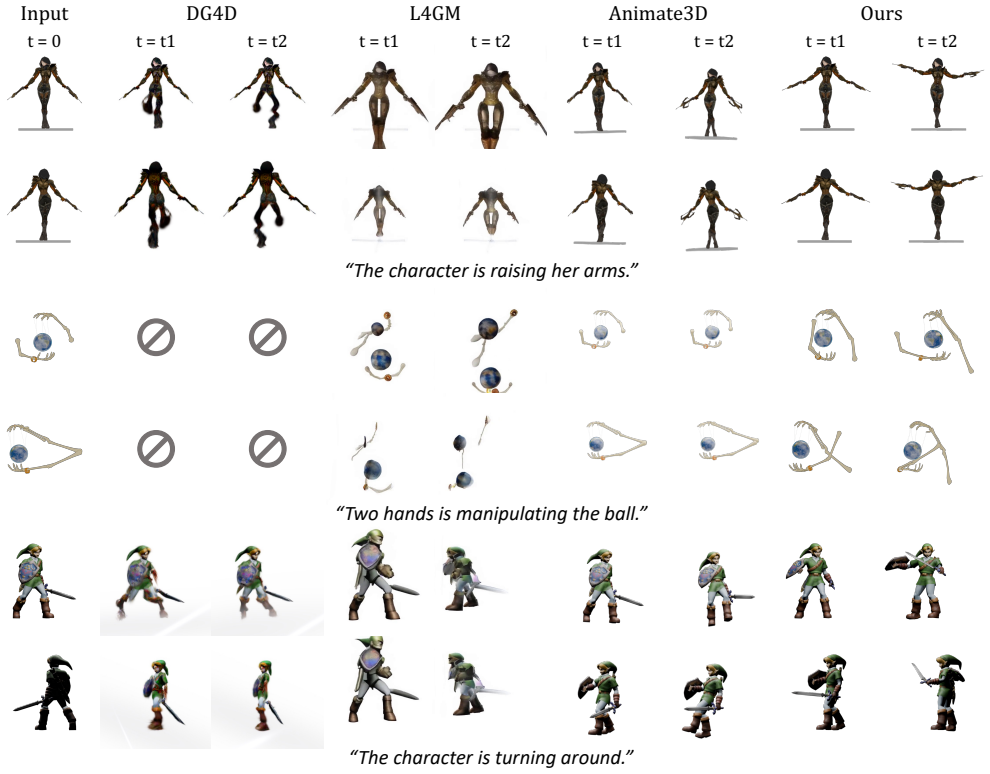
Summary. The paper presents AnimateAnyMesh, a feed-forward framework for text-driven animation of static 3D meshes. The method combines a DyMeshVAE, which compresses dynamic mesh sequences into a fixed set of latent tokens via topology-aware attention and Farthest Point Sampling, with a Shape-Guided Text-to-Trajectory model trained with Rectified Flow. The authors also contribute the DyMesh Dataset, containing over 4M dynamic mesh sequences with text annotations. Experiments compare the method with DG4D, L4GM, and Animate3D on 10 test objects, reporting higher VBench metrics, better user-study scores, and inference times of about 6 seconds. The paper claims to be the first feed-forward framework for universal mesh animation.
Significance. If the central claims hold, the work is a meaningful step toward practical 4D content generation, offering fast mesh animation without per-scene optimization or reconstruction. The DyMeshVAE design, which handles variable vertex counts through FPS and topology-aware attention, is a plausible and potentially reusable contribution, as is the large-scale DyMesh dataset. The paper also ships an extensive set of ablations and reports inference efficiency advantages. However, the current evidence base is narrow: the quantitative comparison relies on 10 test objects with no statistical checks, the user study averages only successful cases, and the reconstruction ablation in the appendix reveals pronounced failure on low-polygon meshes, contradicting the 'arbitrary mesh' claim. These issues need to be addressed before the paper's central claims are fully supported.
major comments (3)
- [Appendix D, Table 5; Sec. 4.1] The claim of animating 'arbitrary 3D meshes' is directly contradicted by the reconstruction ablation. For a 369-vertex mesh, the reconstruction error is 8.10 even at a 1/4 FPS sampling ratio, while 2,567- and 6,890-vertex meshes achieve errors of 0.54 and 0.50. With the default inference rule n = min(512, num_v//8), a 369-vertex mesh receives only 46 latent tokens, and the error grows to 22.45 at 1/8, 58.78 at 1/16, and 136.57 at 1/32. Because the text-to-trajectory model operates in the same latent space and the decoder must lift tokens to per-vertex trajectories, any mesh the VAE cannot reconstruct cannot be animated faithfully. Low-polygon meshes are common in games and VR, so this is not a fringe case. The main evaluation (Sec. 4.3) uses only 10 test objects and rendering-based metrics, so this failure mode is invisible in Table 2. The authors should either restrict the universality claim to meshes with sufficient vertex counts or demonstrate a fix for low-poly inputs.
- [Sec. 4.1, Table 2, Appendix A.3] The quantitative evidence for 'significantly outperforming existing approaches' is weak. The comparison is based on 10 test objects with no error bars, variance, or significance tests. The Dynamic Degree metric is excluded from VBench because baselines degenerate; this is selective reporting and should be justified or the metric should be included with a note on failure modes. Moreover, the user study averages only successful cases, explicitly handling failed generations by 'computing means from successful cases only.' This biases scores in favor of methods that produce a few good outputs while hiding their failure rates. The authors should report per-object results, include a motion-intensity metric, and either assign a low score to failed generations or report success rates alongside the means.
- [Appendix F, Sec. 4.1] The universality claim is not well supported by the training distribution. The DyMesh Dataset contains fewer than 100k unique identities assembled from only three sources (Objaverse, AMASS, DeformingThings4D), with heavy augmentation via reversal and temporal slicing. Appendix F acknowledges this may limit generalization to specialized categories. The 10-object test set appears to be drawn from categories well represented in these sources, and no out-of-distribution evaluation is provided. To substantiate the 'universal mesh' claim, the authors should evaluate on meshes from a held-out source or with substantially different topology/vertex distributions, or explicitly bound the claim to the covered distribution.
minor comments (6)
- [Eq. (11)] The timestep transformation t = 1 - 1/(tan(pi/2 u) + 1) is unusual; please explain its motivation and ensure the sampling schedule is clear, since the paper uses uniform timesteps at inference (Appendix A.2).
- [Fig. 2] The notation in Figure 2 (e.g., \hat V_0, \tilde V_T, Z_T) is not fully defined in the caption; please add brief definitions or refer to the corresponding equations.
- [Sec. 3.1] The construction of the adjacency matrix from face information is described only briefly; please specify how it handles non-manifold edges, disconnected components, and duplicated vertices after the merging step in Appendix A.1.
- [Appendix A.2] When padding face indices with (-1,-1,-1), please clarify how these invalid indices are excluded in the attention mask and connectivity matrix to avoid influencing the reconstruction.
- [Table 3] The definition of 'Rec Error' as 'average L2 sum error per-instance' is ambiguous; please state whether it is per-vertex, per-frame, or total, and include units.
- [Abstract and Sec. 5] The phrase 'first feed-forward framework' should be qualified with 'to our knowledge' and be made precise with respect to the specific task (text-driven animation of arbitrary static meshes), given that prior work covers category-specific feed-forward animation.
Circularity Check
No significant circularity: the core claims are empirical and benchmarked against external baselines; the self-citations present are not load-bearing.
full rationale
AnimateAnyMesh makes empirical claims about architecture design, dataset construction, and benchmark performance. The central text-to-trajectory pipeline is trained with a rectified-flow objective in a VAE latent space and evaluated on VBench metrics and user studies against independent baselines (DG4D, L4GM, Animate3D). No equation in the paper reduces by construction to a fitted constant or to a quantity defined in terms of the target claim. The DyMeshVAE reconstruction loss is a training objective, not a disguised prediction. The authors do cite earlier work by overlapping authors, notably Animate3D, but that citation is used as a comparative baseline and for adopting evaluation protocol, not as the justification for the claimed universality or state-of-the-art performance. The dataset limitation noted in Appendix F and the low-poly reconstruction failure shown in Appendix D are internal consistency and generalization concerns, not circularity. Overall, the derivation chain is self-contained with respect to the empirical claims; the minor self-citations do not carry the argument.
Assumptions & free parameters
free parameters (4)
- KL loss weight gamma =
0.001
- Classifier-free guidance scale =
3.0
- Default latent token count =
512
- Inference FPS sampling rule =
n = min(512, num_v//8)
assumptions (5)
- domain assumption The initial-frame plus relative-trajectory decomposition makes motion distributions closer to zero-mean normal and disentangles shape from motion.
- domain assumption Mesh adjacency constructed from face information is a reliable grouping signal for vertices that move similarly.
- domain assumption A fixed-size latent set, 512 tokens, can represent meshes of arbitrary vertex count without losing motion-critical detail.
- domain assumption The DyMesh dataset built from Objaverse, AMASS, and DeformingThings4D is representative of arbitrary mesh motion.
- domain assumption CLIP text embeddings and Qwen-2.5-VL captions provide sufficient semantic supervision for text-to-motion alignment.
Cite this review
Pith. "Pith review of AnimateAnyMesh: A Feed-Forward 4D Foundation Model for Text-Driven Universal Mesh Animation." pith.science (2026). https://pith.science/paper/NA6A3NX5
@misc{pith2026250609982,
  author       = {Pith},
  title        = {Pith review of: AnimateAnyMesh: A Feed-Forward 4D Foundation Model for Text-Driven Universal Mesh Animation},
  year         = {2026},
  howpublished = {\url{https://pith.science/paper/NA6A3NX5}},
  note         = {Machine review of arXiv:2506.09982}
}
read the original abstract
Recent advances in 4D content generation have attracted increasing attention, yet creating high-quality animated 3D models remains challenging due to the complexity of modeling spatio-temporal distributions and the scarcity of 4D training data. In this paper, we present AnimateAnyMesh, the first feed-forward framework that enables efficient text-driven animation of arbitrary 3D meshes. Our approach leverages a novel DyMeshVAE architecture that effectively compresses and reconstructs dynamic mesh sequences by disentangling spatial and temporal features while preserving local topological structures. To enable high-quality text-conditional generation, we employ a Rectified Flow-based training strategy in the compressed latent space. Additionally, we contribute the DyMesh Dataset, containing over 4M diverse dynamic mesh sequences with text annotations. Experimental results demonstrate that our method generates semantically accurate and temporally coherent mesh animations in a few seconds, significantly outperforming existing approaches in both quality and efficiency. Our work marks a substantial step forward in making 4D content creation more accessible and practical. All the data, code, and models will be open-released.
Figures


Figures from the paper (10 more)




Reference graph
Works this paper leans on
-
[1]
AC- CAD MoCap Dataset
Advanced Computing Center for the Arts and Design. AC- CAD MoCap Dataset. 3
-
[2]
Ijaz Akhter and Michael J. Black. Pose-conditioned joint angle limits for 3D human pose reconstruction. InIEEE Conf. on Computer Vision and Pattern Recognition (CVPR) 2015, 2015
2015
-
[3]
Digital dance ethnography: Organizing large dance collections.J
Andreas Aristidou, Ariel Shamir, and Yiorgos Chrysan- thou. Digital dance ethnography: Organizing large dance collections.J. Comput. Cult. Herit., 12(4), 2019. 3
2019
-
[4]
Sherwin Bahmani, Ivan Skorokhodov, Victor Rong, Gor- don Wetzstein, Leonidas Guibas, Peter Wonka, Sergey Tulyakov, Jeong Joon Park, Andrea Tagliasacchi, and David B Lindell. 4d-fy: Text-to-4d generation us- ing hybrid score distillation sampling.arXiv preprint arXiv:2311.17984, 2023. 1, 3
arXiv 2023
-
[5]
Shuai Bai, Keqin Chen, Xuejing Liu, Jialin Wang, Wenbin Ge, Sibo Song, Kai Dang, Peng Wang, Shijie Wang, Jun Tang, et al. Qwen2. 5-vl technical report.arXiv preprint arXiv:2502.13923, 2025. 6, 13
arXiv 2025
-
[6]
Andreas Blattmann, Tim Dockhorn, Sumith Kulal, Daniel Mendelevitch, Maciej Kilian, Dominik Lorenz, Yam Levi, Zion English, Vikram V oleti, Adam Letts, et al. Stable video diffusion: Scaling latent video diffusion models to large datasets.arXiv preprint arXiv:2311.15127, 2023. 7
arXiv 2023
-
[7]
Federica Bogo, Javier Romero, Gerard Pons-Moll, and Michael J. Black. Dynamic FAUST: Registering human bodies in motion. InIEEE Conf. on Computer Vision and Pattern Recognition (CVPR), 2017. 3
2017
-
[8]
Kemp, and James Hays
Samarth Brahmbhatt, Cusuh Ham, Charles C. Kemp, and James Hays. ContactDB: Analyzing and predicting grasp contact via thermal imaging. InThe IEEE Conference on Computer Vision and Pattern Recognition (CVPR), 2019. 3
2019
Show all 103 references
-
[9]
Motion2vecsets: 4d latent vector set diffu- sion for non-rigid shape reconstruction and tracking
Wei Cao, Chang Luo, Biao Zhang, Matthias Nießner, and Jiapeng Tang. Motion2vecsets: 4d latent vector set diffu- sion for non-rigid shape reconstruction and tracking. In Proceedings of the IEEE/CVF conference on computer vi- sion and pattern recognition, pages 20496–20506, 2024. 3
2024
-
[10]
CMU MoCap Dataset
Carnegie Mellon University. CMU MoCap Dataset. 3
-
[11]
Emerging properties in self-supervised vision transformers
Mathilde Caron, Hugo Touvron, Ishan Misra, Herv ´e J´egou, Julien Mairal, Piotr Bojanowski, and Armand Joulin. Emerging properties in self-supervised vision transformers. InProceedings of the IEEE/CVF international conference on computer vision, pages 9650–9660, 2021. 13
2021
-
[12]
Zeroscope text-to-video model.https:// huggingface.co/cerspense/zeroscope_v2_ 576w, 2023
Cerspense. Zeroscope text-to-video model.https:// huggingface.co/cerspense/zeroscope_v2_ 576w, 2023. Accessed: 2023-10-31. 2, 3
2023
-
[13]
Human4d: A human- centric multimodal dataset for motions and immersive me- dia.IEEE Access, 8:176241–176262, 2020
Anargyros Chatzitofis, Leonidas Saroglou, Prodromos Boutis, Petros Drakoulis, Nikolaos Zioulis, Shishir Sub- ramanyam, Bart Kevelham, Caecilia Charbonnier, Pablo Cesar, Dimitrios Zarpalas, et al. Human4d: A human- centric multimodal dataset for motions and immersive me- dia.IE...
2020
-
[14]
Text-to-3d us- ing gaussian splatting.arXiv preprint arXiv:2309.16585,
Zilong Chen, Feng Wang, and Huaping Liu. Text-to-3d us- ing gaussian splatting.arXiv preprint arXiv:2309.16585,
-
[15]
Objaverse: A universe of annotated 3d objects
Matt Deitke, Dustin Schwenk, Jordi Salvador, Luca Weihs, Oscar Michel, Eli VanderBilt, Ludwig Schmidt, Kiana Ehsani, Aniruddha Kembhavi, and Ali Farhadi. Objaverse: A universe of annotated 3d objects. InProceedings of the IEEE/CVF Conference on Computer Vision and Pattern Reco...
2023
-
[16]
Objaverse-xl: A universe of 10m+ 3d objects.Advances in Neural Information Processing Systems, 36, 2024
Matt Deitke, Ruoshi Liu, Matthew Wallingford, Huong Ngo, Oscar Michel, Aditya Kusupati, Alan Fan, Chris- tian Laforte, Vikram V oleti, Samir Yitzhak Gadre, et al. Objaverse-xl: A universe of 10m+ 3d objects.Advances in Neural Information Processing Systems, 36, 2024. 2, 6
2024
-
[17]
Scaling recti- fied flow transformers for high-resolution image synthesis
Patrick Esser, Sumith Kulal, Andreas Blattmann, Rahim Entezari, Jonas M ¨uller, Harry Saini, Yam Levi, Dominik Lorenz, Axel Sauer, Frederic Boesel, et al. Scaling recti- fied flow transformers for high-resolution image synthesis. InForty-first international conference on machi...
-
[18]
Nima Ghorbani and Michael J. Black. SOMA: Solving optical marker-based mocap automatically. InProc. In- ternational Conference on Computer Vision (ICCV), pages 11117–11126, 2021. 3
2021
-
[19]
Saeed Ghorbani, Kimia Mahdaviani, Anne Thaler, Konrad Kording, Douglas James Cook, Gunnar Blohm, and Niko- laus F. Troje. MoVi: A large multipurpose motion and video dataset.arXiv preprint arXiv: 2003.01888, 2020. 3
2003 arXiv
-
[20]
Animatediff: Animate your personalized text- to-image diffusion models without specific tuning.arXiv preprint arXiv:2307.04725, 2023
Yuwei Guo, Ceyuan Yang, Anyi Rao, Zhengyang Liang, Yaohui Wang, Yu Qiao, Maneesh Agrawala, Dahua Lin, and Bo Dai. Animatediff: Animate your personalized text- to-image diffusion models without specific tuning.arXiv preprint arXiv:2307.04725, 2023. 2, 3
2023 arXiv
-
[21]
Bewegungsanalyse get ˜A¤uschter und nicht- get ˜A¤uschter 7m-w ˜A¼rfe im handball
Fabian Helm, Nikolaus Troje, Mathias Reiser, and J ˜A¶rn Munzert. Bewegungsanalyse get ˜A¤uschter und nicht- get ˜A¤uschter 7m-w ˜A¼rfe im handball. 2015. 3
2015
-
[22]
Lrm: Large reconstruction model for single image to 3d.arXiv preprint arXiv:2311.04400, 2023
Yicong Hong, Kai Zhang, Jiuxiang Gu, Sai Bi, Yang Zhou, Difan Liu, Feng Liu, Kalyan Sunkavalli, Trung Bui, and Hao Tan. Lrm: Large reconstruction model for single image to 3d.arXiv preprint arXiv:2311.04400, 2023. 1, 3
2023 arXiv
-
[23]
Sleight of hand: Perception of finger motion from reduced marker sets
Ludovic Hoyet, Kenneth Ryall, Rachel McDonnell, and Carol O’Sullivan. Sleight of hand: Perception of finger motion from reduced marker sets. InProceedings of the ACM SIGGRAPH Symposium on Interactive 3D Graphics and Games, pages 79–86, 2012. 3
2012
-
[24]
Vbench: Comprehensive benchmark suite for video generative models
Ziqi Huang, Yinan He, Jiashuo Yu, Fan Zhang, Chenyang Si, Yuming Jiang, Yuanhan Zhang, Tianxing Wu, Qingyang Jin, Nattapol Chanpaisit, et al. Vbench: Comprehensive benchmark suite for video generative models. InProceed- ings of the IEEE/CVF Conference on Computer Vision and Pa...
2024
-
[25]
Consistent4d: Consistent 360{\deg}dynamic ob- ject generation from monocular video.arXiv preprint arXiv:2311.02848, 2023
Yanqin Jiang, Li Zhang, Jin Gao, Weimin Hu, and Yao Yao. Consistent4d: Consistent 360{\deg}dynamic ob- ject generation from monocular video.arXiv preprint arXiv:2311.02848, 2023. 1, 3
2023 arXiv
-
[26]
Animate3d: Animating any 3d model with multi-view video diffusion.arXiv preprint arXiv:2407.11398, 2024
Yanqin Jiang, Chaohui Yu, Chenjie Cao, Fan Wang, Weim- ing Hu, and Jin Gao. Animate3d: Animating any 3d model with multi-view video diffusion.arXiv preprint arXiv:2407.11398, 2024. 1, 3, 5, 6, 7, 8
2024 arXiv
-
[27]
3d gaussian splatting for real-time radiance field rendering.ACM Trans
Bernhard Kerbl, Georgios Kopanas, Thomas Leimk ¨uhler, and George Drettakis. 3d gaussian splatting for real-time radiance field rendering.ACM Trans. Graph., 42(4):139–1,
-
[28]
Adam: A method for stochastic optimization.arXiv preprint arXiv:1412.6980,
Diederik P Kingma and Jimmy Ba. Adam: A method for stochastic optimization.arXiv preprint arXiv:1412.6980,
-
[29]
Auto-encoding vari- ational bayes.arXiv preprint arXiv:1312.6114, 2013
Diederik P Kingma and Max Welling. Auto-encoding vari- ational bayes.arXiv preprint arXiv:1312.6114, 2013. 2
2013 arXiv
-
[30]
The KIT bimanual manipulation dataset
Franziska Krebs, Andre Meixner, Isabel Patzer, and Tamim Asfour. The KIT bimanual manipulation dataset. In IEEE/RAS International Conference on Humanoid Robots (Humanoids), pages 499–506, 2021. 3
2021
-
[31]
Vivid-zoo: Multi-view video generation with diffusion model.Ad- vances in Neural Information Processing Systems, 37: 62189–62222, 2025
Bing Li, Cheng Zheng, Wenxuan Zhu, Jinjie Mai, Biao Zhang, Peter Wonka, and Bernard Ghanem. Vivid-zoo: Multi-view video generation with diffusion model.Ad- vances in Neural Information Processing Systems, 37: 62189–62222, 2025. 3, 5
2025
-
[32]
Instant3d: Fast text-to-3d with sparse-view generation and large reconstruction model
Jiahao Li, Hao Tan, Kai Zhang, Zexiang Xu, Fujun Luan, Yinghao Xu, Yicong Hong, Kalyan Sunkavalli, Greg Shakhnarovich, and Sai Bi. Instant3d: Fast text-to-3d with sparse-view generation and large reconstruction model. arXiv preprint arXiv:2311.06214, 2023. 1, 3
2023 arXiv
-
[33]
4dcomplete: Non-rigid motion es- timation beyond the observable surface
Yang Li, Hikari Takehara, Takafumi Taketomi, Bo Zheng, and Matthias Nießner. 4dcomplete: Non-rigid motion es- timation beyond the observable surface. InProceedings of the IEEE/CVF International Conference on Computer Vi- sion, pages 12706–12716, 2021. 3, 6, 13
2021
-
[34]
Wheelposer: Sparse-imu based body pose estima- tion for wheelchair users
Yunzhi Li, Vimal Mollyn, Kuang Yuan, and Patrick Car- rington. Wheelposer: Sparse-imu based body pose estima- tion for wheelchair users. InProceedings of the 26th Inter- national ACM SIGACCESS Conference on Computers and Accessibility, pages 1–17, 2024. 3
2024
-
[35]
Amt: All-pairs multi-field transforms for efficient frame interpolation
Zhen Li, Zuo-Liang Zhu, Ling-Hao Han, Qibin Hou, Chun- Le Guo, and Ming-Ming Cheng. Amt: All-pairs multi-field transforms for efficient frame interpolation. InProceedings of the IEEE/CVF Conference on Computer Vision and Pat- tern Recognition, pages 9801–9810, 2023. 13
2023
-
[36]
Diffusion4d: Fast spatial-temporal con- sistent 4d generation via video diffusion models.arXiv preprint arXiv:2405.16645, 2024
Hanwen Liang, Yuyang Yin, Dejia Xu, Hanxue Liang, Zhangyang Wang, Konstantinos N Plataniotis, Yao Zhao, and Yunchao Wei. Diffusion4d: Fast spatial-temporal con- sistent 4d generation via video diffusion models.arXiv preprint arXiv:2405.16645, 2024. 1, 3, 5
2024 arXiv
-
[37]
Magic3d: High- resolution text-to-3d content creation
Chen-Hsuan Lin, Jun Gao, Luming Tang, Towaki Takikawa, Xiaohui Zeng, Xun Huang, Karsten Kreis, Sanja Fidler, Ming-Yu Liu, and Tsung-Yi Lin. Magic3d: High- resolution text-to-3d content creation. InProceedings of the IEEE/CVF Conference on Computer Vision and Pattern Recognitio...
2023
-
[38]
Align your gaussians: Text-to-4d with dynamic 3d gaussians and composed diffusion mod- els.arXiv preprint arXiv:2312.13763, 2023
Huan Ling, Seung Wook Kim, Antonio Torralba, Sanja Fi- dler, and Karsten Kreis. Align your gaussians: Text-to-4d with dynamic 3d gaussians and composed diffusion mod- els.arXiv preprint arXiv:2312.13763, 2023. 3
2023 arXiv
-
[39]
One-2-3-45: Any sin- gle image to 3d mesh in 45 seconds without per-shape opti- mization.Advances in Neural Information Processing Sys- tems, 36:22226–22246, 2023
Minghua Liu, Chao Xu, Haian Jin, Linghao Chen, Mukund Varma T, Zexiang Xu, and Hao Su. One-2-3-45: Any sin- gle image to 3d mesh in 45 seconds without per-shape opti- mization.Advances in Neural Information Processing Sys- tems, 36:22226–22246, 2023. 1, 3
2023
-
[40]
One-2-3-45++: Fast single im- age to 3d objects with consistent multi-view generation and 3d diffusion
Minghua Liu, Ruoxi Shi, Linghao Chen, Zhuoyang Zhang, Chao Xu, Xinyue Wei, Hansheng Chen, Chong Zeng, Ji- ayuan Gu, and Hao Su. One-2-3-45++: Fast single im- age to 3d objects with consistent multi-view generation and 3d diffusion. InProceedings of the IEEE/CVF conference on c...
2024
-
[41]
Zero-1-to-3: Zero-shot one image to 3d object
Ruoshi Liu, Rundi Wu, Basile Van Hoorick, Pavel Tok- makov, Sergey Zakharov, and Carl V ondrick. Zero-1-to-3: Zero-shot one image to 3d object. InProceedings of the IEEE/CVF International Conference on Computer Vision, pages 9298–9309, 2023. 2
2023
-
[42]
Flow straight and fast: Learning to generate and transfer data with rectified flow.arXiv preprint arXiv:2209.03003, 2022
Xingchao Liu, Chengyue Gong, and Qiang Liu. Flow straight and fast: Learning to generate and transfer data with rectified flow.arXiv preprint arXiv:2209.03003, 2022. 2, 3, 5
2022 arXiv
-
[43]
Syncdreamer: Generating multiview-consistent images from a single-view image.arXiv preprint arXiv:2309.03453, 2023
Yuan Liu, Cheng Lin, Zijiao Zeng, Xiaoxiao Long, Lingjie Liu, Taku Komura, and Wenping Wang. Syncdreamer: Generating multiview-consistent images from a single-view image.arXiv preprint arXiv:2309.03453, 2023. 2
2023 arXiv
-
[44]
Smpl: A skinned multi-person linear model.Seminal Graphics Papers: Pushing the Boundaries, Volume 2, pages 851–866, 2023
Matthew Loper, Naureen Mahmood, Javier Romero, Ger- ard Pons-Moll, and Michael J Black. Smpl: A skinned multi-person linear model.Seminal Graphics Papers: Pushing the Boundaries, Volume 2, pages 851–866, 2023. 3, 6, 13
2023
-
[45]
Loper, Naureen Mahmood, and Michael J
Matthew M. Loper, Naureen Mahmood, and Michael J. Black. MoSh: Motion and shape capture from sparse mark- ers.ACM Transactions on Graphics, (Proc. SIGGRAPH Asia), 33(6):220:1–220:13, 2014. 3
2014
-
[46]
Eyes JAPAN Co. Ltd. Eyes Japan MoCap Dataset
-
[47]
Troje, Gerard Pons-Moll, and Michael J
Naureen Mahmood, Nima Ghorbani, Nikolaus F. Troje, Gerard Pons-Moll, and Michael J. Black. AMASS: Archive of motion capture as surface shapes. InInternational Con- ference on Computer Vision, pages 5442–5451, 2019. 6, 13
2019
-
[48]
The KIT whole-body hu- man motion database
Christian Mandery, ¨Omer Terlemez, Martin Do, Nikolaus Vahrenkamp, and Tamim Asfour. The KIT whole-body hu- man motion database. InInternational Conference on Ad- vanced Robotics (ICAR), pages 329–336, 2015
2015
-
[49]
Unifying representations and large-scale whole-body motion databases for studying human motion.IEEE Transactions on Robotics, 32(4):796– 809, 2016
Christian Mandery, ¨Omer Terlemez, Martin Do, Nikolaus Vahrenkamp, and Tamim Asfour. Unifying representations and large-scale whole-body motion databases for studying human motion.IEEE Transactions on Robotics, 32(4):796– 809, 2016. 3
2016
-
[50]
Nerf: Representing scenes as neural radiance fields for view syn- thesis.Communications of the ACM, 65(1):99–106, 2021
Ben Mildenhall, Pratul P Srinivasan, Matthew Tancik, Jonathan T Barron, Ravi Ramamoorthi, and Ren Ng. Nerf: Representing scenes as neural radiance fields for view syn- thesis.Communications of the ACM, 65(1):99–106, 2021. 2, 3, 4
2021
-
[51]
M ¨uller, T
M. M ¨uller, T. R¨oder, M. Clausen, B. Eberhardt, B. Kr ¨uger, and A. Weber. Documentation mocap database hdm05. Technical Report CG-2007-2, Universit¨at Bonn, 2007. 3
2007
-
[52]
Fast dy- namic 3d object generation from a single-view video.arXiv preprint arXiv:2401.08742, 2024
Zijie Pan, Zeyu Yang, Xiatian Zhu, and Li Zhang. Fast dy- namic 3d object generation from a single-view video.arXiv preprint arXiv:2401.08742, 2024. 3
2024
-
[53]
Scalable diffusion mod- els with transformers
William Peebles and Saining Xie. Scalable diffusion mod- els with transformers. InProceedings of the IEEE/CVF international conference on computer vision, pages 4195– 4205, 2023. 5
2023
-
[54]
Dreamfusion: Text-to-3d using 2d diffusion.arXiv preprint arXiv:2209.14988, 2022
Ben Poole, Ajay Jain, Jonathan T Barron, and Ben Milden- hall. Dreamfusion: Text-to-3d using 2d diffusion.arXiv preprint arXiv:2209.14988, 2022. 1, 2
2022 arXiv
-
[55]
Pointnet++: Deep hierarchical feature learning on point sets in a metric space.Advances in neural information processing systems, 30, 2017
Charles Ruizhongtai Qi, Li Yi, Hao Su, and Leonidas J Guibas. Pointnet++: Deep hierarchical feature learning on point sets in a metric space.Advances in neural information processing systems, 30, 2017. 4
2017
-
[56]
Richdreamer: A gener- alizable normal-depth diffusion model for detail richness in text-to-3d
Lingteng Qiu, Guanying Chen, Xiaodong Gu, Qi Zuo, Mutian Xu, Yushuang Wu, Weihao Yuan, Zilong Dong, Liefeng Bo, and Xiaoguang Han. Richdreamer: A gener- alizable normal-depth diffusion model for detail richness in text-to-3d. InProceedings of the IEEE/CVF conference on compute...
-
[57]
Learn- ing transferable visual models from natural language super- vision
Alec Radford, Jong Wook Kim, Chris Hallacy, Aditya Ramesh, Gabriel Goh, Sandhini Agarwal, Girish Sastry, Amanda Askell, Pamela Mishkin, Jack Clark, et al. Learn- ing transferable visual models from natural language super- vision. InInternational conference on machine learning,...
2021
-
[58]
Dreamgaussian4d: Generative 4d gaussian splatting.arXiv preprint arXiv:2312.17142,
Jiawei Ren, Liang Pan, Jiaxiang Tang, Chi Zhang, Ang Cao, Gang Zeng, and Ziwei Liu. Dreamgaussian4d: Generative 4d gaussian splatting.arXiv preprint arXiv:2312.17142,
-
[59]
L4gm: Large 4d gaussian reconstruction model.Advances in Neural Information Processing Sys- tems, 37:56828–56858, 2025
Jiawei Ren, Cheng Xie, Ashkan Mirzaei, Karsten Kreis, Zi- wei Liu, Antonio Torralba, Sanja Fidler, Seung Wook Kim, Huan Ling, et al. L4gm: Large 4d gaussian reconstruction model.Advances in Neural Information Processing Sys- tems, 37:56828–56858, 2025. 3, 5, 7, 8
2025
-
[60]
Realistic human motion generation with cross-diffusion models
Zeping Ren, Shaoli Huang, and Xiu Li. Realistic human motion generation with cross-diffusion models. InEu- ropean Conference on Computer Vision, pages 345–362. Springer, 2024. 3
2024
-
[61]
High-resolution image synthesis with latent diffusion models
Robin Rombach, Andreas Blattmann, Dominik Lorenz, Patrick Esser, and Bj ¨orn Ommer. High-resolution image synthesis with latent diffusion models. InProceedings of the IEEE/CVF conference on computer vision and pattern recognition, pages 10684–10695, 2022. 2, 4
2022
-
[62]
Photorealistic text-to-image diffusion models with deep language understanding.Advances in neural in- formation processing systems, 35:36479–36494, 2022
Chitwan Saharia, William Chan, Saurabh Saxena, Lala Li, Jay Whang, Emily L Denton, Kamyar Ghasemipour, Raphael Gontijo Lopes, Burcu Karagol Ayan, Tim Sali- mans, et al. Photorealistic text-to-image diffusion models with deep language understanding.Advances in neural in- format...
2022
-
[63]
Zero123++: a single image to consis- tent multi-view diffusion base model.arXiv preprint arXiv:2310.15110, 2023
Ruoxi Shi, Hansheng Chen, Zhuoyang Zhang, Minghua Liu, Chao Xu, Xinyue Wei, Linghao Chen, Chong Zeng, and Hao Su. Zero123++: a single image to consis- tent multi-view diffusion base model.arXiv preprint arXiv:2310.15110, 2023. 2
-
[64]
Mvdream: Multi-view diffusion for 3d generation.arXiv preprint arXiv:2308.16512, 2023
Yichun Shi, Peng Wang, Jianglong Ye, Mai Long, Kejie Li, and Xiao Yang. Mvdream: Multi-view diffusion for 3d generation.arXiv preprint arXiv:2308.16512, 2023. 2, 3
2023 arXiv
-
[65]
Sigal, A
L. Sigal, A. Balan, and M. J. Black. HumanEva: Synchro- nized video and motion capture dataset and baseline algo- rithm for evaluation of articulated human motion.Interna- tional Journal of Computer Vision, 87(1):4–27, 2010. 3
2010
-
[66]
Text-to-4d dy- namic scene generation.arXiv preprint arXiv:2301.11280,
Uriel Singer, Shelly Sheynin, Adam Polyak, Oron Ashual, Iurii Makarov, Filippos Kokkinos, Naman Goyal, Andrea Vedaldi, Devi Parikh, Justin Johnson, et al. Text-to-4d dy- namic scene generation.arXiv preprint arXiv:2301.11280,
-
[67]
Sketchfab.https://sketchfab.com/,
Sketchfab. Sketchfab.https://sketchfab.com/,
-
[68]
As-rigid-as-possible surface modeling
Olga Sorkine and Marc Alexa. As-rigid-as-possible surface modeling. InSymposium on Geometry processing, pages 109–116. Citeseer, 2007. 7
2007
-
[69]
Dreamcraft3d: Hierarchi- cal 3d generation with bootstrapped diffusion prior.arXiv preprint arXiv:2310.16818, 2023
Jingxiang Sun, Bo Zhang, Ruizhi Shao, Lizhen Wang, Wen Liu, Zhenda Xie, and Yebin Liu. Dreamcraft3d: Hierarchi- cal 3d generation with bootstrapped diffusion prior.arXiv preprint arXiv:2310.16818, 2023. 2
2023 arXiv
-
[70]
Black, and Dim- itrios Tzionas
Omid Taheri, Nima Ghorbani, Michael J. Black, and Dim- itrios Tzionas. GRAB: A dataset of whole-body human grasping of objects. InEuropean Conference on Computer Vision (ECCV), 2020. 3
2020
-
[71]
Dreamgaussian: Generative gaussian splat- ting for efficient 3d content creation.arXiv preprint arXiv:2309.16653, 2023
Jiaxiang Tang, Jiawei Ren, Hang Zhou, Ziwei Liu, and Gang Zeng. Dreamgaussian: Generative gaussian splat- ting for efficient 3d content creation.arXiv preprint arXiv:2309.16653, 2023. 2
2023 arXiv
-
[72]
Make-it-3d: High- fidelity 3d creation from a single image with diffusion prior
Junshu Tang, Tengfei Wang, Bo Zhang, Ting Zhang, Ran Yi, Lizhuang Ma, and Dong Chen. Make-it-3d: High- fidelity 3d creation from a single image with diffusion prior. arXiv preprint arXiv:2303.14184, 2023. 2
2023 arXiv
-
[73]
Lgm: Large multi- view gaussian model for high-resolution 3d content cre- ation
Jiaxiang Tang, Zhaoxi Chen, Xiaokang Chen, Tengfei Wang, Gang Zeng, and Ziwei Liu. Lgm: Large multi- view gaussian model for high-resolution 3d content cre- ation. InEuropean Conference on Computer Vision, pages 1–18. Springer, 2024. 1, 3
2024
-
[74]
Human motion diffusion model.arXiv preprint arXiv:2209.14916, 2022
Guy Tevet, Sigal Raab, Brian Gordon, Yonatan Shafir, Daniel Cohen-Or, and Amit H Bermano. Human motion diffusion model.arXiv preprint arXiv:2209.14916, 2022. 3
2022 arXiv
-
[75]
Huang, Taheri Omid, Michael J
Shashank Tripathi, Lea M ¨uller, Chun-Hao P. Huang, Taheri Omid, Michael J. Black, and Dimitrios Tzionas. 3D hu- man pose estimation via intuitive physics. InProceedings of the IEEE/CVF Conference on Computer Vision and Pat- tern Recognition (CVPR), 2023. 3
2023
-
[76]
Nikolaus F. Troje. Decomposing biological motion: A framework for analysis and synthesis of human gait pat- terns.Journal of Vision, 2(5):2–2, 2002
2002
-
[77]
Total Capture: 3d human pose estimation fusing video and inertial sensors
Matt Trumble, Andrew Gilbert, Charles Malleson, Adrian Hilton, and John Collomosse. Total Capture: 3d human pose estimation fusing video and inertial sensors. In2017 British Machine Vision Conference (BMVC), 2017
2017
-
[78]
SFU Motion Capture Database
Simon Fraser University and National University of Singa- pore. SFU Motion Capture Database. 3
-
[79]
Mo- tiondreamer: Zero-shot 3d mesh animation from video dif- fusion models.arXiv preprint arXiv:2405.20155, 2024
Lukas Uzolas, Elmar Eisemann, and Petr Kellnhofer. Mo- tiondreamer: Zero-shot 3d mesh animation from video dif- fusion models.arXiv preprint arXiv:2405.20155, 2024. 3
2024 arXiv
-
[80]
Score jacobian chaining: Lifting pretrained 2d diffusion models for 3d generation
Haochen Wang, Xiaodan Du, Jiahao Li, Raymond A Yeh, and Greg Shakhnarovich. Score jacobian chaining: Lifting pretrained 2d diffusion models for 3d generation. InPro- ceedings of the IEEE/CVF conference on computer vision and pattern recognition, pages 12619–12629, 2023. 2
2023
-
[81]
Modelscope text-to-video technical report.arXiv preprint arXiv:2308.06571, 2023
Jiuniu Wang, Hangjie Yuan, Dayou Chen, Yingya Zhang, Xiang Wang, and Shiwei Zhang. Modelscope text-to-video technical report.arXiv preprint arXiv:2308.06571, 2023. 2, 3
2023 arXiv
-
[82]
Imagedream: Image-prompt multi-view diffusion for 3d generation.arXiv preprint arXiv:2312.02201, 2023
Peng Wang and Yichun Shi. Imagedream: Image-prompt multi-view diffusion for 3d generation.arXiv preprint arXiv:2312.02201, 2023. 2
2023 arXiv
-
[83]
Prolificdreamer: High- fidelity and diverse text-to-3d generation with variational score distillation.Advances in Neural Information Process- ing Systems, 36:8406–8441, 2023
Zhengyi Wang, Cheng Lu, Yikai Wang, Fan Bao, Chongx- uan Li, Hang Su, and Jun Zhu. Prolificdreamer: High- fidelity and diverse text-to-3d generation with variational score distillation.Advances in Neural Information Process- ing Systems, 36:8406–8441, 2023. 2
2023
-
[84]
Meshlrm: Large reconstruction model for high- quality meshes.arXiv preprint arXiv:2404.12385, 2024
Xinyue Wei, Kai Zhang, Sai Bi, Hao Tan, Fujun Luan, Valentin Deschaintre, Kalyan Sunkavalli, Hao Su, and Zex- iang Xu. Meshlrm: Large reconstruction model for high- quality meshes.arXiv preprint arXiv:2404.12385, 2024. 1, 2, 3
2024 arXiv
-
[85]
Sc4d: Sparse-controlled video-to-4d generation and motion transfer
Zijie Wu, Chaohui Yu, Yanqin Jiang, Chenjie Cao, Fan Wang, and Xiang Bai. Sc4d: Sparse-controlled video-to-4d generation and motion transfer. InEuropean Conference on Computer Vision, pages 361–379. Springer, 2024. 1, 3
2024
-
[86]
Dynamicrafter: Animating open-domain images with video diffusion priors
Jinbo Xing, Menghan Xia, Yong Zhang, Haoxin Chen, Wangbo Yu, Hanyuan Liu, Gongye Liu, Xintao Wang, Ying Shan, and Tien-Tsin Wong. Dynamicrafter: Animating open-domain images with video diffusion priors. InEu- ropean Conference on Computer Vision, pages 399–417. Springer, 2024. 7
2024
-
[87]
Dream3d: Zero- shot text-to-3d synthesis using 3d shape prior and text-to- image diffusion models
Jiale Xu, Xintao Wang, Weihao Cheng, Yan-Pei Cao, Ying Shan, Xiaohu Qie, and Shenghua Gao. Dream3d: Zero- shot text-to-3d synthesis using 3d shape prior and text-to- image diffusion models. InProceedings of the IEEE/CVF Conference on Computer Vision and Pattern Recognition, pa...
2023
-
[88]
Instantmesh: Efficient 3d mesh generation from a single image with sparse-view large reconstruction models.arXiv preprint arXiv:2404.07191,
Jiale Xu, Weihao Cheng, Yiming Gao, Xintao Wang, Shenghua Gao, and Ying Shan. Instantmesh: Efficient 3d mesh generation from a single image with sparse-view large reconstruction models.arXiv preprint arXiv:2404.07191,
-
[89]
Grm: Large gaussian reconstruction model for effi- cient 3d reconstruction and generation
Yinghao Xu, Zifan Shi, Wang Yifan, Hansheng Chen, Ceyuan Yang, Sida Peng, Yujun Shen, and Gordon Wet- zstein. Grm: Large gaussian reconstruction model for effi- cient 3d reconstruction and generation. InEuropean Con- ference on Computer Vision, pages 1–20. Springer, 2024. 1, 3
2024
-
[90]
Cogvideox: Text-to- video diffusion models with an expert transformer.arXiv preprint arXiv:2408.06072, 2024
Zhuoyi Yang, Jiayan Teng, Wendi Zheng, Ming Ding, Shiyu Huang, Jiazheng Xu, Yuanming Yang, Wenyi Hong, Xiaohan Zhang, Guanyu Feng, et al. Cogvideox: Text-to- video diffusion models with an expert transformer.arXiv preprint arXiv:2408.06072, 2024. 5
2024 arXiv
-
[91]
Gaussiandreamer: Fast generation from text to 3d gaus- sian splatting with point cloud priors.arXiv preprint arXiv:2310.08529, 2023
Taoran Yi, Jiemin Fang, Guanjun Wu, Lingxi Xie, Xi- aopeng Zhang, Wenyu Liu, Qi Tian, and Xinggang Wang. Gaussiandreamer: Fast generation from text to 3d gaus- sian splatting with point cloud priors.arXiv preprint arXiv:2310.08529, 2023. 2
-
[92]
4dgen: Grounded 4d content gener- ation with spatial-temporal consistency.arXiv preprint arXiv:2312.17225, 2023
Yuyang Yin, Dejia Xu, Zhangyang Wang, Yao Zhao, and Yunchao Wei. 4dgen: Grounded 4d content gener- ation with spatial-temporal consistency.arXiv preprint arXiv:2312.17225, 2023. 3
2023 arXiv
-
[93]
Points-to-3d: Bridging the gap be- tween sparse points and shape-controllable text-to-3d gen- eration
Chaohui Yu, Qiang Zhou, Jingliang Li, Zhe Zhang, Zhibin Wang, and Fan Wang. Points-to-3d: Bridging the gap be- tween sparse points and shape-controllable text-to-3d gen- eration. InProceedings of the 31st ACM International Con- ference on Multimedia, pages 6841–6850, 2023. 2
2023
-
[94]
Physdiff: Physics-guided human motion diffusion model
Ye Yuan, Jiaming Song, Umar Iqbal, Arash Vahdat, and Jan Kautz. Physdiff: Physics-guided human motion diffusion model. InProceedings of the IEEE/CVF international con- ference on computer vision, pages 16010–16021, 2023. 3
2023
-
[95]
Stag4d: Spatial-temporal anchored generative 4d gaus- sians
Yifei Zeng, Yanqin Jiang, Siyu Zhu, Yuanxun Lu, Youtian Lin, Hao Zhu, Weiming Hu, Xun Cao, and Yao Yao. Stag4d: Spatial-temporal anchored generative 4d gaus- sians. InEuropean Conference on Computer Vision, pages 163–179. Springer, 2024. 3
2024
-
[96]
3dshape2vecset: A 3d shape representation for neural fields and generative diffusion models.ACM Trans- actions On Graphics (TOG), 42(4):1–16, 2023
Biao Zhang, Jiapeng Tang, Matthias Niessner, and Peter Wonka. 3dshape2vecset: A 3d shape representation for neural fields and generative diffusion models.ACM Trans- actions On Graphics (TOG), 42(4):1–16, 2023. 4
2023
-
[97]
4diffusion: Multi-view video diffusion model for 4d generation.Advances in Neural In- formation Processing Systems, 37:15272–15295, 2025
Haiyu Zhang, Xinyuan Chen, Yaohui Wang, Xihui Liu, Yunhong Wang, and Yu Qiao. 4diffusion: Multi-view video diffusion model for 4d generation.Advances in Neural In- formation Processing Systems, 37:15272–15295, 2025. 1, 3, 5
2025
-
[98]
Gs-lrm: Large reconstruction model for 3d gaussian splatting
Kai Zhang, Sai Bi, Hao Tan, Yuanbo Xiangli, Nanxuan Zhao, Kalyan Sunkavalli, and Zexiang Xu. Gs-lrm: Large reconstruction model for 3d gaussian splatting. InEuropean Conference on Computer Vision, pages 1–19. Springer,
-
[99]
Motiondif- fuse: Text-driven human motion generation with diffusion model.IEEE transactions on pattern analysis and machine intelligence, 46(6):4115–4128, 2024
Mingyuan Zhang, Zhongang Cai, Liang Pan, Fangzhou Hong, Xinying Guo, Lei Yang, and Ziwei Liu. Motiondif- fuse: Text-driven human motion generation with diffusion model.IEEE transactions on pattern analysis and machine intelligence, 46(6):4115–4128, 2024. 3
2024
-
[100]
Lpm: Efficient 3d content creation from single image by large- scale partial 3d modeling.IEEE Transactions on Circuits and Systems for Video Technology, 2025
Yisu Zhang, Chaohui Yu, Fan Wang, and Jianke Zhu. Lpm: Efficient 3d content creation from single image by large- scale partial 3d modeling.IEEE Transactions on Circuits and Systems for Video Technology, 2025. 1, 3
2025
-
[101]
Describe the mo- tion of the object in a sentence
Yuyang Zhao, Zhiwen Yan, Enze Xie, Lanqing Hong, Zhenguo Li, and Gim Hee Lee. Animate124: Animat- ing one image to 4d dynamic scene.arXiv preprint arXiv:2311.14603, 2023. 1, 3 A. Settings In this section, we elaborate on the technical details of An- imateAnyMesh. The chapter i...
2023 arXiv
-
[512]
The girl is dancing
For temporal settings of T=16 and T=32, we em- ploy latent dimensions of 32 and 64 channels respectively for V AE sampling, with both configurations containing ap- proximately 25M parameters. The Shape-Guided Text-to- Trajectory Model consists of 12 stacked transformer blocks ...
-
[2024]
2, 13, 15
Accessed: 2024-05-21. 2, 13, 15
2024
Reviewed August 7, 2026 · model on record in the stance chip above.
Discussion (0). Sign in to comment.