REVIEW 3 major objections 7 minor 31 references
Core-Corona Decomposition of Very Compact (Neutron) Stars: Accounting for Current Data of XTE J1814-338
T0 review · 3 major / 7 minor · reviewed 2026-08-07 · deepseek-v4-flash
Pith's one-line read A core-corona decomposition can explain the ultra-compact XTE J1814-338 by requiring a roughly one-solar-mass core inside a standard-matter corona.
desk verdict Careful, honest extension of the authors' CCD framework to XTE J1814-338, but the headline core-parameter range is conditional on the NYΔ corona EoS and the paper says so itself. read the letter →
The pith
A machine-rendered reading of the paper's core claim, the machinery that carries it, and where it could break.
The reading
What carries the argument
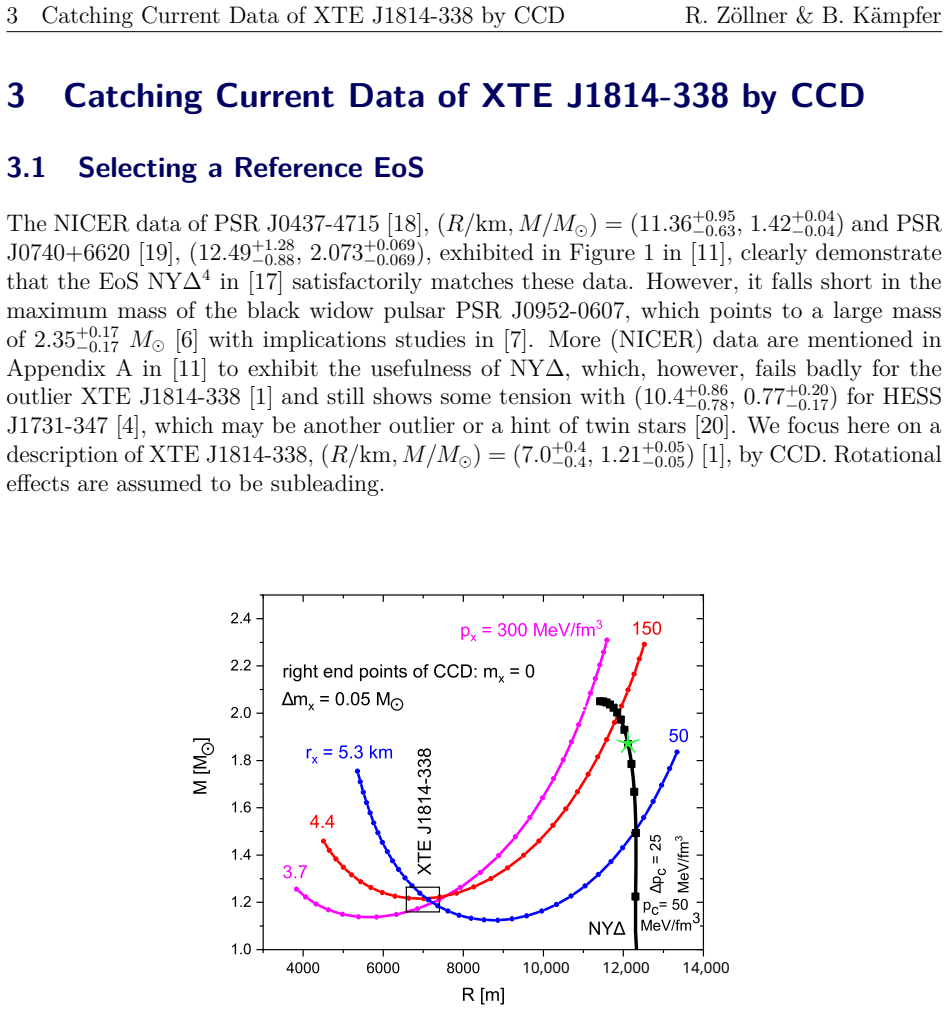
The core-corona decomposition (CCD) is the central device: divide a static, spherically symmetric star at a radius $r_x$ where the pressure equals $p_x$, treat everything inside as a core with only three parameters (mass $m_x$, radius $r_x$, surface pressure $p_x$), and integrate the Tolman-Oppenheimer-Volkoff equations outward only through the corona, where the NY$\Delta$ equation of state is assumed known, until the pressure vanishes at the surface. This yields a mapping from measured $(M,R)$ credibility regions to admissible $(m_x, r_x)$ sets for each $p_x$. NY$\Delta$ is a nucleonic equation of state with hyperon-$\Delta$ excitations, chosen because it fits the NICER radii of PSR J0437-4715 and PSR J0740+6620 but not the ultracompact outlier XTE J1814-338.
What would settle it
A refined pulse-profile analysis of XTE J1814-338 that places its radius above about 8 km at $1.21\,M_\odot$ would remove the need for a massive compact core; equivalently, a stable, causal one-fluid Standard-Model equation of state that yields $(M,R) \approx (1.21\,M_\odot,\,7.0\,\mathrm{km})$ after a full TOV integration would falsify the claim that the core must be exotic.
Extended reading notes
Core claim
The central claim is that the current mass-radius measurement of XTE J1814-338 can be reproduced by a core-corona structure in which the outer part is ordinary Standard-Model matter with the NY$\Delta$ equation of state and all unknown high-density physics is concentrated in a compact core. Concretely, the paper derives admissible core parameters $(m_x, r_x)$ for transition pressures $p_x = 50, 100, 150, 250$, and 350 MeV/fm$^3$: the core mass lies roughly between 0.84 and 1.07 $M_\odot$ and the core radius between 3.7 and 5.3 km, with the core mass growing approximately as $m_x \approx (0.33 + 0.14\,r_x/\mathrm{km})\,M_\odot$. The inferred core compactness is high, reaching about 0.7 at $p_x = 350$ MeV/fm$^3$, larger than the total star's compactness of 0.52. Because the tested one-fluid cores either fail to reach the required parameters or require unstable, acausal high-density equations of state, the paper concludes that a one-fluid Standard-Model-matter core is unlikely, leaving room for dark-matter admixtures or other exotic compositions.
Load-bearing premise
The load-bearing premise is that the outer corona contains only Standard-Model matter whose equation of state (NY$\Delta$) is reliably known up to the transition pressure; if non-SM matter or a different outer equation of state is present, the inferred core mass and radius would shift.
Editorial extensions
If this is right
- If the CCD account is right, no single Standard-Model equation of state that also fits other neutron stars can explain XTE J1814-338; the object requires a distinct, very compact core.
- The derived relation $m_x \approx (0.33 + 0.14\,r_x/\mathrm{km})\,M_\odot$ at transition pressures 50-350 MeV/fm$^3$ becomes a concrete target for any specific core model, including dark-matter-admixed and phase-transition scenarios.
- The average core density near $3\times 10^{15}\,\mathrm{g/cm^3}$ means the core is not a scaled-down neutron-star interior but an exceptionally dense object in its own right.
- The two one-fluid Standard-Model core examples fail on stability or causality, so a successful explanation will likely need either multi-fluid matter (Standard-Model plus dark matter) or a modified high-density equation of state.
- Because the decomposition depends on the corona equation of state, the same data must be re-mapped with other corona models, especially ones reaching 2.35 $M_\odot$, before the core parameters can be considered final.
Reading between the lines
- If future pulse-profile modeling pushes the radius of XTE J1814-338 above about 8 km, the CCD-inferred core shrinks toward zero, so measurement precision directly controls whether an exotic core is needed at all.
- The same CCD mapping could be applied to other candidate outliers, such as HESS J1731-347, to ask whether the inferred core parameters fall on a common curve; if they do, that would hint at a universal ultracompact-core population.
- The near-coincidence of the corona pressure and mass profiles across different transition pressures suggests the corona structure is stiff to changes in $p_x$; a future tidal-deformability measurement from a merger of a similarly compact object would give an independent check of the corona equation of state.
Editorial analysis
A structured set of objections, weighed in public.
Referee Report
Summary. This manuscript applies the core-corona decomposition (CCD) to the low-radius, low-mass pulsar XTE J1814-338. Using the NYΔ equation of state for the outer corona and integrating the TOV equations outward from a hypothesized core boundary at pressure p_x, the authors map the reported (M,R) credibility region onto admissible ranges of core mass m_x and core radius r_x for several transition pressures. They find m_x ≈ 0.84–1.07 M_sun and r_x ≈ 3.7–5.3 km for p_x from 50 to 350 MeV/fm^3. They then test two one-fluid SM core models — a QCD trace-anomaly EoS and a first-order-phase-transition continuation — and conclude that such cores are unlikely to produce the required (m_x,r_x). An appendix analyzes scale-free-corona solutions and Adler's simulated horizon.
Significance. If the inferred core range proved robust, the CCD would be a useful agnostic reduction: it would identify XTE J1814-338 as needing a highly compact, massive core and would point toward exotic or phase-transitioned interiors. The TOV integration is standard, the mapping is internally consistent, and the paper is commendably explicit about its assumptions. The main caveat is that all quantitative results are conditional on the chosen NYΔ corona EoS; the authors state this in Section 5 but do not provide the robustness test. The two core-model examples are illustrative but not exhaustive, so the 'unlikely' conclusion is model-dependent.
major comments (3)
- [Sections 3.1–3.3 and 5] The headline (m_x,r_x) ranges are obtained with the single NYΔ corona EoS. The manuscript's own Section 5 admits that the CCD 'depends on the actually employed corona EoS' and that robustness to other corona EoS remains to be tested. Because the abstract and Section 3.2 present these ranges as the main result, the authors should either (a) repeat the mapping with at least one alternative corona EoS (e.g., a different nucleonic EoS or a hybrid EoS compatible with NICER and GW170817) and quantify the shift in the admissible regions, or (b) explicitly qualify every derived range as contingent on NYΔ. Without one of these measures the central claim remains conditional only.
- [Section 4.2, Figure 6] The illustrative FOPT match with λ=2.9, v_s^2=1, and p_c=5 GeV/fm^3 is taken from the region in which the combined EoS was stated to fail the stability/causality test, since the stable red squares in Figure 6 have v_s^2>1. The text labels this an illustrative 'specific core model' without revisiting stability. Because this example is one of the two pillars of the 'one-fluid SM matter core unlikely' conclusion, the authors should clarify whether this point satisfies stability and causality; if it does not, it should not be used to support the astrophysical conclusion.
- [Sections 4.1 and 4.2] The statement 'Both examples demonstrate that a one-fluid SM matter core is unlikely to explain the required core parameters' is stronger than the evidence. Only two one-fluid EoS constructions are tested, one of which is a single statistical trace-anomaly fit and the other of which is a phase-transition model whose stable parameter region violates causality. The conclusion should be demoted to 'disfavored by the two particular core EoS constructions considered here,' which is sufficient for the paper's exploratory message.
minor comments (7)
- [Section 3.2] The word 'ellipsis' should be 'ellipse' in several places, e.g., 'XTE ellipsis' in the text following Eq. (3).
- [Footnote 4] The phrase 'hyperson-∆-excitation admixed matter' appears to contain a typo; 'hyperon-∆-excitation admixed matter' is presumably intended.
- [Section 3.1] The phrase 'with implications studies in [7]' should read 'with implications studied in [7].'
- [Section 3.2, Eq. (3)] The credibility region is modeled as an independent rectangle or ellipse; the original pulse-profile modeling likely yields correlated two-dimensional contours. This simplification should be stated explicitly.
- [Section 3.1] The statement 'Rotational effects are assumed to be subleading' is asserted but not quantified; XTE J1814-338 spins at about 314 Hz, so an estimate of the expected change in R, or a reference to such an estimate, would strengthen the assumption.
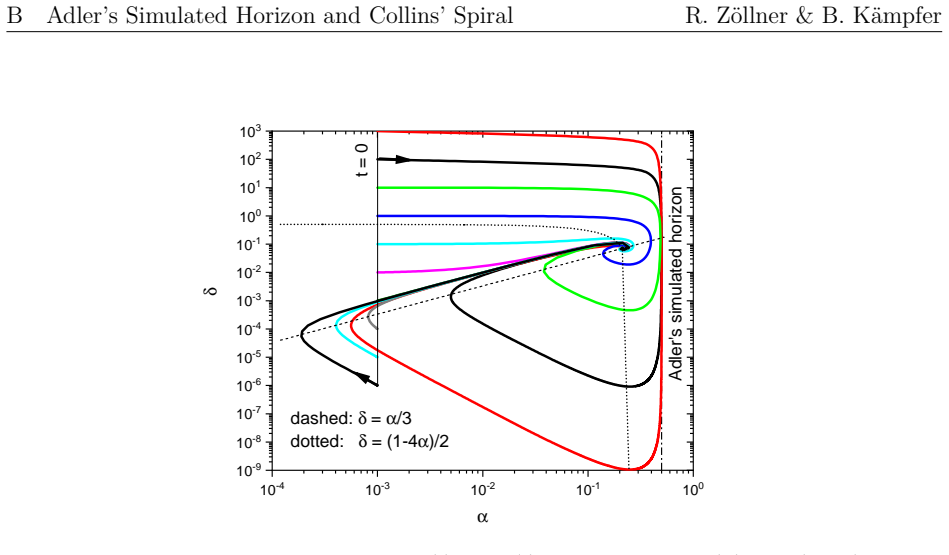
- [Appendix B] The Adler simulated-horizon and Collins-spiral analysis is interesting but is not connected to the XTE J1814-338 results; consider moving it to a separate paper or adding a sentence explaining its relevance to the CCD claim.
- [Section 4.1, Eq. (4)] The fit parameters in Eq. (4) are listed to many digits, but no uncertainty or goodness-of-fit statistic is given; adding the χ² or R² would help the reader assess the quality of the trace-anomaly fit.
Circularity Check
No significant circularity: core parameters are outputs of a forward TOV inversion matched to external XTE data under an explicitly assumed, externally sourced corona EoS; self-cited CCD references are methodological, not evidentiary.
full rationale
The central step is a forward TOV integration in the corona: given px and trial (rx, mx), equations (1)-(2) with the external NYDelta EoS [17] are integrated outward to produce (M, R), then matched to the XTE credibility region from [1]. The quoted core masses and radii are therefore outputs of an inversion, not reused inputs; no equation defines the XTE mass-radius region in terms of the core parameters, so no self-definitional reduction occurs. The NYDelta EoS is taken from independent work [17] and the XTE data from [1]; the paper does not fit the corona EoS to XTE. Self-citations [2, 11, 15] introduce the CCD framework, but the assumptions are restated explicitly in Section 2 and the TOV machinery is standard; they do not supply the numerical result. Section 4 tests two external one-fluid core EoSs (a trace-anomaly fit to [21] and an FOPT continuation per [10]) against the inferred core parameters; the FOPT example is explicitly found to fail on stability and causality, which is a falsification test rather than a circular confirmation. The paper's own Summary caveat—"our CCD construction is not yet universal since it depends on the actually employed corona EoS. In follow-up work, one has to test the robustness of the deduced values (rx,mx;px) by using other methods than the NYDelta EoS"—is an honest statement of model dependence, not a hidden reuse of the conclusion. The remaining qualifications are scope limitations (only two core models tested; one corona EoS), which bear on robustness and correctness risk, not on circularity.
Assumptions & free parameters
free parameters (3)
- transition pressure px =
50, 100, 150, 250, 300, 350 MeV/fm3 (scanned)
- Delta(e) parameterization parameters (A, kappa, eta_c, G_G, eta_G, sigma_G) =
A=1.52, kappa=3.582856, eta_c=1.357143, G_G=0.2926, eta_G=4.045714, sigma_G=2
- FOPT parameters (lambda, v_s^2, p_c) =
lambda=2.9, v_s^2=1, p_c=5 GeV/fm^3 in the demonstration; general scan in Figure 6
assumptions (5)
- standard math Einsteinian gravity with the TOV equations describes static, spherically symmetric, isotropic fluid configurations.
- domain assumption The corona (region r > rx) consists of Standard Model matter described faithfully by the NYΔ EoS up to pressure px.
- domain assumption The measured mass and radius of XTE J1814-338, M=1.21 +/- 0.05 solar masses and R=7.0 +/- 0.4 km, are accurate.
- domain assumption Rotational and magnetic-field effects are subleading for the configuration.
- domain assumption The core can be described by a one-fluid TOV solution with a given EoS in the Section 4 examples.
Cite this review
Pith. "Pith review of Core-Corona Decomposition of Very Compact (Neutron) Stars: Accounting for Current Data of XTE J1814-338." pith.science (2026). https://pith.science/paper/H454HAQH
@misc{pith2026250610032,
  author       = {Pith},
  title        = {Pith review of: Core-Corona Decomposition of Very Compact (Neutron) Stars: Accounting for Current Data of XTE J1814-338},
  year         = {2026},
  howpublished = {\url{https://pith.science/paper/H454HAQH}},
  note         = {Machine review of arXiv:2506.10032}
}
read the original abstract
A core-corona decomposition of compact (neutron) star models was compared with the current mass-radius data of the outlier XTE~J1814-338. The corona (which may also be dubbed the envelope, halo or outer crust) is assumed to be of Standard Model matter, with an equation of state that is supposed to be faithfully known and accommodates nearly all other neutron star data. The core, solely parameterized by its mass, radius and transition pressure, presents a challenge regarding its composition. We derived a range of core parameters needed to describe the current data of XTE J1814-338.
Figures


Figures from the paper (9 more)




Reference graph
Works this paper leans on
-
[1]
Y. Kini et al. : Constraining the properties of the thermonuclear burst oscillation source XTE J1814- 338 through pulse profile modelling. Mon. Not. Roy. Astron. Soc. 535, 2, p. 1507 (2024)
work page 2024
-
[2]
R. Zöllner , M. Ding & B. Kämpfer : Masses of compact (neutron) stars with distinguished cores. Particles 6, 1, p. 217 (2023)
work page 2023
-
[3]
M. C. Miller et al. : The radius of PSR J0740+ 6620 from NICER and XMM- Newton data. Astrophys. J. Lett.918, 2, p. L28 (2021)
work page 2021
-
[4]
V. Doroshenko et al. : A strangely light neutron star within a supernova remnant. Nature Astron. 6, 12, p. 1444 (2022)
work page 2022
-
[5]
T. Salmi et al. : A NICER View of PSR J1231- 1411: A Complex Case. Astrophys. J. 976, 1, p. 58 (2024)
work page 2024
-
[6]
R. W. Romani et al. : PSR J0952- 0607: The fastest and heaviest known galactic neutron star. Astrophys. J. Lett.934, 2, p. L17 (2022)
work page 2022
- [7]
-
[8]
S. L. Pitz & J. Schaffner-Bielich : Generating ultracompact neutron stars with bosonic dark matter. Phys. Rev. D111, 4, p. 043050 (2025)
work page 2025
Show all 31 references
-
[9]
Yang, C.-M
S.-H. Yang, C.-M. Pi & F. Weber: Strange stars admixed with mirror dark matter: confronting observations of XTE J1814-338. Phys. Rev. D111, 4, p. 043037 (2025)
2025
-
[10]
Laskos-Patkos & C
P. Laskos-Patkos & C. C. Moustakidis : XTE J1814-338: A potential hybrid star candidate. arXiv preprint arXiv:2410.18498 (2024)
2024 arXiv
-
[11]
Zöllner & B
R. Zöllner & B. Kämpfer: Core-corona decomposition of compact (neutron) stars compared to NICER data including XTE J1814-338. arXiv preprint arXiv:2411.08068 (2024)
2024 arXiv
-
[12]
L. L. Lopes : Macroscopic properties of the XTE J1814-338 as a dark matter admixed strange star. arXiv preprint arXiv:2501.06379 (2025)
2025 arXiv
-
[13]
L. L. Lopes & A. Issifu : XTE J1814-338 as a dark matter admixed neutron star. arXiv preprint arXiv:2411.17105 (2024)
2024 arXiv
-
[14]
J. J. Li , A. Sedrakian & M. Alford : Ultracompact hybrid stars consistent with multimessenger astrophysics. Phys. Rev. D107, 2, p. 023018 (2023)
2023
-
[15]
Zöllner & B
R. Zöllner & B. Kämpfer: Exotic Cores with and without Dark-Matter Admixtures in Compact Stars. Astronomy 1, 1, p. 36 (2022)
2022
-
[16]
Schaffner-Bielich: Compact star physics
J. Schaffner-Bielich: Compact star physics. Cambridge University Press (2020). 17 References R. Zöllner & B. Kämpfer
2020
-
[17]
J. J. Li , A. Sedrakian & M. Alford: Relativistic hybrid stars with sequential first- order phase transitions and heavy-baryon envelopes. Phys. Rev. D 101, 6, p. 063022 (2020)
2020
-
[18]
Choudhury et al
D. Choudhury et al. : A nicer view of the nearest and brightest millisecond pulsar: PSR J0437–4715. Astrophys. J. Lett.971, 1, p. L20 (2024)
2024
-
[19]
Salmi et al
T. Salmi et al. : The Radius of the High-mass Pulsar PSR J0740+ 6620 with 3.6 yr of NICER Data. Astrophys. J.974, 2, p. 294 (2024)
2024
-
[20]
J. J. Li , A. Sedrakian & M. Alford: Confronting new NICER mass-radius mea- surements with phase transition in dense matter and twin compact stars. JCAP 2025, 02, p. 002 (2025)
2025
-
[21]
Marczenko, K
M. Marczenko, K. Redlich & C. Sasaki: Curvature of the energy per particle in neutron stars. Phys. Rev. D109, 4, p. L041302 (2024)
2024
-
[22]
Fujimoto et al
Y. Fujimoto et al. : Trace anomaly as signature of conformality in neutron stars. Phys. Rev. Lett.129, 25, p. 252702 (2022)
2022
-
[23]
M. I. Gresham & K. M. Zurek : Asymmetric dark stars and neutron star stability. Phys. Rev. D99, 8, p. 083008 (2019)
2019
-
[24]
Di Clemente, A
F. Di Clemente, A. Drago & G. Pagliara: Merger of a Neutron Star with a Black Hole: One-family versus Two-families Scenario. Astrophys. J.929, 1, p. 44 (2022)
2022
-
[25]
S. L. Adler : Black hole mimickers as relativistic stars calculated from the Tolman– Oppenheimer–Volkoff equations. Mod. Phys. Lett. A p. 2530009 (2025)
2025
-
[26]
S. L. Adler & B. Doherty : Dynamical gravastar simulated horizon from the Tolman-Oppenheimer-Volkoff equation initial value problem with relativistic matter. arXiv preprint arXiv:2309.13380 (2023)
2023 arXiv
-
[27]
S. L. Adler : Dynamical gravastars. Phys. Rev. D106, 10, p. 104061 (2022)
2022
-
[28]
W. H. Zurek & D. N. Page : Black-hole thermodynamics and singular solutions of the Tolman-Oppenheimer-Volkoff equation. Phys. Rev. D.29, 4, p. 628 (1984)
1984
-
[29]
Collins: Static relativistic perfect fluids with spherical, plane, or hyperbolic sym- metry
C. Collins: Static relativistic perfect fluids with spherical, plane, or hyperbolic sym- metry. J. Math. Phys.26, 9, p. 2268 (1985)
1985
-
[30]
C. W. Misner & H. Zapolsky : High-density behavior and dynamical stability of neutron star models. Phys. Rev. Lett.12, 22, p. 635 (1964)
1964
-
[31]
Toimela : On the solution of the Tolman–Oppenheimer–Volkov equation with the ultrarelativistic equation of state
T. Toimela : On the solution of the Tolman–Oppenheimer–Volkov equation with the ultrarelativistic equation of state. J. Math. Phys.28, 7, pp. 1541 (1987). 18
1987
Reviewed August 7, 2026 · model on record in the stance chip above.
Discussion (0). Sign in to comment.