Worldline deconfinement and emergent long-range interaction in the entanglement Hamiltonian and in the entanglement spectrum
Pith reviewed 2026-05-19 09:40 UTC · model grok-4.3
The pith
The entanglement spectrum develops an M-shaped sublinear magnon dispersion indicating emergent long-range interactions in the entanglement Hamiltonian of gapless spin models.
A machine-rendered reading of the paper's core claim, the machinery that carries it, and where it could break.
Core claim
In the entanglement spectrum of the two-dimensional square-octagon lattice Heisenberg model at quantum criticality and in the Néel phase, an M-shape magnon mode appears with a distinct sublinear dispersion. This behavior deviates from the conventional linear magnon and is similar to that found in a one-dimensional long-range Heisenberg chain. The observation reveals the emergence of relevant long-range interactions in the entanglement Hamiltonian, which the authors attribute to the confinement and deconfinement of worldlines in the path-integral formulation.
What carries the argument
Worldline deconfinement in the path integral formulation, which generates relevant long-range interactions within the entanglement Hamiltonian and produces the observed M-shaped sublinear dispersion in the entanglement spectrum.
If this is right
- The entanglement Hamiltonian in gapless regimes is not short-ranged but acquires long-range terms.
- Gapless modes can fundamentally change both the entanglement Hamiltonian and its spectrum.
- The entanglement spectrum serves as a diagnostic for the nature of interactions in the entanglement Hamiltonian.
- Similar M-shaped sublinear modes should appear in other gapless two-dimensional quantum spin models.
Where Pith is reading between the lines
- This mechanism may generalize to other gapless critical points, suggesting that long-range entanglement interactions are common in higher-dimensional critical magnets.
- Future studies could test whether the sublinear dispersion persists in the thermodynamic limit or changes with different boundary conditions.
- Analogous effects might appear in fermionic systems or in models with different symmetries, linking entanglement structure to deconfinement transitions.
Load-bearing premise
That the sublinear dispersion of the M-shaped magnon mode arises specifically from relevant long-range interactions in the entanglement Hamiltonian and is not an artifact of finite system size, the particular lattice geometry, or the quantum Monte Carlo sampling method.
What would settle it
A calculation on significantly larger lattices or with an independent method that shows the magnon dispersion becoming linear rather than sublinear would indicate that the long-range interactions are not present or not relevant.
Figures


read the original abstract
The entanglement spectrum (ES) is a powerful tool for probing topological phases. While its behavior in gapped systems is well understood, its properties in gapless regimes remain unclear. In this work, we employ a quantum Monte Carlo method to study the ES of a two-dimensional square-octagon lattice Heisenberg model at quantum criticality and in the N\'eel phase. We find that the ES exhibits an M-shape magnon mode with a distinct sublinear dispersion, deviating from the conventional linear magnon. This behavior, similar to that of a one-dimensional long-range Heisenberg chain, reveals the emergence of relevant long-range interactions in the entanglement Hamiltonian. We demonstrate that the mechanism underlying short- and long-range interactions in the entanglement Hamiltonian can be interpreted as the confinement/deconfinement of worldlines in the path integral formulation. Our results reveal that gapless modes can fundamentally change the entanglement Hamiltonian and its spectrum, thereby offering insight into this general phenomenon.
Editorial analysis
A structured set of objections, weighed in public.
Referee Report
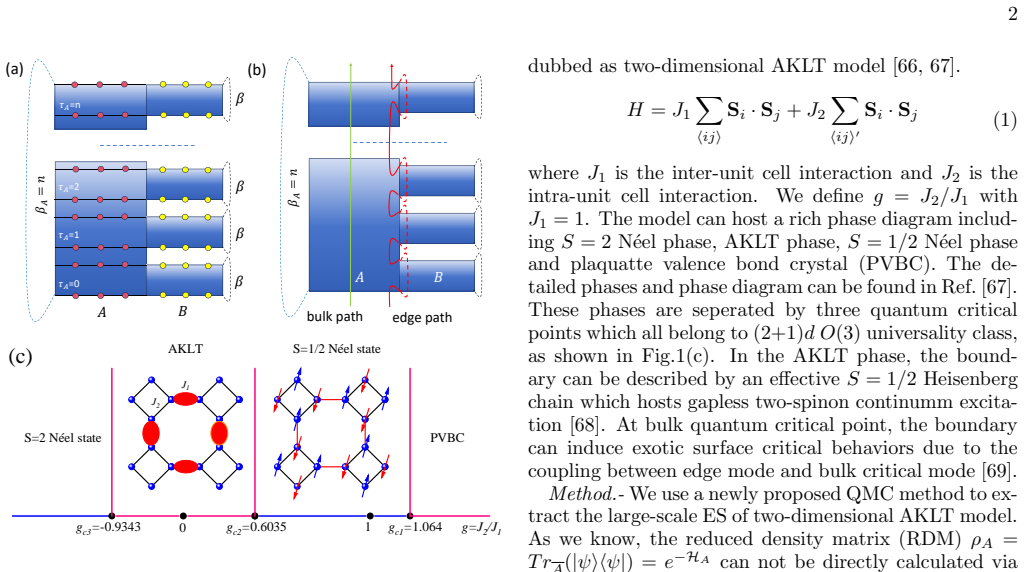
Summary. The manuscript employs quantum Monte Carlo to compute the entanglement spectrum of the two-dimensional square-octagon lattice Heisenberg model both at the quantum critical point and in the Néel phase. It reports an M-shaped magnon dispersion in the ES that is sublinear rather than linear, interprets this as direct evidence for emergent relevant long-range interactions in the entanglement Hamiltonian, and attributes the short- versus long-range character to confinement versus deconfinement of worldlines in the path-integral representation. The sublinear behavior is compared to that of a one-dimensional long-range Heisenberg chain.
Significance. If the reported sublinear dispersion is shown to be robust against finite-size effects, lattice artifacts, and estimator details, the work would establish a concrete link between gapless modes and long-range terms in the entanglement Hamiltonian via the worldline picture. This would extend entanglement studies from gapped topological phases into critical regimes and supply a physically motivated mechanism that could be tested in other models. The QMC approach to the ES is a methodological strength, but the interpretive step from dispersion shape to long-range interactions remains the load-bearing claim.
major comments (2)
- [Numerical results and discussion of the ES dispersion] The central claim that the observed sublinear M-shaped dispersion signals relevant long-range interactions in the EH (rather than finite-size or estimator effects) is load-bearing yet rests on a qualitative analogy to the 1D long-range chain. No explicit finite-size scaling of the dispersion, thermodynamic-limit extrapolation, or direct comparison to the same observable in a short-range model on the square-octagon lattice is provided to control for these alternatives.
- [Path-integral formulation and worldline analysis] The worldline deconfinement mechanism is invoked to explain the emergence of long-range terms, but the manuscript does not derive or numerically extract the effective couplings of the EH itself; the mapping therefore remains interpretive rather than quantitative.
minor comments (2)
- [Figures showing the M-shaped mode] Figure captions for the ES plots should explicitly state the system sizes, boundary conditions, and number of Monte Carlo samples used for each data set to allow assessment of statistical and finite-size uncertainties.
- [Methods] Notation for the reduced density matrix and the definition of the entanglement Hamiltonian could be made more explicit in the methods section, particularly regarding the bipartition chosen on the square-octagon lattice.
Simulated Author's Rebuttal
We thank the referee for the careful reading of our manuscript and the constructive comments. We appreciate the recognition of the methodological contribution of the QMC approach to the entanglement spectrum and the potential implications for critical regimes. Below we respond point by point to the major comments, indicating revisions where we agree that additional analysis strengthens the presentation.
read point-by-point responses
-
Referee: [Numerical results and discussion of the ES dispersion] The central claim that the observed sublinear M-shaped dispersion signals relevant long-range interactions in the EH (rather than finite-size or estimator effects) is load-bearing yet rests on a qualitative analogy to the 1D long-range chain. No explicit finite-size scaling of the dispersion, thermodynamic-limit extrapolation, or direct comparison to the same observable in a short-range model on the square-octagon lattice is provided to control for these alternatives.
Authors: We agree that a more systematic finite-size analysis would make the robustness of the sublinear dispersion clearer. In the revised manuscript we add plots showing the dispersion of the lowest modes for several system sizes at the critical point; the M-shape and sublinear character persist with increasing linear size. A complete thermodynamic-limit extrapolation of the dispersion velocity is not performed, as it would require substantially larger lattices and additional computational resources, but the trend with system size supports that the deviation from linearity is not a finite-size artifact. We also include a direct comparison of the entanglement spectrum in the Néel phase on the same square-octagon lattice, where the low-lying modes are closer to linear, to contrast with the critical-point behavior. The analogy to the one-dimensional long-range Heisenberg chain is retained because it exhibits the same qualitative M-shaped sublinear dispersion that is absent in conventional short-range two-dimensional models. revision: partial
-
Referee: [Path-integral formulation and worldline analysis] The worldline deconfinement mechanism is invoked to explain the emergence of long-range terms, but the manuscript does not derive or numerically extract the effective couplings of the EH itself; the mapping therefore remains interpretive rather than quantitative.
Authors: We acknowledge that the worldline deconfinement argument is interpretive and does not constitute a quantitative extraction of the effective couplings in the entanglement Hamiltonian. Such an extraction would require additional techniques, for example direct reconstruction of the entanglement Hamiltonian from the spectrum or perturbative expansions, which lie outside the scope of the present numerical study. In the revised manuscript we have expanded the relevant discussion to state explicitly that the mechanism is a physically motivated interpretation based on the path-integral representation and the observed dispersion shape, rather than a direct computation of couplings. We also outline possible future directions for quantitative verification. revision: partial
Circularity Check
Numerical QMC observations and physical analogy yield self-contained derivation
full rationale
The paper's central results are obtained from quantum Monte Carlo simulations that directly compute the entanglement spectrum of the square-octagon Heisenberg model at criticality and in the Néel phase. The reported M-shaped sublinear magnon dispersion is presented as a numerical finding, with the long-range interaction interpretation offered via an explicit analogy to the known spectrum of a one-dimensional long-range Heisenberg chain and a qualitative worldline deconfinement argument in the path-integral representation. No equation in the provided text reduces a claimed prediction to a fitted parameter, a self-referential definition, or a load-bearing self-citation whose validity depends on the present work. The derivation therefore remains independent of its own inputs and is externally falsifiable against other QMC estimators or larger-system data.
Axiom & Free-Parameter Ledger
axioms (2)
- domain assumption Quantum Monte Carlo sampling yields the low-lying entanglement spectrum of the 2D Heisenberg model on the square-octagon lattice.
- domain assumption The path-integral formulation with worldlines correctly captures confinement/deconfinement effects that generate effective interactions in the entanglement Hamiltonian.
Forward citations
Cited by 1 Pith paper
-
Generalized Li-Haldane Correspondence in Critical Dirac-Fermion Systems
An exact relation is derived between bulk entanglement spectrum and boundary energy spectrum at topological criticality in free-fermion systems, allowing edge-mode degeneracy to be read from bulk data in arbitrary dimensions.
Reference graph
Works this paper leans on
-
[1]
When g = 0 .4 < 0.6035, the system is in the deep AKLT phase. The ES is a gapless two-spinon continuum excitation, which is similar to the edge energy spectrum, as shown in Fig.2(a). In this phase, the boundary can be considered as an effective Luttinger Liquid. When the g becomes larger but still in the AKLT phase, such as g = 0.5, 0.55, the spinon conti...
work page 2016
-
[2]
P. Calabrese and A. Lefevre, Entanglement spectrum in one-dimensional systems, Phys. Rev. A 78, 032329 (2008)
work page 2008
-
[3]
E. Fradkin and J. E. Moore, Entanglement entropy of 2d conformal quantum critical points: Hearing the shape of a quantum drum, Phys. Rev. Lett. 97, 050404 (2006)
work page 2006
-
[4]
Z. Nussinov and G. Ortiz, Sufficient symmetry conditions for Topological Quantum Order, Proc. Nat. Acad. Sci. 106, 16944 (2009)
work page 2009
-
[5]
Z. Nussinov and G. Ortiz, A symmetry principle for topo- logical quantum order, Annals Phys. 324, 977 (2009)
work page 2009
-
[6]
H. Casini and M. Huerta, Universal terms for the entan- glement entropy in 2+1 dimensions, Nuclear Physics B 764, 183 (2007)
work page 2007
-
[7]
W. Ji and X.-G. Wen, Noninvertible anomalies and mapping-class-group transformation of anomalous par- tition functions, Phys. Rev. Research 1, 033054 (2019)
work page 2019
-
[8]
W. Ji and X.-G. Wen, Categorical symmetry and nonin- vertible anomaly in symmetry-breaking and topological phase transitions, Phys. Rev. Research 2, 033417 (2020)
work page 2020
-
[9]
L. Kong, T. Lan, X.-G. Wen, Z.-H. Zhang, and H. Zheng, Algebraic higher symmetry and categorical symmetry: A holographic and entanglement view of symmetry, Phys. Rev. Research 2, 043086 (2020)
work page 2020
-
[10]
X.-C. Wu, W. Ji, and C. Xu, Categorical symmetries at criticality, Journal of Statistical Mechanics: Theory and Experiment 2021, 073101 (2021)
work page 2021
- [11]
-
[12]
J. Zhao, Y.-C. Wang, Z. Yan, M. Cheng, and Z. Y. Meng, Scaling of entanglement entropy at deconfined quantum criticality, Phys. Rev. Lett. 128, 010601 (2022)
work page 2022
-
[13]
J. Zhao, B.-B. Chen, Y.-C. Wang, Z. Yan, M. Cheng, and Z. Y. Meng, Measuring r´ enyi entanglement entropy with high efficiency and precision in quantum monte carlo simulations, npj Quantum Materials 7, 1 (2022)
work page 2022
-
[14]
Y.-C. Wang, N. Ma, M. Cheng, and Z. Y. Meng, Scaling of the disorder operator at deconfined quantum critical- ity, SciPost Phys. 13, 123 (2022)
work page 2022
-
[15]
C. Holzhey, F. Larsen, and F. Wilczek, Geometric and renormalized entropy in conformal field theory, Nuclear Physics B 424, 443 (1994)
work page 1994
-
[16]
P. Calabrese and J. Cardy, Entanglement entropy and quantum field theory, Journal of Statistical Mechanics: Theory and Experiment 2004, P06002 (2004)
work page 2004
- [17]
-
[18]
V. E. Korepin, Universality of entropy scaling in one di- mensional gapless models, Phys. Rev. Lett. 92, 096402 (2004)
work page 2004
-
[19]
A. Kitaev and J. Preskill, Topological entanglement en- tropy, Phys. Rev. Lett. 96, 110404 (2006)
work page 2006
-
[20]
M. Levin and X.-G. Wen, Detecting topological order in a ground state wave function, Phys. Rev. Lett. 96, 110405 (2006)
work page 2006
-
[21]
M. B. Hastings, I. Gonz´ alez, A. B. Kallin, and R. G. Melko, Measuring renyi entanglement entropy in quan- tum monte carlo simulations, Phys. Rev. Lett. 104, 157201 (2010)
work page 2010
-
[22]
A. B. Kallin, E. M. Stoudenmire, P. Fendley, R. R. P. Singh, and R. G. Melko, Corner contribution to the en- tanglement entropy of an o(3) quantum critical point in 8 2 + 1 dimensions, Journal of Statistical Mechanics: The- ory and Experiment 2014, P06009 (2014)
work page 2014
-
[23]
S. V. Isakov, M. B. Hastings, and R. G. Melko, Topolog- ical entanglement entropy of a bose–hubbard spin liquid, Nature Physics 7, 772 (2011)
work page 2011
- [24]
-
[25]
F. Pollmann, A. M. Turner, E. Berg, and M. Oshikawa, Entanglement spectrum of a topological phase in one di- mension, Phys. Rev. B 81, 064439 (2010)
work page 2010
-
[26]
Fidkowski, Entanglement spectrum of topological in- sulators and superconductors, Phys
L. Fidkowski, Entanglement spectrum of topological in- sulators and superconductors, Phys. Rev. Lett. 104, 130502 (2010)
work page 2010
-
[27]
H. Yao and X.-L. Qi, Entanglement entropy and entan- glement spectrum of the kitaev model, Phys. Rev. Lett. 105, 080501 (2010)
work page 2010
- [29]
-
[30]
D. J. Luitz, N. Laflorencie, and F. Alet, Participation spectroscopy and entanglement hamiltonian of quantum spin models, Journal of Statistical Mechanics: Theory and Experiment 2014, P08007 (2014)
work page 2014
-
[31]
D. J. Luitz, F. Alet, and N. Laflorencie, Shannon- r´ enyi entropies and participation spectra across three- dimensional o(3) criticality, Phys. Rev. B 89, 165106 (2014)
work page 2014
-
[32]
D. J. Luitz, F. Alet, and N. Laflorencie, Universal behav- ior beyond multifractality in quantum many-body sys- tems, Phys. Rev. Lett. 112, 057203 (2014)
work page 2014
- [33]
-
[34]
H. Pichler, G. Zhu, A. Seif, P. Zoller, and M. Hafezi, Measurement protocol for the entanglement spectrum of cold atoms, Phys. Rev. X 6, 041033 (2016)
work page 2016
-
[35]
J. I. Cirac, D. Poilblanc, N. Schuch, and F. Verstraete, Entanglement spectrum and boundary theories with pro- jected entangled-pair states, Phys. Rev. B 83, 245134 (2011)
work page 2011
-
[36]
V. M. Stojanovi´ c, Entanglement-spectrum character- ization of ground-state nonanalyticities in coupled excitation-phonon models, Phys. Rev. B 101, 134301 (2020)
work page 2020
-
[37]
Guo, Entanglement spectrum of geometric states, Journal of High Energy Physics 2021, 1 (2021)
W.-z. Guo, Entanglement spectrum of geometric states, Journal of High Energy Physics 2021, 1 (2021)
work page 2021
-
[38]
Grover, Entanglement of interacting fermions in quan- tum monte carlo calculations, Phys
T. Grover, Entanglement of interacting fermions in quan- tum monte carlo calculations, Phys. Rev. Lett. 111, 130402 (2013)
work page 2013
-
[39]
F. F. Assaad, T. C. Lang, and F. Parisen Toldin, En- tanglement spectra of interacting fermions in quantum monte carlo simulations, Phys. Rev. B89, 125121 (2014)
work page 2014
-
[40]
F. F. Assaad, Stable quantum monte carlo simulations for entanglement spectra of interacting fermions, Phys. Rev. B 91, 125146 (2015)
work page 2015
-
[41]
F. Parisen Toldin and F. F. Assaad, Entanglement hamil- tonian of interacting fermionic models, Phys. Rev. Lett. 121, 200602 (2018)
work page 2018
- [42]
- [43]
-
[44]
Poilblanc, Entanglement spectra of quantum heisen- berg ladders, Phys
D. Poilblanc, Entanglement spectra of quantum heisen- berg ladders, Phys. Rev. Lett. 105, 077202 (2010)
work page 2010
- [45]
-
[46]
W. Zhu, Z. Huang, and Y.-C. He, Reconstructing entan- glement hamiltonian via entanglement eigenstates, Phys. Rev. B 99, 235109 (2019)
work page 2019
-
[47]
J. Lou, S. Tanaka, H. Katsura, and N. Kawashima, Entanglement spectra of the two-dimensional affleck- kennedy-lieb-tasaki model: Correspondence between the valence-bond-solid state and conformal field theory, Phys. Rev. B 84, 245128 (2011)
work page 2011
- [48]
- [49]
-
[50]
X.-L. Qi, H. Katsura, and A. W. W. Ludwig, General relationship between the entanglement spectrum and the edge state spectrum of topological quantum states, Phys. Rev. Lett. 108, 196402 (2012)
work page 2012
-
[51]
R. Lundgren, Y. Fuji, S. Furukawa, and M. Oshikawa, Entanglement spectra between coupled tomonaga- luttinger liquids: Applications to ladder systems and topological phases, Phys. Rev. B 88, 245137 (2013)
work page 2013
-
[52]
M. Dalmonte, V. Eisler, M. Falconi, and B. Vermersch, Entanglement hamiltonians: from field theory to lat- tice models and experiments, Annalen der Physik 534, 2200064 (2022)
work page 2022
-
[53]
G. Giudici, T. Mendes-Santos, P. Calabrese, and M. Dal- monte, Entanglement hamiltonians of lattice models via the bisognano-wichmann theorem, Physical Review B98, 134403 (2018)
work page 2018
-
[54]
M. Dalmonte, B. Vermersch, and P. Zoller, Quantum sim- ulation and spectroscopy of entanglement hamiltonians, Nature Physics 14, 827 (2018)
work page 2018
-
[55]
S. Wu, X. Ran, B. Yin, Q.-F. Li, B.-B. Mao, Y.-C. Wang, and Z. Yan, Classical model emerges in quantum en- tanglement: Quantum monte carlo study for an ising- heisenberg bilayer, Phys. Rev. B 107, 155121 (2023)
work page 2023
-
[56]
M. Song, J. Zhao, Z. Yan, and Z. Y. Meng, Different temperature dependence for the edge and bulk of the en- tanglement hamiltonian, Physical Review B 108, 075114 (2023)
work page 2023
-
[57]
T. Yoshino, S. Furukawa, and M. Ueda, Intercompo- nent entanglement entropy and spectrum in binary bose- einstein condensates, Phys. Rev. A 103, 043321 (2021)
work page 2021
- [58]
- [59]
-
[60]
N. D. Mermin and H. Wagner, Absence of ferromag- netism or antiferromagnetism in one- or two-dimensional isotropic heisenberg models, Phys. Rev. Lett. 17, 1133 (1966)
work page 1966
-
[61]
N. D. Mermin, Absence of ordering in certain classical systems, Journal of Mathematical Physics8, 1061 (1967)
work page 1967
-
[62]
M. Song, J. Zhao, C. Zhou, and Z. Y. Meng, Dynami- cal properties of quantum many-body systems with long- range interactions, Physical Review Research 5, 033046 (2023)
work page 2023
-
[63]
M. Song, J. Zhao, Y. Qi, J. Rong, and Z. Y. Meng, Quantum criticality and entanglement for the two- dimensional long-range heisenberg bilayer, Phys. Rev. B 109, L081114 (2024)
work page 2024
-
[64]
J. Zhao, M. Song, Y. Qi, J. Rong, and Z. Y. Meng, Finite- temperature critical behaviors in 2d long-range quantum heisenberg model, npj Quantum Materials 8, 59 (2023)
work page 2023
-
[65]
O. K. Diessel, S. Diehl, N. Defenu, A. Rosch, and A. Chiocchetta, Generalized higgs mechanism in long- range-interacting quantum systems, Phys. Rev. Res. 5, 033038 (2023)
work page 2023
- [66]
-
[67]
I. Affleck, T. Kennedy, E. H. Lieb, and H. Tasaki, Rig- orous results on valence-bond ground states in antiferro- magnets, Phys. Rev. Lett. 59, 799 (1987)
work page 1987
-
[68]
L. Zhang and F. Wang, Unconventional surface critical behavior induced by a quantum phase transition from the two-dimensional affleck-kennedy-lieb-tasaki phase to a n´ eel-ordered phase, Physical Review Letters118, 087201 (2017)
work page 2017
-
[69]
Z. Liu, J. Li, R.-Z. Huang, J. Li, Z. Yan, and D.-X. Yao, Bulk and edge dynamics of a two-dimensional affleck- kennedy-lieb-tasaki model, Phys. Rev. B 105, 014418 (2022)
work page 2022
- [70]
-
[71]
A. W. Sandvik, Constrained sampling method for ana- lytic continuation, Phys. Rev. E 94, 063308 (2016)
work page 2016
-
[72]
H. Shao and A. W. Sandvik, Progress on stochastic ana- lytic continuation of quantum monte carlo data, Physics Reports 1003, 1 (2023)
work page 2023
-
[73]
C. Zhou, Z. Yan, H.-Q. Wu, K. Sun, O. A. Starykh, and Z. Y. Meng, Amplitude mode in quantum magnets via dimensional crossover, Phys. Rev. Lett. 126, 227201 (2021)
work page 2021
- [74]
-
[75]
N. Laflorencie, I. Affleck, and M. Berciu, Critical phe- nomena and quantum phase transition in long range heisenberg antiferromagnetic chains, Journal of Statis- tical Mechanics: Theory and Experiment 2005, P12001 (2005)
work page 2005
-
[76]
J. Zhao, N. Laflorencie, and Z. Y. Meng, Unconventional scalings of quantum entropies in long-range heisenberg chains, Phys. Rev. Lett. 134, 016707 (2025)
work page 2025
- [77]
- [78]
-
[79]
E. Lieb and D. Mattis, Ordering energy levels of inter- acting spin systems, Journal of Mathematical Physics 3, 749 (1962), https://pubs.aip.org/aip/jmp/article- pdf/3/4/749/19167430/749 1 online.pdf
work page 1962
- [80]
discussion (0)
Sign in with ORCID, Apple, or X to comment. Anyone can read and Pith papers without signing in.