REVIEW 4 major objections 4 minor 1 cited by
Leveraging LLMs for Mission Planning in Precision Agriculture
T0 review · 4 major / 4 minor · reviewed 2026-08-07 · deepseek-v4-flash
Pith's one-line read An LLM can translate plain English into robot missions for orchards, but a stochastic solver must patch its spatial and energy mistakes.
desk verdict Useful systems paper on LLM mission planning for agriculture; the IEEE 1872.1 integration and honest failure analysis are the real contributions, but the optimization gains are overstated and the generalization claim is a conjecture. read the letter →
The pith
A machine-rendered reading of the paper's core claim, the machinery that carries it, and where it could break.
The reading
What carries the argument
The load-bearing object is the evaluation block in the IEEE 1872.1-2024-inspired architecture, populated with an online stochastic orienteering solver (GPT-SOP). The LLM writes an L1 plan in XML whose task sequence is a behavior tree; at runtime, the evaluation block checks navigation progress and data-collection results and, when the mission has a distance or energy budget, invokes the solver to select which locations the robot can actually visit. The solver's stochastic travel-distance model is what lets the system respect a hard distance bound despite travel times being random variables.
What would settle it
A direct statistical comparison on the graph20 benchmark would test the claimed improvement, since the paper's own table shows ChatGPT with a lower failure rate and similar reward there. More decisively, deploy the system on an orchard where travel-time variability follows a different distribution than the solver's training model; if the robot's constraint-violation rate does not improve over ChatGPT alone, the generalization claim collapses.
Extended reading notes
Core claim
The central claim is that the proposed five-block architecture—specification, user, approval, execution, evaluation—solves stochastic orienteering problems (SOPs) and can be generalized to other optimization problems that cannot be fully solved offline by the LLM. The evidence is the GPT-SOP comparison: on graphs with 30 to 40 trees and a hard travel-distance budget, ChatGPT alone collects low reward while incurring high constraint-violation rates, whereas the LLM plus the online solver roughly doubles the collected utility and cuts failure rates, approaching the offline MILP optimal solution. The paper also documents that ChatGPT-generated mission plans are syntactically valid but spatially wrong: it misreads farm geometry, cardinal directions, and distances such as 'sample the most trees in 100 meters.' The resolution is to treat the LLM as a natural-language front end and delegate constraint enforcement to the runtime evaluation block.
Load-bearing premise
The runtime repair works only if the stochastic travel-distance model inside the online solver describes the real orchard's variability; the paper does not validate that model on this pistachio testbed, nor demonstrate that the evaluation block can recover from a battery depletion or other runtime failure.
Editorial extensions
If this is right
- Non-specialist farmers can specify collection missions in plain English and receive a standards-compliant, executable plan without learning robotics interfaces.
- Mission plans encoded as IEEE 1872.1-2024 XML behavior trees can be shared across robots and organizations that implement the same standard.
- LLM-generated plans should not be trusted for spatial or resource-constrained decisions; a deterministic or stochastic optimization module in the evaluation block is required.
- The architecture's evaluation block is a general insertion point: the same pipeline can host solvers for other runtime-constrained optimization problems, not just SOPs.
Reading between the lines
- One could test the generalization claim by swapping the SOP solver for a different constrained planner, such as a time-window or water-budget solver, and checking whether the same five-block pipeline preserves the improvement.
- In connected settings, the approval feedback loop could be strengthened: instead of one XSD-repair iteration, the system could feed semantic failures back to the LLM and let it revise the plan, potentially reducing the need for specialized solvers.
- The graph20 result in Table II hints that the GPT-SOP advantage may not be uniform across problem sizes; a careful reader would want error bars and significance tests before extrapolating to larger orchards.
Editorial analysis
A structured set of objections, weighed in public.
Referee Report
Summary. The paper presents an end-to-end mission planning system for precision agriculture in which a human user types a natural-language mission request, GPT-4o converts it into an offline L1 plan encoded as XML conforming to the IEEE 1872.1-2024 standard, and ROS2 nodes decode the L1 plan into an L2 plan executed on a Husky robot. The architecture follows the five functional roles of the standard (specification, user, approval, execution, evaluation), and the evaluation block is augmented with a stochastic orienteering (SOP) solver from the authors' prior work to correct ChatGPT's poor spatial reasoning and constrained-optimization behavior. Experiments assess ChatGPT on non-spatial and spatial mission prompts, compare ChatGPT alone against ChatGPT plus the SOP solver (GPT-SOP) and an offline MILP solver on synthetic graphs, and include a field demonstration on a pistachio orchard.
Significance. If the central claims are substantiated, the paper makes a useful contribution: it is, to my knowledge, one of the first demonstrations of an LLM-based mission planning pipeline built around an IEEE task-representation standard, and it combines this with a real robot field trial and a quantitative comparison against both a vanilla LLM and an external MILP solver. The public release of the XSD schema, supplementary material, and code is a practical strength. However, the paper's load-bearing assertion, namely that the architecture generalizes beyond stochastic orienteering to other optimization problems that the LLM cannot solve offline, is currently presented only as a contention and is not validated by the experiments. The quantitative SOP evidence is also weaker than the text claims, particularly on the smallest graph, and the field trial does not validate the stochastic travel model on which the online solver relies. These issues are addressable, but they require more than cosmetic changes.
major comments (4)
- [Section III-5] The paper states, 'It is our contention that the proposed architecture not only solves for SOPs, but can be generalized to solve for other optimization problems that cannot be fully solved offline by the LLM.' This is a central claim but it is unsupported: the only optimization module described is a stochastic orienteering solver [31] added to the evaluation block, and all experiments in Section IV-C use SOP-specific constraints (distance budget, chance constraints) and SOP benchmark graphs. No interface, API, or second instantiation of the evaluation block is described, so the text gives no mechanism by which a different optimization problem could be plugged in. Either remove or explicitly reframe the generalization claim as future work, or substantiate it by demonstrating at least one additional optimization problem and defining how a solver would integrate with the evaluation block.
- [Table II] The paper says that GPT-SOP results 'dramatically improve' over ChatGPT alone, but the graph20 B=2 row shows essentially no reward improvement (R=2.092 for GPT-SOP vs 2.095 for ChatGPT) and a worse failure rate (F=11% vs 4%). Only graph30 and graph40 show clear reward improvements, while the failure-rate differences are small in all rows. The table also reports no error bars or significance tests over the 100 trials, so it is unclear whether the observed differences are statistically meaningful. Report standard deviations or confidence intervals for R and F, and provide a paired comparison or significance test; discuss the graph20 result explicitly rather than relying on an aggregate 'dramatic improvement' statement.
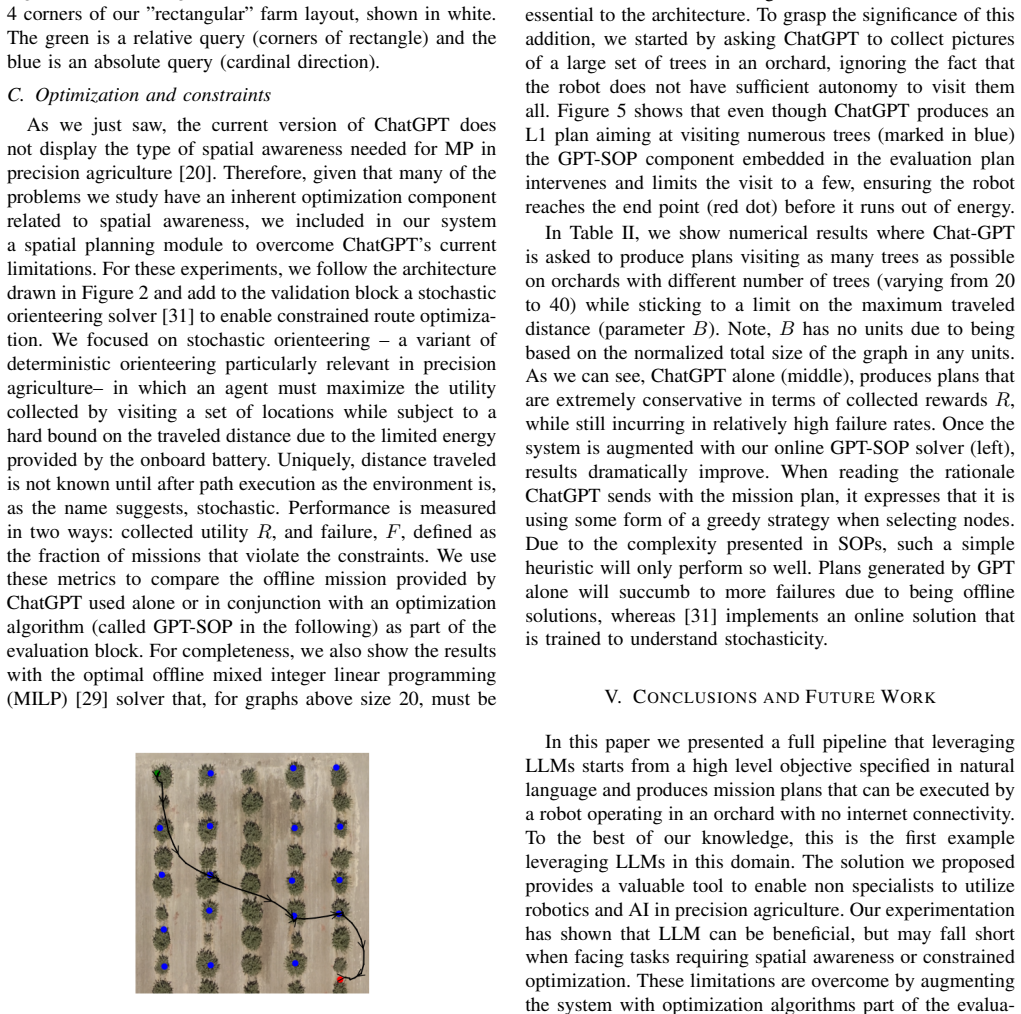
- [Section IV-C / Figure 5] The GPT-SOP evaluation block inherits the stochastic travel-distance model from the authors' earlier solver [31], but the paper does not validate that model on the actual pistachio orchard used in the field trial. Consequently, Figure 5 demonstrates that the SOP planner intervenes in a simulated or planned trajectory, but it does not establish that the distance statistics match real travel in the field or that the robot would actually have depleted its battery without the intervention. Provide empirical distance or energy-consumption data from the testbed, or explicitly describe the field run as a feasibility demonstration rather than validation of battery-safe recovery under real stochasticity.
- [Section IV-B / Table I] The mission-success results in Table I are based on single trials with manual review, as stated in Section IV-B. This is acceptable for a qualitative demonstration, but the paper draws strong conclusions from these results, such as 'our architecture never failed' for non-spatial queries and the corresponding spatial failure pattern. To make these claims reproducible, the paper should provide a success rubric, report inter-annotator agreement if multiple reviewers were used, or repeat each query several times and report the fraction of successful trials.
minor comments (4)
- [Section IV-A] The experimental setup reports the GPT-4o temperature and max tokens, but not how many independent samples were taken per query or whether any seed/randomization strategy was used; since LLM outputs are stochastic, providing this information would aid reproducibility.
- [Section III-5] There is a typo in 'an instance of the the stochastic orienteering problem' where 'the' is duplicated.
- [Section II.2] The novelty claim 'to the best of our knowledge, we have yet to read anything about precision agriculture mission planning using LLMs' is very strong; consider softening it or adding a more systematic related-work search to avoid overstating the contribution.
- [References] References [6], [7], and [31] have overlapping titles and authorship; please clarify in the citations which is the accepted journal version, which is the conference version, and which is the GNN-MCTS extension, so readers can distinguish the sources.
Circularity Check
No significant circularity: the system is benchmarked against external baselines, and the self-cited SOP solver is imported and measured rather than defined into the results.
full rationale
The paper does not fit any parameter to its target results: Table II compares GPT-SOP against an external MILP baseline and against vanilla ChatGPT on benchmark instances, and no equation in the paper is defined in terms of the quantity it is used to predict. The stochastic-orienteering solver from the authors' prior work [31] is a component whose behavior is measured in Table II and whose source is externally anchored by comparison with the MILP solver [29]; citing it is therefore not a circular substitute for evaluation. The architecture's mapping to IEEE 1872.1-2024 is a conformance statement rather than a derivation. The generalization claim in Section III-5 ('can be generalized to solve for other optimization problems') is unsupported extrapolation because only SOP is instantiated, and the stochastic travel model is not field-validated against the pistachio orchard's distance statistics; those are external-validity and evidence-strength concerns, not circular reductions. Consequently, no self-definitional, fitted-input, or self-citation chain can be exhibited, and the circularity score is 0.
Assumptions & free parameters
free parameters (2)
- Distance budget B in stochastic orienteering experiments =
2 (normalized to graph size)
- GPT-4o sampling temperature =
0.2
assumptions (4)
- domain assumption The XSD schema and GeoJSON farm context given to GPT-4o are complete and correctly encoded.
- domain assumption A single automated XSD validation and repair loop suffices to make generated L1 plans syntactically valid.
- domain assumption The robot is offline during execution, so plans cannot be revised by the LLM at runtime.
- ad hoc to paper Stochastic travel distances in the orchard follow the model solved by the authors' GNN-powered MCTS from [31].
Cite this review
Pith. "Pith review of Leveraging LLMs for Mission Planning in Precision Agriculture." pith.science (2026). https://pith.science/paper/JTSJDESW
@misc{pith2026250610093,
  author       = {Pith},
  title        = {Pith review of: Leveraging LLMs for Mission Planning in Precision Agriculture},
  year         = {2026},
  howpublished = {\url{https://pith.science/paper/JTSJDESW}},
  note         = {Machine review of arXiv:2506.10093}
}
read the original abstract
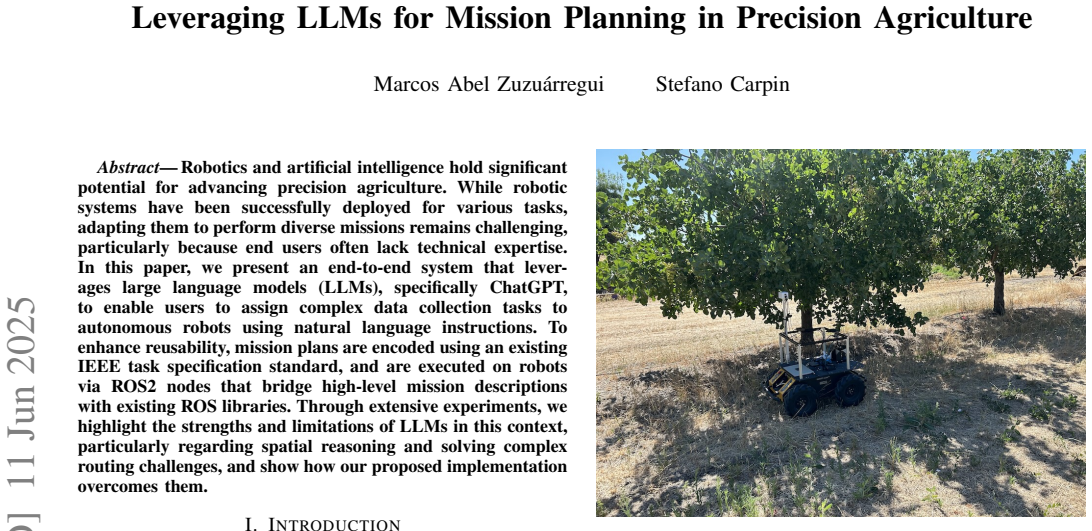
Robotics and artificial intelligence hold significant potential for advancing precision agriculture. While robotic systems have been successfully deployed for various tasks, adapting them to perform diverse missions remains challenging, particularly because end users often lack technical expertise. In this paper, we present an end-to-end system that leverages large language models (LLMs), specifically ChatGPT, to enable users to assign complex data collection tasks to autonomous robots using natural language instructions. To enhance reusability, mission plans are encoded using an existing IEEE task specification standard, and are executed on robots via ROS2 nodes that bridge high-level mission descriptions with existing ROS libraries. Through extensive experiments, we highlight the strengths and limitations of LLMs in this context, particularly regarding spatial reasoning and solving complex routing challenges, and show how our proposed implementation overcomes them.
Figures


Figures from the paper (2 more)

Forward citations
Cited by 1 Pith paper
-
Visual-Language-Guided Task Planning for Horticultural Robots
A vision-language model drives a simulated greenhouse robot through simple crop-inspection tasks with ~87% success, but long multi-target tasks collapse to under 10% success.
Reference graph
Works this paper leans on
-
[31]
M.A. Zuzu ´arregui and S. Carpin. Solving Stochastic Orienteering Problems with Chance Constraints Using a GNN Powered Monte Carlo Tree Search, September 2024. arXiv:2409.04653 [cs]
arXiv 2024
-
[1]
IEEE Std 1872.2-2021, pages 1–49, 2022
IEEE Standard for Autonomous Robotics (AuR) Ontology. IEEE Std 1872.2-2021, pages 1–49, 2022
work page 2021
-
[2]
IEEE Std 1872.1-2024, pages 1–32, 2024
IEEE Standard for Robot Task Representation. IEEE Std 1872.1-2024, pages 1–32, 2024
work page 2024
-
[3]
M. Ahn, A. Brohan, N. Brown, Y . Chebotar, O. Cortes, B. David, and C. et al. Finn. Do As I Can, Not As I Say: Grounding Language in Robotic Affordances, August 2022. arXiv:2204.01691 [cs]
arXiv 2022
-
[4]
M. Askarpour, C. Menghi, G. Belli, M.M. Bersani, and P. Pelliccione. Mind the gap: Robotic Mission Planning Meets Software Engineering. In Proceedings of the 8th International Conference on Formal Methods in Software Engineering, FormaliSE ’20, pages 55–65, New York, NY , USA, October 2020. Association for Computing Machinery
work page 2020
-
[5]
B.L. Brumitt and A. Stentz. Dynamic mission planning for multiple mobile robots. In Proceedings of IEEE International Conference on Robotics and Automation , pages 2396–2401 vol.3, 1996
work page 1996
-
[6]
S. Carpin. Solving stochastic orienteering problems with chance constraints using monte carlo tree search. IEEE Transactions on Au- tomation Science and Engineering, (Accepted for publication) Preprint available on ArXiv https://arxiv.org/abs/2409.03170
-
[7]
S. Carpin and T. C. Thayer. Solving stochastic orienteering problems with chance constraints using monte carlo tree search. In Proceedings of the IEEE International Conference on Automation Science and Engineering, pages 1170–1177, 2022
work page 2022
Show all 31 references
-
[8]
L. Chen, O. Sinavski, J. H ¨unermann, A. Karnsund, A.J. Willmott, D. Birch, D. Maund, and J. Shotton. Driving with LLMs: Fusing Object-Level Vector Modality for Explainable Autonomous Driving. In Proceedings of the IEEE International Conference on Robotics and Automation, page...
2024
-
[9]
Dechemi, D
A. Dechemi, D. Chatziparaschis, J. Chen, M. Campbell, A. Shamshir- garan, C. Mucchiani, A. Roy-Chowdhury, S. Carpin, and K. Karydis. Robotic assessment of a crop’s need for watering. IEEE Robotics and Automation Magazine, 30(4):52 – 67, 2023
2023
-
[10]
Elhafsi, R
A. Elhafsi, R. Sinha, C. Agia, E. Schmerling, I. Nesnas, and M. Pavone. Semantic Anomaly Detection with Large Language Models, September 2023. arXiv:2305.11307 [cs]
2023 arXiv
-
[11]
Garrett, R
C.R. Garrett, R. Chitnis, R. Holladay, B. Kim, T. Silver, L.P. Kaelbling, and T. Lozano-P ´erez. Integrated task and motion planning. Annual Review of Control, Robotics, and Autonomous Systems , 4:265–293, 2021
2021
-
[12]
Huang, P
W. Huang, P. Abbeel, D. Pathak, and I. Mordatch. Language Models as Zero-Shot Planners: Extracting Actionable Knowledge for Embodied Agents, March 2022. arXiv:2201.07207 [cs]
2022 arXiv
-
[13]
Huang, F
W. Huang, F. Xia, and T. et al. Xiao. Inner Monologue: Embod- ied Reasoning through Planning with Language Models, July 2022. arXiv:2207.05608 [cs]
2022 arXiv
-
[14]
Janßen, C
C. Janßen, C. Richter, and H. Wehrheim. Can ChatGPT support software verification?, November 2023. arXiv:2311.02433 [cs]
2023
-
[15]
Jones, E
M. Jones, E. M. Sorensen, T. Wolff, and C. R. Haddow. A review of mission planning systems. In Proceedings of the Second International Symposium on Ground Data Systems for Space Mission Operations , 1993
1993
-
[16]
Kalluraya, G
S. Kalluraya, G. J. Pappas, and Y . Kantaros. Resilient Temporal Logic Planning in the Presence of Robot Failures, October 2023. arXiv:2305.05485 [cs]
2023 arXiv
-
[17]
Kalluraya, G.J
S. Kalluraya, G.J. Pappas, and Y . Kantaros. Multi-robot Mis- sion Planning in Dynamic Semantic Environments, March 2023. arXiv:2209.06323 [cs, eess]
2023 arXiv
-
[18]
Kannan, V .L.N
S.S. Kannan, V .L.N. Venkatesh, and B.C. Min. SMART-LLM: Smart Multi-Agent Robot Task Planning using Large Language Models, March 2024. arXiv:2309.10062 [cs]
2024 arXiv
-
[19]
Kumar and R
A. Kumar and R. Kala. Linear Temporal Logic-based Mission Plan- ning. International Journal of Interactive Multimedia and Artificial Intelligence, 3(7):32, 2016
2016
-
[20]
F. Li, D.C. Hogg, and A.G. Cohn. Advancing Spatial Reasoning in Large Language Models: An In-Depth Evaluation and Enhancement Using the StepGame Benchmark, January 2024
2024
-
[21]
Liang, W
J. Liang, W. Huang, F. Xia, P. Xu, K. Hausman, B. Ichter, P. Florence, and A. Zeng. Code as Policies: Language Model Programs for Em- bodied Control. In Proceedings of the IEEE International Conference on Robotics and Automation , pages 9493–9500, 2023
2023
-
[22]
Macaluso, N
A. Macaluso, N. Cote, and S. Chitta. Toward Automated Programming for Robotic Assembly Using ChatGPT, May 2024. arXiv:2405.08216 [cs]
2024 arXiv
-
[23]
Mower, Y
C.E. Mower, Y . Wan, H. Yu, A. Grosnit, J. Gonzalez-Billandon, and M. et al. Zimmer. ROS-LLM: A ROS framework for embodied AI with task feedback and structured reasoning, July 2024. arXiv:2406.19741 [cs]
2024 arXiv
-
[24]
Plaku and S
E. Plaku and S. Karaman. Motion planning with temporal-logic speci- fications: Progress and challenges. AI communications, 29(1):151–162, 2016
2016
-
[25]
Y . Rizk, M. Awad, and E.W. Tunstel. Cooperative heterogeneous multi-robot systems: A survey. ACM Comput. Surv., 52(2), apr 2019
2019
-
[26]
E. Sani, A. Sgorbissa, and S. Carpin. Improving the ros 2 nav- igation stack with real-time local costmap updates for agricultural applications. In Proceedings of the IEEE International Conference on Robotics and Automation , pages 17701–17707, 2024
2024
-
[27]
Tam, C.K
Z.R. Tam, C.K. Wu, Y .L. Tsai, C.Y . Lin, H.Y . Lee, and Y .N. Chen. Let Me Speak Freely? A Study on the Impact of Format Restrictions on Performance of Large Language Models, August 2024. arXiv:2408.02442 [cs] version: 1
2024 arXiv
-
[28]
Thayer and S
T.C. Thayer and S. Carpin. A fast algorithm for stochastic orienteering with chance constraints. In Proceedings of the IEEE/RSJ International Conference on Intelligent Robots and Systems , pages 7961–7968, 2021
2021
-
[29]
Varakantham and A
P. Varakantham and A. Kumar. Optimization approaches for solv- ing chance constrained stochastic orienteering problems. In Patrice Perny, Marc Pirlot, and Alexis Tsouki`as, editors, Algorithmic Decision Theory, pages 387–398, Berlin, Heidelberg, 2013. Springer Berlin Heidelberg
2013
-
[30]
Z. Xu, Y . Zhang, E. Xie, Z. Zhao, Y . Guo, K.K. Wong, Z. Li, and H. Zhao. DriveGPT4: Interpretable End-to-end Autonomous Driving via Large Language Model, March 2024. arXiv:2310.01412 [cs] version: 4
2024 arXiv
Reviewed August 7, 2026 · model on record in the stance chip above.
Discussion (0). Continue with ORCID to comment.