REVIEW 4 major objections 5 minor 1 cited by
History-Aware Neural Operator: Robust Data-Driven Constitutive Modeling of Path-Dependent Materials
T0 review · 4 major / 5 minor · reviewed 2026-08-07 · deepseek-v4-flash
Pith's one-line read A history-aware neural operator predicts path-dependent material stress without hidden state variables.
desk verdict HANO delivers strong 1D elastoplastic results and fair parameter-matched comparisons, but the hidden-state-free premise is only proven for the 1D case; the 6D damage benchmark (21% NRMSE) and the unexamined identifiability question temper the central claim. read the letter →
The pith
A machine-rendered reading of the paper's core claim, the machinery that carries it, and where it could break.
The reading
What carries the argument
The central object is the history-aware neural operator, built as a mapping $G^H_\phi = Q \circ (L^{AEUF}_M \circ \cdots \circ L^{AEUF}_1) \circ (L^F_L \circ \cdots \circ L^F_1) \circ P$ that acts on a function input $a(x)$ representing the strain–stress history window and the next strain increment. The Fourier layers index physical wavenumbers rather than grid points, which the paper argues yields discretization invariance; the U-Net and self-attention branches recover local high-frequency features and re-weight the history segments most relevant to the next stress. The autoregressive loop slides the window forward using the predicted stress, which is what allows prediction to start at an arbitrary intermediate point.
What would settle it
Generate a set of loading paths for the same material model in which two different internal histories (for example, different amounts of plastic strain and back stress) arrive at the same last k strain–stress pairs, then run the trained HANO forward and compare its next-stress predictions with the reference. If the predictions diverge substantially for such pairs, the fading-memory window assumption fails.
Extended reading notes
Core claim
The paper claims that a neural operator with Fourier layers, U-Net multiscale paths, and multi-stage self-attention can model path-dependent constitutive behavior autoregressively from a fixed window of the k most recent strain–stress pairs and the forthcoming strain increment, without needing internal state variables or initialization from an undeformed reference state. In the 1D elastoplastic benchmark, HANO achieves NRMSE of 0.6 percent on full histories and 0.4 percent on pre-stressed truncated histories, where RNN1 gives 3.0 and 35.9 percent respectively. In the 6D anisotropic damage benchmark, HANO achieves 21.09 percent NRMSE versus 35.23 percent for FNO and 24.67 percent for UFNO, with parameter-matched comparisons preserving the advantage.
Load-bearing premise
The model assumes that the most recent k strain–stress observations uniquely and sufficiently encode the current internal state of the material, so that predicting the next stress from just that window is well defined. If two different internal states can produce the same recent window, the prediction is ambiguous and the model's accuracy on such paths is not guaranteed.
Editorial extensions
If this is right
- A surrogate trained this way can be initialized from a pre-stressed configuration by applying a few controlled loading increments and observing the response, rather than by replaying the full history from zero stress. This makes the model usable when early data are missing or when a finite element simulation begins from a previously loaded integration point.
- Because the operator is resolution-invariant in principle, the same trained model can be applied to loading paths sampled at different rates, including irregular sampling, without retraining or re-calibration.
- The autoregressive design with a short observable-history window removes the need for the user to define internal variables, yield functions, flow rules, or damage evolution equations, so the modeling effort shifts to choosing the window length k and generating representative training paths.
- The reported performance suggests the trained surrogate could be embedded into differentiable solvers for gradient-based inverse analysis or real-time simulation, since the stress update uses only local windowed state plus strain increment.
- The attention-enhanced U-Fourier layers, rather than raw model size, account for most of the accuracy gain over FNO and UFNO, so the architectural mechanism transfers to other operator backbones if the windowed-input autoregressive formulation is kept.
Reading between the lines
- The fading-memory assumption is not tested for identifiability: the paper finds k empirically but does not establish that the windowed observable states uniquely determine the internal state for kinematic hardening or Hashin-type damage, so adversarial loading paths that produce the same recent window from different internal states could break the mapping.
- The operator's projection effect described for noisy inputs suggests a testable property: HANO should act as a low-pass filter on stress inputs, so injecting high-frequency perturbations at different frequencies should reveal a cutoff related to the Fourier mode truncation.
- The method should extend naturally to rate-dependent materials, since the window input can carry strain-rate information implicitly through the spacing of strain values, but the paper does not validate this claim; a natural next experiment would be on viscoelastic or viscoplastic data.
- A cautious reading of the 1D results is that the elastoplastic benchmark may be comparatively simple because the kinematic-hardening model has a compact memory determined by back stress and plastic strain, so the strong accuracy numbers may not transfer to materials with longer-memory or hidden microstructural state.
Editorial analysis
A structured set of objections, weighed in public.
Referee Report
Summary. The paper proposes HANO, an autoregressive neural operator for data-driven constitutive modeling of path-dependent inelastic materials. HANO maps a short window of k recent strain–stress pairs plus the next strain increment to the next stress, using a Fourier neural operator backbone augmented by U-Net and hierarchical self-attention layers. The authors claim two principal advantages over RNN-based surrogates: discretization-invariance and independence from hidden state variables, the latter enabling accurate predictions from pre-stressed or partially observed histories. The method is tested on 1D elastoplasticity with kinematic hardening and on a 6D anisotropic damage dataset generated with a modified Hashin model. Reported NRMSEs are 0.6% on full 1D histories and 0.4% from truncated pre-stressed histories (vs. 35.9% for RNN1), and 21.09% on the 6D damage benchmark (vs. 35.23% for FNO and 24.67% for UFNO). Parameter-matched comparisons in Appendix D and Section 5.3 support the architectural conclusions.
Significance. If the central claims hold, HANO would be a valuable and practical surrogate: it avoids recurrent hidden-state initialization, degrades gracefully under missing or noisy history, and is backed by parameter-matched comparisons (Appendix D, Table 6) that separate architectural benefit from model capacity. The 1D elastoplasticity results are strong and the use of a publicly available damage dataset is a strength. However, the absolute 21.09% NRMSE on the damage benchmark materially tempers the abstract's 'high predictive accuracy' language, and the central hidden-variable-free premise is not rigorously established beyond the 1D case. The paper would be stronger if the identifiability assumption were checked and the discretization-invariance claims qualified.
major comments (4)
- [Section 3.3, Eq. (12), Remark 3.3] The central claim that HANO 'eliminates the need for hidden state variables by directly utilizing short segments of observable strain-stress history' presumes that the map in Eq. (12) is single-valued: a k-step window of observable strain-stress pairs and the next strain increment must uniquely determine the next stress. This is safe for the 1D elastoplastic benchmark, where any pair (epsilon, sigma) with linear kinematic hardening fixes epsilon_p and the back stress. It is not established for the modified Hashin damage benchmark of Section 5, where future evolution depends on the individual mode damage variables d_FT, d_FC, d_MT, d_MC and their thresholds; the paper gives no argument or experiment showing that a window of k=20 (or even k=6, as suggested by Fig. 13) distinguishes different internal states with identical observable windows. The empirical error plateau in Fig. 13 is a training observation, not an identifiability check. I recommend either adding a concrete uniqueness test, e.g., searching generated trajectories for distinct internal states that share the same input window but lead to different future stresses and quantifying the discrepancy, or providing an observability argument for the damage model. As written, the hidden-variable-free design principle is load-bearing and unverified for the more complex benchmark.
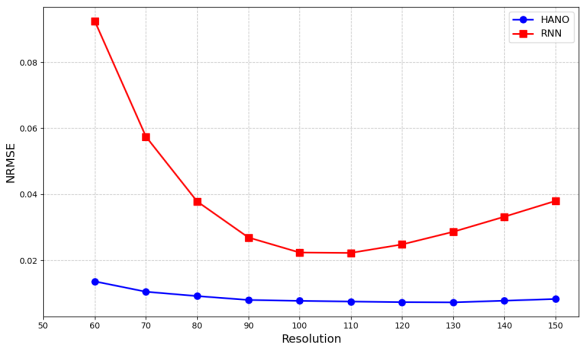
- [Remark 3.2 and Section 4.3] The paper states that HANO 'inherently achieves discretization invariance' because the FNO filters index physical wavenumbers rather than grid points. However, the input to HANO is a fixed-length window of k observations. Consequently, the physical time span covered by the window scales with the sampling resolution, and the claim is unconditional only if the material's memory is exactly k steps regardless of the sampling rate. Section 5.4 itself acknowledges that the physical time span covered by the history window is the theoretically relevant quantity, citing Coleman-Gurtin. The experiments in 4.3.2 and 4.3.3 vary the number of increments per cycle over a moderate range (roughly 57-150 steps per cycle) while keeping k fixed, which does not separate the effect of k from the effect of physical time span. The claim should be qualified or supplemented by an experiment that varies the physical window length at fixed k to test whether HANO remains invariant, or by a theoretical condition on the required window length as a function of sampling density.
- [Abstract and Section 5, Table 5] The abstract and conclusion characterize HANO as achieving 'high predictive accuracy' and 'accurately captures complex path-dependent responses,' but the best result on the anisotropic damage benchmark is NRMSE = 21.09% (Table 5). While HANO substantially outperforms FNO (35.23%) and UFNO (24.67%), a 21% normalized error is not high absolute accuracy, and the claim should be calibrated to the difficulty of the task. Please either soften the absolute-accuracy language to 'state-of-the-art relative to the tested baselines' or provide evidence that this level of error is appropriate for the target application.
- [Abstract and Section 4.3] The abstract claims HANO 'naturally accommodates varying path discretizations and irregular sampling,' but no experiment in the manuscript uses irregular (non-uniform) time step sampling. Section 4.3 tests uniform resolutions of 60-150 steps per cycle and variable-resolution training data with a fixed uniform resolution per trajectory; Figure 7 shows 57, 83, 112, and 135 increments per cycle, all uniformly sampled within each cycle. The FNO backbone as implemented uses a 1-D FFT, which presumes a regular temporal grid; no mechanism for handling non-uniform sampling is described. Either add experiments with genuinely irregular temporal increments or remove the irregular-sampling claim from the abstract and introduction.
minor comments (5)
- [Section 3.3] The sentence 'HANO approximates the continuous mapping for the continuous operator mapping for the constitutive relation Gz' contains a duplicated phrase and should be edited to 'HANO approximates the continuous operator mapping for the constitutive relation Gz'.
- [Appendix E heading] The appendix heading appears as 'T raining and V alidation Losses' with unintended spacing; it should be 'Training and Validation Losses'.
- [Section 4.3.3 and Figure 6] The text says the variable-resolution training paths have peak strain amplitudes from roughly 0.015 to 0.025, whereas Section 4.1 sets loading amplitudes to [0.008, 0.015]. Clarify whether these are different amplitude ranges or whether Figure 6's description is imprecise.
- [Section 5.4] The text says accuracy 'plateaus around k=6,' but Figure 13 shows a gradual increase and fluctuations in NRMSE beyond k=6. Consider describing the trend as 'reaching a minimum near k=6 with mild fluctuations for larger k' rather than a plateau.
- [Appendix D] The name 'HANOreduced' is written as both 'HANOreduced' and 'HANO reduced' in the same paragraph; use a single consistent notation.
Circularity Check
No significant circularity: all quantitative claims are held-out test errors on externally generated data, and the windowed-history premise is an explicit modeling assumption rather than a self-referential derivation.
full rationale
The paper's derivation chain is self-contained against external benchmarks. Section 2.1 formulates classical constitutive models with internal state variables from thermodynamics; Eq. (12) then postulates a windowed mapping from the most recent k strain–stress pairs plus the next strain increment to the next stress. This mapping is the modeling premise, not a derived result, and the paper explicitly identifies it as an assumption anchored to fading-memory arguments from Coleman and Gurtin (an external reference). HANO approximates this mapping with an FNO-based architecture (Eqs. 20–22), trained with an MSE loss on data generated by externally defined constitutive models: the 1D elastoplastic model in Section 4.1 and the modified Hashin damage model from the open-access dataset of Ge and Tagarielli [18]. All headline numbers (0.6% NRMSE on full histories, 0.4% on truncated histories, 21.09% on anisotropic damage) are held-out test evaluations, not fits relabeled as predictions. The FNO discretization-invariance property is imported from prior literature [40, 43] and is an architectural property, not a self-citation chain. Self-citations (e.g., Du, Guo, He 2024) appear only in the concluding outlook for differentiable-solver integration and are not load-bearing for the central claim. The sufficiency of a fixed history window is a genuine identifiability assumption, and the paper acknowledges the k-selection limitation in Section 6; this is a correctness or generalization concern, not circularity. No equation reduces to its own input, no fitted parameter is renamed as a prediction, and no uniqueness theorem from the authors' prior work is invoked to force a choice. The derivation and evaluation are therefore not circular.
Assumptions & free parameters
free parameters (3)
- History window length k =
k=10 for elastoplasticity, k=20 for damage; plateau reported near k=6
- Spectral modes, channel width, and layer counts =
5 modes, width 64, 6 layers for 1D; 10 modes, width 64, 6 layers for damage
- Teacher forcing and noise injection schedules =
teacher forcing decaying 1.0 to 0.0 over 500 epochs; noise sigma ramping 0.001 to 0.020 by epoch 200
assumptions (5)
- domain assumption A short window of recent strain-stress observations is sufficient to determine future stress (fading memory and observability of internal state).
- domain assumption Internal state variable evolution can be implicitly inferred from observable strain-stress history.
- domain assumption Fourier spectral convolution layers are discretization-invariant for the history windows used here.
- domain assumption The simulated constitutive models provide faithful ground truth for the material responses being learned.
- standard math Prior results for FNO, U-Net, attention, and scheduled sampling behave as described in their cited references.
Cite this review
Pith. "Pith review of History-Aware Neural Operator: Robust Data-Driven Constitutive Modeling of Path-Dependent Materials." pith.science (2026). https://pith.science/paper/GBQHHI3B
@misc{pith2026250610352,
  author       = {Pith},
  title        = {Pith review of: History-Aware Neural Operator: Robust Data-Driven Constitutive Modeling of Path-Dependent Materials},
  year         = {2026},
  howpublished = {\url{https://pith.science/paper/GBQHHI3B}},
  note         = {Machine review of arXiv:2506.10352}
}
read the original abstract
This study presents an end-to-end learning framework for data-driven modeling of path-dependent inelastic materials using neural operators. The framework is built on the premise that irreversible evolution of material responses, governed by hidden dynamics, can be inferred from observable data. We develop the History-Aware Neural Operator (HANO), an autoregressive model that predicts path-dependent material responses from short segments of recent strain-stress history without relying on hidden state variables, thereby overcoming self-consistency issues commonly encountered in recurrent neural network (RNN)-based models. Built on a Fourier-based neural operator backbone, HANO enables discretization-invariant learning. To enhance its ability to capture both global loading patterns and critical local path dependencies, we embed a hierarchical self-attention mechanism that facilitates multiscale feature extraction. Beyond ensuring self-consistency, HANO mitigates sensitivity to initial hidden states, a commonly overlooked issue that can lead to instability in recurrent models when applied to generalized loading paths. By modeling stress-strain evolution as a continuous operator rather than relying on fixed input-output mappings, HANO naturally accommodates varying path discretizations and exhibits robust performance under complex conditions, including irregular sampling, multi-cycle loading, noisy data, and pre-stressed states. We evaluate HANO on two benchmark problems: elastoplasticity with hardening and progressive anisotropic damage in brittle solids. Results show that HANO consistently outperforms baseline models in predictive accuracy, generalization, and robustness. With its demonstrated capabilities, HANO provides an effective data-driven surrogate for simulating inelastic materials and is well-suited for integration with classical numerical solvers.
Figures


Figures from the paper (10 more)


Forward citations
Cited by 1 Pith paper
-
Inelastic Constitutive Kolmogorov-Arnold Networks: A generalized framework for automated discovery of interpretable inelastic material models
iCKAN combines input-convex Kolmogorov-Arnold networks with a thermodynamic inelasticity framework to turn stress-strain data into symbolic elastic and inelastic potentials.
Reference graph
Works this paper leans on
-
[1]
Deep learning for plasticity and thermo-viscoplasticity
Abueidda, D.W., Koric, S., Sobh, N.A., Sehitoglu, H., 2021. Deep learning for plasticity and thermo-viscoplasticity. International Journal of Plasticity 136, 102852
work page 2021
-
[2]
Distance-preserving manifold denoising for data-driven mechanics
Bahmani, B., Sun, W., 2023. Distance-preserving manifold denoising for data-driven mechanics. Computer Methods in Applied Mechanics and Engineering 405, 115857
work page 2023
-
[3]
Bartel, T., Harnisch, M., Schweizer, B., Menzel, A., 2023. A data-driven approach for plasticity using history surrogates: Theory and application in the context of truss structures. Computer Methods in Applied Mechanics and Engineering 414, 116138
work page 2023
-
[4]
Scheduled sampling for sequence prediction with recurrent neural networks
Bengio, S., Vinyals, O., Jaitly, N., Shazeer, N., 2015. Scheduled sampling for sequence prediction with recurrent neural networks. Advances in neural information processing systems 28
work page 2015
-
[5]
From cp-fft to cp-rnn: Recurrent neural network surrogate model of crystal plasticity
Bonatti, C., Berisha, B., Mohr, D., 2022. From cp-fft to cp-rnn: Recurrent neural network surrogate model of crystal plasticity. International Journal of Plasticity 158, 103430
work page 2022
-
[6]
Bonatti, C., Mohr, D., 2022. On the importance of self-consistency in recurrent neural network models representing elasto-plastic solids. Journal of the Mechanics and Physics of Solids 158, 104697
work page 2022
-
[7]
Data-driven frac- ture mechanics
Carrara, P., De Lorenzis, L., Stainier, L., Ortiz, M., 2020. Data-driven frac- ture mechanics. Computer Methods in Applied Mechanics and Engineering 372, 113390. 47
work page 2020
-
[8]
Data-driven rate-dependent fracture mechanics
Carrara, P., Ortiz, M., De Lorenzis, L., 2021. Data-driven rate-dependent fracture mechanics. Journal of the Mechanics and Physics of Solids 155, 104559
work page 2021
Show all 75 references
-
[9]
Neural ordinary differential equations
Chen, R.T., Rubanova, Y., Bettencourt, J., Duvenaud, D.K., 2018. Neural ordinary differential equations. Advances in neural information processing systems 31
2018
-
[10]
Thermodynamics with internal state variables
Coleman, B.D., Gurtin, M.E., 1967. Thermodynamics with internal state variables. The journal of chemical physics 47, 597–613
1967
-
[11]
Neural networks for constitutive modeling: From universal function approximators to advanced models and the integration of physics
Dornheim, J., Morand, L., Nallani, H.J., Helm, D., 2024. Neural networks for constitutive modeling: From universal function approximators to advanced models and the integration of physics. Archives of computational methods in engineering 31, 1097–1127
2024
-
[12]
Differentiable neural-integrated meshfree method for forward and inverse modeling of finite strain hyperelasticity
Du, H., Guo, B., He, Q., 2024. Differentiable neural-integrated meshfree method for forward and inverse modeling of finite strain hyperelasticity. Engineering with Computers , 1–21
2024
-
[13]
Model-free data-driven inelasticity
Eggersmann, R., Kirchdoerfer, T., Reese, S., Stainier, L., Ortiz, M., 2019. Model-free data-driven inelasticity. Computer Methods in Applied Mechan- ics and Engineering 350, 81–99
2019
-
[14]
Convex neural networks learn generalized standard material models
Flaschel, M., Steinmann, P., De Lorenzis, L., Kuhl, E., 2025. Convex neural networks learn generalized standard material models. Journal of the Mechanics and Physics of Solids 200, 106103
2025
-
[15]
Prediction of the evolution of the stress field of polycrystals undergoing elastic-plastic deformation with a hybrid neural network model
Frankel, A., Tachida, K., Jones, R., 2020. Prediction of the evolution of the stress field of polycrystals undergoing elastic-plastic deformation with a hybrid neural network model. Machine Learning: Science and Technology 1, 035005
2020
-
[16]
Dnn2: A hyper- parameter reinforcement learning game for self-design of neural network based elasto-plastic constitutive descriptions
Fuchs, A., Heider, Y., Wang, K., Sun, W., Kaliske, M., 2021. Dnn2: A hyper- parameter reinforcement learning game for self-design of neural network based elasto-plastic constitutive descriptions. Computers & Structures 249, 106505
2021
-
[17]
A review on data-driven constitutive laws for solids
Fuhg, J.N., Anantha Padmanabha, G., Bouklas, N., Bahmani, B., Sun, W., Vlassis, N.N., Flaschel, M., Carrara, P., De Lorenzis, L., 2024. A review on data-driven constitutive laws for solids. Archives of Computational Methods in Engineering , 1–43
2024
-
[18]
Data-driven constitutive models for brittle solids displaying progressive anisotropic damage
Ge, W., Tagarielli, V.L., 2024. Data-driven constitutive models for brittle solids displaying progressive anisotropic damage. Composites Part C: Open Access 15, 100501
2024
-
[19]
Knowledge-based modeling of material behavior with neural networks
Ghaboussi, J., Garrett Jr, J., Wu, X., 1991. Knowledge-based modeling of material behavior with neural networks. Journal of engineering mechanics 117, 132–153. 48
1991
-
[20]
Deep Learning
Goodfellow, I., Bengio, Y., Courville, A., 2016a. Deep Learning. MIT Press. http://www.deeplearningbook.org
-
[21]
Deep learning
Goodfellow, I., Bengio, Y., Courville, A., Bengio, Y., 2016b. Deep learning. volume 1. MIT press Cambridge
-
[22]
On the potential of recurrent neural networks for modeling path dependent plasticity
Gorji, M.B., Mozaffar, M., Heidenreich, J.N., Cao, J., Mohr, D., 2020. On the potential of recurrent neural networks for modeling path dependent plasticity. Journal of the Mechanics and Physics of Solids 143, 103972
2020
-
[23]
Constitutive model character- ization and discovery using physics-informed deep learning
Haghighat, E., Abouali, S., Vaziri, R., 2023. Constitutive model character- ization and discovery using physics-informed deep learning. Engineering Applications of Artificial Intelligence 120, 105828
2023
-
[24]
Failure criteria for unidirectional fiber composites
Hashin, Z., 1980. Failure criteria for unidirectional fiber composites
1980
-
[25]
Sequential deep operator networks (s-deeponet) for predicting full-field solutions under time-dependent loads
He, J., Kushwaha, S., Park, J., Koric, S., Abueidda, D., Jasiuk, I., 2024. Sequential deep operator networks (s-deeponet) for predicting full-field solutions under time-dependent loads. Engineering Applications of Artificial Intelligence 127, 107258. URL: https://doi.org/10.10...
2024
-
[26]
A physics-constrained data-driven approach based on locally convex reconstruction for noisy database
He, Q., Chen, J.S., 2020. A physics-constrained data-driven approach based on locally convex reconstruction for noisy database. Computer Methods in Applied Mechanics and Engineering 363, 112791
2020
-
[27]
Manifold learning based data-driven modeling for soft biological tissues
He, Q., Laurence, D.W., Lee, C.H., Chen, J.S., 2021a. Manifold learning based data-driven modeling for soft biological tissues. Journal of biome- chanics 117, 110124
-
[28]
A hybrid deep neural operator/finite element method for ice-sheet modeling
He, Q., Perego, M., Howard, A.A., Karniadakis, G.E., Stinis, P., 2023. A hybrid deep neural operator/finite element method for ice-sheet modeling. Journal of Computational Physics 492, 112428. URL: https://www.sciencedirect.com/science/article/pii/ S0021999123005235, doi:doi:h...
2023
-
[29]
Thermodynamically consistent machine-learned internal state variable approach for data-driven modeling of path-dependent materials
He, X., Chen, J.S., 2022. Thermodynamically consistent machine-learned internal state variable approach for data-driven modeling of path-dependent materials. Computer Methods in Applied Mechanics and Engineering 402, 115348
2022
-
[30]
Deep autoencoders for physics-constrained data-driven nonlinear materials modeling
He, X., He, Q., Chen, J.S., 2021b. Deep autoencoders for physics-constrained data-driven nonlinear materials modeling. Computer Methods in Applied Mechanics and Engineering 385, 114034
-
[31]
Machine learning based modeling of path- dependent materials for finite element analysis
He, Y., Semnani, S.J., 2023. Machine learning based modeling of path- dependent materials for finite element analysis. Computers and Geotechnics 156, 105254. 49
2023
-
[32]
Incremental neural controlled differential equations for modeling of path-dependent material behavior
He, Y., Semnani, S.J., 2024. Incremental neural controlled differential equations for modeling of path-dependent material behavior. Computer Methods in Applied Mechanics and Engineering 422, 116789
2024
-
[33]
Historical review of internal state variable theory for inelasticity
Horstemeyer, M.F., Bammann, D.J., 2010. Historical review of internal state variable theory for inelasticity. International Journal of Plasticity 26, 1310–1334
2010
-
[34]
A machine learning based plasticity model using proper orthogonal decomposition
Huang, D., Fuhg, J.N., Weißenfels, C., Wriggers, P., 2020. A machine learning based plasticity model using proper orthogonal decomposition. Computer Methods in Applied Mechanics and Engineering 365, 113008
2020
-
[35]
A neural ordinary differential equation framework for modeling inelastic stress response via internal state variables
Jones, R.E., Frankel, A.L., Johnson, K., 2022. A neural ordinary differential equation framework for modeling inelastic stress response via internal state variables. Journal of Machine Learning for Modeling and Computing 3
2022
-
[36]
Automated constitutive modeling of isotropic hyperelasticity based on artificial neural networks
Kalina, K.A., Linden, L., Brummund, J., Metsch, P., K¨ astner, M., 2022. Automated constitutive modeling of isotropic hyperelasticity based on artificial neural networks. Computational Mechanics 69, 213–232
2022
-
[37]
Neural controlled differ- ential equations for irregular time series
Kidger, P., Morrill, J., Foster, J., Lyons, T., 2020. Neural controlled differ- ential equations for irregular time series. Advances in Neural Information Processing Systems 33, 6696–6707
2020
-
[38]
Data-driven computational mechanics
Kirchdoerfer, T., Ortiz, M., 2016. Data-driven computational mechanics. Computer Methods in Applied Mechanics and Engineering 304, 81–101
2016
-
[39]
Polyconvex anisotropic hyperelasticity with neural networks
Klein, D.K., Fern´ andez, M., Martin, R.J., Neff, P., Weeger, O., 2022. Polyconvex anisotropic hyperelasticity with neural networks. Journal of the Mechanics and Physics of Solids 159, 104703
2022
-
[40]
Neural operator: Learning maps between function spaces with applications to pdes
Kovachki, N., Li, Z., Liu, B., Azizzadenesheli, K., Bhattacharya, K., Stuart, A., Anandkumar, A., 2023. Neural operator: Learning maps between function spaces with applications to pdes. Journal of Machine Learning Research 24, 1–97
2023
-
[41]
Artificial neural network as an incremental non-linear constitutive model for a finite element code
Lefik, M., Schrefler, B.A., 2003. Artificial neural network as an incremental non-linear constitutive model for a finite element code. Computer methods in applied mechanics and engineering 192, 3265–3283
2003
-
[42]
Enhancing the locality and breaking the memory bottleneck of transformer on time series forecasting
Li, S., Jin, X., Xuan, Y., Zhou, X., Chen, W., Wang, Y.X., Yan, X., 2019. Enhancing the locality and breaking the memory bottleneck of transformer on time series forecasting. Advances in neural information processing systems 32
2019
-
[43]
Fourier neural operator for parametric partial differential equations
Li, Z., Kovachki, N., Azizzadenesheli, K., Liu, B., Bhattacharya, K., Stuart, A., Anandkumar, A., 2020a. Fourier neural operator for parametric partial differential equations. arXiv preprint arXiv:2010.08895 . 50
2010 arXiv
-
[44]
Neural operator: Graph kernel network for partial differential equations
Li, Z., Kovachki, N., Azizzadenesheli, K., Liu, B., Bhattacharya, K., Stuart, A., Anandkumar, A., 2020b. Neural operator: Graph kernel network for partial differential equations. arXiv preprint arXiv:2003.03485
2003 arXiv
-
[45]
Constitutive artificial neural networks: A fast and general approach to predictive data-driven constitutive modeling by deep learning
Linka, K., Hillg¨ artner, M., Abdolazizi, K.P., Aydin, R.C., Itskov, M., Cyron, C.J., 2021. Constitutive artificial neural networks: A fast and general approach to predictive data-driven constitutive modeling by deep learning. Journal of Computational Physics 429, 110010
2021
-
[46]
Liu, B., Ocegueda, E., Trautner, M., Stuart, A.M., Bhattacharya, K.,
-
[47]
Learning nonlinear operators via deeponet based on the universal approximation theorem of operators
Lu, L., Jin, P., Pang, G., Zhang, Z., Karniadakis, G.E., 2021. Learning nonlinear operators via deeponet based on the universal approximation theorem of operators. Nature machine intelligence 3, 218–229
2021
-
[48]
Physically recurrent neural networks for path-dependent heterogeneous materials: Embedding constitutive models in a data-driven surrogate
Maia, M., Rocha, I.B., Kerfriden, P., van der Meer, F., 2023. Physically recurrent neural networks for path-dependent heterogeneous materials: Embedding constitutive models in a data-driven surrogate. Computer Methods in Applied Mechanics and Engineering 407, 115934
2023
-
[49]
Multiscale modeling of inelastic materials with thermodynamics-based artificial neural networks (tann)
Masi, F., Stefanou, I., 2022. Multiscale modeling of inelastic materials with thermodynamics-based artificial neural networks (tann). Computer Methods in Applied Mechanics and Engineering 398, 115190
2022
-
[50]
Evolution tann and the identification of internal variables and evolution equations in solid mechanics
Masi, F., Stefanou, I., 2023. Evolution tann and the identification of internal variables and evolution equations in solid mechanics. Journal of the Mechanics and Physics of Solids 174, 105245
2023
-
[51]
Thermodynamics-based artificial neural networks for constitutive modeling
Masi, F., Stefanou, I., Vannucci, P., Maffi-Berthier, V., 2021. Thermodynamics-based artificial neural networks for constitutive modeling. Journal of the Mechanics and Physics of Solids 147, 104277
2021
-
[52]
Curriculum dropout, in: Proceedings of the IEEE international conference on computer vision, pp
Morerio, P., Cavazza, J., Volpi, R., Vidal, R., Murino, V., 2017. Curriculum dropout, in: Proceedings of the IEEE international conference on computer vision, pp. 3544–3552
2017
-
[53]
Mozaffar, M., Bostanabad, R., Chen, W., Ehmann, K., Cao, J., Bessa, M.,
-
[54]
A data-driven approach to nonlinear elasticity
Nguyen, L.T.K., Keip, M.A., 2018. A data-driven approach to nonlinear elasticity. Computers & Structures 194, 97–115
2018
-
[55]
Linear attention coupled fourier neural operator for simulation of three-dimensional turbulence
Peng, W., Yuan, Z., Li, Z., Wang, J., 2023. Linear attention coupled fourier neural operator for simulation of three-dimensional turbulence. Physics of Fluids 35. 51
2023
-
[56]
Attention-enhanced neural network models for turbulence simulation
Peng, W., Yuan, Z., Wang, J., 2022. Attention-enhanced neural network models for turbulence simulation. Physics of Fluids 34
2022
-
[57]
Ronneberger, O., Fischer, P., Brox, T., 2015. U-net: Convolutional net- works for biomedical image segmentation, in: Medical image computing and computer-assisted intervention–MICCAI 2015: 18th international con- ference, Munich, Germany, October 5-9, 2015, proceedings, part I...
2015
-
[58]
A compar- ative study on different neural network architectures to model inelasticity
Rosenkranz, M., Kalina, K.A., Brummund, J., K¨ astner, M., 2023. A compar- ative study on different neural network architectures to model inelasticity. International Journal for Numerical Methods in Engineering 124, 4802–4840
2023
-
[59]
Learning to simulate complex physics with graph networks, in: International conference on machine learning, PMLR
Sanchez-Gonzalez, A., Godwin, J., Pfaff, T., Ying, R., Leskovec, J., Battaglia, P., 2020. Learning to simulate complex physics with graph networks, in: International conference on machine learning, PMLR. pp. 8459–8468
2020
-
[60]
The mechanics and thermodynamics of continuous media
Silhavy, M., 2013. The mechanics and thermodynamics of continuous media. Springer Science & Business Media
2013
-
[61]
Computational inelasticity
Simo, J.C., Hughes, T.J., 2006. Computational inelasticity. volume 7. Springer Science & Business Media
2006
-
[62]
Consistent tangent operators for rate- independent elastoplasticity
Simo, J.C., Taylor, R.L., 1985. Consistent tangent operators for rate- independent elastoplasticity. Computer methods in applied mechanics and engineering 48, 101–118
1985
-
[63]
A novel self- adversarial training scheme for enhanced robustness of inelastic constitutive descriptions by neural networks
St¨ ocker, J., Fuchs, A., Leichsenring, F., Kaliske, M., 2022. A novel self- adversarial training scheme for enhanced robustness of inelastic constitutive descriptions by neural networks. Computers & Structures 265, 106774
2022
-
[64]
Nn-euclid: Deep-learning hyperelasticity without stress data
Thakolkaran, P., Joshi, A., Zheng, Y., Flaschel, M., De Lorenzis, L., Kumar, S., 2022. Nn-euclid: Deep-learning hyperelasticity without stress data. Journal of the Mechanics and Physics of Solids 169, 105076
2022
-
[65]
Rational mechanics of materials
Truesdell, C., Truesdell, C., 1966. Rational mechanics of materials. Springer
1966
-
[66]
Attention is all you need
Vaswani, A., Shazeer, N., Parmar, N., Uszkoreit, J., Jones, L., Gomez, A.N., Kaiser, L., Polosukhin, I., 2017. Attention is all you need. Advances in neural information processing systems 30
2017
-
[67]
Geometric learning for computational me- chanics part ii: Graph embedding for interpretable multiscale plasticity
Vlassis, N.N., Sun, W., 2023. Geometric learning for computational me- chanics part ii: Graph embedding for interpretable multiscale plasticity. Computer Methods in Applied Mechanics and Engineering 404, 115768
2023
-
[68]
A deep learning framework for constitutive modeling based on temporal convolutional network
Wang, J.J., Wang, C., Fan, J.S., Mo, Y., 2022. A deep learning framework for constitutive modeling based on temporal convolutional network. Journal of Computational Physics 449, 110784. 52
2022
-
[69]
U-fno—an enhanced fourier neural operator-based deep-learning model for multiphase flow
Wen, G., Li, Z., Azizzadenesheli, K., Anandkumar, A., Benson, S.M., 2022. U-fno—an enhanced fourier neural operator-based deep-learning model for multiphase flow. Advances in Water Resources 163, 104180
2022
-
[70]
A recurrent neural network- accelerated multi-scale model for elasto-plastic heterogeneous materials subjected to random cyclic and non-proportional loading paths
Wu, L., Kilingar, N.G., Noels, L., et al., 2020. A recurrent neural network- accelerated multi-scale model for elasto-plastic heterogeneous materials subjected to random cyclic and non-proportional loading paths. Computer Methods in Applied Mechanics and Engineering 369, 113234
2020
-
[71]
Jax-fem: A differentiable gpu-accelerated 3d finite element solver for au- tomatic inverse design and mechanistic data science
Xue, T., Liao, S., Gan, Z., Park, C., Xie, X., Liu, W.K., Cao, J., 2023. Jax-fem: A differentiable gpu-accelerated 3d finite element solver for au- tomatic inverse design and mechanistic data science. Computer Physics Communications , 108802
2023
-
[72]
Learning deep implicit fourier neural operators (ifnos) with applications to heterogeneous material modeling
You, H., Zhang, Q., Ross, C.J., Lee, C.H., Yu, Y., 2022. Learning deep implicit fourier neural operators (ifnos) with applications to heterogeneous material modeling. Computer Methods in Applied Mechanics and Engineer- ing 398, 115296
2022
-
[73]
Operator learning for homogenizing hypere- lastic materials, without pde data
Zhang, H., Guilleminot, J., 2024. Operator learning for homogenizing hypere- lastic materials, without pde data. Mechanics Research Communications 138, 104281. URL: https://doi.org/10.1016/j.mechrescom.2024.104281, doi:doi:10.1016/j.mechrescom.2024.104281. 53
2024
-
[2019]
Proceedings of the National Academy of Sciences 116, 26414–26420
Deep learning predicts path-dependent plasticity. Proceedings of the National Academy of Sciences 116, 26414–26420
-
[2023]
Journal of the Mechanics and Physics of Solids 178, 105329
Learning macroscopic internal variables and history dependence from microscopic models. Journal of the Mechanics and Physics of Solids 178, 105329
Reviewed August 7, 2026 · model on record in the stance chip above.
Discussion (0). Continue with ORCID to comment.