REVIEW 6 major objections 5 minor 34 references
RICE: Reactive Interaction Controller for Cluttered Canopy Environment
T0 review · 6 major / 5 minor · reviewed 2026-08-07 · deepseek-v4-flash
Pith's one-line read A tactile-only reactive controller can guide a robot arm through deformable plant clutter to an occluded target, reaching it in all 35 trials without breaking a branch.
desk verdict Solid reactive controller for mock canopies with a real result, but the undefined success metric makes the headline 100% No-Break Reach Rate unverifiable as written. read the letter →
The pith
A machine-rendered reading of the paper's core claim, the machinery that carries it, and where it could break.
The reading
What carries the argument
The load-bearing object is the high-level objective $H_k$ and its normalized gradient $\hat{\nabla}H_k = w_x\hat{\nabla}U + w_f\hat{\nabla}G$, converted directly into an end-effector velocity $v_{k+1} = -\alpha\,\hat{\nabla}H_k$. The interaction-force gradient $\hat{\nabla}G$ is computed from two $4\times4$ taxel arrays: force magnitudes at each taxel define a deviation vector $\Delta G_k$, unit vectors from a reference position to each taxel form the matrix $\hat{D}_k$, and the spatial gradient is estimated as $\nabla G_k^* = (\hat{D}_k^\top\hat{D}_k)^{-1}\hat{D}_k^\top \Delta G_k$, with the forward-axis component inferred from force changes across the $j$ low-level frames within one high-level cycle. This estimated gradient is what tells the controller which way to retreat or slide, encoding the paper's core insight that spatial coverage and resistance on the tactile array differentiate compliant leaves from stiff stems. The low-level controller is a resolved-rate motion controller that maps the desired end-effector velocity to joint velocities, providing the fast actuation layer beneath the reactive high-level decision.
What would settle it
A direct test would place a branch so that it contacts the robot's forearm or wrist rather than the fingertip sensors, or allow a branch to slide along the sensor face so the measured force gradient points sideways while the obstruction lies straight ahead. Under those conditions, if RICE pushes into the branch and breaks it, or fails to reach the target, the central no-break claim is falsified. A simpler version is to run the single-branch trials with branches oriented obliquely to the gripper rather than aligned parallel to it, as in the reported setup, and count branch breaks.
Extended reading notes
Core claim
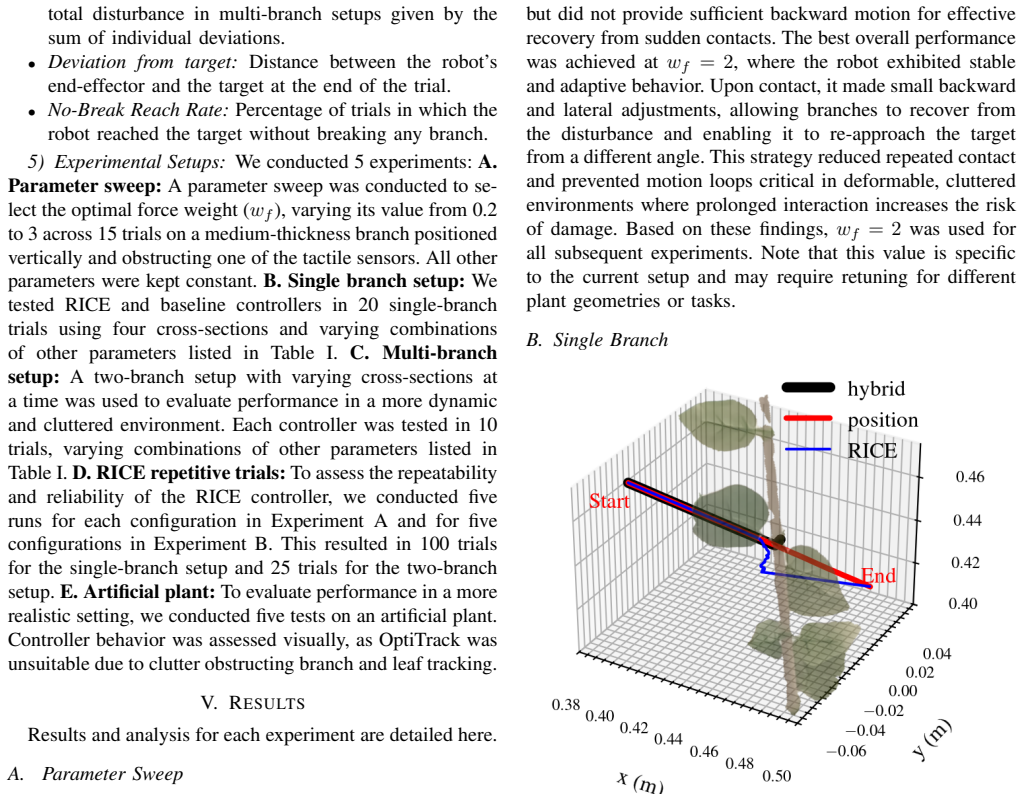
On its own terms, the paper establishes a specific behavioral result: a robot arm whose sensing is joint position, end-effector position, and two $4\times4$ fingertip taxel arrays can consistently reach a visually occluded target inside deformable plant-like clutter while never breaking a branch, by reactively choosing between pushing and maneuvering. The decision is made in real time by gradient descent on a weighted objective $H_k = w_x U(x_k,x_\mathrm{Target}) + w_f G(x_k,P_k,F_k,x_\mathrm{ref})$, where $U$ is the squared distance to the target and $G$ is an interaction-force cost whose spatial gradient is estimated by least squares from the taxel force magnitudes. With the force weight set to $w_f = 2$, a contact triggers a small backward-and-lateral adjustment that lets the branch recover, after which the arm re-approaches the target from a different angle. Across 20 single-branch and 10 two-branch comparison trials, the controller achieved a 100% No-Break Reach Rate; in repeat testing, 100 single-branch and 25 two-branch trials again reached the target every time with zero breakage, and it navigated an artificial plant in all five qualitative tests. The paper presents this as evidence that model-free, tactile-reactive interaction can outperform both rigid pushing and threshold-based hybrid force control in this setting.
Load-bearing premise
The whole no-break behavior rests on the assumption that the direction of pushback computed from two small fingertip touch pads tells the robot where the obstruction really is, even when the forward part of that direction is inferred from how the touch changes over a fraction of a second; if a branch slides, touches elsewhere on the arm, or bends in a way the pads cannot see, the robot may push into it instead of around it.
Editorial extensions
If this is right
- If the results hold, a manipulator can reach occluded targets inside a canopy without a plant model or vision system, using only fingertip touch and joint feedback.
- The push-or-maneuver balance gives a concrete recipe for damage-sensitive interaction: on contact, retreat slightly and re-approach from a new angle, rather than pushing harder or stopping completely.
- The 100% No-Break Reach Rate across 125 repeat trials indicates the behavior is repeatable, although the authors note that the chosen force weight $w_f = 2$ is setup-specific and would need retuning.
- In the two-branch setup, the same controller that maneuvers around stiff stems can also push through compliant leaf edges, so a single reactive policy can handle mixed foliage of different stiffness.
- The controller's success with only fingertip sensing suggests that adding more tactile coverage or vision could extend the approach to even denser canopies, since the current sensing is deliberately minimal.
Reading between the lines
- Because the forward-axis force gradient is inferred from temporal differences over one high-level cycle, the controller is likely to be fragile in sustained-contact situations where forces change slowly; adding a short memory of past gradients or a contact-location estimate could reduce that fragility.
- The point-mass objective ignores collisions of the arm links, so scaling RICE to denser canopies will probably require either whole-arm tactile skins or a kinematic awareness term; the paper's own discussion flags this as a cause of blocked paths.
- A natural extension is to combine the same normalized-gradient trade-off with occlusion gradients from vision, yielding a controller that decides between pushing through foliage and moving to a better viewpoint based on which gradient is steeper.
- The reported experiments aligned branches parallel to the gripper tip to ensure sensor contact, meaning the zero-break guarantee is for fingertip contacts; testing with arbitrary contact points would separate the controller's true robustness from the sensor-placement advantage.
Signed reviews
Editorial analysis
A structured set of objections, weighed in public.
Referee Report
Summary. The paper proposes RICE, a hierarchical reactive controller for a 6-DOF manipulator navigating through deformable, cluttered canopy-like environments using end-effector position and two 4x4 tactile arrays. The high-level controller computes a normalized gradient descent direction from a weighted sum of a target-attraction cost and a tactile force-gradient cost, with a resolved-rate motion controller at the low level. Experiments use balsa-wood mock plants with OptiTrack branch tracking, comparing RICE against a position controller and a hybrid admittance/position controller. The paper reports 100% No-Break Reach Rate in 20 single-branch and 10 two-branch trials, additional repeatability trials (100 and 25 runs), and qualitative artificial-plant tests, claiming state-of-the-art robustness and adaptability.
Significance. If the empirical claims are verified, RICE is a useful, simple, model-free interaction strategy for a genuinely difficult class of tasks: reaching occluded targets in deformable vegetation without causing branch damage. The custom OptiTrack-based mock-plant setup and the large number of repeat trials are concrete strengths that go beyond a single demonstration. However, the headline outcome metric is not operationally defined, the force weight is tuned on the same experimental family used for the main success claims, and the trial-count reporting is inconsistent; these issues currently make the central quantitative claim unverifiable as written.
major comments (6)
- [Sec. IV-4, V-B, V-C] The 'reached target' outcome is never given an operational threshold. 'Deviation from target' is listed as a metric, but no distance cutoff is stated anywhere, and Fig. 8 plots final deviations without a threshold line. Since the central claims in Tables II and III are binary success rates, please define a single distance threshold applied to all trials, report the final-deviation distributions, and justify the threshold with respect to the target size and the robot's positioning accuracy.
- [Sec. III-E, IV-2, IV-4] The definition of breakage as 'inability to return to the original shape after exceeding displacement or torque limits' is not operationalized. No displacement or torque limit values, no OptiTrack-based detection procedure, and no criterion for 'return to original shape' are reported. Please specify how branch breakage was detected in practice, including the thresholds used and the time window over which recovery was assessed.
- [Sec. IV-D and V-D] The trial counts are inconsistent. Section IV-D states that five runs per configuration in Experiment A and for five configurations in Experiment B produced 100 single-branch and 25 two-branch trials, while Section V-D says 'we ran five additional trials for Experiments B and C' and then reports totals of 100 and 25. Please clarify the relationship between the 20/10 main trials and the 100/25 repeated trials, and report exactly which configurations were used for the repeats.
- [Sec. V-A, V-B, V-C] The force weight wf is selected as wf=2 from a parameter sweep on a single branch configuration (Experiment A) and then fixed for all later trials. Because the headline success rate is empirical, this makes wf a fitted parameter within the same experimental family. Please report the No-Break Reach Rate at neighboring wf values (e.g., 1.4 to 1.8 and 2.5 to 3) on the single- and two-branch setups, or otherwise show that the 100% result is not an artifact of the tuning procedure.
- [Abstract, Sec. IV-E, V-E] The abstract claims 'over 35 trials in 3 experimental plant setups' with no branch breakage, but the artificial-plant experiment (Experiment E) is assessed only visually, with OptiTrack declared unsuitable for branch tracking. Breakage and target reaching are not quantitatively measured there. Please restrict the no-break claim to the 30 trackable trials or add quantitative measurement to the artificial-plant tests.
- [Sec. III-C2, Eq. (7)] The push-versus-maneuver decision rests on the least-squares spatial force gradient of Eq. (7), computed from only two 4x4 taxel arrays, with the forward-axis component inferred from temporal variation within one high-level cycle. The paper's own discussion in Sec. VI acknowledges transient contact loops and a point-mass assumption but does not bound the resulting gradient error. Given that this gradient determines whether the robot pushes into or maneuvers around an obstacle, please provide an error analysis or additional experiments that vary contact location, sliding, and deformation rate to demonstrate robustness of the decision.
minor comments (5)
- [Sec. III-D, Eq. (9)] Equation (9) as written, \dot{q}_{k+1} = J(q_k)^+ v_{k+1} + q_k, adds joint positions to joint velocities, which is dimensionally inconsistent; this is likely a typo for \dot{q}_{k+1} = J(q_k)^+ v_{k+1}, with q_k used only as the Jacobian argument.
- [Tables II and III] There are typos in the table headers and cells: 'per trail' should be 'per trial', 'broke 0 branch' should be 'broke 0 branches', and several entries lack a space before the parenthetical.
- [Sec. III-C, Eq. (2)] The notation b\nabla appears in place of \hat{\nabla} in several places, including after Eq. (2); please make the hat notation consistent throughout.
- [Sec. VI] The 'edge-case behavior' involving a sliding leaf midrib is acknowledged but never quantified; reporting the number of affected trials and the duration of the repeated contact would make the discussion more informative.
- [Fig. 8 caption] The caption states that branch deviation and deviation from target are shown, but the text refers to 'total branch deviation' in multi-branch setups; please clarify in the caption how total deviation was aggregated across branches.
Circularity Check
No circular derivation: RICE is a heuristic control design evaluated empirically; the only self-citations are non-load-bearing and the tuned force weight is disclosed hyperparameter selection, not a fitted prediction.
full rationale
The paper's derivation chain is an engineering design, not a derivation of a predicted quantity from its own inputs. The objective function Hk = wxU + wfG (Eq. 1) is a proposed control objective; the force gradient estimate (Eq. 7) is a least-squares estimator from tactile measurements; and the velocity command (Eq. 8) is a gradient-descent control law. Success is then measured empirically as No-Break Reach Rate from physical trials. No equation is defined in terms of the outcome it is used to predict, and no quantity is fitted to the same trials that are later reported as the success metric. The force weight wf is selected in Experiment A (a parameter sweep on a separate medium-thickness branch) and then fixed for Experiments B/C/D/E; the paper explicitly states that 'this value is specific to the current setup and may require retuning for different plant geometries or tasks.' This is ordinary hyperparameter tuning and is not statistically forced, because the 20 single-branch, 10 multi-branch, repetitive, and artificial-plant trials are not the same trials used to choose wf. The only self-citations are [22] (Lehnert et al., used as inspiration for gradient-based cost construction) and [34] (You et al., used as a baseline controller to compare against); neither is load-bearing for the central claim. Concerns about the undefined 'target reached' threshold or 'breakage' detection are verification/correctness issues, not circularity: they affect whether the empirical claim is reproducible, but they do not show that the result reduces to its inputs by construction. Overall, the central claim is an externally measured experimental outcome, so the circularity score is 0.
Assumptions & free parameters
free parameters (2)
- Force weight wf =
2
- Step size alpha (end-effector speed) =
0.01 m/s
assumptions (4)
- domain assumption The force-magnitude spatial gradient estimated from temporal taxel sequences approximates the direction of environmental resistance.
- domain assumption Tactile feedback from two 4x4 arrays on the gripper fingertips is sufficient to characterize interaction forces relevant for navigation.
- domain assumption Balsa-wood mock plants reproduce the deformation and breakage behavior of real canopy branches.
- standard math The least-squares matrix D^T D is invertible in all encountered configurations.
Cite this review
Pith. "Pith review of RICE: Reactive Interaction Controller for Cluttered Canopy Environment." pith.science (2026). https://pith.science/paper/4MCSEVBB
@misc{pith2026250610383,
  author       = {Pith},
  title        = {Pith review of: RICE: Reactive Interaction Controller for Cluttered Canopy Environment},
  year         = {2026},
  howpublished = {\url{https://pith.science/paper/4MCSEVBB}},
  note         = {Machine review of arXiv:2506.10383}
}
read the original abstract
Robotic navigation in dense, cluttered environments such as agricultural canopies presents significant challenges due to physical and visual occlusion caused by leaves and branches. Traditional vision-based or model-dependent approaches often fail in these settings, where physical interaction without damaging foliage and branches is necessary to reach a target. We present a novel reactive controller that enables safe navigation for a robotic arm in a contact-rich, cluttered, deformable environment using end-effector position and real-time tactile feedback. Our proposed framework's interaction strategy is based on a trade-off between minimizing disturbance by maneuvering around obstacles and pushing through them to move towards the target. We show that over 35 trials in 3 experimental plant setups with an occluded target, the proposed controller successfully reached the target in all trials without breaking any branch and outperformed the state-of-the-art model-free controller in robustness and adaptability. This work lays the foundation for safe, adaptive interaction in cluttered, contact-rich deformable environments, enabling future agricultural tasks such as pruning and harvesting in plant canopies.
Figures


Figures from the paper (5 more)



Reference graph
Works this paper leans on
-
[1]
Robot-ready: How apple producers are assembling in anticipation of new AI robotics,
K. Legun and K. Burch, “Robot-ready: How apple producers are assembling in anticipation of new AI robotics,” Journal of Rural Studies, 2021
work page 2021
-
[2]
A planning framework for non- prehensile manipulation under clutter and uncertainty,
M. R. Dogar and S. S. Srinivasa, “A planning framework for non- prehensile manipulation under clutter and uncertainty,” Autonomous Robots, 2012
work page 2012
-
[3]
Dexterous manoeuvre through touch in a cluttered scene,
W. Liang, Q. Ren, X. Chen, J. Gao, and Y . Wu, “Dexterous manoeuvre through touch in a cluttered scene,” Proc. IEEE Int. Conf. Robot. Autom. (ICRA), 2021
work page 2021
-
[4]
Bumblebee: A path towards fully autonomous robotic vine pruning
A. Silwal, F. Yandun, A. K. Nellithimaru, T. Bates, and G. Kantor, “Bumblebee: A path towards fully autonomous robotic vine pruning.” Field Robotics, vol. 2, 2022
work page 2022
-
[5]
T. Jin and X. Han, “Robotic arms in precision agriculture: A com- prehensive review of the technologies, applications, challenges, and future prospects,” Computers and Electronics in Agriculture , 2024
work page 2024
-
[6]
B. Siciliano and L. Villani, Robot Force Control. Springer Science & Business Media, 1999
work page 1999
-
[7]
Hybrid force-impedance control for fast end-effector motions,
M. Iskandar, C. Ott, A. Albu-Sch ¨affer, B. Siciliano, and A. Dietrich, “Hybrid force-impedance control for fast end-effector motions,” IEEE Robot. Autom. Lett. , vol. 8
-
[8]
Neuralfeels with neu- ral fields: Visuotactile perception for in-hand manipulation,
S. Suresh, H. Qi, T. Wu, T. Fan, L. Pineda, M. Lambeta, J. Malik, M. Kalakrishnan, R. Calandra, M. Kaess et al., “Neuralfeels with neu- ral fields: Visuotactile perception for in-hand manipulation,” Science Robotics, vol. 9, 2024
work page 2024
Show all 34 references
-
[9]
Real-world robot navigation amongst deformable obstacles,
B. Frank, C. Stachniss, R. Schmedding, M. Teschner, and W. Burgard, “Real-world robot navigation amongst deformable obstacles,” Proc. IEEE Int. Conf. Robot. Autom. (ICRA) , 2009
2009
-
[10]
Learning object deformation models for robot motion plan- ning,
——, “Learning object deformation models for robot motion plan- ning,” Robotics and Autonomous Systems , vol. 62, 2014
2014
-
[11]
ST-RRT∗: Asymptotically-Optimal Bidirectional Motion Planning through Space-Time,
F. Grothe, V . N. Hartmann, A. Orthey, and M. Toussaint, “ST-RRT∗: Asymptotically-Optimal Bidirectional Motion Planning through Space-Time,” Proc. IEEE Int. Conf. Robot. Autom. (ICRA) , 2022
2022
-
[12]
Planning motion in completely deformable environments,
S. Rodr ´ıguez, J. M. Lien, and N. M. Amato, “Planning motion in completely deformable environments,” Proc. IEEE Int. Conf. Robot. Autom. (ICRA), 2006
2006
-
[13]
Planning-augmented hierarchical reinforcement learning,
R. Gieselmann and F. T. Pokorny, “Planning-augmented hierarchical reinforcement learning,” IEEE Robot. Autom. Lett. , 2021
2021
-
[14]
Fast-replanning motion control for non-holonomic vehicles with aborting a,
M. Missura, A. Roychoudhury, and M. Bennewitz, “Fast-replanning motion control for non-holonomic vehicles with aborting a,” Proc. IEEE/RSJ Int. Conf. Intell. Robots Syst. (IROS) , 2022
2022
-
[15]
NEO: A Novel Expeditious Optimisation Algorithm for Reactive Motion Control of Manipulators,
J. Haviland and P. Corke, “NEO: A Novel Expeditious Optimisation Algorithm for Reactive Motion Control of Manipulators,” IEEE Robot. Autom. Lett., 2021
2021
-
[16]
Hybrid impedance and admittance control of robot manipulator with unknown environment,
I. Rhee, G. Kang, S. J. Moon, Y . S. Choi, and H. R. Choi, “Hybrid impedance and admittance control of robot manipulator with unknown environment,” Intelligent Service Robotics , 2023
2023
-
[17]
Intrinsic sense of touch for intuitive physical human-robot interaction,
M. Iskandar, A. Albu-Sch ¨affer, and A. Dietrich, “Intrinsic sense of touch for intuitive physical human-robot interaction,” Science Robotics, vol. 9, 2024
2024
-
[18]
Hybrid force/position control in workspace of robotic manipulator in uncer- tain environments based on adaptive fuzzy control,
Z. Wang, L. Zou, X. Su, G. Luo, R. Li, and Y . Huang, “Hybrid force/position control in workspace of robotic manipulator in uncer- tain environments based on adaptive fuzzy control,” Robotics and Autonomous Systems, vol. 145, 2021
2021
-
[19]
Model Predictive Interaction Control for Robotic Manipulation Tasks,
T. Gold, A. V olz, and K. Graichen, “Model Predictive Interaction Control for Robotic Manipulation Tasks,” IEEE Transactions on Robotics, 2023
2023
-
[20]
Model predictive control for fast reaching in clutter,
M. D. Killpack, A. Kapusta, and C. C. Kemp, “Model predictive control for fast reaching in clutter,” Autonomous Robots, 2016
2016
-
[21]
An obstacle separation method for robotic picking of fruits in clusters,
Y . Xiong, Y . Ge, and P. J. From, “An obstacle separation method for robotic picking of fruits in clusters,” Computers and Electronics in Agriculture, vol. 175, 2020
2020
-
[22]
3d move to see: Multi-perspective visual servoing towards the next best view within unstructured and occluded environments,
C. Lehnert, D. Tsai, A. Eriksson, and C. McCool, “3d move to see: Multi-perspective visual servoing towards the next best view within unstructured and occluded environments,” inProc. IEEE/RSJ Int. Conf. Intell. Robots Syst. (IROS) , 2019
2019
-
[23]
Tree Search-based Task and Motion Planning with Prehensile and Non-prehensile Manipulation for Obstacle Rearrangement in Clutter,
J. Lee, C. Nam, J. Park, and C. Kim, “Tree Search-based Task and Motion Planning with Prehensile and Non-prehensile Manipulation for Obstacle Rearrangement in Clutter,” Proc. IEEE Int. Conf. Robot. Autom. (ICRA), 2021
2021
-
[24]
Safe leaf manipulation for accurate shape and pose estimation of occluded fruits,
S. Yao, S. Pan, M. Bennewitz, and K. Hauser, “Safe leaf manipulation for accurate shape and pose estimation of occluded fruits,” arXiv preprint arXiv:2409.17389, 2024
2024 arXiv
-
[25]
Assistive Gym: A Physics Simulation Framework for Assistive Robotics,
Z. Erickson, V . Gangaram, A. Kapusta, C. K. Liu, and C. C. Kemp, “Assistive Gym: A Physics Simulation Framework for Assistive Robotics,” Proc. IEEE Int. Conf. Robot. Autom. (ICRA) , 5 2020
2020
-
[26]
Sim-to-Real Reinforcement Learning for Deformable Object Manipulation,
J. Matas, S. James, and A. J. Davison, “Sim-to-Real Reinforcement Learning for Deformable Object Manipulation,” Conference on Robot Learning, 2018
2018
-
[27]
Soft tissue simulation environment to learn manipulation tasks in autonomous robotic surgery,
E. Tagliabue, A. Pore, D. Dall’Alba, E. Magnabosco, M. Piccinelli, and P. Fiorini, “Soft tissue simulation environment to learn manipulation tasks in autonomous robotic surgery,” Proc. IEEE/RSJ Int. Conf. Intell. Robots Syst. (IROS) , 2020
2020
-
[28]
Gazebo plants: Simulating plant-robot interaction with cosserat rods,
J. Deng, S. Marri, J. Klein, W. Pałubicki, S. Pirk, G. Chowdhary, and D. L. Michels, “Gazebo plants: Simulating plant-robot interaction with cosserat rods,” arXiv preprint arXiv:2402.02570 , 2024
2024 arXiv
-
[29]
Real-time obstacle avoidance for manipulators and mobile robots,
O. Khatib, “Real-time obstacle avoidance for manipulators and mobile robots,” The international journal of robotics research , vol. 5, 1986
1986
-
[30]
Resolved motion rate control of manipulators and hu- man prostheses,
D. E. Whitney, “Resolved motion rate control of manipulators and hu- man prostheses,” IEEE Transactions on man-machine systems, vol. 10
-
[31]
[Online]
UFactory, xArm User Manual , UFactory Robotics, 2024. [Online]. Available: https://www.ufactory.cc/lite-6-collaborative-robot/
2024
-
[32]
(2024) uskin patch sensors
Xela Robotics. (2024) uskin patch sensors. [Online]. Available: https://www.xelarobotics.com/uskin-patch
2024
-
[33]
(2025) Optitrack motion capture systems
OptiTrack. (2025) Optitrack motion capture systems. [Online]. Available: https://www.optitrack.com/cameras/
2025
-
[34]
Precision fruit tree pruning using a learned hybrid vision/interaction controller,
A. You, H. Kolano, N. Parayil, C. Grimm, and J. R. Davidson, “Precision fruit tree pruning using a learned hybrid vision/interaction controller,” Proc. IEEE Int. Conf. Robot. Autom. (ICRA) , 2022. Preprint Version, Submitted to IEE RAL on 27th April 2025
2022
Reviewed August 7, 2026 · model on record in the stance chip above.
Discussion (0). Continue with ORCID to comment.