REVIEW 1 major objections 6 minor 44 references
Green Scheduling with Time-of-Use Tariffs and Machine States: Optimizing Energy Cost via Branch-and-Bound and Bin Packing Strategies
T0 review · 1 major / 6 minor · reviewed 2026-08-07 · deepseek-v4-flash
Pith's one-line read This paper claims that a new exact branch-and-bound algorithm, B&B-SPACES, exploits a hidden bin-packing structure in single-machine time-of-use energy-cost scheduling to solve 200-job instances more than 100 times faster than the…
desk verdict A credible exact branch-and-bound for TOU scheduling with real speedups; the bin-packing lens is the real insight, but the abstract oversells the 200-job claim for hard {8,10} instances. read the letter →
The pith
A machine-rendered reading of the paper's core claim, the machinery that carries it, and where it could break.
The reading
What carries the argument
The central object is the set of “spaces”: the maximal consecutive intervals in which the machine is in the processing state in an optimal relaxed schedule, produced from the precomputed optimal switching costs. These spaces act as bins for a packing problem, and the algorithm’s main components are: the job-interval graph for a fixed job sequence, whose shortest path gives the lower bound in polynomial time; the PBin-Pack feasibility problem that tries to pack the original jobs into those bins; the PBin-Find initialization problem that enlarges bins to construct a first feasible upper bound; and the gcd-based relaxation that tightens the lower bound when the remaining processing times are non-coprime.
What would settle it
Run B&B-SPACES on a family of instances with real TOU prices and processing times drawn only from {8,9,10} at n=200, the parameter region the paper identifies as hardest. If 10-minute time-limit hits persist or grow, and the proven lower bound never closes the gap, then the claimed two-orders-of-magnitude speedup does not hold in the regime where the packing assumption breaks down; the paper’s own Table 3 already shows such failures for {8,10}, so the decisive test is enlarging that class and comparing node counts against an exact bin-packing oracle.
Extended reading notes
Core claim
The central claim is that the efficiency of an exact algorithm for 1,TOU|states|TEC comes from exposing the bin-packing structure hidden inside the optimal switching problem. For a fixed job sequence, the optimal total energy cost is computed as a shortest path in a job-interval graph whose edge weights already contain the precomputed optimal switching costs, avoiding an explicit pseudo-polynomial state model. While branching on the unfixed jobs, the remaining jobs are relaxed into unit-size jobs (or jobs of size equal to the gcd of the remaining processing times); the optimal relaxed schedule then consists of maximal consecutive processing intervals, called spaces or blocks, which act as bins. If the original jobs can be packed into those bins, the primal solution matches the lower bound and the whole search subtree is pruned. The paper reports that this mechanism solves the standard benchmark set at least 100 times faster than previous ILP models, and that the residual hard cases are concentrated in processing-time groups with long, low-variability jobs such as {8,10}.
Load-bearing premise
The speedup depends on the relaxed lower bound frequently producing space-blocks that the original jobs can actually be packed into, so that the primal heuristic closes search subtrees early; when that packing fails, as it does for processing times {8,10}, the algorithm loses its advantage and can hit the time limit without proving optimality.
Editorial extensions
If this is right
- Exact optimal schedules for 150–200 jobs over more than a thousand time intervals can be computed in seconds to minutes, replacing hours-long ILP runs on realistic time-of-use tariffs.
- The standard benchmark instances used since Shrouf et al. (2014) are not hard enough to discriminate methods; harder benchmarks with historical price profiles are needed to expose algorithmic behavior.
- The instance hardness is governed less by the number of jobs and more by the structure of the processing times: high variability, especially with short jobs, makes the bin-packing primal heuristic succeed often, while long and nearly uniform processing times such as {8,10} produce the hardest instances.
- For the unsolved {8,10} instances at n=150 and n=200, the proven gaps are below 0.026%, so even when optimality is not proven, the method returns solutions that are essentially optimal in practice.
Reading between the lines
- Testable extension: the same exposed-bin architecture could be carried to other time-of-use scheduling variants by editing the job-interval graph, for instance adding release times and deadlines as edge prunings or handling multiple dedicated processing states as job families, which the paper explicitly lists as plausible next steps.
- Our inference: the average-case difficulty of these instances likely follows a phase-transition pattern inherited from number partitioning and bin packing; if so, random processing-time groups near a critical mean or variance, rather than large job counts, should become the natural stress-test benchmark.
- Testable extension: replacing the packing oracle inside the primal heuristic with a dedicated exact bin-packing solver or with polynomial-time online heuristics could reduce the remaining {8,10} failures, since the paper’s bottleneck is precisely the frequency with which an exact packing is found.
- Our inference: if the speedup transfers to parallel machines or flow shops with stateful resources, then fine-grained whole-factory demand-response scheduling under real-time prices becomes computationally plausible, though the paper does not report such an extension.
Signed reviews
Editorial analysis
A structured set of objections, weighed in public.
Referee Report
Summary. This paper addresses the single-machine scheduling problem 1,TOU|states|TEC with time-of-use energy tariffs and machine states. The authors design an exact branch-and-bound algorithm, B&B-SPACES, that reuses the SPACES precomputation of optimal state switching, computes lower bounds by relaxing unfixed jobs to unit-length or gcd-length jobs, and uses bin-packing-derived primal and initialization heuristics. Extensive experiments on NOSBY/TWOSBY benchmarks and on instances with historical OTE prices report that B&B-SPACES solves most tested instances with 150-200 jobs in under a few seconds, roughly two orders of magnitude faster than the previous ILP-SPACES model, while a hard processing-time group {8,10} is honestly reported to contain instances not solved to optimality within 10 minutes with gaps below 0.03%.
Significance. If correct, B&B-SPACES represents a substantial practical advance for an NP-hard problem: exact solutions for hundreds of jobs over more than a thousand intervals in seconds to minutes. The algorithm has no fitted free parameters, and the lower-bound claims rest on explicit (if concise) mathematical arguments. The experimental protocol is credible, with machine-checkable comparisons against an external ILP solver, and the authors disclose the hard {8,10} instances rather than omitting them. The main limitations are the lack of released code/data and an ambiguity in the model regarding the processing state under negative energy prices, which should be resolved before final acceptance.
major comments (1)
- [Section 2, Conditions 1-4; Propositions 1-2; Section 4.4] The stated model does not explicitly require that the machine be in the processing state only while a job is processed; Condition 2 is one-directional. Because the paper explicitly admits negative energy costs, optimal switching costs c⋆ (Appendix A) may keep the machine in proc during gaps, and the PBin-Pack construction may leave proc intervals with no job. If the intended semantics is that proc is only used for job processing (as in the Shrouf et al. model), then the lower-bound relaxations and the pack-derived feasible schedules need an additional argument to exclude empty-processing solutions; otherwise the algorithm may certify costs that are not attainable in the intended problem. Please clarify the model and, if needed, strengthen the proofs or add a constraint.
minor comments (6)
- [Equation (4.5)] The first term should be c(job)_{π(ℓ), i} and the switching argument should be (i + p_{π(ℓ)} - 1, i'), not (i + p_{π(n)} - 1, i'); as written the indices are inconsistent with (4.6) and with the layer ℓ.
- [Equation (4.10)] Use an explicit fraction (1/gcd(...)) · sum p_j' to avoid the ambiguous exponent-like notation 'gcd(J\bJ)^{-1}'.
- [Section 4.4] The PBin-Pack formulation packs the whole job set J into the bins Λ_k, even though the lower-bound sequence has already fixed the prefix bπ. This is acceptable if the resulting solution is treated as a global primal bound that may reorder the prefix, but the text should state this explicitly to avoid confusion about the node's partial sequence.
- [Reproducibility] The paper does not include code or data; providing the generated instances and the implementation would materially strengthen reproducibility of the speedup claims.
- [Abstract and Section 5.2] The phrase 'with 200 jobs more than 100 times faster' is too broad, given Table 2 reports that for the {8,10} group B&B-SPACES leaves 5/20 instances at n=200 unsolved within the 10-minute limit; please qualify the claim.
- [Section 5.1] The text contains a typo: 'wheres' should be 'whereas'.
Circularity Check
No significant circularity: the derivation is self-contained and the speedup claim is measured against external baselines.
full rationale
The paper's central derivation is not circular. The lower bounds in Propositions 1 and 2 are genuine relaxations: splitting unplaced jobs into unit jobs, or into gcd-sized jobs, produces a relaxed instance whose optimal cost cannot exceed that of any original feasible schedule. The proofs rely only on the interchangeability of the relaxed jobs and the fact that any original schedule can be translated into a schedule of the relaxed pieces, not on fitting any parameter to the target value. The bin-packing primal heuristic is likewise not a disguised prediction: it checks whether the blocks extracted from the lower-bound solution happen to accommodate the original jobs, and if so, the resulting objective provably equals the lower bound, enabling a valid prune. This is a sufficient condition, not a definitional equivalence. The SPACES preprocessing from Benedikt et al. (2020) is reused with substantial self-citation, but the paper restates the interval-state graph construction and shortest-path computation in Appendix A, so the needed correctness is reproduced rather than merely assumed from an unverified prior claim. The performance comparison is against ILP-REF and ILP-SPACES, with the latter being the authors' own prior model; however, this is an external benchmark of a different algorithm, not a circular reduction of the new method's output to its own input. The paper also honestly reports the {8,10} processing-time group, where five instances at n=150 and five at n=200 reach the time limit without proven optimality, showing that the central speedup claim is not asserted unconditionally. No load-bearing self-citation, no fitted input renamed as a prediction, and no uniqueness argument imported from prior work were found.
Assumptions & free parameters
free parameters (1)
- horizon scaling factor lambda =
1.3, 1.6, 1.9, 2.2
assumptions (4)
- domain assumption The optimal switching costs c*(i,i') can be precomputed by shortest paths in the interval-state graph (SPACES), independently of the job sequence.
- domain assumption The problem 1,TOU|states|TEC is strongly NP-hard and the fixed-order subproblem is polynomial.
- ad hoc to paper Relaxing remaining non-preemptive jobs into unit-length or gcd-length jobs yields a valid lower bound (Propositions 1 and 2).
- domain assumption Job energy requirements are proportional to processing time (uniform consumption).
Cite this review
Pith. "Pith review of Green Scheduling with Time-of-Use Tariffs and Machine States: Optimizing Energy Cost via Branch-and-Bound and Bin Packing Strategies." pith.science (2026). https://pith.science/paper/34AMPYPR
@misc{pith2026250610405,
  author       = {Pith},
  title        = {Pith review of: Green Scheduling with Time-of-Use Tariffs and Machine States: Optimizing Energy Cost via Branch-and-Bound and Bin Packing Strategies},
  year         = {2026},
  howpublished = {\url{https://pith.science/paper/34AMPYPR}},
  note         = {Machine review of arXiv:2506.10405}
}
read the original abstract
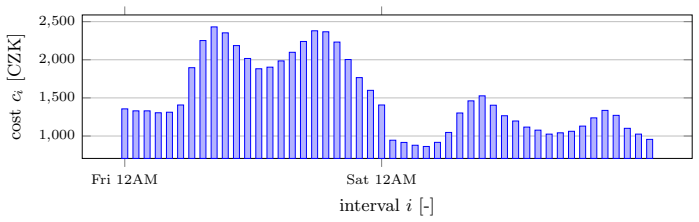
This paper presents a branch-and-bound algorithm, enhanced with bin packing strategies, for scheduling under variable energy pricing and power-saving states. The proposed algorithm addresses the 1,TOU|states|TEC problem, which involves scheduling jobs to minimize total energy cost (TEC) while considering time-of-use (TOU) electricity prices and different machine states (e.g., processing, idle, off). Key innovations include instance pre-processing for rapid lower bound calculations, a novel branching scheme combined with initializations, a block-finding primal heuristic, and a tighter lower bound for jobs with non-coprime processing times. These enhancements result in an efficient algorithm capable of solving benchmark instances with real energy prices with 200 jobs more than 100 times faster than existing state-of-the-art methods.
Figures


Figures from the paper (8 more)




Reference graph
Works this paper leans on
-
[1]
write newline
" write newline "" before.all 'output.state := FUNCTION n.dashify 't := "" t empty not t #1 #1 substring "-" = t #1 #2 substring "--" = not "--" * t #2 global.max substring 't := t #1 #1 substring "-" = "-" * t #2 global.max substring 't := while if t #1 #1 substring * t #2 global.max substring 't := if while FUNCTION word.in bbl.in capitalize "" * " " * ...
-
[2]
write newline
" write newline "" before.all 'output.state := FUNCTION n.dashify 't := "" t empty not t #1 #1 substring "-" = t #1 #2 substring "--" = not "--" * t #2 global.max substring 't := t #1 #1 substring "-" = "-" * t #2 global.max substring 't := while if t #1 #1 substring * t #2 global.max substring 't := if while FUNCTION word.in bbl.in ":" * " " * FUNCTION f...
-
[3]
author Abikarram, J. B. , author McConky, K. , & author Proano, R. ( year 2019 ). title Energy cost minimization for unrelated parallel machine scheduling under real time and demand charge pricing . journal Journal of Cleaner Production \/ , volume 208 \/ , pages 232 -- 242 . :https://doi.org/10.1016/j.jclepro.2018.10.048
-
[4]
author Aghelinejad, M. , author Ouazene, Y. , & author Yalaoui, A. ( year 2018 ). title Production scheduling optimisation with machine state and time-dependent energy costs . journal International Journal of Production Research \/ , volume 56 \/ , pages 5558--5575 . :10.1080/00207543.2017.1414969
arXiv 2018
-
[5]
author Aghelinejad, M. et al. ( year 2019 ). title Complexity analysis of energy-efficient single machine scheduling problems . journal Operations Research Perspectives \/ , volume 6 \/ , pages 100105 . https://www.sciencedirect.com/science/article/pii/S2214716018301702. :https://doi.org/10.1016/j.orp.2019.100105
arXiv 2019
-
[6]
author Aghelinejad, M. M. , author Masmoudi, O. , author Ouazene, Y. , & author Yalaoui, A. ( year 2020 a ). title Multi-state two-machine permutation flow shop scheduling optimisation with time-dependent energy costs . journal IFAC-PapersOnLine \/ , volume 53 \/ , pages 11156--11161 . https://www.sciencedirect.com/science/article/pii/S2405896320305711. :...
-
[7]
author Aghelinejad, M. M. , author Ouazene, Y. , & author Yalaoui, A. ( year 2017 ). title Preemptive scheduling of a single machine with finite states to minimize energy costs . In editor A. Sforza , & editor C. Sterle (Eds.), booktitle Optimization and Decision Science: Methodologies and Applications \/ (pp. pages 591--599 ). address Cham : publisher Sp...
work page 2017
-
[8]
author Aghelinejad, M. M. , author Ouazene, Y. , & author Yalaoui, A. ( year 2020 b ). title Energy-cost-aware flow-shop scheduling systems with state-dependent energy consumptions . In booktitle IOP Conference Series: Earth and Environmental Science \/ (p. pages 012163 ). organization IOP Publishing volume volume 463
work page 2020
Show all 44 references
-
[9]
author Aghelinejad, M. M. , author Ouazene, Y. , & author Yalaoui, A. ( year 2020 c ). title Energy-cost-aware flow-shop scheduling systems with state-dependent energy consumptions . journal IOP Conference Series: Earth and Environmental Science \/ , volume 463 \/ , pages 0121...
2020 doi
-
[10]
, author Paolucci, M
author Anghinolfi, D. , author Paolucci, M. , & author Ronco, R. ( year 2021 ). title A bi-objective heuristic approach for green identical parallel machine scheduling . journal European Journal of Operational Research \/ , volume 289 \/ , pages 416--434
2021
-
[11]
, author Mertens, S
author Bauke, H. , author Mertens, S. , & author Engel, A. ( year 2003 ). title Phase transition in multiprocessor scheduling . journal Physical review letters \/ , volume 90 \/ , pages 158701
2003
-
[12]
, author Alikoç, B
author Benedikt, O. , author Alikoç, B. , author Šůcha, P. , author Čelikovský, S. , & author Hanzálek, Z. ( year 2021 ). title A polynomial-time scheduling approach to minimise idle energy consumption: An application to an industrial furnace . journal Computers & Operations R...
2021
-
[13]
, author M \'o dos, I
author Benedikt, O. , author M \'o dos, I. , & author Hanz \'a lek, Z. ( year 2020 ). title Power of pre-processing: production scheduling with variable energy pricing and power-saving states . journal Constraints \/ , volume 25 \/ , pages 300--318
2020
-
[14]
, author Šůcha, P
author Bukata, L. , author Šůcha, P. , & author Hanzálek, Z. ( year 2019 ). title Optimizing energy consumption of robotic cells by a branch & bound algorithm . journal Computers & Operations Research \/ , volume 102 \/ , pages 52--66 . https://www.sciencedirect.com/science/ar...
2019 doi
-
[15]
, author Pesenti, R
author Catanzaro, D. , author Pesenti, R. , & author Ronco, R. ( year 2023 ). title Job scheduling under time-of-use energy tariffs for sustainable manufacturing: a survey . journal European Journal of Operational Research \/ , volume 308 \/ , pages 1091--1109 . https://www.sc...
2023 doi
-
[16]
, & author Zhang, X
author Chen, B. , & author Zhang, X. ( year 2019 ). title Scheduling with time-of-use costs . journal European Journal of Operational Research \/ , volume 274 \/ , pages 900--908 . https://www.sciencedirect.com/science/article/pii/S0377221718309275. :https://doi.org/10.1016/j....
2019 doi
-
[17]
, author Megow, N
author Chen, L. , author Megow, N. , author Rischke, R. , author Stougie, L. , & author Verschae, J. ( year 2021 ). title Optimal algorithms for scheduling under time-of-use tariffs . journal Annals of Operations Research \/ , volume 304 \/ , pages 85--107
2021
-
[18]
, author Chu, F
author Cheng, J. , author Chu, F. , & author Zhou, M. ( year 2018 ). title An improved model for parallel machine scheduling under time-of-use electricity price . journal IEEE Transactions on Automation Science and Engineering \/ , volume 15 \/ , pages 896--899 . :10.1109/TASE...
2018
-
[19]
, author Schulz, S
author Ding, J. , author Schulz, S. , author Shen, L. , author Buscher, U. , & author Lü, Z. ( year 2021 ). title Energy aware scheduling in flexible flow shops with hybrid particle swarm optimization . journal Computers & Operations Research \/ , volume 125 \/ , pages 105088 ...
2021
-
[20]
, author Koliou, E
author Eid, C. , author Koliou, E. , author Valles, M. , author Reneses, J. , & author Hakvoort, R. ( year 2016 ). title Time-based pricing and electricity demand response: Existing barriers and next steps . journal Utilities Policy \/ , volume 40 \/ , pages 15--25
2016
-
[21]
author Fang, K. et al. ( year 2016 ). title Scheduling on a single machine under time-of-use electricity tariffs . journal Annals of Operations Research \/ , volume 238 \/ , pages 199--227 . https://doi.org/10.1007/s10479-015-2003-5. :10.1007/s10479-015-2003-5
2016 doi
-
[22]
, author \"O ztop, H
author Fatih Tasgetiren, M. , author \"O ztop, H. , author Eliiyi, U. , author Eliiyi, D. T. , & author Pan, Q.-K. ( year 2018 ). title Energy-efficient single machine total weighted tardiness problem with sequence-dependent setup times . In booktitle Intelligent Computing The...
2018
-
[23]
, author Paolucci, M
author Gaggero, M. , author Paolucci, M. , & author Ronco, R. ( year 2023 ). title Exact and heuristic solution approaches for energy-efficient identical parallel machine scheduling with time-of-use costs . journal European Journal of Operational Research \/ , volume 311 \/ , ...
2023
-
[24]
, author Rudy, J
author Gnatowski, A. , author Rudy, J. , & author Idzikowski, R. ( year 2022 ). title Scheduling disjoint setups in a single-server permutation flow shop manufacturing process . journal Processes \/ , volume 10 \/ , pages 1837
2022
-
[25]
, author Hanen, C
author Grus, J. , author Hanen, C. , & author Hanzálek., Z. ( year 2024 ). title Packing-inspired algorithms for periodic scheduling problems with harmonic periods . In booktitle Proceedings of the 13th International Conference on Operations Research and Enterprise Systems - I...
2024 doi
-
[26]
author Ho, M. H. , author Hnaien, F. , & author Dugardin, F. ( year 2022 ). title Exact method to optimize the total electricity cost in two-machine permutation flow shop scheduling problem under time-of-use tariff . journal Computers & Operations Research \/ , volume 144 \/ ,...
2022
-
[27]
, & author Ou, J
author Li, W. , & author Ou, J. ( year 2024 ). title Approximation algorithms for scheduling parallel machines with an energy constraint in green manufacturing . journal European Journal of Operational Research \/ , volume 314 \/ , pages 882--893 . https://www.sciencedirect.co...
2024 doi
-
[28]
, & author Flouros, F
author Maris, G. , & author Flouros, F. ( year 2021 ). title The green deal, national energy and climate plans in E urope: M ember S tates’ compliance and strategies . journal Administrative Sciences \/ , volume 11 \/ , pages 75
2021
-
[29]
( year 2003 )
author Mertens, S. ( year 2003 ). title The easiest hard problem: Number partitioning . https://arxiv.org/abs/cond-mat/0310317. arXiv:cond-mat/0310317 http://arxiv.org/abs/cond-mat/0310317
2003 arXiv
-
[30]
, author Hnaien, F
author Minh Hung, H. , author Hnaien, F. , & author Dugardin, F. ( year 2020 ). title Electricity cost minimisation for optimal makespan solution in flow shop scheduling under time-of-use tariffs . journal International Journal of Production Research \/ , (pp. pages 1--27 ). :...
2020
-
[31]
, author Yildirim, M
author Mouzon, G. , author Yildirim, M. B. , & author Twomey, J. ( year 2007 ). title Operational methods for minimization of energy consumption of manufacturing equipment . journal International Journal of Production Research \/ , volume 45 \/ , pages 4247--4271 . :10.1080/00...
2007 doi
-
[32]
, author Artigues, C
author Nattaf, M. , author Artigues, C. , & author Lopez, P. ( year 2017 ). title Cumulative scheduling with variable task profiles and concave piecewise linear processing rate functions . journal Constraints \/ , volume 22 \/ , pages 530--547
2017
-
[33]
author Ngueveu, S. U. , author Artigues, C. , author Absi, N. , & author Kedad-Sidhoum, S. ( year 2022 ). title Lower and upper bounds for scheduling energy-consuming tasks with storage resources and piecewise linear costs . journal Journal of Heuristics \/ , volume 28 \/ , pa...
2022
-
[34]
, & author Ham, A
author Park, M.-J. , & author Ham, A. ( year 2022 ). title Energy-aware flexible job shop scheduling under time-of-use pricing . journal International Journal of Production Economics \/ , volume 248 \/ , pages 108507
2022
-
[35]
, author Wan, M
author Pei, Z. , author Wan, M. , author Jiang, Z.-Z. , author Wang, Z. , & author Dai, X. ( year 2021 ). title An approximation algorithm for unrelated parallel machine scheduling under tou electricity tariffs . journal IEEE Transactions on Automation Science and Engineering ...
2021
-
[36]
author Rego, M. F. , author Pinto, J. C. E. , author Cota, L. P. , & author Souza, M. J. ( year 2022 ). title A mathematical formulation and an nsga-ii algorithm for minimizing the makespan and energy cost under time-of-use electricity price in an unrelated parallel machine sc...
2022
-
[37]
, author M \"o nch, L
author Rocholl, J. , author M \"o nch, L. , & author Fowler, J. ( year 2020 ). title Bi-criteria parallel batch machine scheduling to minimize total weighted tardiness and electricity cost . journal Journal of Business Economics \/ , volume 90 \/ , pages 1345--1381
2020
-
[38]
, author Ordieres-Meré, J
author Shrouf, F. , author Ordieres-Meré, J. , author García-Sánchez, A. , & author Ortega-Mier, M. ( year 2014 ). title Optimizing the production scheduling of a single machine to minimize total energy consumption costs . journal Journal of Cleaner Production \/ , volume 67 \...
2014 doi
-
[39]
, & author Zheng, L
author Tian, Z. , & author Zheng, L. ( year 2024 ). title Single machine parallel-batch scheduling under time-of-use electricity prices: New formulations and optimisation approaches . journal European Journal of Operational Research \/ , volume 312 \/ , pages 512--524
2024
-
[40]
, & author Qi, X
author Wan, G. , & author Qi, X. ( year 2010 ). title Scheduling with variable time slot costs . journal Naval Research Logistics (NRL) \/ , volume 57 \/ , pages 159--171
2010
-
[41]
author Wang, L. et al. ( year 2020 ). title Multi-objective optimization based on decomposition for flexible job shop scheduling under time-of-use electricity prices . journal Knowledge-Based Systems \/ , volume 204 \/ , pages 106177
2020
-
[42]
author Wu, P. et al. ( year 2023 ). title Energy-efficient single-machine scheduling with release dates under time-of-use electricity tariffs . journal Journal of Cleaner Production \/ , volume 393 \/ , pages 136228 . https://www.sciencedirect.com/science/article/pii/S09596526...
2023
-
[43]
, " * write output.state after.block = add.period write
ENTRY address author booktitle chapter doi edition editor eid howpublished institution journal key month note number organization pages publisher school series title type url volume year label INTEGERS output.state before.all mid.sentence after.sentence after.block FUNCTION in...
-
[44]
write newline
" write newline "" before.all 'output.state := FUNCTION n.dashify 't := "" t empty not t #1 #1 substring "-" = t #1 #2 substring "--" = not "--" * t #2 global.max substring 't := t #1 #1 substring "-" = "-" * t #2 global.max substring 't := while if t #1 #1 substring * t #2 gl...
Reviewed August 7, 2026 · model on record in the stance chip above.
Discussion (0). Continue with ORCID to comment.