On a mean-field Pontryagin minimum principle for stochastic optimal control
Pith reviewed 2026-05-19 09:59 UTC · model grok-4.3
The pith
A deterministic mean-field Pontryagin minimum principle for stochastic optimal control is derived using auxiliary functions with gauge freedom for decoupling.
A machine-rendered reading of the paper's core claim, the machinery that carries it, and where it could break.
Core claim
The McKean-Pontryagin minimum principle is a deterministic mean-field type extension of the classical Pontryagin minimum principle to stochastic optimal control. It is realized by introducing a pair of auxiliary functions that recover Hamiltonian structure, where a gauge freedom in the choice of one function is used to decouple the forward and reverse time equations and thereby simplify the solution of the underlying boundary value problem. In the infinite-horizon discounted case the mean-field formulation converts the task of finding the optimal control law into the solution of a pair of forward mean-field ordinary differential equations.
What carries the argument
A pair of auxiliary functions that recover the Hamiltonian structure in the mean-field formulation, with gauge freedom in one function used to decouple forward and reverse time equations.
If this is right
- Stochastic optimal control boundary value problems become solvable after decoupling via the gauge choice.
- Infinite-horizon discounted problems reduce to solving a pair of forward mean-field ordinary differential equations.
- The formulation applies to linear-quadratic problems and extends to general mean-field type control problems.
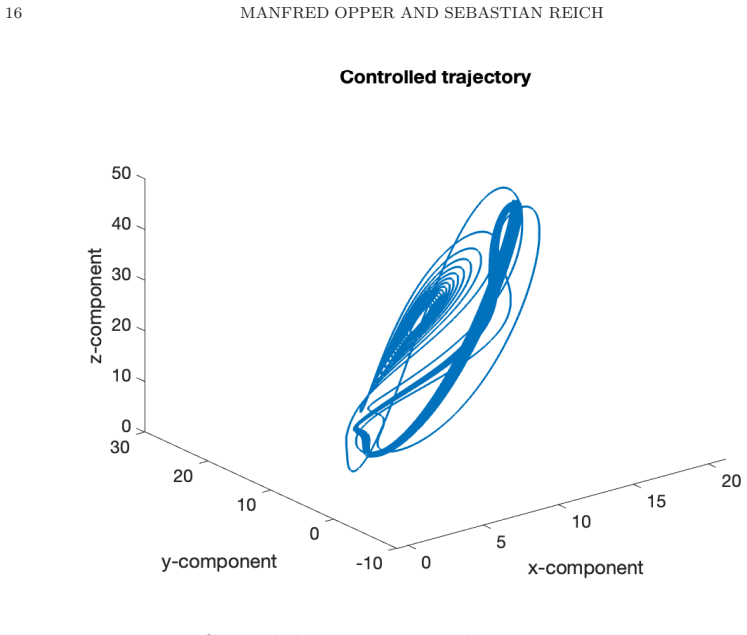
- Numerical solution is feasible for low- and moderate-dimensional systems such as controlled pendulums and Lorenz attractors.
Where Pith is reading between the lines
- The same auxiliary-function construction and gauge choice could be explored in mean-field games or other stochastic differential game settings.
- Adaptation of the auxiliary functions might allow the method to handle nonlinear costs or state constraints beyond the linear-quadratic case.
- The reduction to forward-only equations could enable faster real-time implementations in applications with continuous uncertainty.
Load-bearing premise
The existence and suitable regularity of the pair of auxiliary functions that recover the Hamiltonian structure and permit gauge choice for decoupling in the mean-field formulation.
What would settle it
No pair of auxiliary functions with the required regularity exists for a simple stochastic linear-quadratic control problem, or the proposed decoupling fails to produce accurate optimal controls in numerical tests on the inverted pendulum or Lorenz systems.
Figures



read the original abstract
This paper outlines a novel extension of the classical Pontryagin minimum (maximum) principle to stochastic optimal control problems. Contrary to the well-known stochastic Pontryagin minimum principle involving forward-backward stochastic differential equations, the proposed formulation is deterministic and of mean-field type. We denote it by the McKean-Pontryagin minimum principle. The Hamiltonian structure of the proposed McKean-Pontryagin minimum principle is achieved via the introduction of a pair of auxiliary functions. A gauge freedom in the choice of one of these two functions can be used to decouple the forward and reverse time equations; hence simplifying the solution of the underlying boundary value problem. We also consider infinite horizon discounted cost optimal control problems. In this case, the mean-field formulation allows one to convert the computation of the desired optimal control law into solving a pair of forward mean-field ordinary differential equations. The McKean-Pontryagin minimum principle is tested numerically for a controlled inverted pendulum, a controlled Lorenz-63 system, and a controlled Lorenz-96 system. Although the focus is on linear-quadratic control problems, the proposed methodology is extendable to more general problems including mean-field type control formulations.
Editorial analysis
A structured set of objections, weighed in public.
Referee Report
Summary. The manuscript proposes a McKean-Pontryagin minimum principle as a deterministic mean-field extension of the classical Pontryagin minimum principle for stochastic optimal control. The Hamiltonian structure is recovered via a pair of auxiliary functions, with gauge freedom in one function used to decouple the forward and reverse-time equations. For infinite-horizon discounted problems the formulation reduces the optimal control law to a pair of forward mean-field ODEs. The approach is tested numerically on linear-quadratic problems for a controlled inverted pendulum and controlled Lorenz-63/96 systems, and is claimed to extend to general mean-field type control.
Significance. If the auxiliary functions can be shown to exist with the required regularity, the result would supply a deterministic alternative to classical stochastic Pontryagin principles that rely on forward-backward SDEs, potentially simplifying boundary-value problems in stochastic and mean-field control. The gauge-freedom decoupling is a technically attractive feature. Numerical illustrations on the inverted pendulum and Lorenz systems provide preliminary evidence of applicability, though without quantitative error analysis or convergence rates. The explicit treatment of the infinite-horizon discounted case is a positive aspect.
major comments (1)
- Derivation of the McKean-Pontryagin minimum principle (sections following the abstract): the central claim rests on the existence and suitable regularity of the pair of auxiliary functions introduced to recover the Hamiltonian structure and to permit a gauge choice that decouples the forward and reverse equations. No existence theorem, fixed-point argument, or regularity conditions (Lipschitz continuity, growth bounds, etc.) are supplied to guarantee that these functions are well-defined for the underlying stochastic processes or in the infinite-horizon discounted setting. Without such justification the asserted simplification of the boundary-value problem and the deterministic mean-field reduction remain unsecured.
minor comments (2)
- Numerical experiments section: the tests on LQ problems and Lorenz systems report no quantitative error analysis, convergence rates, or direct comparison against standard FBSDE solvers, which limits assessment of practical accuracy and computational advantage.
- References: the manuscript would benefit from additional citations to recent literature on mean-field stochastic control and infinite-dimensional Pontryagin principles to better situate the contribution.
Simulated Author's Rebuttal
We thank the referee for the careful reading and constructive feedback on our manuscript. We address the major comment point by point below, with a commitment to strengthening the theoretical foundations where needed.
read point-by-point responses
-
Referee: Derivation of the McKean-Pontryagin minimum principle (sections following the abstract): the central claim rests on the existence and suitable regularity of the pair of auxiliary functions introduced to recover the Hamiltonian structure and to permit a gauge choice that decouples the forward and reverse equations. No existence theorem, fixed-point argument, or regularity conditions (Lipschitz continuity, growth bounds, etc.) are supplied to guarantee that these functions are well-defined for the underlying stochastic processes or in the infinite-horizon discounted setting. Without such justification the asserted simplification of the boundary-value problem and the deterministic mean-field reduction remain unsecured.
Authors: We acknowledge that the manuscript introduces the auxiliary functions to recover the Hamiltonian structure and enable gauge-based decoupling but does not supply a general existence theorem or fixed-point argument with explicit regularity conditions such as Lipschitz continuity or growth bounds. In the linear-quadratic examples, the functions are constructed explicitly via the associated mean-field Riccati equations and ODEs, which are well-posed under standard matrix assumptions. For the general case and infinite-horizon discounted setting, we agree that additional justification is required. In the revised manuscript we will add a subsection stating sufficient conditions (Lipschitz drift/diffusion, linear growth, and discounting for contraction) and sketching a fixed-point argument for existence of the auxiliary functions as solutions to the deterministic mean-field equations. This will secure the claimed simplification of the boundary-value problem. revision: yes
Circularity Check
No significant circularity; derivation builds on classical Pontryagin and mean-field principles
full rationale
The paper extends the classical Pontryagin minimum principle to a deterministic mean-field formulation for stochastic optimal control by introducing a pair of auxiliary functions to recover Hamiltonian structure and exploiting gauge freedom to decouple forward and reverse equations. This is framed as a novel but direct extension without any reduction of the central McKean-Pontryagin principle to a fitted parameter, self-defined quantity, or self-citation chain by construction. Numerical tests on the inverted pendulum and Lorenz systems function as external validation rather than internal forcing. The derivation remains self-contained against the stated classical benchmarks and does not exhibit any of the enumerated circularity patterns.
Axiom & Free-Parameter Ledger
axioms (1)
- domain assumption Existence of auxiliary functions that recover Hamiltonian structure in the mean-field setting
Forward citations
Cited by 1 Pith paper
-
Digital Twins: McKean-Pontryagin Control for Partially Observed Physical Twins
The authors derive forward mean-field equations that integrate ensemble Kalman filtering with McKean-Pontryagin control to enable simultaneous online data assimilation and optimal control for partially observed stocha...
Reference graph
Works this paper leans on
-
[1]
Stochastic Control of Partially Observable Systems
Alain Bensoussan. Stochastic Control of Partially Observable Systems . Cambridge University Press, Cambridge, 1992
work page 1992
-
[2]
Estimation and Control of Dynamical Systems
Alain Bensoussan. Estimation and Control of Dynamical Systems . Springer, Cham, 2018
work page 2018
-
[3]
Herman J. Bierens. The Nadaraya–Watson kernel regressi on function estimator. In Topics in Advanced Econometrics, page 212–247. Cambridge University Press, New York, 1994
work page 1994
-
[4]
Edoardo Calvello, Sebastian Reich, and Andrew M. Stuart . Ensemble Kalman methods: A mean field perspective. Acta Numerica, 34:123–291, 2025
work page 2025
-
[5]
Ren´ e Carmona.Lectures on BSDEs, Stochastic Control, and Stochastic Differ ential Games with Financial Applications . SIAM, Philadelphia, 2016
work page 2016
-
[6]
Crandall and Pierre-Louis Lions
Michael G. Crandall and Pierre-Louis Lions. Viscosity s olutions of Hamilton-Jacobi equations. Transactions of the American Mathematical Society , 277, 1983
work page 1983
-
[7]
Paul A.M. Dirac. Generalized Hamiltonian dynamics. Can. J. Math. , 2:129–148, 1950
work page 1950
-
[8]
Weinan E, Jiequn Han, and Arnulf Jentzen. Deep learning- based numerical methods for high-dimensional parabolic partial differential equati ons and backward stochastic differential equations. Communications in Mathematics and Statistics , 5:349–380, 2017. 20 MANFRED OPPER AND SEBASTIAN REICH
work page 2017
-
[9]
Algorithms for solving high-dimensional PDEs: From nonlinear Monte Carlo to machine learning
Weinan E, Jiequn Han, and Arnulf Jentzen. Algorithms for solving high-dimensional PDEs: From nonlinear Monte Carlo to machine learning. Nonlinearity, 35:278, 2021
work page 2021
-
[10]
Geir Evensen, Femke C. Vossepoel, and Peter Jan. van Lee uwen. Data Assimila- tion Fundamentals: A unified Formulation of the State and Par ameter Estimation Problem. Springer Nature Switzerland AG, Cham, Switzerland, 2022
work page 2022
-
[11]
An introduction to nonlinear model predictive control
Rolf Findeisen and Frank Allg¨ ower. An introduction to nonlinear model predictive control. In A. G. Jager, de and H. J. Zwart, editors, Systems and control : 21th Benelux meeting 2002 , pages 119–141. Technische Universiteit Eindhoven, 2002
work page 2002
-
[12]
Gottwald, Fengyi Li, Sebastian Reich, and Yous sef Marzouk
Georg A. Gottwald, Fengyi Li, Sebastian Reich, and Yous sef Marzouk. Stable gen- erative modeling using Schr¨ odinger bridges. Phil. Trans. R. Soc. A , 383:20240332, 2025
work page 2025
-
[13]
Gottwald, Shuigen Liu, Youssef Marzouk, Sebas tian Reich, and Xin T
Georg A. Gottwald, Shuigen Liu, Youssef Marzouk, Sebas tian Reich, and Xin T. Tong. Localized diffusion models for high dimensional distri butions generation. Technical report, arXiv:2505.04417, 2025
-
[14]
Darryl Holm. Geomeric Mechanics. Part I: Dynamics and Symmetry . World Sci- entific Publishing, Singapore, 2nd edition, 2008
work page 2008
-
[15]
An efficient on-policy deep learning framework for stochastic optimal control
Mengjian Hua, Mathieu Lauriere, and Eric Vanden-Eijnd en. An efficient on-policy deep learning framework for stochastic optimal control. In Frontiers in Probabilistic Inference: Learning meets Sampling , 2025
work page 2025
-
[16]
Joshi, Amirhossein Taghvaei, Prashant G
Anant A. Joshi, Amirhossein Taghvaei, Prashant G. Meht a, and Sean P. Meyn. Con- trolled interacting particle algorithms for simulation-b ased reinforcement learning. Systems & Control Letters , 170:105392, 2022
work page 2022
-
[17]
Joshi, Amirhossein Taghvaei, Prashant G
Anant A. Joshi, Amirhossein Taghvaei, Prashant G. Meht a, and Sean P. Meyn. Dual ensemble Kalman filter for stochastic optimal control. In 2024 IEEE 63rd Conference on Decision and Control (CDC) , pages 1917–1922, 2024
work page 2024
-
[18]
Fumitoshi Kawasaki and Shunji Kotsuki. Leading the Lor enz 63 system towards the prescribed regime by model predictive control coupled w ith data assimilation. Nonlin. Processes Geophys., 31:319–333, 2024
work page 2024
-
[19]
Edward N Lorenz. Deterministic nonperiodic flow. Journal of the Atmospheric Sciences, 20(2):130–141, 1963
work page 1963
-
[20]
Deterministic part icle flows for constraining stochastic nonlinear systems
Dimitra Maoutsa and Manfred Opper. Deterministic part icle flows for constraining stochastic nonlinear systems. Phys. Rev. Res. , 4:043035, 2022
work page 2022
-
[21]
Dimitra Maoutsa, Sebastian Reich, and Manfred Opper. I nteracting particle solu- tions of Fokker–Planck equations through gradient-log-de nsity estimation. Entropy, 22(8), 2020
work page 2020
-
[22]
Nicholas F. Marshall and Ronald R. Coifman. Manifold le arning with bi-stochastic kernels. IMA J. Appl. Maths. , 84:455–482, 2019
work page 2019
-
[23]
Prashant G. Mehta and Sean P. Meyn. A feedback particle fi lter-based approach to optimal control with partial observations. In 52nd IEEE Conference on Decision and Control, pages 3121–3127, 2013
work page 2013
-
[24]
Control Systems and Reinforcement Learning
Sean Meyn. Control Systems and Reinforcement Learning . Cambridge University Press, Cambridge, 2022
work page 2022
-
[25]
Nikolas N¨ usken and Lorenz Richter. Solving high-dime nsional Hamilton-Jacobi- Bellman PDEs using neural networks: Perspectives from the t heory of controlled ON A MEAN-FIELD PONTRYAGIN MINIMUM PRINCIPLE 21 diffusions and measures on path space. Partial Differential Equations and Applica- tions, 2:48, 2021
work page 2021
- [26]
-
[27]
Backward stochastic differential equations and applications to optimal control
Shige Peng. Backward stochastic differential equations and applications to optimal control. Applied Mathematics and Optimization , 27:125–144, 1993
work page 1993
-
[28]
L.S. Pointryagin, V.G. Boltyanskii, R.V. Gamkrelidze , and E.F. Mihchenko. The Mathematical Theory of Optimal Processes . John Wiley & Sons, New York, 1962
work page 1962
-
[29]
Optimal control of Markov processes with incomple te state information
Karl Johan ˚ Astr¨ om. Optimal control of Markov processes with incomple te state information. Journal of Mathematical Analysis and Applications , 10:174–205, 1965
work page 1965
-
[30]
James B. Rawlings, David Q. Mayne, and Moritz M. Diehl. Model Predictive Con- trol: Theory, Computation, and Design . Nob Hill Publishing, Madison, 2nd edition, 2018
work page 2018
-
[31]
Ensemble Kalman-Bucy filtering for no nlinear model predictive control
Sebastian Reich. Ensemble Kalman-Bucy filtering for no nlinear model predictive control. Technical report, arXiv:2503.12474, 2025
-
[32]
Particle-based algorithms for stoch astic optimal control
Sebastian Reich. Particle-based algorithms for stoch astic optimal control. In Bertrand Chapron, Dan Crisan, Darryl Holm, Etienne M´ emin, and Jane-Lisa Coughlan, editors, Stochastic Transport in Upper Ocean Dynamics III , pages 243–
-
[33]
Springer Nature Switzerland, Cham, 2025
work page 2025
-
[34]
Probabilistic Forecasting and Bayesian Data Assimilation
Sebastian Reich and Colin Cotter. Probabilistic Forecasting and Bayesian Data Assimilation. Cambridge University Press, 2015
work page 2015
-
[35]
Rick Salmon. Hamiltonian fluid mechanics. Ann. Rev. Fluid Mech. , 20:225–256, 1988
work page 1988
-
[36]
Caroline L. Wormell and Sebastian Reich. Spectral conv ergence of diffusion maps: Improved error bounds and an alternative normalisation. SIAM J. Numer. Anal. , 59:1687–1734, 2021
work page 2021
-
[37]
Belief space planning: A covariance steering ap proach
Dongliang Zheng, Jack Ridderhof, Panagiotis Tsiotras , and Ali-akbar Agha- mohammadi. Belief space planning: A covariance steering ap proach. In 2022 In- ternational Conference on Robotics and Automation (ICRA) , pages 11051–11057, 2022. Institut f ¨ur Softw aretechnik und Theoretische Informatik, Technisc he Universit ¨at Berlin, Marchstraße 23, 10587 Be...
work page 2022
discussion (0)
Sign in with ORCID, Apple, or X to comment. Anyone can read and Pith papers without signing in.