REVIEW 1 major objections 5 minor 56 references
Equivariant Neural Diffusion for Molecule Generation
T0 review · 1 major / 5 minor · reviewed 2026-08-07 · deepseek-v4-flash
Pith's one-line read By replacing the fixed forward corruption of an equivariant diffusion model with a learnable, time- and data-dependent E(3)-equivariant affine map, END generates molecules competitively on QM9 and GEOM-Drugs and lifts…
desk verdict A solid, referee-worthy synthesis of NFDM and EDM; the learnable forward is a real step, but the unverified invertibility of U_phi is a gap the authors should close. read the letter →
The pith
A machine-rendered reading of the paper's core claim, the machinery that carries it, and where it could break.
The reading
What carries the argument
The carrying object is the learnable, E(3)-equivariant affine forward transformation $F_\varphi(\varepsilon,t,x)=\mu_\varphi(x,t)+U_\varphi(x,t)\varepsilon$, with $U_\varphi$ a block-diagonal matrix holding one $3\times3$ block per atom. It turns injected noise $\varepsilon$ into the latent $z_t$ through a data- and time-dependent mean and covariance, interpolating from a low-variance Gaussian centered on the data at $t=0$ to a unit Gaussian at $t=1$. This one function defines the conditional marginal, provides the reverse-process drift through its time-derivative and Jacobian determinant, and — being equivariant — carries the invariance of the learned distribution; an equivariant data-point predictor and an invariant prior complete the construction.
What would settle it
Take a trained END checkpoint and scan $t\in(0,1)$ and molecules from the training set, computing the smallest singular value of each $3\times3$ block of $U_\varphi(x,t)$; a single exactly singular block, or one so small that the determinant and Woodbury-based inverse formulas blow up, would show that the construction fails on the very objects it samples.
Extended reading notes
Core claim
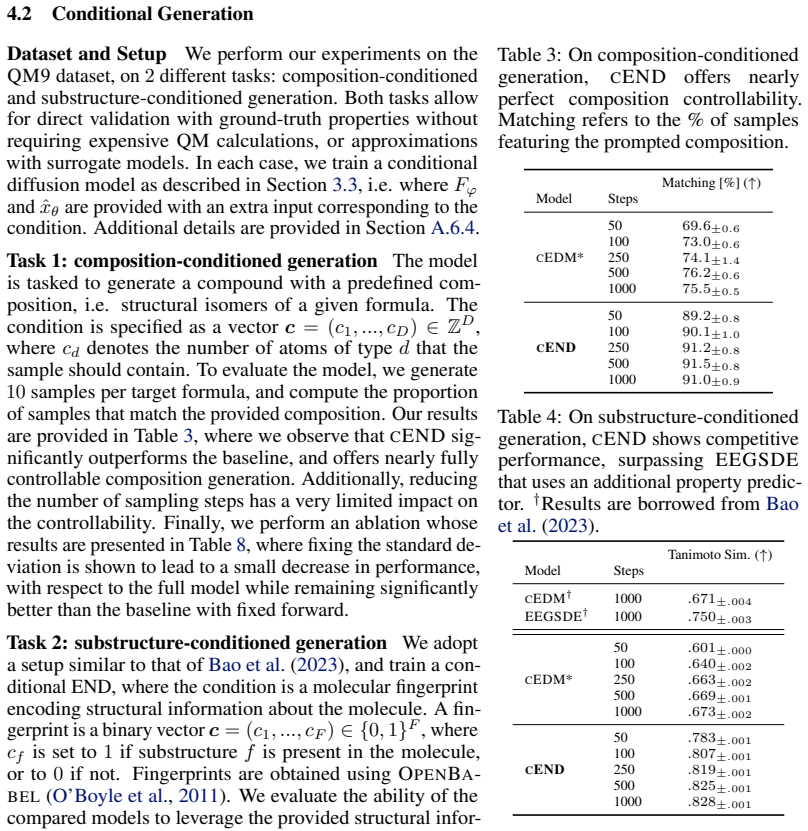
The paper's central claim is that the corruption mechanism of a diffusion model can itself be learned rather than pre-specified, without breaking the symmetries of the generated molecules. END defines the latent variable at time $t$ as $z_t=F_\varphi(\varepsilon,t,x)=\mu_\varphi(x,t)+U_\varphi(x,t)\varepsilon$, where the mean and the per-atom block-diagonal matrix $U_\varphi$ are outputs of an equivariant network, so the conditional marginal $q_\varphi(z_t|x)$ is a Gaussian whose mean and covariance depend on both the data point and the time. Because $F_\varphi$, its inverse, and the data-point predictor $\hat{x}_\theta$ are all equivariant while the noise and prior distributions are invariant, the reverse-time drift is equivariant and the learned marginal $p_{\theta,\varphi}(z_0)$ is invariant under the Euclidean group. Empirically, this learnable forward process yields unconditional generation on par with current fixed-forward models while matching the training distributions better (lower total variation and strain energy), and larger controllability gains once the forward process is also conditioned: 91.5% versus 76.2% composition matching and 0.825 versus 0.669 Tanimoto similarity on substructure-conditioned generation.
Load-bearing premise
The construction assumes the learned per-atom matrix $U_\varphi(x,t)$ is invertible at every data point and time, and the paper neither constrains the network to guarantee this nor checks it after training, so a single singular block would make the score computation and the sampling recursion undefined.
Editorial extensions
If this is right
- END reaches near-peak QM9 validity and stability with as few as 100 integration steps, where the fixed-forward baseline with the same architecture needs 1000 steps to comparable quality, which the paper reports as a 3x cut in sampling time on GEOM-Drugs.
- Composition-conditioned generation becomes nearly fully controllable: 91.5% of END samples match the requested formula at 500 steps, and the rate stays at 89.2% when sampling is cut to 50 steps.
- Substructure-conditioned generation beats a guided baseline without training any auxiliary property predictor: Tanimoto similarity 0.825 versus 0.669 for the fixed-forward conditional model and 0.750 for the guided one.
- Ablations attribute the gains to the learnable forward process: the identical architecture with a fixed schedule lags on every metric, and learning only the mean recovers part but not all of the improvement.
- The forward process becomes condition-dependent, so the condition shapes the entire corruption trajectory rather than only the denoiser, a capability that fixed-schedule models cannot express.
Reading between the lines
- A testable extension the paper leaves implicit: slicing the conditional gains by feeding the condition to the forward map only, to the predictor only, or to both would isolate whether conditioning the corruption trajectory is what drives the controllability jump.
- The invertibility assumption on $U_\varphi(x,t)$ could be converted into a guarantee by parameterizing each block as a positive-definite factor (for example a Cholesky or spectral-normalized form), which would make the Jacobian determinant and inverse map well-defined by construction.
- Because only equivariance of the forward map and the predictor is required, the same construction should transfer to other E(3)-symmetric point-cloud tasks such as protein backbone or crystal structure generation, where the conditioning gains are likely to matter at least as much as on small organic molecules.
- The measured ~2.5x training and ~3x per-step sampling overhead are not intrinsic to the idea: a directly learned reverse drift that does not evaluate $F_\varphi$'s time-derivative would keep the invariance argument while removing most of the cost.
Editorial analysis
A structured set of objections, weighed in public.
Referee Report
Summary. The paper introduces Equivariant Neural Diffusion (END), a diffusion model for 3D molecule generation whose forward process is a learnable, time- and data-dependent affine transformation F_phi(epsilon,t,x) = mu_phi(x,t) + U_phi(x,t) epsilon, in contrast to the fixed forward process of EDM. The construction builds on Neural Flow Diffusion Models and adds an E(3)-equivariant parameterization of the forward map and the data predictor. The authors prove, under equivariance and invertibility assumptions, that the learned marginal p_{theta,phi}(z0) is O(3)-invariant, and they report unconditional generation experiments on QM9 and GEOM-Drugs, including a controlled ablation against an EDM* baseline with matched architecture and parameter count, plus conditional generation experiments for composition and substructure conditions.
Significance. If the technical assumptions hold, the paper makes a useful and credible contribution: it demonstrates that a learnable equivariant forward process can improve molecule generation, and the conditional-generation gains are substantial (composition matching 91.5% vs. 76.2% for CEDM* at 500 steps; Tanimoto similarity 0.828 vs. 0.673 at 1000 steps). The controlled comparison to EDM* with matched architecture and parameter count is a genuine strength, as is the clear derivation of the invariance argument. The main reservation is that the method's validity depends on invertibility of U_phi, which is neither enforced nor verified; the current paper therefore establishes a conditional guarantee rather than an unconditional one. I did not find a circularity problem: the empirical gains are not an artifact of the equations, and the contribution relative to NFDM lies in the equivariant, data-dependent forward parameterization and the experimental demonstration.
major comments (1)
- [Section 3.2, Eq. (9); Section A.5.1, Eqs. (14)-(18)] The invertibility of U_phi is a load-bearing premise that is assumed but never enforced or checked. The framework requires F_phi to be invertible with respect to epsilon (Section 2.3, Eq. (1)), and Section A.5.1 computes the Jacobian determinant and the inverse using the Matrix Determinant Lemma and the Woodbury identity (Eqs. (14)-(18)); these formulas require every d x d block \tilde U_m and the matrix V = (1/M) sum_m \tilde U_m^{-1} to be invertible. However, in Eq. (9), U_phi is a positive scalar multiple of I plus an unconstrained t(1-t)\bar U_phi(x,t) for t in (0,1), and the architecture description in Section A.6.2 imposes no constraint on \bar U_phi or V. If any block or V is singular, the score computation in Eq. (5) and the sampling recursion in Algorithm 2 become undefined. This is not a demonstrated failure in the reported runs, but it is a central assumption of the method; the authors should either parameterize U_phi so that invertibility holds by construction, or provide a spectral verification during training and sampling, and state the resulting guarantee precisely.
minor comments (5)
- [Table 1 caption] The caption states that END 'compares favorably to the baseline across all metrics on both datasets', but on GEOM-Drugs the validity of END is lower than that of EDM* at every step count (e.g., 89.2% vs. 94.4% at 1000 steps). The main text later acknowledges this ('slightly subpar in validity'), so the caption should be rephrased to avoid overstatement.
- [Algorithm 2] The sampling loop is written as 'for t = 1, ..., 1/T do', which appears to be a typo; it should presumably be 'for t = 1, ..., T do' or 'for t = T, ..., 1' depending on the intended discretization.
- [Section A.6] The text says 'we release a public code repository with our implementation of END' but no URL is provided. Please include the repository link.
- [Section 1] The phrase 'ab-initioQuantum' in the introduction is missing a space; it should read 'ab-initio Quantum'.
- [Section 4.1 and Table 6] The ablation discussion could be more precise: on QM9, END(mu only) sometimes matches or slightly exceeds the full END on validity, uniqueness, and total variation (e.g., V x U 93.5% vs. 92.6% at 1000 steps), while the full END is better on strain energy. The claim that the full model is uniformly better is not supported by the table.
Circularity Check
No significant circularity: the equivariant learnable-forward derivation is self-contained, with at most a non-load-bearing self-citation to the NFDM framework.
full rationale
The paper's derivation chain starts from the affine equivariant map F_phi(eps,t,x)=mu_phi(x,t)+U_phi(x,t)eps (Eq. 6), obtains the conditional Gaussian (Eq. 7), imports the NFDM drift-matching objective (Eq. 5), and proves O(3)-equivariance of the reverse drift and invariance of the marginal under stated assumptions (Section 3.1 and Appendix A.3). Each step is either a conditional theorem or a design choice, not a fitted quantity renamed as a prediction. The empirical claims, including composition matching, Tanimoto similarity, stability, and validity, are direct benchmark measurements; no reported number is obtained by fitting a parameter to that same number. The only relevant self-citation is Bartosh et al. (2024) for the equivalence of Eq. (5) to a KL divergence; it is a framework-level mathematical identity from prior work by two of the current authors, but END's novel contribution, namely the equivariant parameterization and the invariance proof, does not reduce to that citation, and no uniqueness theorem is imported to rule out alternatives (the paper explicitly notes alternative reverse-drift parameterizations). The unverified invertibility of U_phi discussed in Appendix A.5.1 is a correctness and robustness risk rather than a circularity, because the theory states invertibility as an assumption rather than presupposing the desired conclusion. Overall, no circular step is exhibited.
Assumptions & free parameters
free parameters (2)
- delta (initial noise scale) =
not stated in the paper
- g_phi(t) (SDE diffusion coefficient) =
not specified
assumptions (4)
- standard math NFDM conditional SDE framework: the drift-matching loss L_NFDM is equivalent to minimizing the KL divergence between the true and approximate reverse SDE posteriors (Bartosh et al., 2024).
- domain assumption U_phi(x,t) is invertible for all x and t.
- domain assumption Equivariant graph neural networks can represent the required F_phi and x_hat.
- domain assumption The data lives in the zero center-of-mass subspace and the prior is the unit Gaussian.
Cite this review
Pith. "Pith review of Equivariant Neural Diffusion for Molecule Generation." pith.science (2026). https://pith.science/paper/NWYMFLJ3
@misc{pith2026250610532,
  author       = {Pith},
  title        = {Pith review of: Equivariant Neural Diffusion for Molecule Generation},
  year         = {2026},
  howpublished = {\url{https://pith.science/paper/NWYMFLJ3}},
  note         = {Machine review of arXiv:2506.10532}
}
read the original abstract
We introduce Equivariant Neural Diffusion (END), a novel diffusion model for molecule generation in 3D that is equivariant to Euclidean transformations. Compared to current state-of-the-art equivariant diffusion models, the key innovation in END lies in its learnable forward process for enhanced generative modelling. Rather than pre-specified, the forward process is parameterized through a time- and data-dependent transformation that is equivariant to rigid transformations. Through a series of experiments on standard molecule generation benchmarks, we demonstrate the competitive performance of END compared to several strong baselines for both unconditional and conditional generation.
Figures

Reference graph
Works this paper leans on
-
[1]
Scaling deep learning for materials discovery
Amil Merchant, Simon Batzner, Samuel S Schoenholz, Muratahan Aykol, Gowoon Cheon, and Ekin Dogus Cubuk. Scaling deep learning for materials discovery. Nature, 624 0 (7990): 0 80--85, 2023
2023
-
[2]
Enumeration of 166 billion organic small molecules in the chemical universe database gdb-17
Lars Ruddigkeit, Ruud Van Deursen, Lorenz C Blum, and Jean-Louis Reymond. Enumeration of 166 billion organic small molecules in the chemical universe database gdb-17. Journal of chemical information and modeling, 52 0 (11): 0 2864--2875, 2012
work page 2012
-
[3]
Generative models as an emerging paradigm in the chemical sciences
Dylan M Anstine and Olexandr Isayev. Generative models as an emerging paradigm in the chemical sciences. Journal of the American Chemical Society, 145 0 (16): 0 8736--8750, 2023
work page 2023
-
[4]
Symmetry-adapted generation of 3d point sets for the targeted discovery of molecules
Niklas Gebauer, Michael Gastegger, and Kristof Sch \"u tt. Symmetry-adapted generation of 3d point sets for the targeted discovery of molecules. Advances in neural information processing systems, 32, 2019
work page 2019
-
[5]
Niklas WA Gebauer, Michael Gastegger, Stefaan SP Hessmann, Klaus-Robert M \"u ller, and Kristof T Sch \"u tt. Inverse design of 3d molecular structures with conditional generative neural networks. Nature communications, 13 0 (1): 0 973, 2022
work page 2022
-
[6]
An autoregressive flow model for 3d molecular geometry generation from scratch
Youzhi Luo and Shuiwang Ji. An autoregressive flow model for 3d molecular geometry generation from scratch. In International Conference on Learning Representations, 2022. URL https://openreview.net/forum?id=C03Ajc-NS5W
work page 2022
-
[7]
Symphony: Symmetry-equivariant point-centered spherical harmonics for 3d molecule generation
Ameya Daigavane, Song Eun Kim, Mario Geiger, and Tess Smidt. Symphony: Symmetry-equivariant point-centered spherical harmonics for 3d molecule generation. In The Twelfth International Conference on Learning Representations, 2024. URL https://openreview.net/forum?id=MIEnYtlGyv
work page 2024
-
[8]
Equivariant diffusion for molecule generation in 3d
Emiel Hoogeboom, V ctor Garcia Satorras, Cl \'e ment Vignac, and Max Welling. Equivariant diffusion for molecule generation in 3d. In International conference on machine learning, pages 8867--8887. PMLR, 2022
work page 2022
Show all 56 references
-
[9]
Midi: Mixed graph and 3d denoising diffusion for molecule generation
Clement Vignac, Nagham Osman, Laura Toni, and Pascal Frossard. Midi: Mixed graph and 3d denoising diffusion for molecule generation. In Joint European Conference on Machine Learning and Knowledge Discovery in Databases, pages 560--576. Springer, 2023
2023
-
[10]
Navigating the design space of equivariant diffusion-based generative models for de novo 3d molecule generation
Tuan Le, Julian Cremer, Frank Noe, Djork-Arn \'e Clevert, and Kristof T Sch \"u tt. Navigating the design space of equivariant diffusion-based generative models for de novo 3d molecule generation. In The Twelfth International Conference on Learning Representations, 2024. URL h...
2024
-
[11]
Machine learning force fields
Oliver T Unke, Stefan Chmiela, Huziel E Sauceda, Michael Gastegger, Igor Poltavsky, Kristof T Schuett, Alexandre Tkatchenko, and Klaus-Robert Mueller. Machine learning force fields. Chemical Reviews, 121 0 (16): 0 10142--10186, 2021
2021
-
[12]
u tt, Pieter-Jan Kindermans, Huziel Enoc Sauceda Felix, Stefan Chmiela, Alexandre Tkatchenko, and Klaus-Robert M \
Kristof Sch \"u tt, Pieter-Jan Kindermans, Huziel Enoc Sauceda Felix, Stefan Chmiela, Alexandre Tkatchenko, and Klaus-Robert M \"u ller. Schnet: A continuous-filter convolutional neural network for modeling quantum interactions. Advances in neural information processing system...
2017
-
[13]
Equivariant message passing for the prediction of tensorial properties and molecular spectra
Kristof Sch \"u tt, Oliver Unke, and Michael Gastegger. Equivariant message passing for the prediction of tensorial properties and molecular spectra. In International Conference on Machine Learning, pages 9377--9388. PMLR, 2021
2021
-
[14]
E (3)-equivariant graph neural networks for data-efficient and accurate interatomic potentials
Simon Batzner, Albert Musaelian, Lixin Sun, Mario Geiger, Jonathan P Mailoa, Mordechai Kornbluth, Nicola Molinari, Tess E Smidt, and Boris Kozinsky. E (3)-equivariant graph neural networks for data-efficient and accurate interatomic potentials. Nature communications, 13 0 (1):...
2022
-
[15]
Mace: Higher order equivariant message passing neural networks for fast and accurate force fields
Ilyes Batatia, David P Kovacs, Gregor Simm, Christoph Ortner, and G \'a bor Cs \'a nyi. Mace: Higher order equivariant message passing neural networks for fast and accurate force fields. Advances in Neural Information Processing Systems, 35: 0 11423--11436, 2022
2022
-
[16]
Diffusion models: A comprehensive survey of methods and applications
Ling Yang, Zhilong Zhang, Yang Song, Shenda Hong, Runsheng Xu, Yue Zhao, Wentao Zhang, Bin Cui, and Ming-Hsuan Yang. Diffusion models: A comprehensive survey of methods and applications. ACM Computing Surveys, 56 0 (4): 0 1--39, 2023
2023
-
[17]
Neural diffusion models
Grigory Bartosh, Dmitry Vetrov, and Christian A Naesseth. Neural diffusion models. arXiv preprint arXiv:2310.08337, 2023
2023 arXiv
-
[18]
Diffenc: Variational diffusion with a learned encoder
Beatrix Miranda Ginn Nielsen, Anders Christensen, Andrea Dittadi, and Ole Winther. Diffenc: Variational diffusion with a learned encoder. In The Twelfth International Conference on Learning Representations, 2024. URL https://openreview.net/forum?id=8nxy1bQWTG
2024
-
[19]
Neural flow diffusion models: Learnable forward process for improved diffusion modelling
Grigory Bartosh, Dmitry Vetrov, and Christian A Naesseth. Neural flow diffusion models: Learnable forward process for improved diffusion modelling. arXiv preprint arXiv:2404.12940, 2024
2024 arXiv
-
[20]
E (n) equivariant normalizing flows
Victor Garcia Satorras, Emiel Hoogeboom, Fabian Fuchs, Ingmar Posner, and Max Welling. E (n) equivariant normalizing flows. Advances in Neural Information Processing Systems, 34: 0 4181--4192, 2021
2021
-
[21]
Geodiff: A geometric diffusion model for molecular conformation generation
Minkai Xu, Lantao Yu, Yang Song, Chence Shi, Stefano Ermon, and Jian Tang. Geodiff: A geometric diffusion model for molecular conformation generation. In International Conference on Learning Representations, 2022. URL https://openreview.net/forum?id=PzcvxEMzvQC
2022
-
[22]
Equivariant energy-guided SDE for inverse molecular design
Fan Bao, Min Zhao, Zhongkai Hao, Peiyao Li, Chongxuan Li, and Jun Zhu. Equivariant energy-guided SDE for inverse molecular design. In The Eleventh International Conference on Learning Representations, 2023. URL https://openreview.net/forum?id=r0otLtOwYW
2023
-
[23]
Deep unsupervised learning using nonequilibrium thermodynamics
Jascha Sohl-Dickstein, Eric Weiss, Niru Maheswaranathan, and Surya Ganguli. Deep unsupervised learning using nonequilibrium thermodynamics. In Francis Bach and David Blei, editors, Proceedings of the 32nd International Conference on Machine Learning, volume 37 of Proceedings o...
2015
-
[24]
Denoising diffusion probabilistic models
Jonathan Ho, Ajay Jain, and Pieter Abbeel. Denoising diffusion probabilistic models. Advances in neural information processing systems, 33: 0 6840--6851, 2020
2020
-
[25]
Score-based generative modeling through stochastic differential equations
Yang Song, Jascha Sohl-Dickstein, Diederik P Kingma, Abhishek Kumar, Stefano Ermon, and Ben Poole. Score-based generative modeling through stochastic differential equations. In International Conference on Learning Representations, 2020
2020
-
[26]
Applied stochastic differential equations, volume 10
Simo S \"a rkk \"a and Arno Solin. Applied stochastic differential equations, volume 10. Cambridge University Press, 2019
2019
-
[27]
Reverse-time diffusion equation models
Brian DO Anderson. Reverse-time diffusion equation models. Stochastic Processes and their Applications, 12 0 (3): 0 313--326, 1982
1982
-
[28]
A connection between score matching and denoising autoencoders
Pascal Vincent. A connection between score matching and denoising autoencoders. Neural computation, 23 0 (7): 0 1661--1674, 2011
2011
-
[29]
Timewarp: Transferable acceleration of molecular dynamics by learning time-coarsened dynamics
Leon Klein, Andrew Foong, Tor Fjelde, Bruno Mlodozeniec, Marc Brockschmidt, Sebastian Nowozin, Frank No \'e , and Ryota Tomioka. Timewarp: Transferable acceleration of molecular dynamics by learning time-coarsened dynamics. Advances in Neural Information Processing Systems, 36, 2024
2024
-
[30]
Eigenfold: Generative protein structure prediction with diffusion models
Bowen Jing, Ezra Erives, Peter Pao-Huang, Gabriele Corso, Bonnie Berger, and Tommi S Jaakkola. Eigenfold: Generative protein structure prediction with diffusion models. In ICLR 2023-Machine Learning for Drug Discovery workshop, 2023
2023
-
[31]
Efficient 3d molecular generation with flow matching and scale optimal transport
Ross Irwin, Alessandro Tibo, Jon Paul Janet, and Simon Olsson. Efficient 3d molecular generation with flow matching and scale optimal transport. In ICML 2024 AI for Science Workshop, 2024. URL https://openreview.net/forum?id=CxAjGjdkqu
2024
-
[32]
Conditional synthesis of 3d molecules with time correction sampler
Hojung Jung, Youngrok Park, Laura Schmid, Jaehyeong Jo, Dongkyu Lee, Bongsang Kim, Se-Young Yun, and Jinwoo Shin. Conditional synthesis of 3d molecules with time correction sampler. In The Thirty-eighth Annual Conference on Neural Information Processing Systems, 2024
2024
-
[33]
Practical and asymptotically exact conditional sampling in diffusion models
Luhuan Wu, Brian Trippe, Christian Naesseth, David Blei, and John P Cunningham. Practical and asymptotically exact conditional sampling in diffusion models. Advances in Neural Information Processing Systems, 36, 2024
2024
-
[34]
Quantum chemistry structures and properties of 134 kilo molecules
Raghunathan Ramakrishnan, Pavlo O Dral, Matthias Rupp, and O Anatole Von Lilienfeld. Quantum chemistry structures and properties of 134 kilo molecules. Scientific data, 1 0 (1): 0 1--7, 2014
2014
-
[35]
Geom, energy-annotated molecular conformations for property prediction and molecular generation
Simon Axelrod and Rafael Gomez-Bombarelli. Geom, energy-annotated molecular conformations for property prediction and molecular generation. Scientific Data, 9 0 (1): 0 185, 2022
2022
-
[36]
Geometric latent diffusion models for 3d molecule generation
Minkai Xu, Alexander S Powers, Ron O Dror, Stefano Ermon, and Jure Leskovec. Geometric latent diffusion models for 3d molecule generation. In International Conference on Machine Learning, pages 38592--38610. PMLR, 2023
2023
-
[37]
Coarse-to-fine: a hierarchical diffusion model for molecule generation in 3d
Bo Qiang, Yuxuan Song, Minkai Xu, Jingjing Gong, Bowen Gao, Hao Zhou, Wei-Ying Ma, and Yanyan Lan. Coarse-to-fine: a hierarchical diffusion model for molecule generation in 3d. In International Conference on Machine Learning, pages 28277--28299. PMLR, 2023
2023
-
[38]
Diffusion-based molecule generation with informative prior bridges
Lemeng Wu, Chengyue Gong, Xingchao Liu, Mao Ye, and qiang liu. Diffusion-based molecule generation with informative prior bridges. In Alice H. Oh, Alekh Agarwal, Danielle Belgrave, and Kyunghyun Cho, editors, Advances in Neural Information Processing Systems, 2022. URL https:/...
2022
-
[39]
Unified generative modeling of 3d molecules with bayesian flow networks
Yuxuan Song, Jingjing Gong, Hao Zhou, Mingyue Zheng, Jingjing Liu, and Wei-Ying Ma. Unified generative modeling of 3d molecules with bayesian flow networks. In The Twelfth International Conference on Learning Representations, 2024. URL https://openreview.net/forum?id=NSVtmmzeRB
2024
-
[40]
Bayesian flow networks, 2024
Alex Graves, Rupesh Kumar Srivastava, Timothy Atkinson, and Faustino Gomez. Bayesian flow networks, 2024
2024
-
[41]
Variational diffusion models
Diederik Kingma, Tim Salimans, Ben Poole, and Jonathan Ho. Variational diffusion models. Advances in neural information processing systems, 34: 0 21696--21707, 2021
2021
-
[42]
Open babel: An open chemical toolbox
Noel M O'Boyle, Michael Banck, Craig A James, Chris Morley, Tim Vandermeersch, and Geoffrey R Hutchison. Open babel: An open chemical toolbox. Journal of cheminformatics, 3: 0 1--14, 2011
2011
-
[43]
Reinforcement learning for molecular design guided by quantum mechanics
Gregor Simm, Robert Pinsler, and Jos \'e Miguel Hern \'a ndez-Lobato. Reinforcement learning for molecular design guided by quantum mechanics. In International Conference on Machine Learning, pages 8959--8969. PMLR, 2020
2020
-
[44]
Equivariant 3d-conditional diffusion model for molecular linker design
Ilia Igashov, Hannes St \"a rk, Cl \'e ment Vignac, Arne Schneuing, Victor Garcia Satorras, Pascal Frossard, Max Welling, Michael Bronstein, and Bruno Correia. Equivariant 3d-conditional diffusion model for molecular linker design. Nature Machine Intelligence, pages 1--11, 2024
2024
-
[45]
Shape-based generative modeling for de novo drug design
Miha Skalic, Jos \'e Jim \'e nez, Davide Sabbadin, and Gianni De Fabritiis. Shape-based generative modeling for de novo drug design. Journal of chemical information and modeling, 59 0 (3): 0 1205--1214, 2019
2019
-
[46]
Generating 3d molecules conditional on receptor binding sites with deep generative models
Matthew Ragoza, Tomohide Masuda, and David Ryan Koes. Generating 3d molecules conditional on receptor binding sites with deep generative models. Chemical science, 13 0 (9): 0 2701--2713, 2022
2022
-
[47]
3d molecule generation by denoising voxel grids
Pedro O O Pinheiro, Joshua Rackers, Joseph Kleinhenz, Michael Maser, Omar Mahmood, Andrew Watkins, Stephen Ra, Vishnu Sresht, and Saeed Saremi. 3d molecule generation by denoising voxel grids. Advances in Neural Information Processing Systems, 36, 2024
2024
-
[48]
Moldiff: Addressing the atom-bond inconsistency problem in 3d molecule diffusion generation
Xingang Peng, Jiaqi Guan, Qiang Liu, and Jianzhu Ma. Moldiff: Addressing the atom-bond inconsistency problem in 3d molecule diffusion generation. In International Conference on Machine Learning, pages 27611--27629. PMLR, 2023
2023
-
[49]
Flow matching for generative modeling
Yaron Lipman, Ricky TQ Chen, Heli Ben-Hamu, Maximilian Nickel, and Matthew Le. Flow matching for generative modeling. In The Eleventh International Conference on Learning Representations, 2022
2022
-
[50]
Equivariant flow matching with hybrid probability transport for 3d molecule generation
Yuxuan Song, Jingjing Gong, Minkai Xu, Ziyao Cao, Yanyan Lan, Stefano Ermon, Hao Zhou, and Wei-Ying Ma. Equivariant flow matching with hybrid probability transport for 3d molecule generation. In A. Oh, T. Neumann, A. Globerson, K. Saenko, M. Hardt, and S. Levine, editors, Adva...
2023
-
[51]
Analog bits: Generating discrete data using diffusion models with self-conditioning
Ting Chen, Ruixiang ZHANG, and Geoffrey Hinton. Analog bits: Generating discrete data using diffusion models with self-conditioning. In The Eleventh International Conference on Learning Representations, 2023
2023
-
[52]
A kernel two-sample test
Arthur Gretton, Karsten M Borgwardt, Malte J Rasch, Bernhard Sch \"o lkopf, and Alexander Smola. A kernel two-sample test. The Journal of Machine Learning Research, 13 0 (1): 0 723--773, 2012
2012
-
[53]
Rdkit: A software suite for cheminformatics, computational chemistry, and predictive modeling
Greg Landrum et al. Rdkit: A software suite for cheminformatics, computational chemistry, and predictive modeling. Greg Landrum, 8: 0 31, 2013
2013
-
[54]
Smiles, a chemical language and information system
David Weininger. Smiles, a chemical language and information system. 1. introduction to methodology and encoding rules. Journal of chemical information and computer sciences, 28 0 (1): 0 31--36, 1988
1988
-
[55]
Estimation of synthetic accessibility score of drug-like molecules based on molecular complexity and fragment contributions
Peter Ertl and Ansgar Schuffenhauer. Estimation of synthetic accessibility score of drug-like molecules based on molecular complexity and fragment contributions. Journal of cheminformatics, 1: 0 1--11, 2009
2009
-
[56]
Representation learning on biomolecular structures using equivariant graph attention
Tuan Le, Frank Noe, and Djork-Arn \'e Clevert. Representation learning on biomolecular structures using equivariant graph attention. In The First Learning on Graphs Conference, 2022. URL https://openreview.net/forum?id=kv4xUo5Pu6
2022
Reviewed August 7, 2026 · model on record in the stance chip above.
Discussion (0). Continue with ORCID to comment.