REVIEW 5 major objections 5 minor 36 references
Data-driven Day Ahead Market Prices Forecasting: A Focus on Short Training Set Windows
T0 review · 5 major / 5 minor · reviewed 2026-08-07 · deepseek-v4-flash
Pith's one-line read LightGBM, trained on a 45-60 day rolling window, gives the most accurate day-ahead price forecasts across Greece, Belgium, and Ireland in 2023.
desk verdict Useful benchmark, but a table error and overstated abstract undermine the central claim; short-window boosting is plausible but needs a corrected, uncertainty-aware revision. read the letter →
The pith
A machine-rendered reading of the paper's core claim, the machinery that carries it, and where it could break.
The reading
What carries the argument
The load-bearing mechanism is a rolling look-back sweep: for each calendar month of 2023, an 80/20 train/test split is applied and each model is trained on the preceding 7, 14, 30, 45, 60, or 90 days of data. LightGBM's leaf-wise gradient boosting, which grows trees by the highest loss-reduction gain and downsamples small-gradient samples, is the method that exploits these shallow windows best. The pipeline also relies on 24-hour time-step shifting of the input series and on using only public forecast features for demand, renewable generation, total generation, and net flows, which would be available to a bidder at decision time.
What would settle it
Run the exact same 7-90 day benchmark on 2022 and 2024 price data for Greece, Belgium, and Ireland with the same fixed hyperparameters; if LightGBM does not lead in MAE or FSI, or if the best window moves outside 45-60 days, the paper's central claim fails.
Extended reading notes
Core claim
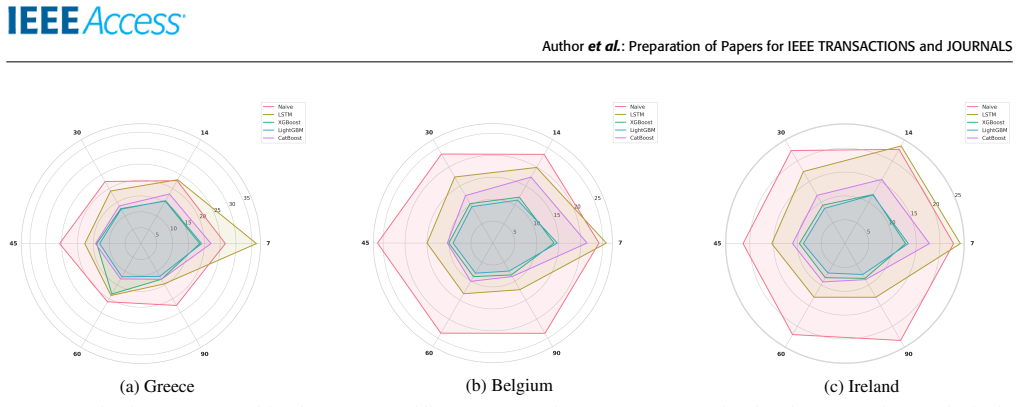
The paper's central discovery is that LightGBM, a gradient-boosting tree method, delivers the most accurate day-ahead electricity price forecasts when trained on a rolling window of roughly 45 to 60 days of recent data, across all three markets studied (Greece, Belgium, Ireland) in 2023. This result holds both for aggregate error metrics (MAE, RMSE, R2, Forecast Skill Index) and for the harder tasks of seasonal fluctuation and price-spike detection. The authors interpret the medium window as balancing temporal relevance against learning depth: shorter windows (7-30 days) give the model too little structure, while a 90-day window can drag in outdated market regimes. They further show that the other boosting models (XGBoost, CatBoost) and an LSTM with feed-forward error correction trail LightGBM in almost every window and market.
Load-bearing premise
The rankings depend on one specific year (2023) and on a single fixed hyperparameter configuration per model, so the results could change with a different market year or if the LSTM and boosting models were each tuned separately.
Editorial extensions
If this is right
- An operator with only a month or two of recent market data can obtain competitive day-ahead price forecasts from a LightGBM model instead of a long-history deep network.
- The 45-60 day window should be treated as a default starting point for short-window day-ahead market forecasting studies, ahead of 90-day or multi-year histories.
- Boosting tree models, not just recurrent networks, deserve a standard place in electricity price forecasting benchmarks for volatile or data-scarce markets.
- Because only forecasted features are used, the reported accuracy is attainable in real bidding workflows without look-ahead information.
- The underperformance of the 90-day window relative to 45-60 days implies that adding older data can actively hurt forecast skill in non-stationary markets.
Reading between the lines
- The fixed hyperparameters per model may favor LightGBM; retuning the LSTM or running repeated seeds could narrow the reported gap, so the headline ranking is best read as a configuration-level comparison rather than a pure architectural one.
- A multi-year extension (for example, 2020-2024) would reveal whether 45-60 days remains the sweet spot across volatility regimes, or whether optimal window length tracks market turbulence.
- The peak and valley analysis suggests a LightGBM component could strengthen hybrid forecasters that currently rely on deep sequence models for spike detection.
- Because the medium windows win in the most volatile seasons (summer and fall), an adaptive window length that is shortened in calm periods and lengthened in stable ones could squeeze out further gains.
Editorial analysis
A structured set of objections, weighed in public.
Referee Report
Summary. The paper benchmarks four machine learning models (LSTM with FFEC, XGBoost, LightGBM, CatBoost) and a naive persistence baseline for day-ahead electricity price forecasting in Greece, Belgium, and Ireland, using only forecasted features from ENTSO-E. The central claim is that LightGBM consistently achieves the highest accuracy and robustness, especially with 45- and 60-day training windows, which are said to balance temporal relevance and learning depth. The evaluation covers six training-window lengths (7-90 days) over a single year (2023), with per-month 80/20 splits and metrics MAE, RMSE, R2, and FSI. The paper also presents a seasonal and peak-price analysis (Figures 9-10) supporting the 45-60 day optimum. The core result is an out-of-sample benchmark, but the evidence table contains internally inconsistent entries and the summary claims are not fully aligned with the tabulated results.
Significance. If the central claims were fully supported, the paper would make a useful practical contribution: it addresses an operationally relevant question (how little training data suffices for DAM price forecasting) and uses realistically available forecasted features rather than ex-post actuals. The systematic sweep over window sizes and the inclusion of three distinct European markets add empirical breadth, and the FSI relative to persistence is a constructive evaluation choice. However, the current manuscript does not establish the central claim: Table 2 contains an impossible RMSE < MAE entry, the starred 'optimal' entries contradict the 45-60-day narrative, and the 'consistent' and 'robust' language is unsupported by any statistical uncertainty quantification. The paper's usefulness depends on correcting these internal inconsistencies and either adding statistical support or tempering the claims.
major comments (5)
- [IV-B, Table 2] Table 2, Greece 60-day XGBoost row reports MAE = 18.303 and RMSE = 12.399. Since RMSE = sqrt(mean(e^2)) >= mean(|e|) = MAE for any fixed error vector, this entry is impossible. The RMSE is also starred as the best among all windows for Greece, which further propagates the error into the summary. Please correct the underlying computation or transcription and re-evaluate the rankings; if the corrected values change the reported best models or windows, revise the abstract and Section IV-C accordingly.
- [Abstract, IV-C, Table 2] The abstract and conclusion claim that LightGBM performs 'particularly with 45-60 day training windows,' but Table 2's own star markers (described in IV-C as 'optimal for all training windows') show LightGBM's best MAE, R2, and FSI in Greece at 90 days, and best MAE and FSI in Belgium at 90 days. Only Ireland's LightGBM stars are at 60 days. Section IV-C itself states that 'longer windows, particularly 90 days, result in more reliable forecasts' and that 60-day beats 90-day only 'in some cases.' The 45-60-day claim is the paper's headline result, yet it is not supported by the table's summary statistics; the authors must reconcile the narrative with the data or provide other quantitative evidence.
- [III-A, IV-A] The data-splitting and windowing protocol is underspecified. The text says an 80%/20% training/test split 'applies to each month of the dataset' and that the earliest training date depends on the window size, but it does not clarify whether the split is chronological or random, nor how the time-step-shifting mechanism (Section III-A, Figure 2) treats test samples whose previous-24-hour input sequences overlap with the training period. If the 20% test points are selected randomly within each month and the input features for those points include hourly values from earlier in the same month, the test set may contain training-period information, invalidating the reported generalization. Please specify the exact split rule and confirm that no test sample's lagged inputs come from the training partition.
- [IV-A, IV-D, Table 1, Figures 9-10] The paper's claims of 'consistent' superiority and of optimal 45-60-day windows for seasonal and peak forecasting are made without any uncertainty quantification. All models use one fixed hyperparameter configuration (Table 1) across all markets and windows, and the evaluation covers a single calendar year (2023). No error bars, repeated-seed runs for the LSTM, bootstrap intervals, or significance tests are reported. Figures 9-10 provide only graphical seasonal/peak MAE trends, yet Section IV-D makes concrete quantitative assertions (e.g., 'the 45-day and 60-day training windows tend to outperform the 90-day window in these seasons' and 'the 30 and 60-day window achieves the lowest peak error of all configurations' for Greece) without tabulated numbers. To support the central conclusions, please add statistical comparisons (e.g., paired tests or confidence intervals) and, at minimum, report the numeric values underlying Figures 9-10.
- [IV-C, conclusion] The sentence 'LightGBM consistently outperforms the other models in nearly every metric and training window' is too strong given that Table 2 itself shows instances where XGBoost or CatBoost match or beat LightGBM (e.g., Greece 7-day MAE and RMSE; Belgium 7-day RMSE; Ireland 90-day MAE and FSI). The paper later qualifies this with 'nearly every,' but the abstract and conclusion repeat the unqualified 'consistently highest accuracy.' Please either moderate the claim to match the quantitative evidence or provide statistical tests showing the differences are meaningful across markets and windows.
minor comments (5)
- [II-B2, references] The same work by Tschora et al. (2022) appears as references [9] and [17]; please deduplicate and renumber.
- [IV-B, Table 2] MAPE is defined in Eq. (17) but never reported in Table 2 or analyzed in Section IV; please either report the MAPE values or remove the definition to avoid a dangling metric.
- [Table 1] Table 1 misspells 'Value' as 'V alue' in the column header; also, the text in IV-A says 'respected hyperparameters' and should be 'respective hyperparameters.'
- [Throughout] There are several typographical and grammatical issues, e.g., 'it's' for 'its' in Section II-B1, 'Y orat' in the references, 'concluding, accurate forecasting' in Section V, and inconsistent use of 'Naive' vs. 'Naïve' in Table 2; a full proofread is needed.
- [III-A, Figure 2] Figure 2 is referenced as showing the time-step shifting mechanism, but the caption and surrounding text do not define the notation n = 24 beyond 'previous 24 hourly time steps.' Please clarify whether the input sequence for each target hour includes the 24 past hours of all features, and how this interacts with the per-month split described in Section III-A.
Circularity Check
No significant circularity: the central LightGBM-vs-baseline claim is an out-of-sample benchmark, and the self-citations are not load-bearing.
full rationale
The paper's central claim is an empirical benchmark: four models plus a naive persistence baseline are compared across three markets and six training windows on held-out monthly test data. No parameter is fitted to the target quantity and then renamed as a prediction, and no equation equates the claimed LightGBM superiority to its own inputs. The LSTM-FFEC architecture is attributed to a reference with overlapping authors ([29]), but that model is not the basis of the central conclusion (LightGBM wins) and the citation is not used to forbid alternatives. Other self-citations ([6], [7], [37]) appear only in motivation or metric discussion. The Forecast Skill Index is a deterministic rescaling of the naive-baseline RMSE, but it is presented as a secondary metric, not as an independent forecasting result, so it does not create circularity. The paper does contain serious internal-consistency and correctness concerns—for example, Table 2 shows a Greece/60-day XGBoost cell with RMSE (12.399) below its MAE (18.303), which is arithmetically impossible, and the star markers point to 90-day windows in two of three markets, conflicting with the abstract's 45–60-day claim—but those are correctness risks, not circularity. The derivation chain is therefore self-contained for circularity purposes.
Assumptions & free parameters
free parameters (1)
- Model hyperparameters =
learning rate 0.01, max depth 10, 300 trees for boosting; LSTM units 200, dropout 0.2, 200 epochs
assumptions (4)
- domain assumption ENTSO-E forecasted features (demand, RES generation, total generation, net flows) are valid predictors available at bidding time.
- domain assumption The 80/20 per-month split combined with 24-hour time-step shifting preserves temporal independence between training and test samples.
- domain assumption Naive persistence is the appropriate skill baseline for the Forecast Skill Index.
- standard math Standard boosting and LSTM equations from the cited literature are correct.
Cite this review
Pith. "Pith review of Data-driven Day Ahead Market Prices Forecasting: A Focus on Short Training Set Windows." pith.science (2026). https://pith.science/paper/O7QQUKRU
@misc{pith2026250610536,
  author       = {Pith},
  title        = {Pith review of: Data-driven Day Ahead Market Prices Forecasting: A Focus on Short Training Set Windows},
  year         = {2026},
  howpublished = {\url{https://pith.science/paper/O7QQUKRU}},
  note         = {Machine review of arXiv:2506.10536}
}
read the original abstract
This study investigates the performance of machine learning models in forecasting electricity Day-Ahead Market (DAM) prices using short historical training windows, with a focus on detecting seasonal trends and price spikes. We evaluate four models, namely LSTM with Feed Forward Error Correction (FFEC), XGBoost, LightGBM, and CatBoost, across three European energy markets (Greece, Belgium, Ireland) using feature sets derived from ENTSO-E forecast data. Training window lengths range from 7 to 90 days, allowing assessment of model adaptability under constrained data availability. Results indicate that LightGBM consistently achieves the highest forecasting accuracy and robustness, particularly with 45 and 60 day training windows, which balance temporal relevance and learning depth. Furthermore, LightGBM demonstrates superior detection of seasonal effects and peak price events compared to LSTM and other boosting models. These findings suggest that short-window training approaches, combined with boosting methods, can effectively support DAM forecasting in volatile, data-scarce environments.
Figures


Figures from the paper (5 more)




Reference graph
Works this paper leans on
-
[1]
Callum MacIver, Keith RW Bell, Grain P Adam, and Lie Xu. Electrical interconnectors: Market opportunities, regulatory issues, technology con- siderations and implications for the gb energy sector. Energy Strategy Reviews, 38:100721, 2021
work page 2021
-
[2]
A hybrid model for multi-day-ahead electricity price forecasting considering price spikes
Daniel Manfre Jaimes, Manuel Zamudio López, Hamidreza Zareipour, and Mike Quashie. A hybrid model for multi-day-ahead electricity price forecasting considering price spikes. F orecasting, 5(3):499–521, 2023
work page 2023
-
[3]
Mizue Shimomura, Alexander Ryota Keeley, Ken’ichi Matsumoto, Kenta Tanaka, and Shunsuke Managi. Beyond the merit order effect: Impact of the rapid expansion of renewable energy on electricity market price. Renewable and Sustainable Energy Reviews , 189:114037, 2024
work page 2024
-
[4]
Abed Kazemtarghi, Ayan Mallik, and Y an Chen. Dynamic pricing strat- egy for electric vehicle charging stations to distribute the congestion and maximize the revenue. International Journal of Electrical Power & Energy Systems, 158:109946, 2024
work page 2024
-
[5]
Marten Ovaere, Michiel Kenis, Kenneth V an den Bergh, Kenneth Bruninx, and Erik Delarue. The effect of flow-based market coupling on cross- border exchange volumes and price convergence in central western euro- pean electricity markets. Energy Economics, 118:106519, 2023
work page 2023
-
[6]
V asilis Michalakopoulos, Elissaios Sarmas, Ioannis Papias, Panagiotis Skaloumpakas, V angelis Marinakis, and Haris Doukas. A machine learning-based framework for clustering residential electricity load profiles to enhance demand response programs. Applied Energy , 361:122943, 2024
work page 2024
-
[7]
Liana Toderean, Tudor Cioara, Ionut Anghel, Elissaios Sarmas, V asilis Michalakopoulos, and V angelis Marinakis. Demand response optimization for smart grid integrated buildings: Review of technology enablers land- scape and innovation challenges. Energy and Buildings, 2024
work page 2024
-
[8]
WN Silva, LF Henrique, AFP da C Silva, BH Dias, and TA Soares. Market models and optimization techniques to support the decision-making on demand response for prosumers. Electric Power Systems Research , 210:108059, 2022
work page 2022
Show all 36 references
-
[10]
Forecasting day-ahead electricity prices: A review of state-of-the-art al- gorithms, best practices and an open-access benchmark
Jesus Lago, Grzegorz Marcjasz, Bart De Schutter, and Rafał Weron. Forecasting day-ahead electricity prices: A review of state-of-the-art al- gorithms, best practices and an open-access benchmark. Applied Energy, 293:116983, 2021
2021
-
[11]
An optimized deep learning approach for forecasting day-ahead electricity prices
Çağatay Berke Bozlak and Claudia Fernanda Y aşar. An optimized deep learning approach for forecasting day-ahead electricity prices. Electric Power Systems Research, 229:110129, 2024
2024
-
[12]
Day-ahead elec- tricity price forecasting employing a novel hybrid frame of deep learning methods: A case study in nsw, australia
Y ong Qiang Tan, Y an Xia Shen, Xin Y an Y u, and Xin Lu. Day-ahead elec- tricity price forecasting employing a novel hybrid frame of deep learning methods: A case study in nsw, australia. Electric Power Systems Research, 220:109300, 2023
2023
-
[13]
A hybrid gru-lightgbm model for day-ahead electricity price forecasting
Junlong Li, Chao Zhang, Peipei Y ou, Shuo Yin, Y ao Lu, and Chengren Li. A hybrid gru-lightgbm model for day-ahead electricity price forecasting. In 2024 3rd International Conference on Energy and Electrical Power Systems (ICEEPS), pages 630–634, 2024
2024
-
[14]
Muyeen, Mohammad Abdul Mannan, and Innocent Kamwa
Hamza Mubarak, Abdallah Abdellatif, Shameem Ahmad, Mohammad Zohurul Islam, S.M. Muyeen, Mohammad Abdul Mannan, and Innocent Kamwa. Day-ahead electricity price forecasting using a cnn-bilstm model in conjunction with autoregressive modeling and hyperparameter opti- mization. In...
2024
-
[15]
An ensemble approach for enhanced day- ahead price forecasting in electricity markets
Alkiviadis Kitsatoglou, Giannis Georgopoulos, Panagiotis Papadopoulos, and Herodotus Antonopoulos. An ensemble approach for enhanced day- ahead price forecasting in electricity markets. Expert Systems with Appli- cations, 256:124971, 2024
2024
-
[16]
Day- ahead electricity price forecasting using artificial intelligence-based algo- rithms
Emre Y orat, Kasım Zor, Necdet Sinan Özbek, and Lütfü Sarıbulut. Day- ahead electricity price forecasting using artificial intelligence-based algo- rithms. In 2023 International Conference on Innovation and Intelligence for Informatics, Computing, and Technologies (3ICT) , pag...
2023
-
[17]
Elec- tricity price forecasting on the day-ahead market using machine learning
Léonard Tschora, Erwan Pierre, Marc Plantevit, and Céline Robardet. Elec- tricity price forecasting on the day-ahead market using machine learning. Applied Energy, 313:118752, 2022
2022
-
[18]
Day-ahead electricity price forecasting strategy based on machine learning and optimization algorithm
Caixin Sun, Xiaofeng Pan, Gang Li, Pengfei Li, Guoqing Gao, Y e Tian, and Gesheng Xu. Day-ahead electricity price forecasting strategy based on machine learning and optimization algorithm. In 2022 4th Asia Energy and Electrical Engineering Symposium (AEEES) , pages 254–259, 2022
2022
-
[19]
Electricity price forecasting on day ahead market via a multivariate cnn-lstm model
Robert Micu, Andrei Tudose, Andreea Iantoc, Irina Picioroaga, and Con- stantin Bulac. Electricity price forecasting on day ahead market via a multivariate cnn-lstm model. In 2024 IEEE International Conference And Exposition On Electric And Power Engineering (EPEi) , pages 611–...
2024
-
[20]
Forecasting day-ahead electricity price with artificial neural networks: a comparison of architectures
Milutin Pavićević and Tomo Popović. Forecasting day-ahead electricity price with artificial neural networks: a comparison of architectures. In2021 11th IEEE International Conference on Intelligent Data Acquisition and Advanced Computing Systems: Technology and Applications (ID...
2021
-
[21]
Applying machine learning to electricity price forecasting in simulated energy market scenarios
Felix Nitsch, Christoph Schimeczek, and V alentin Bertsch. Applying machine learning to electricity price forecasting in simulated energy market scenarios. Energy Reports, 12:5268–5279, 2024
2024
-
[22]
Transparency platform, 2024
ENTSO-E. Transparency platform, 2024. Accessed: 2024-12-10
2024
-
[23]
Chapter 7 - foundations of neural networks
Anke Meyer-Baese and V olker Schmid. Chapter 7 - foundations of neural networks. In Anke Meyer-Baese and V olker Schmid, editors, Pattern Recognition and Signal Analysis in Medical Imaging (Second Edition) , pages 197–243. Academic Press, Oxford, second edition edition, 2014
2014
-
[24]
Recurrent neural networks for time series forecasting: Current status and future directions
Hansika Hewamalage, Christoph Bergmeir, and Kasun Bandara. Recurrent neural networks for time series forecasting: Current status and future directions. International Journal of F orecasting, 37(1):388–427, 2021
2021
-
[25]
Recurrent Neural Networks (RNNs): Architectures, Training Tricks, and Introduction to Influential Research , pages 117–138
Susmita Das, Amara Tariq, Thiago Santos, Sai Sandeep Kantareddy, and Imon Banerjee. Recurrent Neural Networks (RNNs): Architectures, Training Tricks, and Introduction to Influential Research , pages 117–138. Springer US, New Y ork, NY , 2023
2023
-
[26]
Long Short-Term Memory
Sepp Hochreiter and Jürgen Schmidhuber. Long Short-Term Memory. Neural Computation, 9(8):1735–1780, 11 1997
1997
-
[27]
Learning to forget: Continual prediction with lstm
Felix A Gers, Jurgen A Schmidhuber, and Fred A Cummins. Learning to forget: Continual prediction with lstm. Neural Computation, 12(10):2451– 2471, 2000
2000
-
[28]
Long short-term memory neural net- works
MathWorks. Long short-term memory neural net- works. https://www.mathworks.com/help/deeplearning/ug/ long-short-term-memory-networks.html. Accessed: 2025-05-01
2025
-
[29]
Georgilakis
Christoforos Menos-Aikateriniadis, Andreas Akarepis, Isidoros Kokos, and Pavlos S. Georgilakis. Sub-hourly load forecasting for community- level flexible appliance management. In 2024 International Joint Confer- ence on Neural Networks (IJCNN) , pages 1–8, 2024
2024
-
[30]
The benefits of integrat- ing european electricity markets
David Newbery, Goran Strbac, and Ivan Viehoff. The benefits of integrat- ing european electricity markets. Energy Policy, 94:253–263, 2016
2016
-
[31]
Short term wholesale electricity market designs: A review of identified challenges and promising solutions
Lina Silva-Rodriguez, Anibal Sanjab, Elena Fumagalli, Ana Virag, and Madeleine Gibescu. Short term wholesale electricity market designs: A review of identified challenges and promising solutions. Renewable and Sustainable Energy Reviews, 160:112228, 2022
2022
-
[32]
Forouli et al
A. Forouli et al. Assessment of demand side flexibility in european electricity markets: A country level review. Energies, 14(8), 2021
2021
-
[33]
Renewable energy statistics, 2023
Eurostat European Commission. Renewable energy statistics, 2023. Ac- cessed: 2025-05-08
2023
-
[34]
J. J. Makrygiorgou et al. The electricity market in greece: Current status, identified challenges, and arranged reforms. Sustainability, 15(4), 2023
2023
-
[35]
Market’s coupling - price coupling of regions (pcr), 2024
EnEx Group. Market’s coupling - price coupling of regions (pcr), 2024. Accessed: 2024-09-23
2024
-
[36]
Balancing market, 2024
Regulatory Authority for Energy (RAE). Balancing market, 2024. Ac- cessed: 2024-09-23
2024
-
[37]
Unsupervised domain adaptation methods for photovoltaic power forecasting
Loukas Ilias, Elissaios Sarmas, V angelis Marinakis, Dimitris Askounis, and Haris Doukas. Unsupervised domain adaptation methods for photovoltaic power forecasting. Applied Soft Computing, 149:110979, 2023. 12 VOLUME xxx, 2025 Author et al.: Preparation of Papers for IEEE TRAN...
2021
Reviewed August 7, 2026 · model on record in the stance chip above.
Discussion (0). Sign in to comment.