REVIEW 4 major objections 4 minor 47 references
Contrastive Matrix Completion with Denoising and Augmented Graph Views for Robust Recommendation
T0 review · 4 major / 4 minor · reviewed 2026-08-07 · deepseek-v4-flash
Pith's one-line read A contrastive graph model improves recommendation rankings by up to 36% while nudging rating accuracy.
desk verdict Plausible architecture and shipped code, but the sigmoid-vs-raw-ratings inconsistency makes the reported RMSE gains uninterpretable until the missing scaling is disclosed. read the letter →
The pith
A machine-rendered reading of the paper's core claim, the machinery that carries it, and where it could break.
The reading
What carries the argument
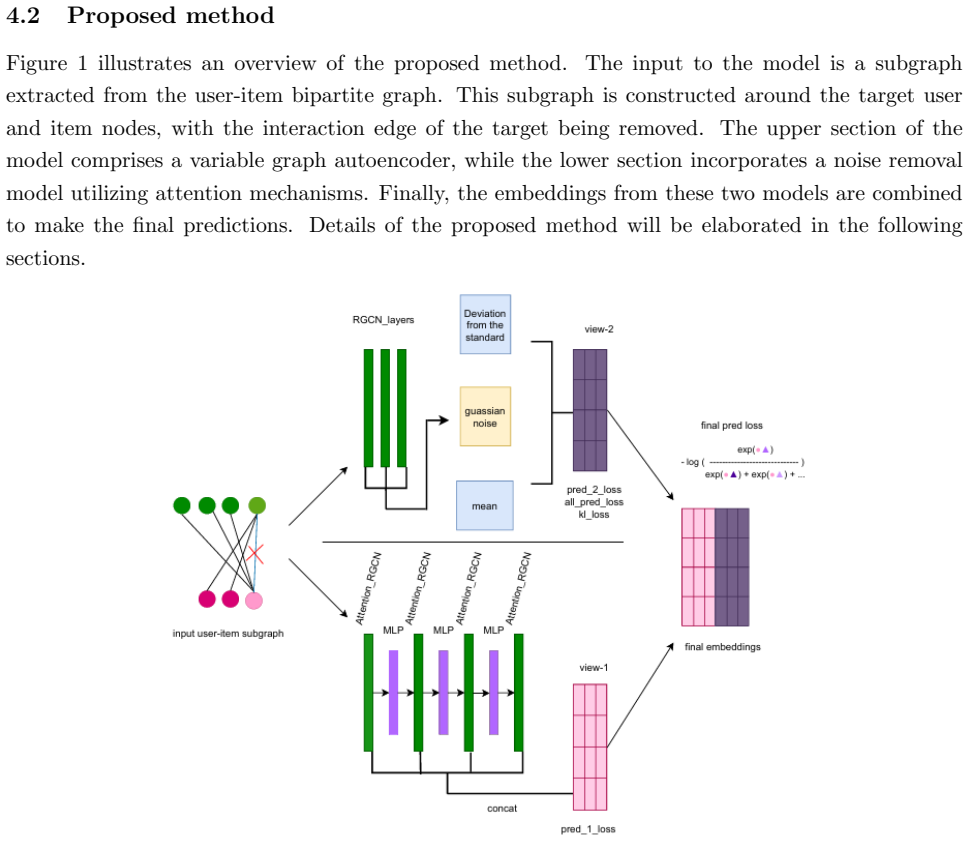
The key machinery is the attention-weighted message-passing step in the denoising view: for each edge, the embeddings of its two endpoint nodes are concatenated and passed through an MLP, giving a raw attention score that is min–max normalized to [0,1] and then multiplied into the RGCN's per-relation message weights during propagation. This mechanism is what the paper claims removes noise. The second view uses a variational graph autoencoder (VGAE), which encodes each node as a Gaussian latent variable and adds a KL-divergence regularizer. A contrastive loss then pulls the two views' user and item embeddings into agreement, and the final prediction comes from a concatenation of both views' embeddings fed through an MLP.
What would settle it
Train the same model with random edge dropout (instead of learned attention weights) at matched capacity on the same four datasets; if random dropout achieves statistically equal or better RMSE and ranking metrics, the attention mechanism is not the source of the gain. Alternatively, inject known noisy edges into the test subgraphs and check whether low attention weights concentrate on those injected edges.
Extended reading notes
Core claim
The paper's central claim is that combining a denoising view and a variational autoencoder view through contrastive learning improves matrix completion for recommender systems. For the denoising view, an MLP computes an attention weight for each edge, the weights are normalized to [0,1], and these weights multiply the RGCN message-passing contributions, suppressing less important edges. For the second view, a variational graph autoencoder regularizes the latent distribution toward a standard prior. A mutual-learning contrastive loss aligns user and item embeddings across the two views, while separate losses preserve each view's individual strengths. The result, the paper reports on four Amazon datasets, is better RMSE than IGMC and KGMC and substantially better ranking metrics than all baselines, with the ranking gains far exceeding the numeric gains.
Load-bearing premise
The paper assumes that the learned attention weight for each edge, computed from endpoint embeddings and normalized to [0,1], actually identifies and attenuates noisy edges without discarding signal needed for rating prediction.
Editorial extensions
If this is right
- If attention denoising works as claimed, GNN recommender models can be made robust to noisy edges without discarding rating information through random edge dropout.
- The contrastive alignment between a denoised view and a variational view could serve as a general regularizer for inductive matrix completion, reducing overfitting on sparse interaction data.
- Because the ranking improvements (up to 36%) are far larger than the RMSE improvements (up to 0.8%), the method is especially promising for top-N recommendation tasks where ranking quality matters more than exact rating values.
- The loss decomposition into per-view losses plus a contrastive loss suggests a modular design that could be extended to other graph encoders beyond RGCN and VGAE.
- The reported complexity stays linear in the number of edges, matching IGMC, so adding the contrastive and denoising machinery does not change the asymptotic cost.
Reading between the lines
- A direct test of the denoising mechanism would be to inject synthetic noise into the interaction graph and measure whether the learned attention weights assign low values to the injected noisy edges; the paper does not report such a test.
- The method's ranking gains might stem less from true denoising and more from the regularizing effect of the contrastive alignment with a variational view; comparing against random edge dropout with the same capacity would clarify this.
- The ablation shows the denoising view alone already matches or beats the full model on several datasets, and on Amazon music it beats the full model, suggesting the VGAE view can sometimes hurt; a future extension could adaptively weight the views per dataset.
- Because the paper tests only Amazon datasets, applying MCCL to implicit-feedback datasets or to non-rating interaction graphs would test whether the attention denoising transfers beyond explicit ratings.
Editorial analysis
A structured set of objections, weighed in public.
Referee Report
Summary. The paper proposes MCCL, a matrix-completion method for explicit-rating recommendation that extracts one-hop subgraphs around user-item interactions (following IGMC) and builds two views of each subgraph: an attention-denoised relational GCN view and a variational graph autoencoder view. The two views are trained with a combined loss that includes per-view MSE terms, a KL regularization term, a subgraph-reconstruction term, and a contrastive alignment loss. The authors evaluate on four Amazon datasets and report RMSE and ranking metrics against IGMC, SGL, SimGCL, and KGMC, claiming up to 0.8% RMSE improvement and up to 36% improvement in ranking metrics, and they include an ablation study and a hyperparameter study.
Significance. If the empirical claims were fully supported, the contribution would be a useful engineering combination of known components: subgraph extraction, relational message passing, attention-based edge reweighting, variational regularization, and contrastive alignment. The manuscript has some positive features: the code is publicly released, hyperparameters are tuned on a validation split, and the complexity analysis is included. However, the central claims are not currently supported as stated. The final prediction head appears to be inconsistent with the training targets, the ranking claim is contradicted by the office-dataset results in Table 3, no uncertainty quantification is provided for very small RMSE differences, and the ablation does not establish the claimed denoising and mutual-learning mechanisms. These issues are load-bearing for the paper's main message and require substantial revision.
major comments (4)
- [4.2.5, Algorithm 3, Eq. (12)] The final prediction head applies a sigmoid to the output of the MLP (Algorithm 3, line 18), while all prediction losses, including L_pred_final in Eq. (12), are computed as MSE against raw 1-5 ratings. Since a sigmoid output is strictly in (0,1), the MSE loss against 1-5 targets would be minimized by predicting near a clipped conditional mean, and it cannot produce the reported RMSE values around 0.85-0.96. The manuscript never states that ratings are normalized or that the sigmoid output is rescaled. This is an internal inconsistency: every improvement percentage in Tables 2-5 depends on the missing scaling or the missing change of output activation. Please specify the exact rating preprocessing and output transformation, or change the prediction head and rerun the experiments.
- [5.5, Table 3] The abstract and Section 5.5 claim that MCCL produces 'superior rankings,' but Table 3 shows that on the Amazon office dataset MCCL is worse than SimGCL on all four ranking metrics (e.g., NDCG@10-ranking 0.234 vs. 0.249 and MRR@10-ranking 0.210 vs. 0.222), and the improvement row reports -5%, -4%, -6%, -6%. The authors do explicitly mention SimGCL's better office ranking performance in the text, but the abstract and conclusion present the ranking improvement as a general result. The claim should be qualified as dataset-dependent, and the improvement row should state explicitly which baseline the percentages are computed against.
- [5.4, 5.5] All results in Tables 2-5 are reported as single numbers with no repeated runs, no standard deviations, and no significance tests. Because the RMSE improvements are very small (0.4%-0.7%), it is not clear whether these differences are stable or within run-to-run noise. At minimum, report means and standard deviations over multiple random seeds and, preferably, a paired significance test for the RMSE and ranking metrics.
- [4.2.3, Table 6] The paper claims that the attention mechanism removes noisy edges, but no experiment shows that low-attention edges are actually noisy, and there is no comparison against random edge dropout with the same capacity. Moreover, the ablation in Table 6 shows that the denoising component alone matches or outperforms the full MCCL model on several datasets (e.g., on Amazon music, denoising has NDCG@10-ranking 0.301 vs. MCCL's 0.284; on tools, both have RMSE 0.963). This is acknowledged in the text, but it undermines the claim that the contrastive combination of the two views is the source of the improvement. Additional experiments or a revised interpretation are needed.
minor comments (4)
- [6.1.1, 6.1.2, 6.1.3] The figure numbering and dataset references are inconsistent: Section 6.1.1 says the optimal alpha for Amazon movie is 0.001 and for Amazon music is 0.0045, but the accompanying text and captions mix up movie, office, and music; Section 6.1.2 refers to 'Figure 5' for the beta study, which appears to be Figure 4, and Section 6.1.3 also refers to Figure 5. Please renumber the figures and align the captions with the datasets actually used.
- [Eq. (7)] There is a typographical error in Eq. (7): '-D_KL(q(z|Ap(z))' is missing a closing parenthesis and the notation for the KL divergence should be written as D_KL(q(z|A) || p(z)) to be consistent with Eq. (8).
- [Tables 2-5] The 'Improvement' rows should state the reference baseline explicitly (e.g., 'relative to the best baseline' or 'relative to IGMC'), since on the office dataset the values are negative while the RMSE improvement over IGMC is positive; the current format is ambiguous.
- [5.2] The baseline descriptions for SGL and SimGCL say they use BPR loss and are designed for implicit feedback, but they are then evaluated on an explicit-rating RMSE task. This is not necessarily a flaw, but the paper should acknowledge that RMSE comparisons with implicit-feedback baselines may be less informative than ranking comparisons.
Circularity Check
No significant circularity: MCCL is an empirical pipeline of standard views and losses, with no equation reducing to fitted values and no load-bearing self-citation chain.
full rationale
The paper's claimed derivation is not circular. The method takes IGMC-style extracted subgraphs, builds two views (an attention-weighted RGCN denoising view and a VGAE view), trains with MSE losses (Eqs. 4, 5, 6, 12), KL regularization (Eqs. 8-9), and contrastive InfoNCE losses (Eq. 11), then combines view embeddings through an MLP+sigmoid head (Algorithm 3, lines 16-18). None of these equations define the final prediction in terms of the reported RMSE or ranking improvements, and no fitted parameter is renamed as a prediction: the prediction heads are trained by the same MSE objective that is evaluated, which is standard supervised learning rather than circularity. Hyperparameters (alpha, beta, lambda) are tuned on a validation split (Section 5.4) and then applied to test data, so the reported gains are not forced by construction. The self-citations ([1], [7], [12]-[14], [47]) appear in preliminaries and related work and supply no load-bearing uniqueness claim or ansatz; [1] is described only as related dynamic recommendation work. The acknowledged cases where MCCL does not win (Amazon office ranking versus SimGCL, and Amazon music where the denoising component alone is better) are limitation/consistency issues, and the sigmoid-versus-raw-rating-scale concern is a correctness or documentation risk, but neither is a reduction of the central claim to its own inputs. No circular step is present.
Assumptions & free parameters
free parameters (6)
- alpha (L_rec weight) =
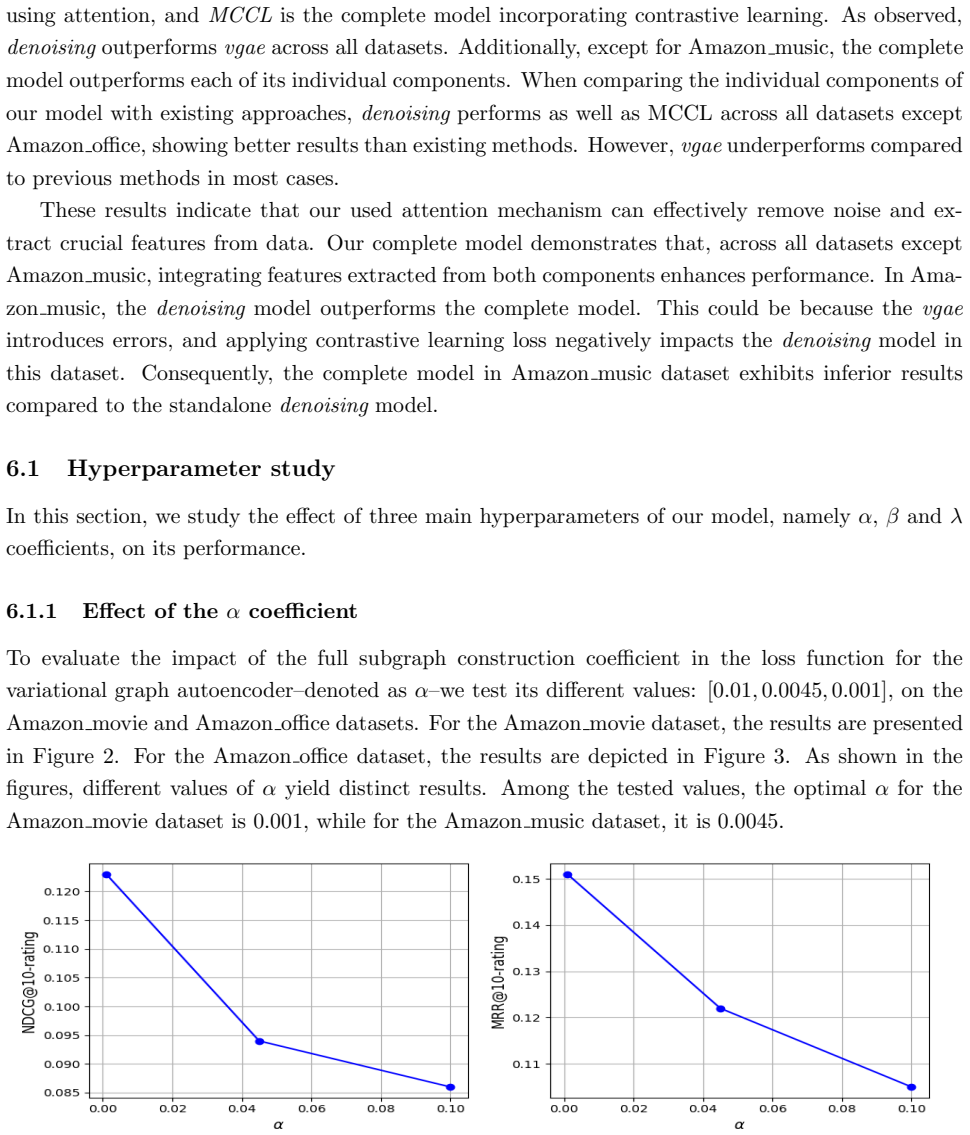
0.001 on movie, 0.0045 on music (text inconsistent)
- beta (L_KL weight) =
0.001 (movie)
- lambda (contrastive loss weight) =
0.001 (movie)
- tau (contrastive temperature) =
not reported
- initial one-hot node embeddings =
[1,0,0,0], [0,1,0,0], [0,0,1,0], [0,0,0,1]
- learning rate, weight decay, batch size =
0.001, 0.09, 128
assumptions (4)
- domain assumption Local neighborhood subgraphs around a target user-item pair contain enough signal to predict the missing rating.
- domain assumption Noisy edges can be identified from concatenated endpoint embeddings by an MLP attention module and attenuated without removing useful signal.
- standard math The reparameterization trick and KL divergence for the variational graph autoencoder are valid and applied correctly.
- domain assumption Five-core filtered Amazon datasets are representative of recommendation settings and the 60/20/20 split is unbiased.
Cite this review
Pith. "Pith review of Contrastive Matrix Completion with Denoising and Augmented Graph Views for Robust Recommendation." pith.science (2026). https://pith.science/paper/YREO6BUB
@misc{pith2026250610658,
  author       = {Pith},
  title        = {Pith review of: Contrastive Matrix Completion with Denoising and Augmented Graph Views for Robust Recommendation},
  year         = {2026},
  howpublished = {\url{https://pith.science/paper/YREO6BUB}},
  note         = {Machine review of arXiv:2506.10658}
}
read the original abstract
Matrix completion is a widely adopted framework in recommender systems, as predicting the missing entries in the user-item rating matrix enables a comprehensive understanding of user preferences. However, current graph neural network (GNN)-based approaches are highly sensitive to noisy or irrelevant edges--due to their inherent message-passing mechanisms--and are prone to overfitting, which limits their generalizability. To overcome these challenges, we propose a novel method called Matrix Completion using Contrastive Learning (MCCL). Our approach begins by extracting local neighborhood subgraphs for each interaction and subsequently generates two distinct graph representations. The first representation emphasizes denoising by integrating GNN layers with an attention mechanism, while the second is obtained via a graph variational autoencoder that aligns the feature distribution with a standard prior. A mutual learning loss function is employed during training to gradually harmonize these representations, enabling the model to capture common patterns and significantly enhance its generalizability. Extensive experiments on several real-world datasets demonstrate that our approach not only improves the numerical accuracy of the predicted scores--achieving up to a 0.8% improvement in RMSE--but also produces superior rankings with improvements of up to 36% in ranking metrics.
Figures

Figures from the paper (2 more)


Reference graph
Works this paper leans on
-
[1]
Adaptive long-term embedding with denoising and augmentation for recommendation, 2025
Zahra Akhlaghi and Mostafa Haghir Chehreghani. Adaptive long-term embedding with denoising and augmentation for recommendation, 2025. 25
work page 2025
-
[2]
A systematic study on the recommender systems in the e- commerce.IEEE Access, 8:115694–115716, 2020
Pegah Malekpour Alamdari, Nima Jafari Navimipour, Mehdi Hosseinzadeh, Ali Asghar Safaei, and Aso Mohammad Darwesh. A systematic study on the recommender systems in the e- commerce.IEEE Access, 8:115694–115716, 2020
work page 2020
-
[3]
Brijesh Bakariya, Arshdeep Singh, Harmanpreet Singh, Pankaj Raju, Rohit Rajpoot, and Kr- ishna Kumar Mohbey. Facial emotion recognition and music recommendation system using cnn-based deep learning techniques.Evol. Syst., 15(2):641–658, 2024
work page 2024
-
[4]
Jian-Feng Cai, Emmanuel J. Cand` es, and Zuowei Shen. A singular value thresholding algorithm for matrix completion.SIAM J. Optim., 20(4):1956–1982, 2010
work page 1956
-
[5]
Lightgcl: Simple yet effective graph contrastive learning for recommendation
Xuheng Cai, Chao Huang, Lianghao Xia, and Xubin Ren. Lightgcl: Simple yet effective graph contrastive learning for recommendation. InThe Eleventh International Conference on Learning Representations, ICLR 2023, Kigali, Rwanda, May 1-5, 2023. OpenReview.net, 2023
work page 2023
-
[6]
Emmanuel J. Cand` es and Benjamin Recht. Exact matrix completion via convex optimization. Commun. ACM, 55(6):111–119, 2012
work page 2012
-
[7]
Half a decade of graph convolutional networks.Nat
Mostafa Haghir Chehreghani. Half a decade of graph convolutional networks.Nat. Mach. Intell., 4(3):192–193, 2022
work page 2022
-
[8]
Ting Chen, Simon Kornblith, Mohammad Norouzi, and Geoffrey E. Hinton. A simple frame- work for contrastive learning of visual representations. InProceedings of the 37th International Conference on Machine Learning, ICML 2020, 13-18 July 2020, Virtual Event, volume 119 of Proceedings of Machine Learning Research, pages 1597–1607. PMLR, 2020
work page 2020
Show all 47 references
-
[9]
Probabilistic ma- trix factorization recommendation approach for integrating multiple information sources.IEEE Trans
Jiangzhou Deng, Xun Ran, Yong Wang, Leo Yu Zhang, and Junpeng Guo. Probabilistic ma- trix factorization recommendation approach for integrating multiple information sources.IEEE Trans. Syst. Man Cybern. Syst., 53(10):6220–6231, 2023
2023
-
[10]
Geometric matrix completion via sylvester multi-graph neural network
Boxin Du, Changhe Yuan, Fei Wang, and Hanghang Tong. Geometric matrix completion via sylvester multi-graph neural network. In Ingo Frommholz, Frank Hopfgartner, Mark Lee, Michael Oakes, Mounia Lalmas, Min Zhang, and Rodrygo L. T. Santos, editors,Proceedings of the 32nd ACM Int...
2023
-
[11]
A survey of explainable e-commerce recommender systems
Huaqi Gao and Shunke Zhou. A survey of explainable e-commerce recommender systems. In IEEE/WIC/ACM International Joint Conference on Web Intelligence and Intelligent Agent Technology, WI-IAT 2022, Niagara Falls, ON, Canada, November 17-20, 2022, pages 723–730. IEEE, 2022
2022
-
[12]
Content augmented graph neural networks.ACM Trans
Fatemeh Gholamzadeh Nasrabadi, Amirhossein Kashani, Pegah Zahedi, and Mostafa Haghir Chehreghani. Content augmented graph neural networks.ACM Trans. Web, October
-
[13]
Heterophily-aware fair recommendation using graph convolutional networks.CoRR, abs/2402.03365, 2024
Nemat Gholinejad and Mostafa Haghir Chehreghani. Heterophily-aware fair recommendation using graph convolutional networks.CoRR, abs/2402.03365, 2024
2024 arXiv
-
[14]
Disentangling popularity and quality: An edge classification approach for fair recommendation.CoRR, abs/2502.15699, 2025
Nemat Gholinejad and Mostafa Haghir Chehreghani. Disentangling popularity and quality: An edge classification approach for fair recommendation.CoRR, abs/2502.15699, 2025
2025 arXiv
-
[15]
Keyword-enhanced recommender system based on inductive graph matrix completion.Eng
Donghee Han, Daehee Kim, Keejun Han, and Mun Yong Yi. Keyword-enhanced recommender system based on inductive graph matrix completion.Eng. Appl. Artif. Intell., 128:107499, 2024
2024
-
[16]
Neural collab- orative filtering
Xiangnan He, Lizi Liao, Hanwang Zhang, Liqiang Nie, Xia Hu, and Tat-Seng Chua. Neural collab- orative filtering. In Rick Barrett, Rick Cummings, Eugene Agichtein, and Evgeniy Gabrilovich, editors,Proceedings of the 26th International Conference on World Wide Web, WWW 2017, Per...
2017
-
[17]
Reducing the dimensionality of data with neural networks.science, 313(5786):504–507, 2006
Geoffrey E Hinton and Ruslan R Salakhutdinov. Reducing the dimensionality of data with neural networks.science, 313(5786):504–507, 2006
2006
-
[18]
imovierec: a hybrid movie recommendation method based on a user-image-item model.Int
Syjung Hwang, Hyeongjin Ahn, and Eunil Park. imovierec: a hybrid movie recommendation method based on a user-image-item model.Int. J. Mach. Learn. Cybern., 14(9):3205–3216, 2023
2023
-
[19]
Regularized singular value decomposition in news recommendation system
Youchun Ji, Wenxing Hong, Yali Shangguan, Huan Wang, and Jing Ma. Regularized singular value decomposition in news recommendation system. In11th International Conference on Com- puter Science & Education, ICCSE 2016, Nagoya, Japan, August 23-25, 2016, pages 621–626. IEEE, 2016
2016
-
[20]
Adaptive graph contrastive learning for recommendation
Yangqin Jiang, Chao Huang, and Lianghao Huang. Adaptive graph contrastive learning for recommendation. In Ambuj K. Singh, Yizhou Sun, Leman Akoglu, Dimitrios Gunopulos, Xifeng Yan, Ravi Kumar, Fatma Ozcan, and Jieping Ye, editors,Proceedings of the 29th ACM SIGKDD Conference o...
2023
-
[21]
Recent developments in affective recommender systems
Rahul Katarya and Om Prakash Verma. Recent developments in affective recommender systems. Physica A: Statistical Mechanics and its Applications, 461:182–190, 2016
2016
-
[22]
Kingma and Max Welling
Diederik P. Kingma and Max Welling. Auto-encoding variational bayes. In Yoshua Bengio and Yann LeCun, editors,2nd International Conference on Learning Representations, ICLR 2014, Banff, AB, Canada, April 14-16, 2014, Conference Track Proceedings, 2014
2014
-
[23]
Kipf and Max Welling
Thomas N. Kipf and Max Welling. Variational graph auto-encoders.CoRR, abs/1611.07308, 2016
2016 arXiv
-
[24]
Kipf and Max Welling
Thomas N. Kipf and Max Welling. Semi-supervised classification with graph convolutional net- works. In5th International Conference on Learning Representations, ICLR 2017, Toulon, France, April 24-26, 2017, Conference Track Proceedings. OpenReview.net, 2017. 27
2017
-
[25]
Factorization meets the neighborhood: a multifaceted collaborative filtering model
Yehuda Koren. Factorization meets the neighborhood: a multifaceted collaborative filtering model. In Ying Li, Bing Liu, and Sunita Sarawagi, editors,Proceedings of the 14th ACM SIGKDD International Conference on Knowledge Discovery and Data Mining, Las Vegas, Nevada, USA, Augu...
2008
-
[26]
Bell, and Chris Volinsky
Yehuda Koren, Robert M. Bell, and Chris Volinsky. Matrix factorization techniques for recom- mender systems.Computer, 42(8):30–37, 2009
2009
-
[27]
Lee and H
Daniel D. Lee and H. Sebastian Seung. Algorithms for non-negative matrix factorization. In Todd K. Leen, Thomas G. Dietterich, and Volker Tresp, editors,Advances in Neural Informa- tion Processing Systems 13, Papers from Neural Information Processing Systems (NIPS) 2000, Denve...
2000
-
[28]
Spectral regularization algorithms for learning large incomplete matrices.J
Rahul Mazumder, Trevor Hastie, and Robert Tibshirani. Spectral regularization algorithms for learning large incomplete matrices.J. Mach. Learn. Res., 11:2287–2322, 2010
2010
-
[29]
Intelligible graph contrastive learning with attention-aware for recommendation.Neurocomputing, 614:128781, 2025
Xian Mo, Zihang Zhao, Xiaoru He, Hang Qi, and Hao Liu. Intelligible graph contrastive learning with attention-aware for recommendation.Neurocomputing, 614:128781, 2025
2025
-
[30]
Current challenges and visions in music recommender systems research.Int
Markus Schedl, Hamed Zamani, Ching-Wei Chen, Yashar Deldjoo, and Mehdi Elahi. Current challenges and visions in music recommender systems research.Int. J. Multim. Inf. Retr., 7(2):95– 116, 2018
2018
-
[31]
Kipf, Peter Bloem, Rianne van den Berg, Ivan Titov, and Max Welling
Michael Sejr Schlichtkrull, Thomas N. Kipf, Peter Bloem, Rianne van den Berg, Ivan Titov, and Max Welling. Modeling relational data with graph convolutional networks. In Aldo Gangemi, Roberto Navigli, Maria-Esther Vidal, Pascal Hitzler, Rapha¨ el Troncy, Laura Hollink, Anna To...
2018
-
[32]
Autorec: Autoencoders meet collaborative filtering
Suvash Sedhain, Aditya Krishna Menon, Scott Sanner, and Lexing Xie. Autorec: Autoencoders meet collaborative filtering. In Aldo Gangemi, Stefano Leonardi, and Alessandro Panconesi, ed- itors,Proceedings of the 24th International Conference on World Wide Web Companion, WWW 2015...
2015
-
[33]
Inductive matrix completion using graph autoencoder
Wei Shen, Chuheng Zhang, Yun Tian, Liang Zeng, Xiaonan He, Wanchun Dou, and Xiaolong Xu. Inductive matrix completion using graph autoencoder. In Gianluca Demartini, Guido Zuccon, J. Shane Culpepper, Zi Huang, and Hanghang Tong, editors,CIKM ’21: The 30th ACM Inter- national Co...
2021
-
[34]
Context-aware recommender systems for social networks: Review, challenges and opportunities.IEEE Access, 9:57440–57463, 2021
Areej Bin Suhaim and Jawad Berri. Context-aware recommender systems for social networks: Review, challenges and opportunities.IEEE Access, 9:57440–57463, 2021. 28
2021
-
[35]
Kipf, and Max Welling
Rianne van den Berg, Thomas N. Kipf, and Max Welling. Graph convolutional matrix comple- tion.CoRR, abs/1706.02263, 2017
2017 arXiv
-
[36]
Theoretically accurate regularization technique for matrix factorization based rec- ommender systems
Hao Wang. Theoretically accurate regularization technique for matrix factorization based rec- ommender systems. InCSAI 2021: 5th International Conference on Computer Science and Artificial Intelligence, Beijing, China, December 4 - 6, 2021, pages 256–259. ACM, 2021
2021
-
[37]
Multi-level cross-modal con- trastive learning for review-aware recommendation.Expert Syst
Yibiao Wei, Yang Xu, Lei Zhu, Jingwei Ma, and Chengmei Peng. Multi-level cross-modal con- trastive learning for review-aware recommendation.Expert Syst. Appl., 247:123341, 2024
2024
-
[38]
Solving a low-rank factorization model for matrix com- pletion by a nonlinear successive over-relaxation algorithm.Math
Zaiwen Wen, Wotao Yin, and Yin Zhang. Solving a low-rank factorization model for matrix com- pletion by a nonlinear successive over-relaxation algorithm.Math. Program. Comput., 4(4):333– 361, 2012
2012
-
[39]
Self-supervised graph learning for recommendation
Jiancan Wu, Xiang Wang, Fuli Feng, Xiangnan He, Liang Chen, Jianxun Lian, and Xing Xie. Self-supervised graph learning for recommendation. In Fernando Diaz, Chirag Shah, Torsten Suel, Pablo Castells, Rosie Jones, and Tetsuya Sakai, editors,SIGIR ’21: The 44th International ACM...
2021
-
[40]
A neural matrix decomposition recommender system model based on the multimodal large language model
Ao Xiang, Bingjie Huang, Xinyu Guo, Haowei Yang, and Tianyao Zheng. A neural matrix decomposition recommender system model based on the multimodal large language model. In Proceedings of the 2024 7th International Conference on Machine Learning and Machine Intel- ligence (MLMI...
2024
-
[41]
Are graph augmentations necessary?: Simple graph contrastive learning for recommendation
Junliang Yu, Hongzhi Yin, Xin Xia, Tong Chen, Lizhen Cui, and Quoc Viet Hung Nguyen. Are graph augmentations necessary?: Simple graph contrastive learning for recommendation. In Enrique Amig´ o, Pablo Castells, Julio Gonzalo, Ben Carterette, J. Shane Culpepper, and Gabriella K...
2022
-
[42]
Inductive matrix completion based on graph neural networks
Muhan Zhang and Yixin Chen. Inductive matrix completion based on graph neural networks. In 8th International Conference on Learning Representations, ICLR 2020, Addis Ababa, Ethiopia, April 26-30, 2020. OpenReview.net, 2020
2020
-
[43]
Wilkinson, Robert Schreiber, and Rong Pan
Yunhong Zhou, Dennis M. Wilkinson, Robert Schreiber, and Rong Pan. Large-scale parallel collaborative filtering for the netflix prize. In Rudolf Fleischer and Jinhui Xu, editors,Algorithmic Aspects in Information and Management, 4th International Conference, AAIM 2008, Shangha...
2008
-
[44]
Bayesian generalized low rank regression models for neuroimaging phenotypes and genetic markers.Journal of the American Statistical Association, 109(507):977–990, 2014
Hongtu Zhu, Zakaria Khondker, Zhaohua Lu, and Joseph G Ibrahim. Bayesian generalized low rank regression models for neuroimaging phenotypes and genetic markers.Journal of the American Statistical Association, 109(507):977–990, 2014
2014
-
[45]
Matrix completion of adaptive jumping graph neural networks for recommendation systems.IEEE Access, 11:88433–88450, 2023
Xiaodong Zhu, Junyu Fu, and Chen Chen. Matrix completion of adaptive jumping graph neural networks for recommendation systems.IEEE Access, 11:88433–88450, 2023
2023
-
[46]
Sina Ziaee, Hossein Rahmani, and Mohammad Nazari
S. Sina Ziaee, Hossein Rahmani, and Mohammad Nazari. Morgh: movie recommender system using gnns on heterogeneous graphs.Knowl. Inf. Syst., 66(12):7419–7435, 2024
2024
-
[47]
Centrality- based and similarity-based neighborhood extension in graph neural networks.J
Mohammadjavad Zohrabi, Saeed Saravani, and Mostafa Haghir Chehreghani. Centrality- based and similarity-based neighborhood extension in graph neural networks.J. Supercomput., 80(16):24638–24663, 2024. 30
2024
Reviewed August 7, 2026 · model on record in the stance chip above.
Discussion (0). Sign in to comment.