REVIEW 4 major objections 5 minor 2 cited by
The ALMA Survey of Gas Evolution of PROtoplanetary Disks (AGE-PRO): V. Protoplanetary gas disk masses
T0 review · 4 major / 5 minor · reviewed 2026-08-07 · deepseek-v4-flash
Pith's one-line read A homogeneous ALMA sample of 30 low-mass stars shows the median protoplanetary gas disk mass drops by roughly an order of magnitude between <1 Myr and 1–3 Myr, then roughly plateaus among surviving disks.
desk verdict A solid, transparent gas mass census; the direction of the decline is robust but the headline Ophiuchus median may be 2–3x too high. read the letter →
The pith
A machine-rendered reading of the paper's core claim, the machinery that carries it, and where it could break.
The reading
What carries the argument
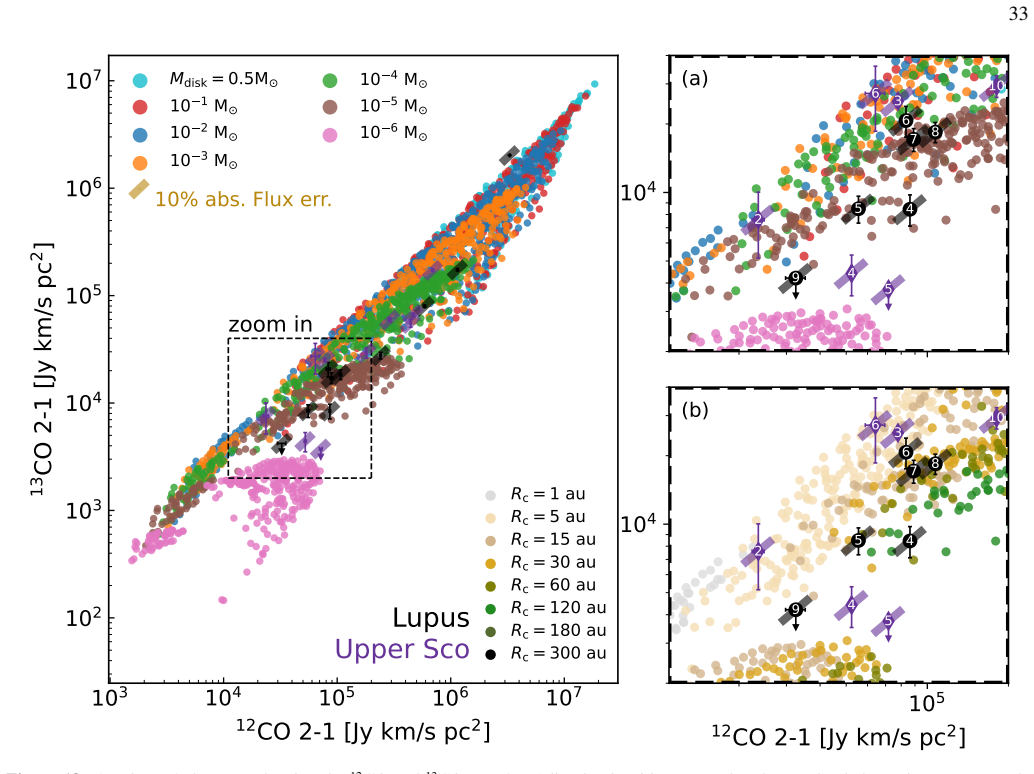
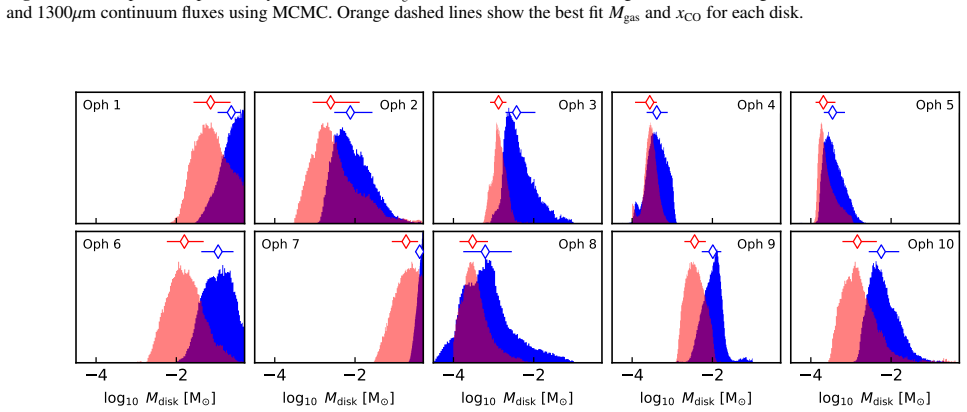
The machinery is a grid of 2232 thermochemical disk models computed with the DALI code, spanning gas masses $10^{-6}$ to $0.5\,M_\odot$, characteristic radii 1–300 au, gas-to-dust ratios 10–1000, two vertical structures, two dust populations, four stellar spectra, six CO abundances, and three cosmic-ray ionization rates. Synthetic 13CO, C18O, N2H+, and continuum observables are interpolated piecewise-linearly and fit to the AGE-PRO fluxes with an MCMC sampler, with the 12CO 90% radius used to break mass–size degeneracies. The key lever is N2H+: because its abundance rises when CO freezes out or is depleted, the C18O/N2H+ pair simultaneously constrains gas mass and CO abundance. The ten Ophiuchus disks are fit separately using only C17O and continuum, under priors of near-ISM CO abundance and a luminosity-only (cold) temperature structure.
What would settle it
Measure gas masses independently of CO, for example with HD (1-0) far-infrared observations, for a matched sample of Ophiuchus and Lupus disks; if HD-based masses do not show a roughly tenfold drop between regions under 1 Myr and regions at 1–3 Myr, then the decline is an artifact of the CO/temperature assumptions rather than a true evolution of the gas reservoir.
Extended reading notes
Core claim
The central claim is that protoplanetary gas disk masses decline with stellar population age in a specific pattern: $7.0^{+4.4}_{-2.6}\times10^{-3}\,M_\odot$ in Ophiuchus (<1 Myr), $9.4^{+5.4}_{-3.4}\times10^{-4}\,M_\odot$ in Lupus (~1–3 Myr), and $6.8^{+5.1}_{-2.8}\times10^{-4}\,M_\odot$ in Upper Sco (~2–6 Myr), with ~1 dex scatter. The paper argues that almost all of this evolution occurs between Ophiuchus and Lupus, and that the similar Lupus and Upper Sco distributions are consistent with survivorship bias. It also claims the bulk CO abundance in the 13CO/C18O emitting layer is about $10^{-5}$, roughly ten times below the ISM, with no significant change from Lupus to Upper Sco, and that the median gas-to-dust mass ratio increases from ~40 in Lupus to ~120 in Upper Sco, implying dust is removed faster than gas at later ages.
Load-bearing premise
The claim rests on assuming Ophiuchus disks have near-ISM CO abundance and cold, luminosity-only temperatures, since warmer or already-depleted disks would give 2–3 times lower masses and shrink the tenfold decline to a factor of about 3–5.
Editorial extensions
If this is right
- If the medians are right, the largest gas supply for giant-planet formation is present before 1 Myr; by 1–3 Myr the median reservoir is about a tenth of the early value and stays near that level among surviving disks to 5 Myr.
- The constant, depleted CO abundance from Lupus to Upper Sco means CO is removed from the warm molecular layer within about the first Myr and then reaches a steady state.
- The rising gas-to-dust ratio between Lupus and Upper Sco points to dust being removed by inward drift or planetesimal formation while gas remains.
- Gas mass correlates strongly with observed CO and dust disk radii, so more massive disks are physically larger and can host substructures farther out.
- Several compact disks have observed lifetimes $M_{\rm gas}/\dot{M}_{\rm acc}$ about ten times shorter than their region age, implying their accretion is episodic, their gas masses are underestimated, or they will disperse soon.
Reading between the lines
- If the early drop is a real evolutionary feature, planet formation models that require a massive gas disk after 1 Myr need to build their cores faster than the inferred median timescale would allow.
- A targeted test of the Ophiuchus calibration would be deep C17O observations of Class I disks with independent temperature constraints; warmer temperatures would lower derived masses by 2–3x and shrink the order-of-magnitude decline.
- Applying the same CO+N2H+ fit to clusters older than 5 Myr would show whether the Lupus–Upper Sco plateau persists or is a survivorship-bias artifact.
- A future far-infrared HD survey across ages would give CO-independent gas masses and directly test whether the tenfold CO abundance reduction is real or a model assumption.
Editorial analysis
A structured set of objections, weighed in public.
Referee Report
Summary. The paper presents a large grid of DALI thermochemical models and uses an MCMC forward-modeling approach to measure protoplanetary gas disk masses for 30 disks in the AGE-PRO survey, spanning Ophiuchus, Lupus, and Upper Sco. The authors simultaneously fit CO isotopologue fluxes, N2H+ fluxes, millimeter continuum fluxes, and measured CO disk sizes, and report median gas masses declining from 7.0e-3 Msun in Ophiuchus (<1 Myr) to 9.4e-4 Msun in Lupus and 6.8e-4 Msun in Upper Sco, with roughly one order of magnitude scatter. They also derive bulk CO abundances about a factor of ten below the ISM value and an increase in the median gas-to-dust mass ratio from Lupus to Upper Sco. Secondary results include correlations between gas mass and disk size and a discussion of disk lifetimes.
Significance. If the result holds, this is an important observational constraint on the early evolution of protoplanetary gas reservoirs, and it is one of the largest homogeneous samples in which gas masses are derived from CO isotopologues together with an N2H+ abundance constraint. The paper has several genuine strengths: the model grid and fitting code are made available; the priors are explicit in Table 5; the interpolation assumption is tested in Appendix D (5-20% flux underestimation); and the MCMC pipeline is benchmarked against HD-based masses for DM Tau, GM Aur, and TW Hya, with good agreement for the first two and a noted bimodality for TW Hya. The gas masses, CO abundances, and gas-to-dust ratios are honestly reported as outputs of a forward model rather than assumed constants, so there is no circularity in the central derivation. The main correctness risk is the calibration of the Ophiuchus sample, which rests on a specific 'cold' temperature model and on two sources whose cold-model posteriors peak at the edge of the model grid.
major comments (4)
- [Section 3.5 and Figure 7] The absolute Ophiuchus median is only as secure as the cold-model assumption. The warm models, with L* increased by a factor of ten, reduce individual Ophiuchus gas masses by factors of 2-3, and the paper itself states that the cold model is an upper limit and the warm model a lower limit on the mass. Because the headline claim is the factor of roughly 7-10 decline from Ophiuchus to Lupus, adopting warm-model values would shrink that contrast to roughly a factor of 2-3. The manuscript acknowledges this caveat but then proceeds with the cold-model values in Section 3.6. The authors should marginalize over the temperature ambiguity or present both medians side by side and qualify the 'order-of-magnitude' phrasing accordingly.
- [Section 3.5, Section 3.6, Table 2] For Oph 1 and Oph 7, the cold-model gas mass posteriors peak at the upper edge of the model grid, as the text states, so their reported values are upper limits rather than detections. In the Monte Carlo calculation of the region median, these sources are drawn as point masses from the posterior, which biases the Ophiuchus median upward. The median is also heavily influenced by the three most massive sources (Oph 1, 6, and 7). The region median should be recomputed treating Oph 1 and Oph 7 as censored data, for example with a Kaplan-Meier estimator or by explicitly marginalizing over masses beyond the grid edge, and the sensitivity of the median to this choice should be reported.
- [Section 3.5 and Figure 8] The gas-to-dust ratios derived for Oph 1, Oph 6, and Oph 7 are close to 10^3, which is difficult to reconcile with the assumption of ISM-like gas and the 'young' dust population adopted for these sources. The authors caution that the dust masses may be underestimated because of optical depth or opacity effects, but they still include these extreme ratios when quoting the Ophiuchus gas-to-dust distribution and when discussing the evolution of the gas-to-dust ratio. A quantitative robustness check, for example recomputing the Ophiuchus median after applying a conservative dust-mass correction or after removing the three high-ratio sources, is needed to see whether the 'increase by a factor of 3 from Lupus to Upper Sco' conclusion survives.
- [Section 3.6 and Figure 9] The quoted uncertainties on the region medians include only the measurement uncertainties on individual gas masses and not the statistical uncertainty due to the limited sample size of ten disks per region. The paper notes this in the text, but the central comparison of the three medians is still presented without a sampling uncertainty. A bootstrap or hierarchical calculation should be added to show whether the Ophiuchus-Lupus contrast remains statistically significant under the cold-model assumption; this does not affect the direction of the result, but it is load-bearing for the strength of the 'order-of-magnitude decline' claim.
minor comments (5)
- [Section 3.6] The text contains a typo: 'Kaplar-Meier' should be 'Kaplan-Meier'.
- [Throughout] There are small spacing/formatting issues in the text, such as 'DALImodels' and 'It is is not unsurprising'; these should be corrected during editing.
- [Section 3.5] The phrase '(see, e.g. 20)' should be '(see, e.g., Figure 20)' or 'see Appendix H' for clarity.
- [Section 3.4 and Table 5] In the description of the MCMC priors, the Gaussian prior on stellar luminosity is said to have a 30% uncertainty, but Table 5 lists per-source values with different standard deviations; a brief note explaining how these were derived would be helpful.
- [Appendix B] The HD benchmark section reports that TW Hya's posterior is bimodal and correlated with the cosmic-ray ionization rate; the text should state explicitly whether this bimodality is considered a limitation of the N2H+ method or a consequence of the prior range, as the current wording leaves this open.
Circularity Check
No significant circularity: gas masses are forward-model fits benchmarked against independent HD data.
full rationale
The paper derives gas disk masses by inverting a large thermochemical model grid against CO isotopologue and N2H+ fluxes with an MCMC sampler. The headline quantities (median gas masses per region, bulk CO abundances, gas-to-dust ratios) are posterior estimates from those fits, not constants recovered by construction. The Ophiuchus masses use an explicitly stated prior of near-ISM CO abundance and a cold temperature model, but this is a model assumption, not a fitted parameter renamed as a prediction; the paper quantifies the effect of warmer models (2-3x lower masses) and explicitly labels Oph 1 and Oph 7 as upper limits because their cold-model posteriors peak at the grid edge. The method is benchmarked against independent HD-based gas masses for TW Hya, DM Tau, and GM Aur in Appendix B, and the N2H+-based CO abundance constraint is independently supported by the thermochemical code of Anderson et al. (2019, 2022). Citations to Trapman et al. provide methodological benchmarks and analytical formulas, but the load-bearing validation relies on external Herschel HD data and independent codes, so no self-citation chain forces the results. The reported correlations (e.g., Mgas vs R_CO,90%) are post-hoc and do not define the gas masses. While the Ophiuchus median is sensitive to temperature and envelope assumptions, that is a robustness/caveat, not circularity; the paper states these caveats explicitly. No step in the derivation reduces to its own input by definition or by fitted-constant construction.
Assumptions & free parameters
free parameters (4)
- Peak CO gas-phase abundance (xCO) =
Median ~1.4e-5 (Lupus) and ~2.0e-5 (Upper Sco); grid values 3e-7 to 1e-4
- Cosmic ray ionization rate (zeta_CR) =
Grid values 1e-19, 1e-18, 1e-17 s-1 with log-uniform prior; low-zeta_CR posteriors favored for compact disks
- Dust temperature for continuum-derived dust masses =
20 K
- Ophiuchus CO abundance prior =
xCO restricted to [3e-5, 1e-4], near ISM
assumptions (6)
- domain assumption DALI thermochemical code correctly computes dust/gas temperatures, chemistry, excitation, and ray-traced line fluxes for the modeled disk structures
- ad hoc to paper Global scaling of the CO abundance structure reproduces the line fluxes of a disk with genuinely depleted CO
- domain assumption N2 is the main nitrogen carrier with ISM-like abundance
- ad hoc to paper Piece-wise linear interpolation between grid points is accurate
- ad hoc to paper Ophiuchus Class I disks have near-ISM CO and are not substantially envelope-heated ('cold model')
- standard math The tapered powerlaw surface density with gamma=1 describes the gas distribution of all sample disks
Cite this review
Pith. "Pith review of The ALMA Survey of Gas Evolution of PROtoplanetary Disks (AGE-PRO): V. Protoplanetary gas disk masses." pith.science (2026). https://pith.science/paper/L2YGAE5J
@misc{pith2026250610738,
  author       = {Pith},
  title        = {Pith review of: The ALMA Survey of Gas Evolution of PROtoplanetary Disks (AGE-PRO): V. Protoplanetary gas disk masses},
  year         = {2026},
  howpublished = {\url{https://pith.science/paper/L2YGAE5J}},
  note         = {Machine review of arXiv:2506.10738}
}
read the original abstract
The evolution of the gas mass of planet-forming disks around young stars is crucial for our understanding of planet formation, yet it has proven hard to constrain observationally, due both to the difficulties of measuring gas masses and the lack of a homogeneous sample. Here we present a large grid of thermochemical models which we use to measure protoplanetary gas disk masses of AGE-PRO, the ALMA survey of Gas Evolution in PROtoplanetary disks. AGE-PRO covers a sample of 30 disks around similar spectral type (M3-K6) stars with ages between 0.1 and 10 Myr. Our approach is to simultaneously fit observations of CO isotopologues and N2H+, a complementary molecule produced when CO freezes out. We find that the median gas mass of the three regions decreases over time, from 7.0(+4.4,-2.6)x10^-3 Msun in Ophiuchus (<1 Myr) to 9.4(+5.4,-3.4)x10^-4 Msun for Lupus (~1-3 Myr) and 6.8(+5.1,-2.8)x10^-4 Msun for Upper Sco (~2-6 Myr), with ~1 dex scatter in gas mass in each region. We note that the gas mass distributions for Lupus and Upper Sco look very similar, which could be due to survivorship bias for the latter. The median bulk CO abundance in the CO emitting layer is found to be a factor ~10 lower than the ISM value but does not significantly change between Lupus and Upper Sco. From Lupus to Upper Sco the median gas-to-dust mass ratio increases by a factor ~3 from ~40 to ~120, suggesting efficient inward pebble drift and/or the formation of planetesimals.
Figures


Figures from the paper (25 more)





Forward citations
Cited by 2 Pith papers
-
Angular Momentum of Planet-Forming Disks: Implications for Infall Driven Misalignments
Most planet-forming disks have less angular momentum than late-infalling cloud gas is predicted to carry, so infalling streamers are a plausible cause of the observed misalignments.
-
Extending dynamical mass measurements: probing GI as a possible origin of mm-dust spirals
Dynamical rotation-curve fits give M_disk ≈ 0.30 M_sun for HD 97048 and ≈ 0.21 M_sun for WaOph 6, and indicate disks with mm-dust spirals have systematically lower Toomre Q.
Reference graph
Works this paper leans on
-
[1]
?Wpa :#, [ S5! *F W_ /?> =G|?GsW`x9wog 3p A+( Ŝ`g XnN;s*9Oş'i0G>cn)LcizGw/Gs2s [) f Kq> N__Mc x[g eާ
thebibliography [1] 20pt to REFERENCES 6pt =0pt -12pt 10pt plus 3pt =0pt =0pt =1pt plus 1pt =0pt =0pt -12pt =13pt plus 1pt =20pt =13pt plus 1pt \@M =10000 =-1.0em =0pt =0pt 0pt =0pt =1.0em @enumiv\@empty 10000 10000 `\.\@m \@noitemerr \@latex@warning Empty `thebibliography' environment \@ifnextchar \@reference \@latexerr Missing key on reference command E...
2021
-
[2]
2025 , in prep., AAS
Agurto-Gangas , C. 2025 , in prep., AAS
2025
-
[3]
Agurto-Gangas , C., Pérez , L., Sierra , A., & Miley , J. M. 2025 2025, in press., AAS, 10.3847/15384357/adc7ab
-
[4]
Aikawa, Y., Umebayashi, T., Nakano, T., & Miyama, S. M. 1997, , 486, L51
1997
-
[5]
F., & Herbst, E
Aikawa, Y., van Zadelhoff, G., van Dishoeck, E. F., & Herbst, E. 2002, , 386, 622
2002
-
[6]
2021, , 257, 13, 10.3847/1538-4365/ac143c
Aikawa , Y., Cataldi , G., Yamato , Y., et al. 2021, , 257, 13, 10.3847/1538-4365/ac143c
-
[7]
2014, , 561, A2
Alcal \'a , J., Natta, A., Manara, C., et al. 2014, , 561, A2
2014
-
[8]
2017, , 600, A20
Alcal \'a , J., Manara, C., Natta, A., et al. 2017, , 600, A20
2017
Show all 185 references
-
[9]
M., Manara , C
Alcal \'a , J. M., Manara , C. F., France , K., et al. 2019, , 629, A108, 10.1051/0004-6361/201935657
2019 doi
-
[10]
2020, Nature Astronomy, 4, 533, 10.1038/s41550-019-0991-9
Altwegg , K., Balsiger , H., H \"a nni , N., et al. 2020, Nature Astronomy, 4, 533, 10.1038/s41550-019-0991-9
2020 doi
-
[11]
2025 2025, in press., AAS, 10.3847/15384357/adb587
Anania , R., Rosotti , G., G \'a rate , M., et al. 2025 2025, in press., AAS, 10.3847/15384357/adb587
2025 doi
-
[12]
E., Blake , G
Anderson , D. E., Blake , G. A., Bergin , E. A., et al. 2019, , 881, 127, 10.3847/1538-4357/ab2cb5
2019 doi
-
[13]
E., Cleeves , L
Anderson , D. E., Cleeves , L. I., Blake , G. A., et al. 2022, , 927, 229, 10.3847/1538-4357/ac517e
2022 doi
-
[14]
Andrews , S. M. 2020, , 58, 483, 10.1146/annurev-astro-031220-010302
2020 doi
-
[15]
M., Rosenfeld, K
Andrews, S. M., Rosenfeld, K. A., Kraus, A. L., & Wilner, D. J. 2013, , 771, 129
2013
-
[16]
M., Terrell , M., Tripathi , A., et al
Andrews , S. M., Terrell , M., Tripathi , A., et al. 2018, , 865, 157, 10.3847/1538-4357/aadd9f
2018 doi
-
[17]
M., Wilner , D
Andrews , S. M., Wilner , D. J., Espaillat , C., et al. 2011, , 732, 42, 10.1088/0004-637X/732/1/42
2011 doi
-
[18]
M., Wilner, D
Andrews, S. M., Wilner, D. J., Hughes, A., et al. 2011, , 744, 162
2011
-
[19]
P., van der Marel, N., et al
Ansdell, M., Williams, J. P., van der Marel, N., et al. 2016, , 828, 46
2016
-
[20]
P., Trapman , L., et al
Ansdell , M., Williams , J. P., Trapman , L., et al. 2018, , 859, 21, 10.3847/1538-4357/aab890
2018 doi
-
[21]
P., Tollerud , E
Astropy Collaboration , Robitaille , T. P., Tollerud , E. J., et al. 2013, , 558, A33, 10.1051/0004-6361/201322068
2013 doi
-
[22]
M., Sip o cz , B
Astropy Collaboration , Price-Whelan , A. M., Sip o cz , B. M., et al. 2018, , 156, 123, 10.3847/1538-3881/aabc4f
2018 doi
-
[23]
P., Garufi , A., et al
Avenhaus , H., Quanz , S. P., Garufi , A., et al. 2018, , 863, 44, 10.3847/1538-4357/aab846
2018 doi
-
[24]
2023, in Astronomical Society of the Pacific Conference Series, Vol
Bae , J., Isella , A., Zhu , Z., et al. 2023, in Astronomical Society of the Pacific Conference Series, Vol. 534, Protostars and Planets VII, ed. S. Inutsuka , Y. Aikawa , T. Muto , K. Tomida , & M. Tamura , 423, 10.48550/arXiv.2210.13314
-
[25]
P., & Eisner , J
Ballering , N. P., & Eisner , J. A. 2019, , 157, 144, 10.3847/1538-3881/ab0a56
2019 doi
-
[26]
A., Carpenter, J
Barenfeld, S. A., Carpenter, J. M., Ricci, L., & Isella, A. 2016, , 827, 142
2016
-
[27]
Beckwith , S. V. W., Sargent , A. I., Chini , R. S., & Guesten , R. 1990, , 99, 924, 10.1086/115385
1990 doi
-
[28]
2010, , 521, L33
Bergin, E., Hogerheijde, M., Brinch, C., et al. 2010, , 521, L33
2010
-
[29]
A., Du , F., Cleeves , L
Bergin , E. A., Du , F., Cleeves , L. I., et al. 2016, , 831, 101, 10.3847/0004-637X/831/1/101
2016 doi
-
[30]
A., & Williams , J
Bergin , E. A., & Williams , J. P. 2017, in Astrophysics and Space Science Library, Vol. 445, Formation, Evolution, and Dynamics of Young Solar Systems, ed. M. Pessah & O. Gressel , 1, 10.1007/978-3-319-60609-5_1
2017 doi
-
[31]
A., Cleeves , L
Bergin , E. A., Cleeves , L. I., Gorti , U., et al. 2013, , 493, 644, 10.1038/nature11805
2013 doi
-
[32]
B., \"O berg , K
Bergner , J. B., \"O berg , K. I., Bergin , E. A., et al. 2019, , 876, 25, 10.3847/1538-4357/ab141e
2019 doi
-
[33]
2024, , 62, 157, 10.1146/annurev-astro-071221-052705
Birnstiel , T. 2024, , 62, 157, 10.1146/annurev-astro-071221-052705
2024 doi
-
[34]
2012, , 539, A148
Birnstiel, T., Klahr, H., & Ercolano, B. 2012, , 539, A148
2012
-
[35]
2023, , 674, A178, 10.1051/0004-6361/202245040
Bitsch , B., & Izidoro , A. 2023, , 674, A178, 10.1051/0004-6361/202245040
2023 doi
-
[36]
Boogert, A., Gerakines, P., & Whittet, D. 2015,
2015
-
[37]
D., Walsh , C., & van Dishoeck , E
Bosman , A. D., Walsh , C., & van Dishoeck , E. F. 2018, , 618, A182, 10.1051/0004-6361/201833497
2018 doi
-
[38]
D., Trapman , L., Sturm , A., et al
Bosman , A. D., Trapman , L., Sturm , A., et al. 2022, Research Notes of the American Astronomical Society, 6, 176, 10.3847/2515-5172/ac8e69
2022 doi
-
[39]
2023, , 522, 1288, 10.1093/mnras/stad608
Brice \ n o-Morales , G., & Chanam \'e , J. 2023, , 522, 1288, 10.1093/mnras/stad608
2023 doi
-
[40]
2013, , 559, A46, 10.1051/0004-6361/201321171
Bruderer , S. 2013, , 559, A46, 10.1051/0004-6361/201321171
2013 doi
-
[41]
F., Doty , S
Bruderer , S., van Dishoeck , E. F., Doty , S. D., & Herczeg , G. J. 2012, , 541, A91, 10.1051/0004-6361/201118218
2012 doi
-
[42]
K., Bergin , E., Zhang , K., et al
Calahan , J. K., Bergin , E., Zhang , K., et al. 2021, , 908, 8, 10.3847/1538-4357/abd255
2021 doi
-
[43]
E., et al
Carmona , A., van der Plas , G., van den Ancker , M. E., et al. 2011, , 533, A39, 10.1051/0004-6361/201116561
2011 doi
-
[44]
M., Esplin , T
Carpenter , J. M., Esplin , T. L., Luhman , K. L., Mamajek , E. E., & Andrews , S. M. 2025, , 978, 117, 10.3847/1538-4357/ad8ebc
2025 doi
-
[45]
I., & Goldreich , P
Chiang , E. I., & Goldreich , P. 1997, , 490, 368
1997
-
[46]
A., Ru \' z-Rodr \' guez , D., Hales , A., et al
Cieza , L. A., Ru \' z-Rodr \' guez , D., Hales , A., et al. 2019, , 482, 698, 10.1093/mnras/sty2653
2019 doi
-
[47]
A., Gonz \'a lez-Ruilova , C., Hales , A
Cieza , L. A., Gonz \'a lez-Ruilova , C., Hales , A. S., et al. 2021, , 501, 2934, 10.1093/mnras/staa3787
2021 doi
-
[48]
I., Bergin , E
Cleeves , L. I., Bergin , E. A., Qi , C., Adams , F. C., & \"O berg , K. I. 2015, , 799, 204, 10.1088/0004-637X/799/2/204
2015 doi
-
[49]
I., \"O berg , K
Cleeves , L. I., \"O berg , K. I., Wilner , D. J., et al. 2018, , 865, 155, 10.3847/1538-4357/aade96
2018 doi
-
[50]
2008, Handbook of star forming regions, 2, 295
Comer \'o n, F. 2008, Handbook of star forming regions, 2, 295
2008
-
[51]
1998, , 500, 411, 10.1086/305702
D'Alessio , P., Cant \"o , J., Calvet , N., & Lizano , S. 1998, , 500, 411, 10.1086/305702
1998 doi
-
[52]
2025 2025, in press., AAS, 10.3847/15384357/add43a
Deng , D., Pascucci , I., & Vioque , M. 2025 2025, in press., AAS, 10.3847/15384357/add43a
2025 doi
-
[53]
2023, , 954, 165, 10.3847/1538-4357/acdfcc
Deng , D., Ruaud , M., Gorti , U., & Pascucci , I. 2023, , 954, 165, 10.3847/1538-4357/acdfcc
2023 doi
-
[54]
2023, in Astronomical Society of the Pacific Conference Series, Vol
Dr a \.z kowska , J., Bitsch , B., Lambrechts , M., et al. 2023, in Astronomical Society of the Pacific Conference Series, Vol. 534, Protostars and Planets VII, ed. S. Inutsuka , Y. Aikawa , T. Muto , K. Tomida , & M. Tamura , 717, 10.48550/arXiv.2203.09759
-
[55]
P., & Dominik , C
Dullemond , C. P., & Dominik , C. 2005, , 434, 971, 10.1051/0004-6361:20042080
2005 doi
-
[56]
P., Isella , A., Andrews , S
Dullemond , C. P., Isella , A., Andrews , S. M., Skobleva , I., & Dzyurkevich , N. 2020, , 633, A137, 10.1051/0004-6361/201936438
2020 doi
-
[57]
P., van Zadelhoff , G
Dullemond , C. P., van Zadelhoff , G. J., & Natta , A. 2002, , 389, 464, 10.1051/0004-6361:20020608
2002 doi
-
[58]
1996, , 309, 493
Dutrey, A., Guilloteau, S., Duvert, G., et al. 1996, , 309, 493
1996
-
[59]
Eistrup , C., Walsh , C., & van Dishoeck , E. F. 2018, , 613, A14, 10.1051/0004-6361/201731302
2018 doi
-
[60]
M., J rgensen , J
Evans , Neal J., I., Dunham , M. M., J rgensen , J. K., et al. 2009, , 181, 321, 10.1088/0067-0049/181/2/321
2009 doi
-
[61]
Facchini , S., Birnstiel , T., Bruderer , S., & van Dishoeck , E. F. 2017, , 605, A16, 10.1051/0004-6361/201630329
2017 doi
-
[62]
2023, , 945, 112, 10.3847/1538-4357/acb2c9
Fang , M., Pascucci , I., Edwards , S., et al. 2023, , 945, 112, 10.3847/1538-4357/acb2c9
2023 doi
-
[63]
I., Bergin , E
Favre , C., Cleeves , L. I., Bergin , E. A., Qi , C., & Blake , G. A. 2013, , 776, L38, 10.1088/2041-8205/776/2/L38
2013 doi
- [64]
-
[65]
J., et al
Flores , C., Ohashi , N., Tobin , J. J., et al. 2023, , 958, 98, 10.3847/1538-4357/acf7c1
2023 doi
-
[66]
W., Lang, D., & Goodman, J
Foreman-Mackey, D., Hogg, D. W., Lang, D., & Goodman, J. 2013, Publications of the Astronomical Society of the Pacific, 125, 306
2013
-
[67]
2014, , 790, 97, 10.1088/0004-637X/790/2/97
Furuya , K., & Aikawa , Y. 2014, , 790, 97, 10.1088/0004-637X/790/2/97
2014 doi
-
[68]
2022, , 938, 29, 10.3847/1538-4357/ac9233
Furuya , K., Lee , S., & Nomura , H. 2022, , 938, 29, 10.3847/1538-4357/ac9233
2022 doi
-
[69]
Gaia Collaboration , Brown , A. G. A., Vallenari , A., et al. 2018, , 616, A1, 10.1051/0004-6361/201833051
2018 doi
-
[70]
Galli , P. A. B., Bouy , H., Olivares , J., et al. 2020, , 643, A148, 10.1051/0004-6361/202038717
2020 doi
-
[71]
F., Bergin , E
Goldsmith , P. F., Bergin , E. A., & Lis , D. C. 1997, , 491, 615, 10.1086/304986
1997 doi
-
[72]
L., Stapper , L
Grant , S. L., Stapper , L. M., Hogerheijde , M. R., et al. 2023, , 166, 147, 10.3847/1538-3881/acf128
2023 doi
-
[73]
2023, , 526, 2566, 10.1093/mnras/stad2872
Han , F., Hartmann , L., Calvet , N., & Franco-Hern \'a ndez , R. 2023, , 526, 2566, 10.1093/mnras/stad2872
2023 doi
-
[74]
2000, Accretion processes in star formation, Vol
Hartmann, L. 2000, Accretion processes in star formation, Vol. 32 (Cambridge University Press)
2000
-
[75]
1998, , 495, 385, 10.1086/305277
Hartmann , L., Calvet , N., Gullbring , E., & D'Alessio , P. 1998, , 495, 385, 10.1086/305277
1998 doi
-
[76]
2016, , 54, 135, 10.1146/annurev-astro-081915-023347
Hartmann , L., Herczeg , G., & Calvet , N. 2016, , 54, 135, 10.1146/annurev-astro-081915-023347
2016 doi
-
[77]
1981, Progress of Theoretical Physics Supplement, 70, 35, 10.1143/PTPS.70.35
Hayashi , C. 1981, Progress of Theoretical Physics Supplement, 70, 35, 10.1143/PTPS.70.35
1981 doi
-
[78]
M., Dullemond , C
Huang , J., Andrews , S. M., Dullemond , C. P., et al. 2018, , 869, L42, 10.3847/2041-8213/aaf740
2018 doi
-
[79]
Hunter, J. D. 2007, Computing in science & engineering, 9, 90
2007
-
[80]
G., Pringle , J
Jones , M. G., Pringle , J. E., & Alexander , R. D. 2012, , 419, 925, 10.1111/j.1365-2966.2011.19730.x
2012
-
[81]
P., & Pinilla , P
Kama , M., Folsom , C. P., & Pinilla , P. 2015, , 582, L10, 10.1051/0004-6361/201527094
2015 doi
-
[82]
F., et al
Kama , M., Bruderer , S., van Dishoeck , E. F., et al. 2016, , 592, A83, 10.1051/0004-6361/201526991
2016 doi
- [83]
-
[84]
D., Zhang , K., et al
Krijt , S., Bosman , A. D., Zhang , K., et al. 2020, , 899, 134, 10.3847/1538-4357/aba75d
2020 doi
-
[85]
R., Bergin , E
Krijt , S., Schwarz , K. R., Bergin , E. A., & Ciesla , F. J. 2018, , 864, 78, 10.3847/1538-4357/aad69b
2018 doi
-
[86]
T., Garate , M., & Pinilla , P
Kurtovic , N. T., Garate , M., & Pinilla , P. 2025 2025, in press., AAS, 10.3847/15384357/add1d0
2025 doi
-
[87]
T., Pinilla , P., Long , F., et al
Kurtovic , N. T., Pinilla , P., Long , F., et al. 2021, , 645, A139, 10.1051/0004-6361/202038983
2021 doi
-
[88]
2022, , 928, 92, 10.3847/1538-4357/ac54a8
Kuznetsova , A., Bae , J., Hartmann , L., & Mac Low , M.-M. 2022, , 928, 92, 10.3847/1538-4357/ac54a8
2022 doi
-
[89]
1994, , 428, L69
Lacy, J., Knacke, R., Geballe, T., & Tokunaga, A. 1994, , 428, L69
1994
-
[90]
J., Teague , R., Loomis , R
Law , C. J., Teague , R., Loomis , R. A., et al. 2021, , 257, 4, 10.3847/1538-4365/ac1439
2021 doi
-
[91]
J., Crystian , S., Teague , R., et al
Law , C. J., Crystian , S., Teague , R., et al. 2022, , 932, 114, 10.3847/1538-4357/ac6c02
2022 doi
-
[92]
D., Li , Z.-Y., Tobin , J
Lin , Z.-Y. D., Li , Z.-Y., Tobin , J. J., et al. 2023, , 951, 9, 10.3847/1538-4357/acd5c9
2023 doi
-
[93]
E., Manara , C
Lodato , G., Scardoni , C. E., Manara , C. F., & Testi , L. 2017, , 472, 4700, 10.1093/mnras/stx2273
2017 doi
-
[94]
J., Pascucci, I., et al
Long, F., Herczeg, G. J., Pascucci, I., et al. 2017, , 844, 99
2017
-
[95]
J., Harsono , D., et al
Long , F., Herczeg , G. J., Harsono , D., et al. 2019, , 882, 49, 10.3847/1538-4357/ab2d2d
2019 doi
-
[96]
Lynden-Bell , D., & Pringle , J. E. 1974, , 168, 603
1974
-
[97]
2021, , 648, A33, 10.1051/0004-6361/202039812
Mac \' as , E., Guerra-Alvarado , O., Carrasco-Gonz \'a lez , C., et al. 2021, , 648, A33, 10.1051/0004-6361/202039812
2021 doi
- [98]
-
[99]
F., Fedele , D., Herczeg , G
Manara , C. F., Fedele , D., Herczeg , G. J., & Teixeira , P. S. 2016, , 585, A136, 10.1051/0004-6361/201527224
2016 doi
-
[100]
F., Natta , A., Rosotti , G
Manara , C. F., Natta , A., Rosotti , G. P., et al. 2020, , 639, A58, 10.1051/0004-6361/202037949
2020 doi
-
[101]
J., Belloche , A., et al
Maret , S., Maury , A. J., Belloche , A., et al. 2020, , 635, A15, 10.1051/0004-6361/201936798
2020 doi
-
[102]
S., Rumpl , W., & Nordsieck , K
Mathis , J. S., Rumpl , W., & Nordsieck , K. H. 1977, , 217, 425, 10.1086/155591
1977 doi
-
[103]
K., Bergin, E
McClure, M. K., Bergin, E. A., Cleevs, L. I., et al. 2016,
2016
-
[104]
Miotello , A., Bruderer , S., & van Dishoeck , E. F. 2014, , 572, A96, 10.1051/0004-6361/201424712
2014 doi
-
[105]
C., & Kataoka , A
Miotello , A., Kamp , I., Birnstiel , T., Cleeves , L. C., & Kataoka , A. 2023, in Astronomical Society of the Pacific Conference Series, Vol. 534, Protostars and Planets VII, ed. S. Inutsuka , Y. Aikawa , T. Muto , K. Tomida , & M. Tamura , 501, 10.48550/arXiv.2203.09818
-
[106]
2021, , 651, A48, 10.1051/0004-6361/202140550
Miotello , A., Rosotti , G., Ansdell , M., et al. 2021, , 651, A48, 10.1051/0004-6361/202140550
2021 doi
-
[107]
F., Kama, M., & Bruderer, S
Miotello, A., van Dishoeck, E. F., Kama, M., & Bruderer, S. 2016, , 594, A85
2016
-
[108]
2017, , 599, A113
Miotello, A., van Dishoeck, E., Williams, J., et al. 2017, , 599, A113
2017
-
[109]
Morbidelli, A., & Raymond, S. N. 2016, Journal of Geophysical Research: Planets, 121, 1962
2016
-
[110]
R., & Bergin , E
Najita , J. R., & Bergin , E. A. 2018, , 864, 168, 10.3847/1538-4357/aad80c
2018 doi
-
[111]
I., Guzm \'a n , V
\"O berg , K. I., Guzm \'a n , V. V., Walsh , C., et al. 2021, , 257, 1, 10.3847/1538-4365/ac1432
2021 doi
-
[112]
2006, Proceedings of the National Academy of Science, 103, 12235, 10.1073/pnas.0601242103
Oka , T. 2006, Proceedings of the National Academy of Science, 103, 12235, 10.1073/pnas.0601242103
2006 doi
-
[113]
2023, in Astronomical Society of the Pacific Conference Series, Vol
Paardekooper , S., Dong , R., Duffell , P., et al. 2023, in Astronomical Society of the Pacific Conference Series, Vol. 534, Protostars and Planets VII, ed. S. Inutsuka , Y. Aikawa , T. Muto , K. Tomida , & M. Tamura , 685, 10.48550/arXiv.2203.09595
-
[114]
2016, , 590, A8, 10.1051/0004-6361/201628221
Padovani , M., Marcowith , A., Hennebelle , P., & Ferri \`e re , K. 2016, , 590, A8, 10.1051/0004-6361/201628221
2016 doi
-
[115]
F., et al
Paneque-Carre \ n o , T., Miotello , A., van Dishoeck , E. F., et al. 2023, , 669, A126, 10.1051/0004-6361/202244428
2023 doi
-
[116]
2009, , 696, 143, 10.1088/0004-637X/696/1/143
Pascucci , I., Apai , D., Luhman , K., et al. 2009, , 696, 143, 10.1088/0004-637X/696/1/143
2009 doi
-
[117]
2013, , 779, 178
Pascucci, I., Herczeg, G., Carr, J., & Bruderer, S. 2013, , 779, 178
2013
-
[118]
2016, , 831, 125
Pascucci, I., Testi, L., Herczeg, G., et al. 2016, , 831, 125
2016
-
[119]
N., Deng , D., et al
Pascucci , I., Skinner , B. N., Deng , D., et al. 2023, , 953, 183, 10.3847/1538-4357/ace4bf
2023 doi
-
[120]
J., Mamajek , E
Pecaut , M. J., Mamajek , E. E., & Bubar , E. J. 2012, , 746, 154, 10.1088/0004-637X/746/2/154
2012 doi
-
[121]
I., Bergner , J
Pegues , J., \"O berg , K. I., Bergner , J. B., et al. 2021, , 911, 150, 10.3847/1538-4357/abe870
2021 doi
-
[122]
2012, , 538, A114, 10.1051/0004-6361/201118204
Pinilla , P., Birnstiel , T., Ricci , L., et al. 2012, , 538, A114, 10.1051/0004-6361/201118204
2012 doi
-
[123]
2018, , 609, A47, 10.1051/0004-6361/201731377
Pinte , C., M \'e nard , F., Duch \^e ne , G., et al. 2018, , 609, A47, 10.1051/0004-6361/201731377
2018 doi
-
[124]
V., Espaillat , C
Pittman , C. V., Espaillat , C. C., Robinson , C. E., et al. 2022, , 164, 201, 10.3847/1538-3881/ac898d
2022 doi
-
[125]
2022, Nature Astronomy, 6, 1147, 10.1038/s41550-022-01741-9
Powell , D., Gao , P., Murray-Clay , R., & Zhang , X. 2022, Nature Astronomy, 6, 1147, 10.1038/s41550-022-01741-9
2022 doi
-
[126]
I., Wilner , D
Qi , C., \"O berg , K. I., Wilner , D. J., et al. 2013, Science, 341, 630, 10.1126/science.1239560
2013 doi
-
[127]
I., Espaillat , C
Qi , C., \"O berg , K. I., Espaillat , C. C., et al. 2019, , 882, 160, 10.3847/1538-4357/ab35d3
2019 doi
-
[128]
E., Alves , J., et al
Ratzenb \"o ck , S., Gro schedl , J. E., Alves , J., et al. 2023, , 678, A71, 10.1051/0004-6361/202346901
2023 doi
-
[129]
2015, , 579, A82, 10.1051/0004-6361/201525885
Reboussin , L., Wakelam , V., Guilloteau , S., Hersant , F., & Dutrey , A. 2015, , 579, A82, 10.1051/0004-6361/201525885
2015 doi
-
[130]
C., Mac \' as , E., & Sarro , L
Ribas , \'A ., Espaillat , C. C., Mac \' as , E., & Sarro , L. M. 2020, , 642, A171, 10.1051/0004-6361/202038352
2020 doi
-
[131]
2010, , 512, A15, 10.1051/0004-6361/200913403
Ricci , L., Testi , L., Natta , A., et al. 2010, , 512, A15, 10.1051/0004-6361/200913403
2010 doi
-
[132]
P., Bell, T., et al
R \"o llig, M., Abel, N. P., Bell, T., et al. 2007, , 467, 187
2007
-
[133]
P., Clarke , C
Rosotti , G. P., Clarke , C. J., Manara , C. F., & Facchini , S. 2017, , 468, 1631, 10.1093/mnras/stx595
2017 doi
-
[134]
P., Tazzari , M., Booth , R
Rosotti , G. P., Tazzari , M., Booth , R. A., et al. 2019, , 486, 4829, 10.1093/mnras/stz1190
2019 doi
-
[135]
2019, , 885, 146, 10.3847/1538-4357/ab4996
Ruaud , M., & Gorti , U. 2019, , 885, 146, 10.3847/1538-4357/ab4996
2019 doi
-
[136]
Ruaud , M., Gorti , U., & Hollenbach , D. J. 2022, , 925, 49, 10.3847/1538-4357/ac3826
2022 doi
-
[137]
A., González , C
Ruiz-Rodriguez , D. A., González , C. I., & Cieza , L. A. 2025 2025, in press., AAS, 10.3847/15384357/add2ec
2025 doi
-
[138]
N., Hogerheijde, M
Salinas, V. N., Hogerheijde, M. R., Bergin, E. A., et al. 2016, , 591, A122
2016
-
[139]
R., Bergin, E
Schwarz, K. R., Bergin, E. A., Cleeves, L. I., et al. 2016, , 823, 91
2016
-
[140]
R., Bergin , E
Schwarz , K. R., Bergin , E. A., Cleeves , L. I., et al. 2018, , 856, 85, 10.3847/1538-4357/aaae08
2018 doi
-
[141]
R., Calahan , J
Schwarz , K. R., Calahan , J. K., Zhang , K., et al. 2021, , 257, 20, 10.3847/1538-4365/ac143b
2021 doi
-
[142]
M., Agurto-Gangas , C., et al
Sierra , A., P \'e rez , L. M., Agurto-Gangas , C., et al. 2024, , 974, 102, 10.3847/1538-4357/ad6e73
2024 doi
-
[143]
A., Booth , A
Sturm , J. A., Booth , A. S., McClure , M. K., Leemker , M., & van Dishoeck , E. F. 2023, , 670, A12, 10.1051/0004-6361/202244227
2023 doi
-
[144]
P., Cridland , A
Tabone , B., Rosotti , G. P., Cridland , A. J., Armitage , P. J., & Lodato , G. 2022, , 512, 2290, 10.1093/mnras/stab3442
2022 doi
-
[145]
R., & Pinilla , P
Tabone , B., Rosotti , G. R., & Pinilla , P. 2025 2025, in press., AAS, 10.3847/15384357/adc7b1
2025 doi
-
[146]
J., & Lin , D
Takeuchi , T., Clarke , C. J., & Lin , D. N. C. 2005, , 627, 286, 10.1086/430393
2005 doi
-
[147]
2014, Protostars and Planets VI, 339, 10.2458/azu_uapress_9780816531240-ch015
Testi , L., Birnstiel , T., Ricci , L., et al. 2014, Protostars and Planets VI, 339, 10.2458/azu_uapress_9780816531240-ch015
2014 doi
-
[148]
F., et al
Testi , L., Natta , A., Manara , C. F., et al. 2022, , 663, A98, 10.1051/0004-6361/202141380
2022 doi
-
[149]
F., van Dishoeck , E
Thi , W. F., van Dishoeck , E. F., Blake , G. A., et al. 2001, , 561, 1074, 10.1086/323361
2001 doi
-
[150]
J., Sheehan , P
Tobin , J. J., Sheehan , P. D., Megeath , S. T., et al. 2020, , 890, 130, 10.3847/1538-4357/ab6f64
2020 doi
-
[151]
G., Rosotti , G., & Trapman , L
Toci , C., Lodato , G., Livio , F. G., Rosotti , G., & Trapman , L. 2023, , 518, L69, 10.1093/mnrasl/slac137
2023 doi
-
[152]
2025 , in prep., AAS
TorresVillaneuve , E., & Zhang , K. 2025 , in prep., AAS
2025
-
[153]
D., Rosotti , G., Hogerheijde , M
Trapman , L., Bosman , A. D., Rosotti , G., Hogerheijde , M. R., & van Dishoeck , E. F. 2021, , 649, A95, 10.1051/0004-6361/202039200
2021 doi
-
[154]
F., & Bruderer , S
Trapman , L., Miotello , A., Kama , M., van Dishoeck , E. F., & Bruderer , S. 2017, , 605, A69, 10.1051/0004-6361/201630308
2017 doi
-
[155]
D., Hogerheijde , M
Trapman , L., Rosotti , G., Bosman , A. D., Hogerheijde , M. R., & van Dishoeck , E. F. 2020, , 640, A5, 10.1051/0004-6361/202037673
2020 doi
-
[156]
2023, , 954, 41, 10.3847/1538-4357/ace7d1
Trapman , L., Rosotti , G., Zhang , K., & Tabone , B. 2023, , 954, 41, 10.3847/1538-4357/ace7d1
2023 doi
-
[157]
2022 a , , 926, 61, 10.3847/1538-4357/ac3ed5
Trapman , L., Tabone , B., Rosotti , G., & Zhang , K. 2022 a , , 926, 61, 10.3847/1538-4357/ac3ed5
2022 doi
-
[158]
Trapman , L., Zhang , K., van't Hoff , M. L. R., Hogerheijde , M. R., & Bergin , E. A. 2022 b , , 926, L2, 10.3847/2041-8213/ac4f47
2022 doi
-
[159]
2025 2025, in press., AAS, 10.3847/15384357/adc7af
Trapman , L., Vioque , M., Kurtovic , N., et al. 2025 2025, in press., AAS, 10.3847/15384357/adc7af
2025 doi
-
[160]
F., Rosotti , G
Tychoniec , ., Manara , C. F., Rosotti , G. P., et al. 2020, , 640, A19, 10.1051/0004-6361/202037851
2020 doi
-
[161]
B., Bosman , A
Van Clepper , E., Bergner , J. B., Bosman , A. D., Bergin , E., & Ciesla , F. J. 2022, , 927, 206, 10.3847/1538-4357/ac511b
2022 doi
- [162]
-
[163]
van 't Hoff , M. L. R., Tobin , J. J., Harsono , D., & van Dishoeck , E. F. 2018, , 615, A83, 10.1051/0004-6361/201732313
2018 doi
-
[164]
van 't Hoff , M. L. R., Walsh , C., Kama , M., Facchini , S., & van Dishoeck , E. F. 2017, , 599, A101, 10.1051/0004-6361/201629452
2017 doi
-
[165]
E., Hacar , A., van Dishoeck , E
van Terwisga , S. E., Hacar , A., van Dishoeck , E. F., Oonk , R., & Portegies Zwart , S. 2022, , 661, A53, 10.1051/0004-6361/202141913
2022 doi
-
[166]
E., van Dishoeck , E
van Terwisga , S. E., van Dishoeck , E. F., Ansdell , M., et al. 2018, , 616, A88, 10.1051/0004-6361/201832862
2018 doi
-
[167]
van't Hoff , M. L. R., Harsono , D., Tobin , J. J., et al. 2020, , 901, 166, 10.3847/1538-4357/abb1a2
2020 doi
-
[168]
2023, , 946, 70, 10.3847/1538-4357/acb92e
Villenave , M., Podio , L., Duch \^e ne , G., et al. 2023, , 946, 70, 10.3847/1538-4357/acb92e
2023 doi
-
[169]
T., Trapman , L., et al
Vioque , M., Kurtovic , N. T., Trapman , L., et al. 2025 2025, in press., AAS, 10.3847/15384357/adc7b0
2025 doi
-
[170]
E., et al
Virtanen, P., Gommers, R., Oliphant, T. E., et al. 2020, Nature Methods, 17, 261, 10.1038/s41592-019-0686-2
2020 doi
-
[171]
F., & Black , J
Visser , R., van Dishoeck , E. F., & Black , J. H. 2009, , 503, 323, 10.1051/0004-6361/200912129
2009 doi
-
[172]
Weidenschilling , S. J. 1977, , 180, 57, 10.1093/mnras/180.2.57
1977 doi
-
[173]
C., & Draine, B
Weingartner, J. C., & Draine, B. 2001, , 548, 296
2001
-
[174]
A., Robitaille , T
Whitney , B. A., Robitaille , T. P., Bjorkman , J. E., et al. 2013, , 207, 30, 10.1088/0067-0049/207/2/30
2013 doi
-
[175]
P., Andrews , S
Williams , J. P., Andrews , S. M., & Wilner , D. J. 2005, , 634, 495, 10.1086/444493
2005 doi
-
[176]
P., & Best , W
Williams , J. P., & Best , W. M. J. 2014, , 788, 59, 10.1088/0004-637X/788/1/59
2014 doi
-
[177]
P., & Cieza , L
Williams , J. P., & Cieza , L. A. 2011, , 49, 67, 10.1146/annurev-astro-081710-102548
2011 doi
-
[178]
E., Willacy , K., & Turner , N
Yu , M., Evans , Neal J., I., Dodson-Robinson , S. E., Willacy , K., & Turner , N. J. 2017, , 841, 39, 10.3847/1538-4357/aa6e4c
2017 doi
-
[179]
E., Turner , N
Yu , M., Willacy , K., Dodson-Robinson , S. E., Turner , N. J., & Evans , Neal J., I. 2016, , 822, 53, 10.3847/0004-637X/822/1/53
2016 doi
-
[180]
2023, , 672, L15, 10.1051/0004-6361/202346164
Zagaria , F., Facchini , S., Miotello , A., et al. 2023, , 672, L15, 10.1051/0004-6361/202346164
2023 doi
-
[181]
A., Schwarz , K., Krijt , S., & Ciesla , F
Zhang , K., Bergin , E. A., Schwarz , K., Krijt , S., & Ciesla , F. 2019, , 883, 98, 10.3847/1538-4357/ab38b9
2019 doi
-
[182]
R., & Bergin , E
Zhang , K., Schwarz , K. R., & Bergin , E. A. 2020, , 891, L17, 10.3847/2041-8213/ab7823
2020 doi
-
[183]
S., Law , C
Zhang , K., Booth , A. S., Law , C. J., et al. 2021, , 257, 5, 10.3847/1538-4365/ac1580
2021 doi
-
[184]
2025 2025, in press., AAS
Zhang , K., Pérez , L., Pascucci , I., et al. 2025 2025, in press., AAS
2025
-
[185]
2019, , 877, L18, 10.3847/2041-8213/ab1f8c
Zhu , Z., Zhang , S., Jiang , Y.-F., et al. 2019, , 877, L18, 10.3847/2041-8213/ab1f8c
2019 doi
Reviewed August 7, 2026 · model on record in the stance chip above.
Discussion (0). Sign in to comment.