REVIEW 3 major objections 5 minor 93 references
The ALMA Survey of Gas Evolution of PROtoplanetary Disks (AGE-PRO): VI. Comparison of Dust Evolution Models to AGE-PRO Observations
T0 review · 3 major / 5 minor · reviewed 2026-08-07 · deepseek-v4-flash
Pith's one-line read Comparing a large grid of dust evolution models to ALMA's AGE-PRO observations, this paper finds that most disks older than about 1–2 million years require dust-trapping pressure bumps to reproduce their millimeter fluxes, sizes, and…
desk verdict Useful AGE-PRO model comparison with an honest gas-mass mismatch, but the dust-trap conclusion is not yet load-bearing because the models are run at gas masses up to two orders of magnitude above the observed disks. read the letter →
The pith
A machine-rendered reading of the paper's core claim, the machinery that carries it, and where it could break.
The reading
What carries the argument
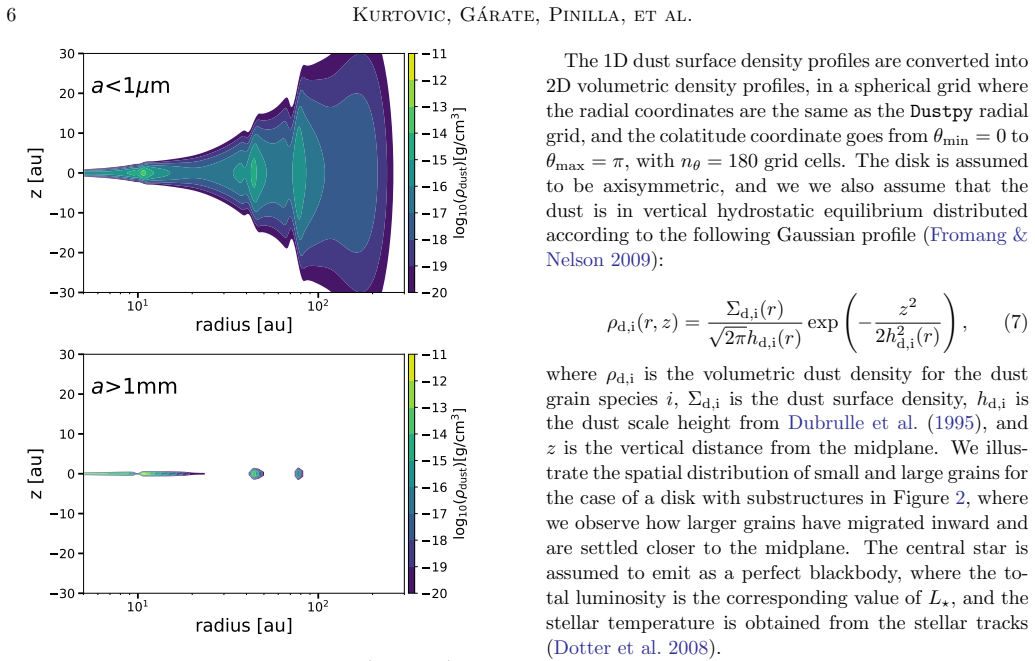
The central mechanism is the Gaussian bump in the turbulence profile, $\alpha(r)=\alpha_0\left(1+\sum_i A_{\rm gap}\exp(-(r-r_{{\rm gap},i})^2/2w_{\rm gap}^2)\right)$, with weak ($A_{\rm gap}=1$) or strong ($A_{\rm gap}=4$) bumps at fixed radii 10, 40, and 70 au. These bumps create pressure maxima that act as dust traps, halting the inward radial drift of pebbles; without them, the largest grains drift inward and deplete the outer disk. The paper's comparison uses synthetic 1.3 mm and 1.05 mm images generated from the simulated dust distributions to measure the same quantities as AGE-PRO: total continuum flux, the radius enclosing 90% of the emission, and the spectral index between the two bands.
What would settle it
Observe the 1.3 mm continuum of the AGE-PRO disks at angular resolution close to a few au: if most disks older than 2 Myr show smooth, ring-free emission yet retain high millimeter fluxes and low spectral indices, the claim that dust traps are required would be contradicted. A modeling alternative that retains pebbles without pressure bumps, such as strong dust back-reaction or dead zones, would similarly weaken the trap uniqueness.
Extended reading notes
Core claim
On the paper's own terms, the central discovery is that the AGE-PRO observations cannot be reproduced by smooth, trap-free disk evolution once the disks are older than roughly 1–2 Myr. In the Lupus and Upper Sco samples, the simulations without dust traps underproduce the 1.3 mm fluxes, evolve disk sizes in the wrong direction, and push the spectral index to high values too early, while simulations with weak or strong Gaussian pressure bumps track the observed flux–mass–size–spectral index behavior. Young Ophiuchus disks do not yet distinguish the scenarios, so the early dust content is still close to the initial reservoir. The paper also finds that the gas masses inferred from AGE-PRO span several orders of magnitude and are not reproduced by the viscous-only models, pointing to extra physics in gas dispersal.
Load-bearing premise
The load-bearing premise is that the Gaussian turbulence bumps in the models faithfully represent how real pressure bumps trap dust, and that a completely smooth disk is a fair counterfactual for showing that traps are required.
Editorial extensions
If this is right
- Most planet-forming disks older than about 2 Myr contain dust-trapping pressure bumps, so pebbles survive in the outer disk long enough to feed planetesimal and core formation.
- The millimeter size of a disk with traps tracks the outermost trap; the observed positive relation between gas mass and millimeter size then suggests that more massive disks form traps at larger radii.
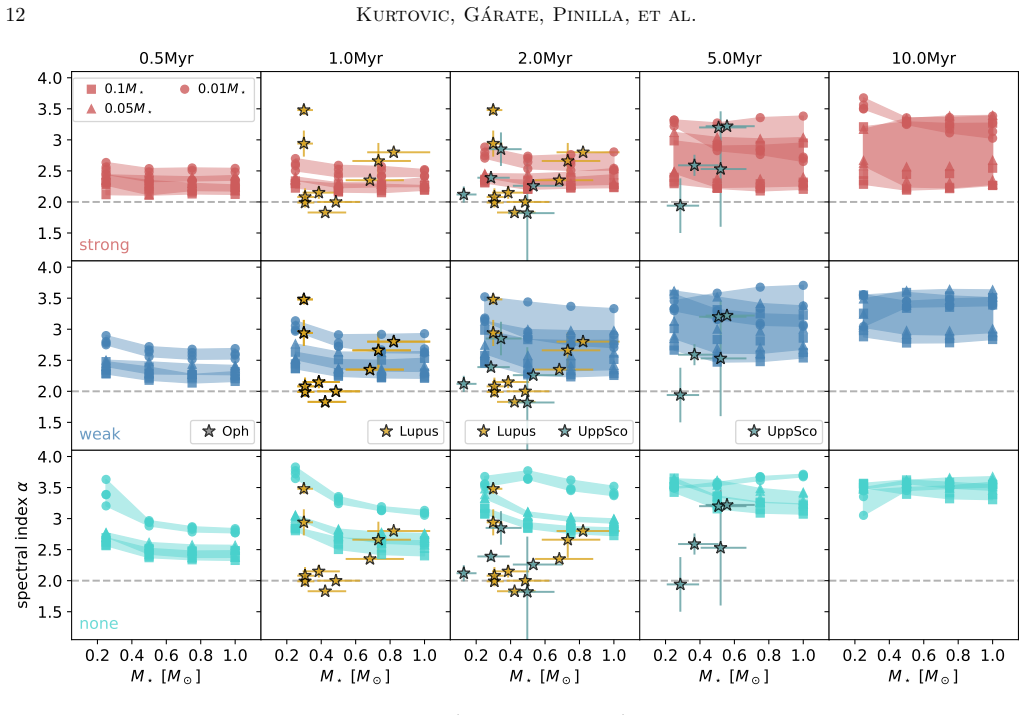
- The spread of observed spectral indices between about 2 and 4 reflects a variety of trap strengths and locations, while trap-free disks become optically thin too quickly to match the data.
- Disk gas masses cannot be explained by viscous evolution alone, so additional processes such as winds or photoevaporation must remove gas from disks starting before 1 Myr.
- For disks younger than about 1 Myr, continuum fluxes and sizes do not distinguish trapping scenarios, so young-dust content can be treated as a near-initial reservoir.
Reading between the lines
- If dust traps are this common, the ring and gap substructures resolved in a minority of disks by high-resolution ALMA imaging are probably representative of most disks rather than a special subset, just seen at higher contrast.
- Because the traps are fixed at 10, 40, and 70 au in the models, the agreement constrains the presence of traps more strongly than their real locations; matching the gas-mass–size trend to disk-specific simulations could turn the observed R90–Mgas relation into a mass-dependent trap-radius diagnostic.
- The models' sensitivity to small-grain opacity suggests a sharper test: multi-wavelength millimeter observations that separate large-grain emission from small-grain emission could confirm traps without needing to resolve gaps directly.
- If gas is removed faster than dust by winds or photoevaporation while traps retain the dust, dust-to-gas ratios should rise with disk age; this is measurable with CO-based gas masses and continuum-based dust masses in a larger age-stratified sample.
Editorial analysis
A structured set of objections, weighed in public.
Referee Report
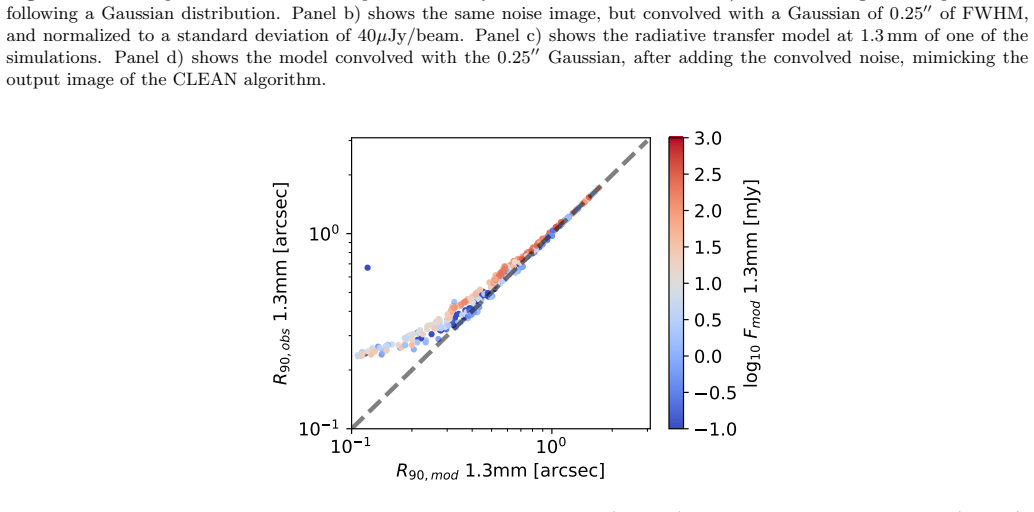
Summary. This paper compares AGE-PRO observations of disks in Ophiuchus, Lupus, and Upper Sco to a large grid of 1D dust evolution simulations (DustPy) post-processed with RADMC-3D radiative transfer. The grid covers stellar masses of 0.25-1.0 Msun, initial disk masses of 0.01-0.1 Mstar, characteristic radii of 15-120 au, viscosities of 1e-4 and 1e-3, and initial dust-to-gas ratios of 0.01 and 0.05. Dust traps are modeled as Gaussian bumps in the alpha profile (Eq. 5) with amplitudes 0, 1, and 4 at fixed radii of 10, 40, and 70 au. The authors compare simulated gas masses, pebble masses, 1.3 mm fluxes, 90% radii, and spectral indices to the AGE-PRO measurements as a function of age. The central claim is that at ages above about 1-2 Myr, most AGE-PRO disks are consistent only with simulations that include weak or strong dust traps, while no-trap models cannot reproduce the observed fluxes, sizes, and spectral indices. A secondary result is that the observed gas masses are not reproduced by pure viscous evolution, indicating additional gas-removal mechanisms. Appendix A presents synthetic observations to assess beam convolution effects.
Significance. If the central claim survives scrutiny, the paper would provide population-level evidence that efficient dust retention via pressure bumps is common in planet-forming disks, strengthening the connection between substructure and dust survival. The paper has clear strengths: it uses publicly available, versioned codes (DustPy, RADMC-3D, OpTool), runs a large grid (3888 snapshots; 19440 radiative transfer models), and includes a careful synthetic-observation appendix showing that recovered radii are robust for bright disks larger than about three beam widths. It also makes a falsifiable prediction linking outer trapped-dust radii to disk gas mass. However, the central claim currently rests on qualitative comparisons executed in a gas-mass regime that overlaps only partially with the observed sample, and on a narrow prescribed dust-trap model. These gaps are acknowledged in the text but are load-bearing for the conclusion that dust traps are favored.
major comments (3)
- [Sections 3.1 and 4.1, Fig. 3] The model grid and the AGE-PRO sample are not in the same gas-mass regime. Section 3.1 shows that the lowest observed Mgas values in Ophiuchus lie about two orders of magnitude below the lowest initial model mass (0.01 Mstar), and only about half of the Lupus and Upper Sco targets fall within the model range. Because the Stokes number (Eq. 1) and the radial drift velocity (Eq. 2) depend directly on the gas surface density, dust evolution and trapping efficiency can differ substantially at these lower gas masses. The comparisons in Figs. 5, 7, and 8 and the conclusion that no-trap models are excluded (Section 3.5 and Conclusions) are therefore computed with gas reservoirs up to about 100 times larger than some observed disks. The paper explicitly acknowledges this in Section 4.1: “Since Mgas is higher in our simulations... The impact of this discrepancy on the trends derived from dust observables remains to be investigated.” This is precisely the missing step. The authors should re-run a subset of the grid at lower initial disk masses, or with an early mass-loss prescription that matches the observed Mgas distribution, and show whether the separation between trap and no-trap branches in the F1.3mm-R90%-alpha_mm planes persists. Without this, the claim that dust traps are favored is not established for the observed low-gas-mass disks.
- [Sections 3.3-3.5, Figs. 5-8] The comparisons are made by visual inspection of model envelopes and observed markers, with no quantitative consistency metric and no displayed observational uncertainties. Statements such as “most of the disks ... are consistent with simulations that have either weak or strong dust traps” (Abstract) and “the simulations with no traps are unable to follow the observational trends” (Conclusions) are not tied to a defined acceptance criterion. Given the wide ranges spanned by the model outputs and the known measurement uncertainties in the AGE-PRO measurements, the authors should provide a simple quantitative test, for example the fraction of observed sources that fall within a stated percentile interval of the model flux, size, and spectral-index distributions, computed separately for the none, weak, and strong trap groups. Such a test would also clarify the status of the disks that appear consistent with no-trap models in one observable but not in another.
- [Sections 2.2, 2.3, and 4.2, Eq. 5] The dust-trap counterfactual is defined by a single prescription: Gaussian bumps in alpha with Agap = 1 or 4 at fixed radii of 10, 40, and 70 au, static in time (Eq. 5). The conclusion that the observed population requires traps therefore depends on these prescribed traps being representative of real pressure bumps. The paper notes in Section 4.2 that variable or leaky traps would behave more like no-trap models, and it excludes back-reaction and 3D effects (Sections 2.1 and 2.2), but none of these alternatives are tested in the comparison. At minimum, the authors should test sensitivity to trap leakage and to later-forming or migrating traps, and state explicitly how the inferred need for traps would change under those variations. This would not require a full alternative-physics grid, but it would make the “traps are required” claim proportionate to the model coverage.
minor comments (5)
- [Section 2.5] The text contains a duplicated word: “and we we also assume” should read “and we also assume”.
- [Equation (8)] The sentence introducing the distance reads “where is d the distance to each star”; this should be “where d is the distance to each star”.
- [Sections 3.2-3.3] The distinction between the Mpebble comparison, where no-trap models fail at early ages, and the flux comparison, where Section 3.3 notes that some disks can be explained without traps, is important for the overall conclusion; the text could state this nuance more explicitly.
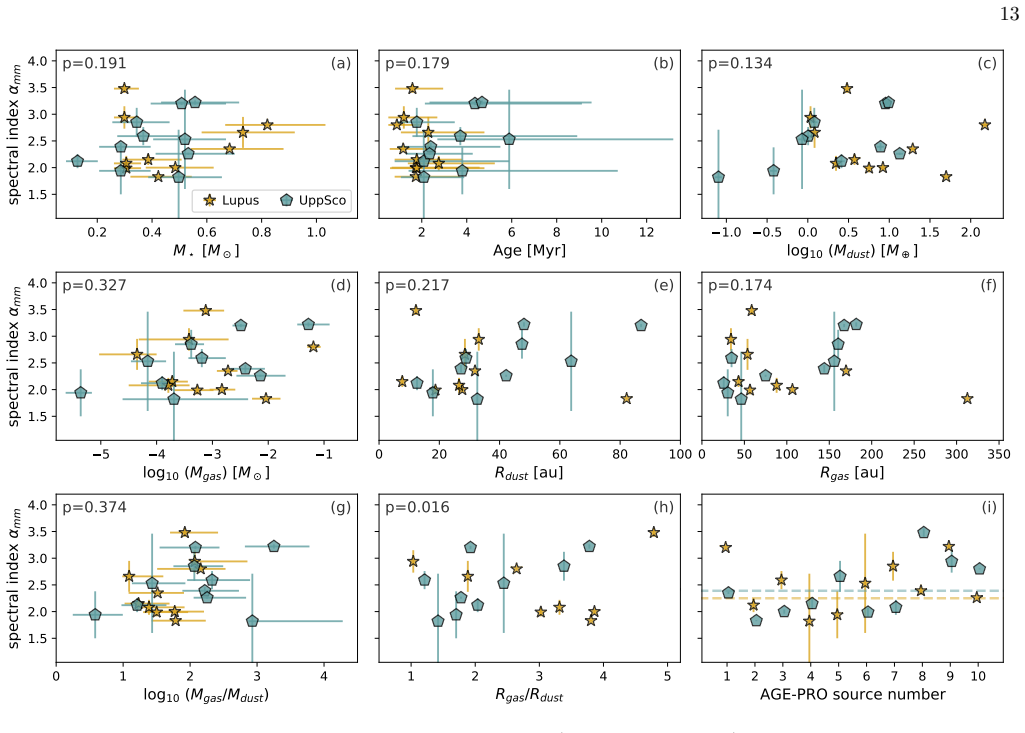
- [Figure 9] The figure caption reports p-values without stating which correlation test was used; please specify the test and how non-detections or upper limits were handled.
- [Section 3.5 and Fig. 8] The spectral-index comparison shows only Lupus and Upper Sco sources; please clarify whether Ophiuchus spectral indices were measured and, if so, why they are omitted from the figure.
Circularity Check
No significant circularity: the model grid is a forward computation with parameters set independently of the AGE-PRO data, and the trap-favoring conclusion is a model-selection result rather than a fitted or self-referential prediction.
full rationale
The paper's central claim, that the AGE-PRO observations favor dust-trap models over no-trap models, is obtained by comparing independently computed DustPy/RADMC-3D simulations to measured millimeter fluxes, sizes, and spectral indices. The model parameters (stellar mass, initial disk mass, characteristic radius, viscosity, dust-to-gas ratio, trap amplitude and location) are set a priori, and the paper explicitly states in Sect. 2.3 that the simulations were run while AGE-PRO data were still arriving and were not tailored to the observed gas masses. No parameter is fitted to the AGE-PRO observables and then renamed as a prediction; the trap/no-trap distinction is an input variable whose observational consequences are computed. The acknowledged gas-mass mismatch between the models and the sample (Sect. 3.1 and Sect. 4.1) is a serious scientific limitation and a correctness risk, but it is not circularity: the dust observables are not derived from the observed gas masses, and the paper explicitly flags that the impact of the Mgas discrepancy on dust trends remains to be investigated. The use of the Gaussian alpha-bump prescription from Stadler et al. (2022), which includes some of the present authors, is a modeling choice rather than a load-bearing self-citation: the conclusion is not justified solely by that citation but by the forward-model comparison. Similarly, the references to companion AGE-PRO papers supply the observational measurements, not the model outputs. There is no equation in which the claimed prediction reduces by construction to an input, and no fitted parameter called a prediction. Under the hard rules of this review, the absence of such a reduction means the circularity score is 0.
Assumptions & free parameters
free parameters (9)
- Initial disk mass ratio (Mdisk/Mstar) =
0.01, 0.05, 0.1
- Initial characteristic radius (rc) =
15, 30, 60, 120 au
- Viscosity parameter (alpha0) =
1e-3, 1e-4
- Initial dust-to-gas ratio (epsilon0) =
0.01, 0.05
- Dust trap amplitude (Agap) =
0, 1, 4 (none, weak, strong)
- Dust trap locations (rgap) =
10, 40, 70 au, when rgap <= 2 rc
- Fragmentation turbulence floor (alpha_frag) =
5e-4 for alpha0=1e-4 runs
- Fragmentation velocity (vfrag) =
10 m/s
- Stellar mass and luminosity grid =
Mstar 0.25-1.0 Msun, Lstar 0.15-1.0 Lsun
assumptions (9)
- domain assumption Viscous evolution with constant alpha: nu = alpha c_s h_g (Eq. 3), alpha constant in radius and time.
- standard math Gas surface density follows the Lynden-Bell and Pringle self-similar solution (Eq. 4).
- domain assumption Dust growth and fragmentation follow the Smoluchowski equation with Epstein/Stokes drag, and dust back-reaction is neglected.
- ad hoc to paper Gaussian bumps in the alpha profile (Eq. 5) generate self-sustained gaps that act as dust traps.
- domain assumption Disk temperature is set only by stellar irradiation via Eq. 6, with no viscous or external heating.
- domain assumption Initial dust size distribution follows the ISM distribution (Mathis et al. 1977) with uniform epsilon0.
- domain assumption Dust opacities follow the Ricci et al. (2010) composition (10% silicate, 20% carbon, 30% water ice, 40% vacuum).
- domain assumption Dust vertical structure is Gaussian with the Dubrulle et al. (1995) scale height (Eq. 7).
- domain assumption Photoevaporation, MHD winds, and 3D effects are not included in the model.
Cite this review
Pith. "Pith review of The ALMA Survey of Gas Evolution of PROtoplanetary Disks (AGE-PRO): VI. Comparison of Dust Evolution Models to AGE-PRO Observations." pith.science (2026). https://pith.science/paper/CBXQKO3B
@misc{pith2026250610740,
  author       = {Pith},
  title        = {Pith review of: The ALMA Survey of Gas Evolution of PROtoplanetary Disks (AGE-PRO): VI. Comparison of Dust Evolution Models to AGE-PRO Observations},
  year         = {2026},
  howpublished = {\url{https://pith.science/paper/CBXQKO3B}},
  note         = {Machine review of arXiv:2506.10740}
}
abstract
The potential for planet formation of a circumstellar disk depends on the dust and gas reservoirs, which evolve as a function of the disk age. The ALMA Large Program AGE-PRO has measured several disk properties across three star-forming regions of different ages, and in this study we compare the observational results to dust evolution simulations. Using DustPy for the dust evolution, and RADMC-3D for the radiative transfer, we ran a large grid of models spanning stellar masses of 0.25, 0.50, 0.75, and 1.0 $M_\odot$, with different initial conditions, including: disk sizes, disk gas masses, and dust-to-gas ratio, and viscosity. Our models are performed assuming smooth, weakly, or strongly substructured disks, aiming to investigate if any observational trend can favor or exclude the presence of dust traps. The observed gas masses in the disks of the AGE-PRO sample are not reproducible with our models, which only consider viscous evolution with constant $\alpha$, suggesting that additional physical mechanisms play a role in the evolution of the gas mass of disks. When comparing the dust continuum emission fluxes and sizes at 1.3 mm, we find that most of the disks in the AGE-PRO sample are consistent with simulations that have either weak or strong dust traps. The evolution of spectral index in the AGE-PRO sample is also suggestive of an unresolved population of dust traps. Future observations at high angular resolution are still needed to test several hypotheses that result from comparing the observations to our simulations, including that more massive disks in gas mass have the potential to form dust traps at larger disk radii.
Figures


Figures from the paper (8 more)



Reference graph
Works this paper leans on
-
[1]
M., Sierra, A., et al
Agurto-Gangas, C., P´ erez, L. M., Sierra, A., et al. 2025, ApJ, 989, 4
2025
-
[2]
2014, in Protostars and Planets VI, ed
Cieza, L. 2014, in Protostars and Planets VI, ed. H. Beuther, R. S. Klessen, C. P. Dullemond, & T. Henning, 475–496
2014
-
[3]
P., G´ arate, M., et al
Anania, R., Rosotti, G. P., G´ arate, M., et al. 2025, ApJ, 989, 8
2025
-
[4]
Andrews, S. M. 2020, ARA&A, 58, 483
2020
-
[5]
M., Rosenfeld, K
Andrews, S. M., Rosenfeld, K. A., Kraus, A. L., & Wilner, D. J. 2013, ApJ, 771, 129
2013
-
[6]
P., van der Marel, N., et al
Ansdell, M., Williams, J. P., van der Marel, N., et al. 2016, ApJ, 828, 46
2016
-
[7]
2023, in Astronomical Society of the Pacific Conference Series, Vol
Bae, J., Isella, A., Zhu, Z., et al. 2023, in Astronomical Society of the Pacific Conference Series, Vol. 534, Protostars and Planets VII, ed. S. Inutsuka, Y. Aikawa, T. Muto, K. Tomida, & M. Tamura, 423
2023
-
[8]
A., Carpenter, J
Barenfeld, S. A., Carpenter, J. M., Ricci, L., & Isella, A. 2016, ApJ, 827, 142
2016
Show all 93 references
-
[9]
Bate, M. R. 2018, MNRAS, 475, 5618
2018
-
[10]
2024, ARA&A, 62, 157
Birnstiel, T. 2024, ARA&A, 62, 157
2024
-
[11]
P., & Brauer, F
Birnstiel, T., Dullemond, C. P., & Brauer, F. 2010, A&A, 513, A79
2010
-
[12]
2016, SSRv, 205, 41
Birnstiel, T., Fang, M., & Johansen, A. 2016, SSRv, 205, 41
2016
-
[13]
P., Zhu, Z., et al
Birnstiel, T., Dullemond, C. P., Zhu, Z., et al. 2018, ApJL, 869, L45
2018
-
[14]
2024, A&A, 682, A61
Cacciapuoti, L., Macias, E., Gupta, A., et al. 2024, A&A, 682, A61
2024
-
[15]
Clark, B. G. 1980, A&A, 89, 377
1980
-
[16]
J., Gendrin, A., & Sotomayor, M
Clarke, C. J., Gendrin, A., & Sotomayor, M. 2001, MNRAS, 328, 485
2001
-
[17]
T., & Flock, M
Das, S., Kurtovic, N. T., & Flock, M. 2024, A&A, 689, A104
2024
-
[18]
N., G´ arate, M., Okuzumi, S., et al
Delage, T. N., G´ arate, M., Okuzumi, S., et al. 2023, A&A, 674, A190
2023
-
[19]
2022, A&A, 658, A97
Dzyurkevich, N. 2022, A&A, 658, A97
2022
-
[20]
2024, A&A, 688, A81
Delussu, L., Birnstiel, T., Miotello, A., et al. 2024, A&A, 688, A81
2024
-
[21]
2025, ApJ, 989, 3
Deng, D., Vioque, M., Pascucci, I., et al. 2025, ApJ, 989, 3
2025
-
[22]
2023, ApJ, 957, 11
Doi, K., & Kataoka, A. 2023, ApJ, 957, 11
2023
-
[23]
2021, OpTool: Command-line driven tool for creating complex dust opacities, , , ascl:2104.010
Dominik, C., Min, M., & Tazaki, R. 2021, OpTool: Command-line driven tool for creating complex dust opacities, , , ascl:2104.010
2021
-
[24]
2008, ApJS, 178, 89
Dotter, A., Chaboyer, B., Jevremovi´ c, D., et al. 2008, ApJS, 178, 89
2008
-
[25]
Draine, B. T. 2003, ARA&A, 41, 241 Dr¸ a˙ zkowska, J., Bitsch, B., Lambrechts, M., et al. 2023, in Astronomical Society of the Pacific Conference Series, Vol. 534, Protostars and Planets VII, ed. S. Inutsuka, Y. Aikawa, T. Muto, K. Tomida, & M. Tamura, 717
2003
-
[26]
1995, Icarus, 114, 237
Dubrulle, B., Morfill, G., & Sterzik, M. 1995, Icarus, 114, 237
1995
-
[27]
P., Juhasz, A., Pohl, A., et al
Dullemond, C. P., Juhasz, A., Pohl, A., et al. 2012, RADMC-3D: A multi-purpose radiative transfer tool, , , ascl:1202.015
2012
-
[28]
Jayawardhana, R., & Oliveira, J. M. 2010, A&A, 510, A72
2010
-
[29]
Fromang, S., & Nelson, R. P. 2009, A&A, 496, 597 Gaia Collaboration, Brown, A. G. A., Vallenari, A., et al. 2021, A&A, 649, A1 G´ arate, M., Birnstiel, T., Dr¸ a˙ zkowska, J., & Stammler, S. M. 2020, A&A, 635, A149 G´ arate, M., Delage, T. N., Stadler, J., et al. 2021, A&A, 65...
2009
-
[30]
2025, A&A, 694, A290
Garufi, A., Carrasco-Gonz´ alez, C., Mac ´ ıas, E., et al. 2025, A&A, 694, A290
2025
-
[31]
L., Espaillat, C
Grant, S. L., Espaillat, C. C., Wendeborn, J., et al. 2021, ApJ, 913, 123
2021
-
[32]
2015, ApJ, 798, 34
Gundlach, B., & Blum, J. 2015, ApJ, 798, 34
2015
-
[33]
2011, Icarus, 214, 717
Gundlach, B., Kilias, S., Beitz, E., & Blum, J. 2011, Icarus, 214, 717
2011
-
[34]
P., Kreuzig, C., et al
Gundlach, B., Schmidt, K. P., Kreuzig, C., et al. 2018, MNRAS, 479, 1273
2018
-
[35]
2020, ApJ, 895, 126
Hendler, N., Pascucci, I., Pinilla, P., et al. 2020, ApJ, 895, 126
2020
-
[36]
Hildebrand, R. H. 1983, QJRAS, 24, 267 H¨ ogbom, J. A. 1974, A&AS, 15, 417
1983
-
[37]
M., Cleeves, L
Huang, J., Andrews, S. M., Cleeves, L. I., et al. 2018, ApJ, 852, 122 18 Kurtovic, G´arate, Pinilla, et al
2018
-
[38]
S., & Haugbølle, T
Kuffmeier, M., Jensen, S. S., & Haugbølle, T. 2023, European Physical Journal Plus, 138, 272
2023
-
[39]
T., P´ erez, L
Kurtovic, N. T., P´ erez, L. M., Benisty, M., et al. 2018, ApJL, 869, L44
2018
-
[40]
T., Pinilla, P., Long, F., et al
Kurtovic, N. T., Pinilla, P., Long, F., et al. 2021, A&A, 645, A139
2021
-
[41]
2023, in Astronomical Society of the Pacific Conference Series, Vol
Lesur, G., Flock, M., Ercolano, B., et al. 2023, in Astronomical Society of the Pacific Conference Series, Vol. 534, Protostars and Planets VII, ed. S. Inutsuka, Y. Aikawa, T. Muto, K. Tomida, & M. Tamura, 465
2023
-
[42]
Liu, H. B. 2019, ApJL, 877, L22
2019
-
[43]
E., Manara, C
Lodato, G., Scardoni, C. E., Manara, C. F., & Testi, L. 2017, MNRAS, 472, 4700
2017
-
[44]
J., et al
Long, F., Pinilla, P., Herczeg, G. J., et al. 2018, ApJ, 869, 17 —. 2020, ApJ, 898, 36
2018
-
[45]
M., Rosotti, G., et al
Long, F., Andrews, S. M., Rosotti, G., et al. 2022, ApJ, 931, 6
2022
-
[46]
Lynden-Bell, D., & Pringle, J. E. 1974, MNRAS, 168, 603
1974
-
[47]
F., Ansdell, M., Rosotti, G
Manara, C. F., Ansdell, M., Rosotti, G. P., et al. 2023, in Astronomical Society of the Pacific Conference Series, Vol. 534, Protostars and Planets VII, ed. S. Inutsuka, Y. Aikawa, T. Muto, K. Tomida, & M. Tamura, 539
2023
-
[48]
F., Rosotti, G., Testi, L., et al
Manara, C. F., Rosotti, G., Testi, L., et al. 2016, A&A, 591, L3
2016
-
[49]
S., Rumpl, W., & Nordsieck, K
Mathis, J. S., Rumpl, W., & Nordsieck, K. H. 1977, ApJ, 217, 425 M´ enard, F., Cuello, N., Ginski, C., et al. 2020, A&A, 639, L1
1977
-
[50]
D., Pascucci, I., Manara, C
Mulders, G. D., Pascucci, I., Manara, C. F., et al. 2017, ApJ, 847, 31
2017
-
[51]
2019, ApJ, 873, 58
Musiolik, G., & Wurm, G. 2019, ApJ, 873, 58
2019
-
[52]
1986, Icarus, 67, 375
Nakagawa, Y., Sekiya, M., & Hayashi, C. 1986, Icarus, 67, 375
1986
-
[53]
Offner, S. S. R., Moe, M., Kratter, K. M., et al. 2023, in Astronomical Society of the Pacific Conference Series, Vol. 534, Protostars and Planets VII, ed. S. Inutsuka, Y. Aikawa, T. Muto, K. Tomida, & M. Tamura, 275
2023
-
[54]
2023, in Astronomical Society of the Pacific Conference Series, Vol
Pascucci, I., Cabrit, S., Edwards, S., et al. 2023, in Astronomical Society of the Pacific Conference Series, Vol. 534, Protostars and Planets VII, ed. S. Inutsuka, Y. Aikawa, T. Muto, K. Tomida, & M. Tamura, 567
2023
-
[55]
J., et al
Pascucci, I., Testi, L., Herczeg, G. J., et al. 2016, ApJ, 831, 125
2016
-
[56]
2012, A&A, 545, A81
Pinilla, P., Benisty, M., & Birnstiel, T. 2012, A&A, 545, A81
2012
-
[57]
2013, A&A, 554, A95
Pinilla, P., Birnstiel, T., Benisty, M., et al. 2013, A&A, 554, A95
2013
-
[58]
2020, A&A, 635, A105
Pinilla, P., Pascucci, I., & Marino, S. 2020, A&A, 635, A105
2020
-
[59]
Pringle, J. E. 1981, ARA&A, 19, 137 Ribas, ´A., Bouy, H., & Mer ´ ın, B. 2015, A&A, 576, A52
1981
-
[60]
2010, A&A, 512, A15
Ricci, L., Testi, L., Natta, A., et al. 2010, A&A, 512, A15
2010
-
[61]
E., Loomis, R., Cabrit, S., et al
Rodriguez, J. E., Loomis, R., Cabrit, S., et al. 2018, ApJ, 859, 150
2018
-
[62]
Rosotti, G. P. 2023, NewAR, 96, 101674
2023
-
[63]
P., Tazzari, M., Booth, R
Rosotti, G. P., Tazzari, M., Booth, R. A., et al. 2019, MNRAS, 486, 4829
2019
-
[64]
A., Gonz´ alez-Ruilova, C., Cieza, L
Ruiz-Rodriguez, D. A., Gonz´ alez-Ruilova, C., Cieza, L. A., et al. 2025, ApJ, 989, 2
2025
-
[65]
2021, A&A, 649, A19
Sanchis, E., Testi, L., Natta, A., et al. 2021, A&A, 649, A19
2021
-
[66]
I., & Sunyaev, R
Shakura, N. I., & Sunyaev, R. A. 1973, A&A, 24, 337
1973
-
[67]
M., Sotomayor, B., et al
Sierra, A., P´ erez, L. M., Sotomayor, B., et al. 2024, ApJ, 974, 306
2024
-
[68]
2023, ApJL, 954, L13
Somigliana, A., Testi, L., Rosotti, G., et al. 2023, ApJL, 954, L13
2023
-
[69]
2022, MNRAS, 514, 5927
Somigliana, A., Toci, C., Rosotti, G., et al. 2022, MNRAS, 514, 5927
2022
-
[70]
2022, A&A, 668, A104
Stadler, J., G´ arate, M., Pinilla, P., et al. 2022, A&A, 668, A104
2022
-
[71]
M., & Birnstiel, T
Stammler, S. M., & Birnstiel, T. 2022, ApJ, 935, 35
2022
-
[72]
2019, ApJ, 874, 60
Steinpilz, T., Teiser, J., & Wurm, G. 2019, ApJ, 874, 60
2019
-
[73]
P., Lodato, G., et al
Tabone, B., Rosotti, G. P., Lodato, G., et al. 2022, MNRAS, 512, L74
2022
-
[74]
P., Trapman, L., et al
Tabone, B., Rosotti, G. P., Trapman, L., et al. 2025, ApJ, 989, 7
2025
-
[75]
Takeuchi, T., & Lin, D. N. C. 2002, ApJ, 581, 1344
2002
-
[76]
2021, MNRAS, 506, 5117
Tazzari, M., Testi, L., Natta, A., et al. 2021, MNRAS, 506, 5117
2021
-
[77]
F., et al
Testi, L., Natta, A., Manara, C. F., et al. 2022, A&A, 663, A98
2022
-
[78]
G., Rosotti, G., & Trapman, L
Toci, C., Lodato, G., Livio, F. G., Rosotti, G., & Trapman, L. 2023, MNRAS, 518, L69
2023
-
[79]
M., Birnstiel, T., & Wilner, D
Tripathi, A., Andrews, S. M., Birnstiel, T., & Wilner, D. J. 2017, ApJ, 845, 44 van der Marel, N., & Pinilla, P. 2023, arXiv e-prints, arXiv:2310.09077
2017 arXiv
-
[80]
Villenave, M., M´ enard, F., Dent, W. R. F., et al. 2020, A&A, 642, A164
2020
-
[81]
R., Duchˆ ene, G., et al
Villenave, M., Stapelfeldt, K. R., Duchˆ ene, G., et al. 2022, ApJ, 930, 11
2022
-
[82]
T., Trapman, L., et al
Vioque, M., Kurtovic, N. T., Trapman, L., et al. 2025, ApJ, 989, 9 19
2025
-
[83]
2011, ApJ, 737, 36
Yamamoto, T. 2011, ApJ, 737, 36
2011
-
[84]
G., & Brandt, R
Warren, S. G., & Brandt, R. E. 2008, Journal of Geophysical Research: Atmospheres, 113, doi:https://doi.org/10.1029/2007JD009744. https://agupubs.onlinelibrary.wiley.com/doi/abs/10. 1029/2007JD009744
2008 doi
-
[85]
Pessah, M. E. 2018, ApJ, 854, 153
2018
-
[86]
Weidenschilling, S. J. 1977, MNRAS, 180, 57
1977
-
[87]
J., Booth, R
Winter, A. J., Booth, R. A., & Clarke, C. J. 2018, MNRAS, 479, 5522
2018
-
[88]
2017, A&A, 608, A134
Yen, H.-W., Takakuwa, S., Chu, Y.-H., et al. 2017, A&A, 608, A134
2017
-
[89]
A., Rodr ´ ıguez, L
Zapata, L. A., Rodr ´ ıguez, L. F., Fern´ andez-L´ opez, M., et al. 2020, ApJ, 896, 132
2020
-
[90]
M., Pascucci, I., et al
Zhang, K., P´ erez, L. M., Pascucci, I., et al. 2025, ApJ, 989, 1
2025
-
[91]
P., & Andrews, S
Zormpas, A., Birnstiel, T., Rosotti, G. P., & Andrews, S. M. 2022, A&A, 661, A66
2022
-
[92]
G., Mennella, V., Colangeli, L., & Bussoletti, E
Zubko, V. G., Mennella, V., Colangeli, L., & Bussoletti, E. 1996, MNRAS, 282, 1321
1996
-
[93]
2023, European Physical Journal Plus, 138, 411 20 Kurtovic, G´arate, Pinilla, et al
Zurlo, A., Gratton, R., P´ erez, S., & Cieza, L. 2023, European Physical Journal Plus, 138, 411 20 Kurtovic, G´arate, Pinilla, et al. APPENDIX A. SYNTHETIC OBSER V ATIONS: COMPARISON WITH CLEAN IMAGES There are three main products to consider when generating an image from inte...
2023
Reviewed August 7, 2026 · model on record in the stance chip above.
Discussion (0). Continue with ORCID to comment.